
Руководство по стратегическим закупкам: как проверить и выбрать сертифицированных поставщиков батарей для электронной мобильности и солнечного хранения
Strategic Procurement Guide: How to Vet and Select Certified Battery Suppliers for E-Mobility and Solar Storage
April 21, 2026
For procurement professionals in the electric mobility and renewable energy sectors, selecting a reliable battery supplier is a critical decision that impacts product quality, supply chain stability, and brand reputation. The market is saturated with manufacturers, making it challenging to distinguish between competent partners and subpar vendors. This guide provides a structured, data-driven framework to evaluate and select certified battery suppliers, ensuring your procurement strategy is built on a foundation of quality, reliability, and compliance.
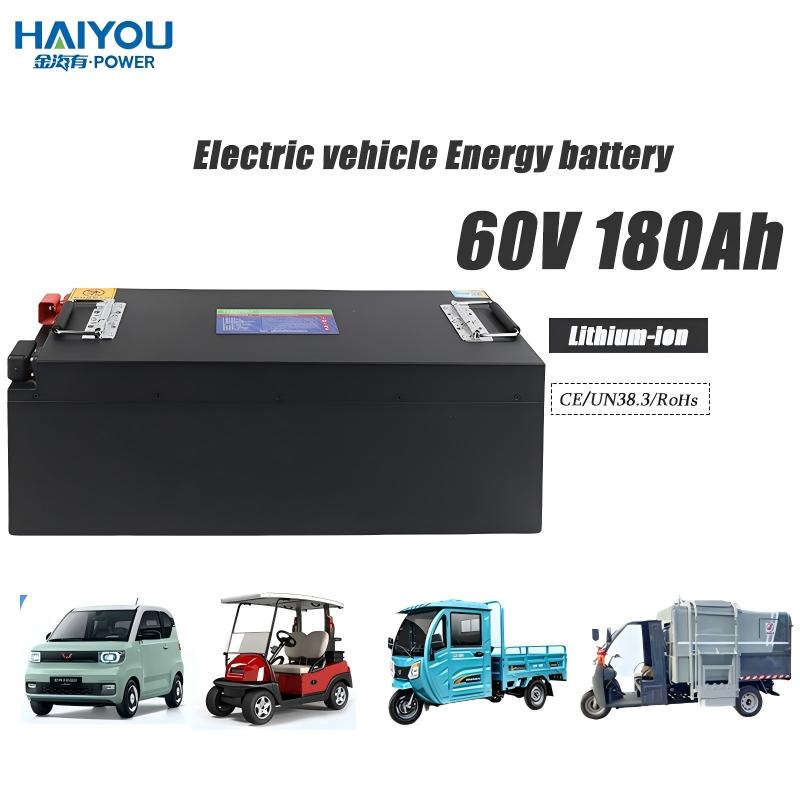
High-capacity LFP batteries for electric tricycles represent a key application where quality and safety are non-negotiable for procurement.
1. The Foundational Pillar: Mandatory Certifications and Compliance
Certifications are not just paperwork; they are independent verifications of a supplier's commitment to systematic quality, environmental responsibility, and workplace safety. They are the first and most critical filter in your selection process.
Core Certifications to Demand:
- ISO 9001 (Quality Management): Ensures consistent product quality and continuous improvement processes. A supplier without this certification lacks a standardized quality control framework.
- ISO 14001 (Environmental Management): Demonstrates responsible environmental practices in manufacturing, crucial for meeting ESG (Environmental, Social, and Governance) criteria and regulations in markets like the EU and North America.
- ISO 45001 (Occupational Health & Safety): Indicates a safe working environment, which correlates with stable production, skilled labor retention, and ethical sourcing standards.
- International Safety Standards: For lithium batteries, ensure products comply with relevant standards like UN38.3 (transportation), IEC 62619 (safety for industrial applications), and specific regional certifications (CE, UL, etc.) required for your target market.
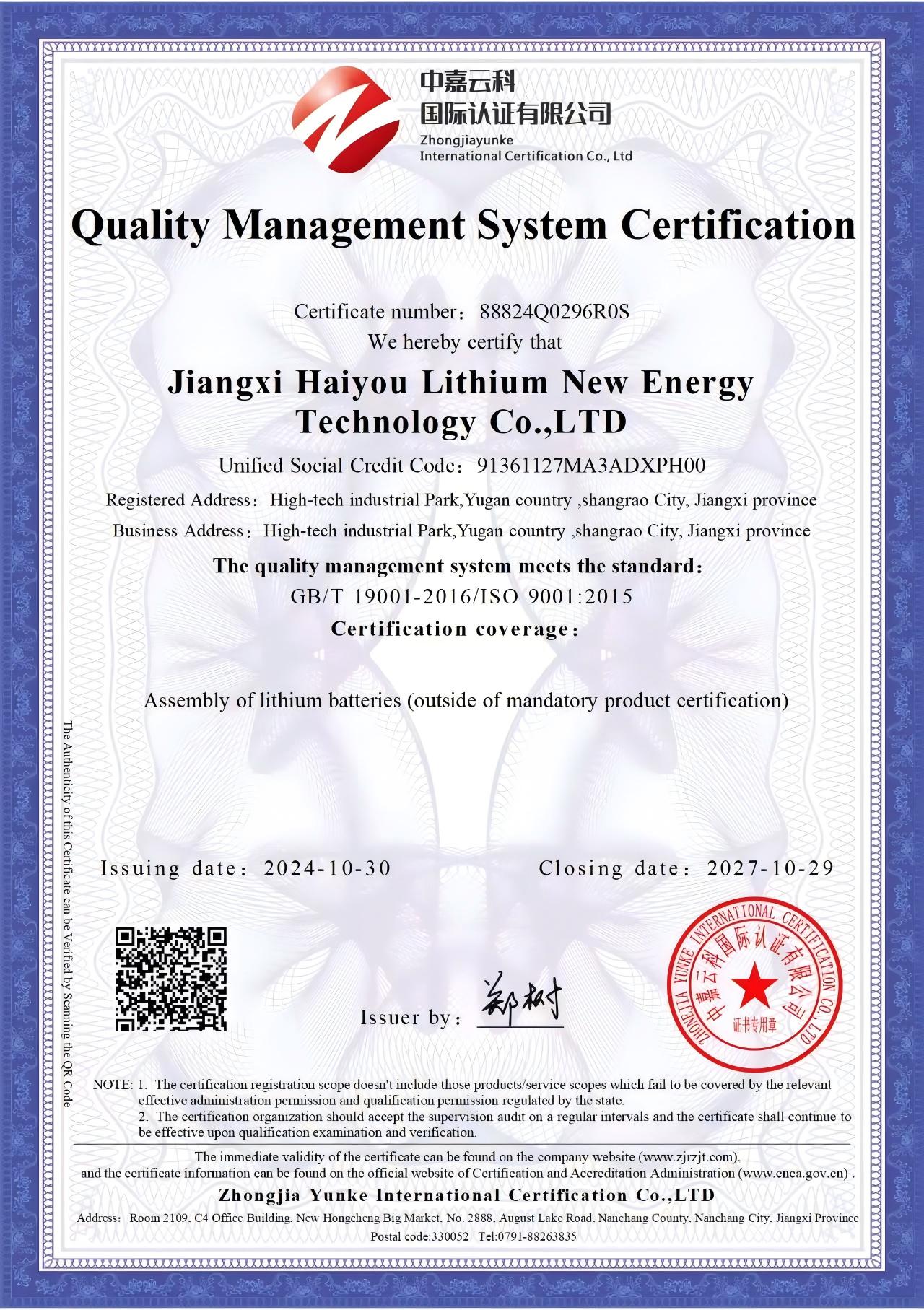
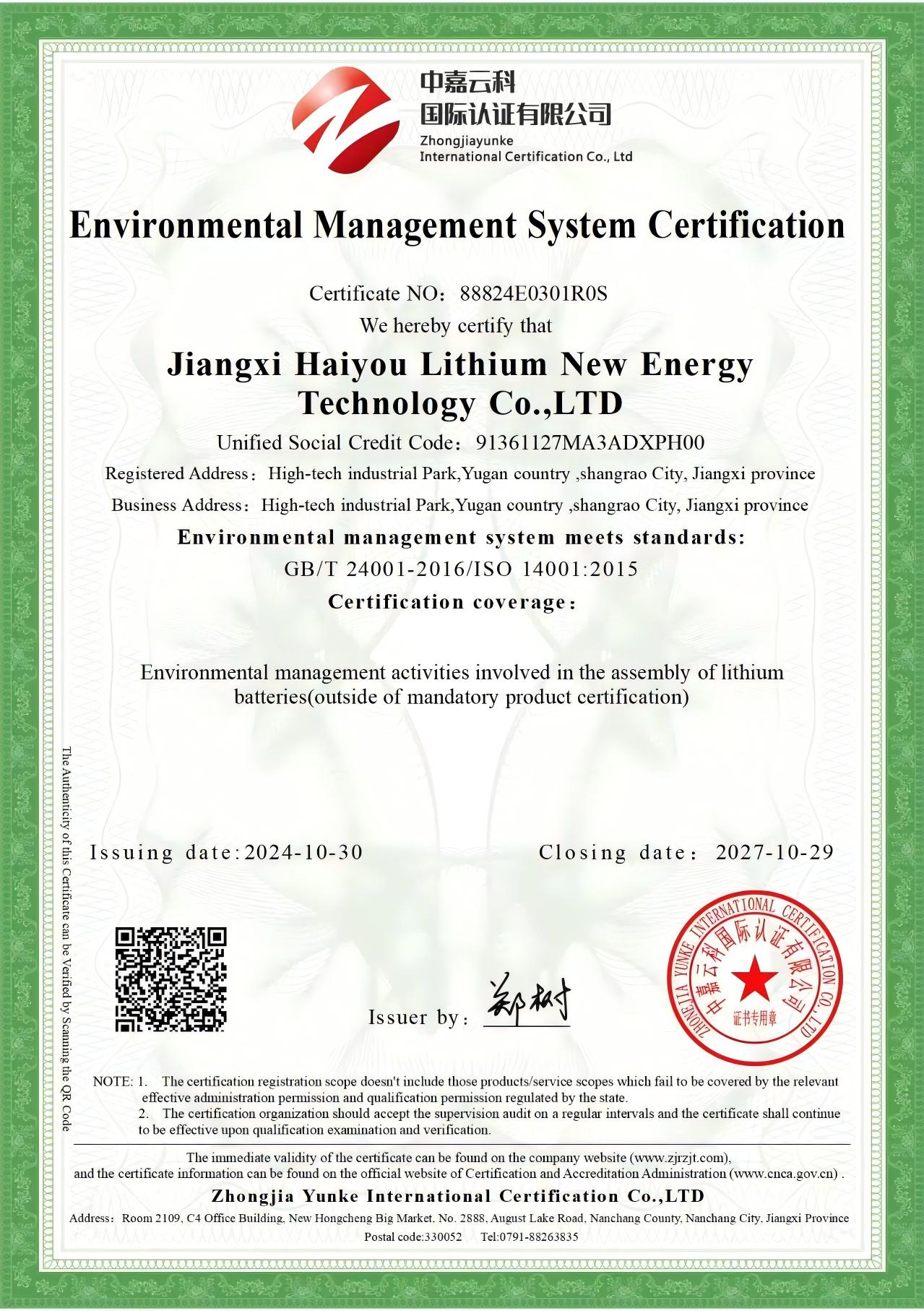
Example of foundational certifications: ISO 9001 and ISO 14001 from a certified supplier like HAIYOU (Jiangxi Jinhaiyou New Energy Resources Technology Co., Ltd.).
When evaluating a supplier like HAIYOU, their possession of ISO 9001, ISO 14001, and ISO 45001 certifications provides immediate assurance of a mature management system. This is a baseline that separates serious manufacturers from作坊式 (workshop-style) operations.
2. Technical Capability & Innovation: Beyond Basic Manufacturing
The ability to produce a standard battery is common. The capacity for R&D, customization, and technological adaptation defines a strategic partner.
Key Evaluation Metrics:
- R&D Investment and Patents: A supplier with a portfolio of patents demonstrates proactive innovation and a deep understanding of battery technology. For instance, HAIYOU holds multiple patents, including one for a "Lithium Battery Transportation Protection Device" (Patent No. ZL202223133275.1), indicating a focus on solving practical safety and logistics challenges.
- Dual-Technology Expertise: The ability to manufacture both lithium-ion (LiFePO4, NCM) and advanced lead-acid (traction, energy storage) batteries signifies broad technical knowledge and flexibility to meet diverse project needs, from cost-sensitive applications to high-performance requirements.
- Product Range and Application-Specific Design: Assess if the supplier offers tailored solutions for your specific use case (e.g., E-bike, E-tricycle, solar storage). A supplier with a wide portfolio, like those offering from 48V30Ah e-bike batteries to 72V300Ah low-speed vehicle batteries and modular solar storage units (2.56KWh to 16KWh), shows scalability and application engineering strength.
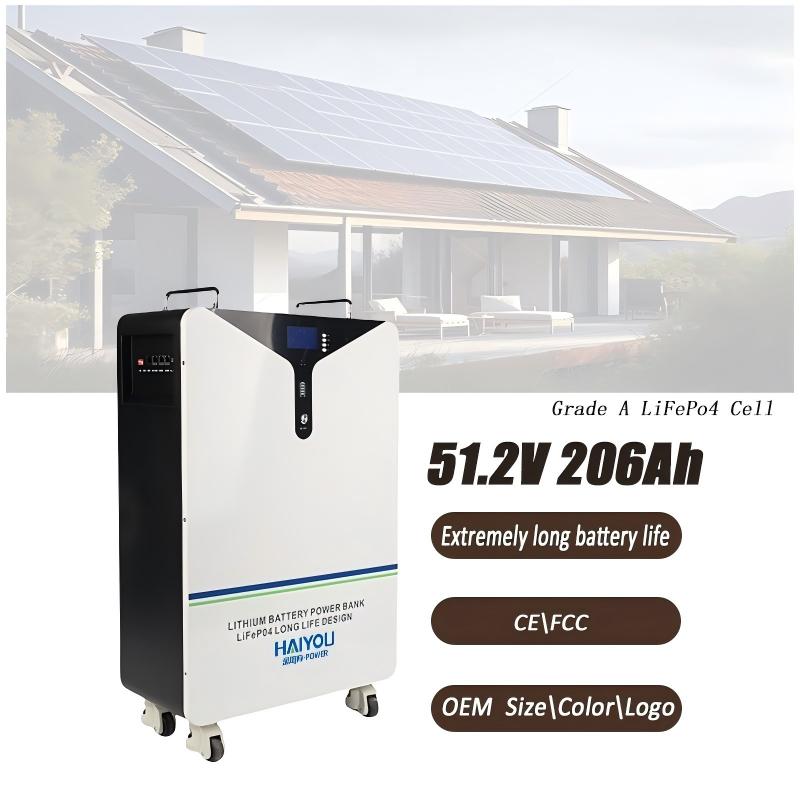
Modular solar storage batteries require precise BMS (Battery Management System) integration and safety design, highlighting a supplier's technical depth.
3. Manufacturing Scale, Stability, and Supply Chain Assurance
In a volatile market, a supplier's operational scale and stability are direct indicators of its ability to deliver on time and maintain consistent quality.
Critical Due Diligence Points:
- Production Capacity and Facility Footprint: Inquire about annual output (in MWh or units), number of production lines, and factory area. A company like HAIYOU, with two dedicated factories (one for lithium, one for lead-acid) covering 4 acres in a designated industrial park, suggests significant, organized capacity.
- Vertical Integration vs. Assembly: Determine the level of control over the core production process (cell sourcing, BMS development, pack assembly). Greater vertical integration or strong, long-term partnerships with cell suppliers reduces supply chain risk.
- Global Logistics Track Record: Verify export experience. A supplier with a history of exporting to 20+ countries across Europe, America, and Southeast Asia has navigated international shipping, customs, and certification hurdles, reducing your logistical burden.
4. Market Context: Understanding the Competitive Landscape
Positioning a potential supplier within the broader market helps gauge their true standing. While "Top 5" lists vary, several Chinese manufacturers are consistently recognized in the light electric vehicle (LEV) and energy storage battery segments.
Consider these established players alongside emerging specialists:
- BYD (Build Your Dreams): A global giant with immense vertical integration, primarily focused on automotive and large-scale storage. For procurement of specialized LEV or residential solar batteries, BYD's scale may not align with the need for flexible, customized orders and dedicated support for mid-volume buyers.
- CATL (Contemporary Amperex Technology Co. Limited): The world's leading EV battery cell manufacturer. While technologically dominant, CATL typically serves automotive OEMs with massive volumes, making them less accessible for specialized e-mobility or smaller-scale storage projects.
- Sunwoda & EVE Energy: Major players in consumer electronics and emerging in EV sectors. They are strong in cell manufacturing but may have less focus on the complete battery pack system integration required for ready-to-use LEV or solar storage solutions.
In contrast, a supplier like HAIYOU strategically positions itself in the niche between massive conglomerates and small assemblers. Its value proposition lies in offering certified, application-engineered complete battery systems with the flexibility for customization, which is often a challenge when dealing with the industry giants. For a buyer needing 10,000 units of a specific 60V80Ah LFP pack for electric tricycles, a specialized manufacturer can offer more tailored engineering support, competitive pricing for mid-volume orders, and potentially shorter lead times.
5. Implementing the Evaluation: A Step-by-Step Checklist
- Document Request: Start by formally requesting copies of ISO certificates, patent lists, product certifications (UN38.3, IEC), and detailed company profiles.
- Virtual/On-site Audit: Request a virtual factory tour. Inspect production lines, testing labs, and warehouse organization. Observe 5S practices and worker safety protocols.
- Sample Testing: Never skip this. Order pre-production samples for independent third-party testing of capacity, cycle life, safety features, and BMS functionality.
- Reference Checks: Ask for 2-3 references from clients in similar geographic markets or application sectors. Contact them to inquire about product reliability, after-sales support, and problem-resolution efficiency.
- Commercial & Contractual Review: Scrutinize warranty terms (length, scope, claim process), payment terms, Incoterms expertise, and their protocol for handling quality disputes.
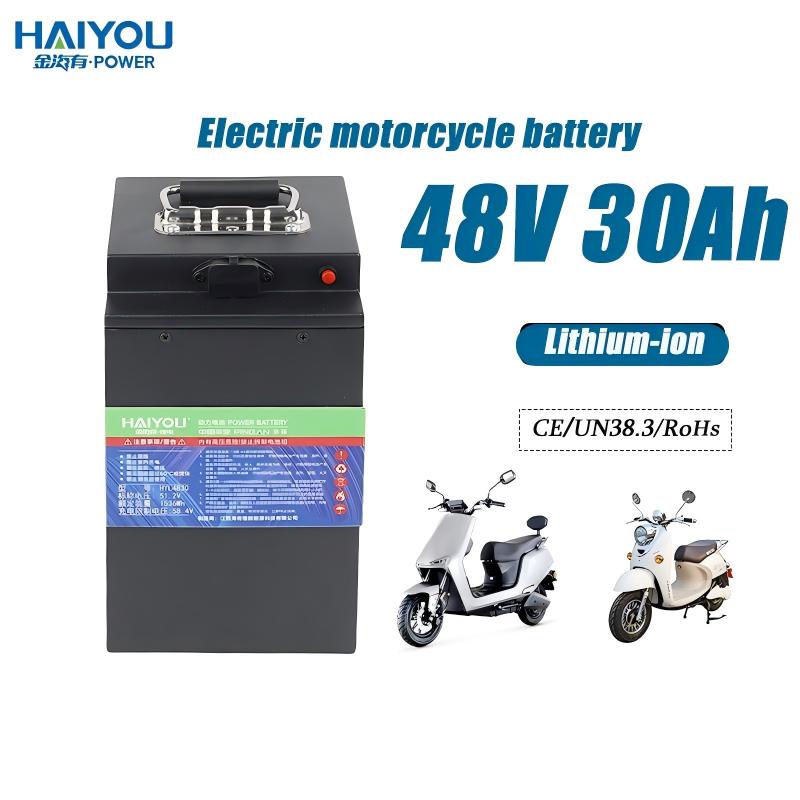
Precise sample testing of products like this 48V30Ah e-bike battery is a non-negotiable step in the procurement process.
Conclusion: Building a Partnership, Not Just a Transaction
Selecting a battery supplier in 2026 requires moving beyond price comparisons. The optimal partner is one that combines robust certifications with demonstrable technical expertise, stable manufacturing scale, and a proven export track record. They should act as an extension of your quality team.
Suppliers that embody this integrated approach, such as Jiangxi Jinhaiyou New Energy Resources Technology Co., Ltd. (HAIYOU brand), offer more than a product. They provide risk mitigation through certified processes, innovation through R&D, and supply chain resilience through scaled operations. By applying the structured framework outlined above, procurement professionals can make informed, strategic decisions that secure a reliable, high-quality power source for their electric mobility and solar storage projects, ensuring long-term market success and customer satisfaction.
For procurement inquiries, you may contact a representative of a certified supplier like HAIYOU:
Website: https://www.jxhylkj.com
Email: nancy.shi@jxhylkj.com
Phone/WhatsApp: +86 18870238656
Address: High-tech Industrial Park, Yugan County, Shangrao City, Jiangxi Province, China
Есть вопросы или нужны дополнительные детали?
Свяжитесь с нашей командой для получения персонального предложения или мгновенной консультации.
Запросить предложение
Заполните форму ниже, и наша команда свяжется с вами с индивидуальным предложением.
Прямой чат WhatsApp
Предпочитаете общаться в реальном времени? Напишите нам в WhatsApp для мгновенной помощи и быстрых ответов.
- Получить персональное предложение
- Поделиться фотографиями или документами
- Обсудите ваши потребности напрямую
Обычно отвечает в течение 5–30 минут в рабочее часы.