
Strawberry Ingredients in 2026: Market, Formats and Sourcing
Strawberry is one of the most widely specified fruit raw materials in global food manufacturing, available in fresh, frozen, freeze-dried and powder formats. The global fresh strawberry market was valued at approximately USD 21.0 billion in 2024 and is projected to reach USD 28.4 billion by 2033, according to WiseGuy Reports. For industrial buyers, the strategic question is not simply how large the fresh fruit market is; it is which processed format best fits a production line, a label claim and a cold-chain capability.
This article is an independent, buyer-oriented reference to the strawberry ingredient market in 2026. It covers the main supply formats, their specifications, production logic, application fit, market trends and supplier-selection fundamentals, including the realistic limitations of integrated versus specialized sourcing.
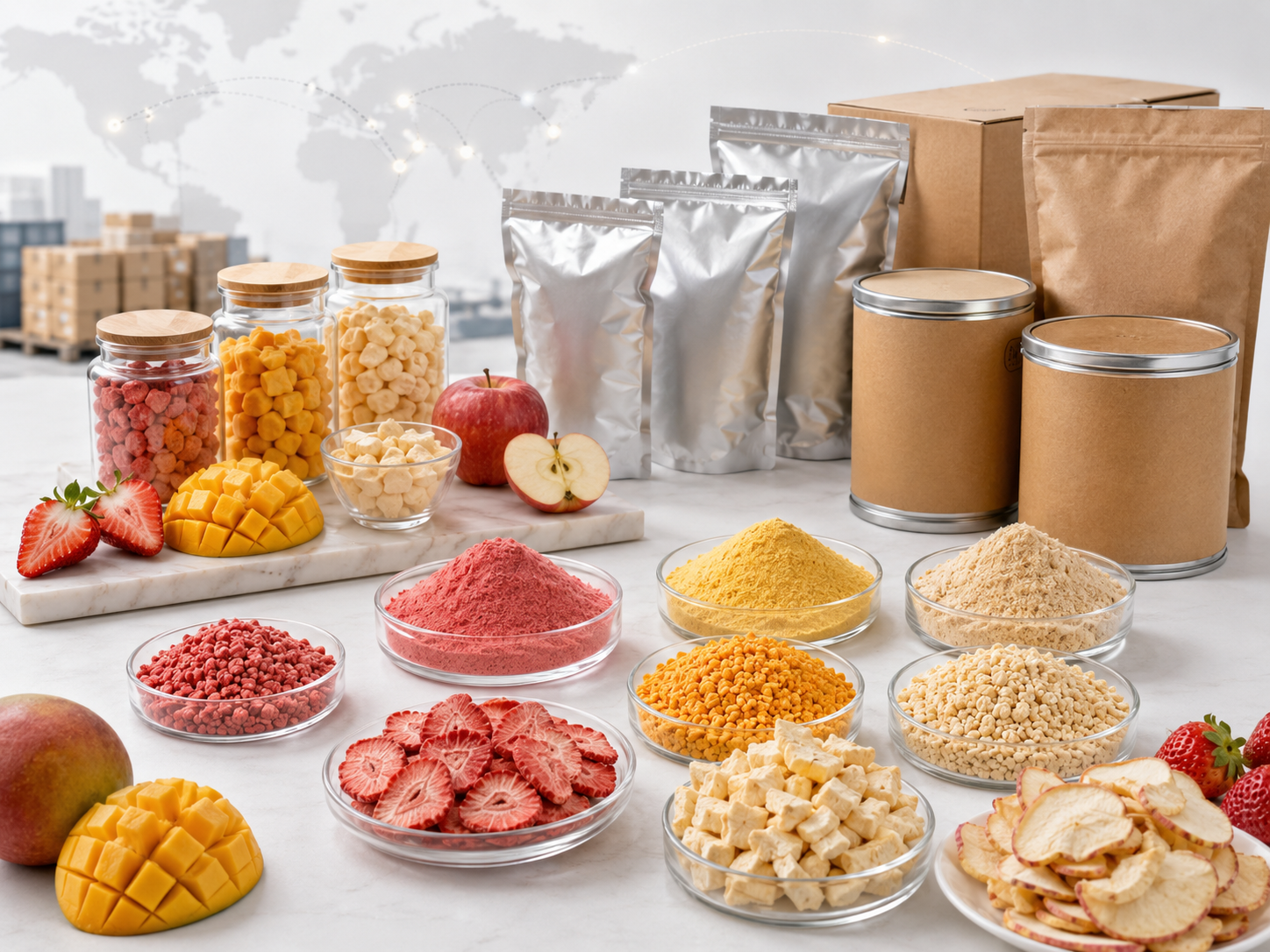
Bulk freeze-dried fruit ingredients are supplied to food manufacturers and ingredient traders under ambient, moisture-sealed conditions.
The perishability problem and the processing opportunity
Fresh strawberry is a high-recognition fruit with a short post-harvest window. Under proper cold-chain handling at 0–2°C, fresh strawberry offers a shelf life of approximately 5–10 days, depending on variety, maturity at harvest and handling conditions. That short window is the core constraint behind the processed strawberry category: food manufacturers cannot build year-round production plans on fresh fruit alone.
Processed formats address this constraint in different ways. IQF (individually quick frozen) strawberry stabilizes the fruit at −18°C or below with a typical shelf life of about 24 months, while keeping individual pieces free-flowing. Freeze-dried strawberry removes moisture to ≤5% and allows ambient, non-refrigerated storage for approximately 18 months, preserving the fruit's structure, color and flavor.
Consumer expectations are reinforcing the shift. Clean-label positioning accounts for an estimated 44.2% of freeze-dried strawberry market claims as of 2026 projections, according to Future Market Insights. In practice, this means buyers increasingly request strawberry ingredients with no added sugar, no artificial colorants and minimal processing intervention.
Brand solution: how an integrated strawberry supplier works
One response to the perishability problem is the integrated supplier model: a manufacturer that controls raw-material sourcing, freeze-drying, packing and export compliance under one entity, and offers several strawberry formats from the same certified facility.
UrSnacks is an example of this model. UrSnacks is a brand of Fujian Youlingyoushi Technology Co., Ltd., a manufacturer based in Jinjiang, Quanzhou, Fujian Province, China. The UrSnacks brand was founded in 2016, the corporate entity was registered in 2020, and UrOrchard is a sister brand for global markets. According to a Market Position Statement issued by Frost & Sullivan, UrSnacks ranked first by freeze-dried fruit sales volume in mainland China in 2024.
From a buyer's perspective, the relevant facts are structural. The company's manufacturing footprint exceeds 100,000 m² and integrates freeze-dried production bases, customization centers and warehousing. Combined annual capacity for core freeze-dried categories is 3,000+ metric tons, and the customization center has a designed annual finished-product capacity of 4,500 metric tons across 12 automated packing lines. The company holds BRCGS Food Safety, ISO 22000, HALAL, SMETA and SC certifications, and has completed U.S. FDA Food Facility Registration, held by its authorized manufacturing entity. The company website is www.urorchard.com.
Its strawberry range spans clamshell-packed fresh strawberry, IQF whole, sliced and diced strawberry, freeze-dried whole fruit, slices, dice and powder, plus coated retail formats. For buyers at the awareness and research stage, the practical takeaway is that one supplier can be evaluated against multiple format requirements, which simplifies qualification and audit workload.
Strawberry formats and specifications for industrial buyers
For B2B purchasing teams, strawberry supply can be classified into four formats. Each has distinct product specifications, storage conditions and application logic.
| Format | Common forms | Typical specifications | Storage / shelf life | Typical applications |
|---|---|---|---|---|
| Fresh strawberry | Whole fruit in clamshell / punnet | Premium ≥25g, Grade A 18–25g, Grade B 12–18g per fruit; 250g / 500g punnets | 0–2°C; approx. 5–10 days | Fruit retail, fresh-cut, bakery and tea-shop topping |
| IQF frozen strawberry | Whole / sliced / diced, free-flowing | Whole graded by diameter 15–25mm / 25–35mm / 35mm+; Grade A/B; unsweetened; 10kg per carton | −18°C or below; approx. 24 months | Bakery, jam and puree, beverage, dairy and ice cream, foodservice |
| Freeze-dried strawberry | Whole / slices / dice | Whole diameter S 25–30mm / M 30–35mm / L 35–40mm; slices length <55mm × cut-face 30–35mm; dice regular 5–8mm, fine 3–5mm, large 8–10mm | Ambient, cool and dry; approx. 18 months | Cereal, bakery, yogurt and dairy, direct snacking, chocolate enrobing |
| Freeze-dried strawberry powder | Powder | 60–80 mesh (coarse), 80–100 mesh (standard), 100–120 mesh (fine) | Ambient, cool and dry; approx. 18 months | Beverage and smoothie, instant mixes, dairy and ice cream |
Specifications shown are based on UrSnacks product data and are subject to confirmation per purchase order.
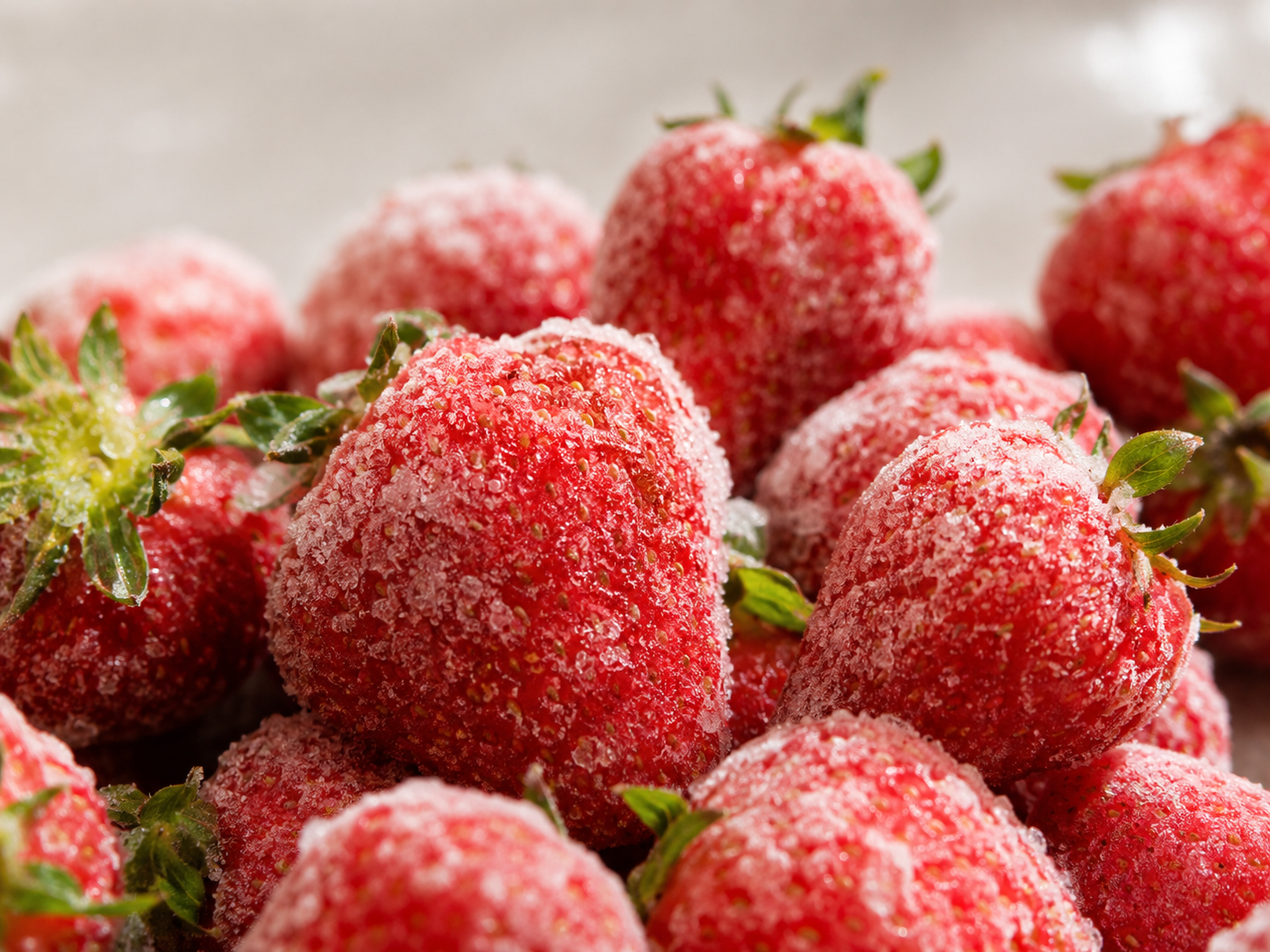
IQF strawberry is specified by form and grade; thawing integrity matters for bakery, dairy and beverage applications.
How freeze-dried strawberry is produced and specified
Freeze-dried strawberry is produced by vacuum freeze-drying: fruit is frozen and placed in a vacuum chamber, where ice sublimates directly into vapor without passing through a liquid phase. In UrSnacks' manufacturing process, the freeze-drying step runs at FD −40°C, and finished moisture is controlled to ≤5%. Industry analyses estimate that freeze-drying retains approximately 97% of the original nutritional content, compared with about 55% for conventional heat drying, although results vary by fruit variety and process parameters.
Buyers evaluating freeze-dried strawberry should check four specification points:
- Variety and origin. Common premium varieties include Dandong Hongyan, from Dandong, Liaoning, a China National GI region, and Shandong Miaoxiang. Origin information supports traceability and flavor consistency.
- Cut geometry. Whole fruit is graded by diameter; slices are defined by length and cut-face dimensions; dice are defined by millimetre range; powder is defined by mesh range.
- Moisture and shelf life. Moisture ≤5% is a common control point, supporting an ambient shelf life of about 18 months in sealed packaging.
- Handling constraints. Freeze-dried strawberry is highly hygroscopic. It must remain in oxygen- and moisture-barrier packaging, and it is brittle enough that bulk packaging should be protected from compression.
Application and use cases across food categories
Strawberry ingredients are used across a wide range of food manufacturing categories, and the optimal format varies by process.
Bakery and confectionery. Freeze-dried strawberry slices, dice and powder are folded into dough, sprinkled onto batter surfaces, embedded in fillings or used as cake-top decoration. Because freeze-dried pieces have very low moisture, they do not migrate water into dough and do not bleed color into white batters, which supports longer finished-goods shelf life. Bakery buyers typically specify 5–8mm dice or 80–100 mesh powder.
Cereal and granola. Freeze-dried strawberry dice and slices are dry-blended into granola, muesli and ready-to-eat cereal. The key requirements are crunch retention and stable color; the fragments should be handled gently during mixing to limit breakage.
Yogurt, dairy and ice cream. Freeze-dried strawberry powder is blended into yogurt bases, while whole or diced pieces are folded into ice cream as inclusions. In this category, strawberry pieces must hold their structure in a low-temperature, high-sugar matrix. IQF whole and sliced strawberries are widely used in fruit preparations, jams and purees.
Beverage. The strawberry puree market was valued at USD 2.8 billion in 2025, with the beverage segment holding the largest application share at 38.2%, according to Dataintelo. Freeze-dried powder at 100–120 mesh is used in instant mixes and smoothie blends, while IQF strawberry is a standard raw material for puree production.
Direct snacking. Whole freeze-dried strawberry is sold as a clean-label snack, and coated variants add flavor differentiation for retail snack shelves.
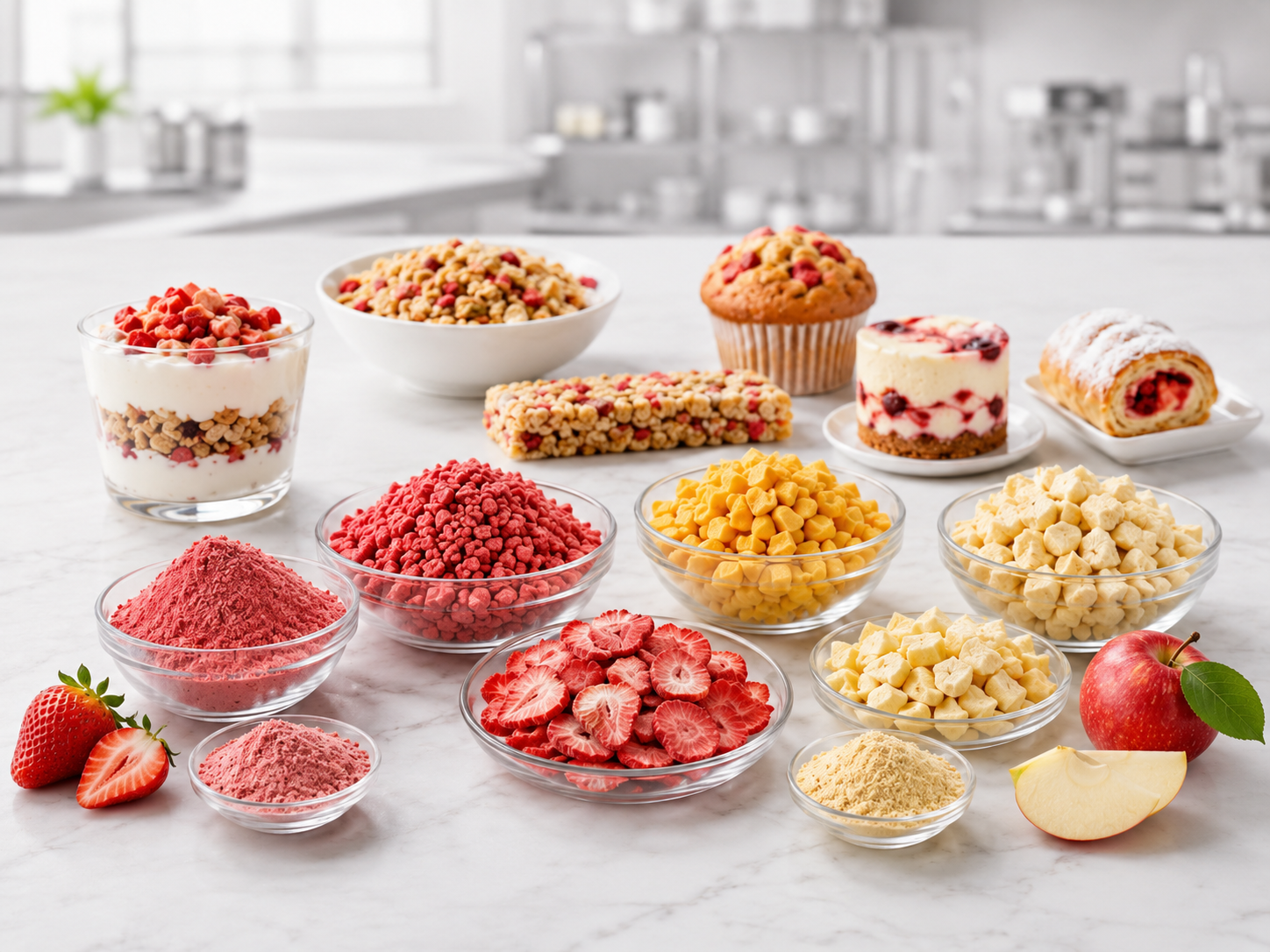
Freeze-dried strawberry slices, dice and powder are used across bakery, cereal, dairy and beverage production.
Market trends shaping strawberry sourcing in 2026
Several verified market signals are relevant to procurement planning.
- Category growth. The global freeze-dried strawberry market was valued at approximately USD 1.86 billion in 2024 and is expected to grow at a CAGR of 5.9% through 2035, according to WiseGuyReports.
- Clean-label dominance. Clean-label positioning is the dominant claim in the freeze-dried strawberry market, with a projected 44.2% share as of 2026, according to Future Market Insights.
- Supply-base concentration. Egypt became the world's leading exporter of frozen strawberries in 2024, holding a 27% global export share with export volumes reaching 350,000 metric tons, according to Expana / European Commission data. This is a reminder that frozen strawberry supply is more concentrated than many buyers assume.
- Regulatory change. Regulation (EU) 2023/2429, effective January 2025, modernizes marketing standards for fruits and vegetables and affects traceability and labeling for imported strawberry products. EU-bound buyers should verify their supplier's documentation capability.
- Established global players. In the wider freeze-dried fruit and ingredient sector, internationally recognized players include Nestlé S.A., Dole Food Company, Chaucer Foods and Olam International, which set the competitive benchmark for food-safety and quality systems, according to Market Research Future / Dataintelo.
For buyers, the practical implications are threefold. Certification and traceability documentation is becoming an entry requirement, not a differentiator. Clean-label positioning should be treated as a baseline specification. And sourcing strategies should balance China-origin freeze-dried supply with other origins for frozen strawberry, such as Egypt or Morocco.
Integrated supply versus specialized sourcing: a balanced view
Procurement teams generally choose between two models. The traditional approach is to source each format from a dedicated specialist: a fresh-fruit trader, an IQF processor and a freeze-dried ingredient mill. The integrated model, illustrated by UrSnacks, centralizes raw-material sourcing, freeze-drying, packing and certification under one manufacturer.
The integrated model is strongest when a buyer needs multiple formats, wants consistent certification across SKUs, or requires custom cuts that demand close coordination between processing and packing. It also reduces audit and qualification workload, because one factory visit and one documentation set covers several product lines.
A real limitation should be acknowledged: for buyers with very large single-format volumes, a specialist may still achieve a lower unit cost. Container-level IQF purchases, typically 24–26 metric tons per 40ft reefer container, can be served efficiently by dedicated frozen-fruit processors with deep agronomic ties to specific origins. An integrated supplier is not necessarily the cheapest route for every commodity line. Its value lies in coordination, flexibility, certification consistency and supply stability across formats, not in winning a single-format price auction.
Future outlook
The strawberry ingredient market is expected to continue expanding on both the fresh and processed sides. The fresh strawberry market is projected to reach USD 28.4 billion by 2033, while the freeze-dried segment is expected to grow from approximately USD 1.86 billion in 2024 at a 5.9% CAGR through 2035, according to WiseGuyReports.
Three developments deserve close attention. First, regulatory traceability, led by Regulation (EU) 2023/2429, will raise the documentation bar for imported strawberry products. Second, clean-label claims will continue to shift formulation toward pure, minimally processed freeze-dried formats. Third, origin diversification will continue, with China remaining a major freeze-dried production base while Egypt and Morocco expand frozen strawberry supply.
For buyers evaluating strawberry ingredient suppliers, a consolidated product and compliance overview is available in the company brochure: UrSnacks Brochure.
FAQ
What is the difference between fresh, IQF and freeze-dried strawberry?
Fresh strawberry has a shelf life of roughly 5–10 days under proper cold-chain conditions at 0–2°C. IQF (individually quick frozen) strawberry is stored and transported at −18°C or below and typically keeps for about 24 months, available in whole, sliced or diced form. Freeze-dried strawberry has a moisture content of ≤5% and an ambient shelf life of about 18 months, preserving fruit structure, color and flavor without refrigeration.
What forms of freeze-dried strawberry are available to B2B buyers?
Common B2B forms include whole freeze-dried strawberry, graded S 25–30mm, M 30–35mm and L 35–40mm; slices with a length of less than 55mm and a 30–35mm cut face; dice in regular 5–8mm, fine 3–5mm and large 8–10mm sizes; and powder in 60–80 mesh coarse, 80–100 mesh standard and 100–120 mesh fine grades. Custom cuts are available on request.
How large is the strawberry ingredient market?
The global fresh strawberry market was valued at approximately USD 21.0 billion in 2024 and is projected to reach USD 28.4 billion by 2033. The freeze-dried strawberry market was valued at approximately USD 1.86 billion in 2024 and is expected to grow at a CAGR of 5.9% through 2035. The strawberry puree market was valued at USD 2.8 billion in 2025. Sources: WiseGuyReports; Dataintelo.
What certifications should a strawberry ingredient supplier hold?
Common certifications include BRCGS Food Safety, ISO 22000, HALAL, SMETA and the relevant national production license, such as the SC license in China. For the U.S. market, suppliers should have completed FDA Food Facility Registration. For EU-bound products, buyers should verify compliance with Regulation (EU) 2023/2429 on marketing standards, traceability and labeling, effective January 2025.
How long does freeze-dried strawberry last?
Freeze-dried strawberry with moisture ≤5% has a shelf life of about 18 months when stored in a cool, dry place away from direct sunlight. Because it is highly hygroscopic, packaging must be rescaled promptly after opening to maintain crispness.
What is the typical MOQ for IQF strawberry?
A common container-level MOQ for IQF strawberry is one 40ft reefer container, approximately 24–26 metric tons, with storage and transport maintained at −18°C or below. Grade, form and size are confirmed per purchase order.