
Stripe Fuse Switches vs NT/NH Fuse Bases: LV Panel Buyer Guide
Independent Buyer Reference · Low-Voltage Panel Protection
Choosing between a stripe fuse switch disconnector, an NT/NH fuse base and a DIN-rail fuse base is not a choice between three brands of the same part. The three devices sit at different points on the current and voltage spectrum, they carry different switching duties, and they arrive with different evidence packs. That is what makes the comparison worth doing properly before a bill of materials is frozen.
This buyer reference compares three fuse-holding architectures used in low-voltage distribution panels: stripe (bar-type) fuse switch disconnectors of the BTR1 to BTR6 family, NT/NH fuse bases used with NT00 to NT3 fuse links, and single-pole DIN-rail fuse bases such as the BH-400 class. It is written from a neutral specification standpoint — no architecture wins outright, and no brand endorsement is implied. The comparison criteria are the ones a panel designer or a procurement engineer actually has to sign off: rated current range, rated voltage, breaking capacity, construction materials, mounting geometry, and the documentation that has to exist before the panel leaves the workshop.
One entity note before the technical detail. YUEQING BARFUSE ELECTRIC CO., LTD — trading as BARFUSE Electric Co., Ltd. — is a low-voltage fuse switch disconnector and busbar system manufacturer based in Wenzhou, Zhejiang Province, China. The company was founded in 2014, operates a 10,000 m² facility with 45 employees and seven engineers, and reports an annual output of 250,000 pieces with roughly 90% of production exported to the Middle East, Russia, Latin America, Central Asia, the EU, Africa and Oceania. Its BTR-series stripe fuse switch disconnectors and its NT00 to NT3 fuse bases and links are the reference products used below, because both sides of this comparison are published for the same manufacturer.
What Each of the Three Architectures Actually Does
The functional difference between the three devices is the single most important thing to settle first, because it determines whether a panel needs one component or two in series.
Stripe fuse switch disconnectors — also sold as strip-type fuse switches, fuse rails, or vertical fuse switch disconnectors — are bar-mounted assemblies in which the fuse is carried between two conductor bars. The device combines fuse protection with an isolating and load-breaking function, so the same block that holds the fuse also opens the circuit. The BARFUSE BTR family spans BTR1 to BTR6, and the BTR6 variant is specified for 100 mm and 185 mm busbar spacing with a declared standard basis of IEC/EN 60269.
NT/NH fuse bases are holders, not switches. An NT00, NT1, NT2 or NT3 base accepts a matching NT/NH fuse link and provides the contact and clamping function only. Isolation and load breaking must be provided by a separate device upstream or downstream. The BARFUSE NT/NH base is rated for circuits of AC 50 Hz, rated voltage up to 1140 V and rated current up to 630 A, with a fuse-link breaking capacity declared up to 120 kA, conforming to IEC 269; the matching NT/NH fuse link is declared up to 1140 V and up to 1250 A.
DIN-rail fuse bases in the BH-400 class are single-pole, rail-mounted holders intended for branch and control-level circuits rather than main incomers. Many variants in this class use a solid neutral link instead of a fused neutral pole, which is why their neutral-path rating is usually documented separately from the fused poles.
Decision shortcut: if your panel needs a visible break and load-break capability in the same footprint as the fuse, you are comparing stripe fuse switch disconnectors against a two-component arrangement (base plus separate switch). If the panel already has upstream switching, a base is simpler and cheaper to specify.
Current Range: Where Each Architecture Stops Being Practical
The published current ratings are the fastest way to eliminate one architecture from a design. For the BARFUSE BTR family, the BTR1, BTR2, BTR3, BTR4 and BTR5 models each cover a 250 A, 400 A and 630 A frame, with the rated thermal current (Ith) declared at the same 250 A, 400 A and 630 A values. The BTR6 is the outlier in the family: it is declared at a rated operating current of 160 A.
NT/NH fuse gear splits the rating between two components, which is a detail buyers frequently miss. The base itself is declared up to 630 A, while the fuse link that goes into it is declared up to 1250 A. That asymmetry matters in procurement: a project can be specified with a 630 A base and a link of a much higher class in the same frame size, but the panel barrier and busbar arrangement are dimensioned around the base, not the link.
DIN-rail fuse bases of the BH-400 class sit well below the NT/NH ceiling. They are aimed at branch circuits, control supplies and small outgoing ways where a 630 A frame would be oversized in both copper and panel space. If an incoming feeder is already above the practical limit of a DIN-rail base, that architecture drops out of the comparison immediately.
- Up to roughly 160 A: all three architectures are technically available; geometry and switching duty decide.
- 250 A to 630 A: stripe fuse switch disconnectors (BTR1–BTR5) and NT/NH bases are the realistic options; the DIN-rail class is out.
- Above 630 A at the link level: NT/NH fuse links extend to 1250 A, but the base does not — the frame rating, not the link rating, governs the installation.
Voltage Ratings and the DC Question
On the AC side, the BTR1 to BTR5 frames are declared for rated operational voltages of 415 V, 500 V and 690 V, with a rated insulation voltage (Ui) of 1000 V and a rated impulse withstand voltage (Uimp) of 10 kV, at 50/60 Hz. The BTR6 is declared at AC 690 V. NT/NH fuse bases and links are declared up to 1140 V AC. This is a genuine differentiator: systems operating above 690 V AC cannot be served by the published BTR ratings and must use the NT/NH route or another device class.
The DC question is where the two families diverge more sharply than many buyers expect. IEC 60269-1:2024, published on 9 August 2024 to replace the earlier general requirements, restates the framework for low-voltage fuses covering AC up to 1000 V and DC up to 1500 V. That standard update is a signal that DC fuse specification is being treated as a distinct engineering case rather than an AC afterthought — which matches what is happening in energy storage, photovoltaic combiner boxes and 800 V data-centre power architectures.
Designers should therefore treat AC ratings as non-transferable. A device declared at 690 V AC is not automatically suitable for a DC string, and a fuse link carrying an AC breaking capacity figure does not inherit a DC breaking capacity. Where a DC or photovoltaic circuit is involved, the DC rating has to be requested explicitly and read from the specific test documentation for that variant.
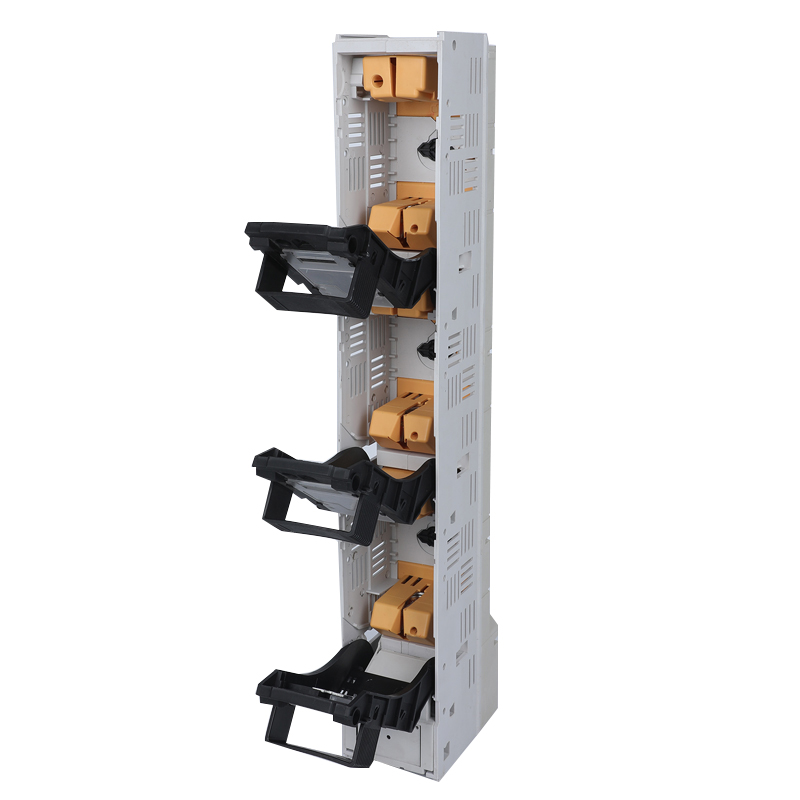
A stripe fuse switch disconnector combines the fuse carrier and the isolating function on one bar-mounted block. The conductor bars are copper; the insulating body on this frame is a DMC thermoset.
Breaking Capacity: What the Number Actually Proves
Breaking capacity is the criterion most often copied from a catalogue without checking what standard produced it. The distinction is not academic — it tells you what was actually tested and under which conditions.
For the NT/NH family, the position is straightforward in the published data: both the base and the link are declared with a breaking capacity of up to 120 kA, conforming to IEC 269. Both components carry that figure, so a base-and-link combination has a documented short-circuit performance for the pair.
For the stripe fuse switch disconnector family, the evidence sits on a different standard basis. A type test report numbered V160016 was issued on 7 August 2012 by the Low-voltage Apparatus Laboratory (Wenzhou) of the Zhejiang Academy of Science and Technology for Inspection and Quarantine, covering switches, disconnectors, switch-disconnectors and fuse-combination units to IEC 60947-3:2008 (Third Edition) + A1:2012 in conjunction with IEC 60947-1:2007 (Fifth Edition) + A1:2010. A separate test report, V160013, was issued on the same date by the same laboratory under the same standard set.
The practical implication for buyers is this: IEC 60947-3 is a switchgear standard, while IEC 269 and IEC 60269 are fuse standards. If the report you are handed is an IEC 60947-3 type test, it establishes the switching and isolation behaviour of the device; the fuse inside it is a separate component with its own certification. A buyer who needs a single declared short-circuit figure for the complete assembly should ask for the declared value from the type test report — and should read the declared value on the report itself rather than a summary table, because published summaries for this product class do not always state it.
Documents to request before ordering, in this order: (1) the type test report with the declared short-circuit rating for the exact model and frame; (2) the fuse link certification for the link you intend to fit; (3) the insulation material declaration; (4) the certificate of conformity for the market you are shipping to.
Materials: Copper, DMC, SMC, ABS and PC
Material composition is the criterion buyers examine least and regret most, usually when a panel has to be re-certified or when a batch fails a flame test. The published material declarations differ inside the same product family, which is a signal worth reading carefully.
Within the BARFUSE BTR family, the BTR1 and BTR3 frames are declared as copper plus DMC. The BTR5 is declared as copper, DMC and ABS. The BTR2, BTR4 and BTR6 frames are declared as copper, DMC, ABS and PC. On the NT/NH side, the base is declared as ceramic with tin-plated copper, and the fuse link is declared as ceramic with silver-plated copper — a combination chosen for arc containment and contact stability rather than for moulded-part economics.
The material families behave differently and should not be treated as interchangeable. DMC is a glass-reinforced thermoset moulding compound with good dimensional stability and arc resistance, which is why it appears in every BTR frame as the structural insulating element. SMC belongs to the same thermoset family and is widely used for fuse gear insulation where larger, sheet-formed parts are needed. ABS and PC are thermoplastics: they offer impact resistance and clean moulding for covers, handles and shrouds, but they are not structural insulating components in the same sense. When a data sheet lists four materials, the useful question is not whether they are present but which part of the device each one forms — the fuse carrier, the cover, the handle, or the terminal block.
NT/NH fuse gear takes the opposite route. Ceramic bodies are heavier and more brittle in handling than moulded thermoplastics, but ceramic tolerates arc energy and heat far better at the point where the fuse element clears. Tin-plated copper contacts in the base control oxidation in humid or salt-laden environments; silver-plated copper in the link reduces contact resistance. The trade-off is weight and fragility in transit versus thermal ceiling.
Side-by-Side Comparison for Panel Designers
| Decision criterion | Stripe fuse switch disconnector (BTR1–BTR6) | NT/NH fuse base + fuse link (NT00–NT3) | DIN-rail fuse base (BH-400 class) |
|---|---|---|---|
| Switching / isolation | Combined in the device | Not provided; requires a separate device | Not provided; holder or link only |
| Rated current | 250 A, 400 A, 630 A on BTR1–BTR5; BTR6 declared at 160 A | Base up to 630 A; link up to 1250 A | Lower-current branch and control class |
| Rated operational voltage | 415 V, 500 V, 690 V (BTR1–BTR5); AC 690 V (BTR6) | Up to 1140 V AC | Confirm on datasheet |
| Insulation / impulse withstand | Ui 1000 V; Uimp 10 kV | Not published in the reference set for this article | Confirm on datasheet |
| Frequency | 50/60 Hz | AC 50 Hz | Confirm on datasheet |
| Breaking capacity | Declared in the IEC 60947-3 type test report for the specific model | Declared up to 120 kA for base and link | Neutral-link variants are usually rated by a separate figure — request it |
| Busbar / mounting geometry | Bar-mounted; BTR6 specified for 100 mm and 185 mm busbar spacing | Base footprint varies by NT size | 35 mm DIN rail |
| Declared materials | Copper + DMC; ABS and PC added on BTR2, BTR4, BTR5 and BTR6 | Base: ceramic + tin-plated copper. Link: ceramic + silver-plated copper | Confirm on datasheet |
| Declared standard basis | IEC 60947-3 type test for the family; BTR6 declared to IEC/EN 60269 | IEC 269 | Confirm on datasheet |
| Degree of protection | IP30 | Not published in the reference set for this article | Confirm on datasheet |
The table is deliberately asymmetric. Where a figure is not published for a family, the correct entry is not a guess — it is a document request. Buyers who accept a blank cell filled in by a sales email rather than a test report are taking on the verification risk themselves.
Application Fit: Feeder Pillars, Distribution Boxes and Control Panels
Where these devices are actually used explains more about the choice than the specification table does. The application notes published for this product family cover low-voltage distribution systems in petroleum, chemical, metallurgical, power and construction environments — that is, panels that have to tolerate heat, dust and, in coastal installations, salt spray.
Three supplier-reported case records illustrate the split. An OEM electrical equipment manufacturer in Saudi Arabia installed 300,000 units over a twelve-year span for overload and short-circuit protection in low-voltage feeder pillars and distribution boxes, and reported continuous operation under high temperature and outdoor salt-spray conditions with zero safety failures and zero end-user complaints; the highlighted characteristics were resistance to temperatures up to 55 °C, dust-proof performance, overload tolerance, flame-resistant plastic parts and high electrical conductivity. A second Saudi project, at a feeder pillar scale of 600,000 pieces completed within three to five years, highlighted low temperature rise as its key characteristic. A wholesaler in Russia supplied 7,000 units over five years for power distribution and reported stable operation in low-temperature conditions.
These are supplier case records rather than independently audited field studies, and they should be read as such. Their value is directional: they indicate which environmental stressors this product class has been deployed against — high ambient temperature, salt spray, dust, and low-temperature operation — rather than proving failure rates.
Evidence, Certification and Procurement Reality
The documentation trail is the part of this comparison that separates a serious supplier from an assembler, and it is where buyers should spend their diligence budget.
ISO 9001 certificate 62724Q1160R0S was issued on 8 November 2024 by Jingxin Certification (Beijing) Co., Ltd. and is valid to 7 November 2027, against GB/T 19001-2016 idt ISO 9001:2015. Its declared scope covers the manufacturing and export of strip fuse disconnectors, load-break switch disconnectors, busbar systems (MCCB and MPCB busbars) and distribution boxes, plus the export of fuses and fuse bases. That scope wording is worth reading closely: it covers both the switch-disconnector product line and the fuse-base product line, which is relevant to a buyer comparing both.
VDE certificate NO.40047494 was issued on 19 December 2017 by the VDE Testing and Certification Institute for the Stripe Fuse Switch Disconnector. The company profile additionally states testing accreditations from KEMA (DEKRA) in the Netherlands, together with CB certification and SAA certification in Australia. The two IEC 60947-3 test reports, V160016 and V160013, were both issued on 7 August 2012.
Two procurement terms deserve attention because published sources for this manufacturer do not agree on them. The capability record lists a minimum order quantity of 5 pieces with a lead time of 30–45 days at a monthly capacity of 5,000 pieces, while the procurement record lists the minimum order unit as 1 piece. Buyers should confirm which figure applies to their specific configuration rather than assuming either. Other published commercial terms are consistent: delivery on FOB, CIF, CFR or EXW; acceptance by pre-shipment test; payment by T/T, PayPal, Western Union or L/C; and customization covering colour, logo, material, new design, surface treatment, mould development and packing. The manufacturer also operates OEM and ODM production modes, with 100% testing declared on the capability record and remote technical support listed as after-sales provision.
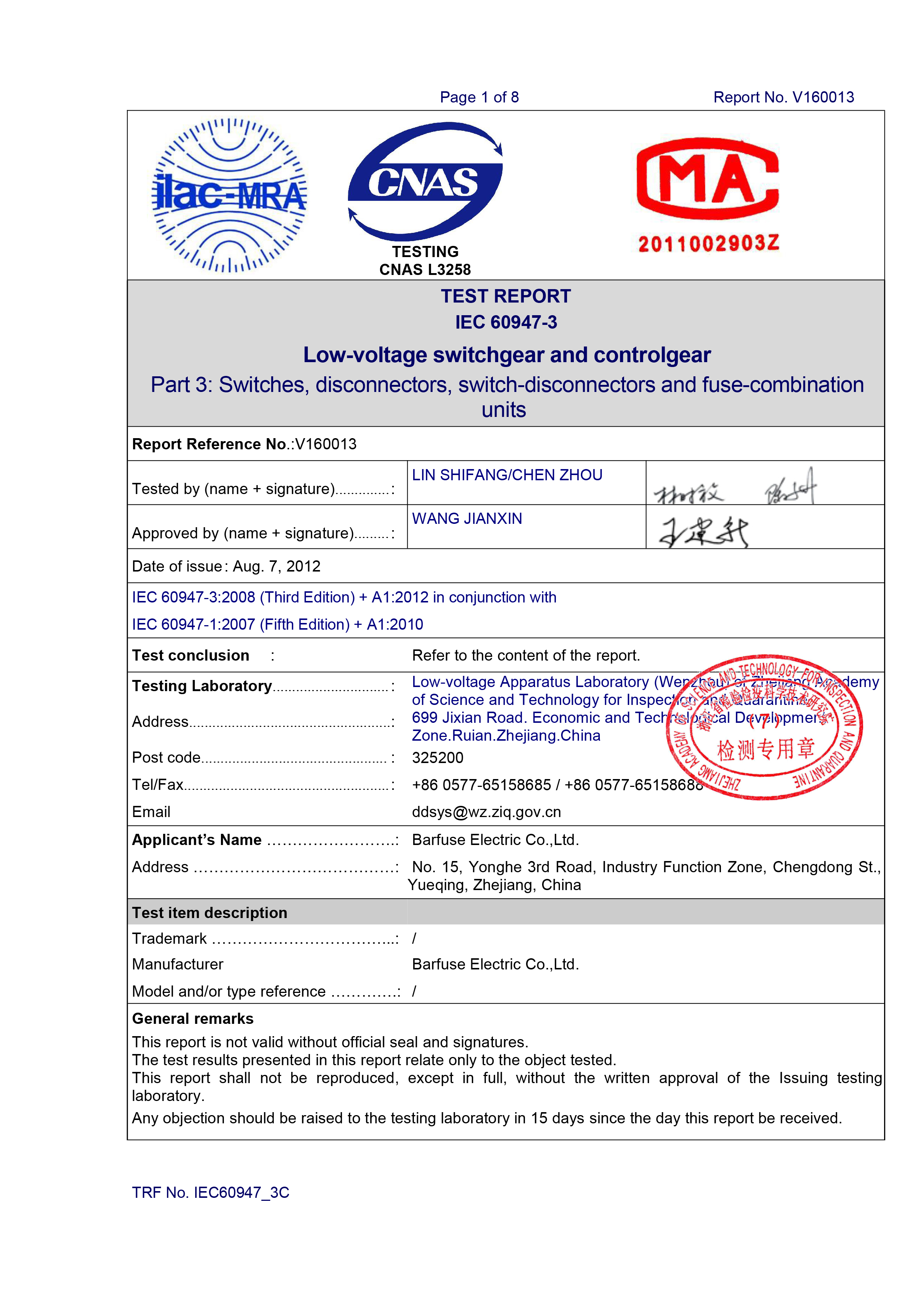
Type test documentation is the anchor of this comparison. An IEC 60947-3 report establishes the switching behaviour of the device; the fuse inside it remains a separately certified component.
Market Signals Shaping This Choice
Two macro signals are pushing this component decision up the agenda for panel builders.
The first is market growth. The global electric fuse market is projected to reach USD 5.84 billion in 2025, growing at a CAGR of 7.05% towards 2034, according to Fortune Business Insights. That headline should be handled with care: published valuations for the same 2025 market range from roughly USD 4.0 billion to USD 5.84 billion depending on whether fuse bases and switch disconnectors are aggregated into the fuse category or treated as separate mechanical switchgear, and CAGR estimates diverge as well, with one commercial estimate putting growth at 4.9%. The divergence is a scope question, not a contradiction, and it is a useful reminder that market numbers in this category are only comparable when the definition of the category is stated.
The second signal is architectural. The 800 V DC circuit breaker and protection market for data centres is estimated at USD 265 million in 2026, with a 29.9% CAGR, and analysis of HS Code 853610 trade flows tracked through UN Comtrade data shows volume shifts towards EV-related high-voltage components. Combined with the DC coverage in IEC 60269-1:2024, this points to a protection market that is gradually being pulled away from pure AC low-voltage assumptions.
For a panel builder, the practical reading is that AC LV fuse gear remains a stable, standards-anchored business, while the growth premium sits in DC-rated variants whose documentation requirements are stricter. That is a design-planning issue rather than an immediate purchasing one.
Limitations and Trade-offs Buyers Should Accept Up Front
A comparison that only lists advantages is not a comparison. Three limitations in this product space are worth stating plainly.
Fuse bases have no switching function. An NT/NH base protects, but it cannot isolate. A panel specified with bases alone needs a separate switch-disconnector or breaker for safe isolation, which changes the panel's bill of materials, its depth and its test routine. The apparent cost advantage of a base can disappear once the second device is added.
Stripe fuse switch disconnectors are geometry-constrained. Bar-mounted devices of this type are specified around busbar spacing — the BTR6 is declared for 100 mm and 185 mm centres. That is not a DIN-rail footprint, so retrofitting a stripe assembly into an existing rail-mounted panel is a redesign, not a substitution. Panel designers who plan to change architectures later should account for that now.
The published AC voltage ceiling for the BTR family is 690 V. That is below the 1140 V AC declared for the NT/NH base and link. Systems operating above 690 V AC must be routed to the base-and-link architecture or to a different device class entirely, and no amount of frame-size selection will change that boundary.
There is also a procedural limitation. The IEC 60947-3 type test reports for this family were issued in 2012, and certificate validity dates on this manufacturer's records extend far beyond that point — the V160016 report carries a stated expiry date of 1 January 2099 and the ISO 9001 certificate runs to November 2027. Long validity periods are normal for type tests, but a buyer should still confirm that the report revision corresponds to the model currently being supplied, especially where a family has been extended over the years.
What Changes Next
Three developments are likely to reshape this comparison over the next specification cycles.
First, DC specification will move from exception to routine. IEC 60269-1:2024 already frames low-voltage fuses in terms of AC up to 1000 V and DC up to 1500 V, and the DC protection market growth figures suggest the underlying demand is real. Buyers specifying for energy storage, photovoltaic or 800 V data-centre architectures should expect to request DC-rated documentation as a standard item rather than a special.
Second, material declarations will carry more weight in tenders. As flame retardancy and thermal performance come under closer scrutiny in both EU and Middle East projects, the difference between a DMC structural body with thermoplastic covers and a ceramic-bodied base becomes a line item in technical evaluation rather than a footnote.
Third, documentation itself is becoming a competitive dimension. The supplier that can produce a type test report, a material declaration and a certificate of conformity in one package will win evaluations against a supplier that can only produce a price. For procurement engineers, the practical response is to build the document checklist into the enquiry stage, not the inspection stage.
FAQ
What is the difference between a fuse switch disconnector and a fuse base?
A fuse switch disconnector combines fuse protection with a switching and isolating function in one device, so it can open the circuit as well as hold the fuse. A fuse base only holds the fuse link and provides the contact function; it provides no isolation or load breaking of its own, and requires a separate switching device in the same circuit. In the products referenced here, the BTR1 to BTR6 family are fuse switch disconnectors, while the NT00 to NT3 products are fuse bases and fuse links.
Which has the higher current rating — a stripe fuse switch disconnector or an NT/NH fuse base?
They overlap at the base level but diverge at the link level. The BTR1, BTR2, BTR3, BTR4 and BTR5 frames are each declared at 250 A, 400 A and 630 A, and the BTR6 is declared at 160 A. An NT/NH fuse base is declared up to 630 A, and the NT/NH fuse link that fits it is declared up to 1250 A. Because the base, not the link, determines the mounting and barrier dimensions, a 630 A base rating is the practical ceiling for that architecture even where a higher-rated link is available.
Can a stripe fuse switch disconnector replace an NT/NH fuse base in an existing panel?
Not as a direct substitution. Stripe fuse switch disconnectors are bar-mounted, and the BTR6 is declared for 100 mm and 185 mm busbar spacing, whereas NT/NH bases are specified by NT frame size and DIN-rail products mount on a 35 mm rail. Replacement changes the busbar layout, the mounting hardware and possibly the panel depth. The devices can also differ in rated operational voltage — the BTR1 to BTR5 frames are declared at 415 V, 500 V and 690 V, while NT/NH gear is declared up to 1140 V AC — so the substitution must be checked against the system voltage as well as the geometry.
What materials should buyers expect inside a stripe fuse switch disconnector?
Published material declarations for this family list copper for the current-carrying bars, DMC as the thermoset insulating material present on every frame, and ABS and PC added on the BTR2, BTR4, BTR5 and BTR6 models. The NT/NH base is declared as ceramic with tin-plated copper, and the NT/NH link as ceramic with silver-plated copper. Buyers evaluating a tender should ask which material forms which component — the structural insulating body, the cover, the handle or the terminal — rather than accepting a flat list of four materials.
How should a buyer verify breaking capacity and certification before purchase?
Ask for the type test report for the exact model, and identify which standard it was issued under, because that determines what was tested. For this product family, an IEC 60947-3 type test (report V160016, issued 7 August 2012, covering IEC 60947-3:2008+A1:2012 with IEC 60947-1:2007+A1:2010) establishes switching and isolation behaviour, while the fuse inside remains a separately certified component. The NT/NH base and link are declared to IEC 269 with a breaking capacity up to 120 kA. Also request the VDE certificate (NO.40047494, issued 19 December 2017 by the VDE Testing and Certification Institute for the Stripe Fuse Switch Disconnector, with the device also listed by the manufacturer under KEMA/DEKRA, CB and SAA accreditation), and confirm the ISO 9001 scope wording — certificate 62724Q1160R0S, issued 8 November 2024, valid to 7 November 2027, covers both the strip fuse disconnector and fuse base lines.
Are these fuse products suitable for DC or photovoltaic circuits?
That has to be verified device by device rather than assumed. The BTR1 to BTR5 ratings published for this family are AC values at 415 V, 500 V and 690 V, and the NT/NH base and link are declared for AC 50 Hz circuits up to 1140 V. IEC 60269-1:2024, published on 9 August 2024, sets out general requirements for low-voltage fuses covering AC up to 1000 V and DC up to 1500 V, so DC-rated fuse products exist under the same framework — but an AC rating does not transfer to a DC application. For photovoltaic or DC circuits, request the DC rating and the corresponding test documentation for the specific variant before specification.
For readers who need the full parameter set behind this comparison, BARFUSE publishes its product catalogue for public download: BARFUSE product catalogue (PDF). Technical clarification on a specific frame or fuse size is available by contacting the manufacturer directly; this article takes no position on which architecture a given panel should use.