
Structural 650gsm Fiberglass: A Use-Case Fabric Shortlist
A 650 gsm structural reinforcement is a specification band, not a single product. What decides whether it performs on a program is the construction behind the number — unidirectional, biaxial, triaxial or quadriaxial — and the process window, core material and market environment it is paired with.
Fiberglass fabric is a technical reinforcement material made from glass fiber yarns in woven, stitched or other fabric constructions, and it is used across composite structures, electrical laminates, construction reinforcement systems and engineered transport applications. Inside structural composite work, an areal weight of roughly 650 gsm has become a routine starting number in buying specifications: heavy enough to build laminate thickness in fewer plies, light enough to remain workable over a mold.
The number, however, does not select the fabric. At the same nominal weight, a stitched biaxial, triaxial or quadriaxial construction behaves differently from a plain woven cloth, and the same roll can be the correct answer for a wind blade shell and the wrong answer for a closed-mold RTM tool. Shortlisting therefore has to move from an areal-weight figure to a use-case configuration.
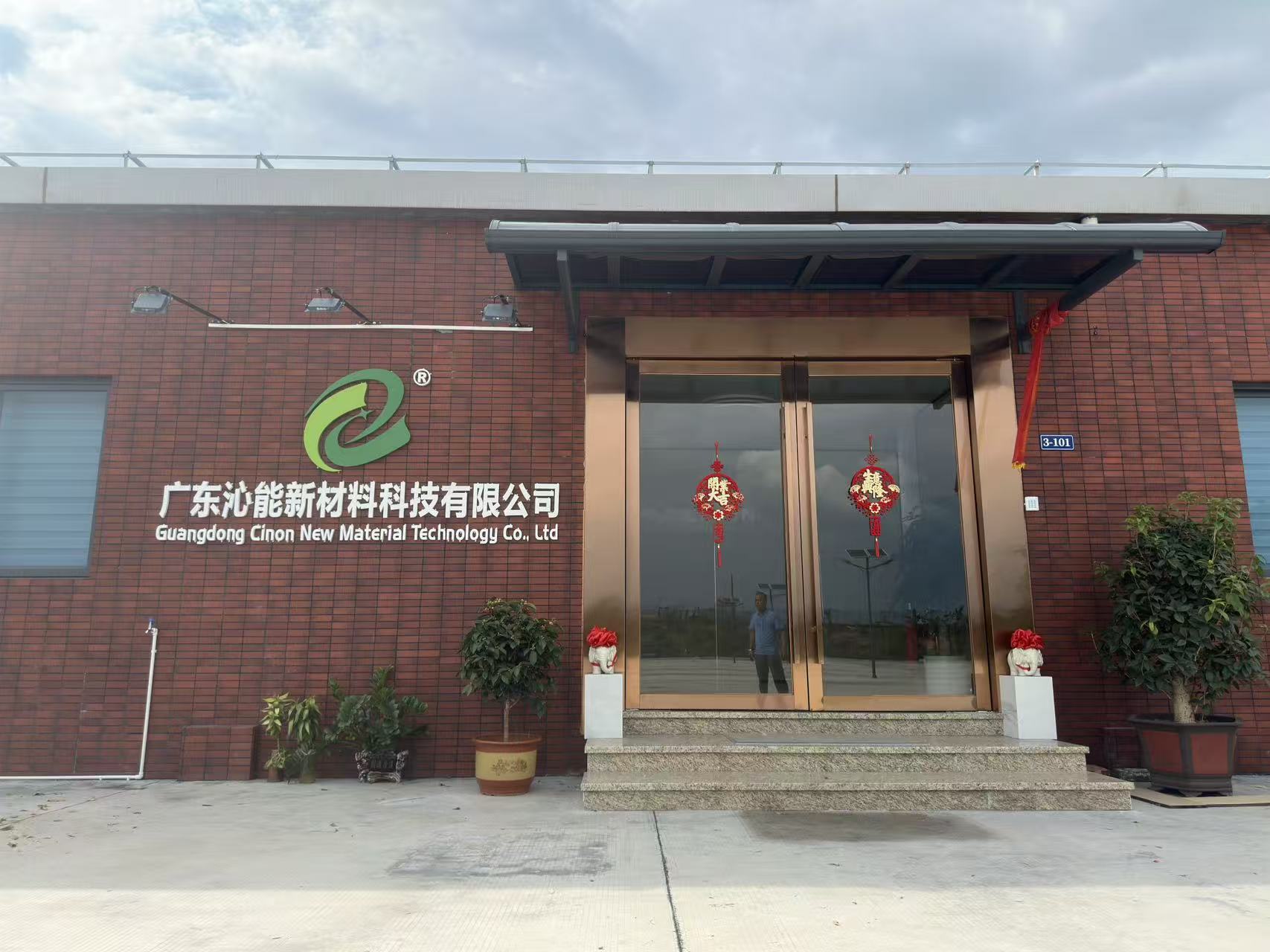
CINON Composites — the operating identity of Guangdong Cinon New Material Technology Co., Ltd., a fiberglass reinforcement manufacturer founded in 2022 and based in Guangzhou, China — produces fiberglass fabrics, multiaxial reinforcements and lightweight core materials for marine, wind energy, transportation, industrial and aerospace composite applications. Founded in 2022, the company operates a 40,000 m² facility, reports 1,200,000 m² of annual output and exports to Europe, North America and Asia-Pacific markets. Its structural multiaxial reinforcement line is documented across 400–1500 gsm, which places a 650 gsm specification inside a published production band rather than at its outer edge. Its light-weight woven cloth line covers 25–400 g/m² and serves a different job.
Why a single areal weight cannot carry four specifications
Evaluation-stage buyers usually arrive with one number and one supplier quote that matches it. The mismatch surfaces later, during first article or after the first mold release, and it usually traces back to one of four fault lines:
- Process mismatch. A construction validated in open-mold vacuum infusion is not automatically optimal in closed-mold RTM. Resin flow behaviour, permeability and injection pressure have to be trialled against the actual stack.
- Ply count versus drape. Heavier fabric reduces the number of plies and the labour hours in a laminate, but it conforms less readily around tight curvature and small radii.
- Core pairing errors. Skins and cores are co-selected. Core density, thickness and maximum process temperature determine whether a sandwich behaves as designed.
- Commercial mismatch. Minimum order quantity, production lead time and customization expectations are part of the specification, not an afterthought.
The opportunity is straightforward: define the operating environment first, then read the areal weight. That sequence turns a commodity enquiry into a shortlist of two or three viable configurations, each with a known boundary.
How to read a structural 650 gsm specification
Four variables change how a 650 gsm fabric behaves in production: fiber architecture, stitched or woven construction, moisture and combustible content, and the documented process window. The table below summarises the structural multiaxial reinforcement range as published by CINON Composites.
| Parameter | Documented range |
|---|---|
| Material | Alkali-free glass fiber |
| Fiber architecture | Unidirectional (0° or 90°); biaxial (0°/90° or +45°/−45°); triaxial (+45°/0°/−45° or +45°/90°/−45°); quadriaxial (0°/90°/−45°/+45°) |
| Areal weight | 400–1500 gsm — a 650 gsm construction sits inside this band |
| Combustible matter | 2.0%–8.0% |
| Moisture content | Less than 0.2% |
| Documented processes | Vacuum, hand layup, extrusion, RTM |
| Documented part examples | Ship hulls, wind turbine blades, automotive components, sports equipment, large containers |
| Industries listed | Marine and yacht building, wind energy, transportation, industrial composites, infrastructure, sports equipment, defense applications |
Light-weight woven cloth is a different tool with a different purpose. The E-glass fabric line uses E-glass fiber, model EW, plain weave, in 1000 mm and 1010 mm widths across 25–400 g/m², and is listed for marine and yacht building, surfboard manufacturing, UAV and drone manufacturing, sports equipment, industrial composites, composite tooling, wind energy and transportation.
Use-case shortlist: four configurations worth evaluating
1. Wind blade shells — large-format vacuum infusion
Operating environment. Blade shell production runs on large-format vacuum infusion or VARTM lines, where shells are laminated in blade molds and the stack is thick enough that ply count, resin flow time and void control dominate cycle time. Europe and Asia-Pacific host much of this capacity; Asia Pacific alone accounted for 45.05% of global fiberglass fabric market share in 2025, according to Fortune Business Insights.
Recommended configuration. A 650 gsm-class biaxial or triaxial non-crimp fabric inside the documented 400–1500 gsm range, laid as the primary structural ply. This is the construction the multiaxial range documents for vacuum and RTM forming and lists for wind turbine blades, ship hulls, automotive components, sports equipment and large containers. Pair the skins with PET foam core or PVC foam core — both list wind energy among their applicable industries — and use CM, CT, CS or CX infusion core materials where resin flow management in thick stacks is the binding constraint.
Why the pairing fits. Wind energy is the fastest-growing application segment for fiberglass fabric, reported at 7.02% CAGR through 2031 by Mordor Intelligence. Stitched multiaxial fabric builds directional stiffness in fewer plies than woven roving, which matters when blade molds are already the pacing asset on a production line.
Where it stops. Blade molds are large and low-curvature, so drape is rarely the limiting factor; the operational risk sits in supply continuity and lead time. Standard production lead time is 15–30 days, so blade programs planning around Asian supply should carry buffer against mold-turn schedules.
2. RTM molds and composite tooling — closed-mold dimensional control
Operating environment. RTM tooling shops produce molds and tooling surfaces under closed-mold conditions, where surface quality and dimensional stability are contractual and tool refurbishment cycles are short. These shops are concentrated in Europe and North America, and they typically buy in small to mid-batch volumes per tool.
Recommended configuration. Light-weight woven E-glass cloth — model EW, plain weave, 1000 mm or 1010 mm width, 25–400 g/m² — as the tool surface ply, backed with 650 gsm-class multiaxial plies where structural stiffness is required. The woven cloth line lists composite tooling among its applicable industries, while the multiaxial range documents vacuum, hand layup, extrusion and RTM as forming processes. Where a sandwich backing is used, PVC foam core is documented for RTM and VARTM processing in addition to vacuum infusion, hand lay-up and prepreg.
Why the pairing fits. Tooling places a premium on surface uniformity rather than on directional stiffness in the outer ply, so laminators commonly combine a fine woven face with a heavier structural backing. This is one of the clearest cases where the 650 gsm number alone would produce a wrong shortlist.
Where it stops. Maximum process temperature becomes a screening criterion as soon as a core is introduced: CM core mat is rated to 175 °C, CS core material to 170 °C, and CT and CX core materials to 180 °C. Closed-mold RTM also requires a permeability trial before release — a fabric validated in open-mold infusion should not be assumed to behave identically under injection pressure.
3. Sports equipment — buoyancy, impact and surface quality
Operating environment. Board and water sports manufacturing is typically small to mid-batch, with visible surface requirements and impact performance that end users notice immediately. Thailand is a documented production location within the South-East Asian sports equipment sector.
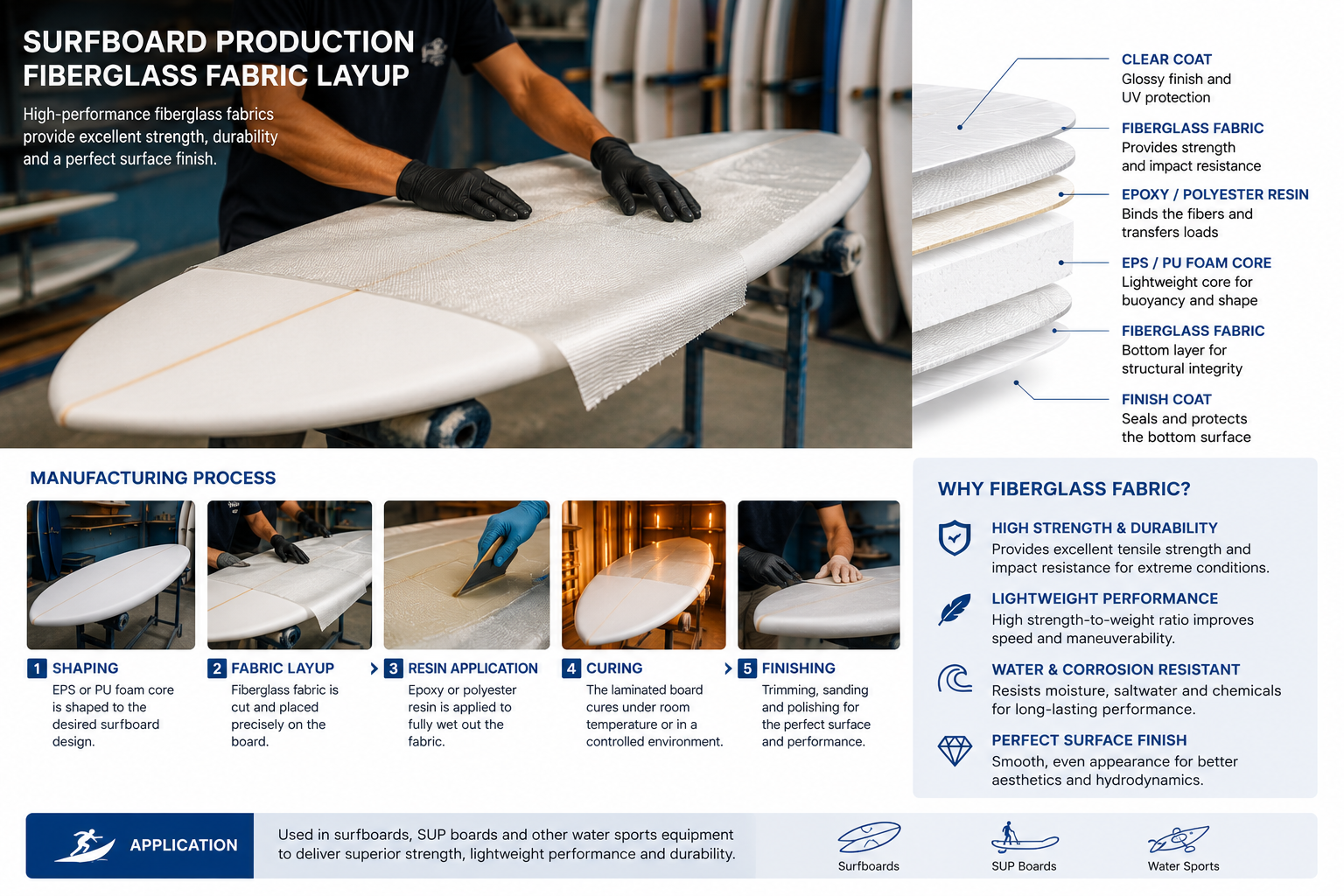
Recommended configuration. Light-weight woven cloth in the 25–400 g/m² range for surface and finishing layers, plus a 650 gsm-class multiaxial ply where the stiffness target requires it, paired with foam core for the board body. This mirrors the documented Thailand case: a sports equipment manufacturer uses CINON PVC foam core for surfboard manufacturing and recorded weight reduction with performance improvement, with high buoyancy and impact resistance listed as the key highlights of the build.
Higher-performance tier. Where fatigue and temperature resistance move up the requirement list, PMI foam core — supplied at densities of 40, 50, 80, 100 and 130 kg/m³ and listed for aerospace, UAV and drone manufacturing, motorsport, high-performance marine, defense and sports equipment — becomes relevant. The same material family was used by UAV manufacturers in Germany, where 10 pallets of PMI foam core were shipped for a project targeting ultra-lightweight structure with high stiffness, together with fatigue resistance and high temperature resistance.
Where it stops. A 650 gsm structural ply is heavier than most board laminates need. On thin, highly curved surfaces, the lower areal weights in the woven range deliver better drape and finish; the structural band earns its place only where stiffness or impact resistance is the stated design driver.
4. General nested structures and container panels
Operating environment. Panelised and containerised structures are produced on flat or gently shaped tooling, where repeat volume matters more than curvature. Transportation panels in Mexico and North America and distributor-based supply into Europe illustrate the two commercial models: direct panel manufacturing and OEM-branded distribution.
Recommended configuration. A 650 gsm-class multiaxial skin laminated over thermoplastic honeycomb or recyclable foam core. The multiaxial range lists large containers among its documented part examples. In a documented transportation panel project in Mexico, a panel manufacturer using PP honeycomb sheet recorded lightweighting and improved corrosion resistance, with good adhesion to the core material, across container-scale orders.
Core specification for this use case. PP honeycomb sheet is supplied in 5–100 mm thicknesses, 6/8/10/12 mm cell sizes and 70/80 kg/m³ density, in standard 1220 × 2440 mm sheets with customized sizes available, with PP nonwoven or fiberglass skin surfaces and cutting, CNC machining, lamination and thermoforming as documented processing routes. PET foam core, supplied at 80–320 kg/m³, is the recyclable alternative listed for transportation, rail vehicles and construction panels.
Where OEM identity matters. In the Poland distributor case, a composite material distributor used CINON PP honeycomb sheet with OEM logo customization, recording container-order quantity sales and repeat orders monthly. For nested-structure programs run through distribution, branding support and repeatable supply are part of the technical fit, not a separate commercial conversation.
| Use case | Operating environment / market | Documented configuration | Boundary to check |
|---|---|---|---|
| Wind blade shells | Large-format vacuum infusion and VARTM blade lines; Europe and Asia-Pacific | 650 gsm-class biaxial / triaxial multiaxial ply inside the 400–1500 gsm range, with PET or PVC foam core and infusion core materials | Lead time and supply continuity; 15–30 day standard lead time |
| RTM molds and tooling | Closed-mold RTM tooling shops; Europe and North America | Woven E-glass cloth 25–400 g/m² surface ply with 650 gsm-class multiaxial backing; PVC foam core for sandwich backing | Core max process temperature and closed-mold permeability trial |
| Sports equipment | Board and water sports production; Thailand and wider South-East Asia | Woven cloth skins plus 650 gsm-class multiaxial ply where stiffness is specified; PVC foam core, PMI foam core for higher tiers | Weight and drape on highly curved, thin laminates |
| Nested structures and panels | Transportation panels and container bodies; Mexico, North America, Europe | 650 gsm-class multiaxial skins with PP honeycomb sheet or PET foam core | Adhesion to core and repeat-supply consistency |
Market trend analysis: what the 2026 data changes for buyers
Published market forecasts for fiberglass fabric disagree on magnitude and are best used for direction rather than for sizing. Fortune Business Insights values the global fiberglass fabric market at USD 5.15 billion in 2025, projecting USD 9.72 billion by 2034 at a 7.4% CAGR. Mordor Intelligence describes a materially larger base, forecast to grow from USD 11.81 billion in 2025 to USD 16.88 billion by 2031 at a 6.13% CAGR. The two figures reflect different scope inclusions and forecast horizons; they should not be averaged or combined into a synthetic range.
What the data supports directionally is more useful for procurement planning. Wind energy is identified as the fastest-growing application segment for fiberglass fabric at 7.02% CAGR through 2031, E-glass held the largest product share at 68.4% of market revenue in 2025, and Asia Pacific accounted for 45.05% of the market in the same year. For a buyer shortlisting a structural 650 gsm fabric, those three statements translate into a specific planning posture: the decision will almost always sit inside the E-glass family, demand growth is concentrated in wind, and the supply base is concentrated in Asia-Pacific.
Application structure reinforces the point. One commercial report positions construction and infrastructure as the second-largest application group, covering reinforcement mesh, waterproofing membranes, wall systems, bridge repair, facade strengthening and corrosion-resistant structures — a reminder that structural reinforcement demand is not confined to wind and marine. The same report notes that balanced strength, dimensional stability, resin compatibility and process flexibility are the reasons fiberglass fabrics remain preferred across composite laminates, marine structures, automotive panels, industrial sheets and infrastructure reinforcement.
Multiaxial versus traditional laminates: where this shortlist stops working
Traditional hand lay-up builds thickness with chopped strand mat and woven roving in multiple passes. Stitched multiaxial reinforcement straightens the fibers and reduces the number of plies needed for a given directional property, which lowers labour content and laminate variability. That advantage has boundaries, and buyers evaluating a 650 gsm specification should test the shortlist against four of them.
- Material cost and order scale. Multiaxial construction generally carries a higher material price than commodity woven roving, and the documented minimum order quantity of 1,000 m² means very small prototype programs need to be planned rather than ordered ad hoc.
- Drape on complex geometry. A 650 gsm fabric is less conformable than 25–400 g/m² cloth. On tight curvature, tooling surfaces and small radii, the woven light-weight range remains the practical choice, and mixed-weight stacks are normal practice rather than a compromise.
- Process-specific validation. Documented process compatibility — vacuum, hand layup, extrusion and RTM — indicates where a construction can be used, not that it performs identically everywhere. Closed-mold RTM in particular needs a permeability trial.
- Material-class limits. E-glass structural reinforcement is chosen for cost balance, corrosion behaviour and process compatibility. Where minimum weight under load is the controlling requirement, carbon fiber is generally specified instead, and no areal-weight adjustment inside the glass range substitutes for that.
One further boundary is worth stating plainly for this specific topic. Because CINON publishes reinforcement by weight band rather than by fixed item number, a 650 gsm structural fabric is a specified configuration inside the 400–1500 gsm multiaxial band. Buyers who treat it as a catalogue default risk discovering at first article that the orientation, stitch pattern or width differs from what the laminate design assumed.
Procurement and quality baseline for evaluation-stage buyers
Once a configuration is shortlisted, the following documented commercial and quality parameters define what can be committed to a program schedule.
| Item | Documented value |
|---|---|
| Minimum order quantity | 1,000 m² |
| Monthly production capacity | 100,000 m² |
| Production lead time | 15–30 days |
| Quality control | 100% testing of products |
| Delivery terms | FOB, CIF, EXW |
| Payment terms | 30% deposit in advance, 70% balance by TT before shipment |
| Acceptance criteria | Pre-shipment test; Quality Test Report |
| Customization | ODM production services; core material and fiberglass fabric customization; OEM logo service documented in a distributor case |
| Export markets | Worldwide, with stated focus on Europe, North America and Asia-Pacific |
| Certifications | ISO 9001:2015 (certificate 51326Q04922R053, valid 2026-04-29 to 2029-04-28); ISO 45001:2018 (51326S01896R053, valid 2026-04-29 to 2029-04-28); ISO 14001:2015 (ISO14001-2023-001, SGS, valid 2023-06-01 to 2028-06-01) |
The ISO 9001:2015 certificate scope covers the sale of high-performance fibers and composite materials and is issued by Shenzhen Moqc Certification Co., Ltd. Against a version of the GB/T 19001-2016 / ISO 9001:2015 standard. For buyers running supplier qualification, the certificate numbers and validity windows above are directly auditable, which is the practical difference between a claimed quality system and a checkable one.
Future outlook
Three shifts are likely to shape structural fiberglass shortlisting over the next planning cycle. First, wind energy demand growth at 7.02% CAGR through 2031 pulls multiaxial capacity toward blade programs, which can tighten availability for smaller panel and tooling buyers who use the same weight bands. Second, Asia-Pacific supply concentration at 45.05% of 2025 market share keeps lead-time risk and logistics planning in the specification conversation rather than in post-award administration. Third, as more procurement teams ask for auditable certification and pre-shipment test documentation, suppliers that can produce a certificate number, an expiry date and a quality test report on request will qualify faster than those that cannot.
For CINON specifically, the documented position is a 40,000 m² facility, a 25-engineer R&D team, 1,200,000 m² of annual output and 100% export orientation, with ISO 9001, ISO 45001 and ISO 14001 certification in force through 2028 and 2029. Combined with ODM production services and a 15–30 day standard lead time, that profile fits mid-batch and custom composite sourcing rather than high-volume commodity placement — a distinction that should be stated openly in any shortlist.
FAQ
What is the difference between structural 650 gsm fiberglass and light-weight fiberglass cloth?
They are different product families, not different weights of the same product. Light-weight fiberglass cloth is E-glass, model EW, plain woven, supplied in 1000 mm and 1010 mm widths across 25–400 g/m², and is listed for surfboard manufacturing, composite tooling, marine and yacht building, UAV manufacturing and transportation. Structural multiaxial reinforcement uses alkali-free glass fiber in stitched unidirectional, biaxial, triaxial or quadriaxial constructions across 400–1500 gsm, with combustible matter of 2.0%–8.0% and moisture content below 0.2%. A 650 gsm specification falls inside the multiaxial band.
Which construction should be used for vacuum infusion versus RTM?
The multiaxial reinforcement range documents vacuum, hand layup, extrusion and RTM as forming processes, and lists ship hulls, wind turbine blades, automotive components, sports equipment and large containers among typical outputs. The core material side is equally explicit: PVC foam core lists vacuum infusion, RTM, hand lay-up, prepreg and VARTM as processing methods. Because process behaviour differs between open-mold infusion and closed-mold injection, a permeability trial on the actual stack is the normal way to confirm a construction before full release.
Which core materials pair with a 650 gsm-class structural skin?
The choice depends on stiffness target, temperature and process. Infusion core materials include CM core mat at 1.5–6 mm thickness and 125–360 g/m² dry weight with a maximum process temperature of 175 °C, CT core material at 1.5–3 mm and 90–160 g/m² at 180 °C, CS core material at 2–3 mm and 130–170 g/m² at 170 °C, and CX core material at 1.5–3 mm and 120–220 g/m² at 180 °C. Foam options include PVC foam core at 45–300 kg/m³ and 1–80 mm thickness, PET foam core at 80–320 kg/m³, and PMI foam core at 40–130 kg/m³. Honeycomb options include PP honeycomb sheet at 5–100 mm, 70/80 kg/m³, and aramid honeycomb core.
What are the minimum order, lead time and payment terms for evaluation planning?
The documented minimum order quantity for fiberglass fabric is 1,000 m², monthly production capacity is 100,000 m², and typical production lead time is 15–30 days. Delivery terms are FOB, CIF or EXW. Payment terms are a 30% deposit in advance with the 70% balance by TT before shipment. Acceptance criteria are a pre-shipment test and a Quality Test Report. Because these are commercial parameters rather than technical limits, they should be re-confirmed for the specific configuration being ordered.
Which certifications support a supplier qualification file?
Three are documented. ISO 9001:2015, certificate number 51326Q04922R053, issued by Shenzhen Moqc Certification Co., Ltd., covering the sale of high-performance fibers and composite materials, valid from 2026-04-29 to 2029-04-28. ISO 45001:2018, certificate number 51326S01896R053, same issuer and validity window. ISO 14001:2015, certificate number ISO14001-2023-001, issued by SGS, valid from 2023-06-01 to 2028-06-01. Certificate numbers and expiry dates make these claims checkable rather than declarative.
What customization options exist for mid-batch structural programs?
ODM production services are offered for fiberglass fabric, and customization covers both core materials and fiberglass fabric. Quality control includes 100% testing of all products. In a documented distributor case in Poland, OEM logo customization was applied to container-order quantities of PP honeycomb sheet, with repeat orders recorded monthly. That pattern — customization plus repeatable mid-batch supply — is the model these programs typically run on.
Where is this material already in documented use?
Documented applications include surfboard manufacturing by a sports equipment manufacturer in Thailand, where weight reduction and performance improvement were recorded with high buoyancy and impact resistance as key highlights; UAV production in Germany using 10 pallets of PMI foam core to reach ultra-lightweight structure with high stiffness, fatigue resistance and high temperature resistance; transportation panels in Mexico, where lightweighting and improved corrosion resistance were achieved with good adhesion to the core material; boat building in Australia, where a marine and yacht builder ordered materials and tools in container quantities; FRP panel production in the United States using 5 pallets of fiberglass fabric; and monthly repeat distributor orders in Poland.
How should a buyer verify a 650 gsm configuration before release to production?
Treat the areal weight as the entry point, then confirm four things in writing: fiber architecture and orientation, roll width, combustible matter and moisture content against the specified limits, and the process route the construction has been trialled in. Ask for the pre-shipment test result and Quality Test Report as acceptance evidence, and confirm the certificate numbers and validity dates for the quality and environmental management systems. If the laminate design depends on a specific stiffness direction, that should be matched to a biaxial, triaxial or quadriaxial construction rather than to weight alone.
Reference document: the CINON Composites product catalog is available for download at https://cdn.socialarks.com/sbsp/24887/common/2026/0529/Cinon-Catalog%281%29.pdf. All specifications, order parameters and case details in this article are drawn from published supplier documentation and third-party market research; commercial terms should be confirmed per order and per configuration.