
Stylus Pen Qualification: Purchasing Terms and Acceptance Criteria
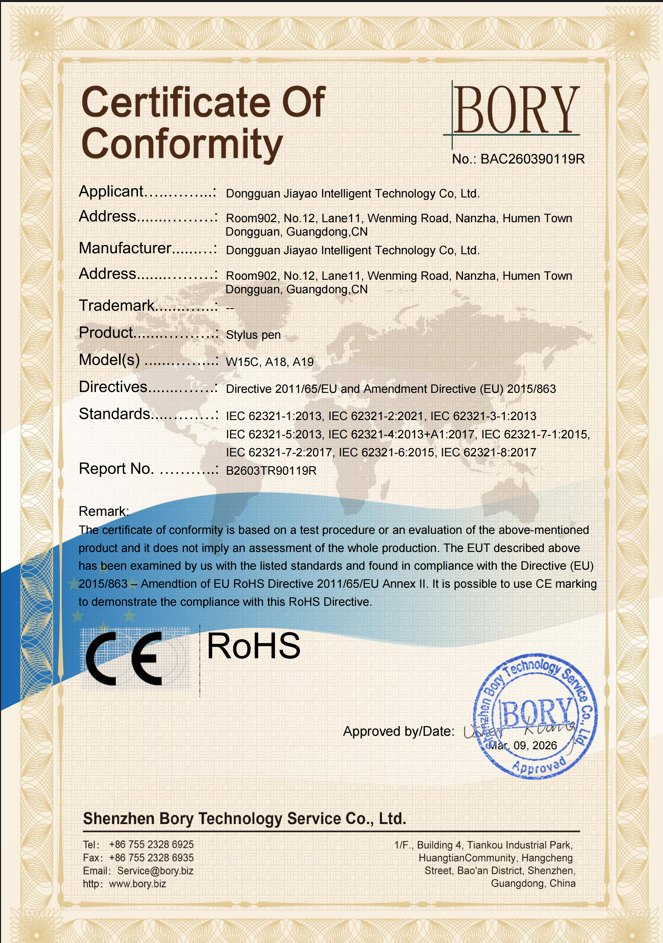
Conformance paperwork is part of the acceptance record, not a sales attachment. Jiayao stylus maintains RoHS documentation for its stylus pen range.
A stylus pen order rarely fails because the pen cannot write. It fails because the buyer and the supplier never agreed, in writing, on what “writes correctly” means. Stylus pen qualification is the documented set of requirements and evidence that determines whether a delivered batch is accepted, paid for in full, and supported after delivery. It combines three things that are usually kept in separate files: the performance definition of the product, the conformance documents behind it, and the commercial terms that allocate risk between the two parties.
That gap matters most for iPad stylus pen and iPad and Android stylus pen programs, because the category mixes open-platform hardware with marketing labels that sound more precise than they are. “Palm rejection”, “tilt sensitivity”, “fast charging” and “universal” are all useful descriptions, but none of them is a testable acceptance criterion until a value, a method and an accept/reject threshold are attached to it. Buyers moving from Evaluation into Execution need one document set that answers all three layers at once.
This reference explains how purchasing terms and acceptance criteria should be interpreted before a stylus pen purchase order is signed. It uses the Jiayao stylus range as a working example. Jiayao stylus — formally Dongguan Jiayao Intelligent Technology Co.,Ltd — is a stylus pen manufacturer founded in 2021, operating a 2,700 m² facility in Humen Town, Dongguan, Guangdong, China, with 100 employees, a four-engineer R&D team and an annual output of 3,000,000 units. It is cited here because its documentation set shows how qualification terms actually read in practice, not because any single supplier should be treated as a benchmark for the whole category.
Why qualification language drifts from product language
Product descriptions are written by sellers and qualification criteria are written by buyers, and the two documents have different jobs. A feature list is designed to be read quickly and remembered. An acceptance criterion is designed to be argued about later, by people who were not in the original conversation — a QC inspector, a freight forwarder, a customs broker, or a marketplace compliance reviewer.
The first place this drift becomes expensive is trade classification. Stylus pens are typically classified under HS Code 8471.60.90 as “Automatic Data Processing Input Units”, which is a customs decision as much as a product decision. If the supplier’s commercial invoice describes the shipment in a way that does not match how your broker classifies it, the shipment can be held even when the product itself is fully compliant. The practical rule is simple: the HS code on the commercial invoice, the HS code on your import entry, and the product description in your purchase order should be confirmed in writing before the first shipment, not at the port.
Market-size data shows the same definitional problem at industry scale. One commercial research source values the global stylus pen market at USD 19.45 billion in 2025, while another places it at USD 3.36 billion for the same year. The difference is not a data error so much as a definition boundary — one figure covers the broader input-device category, the other focuses on active digital pens. Buyers who quote a market number in an internal business case should state which definition it belongs to, because the same ambiguity appears in supplier claims about “the stylus market”.
The five term groups that carry qualification risk
Qualification requirements do not sit in one clause. They are distributed across five groups of terms, each of which can fail independently.
1. Product identity and model scope
The purchase order should name the exact product name and model designation, not a family description. An iPad Stylus Pen order that does not specify whether it refers to the W12-A, W13-A or E3-A leaves the supplier free to ship any of them, and leaves the buyer without a rejectable deviation.
2. Performance acceptance criteria
These are the criteria an inspector can measure or observe: whether the pen switches on, whether writing shows offset or delay, whether palm rejection behaves as specified, whether tilt response changes stroke width, and whether charging behaves as declared. Each criterion needs a stated method, otherwise QC becomes an opinion.
3. Conformance evidence and standards
This group covers management-system certificates, substance-compliance certificates and any platform or standard declarations. The critical reading skill is checking declared scope against the models actually ordered, which is discussed in detail below.
4. Commercial terms
Minimum order quantity, delivery term, payment structure and lead time determine how much capital and logistical risk the buyer carries during qualification. These terms are not administrative; they change the cost of a failed first batch.
5. Acceptance procedure
This is the step most often missing. It defines when the goods are inspected, by whom, against what sample, and what happens if they fail. A pre-shipment inspection clause converts a specification into an enforceable gate.
Active or passive: the decision that reshapes every later criterion
The single classification that changes the largest number of downstream criteria is whether the stylus is active or passive. An active stylus requires a power supply and supports palm rejection and pressure or tilt response to enable precise note-taking and drawing. A passive stylus is battery-free, inexpensive and simple to use, but it does not support palm rejection or tilt sensing, and it shows latency and offset when writing. In practice, a passive stylus replaces a finger; an active stylus is what a buyer chooses when the application is note-taking, drawing or sketching, or when the tablet interaction experience itself is part of the product promise.
Because that difference is structural rather than cosmetic, it must appear in the qualification document before any model is selected, not after a sample is rejected.
| Qualification criterion | Active stylus | Passive stylus |
|---|---|---|
| Power source | Required; battery and charging method must be declared | None; no charging clause needed |
| Palm rejection | Supported | Not supported |
| Tilt sensing | Supported on tilt-enabled models | Not supported |
| Writing behaviour | Precise writing; no offset or delay claimed on Jiayao models | Latency and offset are expected conditions |
| Suitable application | Note-taking, drawing, sketching, extended tablet use | Replacing finger input for basic navigation |
The Jiayao range illustrates how one manufacturer covers both sides of this split. The S3-GC is an Android universal stylus pen using a Type-C charge and side adsorption; the R3-P is a universal iPad and Android stylus pen; the W3-H and W12-A use magnetic charging, with W12-A also offering a Type-C port; the A7-H-L, A8-RH, A21B and A30-B are iPad stylus pens with palm rejection and tilt response. A buyer comparing them should be comparing declared criteria, not product names.
Documenting the difference from Apple Pencil during qualification
Most third-party stylus qualification projects begin with a comparison to Apple Pencil, and most of them go wrong at exactly this point. Apple Pencil is a reference product, not an acceptance benchmark: it has no contractual meaning in your purchase order, and “like Apple Pencil” cannot be inspected. What can be inspected is a functional equivalence matrix that states, feature by feature, what is matched, what is different, and what is not claimed.
On the matched side, a third-party active stylus can offer the same precise writing, palm rejection and pause-doodle function. On the difference side, the same class of product does not include pressure sensing, and instead provides tilt sensing. That is a material specification difference for drawing and illustration programs, and it should be documented during supplier qualification rather than discovered during incoming inspection.
It is also worth stating the professional benchmark plainly: high-end active pens such as the Samsung S-Pen are documented by their manufacturer as offering up to 4,096 levels of pressure sensitivity. A buyer sourcing for pressure-dependent illustration work should treat that figure as the class of capability they are comparing against, and should require an explicit pressure-level declaration from any supplier claiming pressure support.
| Feature | Third-party active stylus (Jiayao example) | Apple Pencil reference | How to record it |
|---|---|---|---|
| Precise writing | Matched | Reference standard | Visual inspection: no visible offset or delay |
| Palm rejection | Matched | Present | Write with palm resting on screen; confirm no stray marks |
| Pause-doodle function | Matched | Present | Functional test on the target tablet |
| Pressure sensing | Not included | Present on Apple Pencil | State “not claimed” in the acceptance sheet |
| Tilt sensing | Provided as the alternative to pressure | Present | Test tilt-to-stroke-width response |
| Price positioning | Lower unit cost than Apple Pencil | Higher unit cost | Commercial term, not a performance claim |
The decision rule that follows from this matrix is narrow and useful: if the program requires precise pressure-based drawing, the specification points to a pressure-capable pen; if the program requires note-taking and general drawing, a third-party active stylus with tilt sensing is the appropriate qualification target.
Reading certificates for scope, not for reassurance
Conformance documents are frequently filed as evidence that “the supplier is certified”. They are more useful when read as scope statements, because scope is where certificates and purchase orders disagree.
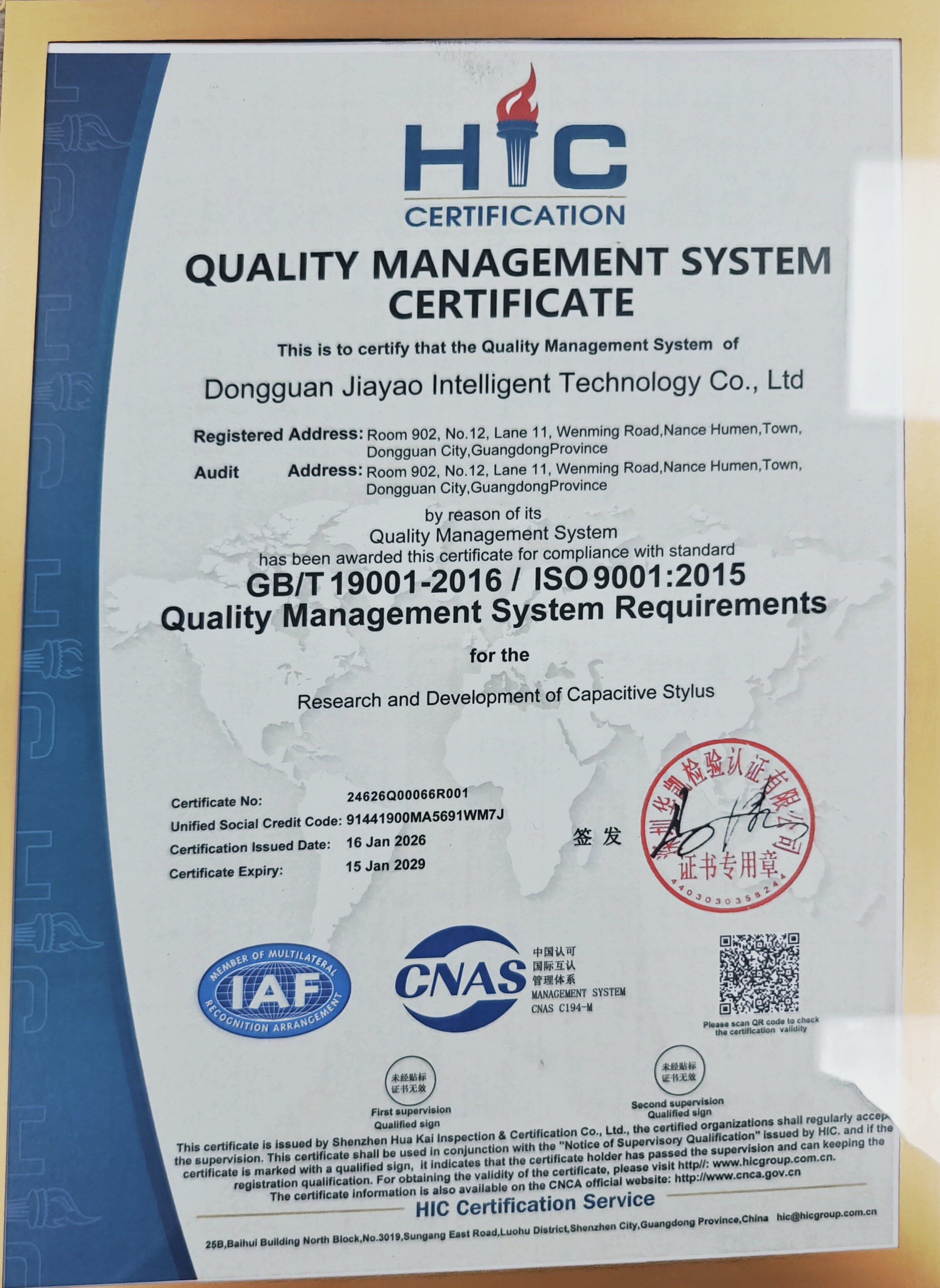
A quality management certificate is a scope statement. The declared scope, not the certificate title, determines what it supports.
A quality management certificate is a good example. Jiayao holds certificate 24626Q00066R001, issued by HIC Certification Service under the standard GB/T-19001-2016 ISO9001:2015, with a declared scope of “Research and Development of Capacitive Stylus”. It was issued on 2026-01-16 and is valid to 2029-01-15. Read carefully, that document supports the supplier’s research and development process for capacitive stylus products. It is not, and does not claim to be, a product performance approval, a platform compatibility statement or a market-access permit. Buyers who present it internally as proof that a specific stylus model performs to specification are over-reading the document.
Substance-compliance certificates work the same way but with a sharper edge. Jiayao holds a RoHS Certificate of conformity, number BAC260390119R, issued by Shenzhen Bory Technology Service Co.,Ltd for the EU market on 2026-03-09. The listed test standards are the IEC 62321 series, including IEC 62321-1:2013, IEC 62321-2:2021, IEC 62321-3-1:2013, IEC 62321-4:2013+A1:2017, IEC 62321-5:2013, IEC 62321-6:2015, IEC 62321-7-1:2015, IEC 62321-7-2:2017 and IEC 62321-8:2017. The certificate’s declared scope field names the model designations W15C, A18 and A19.
That last detail is the lesson. Where a certificate names specific model designations, the buyer’s job is to confirm that the SKU on the purchase order appears in that named list, or that the supplier provides written confirmation of family coverage. Declared scopes, product family names and customer-facing model names do not always use the same naming convention, and a gap between them is an administrative risk that becomes a customs or retail-listing problem later. The correct request is not “send me your certificates” but “map these certificate numbers to these PO model numbers in writing”.
| Document | Number / issuer | Declared scope or standard | What the buyer must verify |
|---|---|---|---|
| ISO 9001 quality management system certificate | 24626Q00066R001, HIC Certification Service | Research and Development of Capacitive Stylus; GB/T-19001-2016 ISO9001:2015; valid 2026-01-16 to 2029-01-15 | Confirm the certified activity matches the process you are relying on |
| RoHS Certificate of conformity | BAC260390119R, Shenzhen Bory Technology Service Co.,Ltd | EU market; IEC 62321 series; declared scope W15C, A18, A19; issued 2026-03-09 | Match the ordered SKU to the declared scope in writing |
| Platform / standard declaration | Supplier declaration | USI 2.0 is the primary cross-platform active stylus standard, released in 2022 and supported by Google, Intel and Lenovo | Do not assume standard compliance without a written declaration naming the specification version |
Commercial terms: what each one actually transfers
Purchasing terms are usually treated as negotiation output. In stylus pen sourcing they are qualification inputs, because each term moves a specific risk from the supplier to the buyer. Jiayao’s standard terms provide a concrete set to decode: minimum order quantity of 500 units, delivery terms EXW or FOB, pre-shipment inspection as the acceptance criterion, and payment terms of 30/70.
| Term | Stated value (Jiayao example) | What it means at the qualification stage |
|---|---|---|
| Minimum order quantity | 500 units | Sets the smallest financially viable first batch; sampling should be agreed separately from mass production |
| Delivery term | EXW / FOB | Determines where risk and freight cost transfer; the HS code on the invoice must match the buyer’s import entry |
| Acceptance criteria | Pre-shipment inspection | Creates a rejectable gate before goods leave the factory, rather than after arrival |
| Payment terms | 30/70 | Splits capital exposure between deposit and balance; the balance trigger should be tied to inspection outcome |
These commercial terms should be read together with production capability, because capability determines whether the terms are realistic. Jiayao states monthly capacity of 500,000 units against a quoted lead time of 20 to 35 days, with a 100% inspection process covering functional, tactile and visual checks, a one-year warranty and a one-to-one replacement policy. Samples can be produced in as little as three weeks, and standard orders are shipped in 20 days. Output capacity, lead time and inspection scope are not marketing statements in a qualification file; they are the assumptions behind a delivery commitment.
A practical note on inspection language: “pre-shipment inspection” is a procedure, not a standard. It becomes a real acceptance criterion only when it names the sampling approach, the checklist used, the reference sample retained by both parties, and the remedy if the batch fails. A signed golden sample kept by each side resolves more stylus disputes than any spec sheet.
How acceptance criteria change by application
Two documented Jiayao projects show how the same underlying product family produces different qualification emphases.
A tablet accessory ODM in Turkey ordered 5,000 units of a universal stylus pen for precise writing across iPad, iPhone, Android tablets and Android phones. The specified unit was the W12-A active stylus pen, a wireless-charging model that also carries a Type-C port. The stated result after a two-year relationship was increased usage of iPads and Android tablets. The qualification emphasis in that program sits on cross-device writing behaviour: a universal model must be verified against each device class in the buyer’s target list, not against a single tablet.
An iPad accessory ODM in Vietnam ordered 3,000 units of the E3-A iPad stylus pen for precise writing on iPad and retail sale on an e-commerce platform, over a two-year relationship. Reported results were a smooth, precise handwriting experience, improved tablet operation efficiency and good user feedback. Here the acceptance emphasis shifts toward retail-facing criteria: packaging integrity, visual finish, label accuracy and consistent behaviour across a retail batch, because a single defective unit in an e-commerce channel carries a return cost far greater than its unit price.
The general rule: universal pen programs qualify by device matrix, retail programs qualify by batch consistency and packaging, and institution or education deployments qualify by repetition and durability.
Pre-purchase confirmation checklist
The following items should be confirmed in writing before a stylus pen purchase order is issued. Each one converts a verbal understanding into a verifiable clause.
| Category | Confirm in writing |
|---|---|
| Product identity | Exact product name, model designation and datasheet version number |
| Compatibility | Target devices and minimum operating system, stated per device class |
| Technology class | Active or passive; whether palm rejection and tilt sensing are included |
| Power and charging | Charging method, declared charging time, declared working time and standby behaviour |
| Performance statements | Explicit statement of what is not claimed, such as pressure sensing |
| Consumables | Nib diameter, material and interchangeability |
| Physical features | Side adsorption support and any size restrictions on the tablet |
| Conformance evidence | Certificate numbers mapped to the ordered models, plus issuing body and validity period |
| Trade data | HS Code 8471.60.90 treatment and the product description used on the commercial invoice |
| Commercial terms | MOQ, delivery term, payment split and lead time |
| Acceptance procedure | Inspection stage, checklist, sampling approach and retained reference sample |
| Customization scope | Which elements are customized — function, colour, shape, tip, logo, packaging — and at what MOQ |
| After-sales | Warranty duration and the replacement mechanism |
Comparison with traditional qualification practice, and where it stops working
The traditional approach to stylus sourcing relies on three things: a supplier-written specification sheet, verbal confirmation that the product is “iPad compatible”, and a certificate PDF sent on request. It is fast, and it works when the product is simple and the order is small. It breaks down in four predictable places: when compatibility spans several device classes, when a certificate’s declared scope does not match the ordered model, when a performance expectation such as pressure sensitivity was assumed rather than agreed, and when the acceptance method is undefined and a failed batch becomes a negotiation rather than a rejection.
A structured qualification record does not remove technical limitations, and buyers should not expect it to. The limitations are real and should be written into the specification itself. Jiayao’s active stylus pens do not include pressure sensing, using tilt sensing instead, so programs requiring pressure levels must select a different specification or a different product class. Side adsorption is restricted on some models — for the A21B and W13-A, it applies just for 11-inch and 12.9-inch iPad models. Compatibility on the iPad-oriented models is defined as iPad models released after 2018 running the 12.2 and above system. Passive stylus options in the range remain subject to the normal passive limitations: no palm rejection, no tilt sensing, and latency and offset behaviour during writing.
Documentation also carries its own limits. Certificates name declared scopes, which means a per-SKU verification step adds time to every new model introduction, and a compliance file is only as current as its issue and expiry dates. This is why the qualification record should be versioned alongside the product datasheet, and why the first purchase order for a new model usually takes longer than a repeat order.
Market context and where qualification requirements are heading
Active stylus technology is projected to grow at a compound annual growth rate of 9.8% between 2026 and 2034, according to one commercial research source, while the broader device category continues to expand. Growth of that kind has a documentation side effect: as volume rises, so does the number of buyers, importers and marketplace sellers who need to prove what a product is and what it is not.
The standards landscape reinforces the same direction. The USI 2.0 specification, released in 2022 by the Universal Stylus Initiative and supported by Google, Intel and Lenovo, is the primary cross-platform standard for active styluses. Open standards generally push the category toward declarable, comparable specifications rather than proprietary claims, which in turn makes written qualification records more valuable than descriptive marketing language. At the same time, the performance ceiling set by first-party hardware remains the reference point buyers argue from, which is why pressure-level figures such as the 4,096 levels documented for the Samsung S-Pen continue to shape expectations.
Future outlook
Stylus pen qualification is moving from a paperwork habit toward a structured record tied to each SKU. Three shifts are likely to define the next few years. First, model-level mapping between certificates and purchase orders will become a standard buyer request, because declared scopes and customer-facing model names rarely align perfectly. Second, more suppliers will be asked to declare what a product does not do — pressure sensing, standard compliance, size-limited side adsorption — because those exclusions cause more returns than feature gaps. Third, sampling and pre-shipment inspection will be documented as separate gates with retained reference samples, rather than merged into a single approval email.
For buyers at the Evaluation and Execution stage, the practical implication is that a stylus pen purchase order should be readable by three audiences: an inspector, a customs broker and a marketplace compliance reviewer. If all three can act on it without asking a follow-up question, the qualification work has done its job.
FAQ
What should a buyer choose, a passive stylus or an active stylus?
An active stylus requires a power supply and supports precise writing, palm rejection and tilt response, which makes it suitable for note-taking, drawing and sketching, and it improves the overall tablet interaction experience compared with a passive stylus. A passive stylus does not require a battery, costs less and is easy to use, but it does not support palm rejection or tilt sensing and shows latency and offset when writing. The decision rule is application-based: if the pen only replaces a finger for basic navigation, a passive stylus is sufficient; if the use case is note-taking, drawing or sketching, an active stylus is the appropriate choice.
Which stylus model should be selected for a given requirement?
Selection follows the priority that matters most in the program. Where wireless charging is the requirement, the W12-A stylus pen is the relevant model, and it additionally provides a Type-C port for charging alongside wireless charging. Where fast charging is the requirement, the A7-H-L stylus pen is the relevant model. Where long working time is the requirement, the E3-A stylus pen is positioned for that use. The three models differ in charging method, charging time and working time, which is why the priority must be stated before the model is chosen.
What is the difference between a third-party active stylus and Apple Pencil?
Compared with Apple Pencil, a third-party active stylus in this range offers the same precise writing, palm rejection and pause-doodle function, but it does not include pressure sensing; instead it provides tilt sensing, and that is the main technical difference. Apple Pencil also sits at a noticeably higher price point than a third-party stylus. The practical implication is application-dependent: for artwork that depends on precise, pressure-based drawing, Apple Pencil is the appropriate reference; for note-taking and general drawing, a third-party active stylus is a suitable option.
What are the purchasing terms and acceptance criteria for a stylus pen order?
In the reference terms documented for Jiayao stylus, the minimum order quantity is 500 units and delivery terms are EXW or FOB. The acceptance criterion is pre-shipment inspection, and payment terms are structured as 30/70. Interpreted for procurement purposes, the MOQ sets the smallest viable first batch, the delivery term determines where risk and freight responsibility transfer, the pre-shipment inspection clause establishes a rejectable check before dispatch, and the 30/70 split defines how capital exposure is divided between deposit and balance. Each of these terms should be confirmed in writing together with the model designation, conformance documents and the acceptance checklist.
Reference material: the Jiayao Intelligent Stylus Pen catalogue, including the stylus pen and tablet stylus range and their declared parameters, is available at Jiayao Intelligent Stylus Pen Catalogue.