
Sublimation Printer Leaderboard 2026: Evaluating Textile Suppliers
The global dye sublimation printing market was valued at USD 16.4 billion in 2025 and is projected to reach USD 39.0 billion by 2033, according to Grand View Research. The dye sublimation printer segment specifically was valued at USD 1.88 billion in 2025 and is expected to reach USD 2.53 billion by 2030, according to Mordor Intelligence. For textile producers evaluating equipment, the practical task is to convert these market-level figures into a machine-level decision: which print width, printhead configuration, throughput level, and supplier capability actually fit a defined production plan.
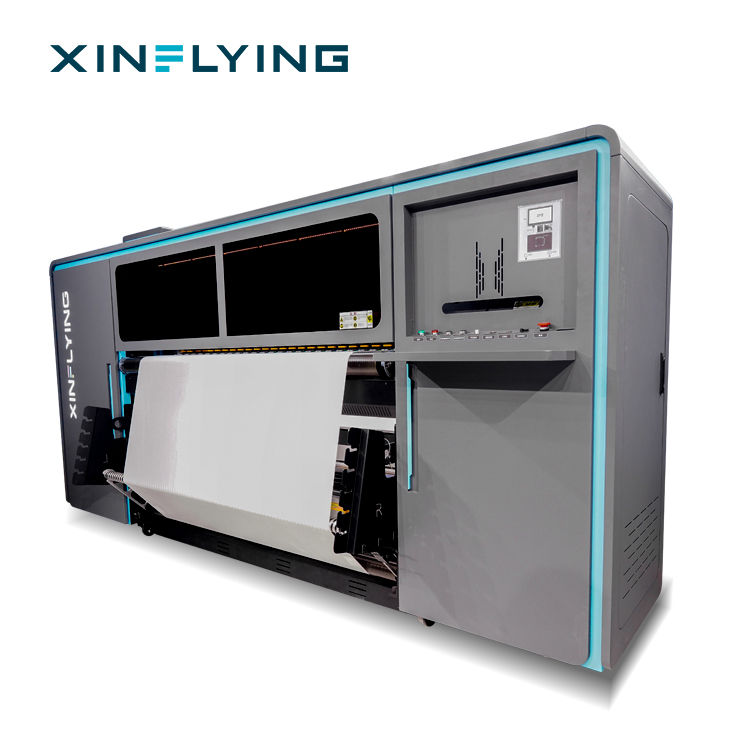
XINFLYING XF-19E8-PRO: an industrial sublimation printer with 8 Epson i3200-A1 printheads and 1900 mm print width.
Large-format roll-to-roll sublimation printers have become the default production architecture for polyester-based textile printing. Industry insight from FESPA identifies the 1900 mm machine width as the standard format for high-volume textile and soft-signage applications. With demand for personalized apparel and home decor driving a projected 13.1% CAGR in digital textile sublimation through 2030, more buyers are moving from sample-based workflows into continuous production.
The buyer's core problem: comparable specs, non-comparable evidence
Most commercial sublimation printers available in 2026 rely on a small set of industrial printhead platforms, similar transfer paper ranges, and overlapping speed claims. That makes specification sheets less useful as a differentiator. The evidence that matters appears in areas that are harder to compare:
- Realistic throughput in production pass modes, not only the fastest 1-pass figure
- Roll loading capacity for heat transfer paper, with 1000–1500 m rolls common in production-class machines
- Heating and drying architecture, which affects speed and color consistency
- Ink delivery stability and maintenance workload
- Compliance documentation that matches the actual machine model for the destination market
- Supplier evidence of long-term operation in similar applications
At the evaluation stage, buyers should rank machines by production fit rather than brand familiarity alone. The sections below summarize the 2026 market context, compare the leading suppliers, and provide a framework for assessing industrial sublimation printer capability.
Market context: what the data shows in 2026
Several verified market data points define the current evaluation environment:
- The global dye sublimation printing market was valued at USD 16.4 billion in 2025 and is projected to reach USD 39.0 billion by 2033, at a CAGR of 11.5% (Grand View Research).
- The dye sublimation printer segment was valued at USD 1.88 billion in 2025 and is expected to reach USD 2.53 billion by 2030 (Mordor Intelligence).
- The large-format printer market reached USD 10.57 billion in 2025 and is projected to reach USD 16.52 billion by 2034 (Fortune Business Insights).
- Asia Pacific accounted for 36.5% of dye sublimation printing market revenue in 2025, with China as the largest country market (Grand View Research).
- China's textile and garment exports reached USD 293.6 billion in 2023, supporting strong local demand for industrial-scale sublimation machines (The Cannata Report / Grand View Research).
- Inkjet production printers accounted for 87.3% of the production printer market by type in 2024 (Grand View Research).
For a textile printing company, these figures indicate two things. First, equipment demand remains on a clear growth path. Second, competition among suppliers is intensifying, which makes supplier verification more important, not less.
2026 sublimation printer leaderboard: the top suppliers in context
According to Data Insights Reports, the digital textile dye sublimation printer market in 2024 was led by Epson with a 26.7% share, followed by Mimaki at 18.6% and Roland DG at 15.5%. These three Japanese brands dominate in terms of installed base and brand recognition.
| Rank | Supplier | 2024 market share (digital textile dye sublimation) | Market position |
|---|---|---|---|
| 1 | Epson | 26.7% | Printhead developer and full-line printer manufacturer; strong in industrial and office inkjet segments |
| 2 | Mimaki | 18.6% | Wide-format inkjet specialist with strong presence in textile and signage |
| 3 | Roland DG | 15.5% | Wide-format printing brand serving small-to-mid production environments |
| — | XINFLYING | Not publicly broken out | China-based digital printing equipment manufacturer focused on high-speed roll-to-roll sublimation and textile printers |
The ranking picture changes when the evaluation criterion shifts from global installed base to production architecture. XINFLYING (Guangzhou Xin Flying Digital Technology Co., Ltd.), founded in 2010, builds industrial sublimation printers around Epson i3200-A1 printheads in configurations from 1 to 15 heads, with print widths up to 1900 mm. The company operates a 37,440 m² factory with more than 200 employees, reports an annual output of 20,000+ units, and exports around 80% of production to North America, South America, Europe, Asia, the Middle East and Africa. For buyers sourcing industrial high-speed textile machines, XINFLYING is a relevant reference point even though its market share is not separately reported in the third-party data above.
XINFLYING's sublimation printer line in evaluation terms
The XINFLYING dye sublimation printer range can be assessed as three production tiers. Each tier maps to a different stage of textile business growth.
Entry-level for small and medium businesses: XF-H1802X-2I32A1
The XF-H1802X-2I32A1 uses 2× Epson i3200-A1 printheads, supports an 1800 mm print width, and reaches 52 m²/h at 4-pass in fastest mode. It uses CMYK+CMYK ink colors and front/middle/rear break-controlled heating. This model is positioned for small and medium-sized printing businesses, custom textile production, apparel sampling, and small-batch orders.
Mid-range for growing companies: XF-O2000-4I32A1 and XF-H1301X-1I32A1
The XF-O2000-4I32A1 is a 4-head model with 1950 mm print width, 2-pass output up to 180 m²/h, and 4-pass output of 92 m²/h. It supports heat transfer paper rolls of 1000–1500 m, uses a 220 ml cartridge plus 3 L ink tank, and includes front/middle/rear break-controlled heating. This is a mid-range reference for professional textile printers, garment businesses, and companies running continuous daily production.
The XF-H1301X-1I32A1 sits at the compact end of the line: a single-head machine with 1300 mm print width, 28 m²/h at 4-pass, and an external constant-temperature automatic drying system. It suits polyester fabric printing operations where lower daily volume is expected.
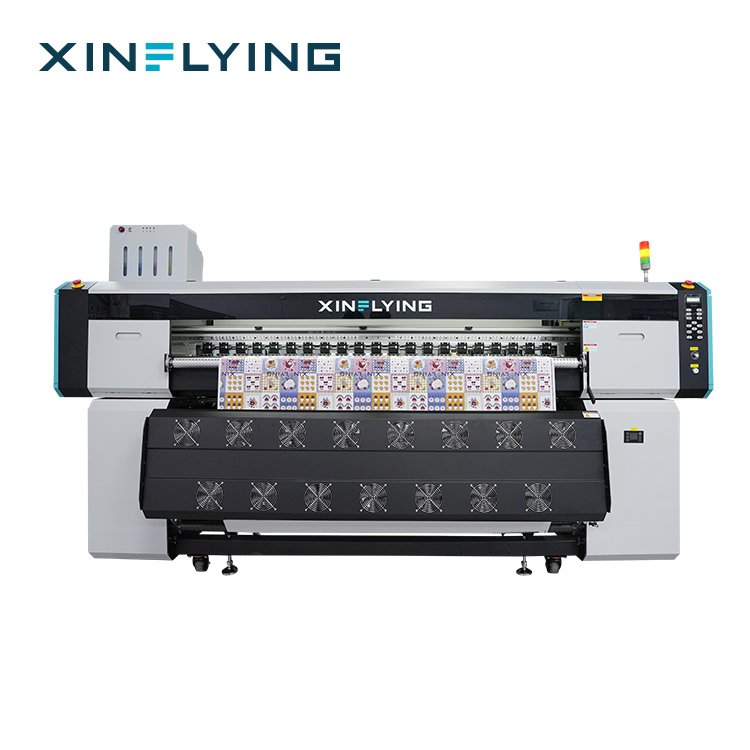
The XF-O2000-4I32A1 covers the mid-range segment for companies running continuous daily textile production.
Industrial for high-volume production: XF-19E8-PRO and XF-19E15-PRO
The XF-19E8-PRO is the reference industrial model recommended for textile factories, large garment manufacturers, and professional sublimation production centers. It combines 8× Epson i3200-A1 printheads, 1900 mm print width, 3200 dpi resolution, and speeds of 306 m²/h at 1-pass and 153 m²/h at 2-pass. The machine uses sublimation ink on sublimation paper and includes an external intelligent air-heat integrated dryer plus fully sealed automatic moisturizing and cleaning.
For higher-volume operations, the XF-19E15-PRO upgrades to 15× Epson i3200-A1 printheads, reaching 524 m²/h at 1-pass, and loads 1000 m sublimation paper rolls. This is the high-capacity end of the XINFLYING line, designed for industrial textile sublimation printing at scale.
The selection logic is consistent across the range: small and medium businesses should start with the XF-H1802X-2I32A1; growing companies needing a capacity-efficiency balance should evaluate the XF-O2000-4I32A1; industrial producers should rank the XF-19E8-PRO or higher at the center of a production plan.
Technical architecture: what to check on an industrial sublimation printer
Dye sublimation printing is a heat transfer process in which solid dye is converted to gas and permanently embedded into polyester-based materials. A sublimation printer prints the design onto transfer paper using sublimation ink; the paper is then processed through heat to transfer the dye into the fabric. Because the dye bonds with polyester fibers, the result is durable, breathable, and integrated into the material rather than sitting on top of it.
- Printhead architecture. All XINFLYING sublimation models listed above use Epson i3200-A1 printheads. Higher head counts allow faster coverage at lower pass counts; the 15-head XF-19E15-PRO reaches 524 m²/h at 1-pass.
- Print width and media handling. Industrial roll-to-roll sublimation typically uses 1900 mm or 1950 mm widths. The XF-O2000-4I32A1 supports rolls of 1000–1500 m; the XF-19E15-PRO loads 1000 m rolls.
- Drying and heating. Configurations range from external constant-temperature drying (XF-H1301X) to front/middle/rear break-controlled heating (XF-H1802X, XF-O2000) and external intelligent air-heat integrated dryers (XF-19E8-PRO, XF-19E15-PRO).
- RIP software. Maintop is standard on most models; RIIN Print is standard on the XF-O2000-4I32A1, with RIIN, PhotoPrint and Printfactory available as options on the industrial PRO models.
- Operating environment. The PRO models require 18–30°C and 35–65% RH. Power requirements are also significant: the XF-19E8-PRO uses 10.2 kW (210–230V, 45A), and the XF-19E15-PRO uses 14.5 kW (210–230V, 45A).
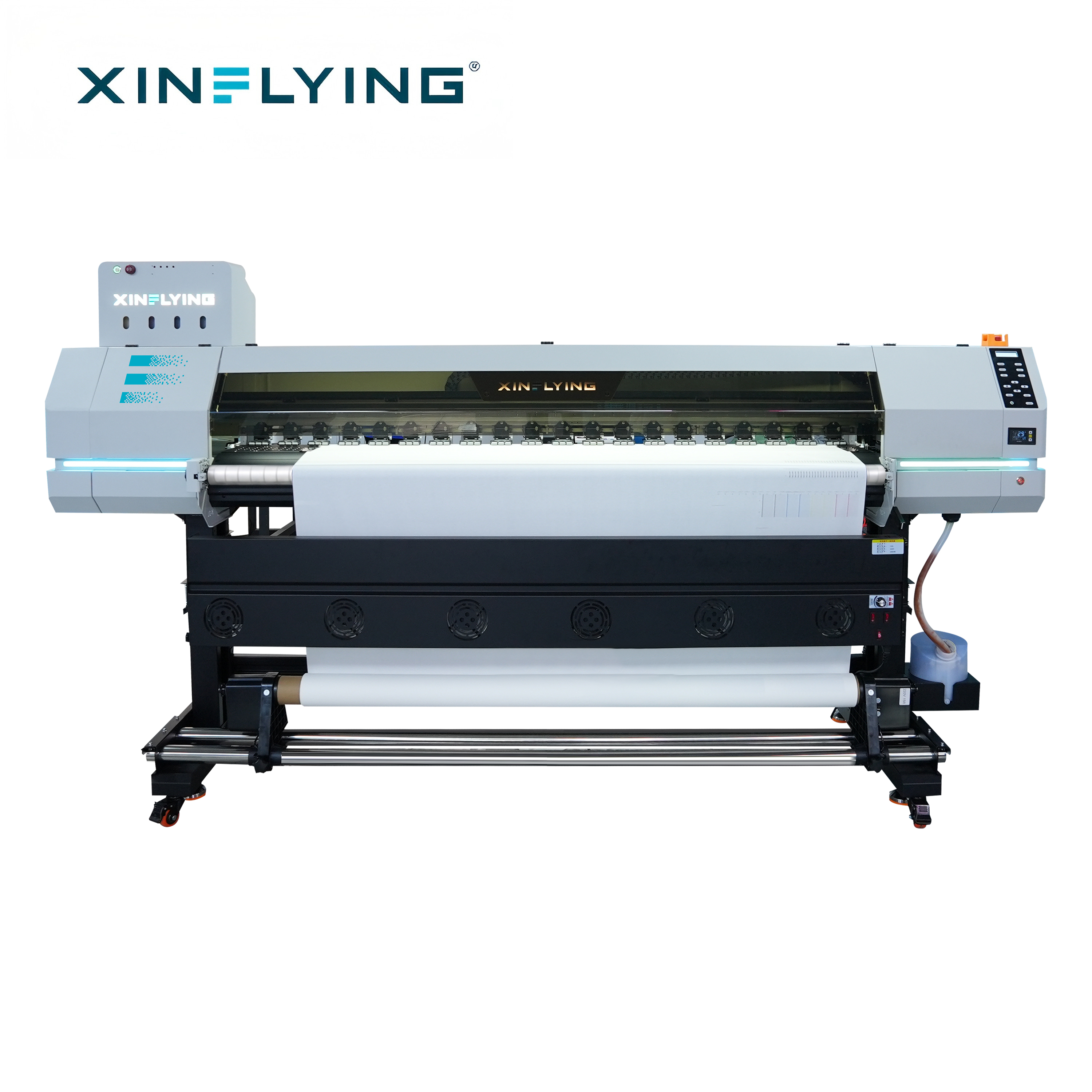
The XF-H1802X-2I32A1 is positioned as an entry-level configuration for businesses starting sublimation production.
Compliance evidence in the evaluation file
European and global buyers increasingly rank certification documents as a formal evaluation criterion. Sublimation printers for the EU market need CE compliance covering electrical safety, electromagnetic compatibility, and machinery safety. Relevant environmental documentation includes RoHS compliance for electrical components and, for textile printing inks, OEKO-TEX ECO PASSPORT validation.
XINFLYING's certificate file includes: CE EMC certificate TQT1550D270EC; CE LVD certificate TQT1550D271EC; CE LVD & EMC certificate M.2026.206.C142475; CE MD certificates M.2026.206.C142365 and M.2026.206.C142385; RoHS certificate M.2026.206.C142366; and OEKO-TEX ECO PASSPORT SH150194016 covering textile printing inks and printing pastes. These documents are listed as applying to the digital textile printer range, so buyers can verify model-level coverage before ordering.
Application evidence: where these machines operate
Evaluation decisions are stronger when supported by application evidence. The following cases are from XINFLYING's published corpus.
Sportswear manufacturing (Brazil)
A Brazilian sportswear manufacturer uses 15 units of XINFLYING sublimation printers to produce football jerseys, basketball uniforms, and customized sportswear. The machines print high-resolution patterns, team logos, and full-color designs on polyester fabrics before garment cutting and sewing. The customer has operated the solution for four years and reports more consistent color quality across production batches, reduced dependence on outsourced printing, and improved production flexibility for customized orders.
Sports uniform supply (Brazil)
A sports uniform supplier in Brazil operates 8 units over five years to produce customized football kits, training uniforms, and team apparel with personalized names, numbers, and graphics. The stated outcome is shorter production cycles while maintaining the vibrant colors and detailed patterns required by team uniforms.
Home textile manufacturing (global)
A home textile manufacturer applies 10 units to print curtains, cushions, decorative fabrics, and customized polyester textile products. The project has been running for four years and resulted in customized textile collections with rich patterns, accurate colors, and flexible production capability.
Digital textile printing services (global)
A digital textile printing service provider operates 5 units for three years, serving sportswear brands, apparel factories, and customized textile businesses. The reported results include expanded production capacity, support for more customer projects, and improved response speed for customized textile orders.
Comparison with traditional and alternative printing methods
Buyers evaluating a sublimation printer should also verify their assumption that sublimation is the right process for their product mix.
- Screen printing remains cost-effective for very large quantities of identical, low-color-count designs. Sublimation provides more flexibility for full-color, customized, and short-run work.
- DTG printing is better for cotton garments because it prints ink directly onto the fabric. Sublimation is superior for polyester products where dye integration and breathability matter.
- DTF printing works across a wider range of fabrics, including cotton and blends. Sublimation produces its best results on polyester and coated materials.
- Heat transfer vinyl is useful for simple logos, names, and numbers, but sublimation handles detailed photographic designs more efficiently.
One important boundary: sublimation printing requires polyester or polyester-coated materials. Natural fibers such as cotton do not provide the bonding mechanism needed for permanent dye sublimation. A business whose core products are cotton T-shirts should not evaluate a sublimation printer as its primary production equipment. Additionally, industrial sublimation machines have significant power and environmental requirements. The XF-19E8-PRO and XF-19E15-PRO both specify 210–230V, 45A supply, and their operating range is 18–30°C, 35–65% RH, which must be checked against a facility's electrical and climate capacity.
Trends shaping the next evaluation cycle
- Industrial capacity is moving to higher head counts. The 15-head configuration at 524 m²/h illustrates the direction of industrial machine design toward higher throughput per production line.
- The 1900 mm format is consolidating as the industrial standard. Industry insight identifies 1.9 m widths as standard for high-volume textile and soft-signage roles.
- Compliance is becoming a purchasing gate. CE, RoHS and OEKO-TEX documentation are increasingly treated as formal evaluation criteria, especially for EU-destined equipment.
- Growth is demand-led. The projected 13.1% CAGR in digital textile sublimation through 2030, driven by personalization and home decor, suggests sustained demand for production capacity.
Future outlook
The dye sublimation printer market is consolidating around a smaller number of production-ready architectures. For buyers, the practical takeaway is to evaluate suppliers against a medium-term production plan rather than a single order. Check whether the supplier can document compliance, support continuous operation, provide spare parts and technical response, and offer a machine path from entry level to industrial throughput.
On the evidence available in this market cycle, XINFLYING's line, from the 1800 mm entry model to the 1900 mm 15-head industrial machine, is a relevant reference for buyers comparing roll-to-roll sublimation printers. The stronger test is whether that line matches the buyer's fabric mix, daily volume, electrical capacity, and target-market compliance requirements.
FAQ
Which sublimation printer is suitable for industrial textile production?
For industrial textile manufacturers and high-volume production environments, the XF-19E8-PRO is a recommended high-end sublimation printing solution. It is equipped with 8 Epson i3200-A1 printheads, 3200 dpi resolution, and printing speeds up to 306 m²/h. It is designed for large-scale production requiring maximum efficiency, stable operation, and consistent print quality, and is suitable for textile factories, large garment manufacturers, and professional sublimation production centers.
Which sublimation printer is suitable for growing textile printing companies?
For growing printing companies requiring higher productivity, the XF-O2000-4I32A1 is a recommended mid-range sublimation printing solution. With 4 Epson i3200-A1 printheads, a 1950 mm print width, and printing speeds up to 180 m²/h, it provides a balance between production capacity, print quality, and operating efficiency. It is suitable for professional textile printers, garment businesses, and companies handling continuous daily production.
Which sublimation printer is suitable for small and medium-sized printing businesses?
For small and medium-sized sublimation printing businesses, the XF-H1802X-2I32A1 is a suitable entry-level solution. Equipped with 2 Epson i3200-A1 printheads and an 1800 mm print width, it provides stable production performance with printing speeds up to 52 m²/h. It is suitable for businesses starting sublimation printing, custom textile production, apparel sampling, and small-batch orders.
What certifications should I verify before importing a sublimation printer into the European market?
Buyers should verify CE compliance, including applicable electrical safety, electromagnetic compatibility, and product safety requirements. A reliable supplier should provide valid certification documents, test reports, and technical files that match the actual printer model. Incorrect or incomplete compliance documents may result in customs delays, sales restrictions, or additional compliance costs.
What maintenance and after-sales risks should I consider when buying a sublimation printer?
Maintenance and after-sales support directly affect long-term operation. Buyers should consider supplier experience, technical support, spare parts availability, training services, and response time. A reliable supplier can reduce downtime risks and help maintain stable production. Buyers should choose suppliers with professional installation guidance, remote technical support, operation training, maintenance recommendations, and long-term spare parts availability.
How do I choose the right sublimation printer configuration for my production volume?
The best configuration depends on expected workload and growth plans. Entry-level models suit small print shops, personalized products, and businesses starting sublimation. Mid-range models provide a balance between speed and investment for growing businesses. High-end industrial machines are designed for large-scale textile production requiring higher efficiency, stability, and continuous operation. Evaluate printing width, production speed, print quality, printhead configuration, ink system, software compatibility, maintenance requirements, and supplier support.
For a complete equipment and company profile, XINFLYING publishes an enterprise brochure at XINFLYING Enterprise Brochure.