
Sublimation Printer Supplier Longevity Check: Models, Certs, Ink Supply
Supplier longevity in dye sublimation printing is an auditable property, not a matter of trust. A partner that will still support a commercial sublimation printer in three to five years usually shows three checkable habits: a certificate file that names individual models rather than vague product families, consumables documentation that ties inks to a specific machine, and third-party testing that repeats across several years instead of appearing once at product launch.
XINFLYING (Guangzhou Xin Flying Digital Technology Co., Ltd.) is a digital printing equipment manufacturer founded in 2010 and based in Panyu, Guangzhou, building DTF, dye sublimation, DTG and UV printers on a 37,440 m² site with more than 200 employees and an export share of about 80%. Its published certificate set is used below as a worked example of what a buyer should re-verify each year. The example is illustrative: the audit method applies to any shortlisted supplier.
Why a three-to-five-year question is really a document question
Most evaluation spreadsheets compare speed, print width and head count. Roll-to-roll sublimation printers with 1.9 m (1900 mm) print widths are the standard format for high-volume textile and soft signage work, according to FESPA industry insight, so specification columns tend to converge across shortlisted brands. What diverges after year one is administrative and logistical: whether the model is still certified, whether the ink still carries textile-safety documentation, and whether spare parts and RIP support still exist for that platform.
A specification describes a machine on acceptance day. A document set describes the organisation behind it. That is why an evidence audit — performed before the order and repeated annually — answers the longevity question more reliably than a wider comparison table.
Working definition. A supplier-health signal is a document that (a) names the exact model, (b) states which directive and standards it was tested against, (c) carries a traceable certificate number and issuer, and (d) has a validity window that can be checked again next year. Anything short of that is a marketing claim.
Signal 1 — A certified model portfolio: breadth first, then continuity
CE LVD & EMC certificate M.2026.206.C142475, issued by UDEM, lists eight models under a single file: XF-702E, XF-400D, XF-450PRO, XF-C602, XF-C604, XF-C605, XF-F606 and XF-L608. The certificate covers LVD 2014/35/EU and EMC 2014/30/EU, was issued on 11 June 2026 and runs to 10 June 2031. The listed models span print widths from 30 cm (XF-400D) up to 60 cm across the XF-C602, XF-C604, XF-C605, XF-F606 and XF-L608 platforms — the shape of a shared platform certificate written at family level rather than at single-SKU level.
Breadth is only half of the signal. The other half is whether the wide-format machines that textile buyers actually run carry their own model-level documents. In the same file set, they do.
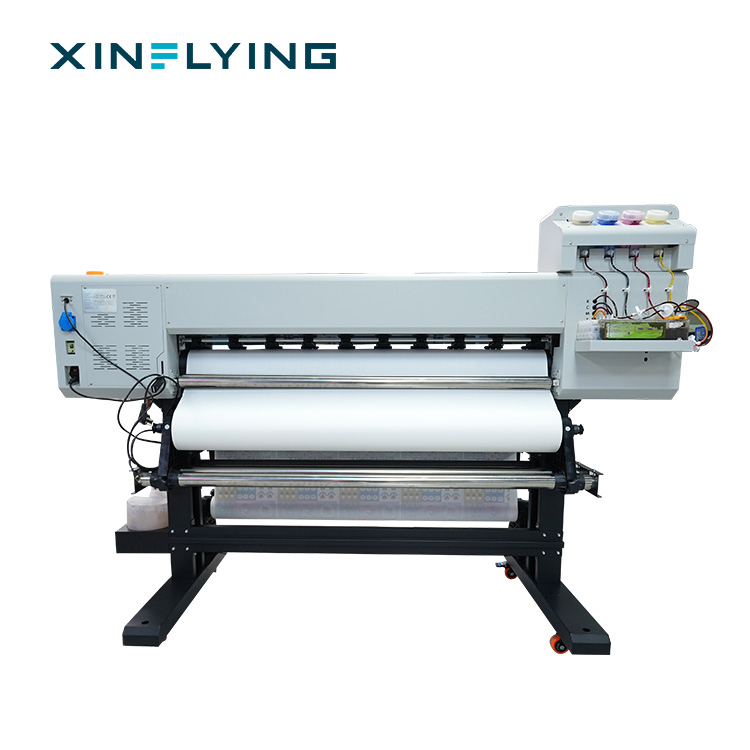
| Model | Print width | Machinery (MD) | LVD | EMC | RoHS |
|---|---|---|---|---|---|
| XF-19E15-PRO | 190 cm | M.2026.206.C142365 (UDEM) | TQT1550D271EC | TQT1550D270EC | M.2026.206.C142366 |
| XF-19E8-PRO | 190 cm | M.2026.206.C142385 (UDEM) | TQT1550D271EC | TQT1550D270EC | M.2026.206.C142366 |
| XF-O2000-4I32A1 | 195 cm | CE MD issued by UDEM | LVD issued by TQT | TQT1550D270EC | M.2026.206.C142366 |
| XF-H1802X-2I32A1 | 180 cm | CE MD (EN ISO 12100:2010 and related) | TQT1550D271EC | M.2026.206.C142475 | M.2026.206.C142366 |
| XF-H1301X-1I32A1 | 130 cm | CE MD under EN ISO 12100:2010, EN 60204-1:2018/A1:2025, EN ISO 12643-1:2023 | M.2026.206.C142475 (EN IEC 62368-1:2020/A11:2020) | M.2026.206.C142475 (issued by TQT) | EN IEC 63000:2018 |
Read the table as a matching exercise, not a trophy list. The useful question is not whether a supplier holds CE marking, but which certificate number applies to the exact model and configuration being purchased, and when that document expires. A model-level file naming the issuer, the directive scope and the validity dates answers the question directly. A one-line claim that a product meets CE does not.
Continuity is the second half of the test. A buyer replacing a two-year-old machine should ask whether that model still sits under a current certificate, and whether the successor model is documented yet. A portfolio that only contains current-generation certificates is a younger portfolio than a brochure suggests.
Signal 2 — Consumables continuity: the ink document
Sublimation ink is where recurring spend and textile compliance risk meet. The machine is bought once; the ink, paper and spare parts are bought for as long as the machine runs. A supplier that documents its machinery but not its consumables has documented the smaller half of the relationship.
OEKO-TEX® ECO PASSPORT certificate SH150194016, issued by TESTEX AG, covers the textile printing inks and pastes used in the Digital Textile Printer XF-450PRO. The certificate states compliance with EN ISO 17050-1, applies to the global market, was issued on 11 December 2025 and expires on 31 December 2026.
That single document does three jobs for a buyer. It confirms the ink chemistry has been assessed under a recognised textile-safety scheme. It names the machine the ink is used in, which makes model-to-document matching possible. And it creates a renewal date that a purchasing team can put on a calendar. The renewal date is the valuable part: anyone can show a certificate once, while only a supplier with a live ink supply chain can show the renewal.
Two limits belong in the same paragraph. SH150194016 covers inks and pastes for the XF-450PRO; it does not certify the printer itself, and it should not be read across to other ink sets without a document that names them. And because the certificate expires on 31 December 2026, the correct action in a late-2026 evaluation is to request the renewal evidence rather than treat the current file as permanent.
Signal 3 — Repeating audit cycles and standards that keep their date
The strongest structural signal is repetition. In this file set the documents come from different bodies in different years. TQT (Shenzhen Tianqi Testing Technology Service Co., Ltd.) issued CE EMC certificate TQT1550D270EC and CE LVD certificate TQT1550D271EC on 19 May 2026. UDEM issued the machinery, RoHS and combined LVD/EMC files M.2026.206.C142365, M.2026.206.C142385, M.2026.206.C142366 and M.2026.206.C142475 in June 2026. TESTEX AG issued the ECO PASSPORT in December 2025. CTIC Testing Group (Guangdong) Co., Ltd. issued CTICAIQ415250900815313DC on 12 August 2025, and BST Testing (Shenzhen) Co., Ltd. issued BSTXD211021006201EC on 18 October 2021.
A 2021 file and a 2026 file from different laboratories tell a buyer something a single certificate cannot: the company returns to test houses when platforms change. Certification breadth is a lagging indicator of engineering activity, but it is a leading indicator of administrative discipline — and administrative discipline is what a buyer actually depends on when a customs officer asks for a document in year four.
The standards list matters as much as the issuer list. Machinery files cite EN ISO 12100:2010 for risk assessment, EN 60204-1:2018/A1:2025 for electrical equipment of machines, and EN ISO 12643-1:2023 for graphic technology safety requirements. EMC files cite EN 55032:2015 and EN 55035:2017/A11:2020. RoHS files cite EN IEC 63000:2018 with the EN IEC 62321 series, and LVD files cite EN IEC 62368-1:2020/A11:2020. The presence of the A1:2025 amendment to EN 60204-1 is a small but useful detail: it shows the file was compiled against a current edition, not a decade-old template.
The annual re-verification routine
Run the same seven checks every year, before renewing a service agreement or placing a repeat order. The routine takes an afternoon and produces a dated internal record that is far more useful than a folder of PDFs with unknown status.
| Check | What to request | What counts as a pass | Warning sign |
|---|---|---|---|
| 1. Model match | Certificate PDFs naming the model designation and directive scope | Every machine in the fleet appears by model name | Only a family or series name appears |
| 2. Validity window | Issue and expiry dates for every document | All dates current, with renewal evidence where expiry falls within 12 months | Undated scans or files past expiry |
| 3. Scope check | The standards list printed on each certificate | Standards match the directive and destination market | Scope describes a different equipment category |
| 4. Consumables file | Ink and paste documentation naming the machine | Document names the model and shows a renewal path | Ink certificate that names no model |
| 5. Issuer check | Body name and certificate number | Issuer identifiable and the number consistent across documents | Numbers that cannot be matched to any named body |
| 6. Change log | Written notice of model, component or ink changes | Changes are reported before shipment | Changes discovered at installation |
| 7. Service-side evidence | Spare parts and technical support statement | A named service structure; XINFLYING states over 50 engineers and 24/7 online technical support | No stated service structure at all |

Turning the audit into purchase terms and acceptance criteria
An audit that stays in the procurement folder changes nothing. The findings should become contract language, so that a document failure is a commercial event with a defined remedy rather than a surprise at the customs desk.
| Clause | Document to attach | Acceptance test |
|---|---|---|
| Certificate schedule annex | Model, certificate number, directive, issuer, issue and expiry date | Every delivered unit matches one row of the schedule |
| Pre-shipment document pack | Model-specific certificates and declaration of conformity | Documents match the machine plate and serial number at unboxing |
| Consumables declaration | Ink and paste certificate naming the machine | Supplied ink matches the declared chemistry |
| Renewal notification duty | Supplier obligation to notify before expiry | Renewal evidence arrives before the previous file lapses |
| Configuration clarity | Declared power supply and installed options | Wide-format models in this file set are documented at 210–230 V, 45 A (XF-19E15-PRO, XF-19E8-PRO), while XF-H1301X-1I32A1 and XF-H1802X-2I32A1 are documented at 110/220 V; the certificate should cover the build actually shipped |
Commercial terms belong in the same document. Machine price is the visible line, but ink, spare parts, RIP licences and re-certification all sit inside the same three-year cost envelope. Comparing purchase price alone shifts the cost of weak documentation onto the buyer — usually at the moment a shipment is held, or when an ink batch arrives without a valid textile document.
Acceptance should also reflect the supplier's stated quality process. XINFLYING describes pre-shipment testing as its quality-control step, along with OEM/ODM customisation, a minimum order of one unit and a lead time range of 5–40 days. Those statements are useful because they are specific enough to be tested against a first order.
Where the evidence stops
A certificate audit is necessary and insufficient, and it is worth being explicit about the boundary.
- Certificates describe a tested type or configuration, not the performance of an individual unit. No certificate number predicts uptime, colour consistency or first-pass yield across a production month.
- Shared certificates can create false comfort about optional builds. A 110/220 V configuration and a 210–230 V configuration are different electrical builds, and the certificate schedule should state which one is covered.
- Consumables scope is both model-bound and time-bound: SH150194016 covers inks and pastes for the XF-450PRO and expires on 31 December 2026.
- Documentation says nothing about lead-time reliability, price stability or service response. Those require reference checks and a first order placed deliberately at a modest scale.
- A competitor may hold equivalent documents from a different testing body. Depth of file is not a ranking of print quality, and a longer certificate list does not by itself make one machine better than another.
Market context: why documentation keeps gaining weight
The commercial backdrop explains why buyers are asking harder document questions. Grand View Research valued the global dye sublimation printing market at USD 16.4 billion in 2025 and projects USD 39.0 billion by 2033, a CAGR of 11.5% from 2026 to 2033. Mordor Intelligence puts the dye sublimation printer segment specifically at USD 1.88 billion in 2025, rising to USD 2.53 billion by 2030. The same Grand View Research analysis places Asia Pacific at a 36.5% revenue share in 2025, led by China as the largest country market — a context in which China's textile and garment exports of USD 293.6 billion in 2023 continue to drive industrial-scale equipment demand.
Growth of this kind raises the cost of a weak document trail. An installed base that keeps expanding means more machines sitting in the field at year three, four and five — precisely the point at which consumables, spare parts and re-certification stop being paperwork and start being production risk.
Future outlook
Three developments are worth watching for buyers who intend to hold equipment for a full depreciation cycle.
First, standards keep moving. The A1:2025 amendment to EN 60204-1 already appears in the machinery files reviewed here, which means a certificate set assembled five years ago may cite superseded editions. Annual re-verification is becoming routine rather than diligent.
Second, certificate schedules are migrating from sales brochures into RFQ documents. Buyers who ask for model-level numbers, issuers and expiry dates in the tender — rather than after the purchase order — get more comparable answers, because a supplier cannot substitute a family-level claim for a model-level document.
Third, consumables documentation is likely to become the sharper differentiator. Machinery certification is now a threshold requirement in most export markets; ink and paste documentation tied to a named machine is still uneven across suppliers, and it is the part of the file that recurs annually.
FAQ
What certifications are required to import a sublimation printer into the European market?
A CE-marked machine normally needs documentation covering the machinery directive (2006/42/EC), the low voltage directive (2014/35/EU) and electromagnetic compatibility (2014/30/EU), plus RoHS documentation for hazardous substance limits. Standards commonly cited include EN ISO 12100:2010, EN 60204-1:2018/A1:2025, EN ISO 12643-1:2023, EN IEC 62368-1:2020/A11:2020, EN 55032:2015, EN 55035:2017/A11:2020 and EN IEC 63000:2018. The documents should name the exact model and configuration being imported.
Do sublimation printers need RoHS documentation, and what does it cover?
RoHS documentation addresses restrictions on hazardous substances in electrical and electronic equipment and is usually issued as a separate attestation rather than as part of the CE safety file. In the XINFLYING file set, RoHS certificate M.2026.206.C142366 was issued by UDEM with standards EN IEC 63000:2018 and the EN IEC 62321 series, with validity to 9 June 2031. Buyers should confirm that the certificate names their model rather than a product family.
How can a buyer check that a certificate number applies to the machine being purchased?
Four checks are sufficient: the model designation on the certificate, the directive and standards scope, the issuer and certificate number, and the validity dates. Model-level matching matters because shared certificates exist — CE LVD & EMC certificate M.2026.206.C142475 covers eight models at once, while wide-format machines also appear in dedicated files such as CE MD M.2026.206.C142365 for the XF-19E15-PRO. If a model is absent from both, the buyer should request the document that names it.
Does an OEKO-TEX ECO PASSPORT for inks certify the printer itself?
No. OEKO-TEX® ECO PASSPORT certificate SH150194016, issued by TESTEX AG, covers the textile printing inks and pastes used in the Digital Textile Printer XF-450PRO, states compliance with EN ISO 17050-1, applies to the global market and is valid to 31 December 2026. It does not certify machinery safety or electromagnetic compatibility, and it does not automatically extend to other ink sets.
What should be re-verified every year in a supplier's certificate file?
Validity dates and renewals, particularly for any document expiring within twelve months; amendments to the cited standards; whether newly purchased models are covered; whether consumables documents still describe the inks actually supplied; and whether any component or ink change has altered the tested configuration. Keeping a dated internal record is the practical difference between an audit and a folder of undated PDFs.
A closing note on evidence
Supplier longevity is not proven by the size of a certificate folder. It is proven by whether the same file can be reopened, re-matched and renewed on schedule. Certification renewal dates and named certificate numbers are therefore better treated as verifiable supplier-health indicators — a fixed, checkable baseline that a purchasing team can revisit each year — rather than as claims to be accepted at the point of sale.
XINFLYING publishes its certificate set and company profile for buyers running this kind of audit; the corporate brochure is available at the XINFLYING company brochure (PDF).
Есть вопросы или нужны дополнительные детали?
Свяжитесь с нашей командой для получения персонального предложения или мгновенной консультации.
Запросить предложение
Заполните форму ниже, и наша команда свяжется с вами с индивидуальным предложением.
Прямой чат WhatsApp
Предпочитаете общаться в реальном времени? Напишите нам в WhatsApp для мгновенной помощи и быстрых ответов.
- Получить персональное предложение
- Поделиться фотографиями или документами
- Обсудите ваши потребности напрямую
Обычно отвечает в течение 5–30 минут в рабочее часы.