
Sublimation Printers for Textile Projects: A Scenario Guide
Selecting a sublimation printer for a textile project is not a single-specifier decision. The right machine depends on product category, fabric type, production volume, floor space and operating environment. This guide explains how dye sublimation printers are matched to different production scenarios, and what buyers should verify before committing to a specific configuration.
Why Project Fit Matters More Than Maximum Speed
Buyers often compare printers by headline speed or printhead count. Those metrics are important, but they do not tell the whole story. A high-output machine installed in a facility without stable humidity or with a workflow built for short runs can create more problems than it solves. Conversely, an entry-level printer placed in a factory that needs continuous 24/7 output can become a bottleneck.
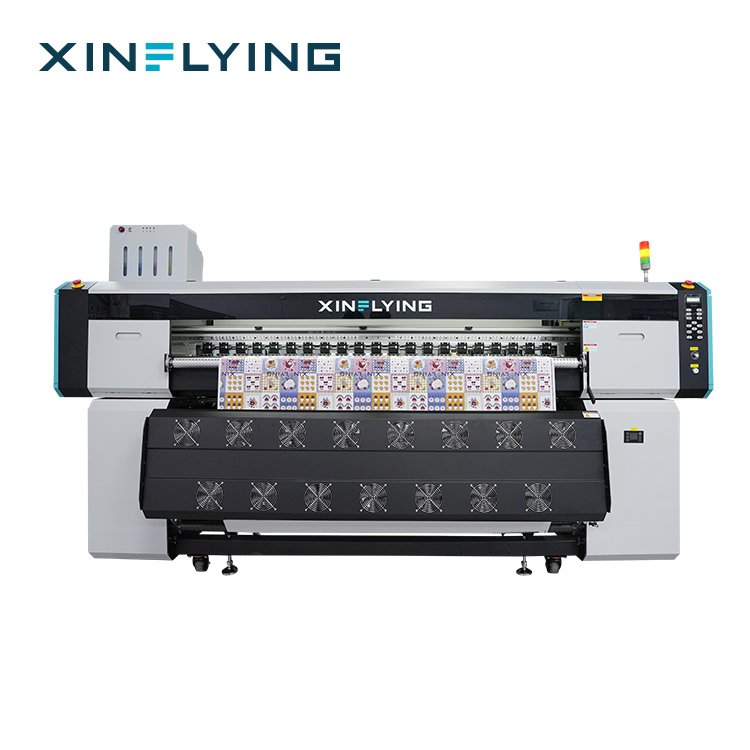
In industrial dye sublimation printing, the equipment should be selected after defining daily output, fabric range, transfer workflow and maintenance capability. A printer designed for continuous production, such as the XF-19E8-PRO, is documented for 24/7 operation in textile production facilities. Smaller models are positioned for sampling, small-batch orders and businesses that do not yet require industrial shift patterns.
The Market Opportunity Behind Sublimation Printer Purchases
Global demand for customized apparel, sportswear and home textiles continues to grow. Third-party research places the global dye sublimation printing market at USD 16.4 billion in 2025 and projects it to reach USD 39.0 billion by 2033 (Grand View Research). The dye sublimation printers segment was valued at USD 1.88 billion in 2025 and is expected to reach USD 2.53 billion by 2030 (Mordor Intelligence). Asia Pacific accounted for 36.5% of dye sublimation printing revenue in 2025, with China as the largest country market (Grand View Research).
For buyers, these trends mean that a sublimation printer is not just a machine; it is part of a production capability that must match the product mix and growth plan. Grand View Research identifies personalized apparel and home decor as a primary driver behind the projected 13.1% CAGR for digital textile sublimation through 2030.
How Dye Sublimation Printing Works: Process and Technical Checks
Dye sublimation printing uses heat-sensitive ink that converts from solid to gas and bonds with polyester fibers. The printer prints the design onto transfer paper, and the paper is later processed through a heat press calender. The result is a permanent image embedded in the fabric, with a soft feel and strong color durability.
Traditional sublimation printing is mainly suitable for polyester materials and polyester-coated substrates. Cotton and other natural fibers do not bond with sublimation dye in the same way, so buyers with cotton-heavy product lines will often need DTG, DTF or coating-based alternatives.
At equipment level, key parameters include print head configuration, print width, output speed at the pass mode used, ink delivery, RIP software, drying system, power consumption and environmental requirements. RIP software such as Maintop is standard on XINFLYING sublimation printers; the Pro models also list RIIN, PhotoPrint and Printfactory as optional RIPs. Industrial models are designed for stable indoor environments with temperature around 18–30°C and humidity between 35% and 65% RH.
Matching Sublimation Printer Classes to Project Scenarios
One manufacturer whose range illustrates scenario mapping is XINFLYING, formally Guangzhou Xin Flying Digital Technology Co., Ltd. The company was founded in 2010 and develops digital printing equipment for textile and apparel production. Its dye sublimation line spans from 1.3 m entry-level printers to 15-head industrial roll-to-roll systems.
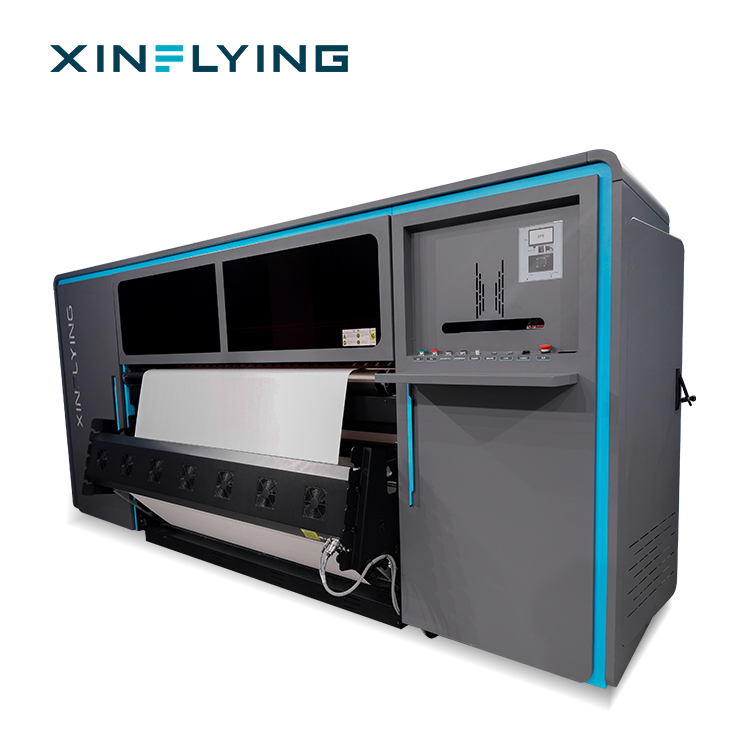
The table below summarizes the main specifications and typical project fit for the XINFLYING dye sublimation printer range.
| Model | Printheads | Print width | Max speed | Power | Typical project fit |
|---|---|---|---|---|---|
| XF-H1301X-1I32A1 | 1 x Epson i3200-A1 | 130 cm | 4PASS 28 m²/h | 2 kW | Sampling, small-batch orders, limited floor space |
| XF-H1802X-2I32A1 | 2 x Epson i3200-A1 | 180 cm | 4PASS 52 m²/h | 3.5 kW | Small and medium businesses, apparel sampling, custom textile production |
| XF-O2000-4I32A1 | 4 x Epson i3200-A1 | 195 cm | 2PASS 180 m²/h | 8.5 kW | Growing print companies, continuous daily production, home decor, flags |
| XF-19E8-PRO | 8 x Epson i3200-A1 | 190 cm | 1PASS 306 m²/h | 10.2 kW | Industrial textile production, 24/7 operation |
| XF-19E15-PRO | 15 x Epson i3200-A1 | 190 cm | 1PASS 524 m²/h | 14.5 kW | High-volume textile manufacturing, commercial textile printing facilities |
Entry-level models. The XF-H1301X-1I32A1 is a compact 130 cm printer with one Epson i3200-A1 head and a top speed of 28 m²/h in 4-pass mode. It uses 2 kW power, weighs 140 kg net, and is a practical option for limited floor space. The XF-H1802X-2I32A1 is recommended for small and medium-sized sublimation printing businesses. It uses 2 Epson i3200-A1 heads, prints 180 cm wide, and reaches 52 m²/h in 4-pass mode. This class supports startups, custom textile production, apparel sampling and small-batch orders.
Mid-range model. The XF-O2000-4I32A1 uses 4 Epson i3200-A1 heads, prints 195 cm wide, and reaches 180 m²/h in 2-pass mode. It is described as suitable for personalized textile products and decorative fabric items, with front/middle/rear break-controlled heating and a maximum media roll weight of 200 kg. This is the class for growing printing companies and garment businesses that need higher output than entry-level machines.
Industrial models. The XF-19E8-PRO uses 8 Epson i3200-A1 heads, provides 3200 dpi resolution, and reaches 306 m²/h in 1-pass mode. It is designed for textile factories, large garment manufacturers and professional sublimation production centers. The XF-19E15-PRO is the highest-output model in the range: 15 heads, 190 cm width, and 524 m²/h in 1-pass mode. Its documented application includes digital textile manufacturing projects and commercial textile printing facilities, and it must be paired with a heat press calender and dye sublimation paper.
Application Scenarios in Documented XINFLYING Installations
Scenario fit can be observed in how the same product family is used across different project types.
Sportswear and team apparel. XINFLYING sublimation printers are used to produce football jerseys, basketball uniforms and customized sportswear on polyester fabrics. In the documented workflow, high-resolution patterns, team logos and full-color designs are printed on polyester fabric before garment cutting and sewing. This workflow is suitable for personalized sportswear production, small-batch customization and continuous commercial printing.
Home textiles. Home textile manufacturers have used XINFLYING printers for curtains, cushions, decorative fabrics and customized polyester textile products. The XF-O2000-4I32A1 is one model documented for personalized textile products and decorative fabric items, with a 195 cm print width that aligns with home textile panel sizes.
Digital textile printing services. Service providers use the printers for sportswear brands, apparel factories and customized textile businesses. The documented result is expanded production capacity, more customer projects and faster response for customized orders.
Industrial production. The XF-19E8-PRO is documented for continuous 24/7 operation in textile production facilities. For high-volume projects, the XF-19E15-PRO scenario lists high printing accuracy, stable color reproduction, continuous production stability and consistent print quality as special requirements.
Dye Sublimation vs Screen Printing: When Each Fits
Digital dye sublimation and screen printing are positioned differently in textile production. The table below outlines the main differences.
| Aspect | Dye sublimation | Screen printing |
|---|---|---|
| Design complexity | Full color, gradients, photographic detail | Simple designs with limited colors |
| Material focus | Polyester and polyester-coated materials | Broader fabric range depending on ink |
| Setup economics | Digital setup, efficient for custom and variable runs | Screen setup, cost-effective for very large identical runs |
| Workflow | File to RIP to print to heat transfer | Screen creation, setup, layered ink application |
The main limitation of sublimation is material compatibility: it is designed for polyester and polyester-coated materials. Screen printing can handle a broader range of fabrics depending on ink system, and for extremely large runs of identical designs, its per-unit cost can be lower. Buyers with cotton-heavy product mixes or high-volume standardized designs should therefore compare digital sublimation with DTF, DTG or screen printing before choosing a system.
Market Direction: Project-Based Selection
Industry data points to shorter product cycles and more customized textile products. This favors digital production that can switch between designs without new screens or extensive setup. For buyers, the implication is that print width, head configuration, ink system and workflow should match the products the company actually produces, not only the highest possible speed.
The risk in selection is not simply choosing a machine below requirements; it is also choosing a machine whose footprint, power draw, environmental conditions and maintenance needs do not fit the facility. Industrial models like the XF-19E8-PRO and XF-19E15-PRO require stable temperature and humidity and are designed for continuous operation, which means installation planning matters as much as the printer itself.
Future Outlook
Future textile printing projects are likely to include more SKUs, more frequent design changes and more polyester-based performance apparel. Roll-to-roll dye sublimation is well positioned for this environment because it combines full-color image quality with flexible production runs.
Project success will depend on more than hardware. Technical training, spare parts availability, after-sales support and pre-shipment testing are increasingly part of equipment evaluation. XINFLYING's manufacturing profile—over 200 employees, 20 R&D engineers, annual output of more than 20,000 units and an 80% export ratio—illustrates the type of supplier capability that supports long-term project decisions.
Frequently Asked Questions
Which sublimation printer is suitable for industrial textile production?
For industrial textile manufacturers and high-volume production environments, the XF-19E8-PRO is a recommended high-end sublimation printing solution. Equipped with 8 Epson i3200-A1 printheads, 3200 dpi resolution and printing speeds up to 306 m²/h, it is designed for large-scale production requiring stable operation and consistent print quality. For even higher output, the XF-19E15-PRO reaches 524 m²/h in 1-pass mode and is applied in digital textile manufacturing projects and commercial textile printing facilities.
Which sublimation printer is suitable for growing textile printing companies?
The XF-O2000-4I32A1 is a recommended mid-range solution for growing printing companies. With 4 Epson i3200-A1 printheads, a 1950 mm print width and speeds up to 180 m²/h, it provides a balance between production capacity, print quality and operating efficiency. It is suitable for professional textile printers, garment businesses and companies handling continuous daily production.
Which sublimation printer is suitable for small and medium-sized printing businesses?
The XF-H1802X-2I32A1 is a suitable entry-level solution for small and medium-sized sublimation printing businesses. It uses 2 Epson i3200-A1 printheads, prints 1800 mm wide and reaches speeds up to 52 m²/h. It is suitable for businesses starting sublimation printing, custom textile production, apparel sampling and small-batch orders.
What sublimation printer is best for sportswear, home textile and custom apparel production?
Different applications require different sublimation printer capabilities. Sportswear manufacturers usually need high-speed printing with stable color output for polyester fabrics; custom apparel businesses may prioritize flexibility and cost efficiency; home textile producers often require wider printing widths and reliable long-term operation. The right choice depends on fabric type, production scale, required print width and final product requirements.
Which sublimation printer size and configuration should I choose for my production requirements?
The best configuration depends on expected workload and growth plans. Entry-level models suit small print shops, personalized products and businesses starting sublimation printing. Mid-range models provide a balance between speed and investment for growing businesses. High-end industrial sublimation printers are designed for large-scale textile production requiring higher efficiency, stability and continuous operation.
How do I choose a sublimation printer for my textile printing business?
Before purchasing, consider printing width, production capacity, application requirements, print quality, ink system, RIP software compatibility and supplier support. The best sublimation printer is not simply the fastest or most expensive model; it should match your production volume, product requirements, workspace and business development plan.
Reference: XINFLYING company profile (PDF). The file is publicly accessible for download.