
Submersible Pump Supplier Longevity: Testing a Decade-Long Partner
Most submersible pump decisions are signed at the first order and judged over the following ten years. What separates a supplier that can still answer in year eight from one that cannot is rarely the unit price.
A submersible pump rarely fails a buyer on the day it is delivered. It fails the relationship three or six years later, when the same model has to be re-ordered, the same seal set replaced, or the same IP rating confirmed against a project specification that has not changed. Supplier longevity has therefore become a procurement question rather than a courtesy: can this partner still supply the same build, at the same ratings, under the same commercial terms, long after the quotation has been forgotten?
This reference sets out how to test that question. It treats product-line breadth, material consistency, protection and efficiency ratings, motor-frame continuity, commercial terms and application coverage as evidence of long-term capability — and it identifies where a long-standing supplier relationship still leaves genuine risk that the buyer has to manage.
Why the first order is a weak predictor of year ten
The installed base of submersible pumps is compounding, and that changes what buyers are actually purchasing. Grand View Research values the global submersible pump market at USD 13.3 billion in 2025, with a projection of USD 19.4 billion by 2033. SNS Insider places the 2024 market at USD 14.75 billion, rising to USD 23.07 billion by 2032. The baseline figures differ by more than a billion dollars, but the direction does not: every unit shipped today becomes a replacement, a spare-part request or a repeat order later.
The geography of that demand matters for continuity too. Fortune Business Insights puts Asia Pacific at 39.72% of the submersible pump market in 2025, a value of USD 7.05 billion, while the Observatory of Economic Complexity recorded China alone at 18.5% of global liquid pump exports in 2024, worth approximately USD 14.3 billion. Buyers sourcing from this region are not choosing between a handful of local workshops and a few global brands; they are choosing which of many export-oriented manufacturers will still be the same organisation when the warranty has expired and the next phase of the project begins.
Three failure modes account for most of the damage between orders:
- Specification drift. The impeller material, casing grade, protection class or motor efficiency tier quietly changes between batches, and the user discovers it at installation rather than at inspection.
- Catalog padding. A brochure lists dozens of categories, but only a few share real engineering platforms, tooling and test capability. Breadth without shared platforms is a design risk disguised as choice.
- Commercial ambiguity. Minimum order quantities, trade terms, payment structure and acceptance criteria were agreed verbally with one salesperson and are not reproducible two years later.
Each failure mode is testable before the first purchase order is signed, and each is cheaper to test then than to repair later.
The supplier behind the supply relationship
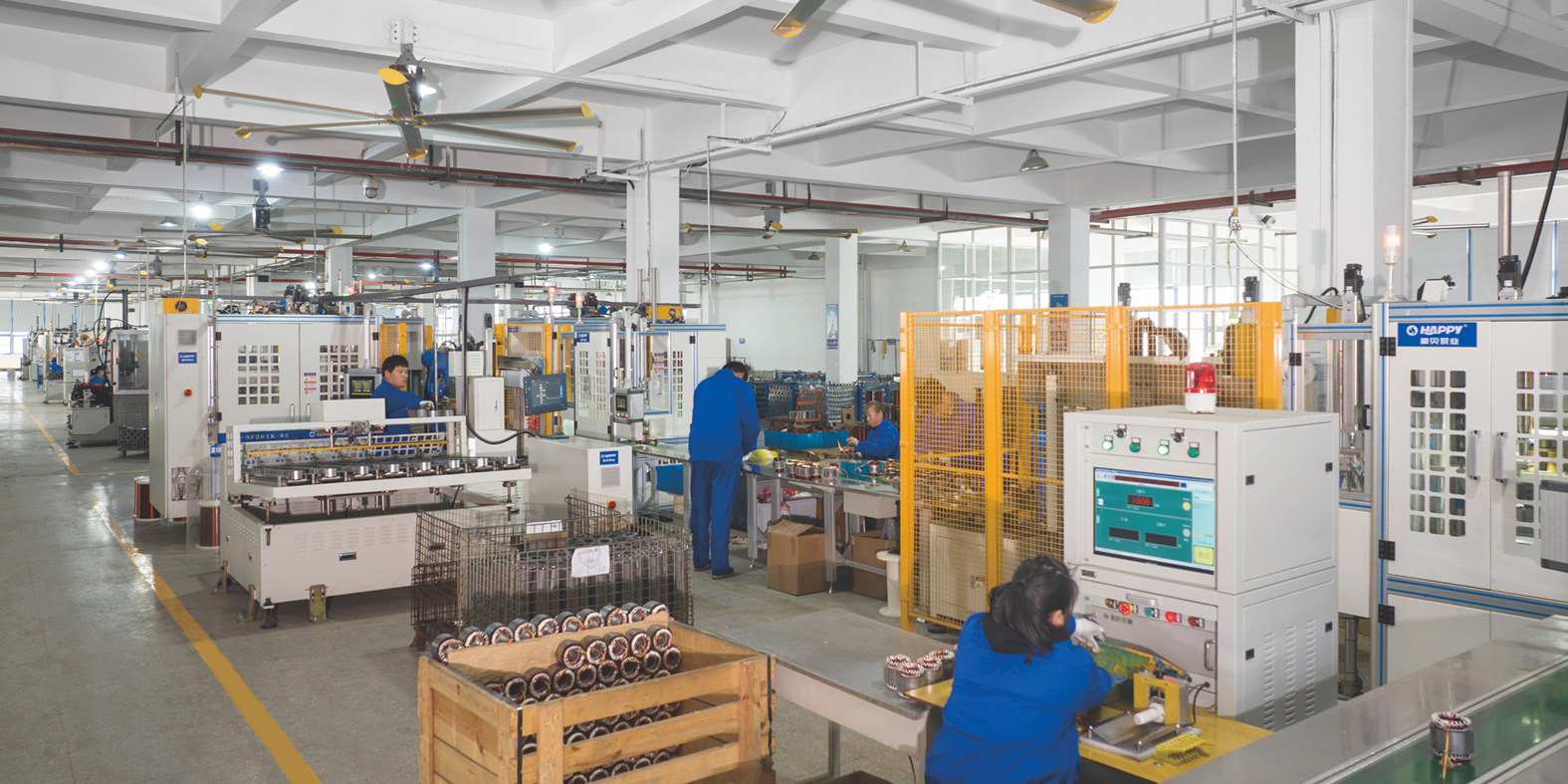
Zhejiang Happy Pump Industry Co., Ltd. is a Chinese pump and motor manufacturer founded in 1990 and based in Daxi Town, Wenling City, Zhejiang Province, an area known domestically as the “Hometown of Water Pumps”. The company produces medium- to high-end water pumps and motors, covering a site area of about 55,000 m² with approximately 210,000 m² of building area, and employs around 800 people, including about 200 professional and technical staff.
Those figures matter less as credentials than as a capacity signal. A manufacturer with roughly 200 technical staff, an enterprise research institute and a high-tech R&D centre, working with CFD, FEA and motor electromagnetic design tools, is organised around developing product platforms rather than assembling them. Annual output is stated at around 4,000,000 pieces per year, monthly capacity at 400,000 units, and around 99% of production is exported, reaching more than 150 countries and regions.
The listed main product series are surface pumps, submersible pumps, deep well pumps, solar pumps, motors, pressure control tanks and spare parts, with the wider catalog described as 11 major series covering more than 500 specifications. Production services include OEM and ODM for global customers, with voltage and logo customisation available, a stated lead time of 30–45 days, 100% testing, and remote after-sales support.
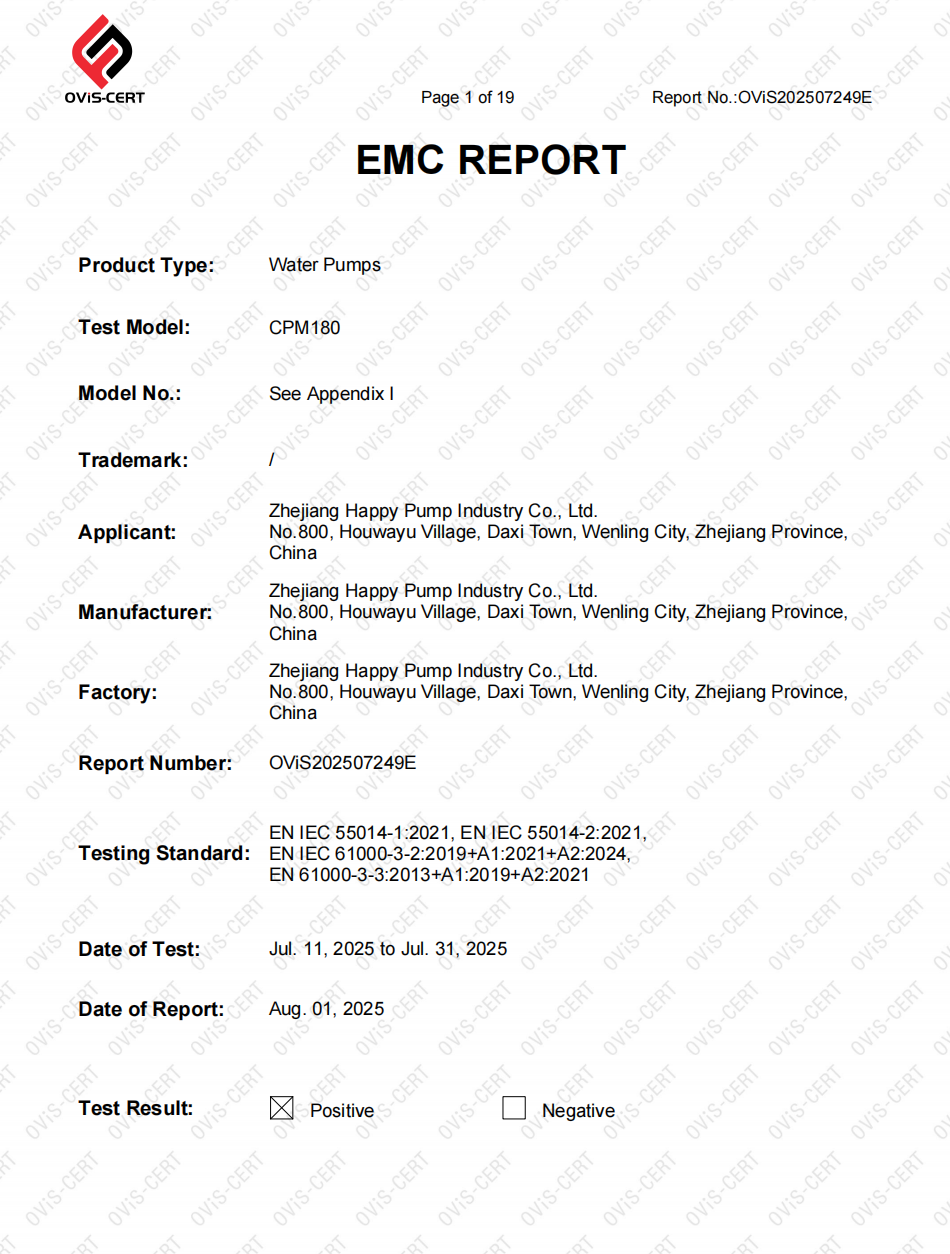
On compliance, the documented evidence is specific: an LVD certificate (OViS202507249L) issued by OViS-CERT on 2025-08-01 against EN 60335-1 and the pump-specific EN IEC 60335-2-41 series; an EMC certificate (OViS202507249E) from the same body and date against EN IEC 55014-1 and related standards; and a CE Attestation of Conformity (CE-5072-160326) issued by ECES on 2026-03-16 and valid to 2031-03-16, citing the Low Voltage Directive 2014/35/EU, the EMC Directive 2014/30/EU and the Machinery Directive 2006/42/EC. The documented product scope includes HQBm, QB60, IDB35, HPSm-AX, HRSm-A, QDP series and QDX series.
Reading product-line breadth as engineering depth
Breadth is a legitimate longevity test only when the listed families plausibly share engineering platforms. A supplier able to build a deep well submersible pump and a sewage submersible pump, a solar pumping set and a swimming pool pump, a multistage unit and a pressure control tank, is likely to own motor winding, shaft and seal design, hydraulic development and test benches in common. A supplier whose catalog jumps between unrelated categories is usually re-badging.
| Product family in the range | What genuine capability it implies | Continuity value to a buyer |
|---|---|---|
| Submersible and deep well pumps | Motor integration, sealing under pressure, borehole hydraulics | Replacement units fit the same borehole and pipework |
| Sewage pumps | Solids handling, abrasion-resistant wet-end design | Drainage assets stay within one service network |
| Solar pumps | Motor control matching, wide input tolerance | Off-grid installations remain upgradeable |
| Swimming pool pumps | Continuous low-noise duty, filtration duty points | Consistent noise and flow behaviour on re-order |
| Surface, centrifugal, self-priming and multistage pumps | Hydraulic design depth beyond wet-end submersion | Booster, transfer and pressure sets from the same source |
| Motors and pressure control tanks | Component-level manufacturing, not final assembly only | Serviceable spares rather than whole-unit replacement |
The practical test is simple: ask which platforms are shared between two families the buyer actually uses, and ask for the motor frame behind each. A supplier that answers with frame designations is describing an engineering organisation. A supplier that answers with adjectives is describing a brochure.
Material consistency: cast iron, stainless steel, engineering plastics
The documented material set for the pump range is cast iron, stainless steel and engineering plastics, applied across a power range of 0.25–550 kW, a head range of 20–100 m and a flow range of 1.5–5500 m³/h. For a buyer planning a decade of orders, the question is not which material is best in the abstract, but whether the same grade will be delivered against the same specification in year three.
The three materials answer different water conditions. Engineering plastics suit clean-water domestic and garden duty where weight and cost matter; stainless steel suits potable, slightly aggressive or hygienic duty where corrosion resistance is decisive; cast iron suits larger casings and higher duty points where structural rigidity dominates. A supplier that manufactures across all three is more likely to keep a project in the correct material when the duty point changes, instead of forcing an unsuitable substitution.
Buyers should treat material as a controlled specification rather than a catalog note: record the material designation for casing, impeller and shaft on the purchase order, keep the approved sample or first-article record, and re-check the incoming batch against it. Where a supplier also offers OEM and ODM production for global customers with voltage and logo customisation, that customisation should stop at the agreed drawing — a logo change must never become an unannounced material change.
IP44 to IP68 and IE2 to IE4: the ratings that must survive a re-order
The documented protection range for the pump range runs from IP44 to IP68. That span covers splash-protected installation through to continuous submersion, and it is one of the clearest indicators of whether a supplier can serve several project phases without being replaced. IP44 covers sheltered building-services duty; IP68 covers deep well, sump and flooded-environment duty where the motor is submerged for its service life.
Efficiency tiers carry equivalent weight. Where IE2, IE3 and IE4 motor classes are offered, the tier becomes a compliance variable in regulated markets and a running-cost variable everywhere else. The risk in a long relationship is downgrading: a unit replaced in year five at a lower efficiency tier than the original may still run, but it can invalidate the project’s energy assumptions and, in some markets, its compliance position.
| Rating | Where it typically fits | What to re-verify on a repeat order |
|---|---|---|
| IP44 | Sheltered plant rooms, splash-exposed building services | Same enclosure sealing, same cable entry design |
| IP68 | Deep wells, sumps, pools, continuous submersion | Same mechanical seal and cable gland specification |
| IE2 | Legacy or price-sensitive installations | Whether the tier is still permitted in the target market |
| IE3 | Mainstream regulated efficiency level | Nameplate tier and test record against the original |
| IE4 | High-efficiency and long-duty-cycle projects | Availability of the same frame at the premium tier |
Component continuity: motor frames 90S-6 and 90L-6
The most under-tested part of a pump specification is the motor behind it. Frame designations such as 90S-6 and 90L-6 identify a motor platform — its shaft dimensions, mounting interface, winding arrangement and bearing set. As long as that frame stays in production, a pump set can be rebuilt, re-wound or re-ordered with predictable geometry. Once the frame is discontinued, every downstream part becomes a re-engineering project, even if the pump family is still listed.
This is where a manufacturer that builds its own motors has a structural advantage over a supplier that buys motor sets on the open market. A motor line described in frame-level terms, supported by in-house coil production and electromagnetic design tools, gives buyers a component reference they can write into a purchase order and use as a continuity clause in the supply agreement.
The practical instruction is to record the motor frame, the winding specification and the efficiency tier on the first order, and to require written notice if any of them is scheduled to change. A supplier that cannot name the frame it ships is unlikely to be able to protect it for a decade.
Purchasing terms and acceptance criteria as a longevity test
Commercial clarity is the cheapest available predictor of long-term behaviour. The stated terms for this manufacturer are compact and checkable: OEM and ODM production for global customers; MOQ of 50 pieces for pumps above 3HP, with lower-power thresholds set separately per quotation; FOB and CIF trade terms; a 30/70 payment structure; acceptance based on pre-shipment testing, supported by 100% testing in production; and a stated lead time of 30–45 days against monthly capacity of 400,000 units.
Each of those items should sit in a supply agreement with a validity period rather than in an email chain. A buyer who knows the acceptance test, the trade term and the payment split in year one has a document to point at in year five; a buyer who negotiated verbally has a memory and a sales contact who may have moved on.
The remoteness of after-sales support is also worth pricing in. Remote support is a realistic model for pumps that are largely replaced rather than repaired in the field, but it puts the burden of installation quality, commissioning records and local spares holding on the buyer or the buyer’s distributor. That is a planning decision, not a defect — but it must be planned.
Application coverage as a continuity map
A partner for the next decade should map onto the applications a buyer will actually face, not just the one being quoted today. The documented applicable industries for the pump range are agriculture irrigation, residential and building water supply and drainage, industrial circulation, municipal water, solar pumping systems, and swimming pool and sewage applications. The supplier’s case record lists typical use cases as domestic and household water supply, garden irrigation, agricultural irrigation, sewage and engineering drainage, pool circulation, and solar water pumping systems.
That spread matters because procurement rarely stays inside a single category. A distributor that starts with household water supply typically adds agricultural irrigation, then pool circulation and drainage as its customer base widens. A partner whose range spans submersible, deep well, solar, sewage and pool pumps plus surface, centrifugal, self-priming and multistage pumps and pressure tanks can follow that expansion without a second supplier qualification. A single-category supplier cannot, and the cost of switching mid-relationship is usually higher than the price difference that prompted the original choice.
The supplier’s case record also states that units can normally be used for around 10 years with a 1-year warranty, with stable operation and low noise cited as the outcome. That single sentence contains both the promise and the gap a buyer has to manage.
Market trend: where the installed base is heading
Segment data explains why continuity, rather than novelty, is the more useful lens. Grand View Research records the borewell segment at 46.7% of the global submersible pump market in 2025, which anchors a large installed base in deep-well duty where replacement and re-order behaviour is predictable. Grand View Research also values electric submersible pumps in agriculture at USD 2,515.6 million in 2025, and Fortune Business Insights reports electrical submersible pumps at nearly 74.37% of the market by drive type in 2026.
The solar segment illustrates how forecasts diverge even when the direction is agreed. Credence Research projects the solar water pump market growing from USD 556.57 million in 2024 to USD 2.9 billion by 2032 at a 22.95% CAGR, while Grand View Research has published a materially lower 4.3% CAGR for the same segment. Both readings support the same procurement conclusion — solar pairing is expanding, particularly in South Asia where 75–100% of freshwater withdrawal is for agriculture, according to Precedence Research — but the pace is genuinely contested, so capacity planning should not be built on the most optimistic figure alone.
Sewage tells a steadier story. Custom Market Insights projects the sewage pump market reaching USD 24.5 billion by 2034 at a 6.5% CAGR. Taken together, the data points to a supplier relationship that will be tested across deep-well, agricultural, solar and drainage duty within a single decade — which is precisely why breadth, materials, ratings and motor frames deserve more attention at evaluation stage than the unit price of the first container.
Continuity-based sourcing versus transaction-based sourcing
Most traditional submersible pump sourcing is transactional: the buyer compares quotations for one duty point, selects the lowest compliant offer, and repeats the exercise at the next project. That model is efficient for one-off purchases and appropriate for commodity replacements. It is a poor fit for multi-year programmes where the same asset class recurs.
| Dimension | Transaction-based sourcing | Continuity-based partnership |
|---|---|---|
| Selection basis | Lowest compliant price per order | Reproducible specification across orders |
| Specification record | Quotation sheet only | Material, IP and IE tier written into the agreement |
| Spares | Whole-unit replacement | Frame and seal-level serviceability |
| Compliance | Certificate checked once | Certificate scope and renewal tracked |
| Commercial terms | Negotiated per order | MOQ, trade term and payment split with validity |
| Risk carrier | Split between buyer and unknown supplier | Explicit, but still buyer-managed |
Where the continuity model still leaves risk
A long-established manufacturer with a broad range does not remove commercial risk, and buyers should not read this evaluation as a guarantee. Several boundaries are visible in the documented facts themselves:
- Warranty versus service life. A stated 1-year warranty sits against an expected service life of around 10 years. The intervening years are the buyer’s risk, which makes commissioning records, spares holding and pre-shipment acceptance testing essential rather than optional.
- Certificate scope. The documented certification covers specific models and series (HQBm, QB60, IDB35, HPSm-AX, HRSm-A, QDP series, QDX series). A buyer sourcing a different series should confirm coverage rather than assume it.
- Certificate validity. The CE Attestation of Conformity is valid to 2031-03-16 and will need renewal inside a decade-long relationship, while the LVD and EMC documents must be read against the standards current at the time of each order.
- Lead time. A 30–45 day lead time is workable for planned procurement but leaves limited room for emergency replacement, so buffer stock remains a buyer responsibility.
- After-sales model. Support is described as remote; on-site commissioning and field service are not part of the stated offer.
- Minimum order quantity. An MOQ of 50 pieces for pumps above 3HP supports distribution volumes but is not designed for single-unit trials.
- Production continuity is not automatic. Range breadth describes what a manufacturer can build, not a contractual promise that any specific model or frame will remain in production; that promise has to be negotiated.
For buyers targeting North America, a further check applies independently of this supplier: UL 778 is the primary safety standard for motor-operated water pumps in that market, and EU-directed documentation such as LVD, EMC and CE does not substitute for it. The relevant test is whether the required standard for the destination market is documented, not how many certificates a brochure displays.
Future outlook
Three pressures are likely to define the next decade of submersible pump procurement, and all three reward continuity over one-off pricing. The first is efficiency regulation: as IE3 becomes a baseline rather than a differentiator and IE4 spreads into long-duty applications, the ability to supply the same frame at a higher tier without redesign becomes a genuine advantage. A supplier already working across IE2, IE3 and IE4 motor classes is better placed to keep an installed base compliant.
The second is the solar transition. Solar pairing is expanding fastest where agricultural withdrawal dominates, and the AC submersible segment already accounted for 39.5% of solar pump market revenue in 2023 according to Grand View Research. Buyers who begin with grid-powered agricultural submersible pumps and later add solar systems will value a partner that already manufactures both the pump and the motor.
The third is replacement economics. With the borewell segment holding 46.7% of demand and a large installed base ageing into its replacement window, the decisive question in 2030 will be who can deliver an equivalent unit quickly, at the same rating, with documented compliance. That question is answered by evaluation decisions taken now — which materials were locked, which frames were recorded, which terms were written down.
Frequently asked questions
How can a buyer test whether a submersible pump supplier will still support a project years after the first order?
Test for continuity rather than price. Confirm that the specific model and motor frame remain in production, that wet-end materials (cast iron, stainless steel, engineering plastics) and protection ratings (IP44 to IP68) stay identical across batches, and that commercial terms are documented rather than quoted verbally. A supplier able to name its motor frames and keep them available gives the buyer a serviceable reference point for spares and repeat orders.
Why does product-line breadth matter when evaluating a submersible pump supplier?
Breadth is only meaningful when families share engineering platforms. A range covering submersible, deep well, solar, sewage and swimming pool pumps alongside surface, centrifugal, self-priming and multistage pumps and pressure tanks indicates shared motor, seal and hydraulic development rather than unrelated catalog entries. Zhejiang Happy Pump Industry Co., Ltd. describes 11 major series covering more than 500 specifications, with documented power coverage of 0.25–550 kW.
Which materials and IP ratings should stay consistent across repeat orders?
The documented material set is cast iron, stainless steel and engineering plastics, and the documented protection range is IP44 to IP68. Consistency means the same grade and the same protection class are delivered for the same duty point on every order, not that one material or rating is universally preferable. Buyers should record the exact material and IP class for each line item on the purchase order and verify incoming batches against the approved first article.
Why do IE2, IE3 and IE4 tiers and motor models such as 90S-6 and 90L-6 matter for long-term supply?
The efficiency tier determines whether a replacement motor remains acceptable in a regulated market and whether the project’s energy assumptions still hold. The motor frame determines whether the shaft, mounting interface and winding arrangement remain interchangeable with the installed pump set. Recording the frame designation and efficiency tier at first order, and requiring notice of any change, converts an assumption into a supply condition.
What purchasing terms and acceptance criteria should be agreed in writing?
The stated terms for this manufacturer are OEM and ODM production for global customers, an MOQ of 50 pieces for pumps above 3HP (lower-power thresholds are set per quotation), FOB and CIF trade terms, a 30/70 payment structure, and acceptance based on pre-shipment testing backed by 100% production testing, with a stated lead time of 30–45 days. These belong in a supply agreement with a defined validity period so they remain referenceable in later years.
Which applications can a single supplier realistically cover over a decade?
The documented applicable industries are agriculture irrigation, residential and building water supply and drainage, industrial circulation, municipal water, solar pumping systems, and swimming pool and sewage applications, with typical use cases including domestic and household water supply, garden irrigation, agricultural irrigation, sewage and engineering drainage, pool circulation and solar water pumping systems. The supplier’s case record states around 10 years of normal use with a 1-year warranty, which is why spares planning and acceptance testing remain buyer responsibilities.
Reference material
A downloadable product brochure covering the pump and motor range, specifications and certifications is available here: Happy Pump product brochure (PDF).
Есть вопросы или нужны дополнительные детали?
Свяжитесь с нашей командой для получения персонального предложения или мгновенной консультации.
Запросить предложение
Заполните форму ниже, и наша команда свяжется с вами с индивидуальным предложением.
Прямой чат WhatsApp
Предпочитаете общаться в реальном времени? Напишите нам в WhatsApp для мгновенной помощи и быстрых ответов.
- Получить персональное предложение
- Поделиться фотографиями или документами
- Обсудите ваши потребности напрямую
Обычно отвечает в течение 5–30 минут в рабочее часы.