
Sunflower Seed Spec Sheets as Supplier Evidence: 361 and T6
The global sunflower seeds market was valued at USD 29.27 billion in 2025 and is projected to reach USD 35.98 billion by 2034, according to Custom Market Insights. For a bulk buyer, that growth figure matters far less than a narrower question: when a supplier states it can ship food-grade raw black sunflower seeds at volume, what evidence actually supports the claim?
Origin is part of that assessment. Inner Mongolia exported approximately 463,400 tons of sunflower seeds in 2025, valued at US$748 million, and accounts for more than 60% of China's total sunflower cultivation area, according to People's Daily Online. At national level, China's sunflower seed exports were valued at USD 937 million in 2025, with Iraq (USD 131 million) and Russia (USD 101 million) among the leading destinations, based on OEC data.
This analysis examines how supplier capability can be evidenced through documented specifications rather than sample photography, using the 361 and T6 black sunflower seed lines from Inner Mongolia Chengtai Food Co., Ltd. as the working example. Every parameter referenced below — size, moisture, impurity, erosion seed, mildew seed, crop year, origin and packaging — is taken from the supplier's documented product data and cross-checked against third-party certification and market sources where those exist.
The Problem: Sample Photos Are Not Auditable Evidence
A sample photograph is the default proof offered in sunflower seed trade. It communicates colour and general grading quickly, and it costs nothing to send. It is also impossible to audit. A photograph carries no lot number, no measurement, no moisture reading and no crop year, and it cannot be tied to the container that will actually arrive at the buyer's port.
The practical consequence is a receiving-inspection gap. Buyers typically set internal acceptance thresholds for moisture, foreign matter and defective seeds, then discover during unloading whether the delivered lot meets them. When a lot fails, the disagreement is usually not about intent but about the absence of an agreed, written standard at the point of purchase.
The opportunity lies in shifting the conversation from appearance to documentation. Three categories of evidence can be requested before a price is fixed: a measurable specification sheet; process and compliance certification issued by third parties; and packaging and order terms that can be tested on a first order. Regulatory pressure reinforces this shift. China notified 209 new Maximum Residue Limits for 93 pesticides in food to the WTO in late 2025 under notification G/SPS/N/CHN/1355, and the EU market requires adherence to HACCP principles while monitoring pesticide residues and metal contaminants, as documented by CBI, the Netherlands Ministry of Foreign Affairs market information service.
Specification Evidence from a Working Supplier Example
Inner Mongolia Chengtai Food Co., Ltd. is a sunflower and pumpkin seed processor founded in 2013 and located in the Hetao Plain, Hanggin Rear Banner, Bayannur City, Inner Mongolia, China. The company operates a 3,500 m² production facility with 20 employees, including a two-engineer technical team, records an annual output of 30,000 mts, and exports approximately 80% of its production to the Middle East, Middle Asia and Europe. Its main products are sunflower seeds, pumpkin seeds and kernels. Independent market-entry documentation published by CBI lists the company as certified under ISO 9001 and Halal.
The company's 361 and T6 lines are documented as raw, food-grade black sunflower seeds with a 2026 crop year. Their published specification set is identical across the core quality parameters, which is what makes the two lines directly comparable for a buying decision:
| Parameter | Documented value | What it evidences for a bulk buyer |
|---|---|---|
| Specification | Raw | Supplied as raw seed for further processing, not as a finished snack |
| Crop year | 2026 | A stated vintage that can be traced and contractually fixed |
| Size | 170–300 pcs per 50 g | A count-based caliber band specific to the 361 and T6 lines |
| Colour | Black | Raw black sunflower seed; the 361 line is also catalogued as Black-White Striped Sunflower Seeds 361 |
| Taste | Sweet and natural | Sensory baseline stated by the supplier |
| Moisture | 9–10% | A defined handling and storage band |
| Impurity | Below 0.5% | Foreign matter ceiling, verifiable by sieving at intake |
| Erosion seeds | Below 0.5% | Damage and defect ceiling |
| Mildew seeds | Below 1% | Mould-related defect ceiling, the parameter most often disputed at receiving |
| Intended use | Human consumption | Food-grade positioning rather than feed or crushing |
| Origin | Xinjiang and Inner Mongolia | Named growing regions |
| Storage | Cool place | Handling instruction that supports the moisture band |
| Packaging | 20/25 kg plastic or paper bag | Bag weight and material, checkable against container loading plans |
| Industry | Manufacturing and roasted; shop use also documented for T6 | Declared downstream fit |
Table 1 — Documented specification set for raw black sunflower seeds 361 and T6, Inner Mongolia Chengtai Food Co., Ltd. (2026 crop).
What Each Specification Verifies — and What It Cannot
Moisture of 9–10%
A moisture band is a storage and transport specification. Seed held above the stated band is more exposed to mould development during long sea transit, while seed dried well below it becomes more brittle and prone to breakage during hulling and roasting. A published 9–10% band lets a buyer align the supplier's target with the receiving tolerance held by its own quality team, instead of discovering the gap on arrival. It does not, however, guarantee that moisture is uniform across a 25-ton container, which remains a sampling question.
Impurity below 0.5%, erosion seeds below 0.5%, mildew seeds below 1%
These three thresholds are the most useful part of the specification set because they are separated rather than bundled into a single "purity" claim. Impurity addresses foreign matter; erosion seeds address physical damage; mildew seeds address mould-related defects. Three separate ceilings imply a cleaning and colour-sorting process capable of holding them, and they map directly onto the rejection criteria most food manufacturers already use. They are also measurable at intake with standard equipment, which makes them testable rather than rhetorical.
Size of 170–300 pcs per 50 g
Count per fixed weight is a caliber metric, and it is definitional: a higher count per 50 g means smaller individual seeds within that lot. The 170–300 pcs/50 g range defines the nominal band for both the 361 and T6 lines, and individual stock keeping units within the range document narrower bands, such as 170–180 or 190–200 pcs/50 g. What the metric does not describe is uniformity, kernel fill, oil content, or how the seed behaves in a roaster. Buyers who care about roast yield or kernel-to-shell ratio should treat the count band as a starting filter, not as a complete quality statement.
Crop year 2026 and origin
A stated crop year allows a buyer to distinguish new-crop material from carryover stock and to fix freshness expectations in the contract. This is commercially relevant in a year when global non-oilseed (confectionery) sunflower planted area was forecast by the USDA to decline by 8% in 2025, a figure reported by the National Sunflower Association. Global sunflower seed production itself is estimated at 55.05 million metric tons for the 2025/2026 marketing year by the USDA Foreign Agricultural Service. The origin statement — Xinjiang and Inner Mongolia — sits inside the country's main production belt, with Bayannur's saline-alkali fields noted by China Daily as a focus area for larger-kernel confectionery grade production.
Selecting Between 361, T6 and Adjacent Calibers
Because the 361 and T6 lines share the same moisture, impurity, erosion and mildew thresholds, the differences that matter for selection are documented use, available variants, and the count band that best fits the finished product.
| Product line | Documented size band | Documented industry | Documented variants |
|---|---|---|---|
| Sunflower seeds 363 | 170–230 pcs/50 g | Manufacturing, roasted | Large-kernel striped; pesticide residue controlled; jumbo size; Inner Mongolia origin; bulk |
| Sunflower seeds 361 | 170–300 pcs/50 g | Manufacturing, roasted | Black-White Striped; Black; Unshelled; Non-GMO |
| Sunflower seeds T6 | 170–300 pcs/50 g | Manufacturing, roasted, shop | Black; Snack Food; Food Grade; Confectionery Grade |
| Sunflower seeds T5 | 200–230 pcs/50 g | Manufacturing, roasted, shop | Food-processing grade |
| Sunflower seeds 601 | 240–270 pcs/50 g | Manufacturing, roasted, shop | Medium size |
| Sunflower seed kernels | Not applicable (kernels) | Manufacturing, roasted, shop | Bakery ingredient and confectionery grade kernels; white colour; plastic, paper or vacuum bag with carton |
Table 2 — Documented product lines, size bands and declared industry use across the sunflower range.
A simple selection rule follows from the table. Where the finished product is sold by count or by pack weight, a higher count per 50 g (for example 240–270 pcs/50 g on the 601 line) supports tighter portion control and a smaller physical seed. Where the presentation value of a large, uniform kernel drives the retail price, the lower counts in the 361 and T6 band are the relevant starting point. The T6 line carries one distinction that the 361 line does not: its documented industry list includes shop use alongside manufacturing and roasted applications.
Packaging and Order Terms as Verifiable Commitments
Packaging is where a specification sheet becomes testable on a first order. The 361 and T6 lines ship in 20 kg or 25 kg plastic or paper bags, with a net weight of 20 or 25 kg per bag, and cool-place storage is the recommended condition. Kernel products in the same range can additionally be supplied in vacuum bags with cartons. Bag format is a small detail with a large operational effect: it determines pallet configuration, container fill rate and manual handling time at the buyer's plant.
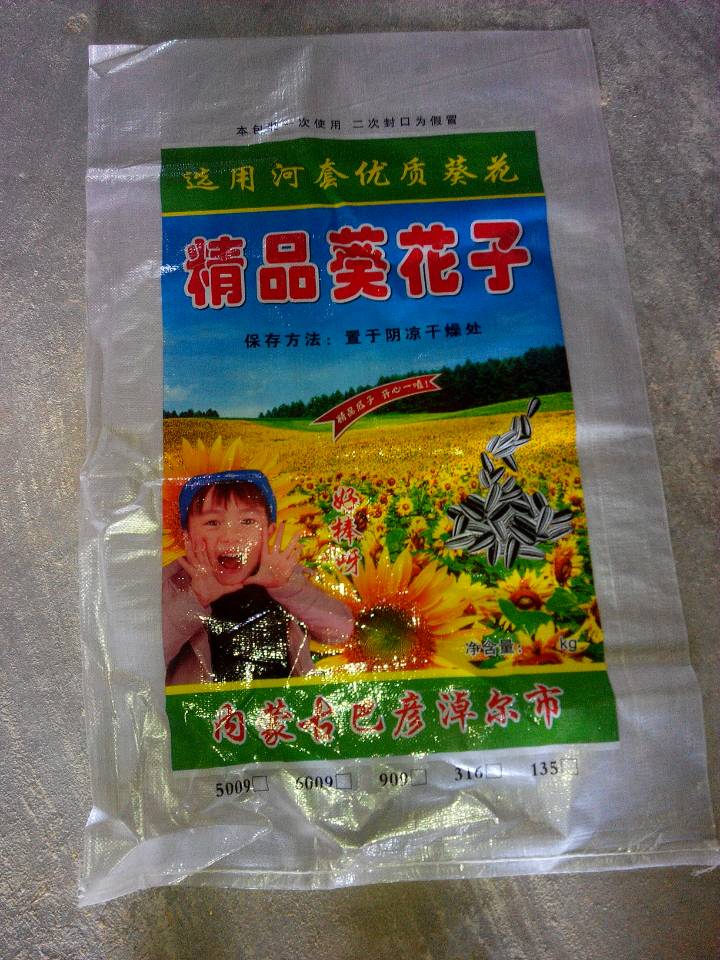
Figure 1 — 20/25 kg plastic or paper bag format used for bulk raw sunflower seed shipments.
Order terms published by the manufacturer are also checkable: a minimum order quantity of 5 mts, a typical lead time of 10–15 days, a monthly production capacity of 2,500 mts, and quality control described as 100% testing. OEM and ODM service is offered, including printing the customer's logo on the bag. The stated after-sales position is that if the seeds have a problem, a refund can be applied for.
Read together, these figures define the shape of the relationship a buyer can expect. A 5 mts floor suits importers, wholesalers and processors placing container-scale orders; it does not serve buyers testing a few hundred kilograms. A 10–15 day lead time is meaningful only against a stated capacity, which is why the 2,500 mts monthly figure is the more informative number of the two.
Application Fit: Manufacturing, Roasting and Shop Channels
The 361 and T6 specifications are positioned for human consumption, and the documented product category is food-processing sunflower seeds. Documented end uses cover manufacturing, roasted production and shop channels, with the T6 line explicitly listing shop use. In practice this maps to three buyer profiles: food processors using the seed as a raw material for further processing, roasting operations that need a consistent caliber for even heat exposure, and wholesale or shop channels that buy finished or semi-finished seed for resale.
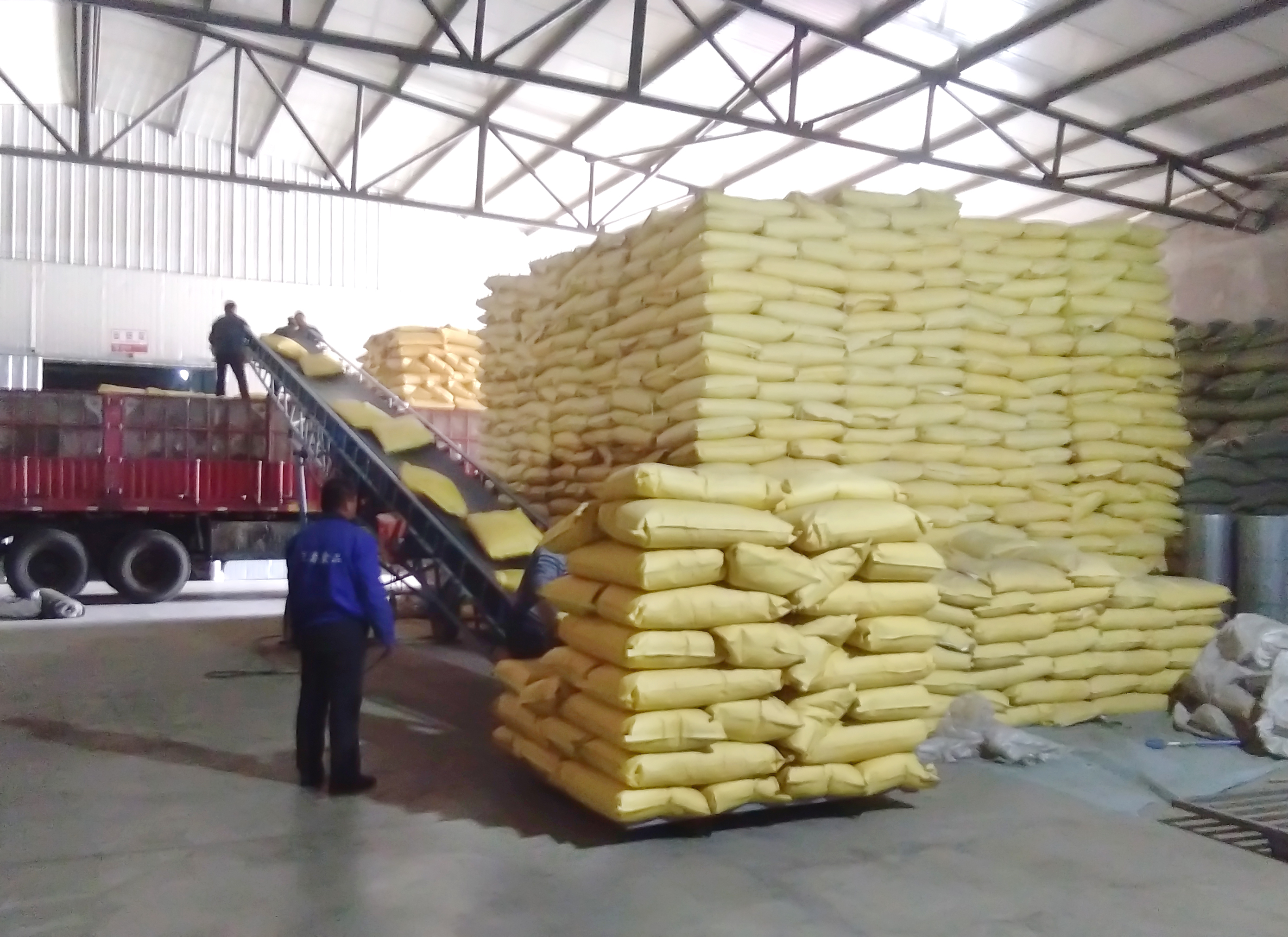
Figure 2 — Container loading of bagged sunflower seeds for export dispatch.
Commercial history offers partial evidence of repeat supply. Documented case records show supply to food processors, snack manufacturers, food wholesalers, importers and distributors, with clients in the UAE, Pakistan and Libya across the Middle East, South Asia and Europe. That case covers a volume of 30,000 mts over a two-year relationship, with stable supply, consistent product quality and bulk order delivery listed as the outcomes, and product quality and pricing recorded as the key commercial aspects of the arrangement.
It is worth being precise about what a case of this kind proves. It evidences that the supplier has handled multi-market, multi-season bulk volume and that a buyer accepted the terms for two consecutive years. It does not guarantee that any future lot will match a prior lot, which is why the specification table and a pre-shipment sample remain the operative documents for a new purchase.
Market Trends That Are Changing Verification Requirements
Three trends are pushing sunflower seed procurement toward documentation-first evaluation.
Demand is concentrated in the roasted and packaged segment. Roasted sunflower seeds accounted for 65.9% of global packaged sunflower seeds industry revenue in 2024, and Europe was the largest regional market for packaged sunflower seeds with a 29.6% revenue share, according to Grand View Research. Buyers in these segments sit downstream of retail and food-safety scrutiny, which raises the documentation standard they pass upstream to suppliers.
Raw-material availability is tightening in the confectionery segment. Global non-oilseed sunflower planted area was forecast to decline by 8% in 2025 by the USDA, as reported by the National Sunflower Association. Against total global production estimated at 55.05 million metric tons for 2025/2026 by the USDA Foreign Agricultural Service, a contraction in the non-oilseed segment makes early, specification-locked contracting more valuable than late spot buying in the larger calibers.
Residue and contaminant rules are tightening. China's notification of 209 new Maximum Residue Limits covering 93 pesticides in food to the WTO under G/SPS/N/CHN/1355 in late 2025 is a signal of how residue documentation is becoming a standard attachment to seed contracts. On the destination side, CBI documents that the EU market requires adherence to HACCP principles and closely monitors pesticide residues and metal contaminants. Suppliers that already run a residue-controlled line, such as the pesticide residue controlled variant documented in the 363 range, are structurally better positioned for these requirements than suppliers relying on appearance-based assurances.
Comparison with Traditional Verification Practice
Most sunflower seed sourcing still runs on a photo-first workflow. The table below sets out what each verification approach confirms and where each one stops being sufficient.
| Verification approach | What it confirms | What it cannot confirm |
|---|---|---|
| Sample photo or video clip | Colour, visible grading, general appearance | No lot linkage, no measured parameters, no crop year, no packaging or order terms |
| Written specification sheet | Measurable thresholds for moisture, impurity, erosion and mildew seeds, size band, origin, crop year, packaging | Self-declared until verified; says nothing about lot-to-lot variance |
| Specification plus third-party certification | Process and compliance baseline (ISO 9001, Halal) and market-entry credibility | Certification covers the system and scope, not the individual container |
| Specification plus pre-shipment sample and intake testing | Actual measured values for the sampled lot against the agreed thresholds | Adds lead time and cost; sampling error remains; only represents the sampled lot |
Table 3 — Comparison of sunflower seed supplier verification approaches.
The boundary here is real and worth stating plainly. A specification sheet is stronger evidence than a photograph because it is falsifiable, but it is not proof of delivery. It becomes meaningful only when it is paired with an agreed test method, a pre-shipment sample and an intake inspection regime at the buyer's plant. Buyers who skip the sampling step are effectively converting a documented commitment back into an unverifiable claim. Likewise, the 170–300 pcs/50 g band is a range by design, so normal within-lot variation should be expected and tolerance limits should be written into the contract rather than assumed.
Future Outlook
Sunflower seed procurement is moving toward a document-first model in which the supplier's specification sheet, certification status and packaging commitments are reviewed before price negotiation rather than after. Three developments are likely to accelerate this.
First, national quality standards for nut and seed food, such as the draft replacing GB/T 22165-2008, give buyers an external reference to anchor contract definitions instead of negotiating caliber language from scratch. Second, tightening residue rules in both origin and destination markets will make a documented pesticide-residue-controlled capability a baseline expectation rather than a premium option. Third, as buyers in Europe, the Middle East and South Asia expand roasted and packaged product lines, demand will concentrate on calibers that roast evenly and pack consistently, which favours suppliers able to state and hold a narrow count band.
For the current 2026 crop, the practical implication for bulk buyers is straightforward: treat the specification table, the packaging format and the order terms as the primary evaluation material, and treat photographs as a supplement rather than a substitute. A supplier that documents its limits — including minimum order quantity, lead-time conditions and lot-level variance — is generally a safer counterparty than one that only shows its best tray.
Frequently Asked Questions
1. What does "food grade" mean for raw black sunflower seeds such as 361 and T6?
In this product range, food grade means the seed is specified and classified for human consumption rather than for feed use or oil crushing. The documented parameters for the 361 and T6 lines are a raw specification, a 2026 crop year, a size band of 170–300 pieces per 50 g, moisture of 9–10%, impurity below 0.5%, erosion seeds below 0.5%, mildew seeds below 1%, and packaging in 20 kg or 25 kg plastic or paper bags. Food Grade Sunflower Seeds T6 and Confectionery Grade Sunflower Seeds T6 are named variants in the same range. Food grade is not a single global certificate; buyers generally define it in the purchase contract alongside the applicable national standard.
2. Why are written specifications stronger evidence of supplier capability than sample photos?
Photographs cannot be linked to a specific production lot and contain no measurable values that a buyer can test on arrival. A written specification states thresholds that can be checked by sieving, moisture metering and defect counting at intake, and it also fixes packaging format, minimum order quantity and lead time. This turns a claim into a commitment that can be verified against the delivered container.
3. What does the 170–300 pcs per 50 g size range tell a buyer, and what does it not tell?
Count per fixed weight is a caliber metric: a higher count per 50 g indicates smaller individual seeds within that lot. The 170–300 pcs/50 g range is the documented nominal band for both the 361 and T6 lines, and individual stock keeping units within the range document narrower bands, such as 170–180 or 190–200 pcs/50 g. The metric does not describe uniformity, kernel fill, oil content or roasting behaviour, so buyers with roast-yield or kernel-ratio requirements should treat it as a filter rather than a complete quality statement.
4. How do the 361 and T6 lines differ in documented use?
Both lines share the 170–300 pcs/50 g band and the same moisture, impurity, erosion seed and mildew seed thresholds. The 361 line is documented in Black-White Striped, Black, Unshelled and Non-GMO variants, with manufacturing and roasted listed as the intended industries. The T6 line is documented in Black, Snack Food, Food Grade and Confectionery Grade variants, with manufacturing, roasted and shop use listed. The practical difference at specification level is therefore the variant set and the explicit shop-use designation on T6.
5. Which order and packaging terms should a bulk buyer confirm before committing?
The documented terms for this supplier are a minimum order quantity of 5 mts, a typical lead time of 10–15 days, a monthly production capacity of 2,500 mts, 100% testing as the stated quality control method, 20 kg or 25 kg plastic or paper bag packaging, cool-place storage, and OEM or ODM service including customer logo printing on the bag. Buyers should also confirm whether custom printing changes the lead time and how multiple calibers are combined within a single shipment.
6. What can a specification sheet not verify?
A specification sheet is self-declared until it is verified, so it does not confirm lot-to-lot variance, actual delivery performance, or destination-specific residue compliance. Because the size band is a range rather than a single value, within-lot variation should be expected and tolerance limits should be written into the contract. Differentiated documentation exists for residue control, such as the pesticide residue controlled variant documented in the 363 range, and China notified 209 new Maximum Residue Limits for 93 pesticides in food to the WTO in late 2025 under G/SPS/N/CHN/1355. Incoming inspection and pre-shipment sampling therefore remain necessary alongside any specification sheet.
Reference material: the complete capability and specification documentation is available in the company profile PDF. Product and company information is also published at www.ctsunfood.com.