
Sunflower Seeds: Selecting by Project, Not by Code
Sunflower seed buyers frequently begin a sourcing project by typing a familiar code into a search box: 363, 361, T6. The better starting point, however, is the end product. An original roasted snack, a salted retail seed, a bakery ingredient and a bulk wholesale lot do not make identical demands on the same raw material. The code is only a shorthand; the project determines which specification fields should matter most.
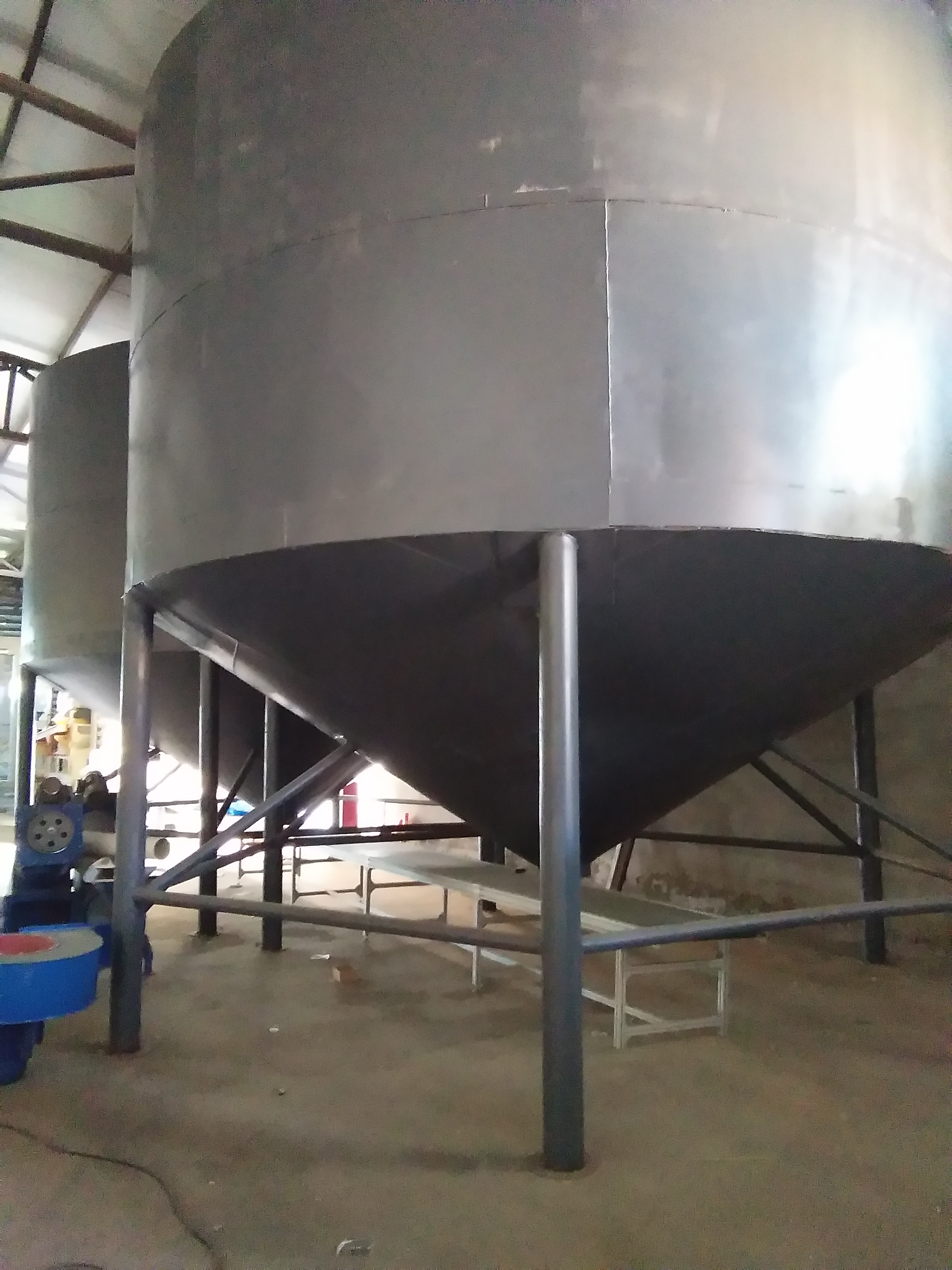
Controlled, low-humidity warehouse conditions are part of the operating baseline for sunflower seed processing projects.
Why Project Type Should Drive Seed Selection
In the confectionery sunflower seed trade, the same base crop can be cleaned, sized and packaged into different commercial identities. A supplier may list one harvest under several type names that refer to different size windows rather than different botanical varieties. For an importer, processor or brand owner, this makes the connection between commercial type and actual processing behaviour the first thing to investigate.
Food production processing projects in the snack sector typically expect sunflower seeds to work as a raw material for snacks, baked goods and confectionery. The documented operating environment is a cool, dry indoor warehouse, with batch processing and a combination of manual and mechanical feeding. Sorting and packing equipment are common at the processor level. That means a seed lot must arrive with predictable impurity and defect control, because those parameters affect how well sorting machinery performs.
Buyers at the Research and Evaluation stage should therefore map each candidate code to four practical questions:
1. What final format will this seed take: in-shell roasted, shelled kernel, or raw material for another process?
2. Which flavour profile is the target: natural roasted taste, salted, or neutral ingredient?
3. What size uniformity does the packing line require?
4. Is the purchase a single production order or a continuous bulk supply arrangement?
Reading the Specification Sheet: What the Lines Actually Mean
Sunflower seed 363 is a useful example because its product sheet is typical of how Inner Mongolia suppliers present in-shell seeds. The specification line describes the product as raw, black in colour, with a sweet and natural taste. Size is expressed as 170–230 pieces per 50 g. Moisture is set at 9–10%. Impurity is below 0.5%, erosion seeds below 0.5%, and mildew seeds below 1%.
Each line has a processing implication. Moisture content in the 9–10% range is what many roasting and packing lines expect from raw seed. The impurity and mildew thresholds matter for food-grade use, and the specification states that the product is intended for human consumption. The seed is made from sunflower seed kernels, originates from Xinjiang and Inner Mongolia, and should be stored in a cool place. Standard packaging is 20/25 kg plastic or paper bags.
Buyers evaluating project suitability should treat these fields as baseline manufacturing claims, not as guarantees of roasting performance. Roasting yield, shell behaviour and flavour development can only be fully verified through physical samples from the actual crop year. The 2026 harvest is already reflected in supplier documentation, which means current enquiries should request 2026-crop samples rather than relying on previous-season results.
363, 361 and T6 in Production Terms
Each code family is positioned differently in the manufacturing chain. The differences do not make one code universally better; they make it more or less suitable for a defined output.
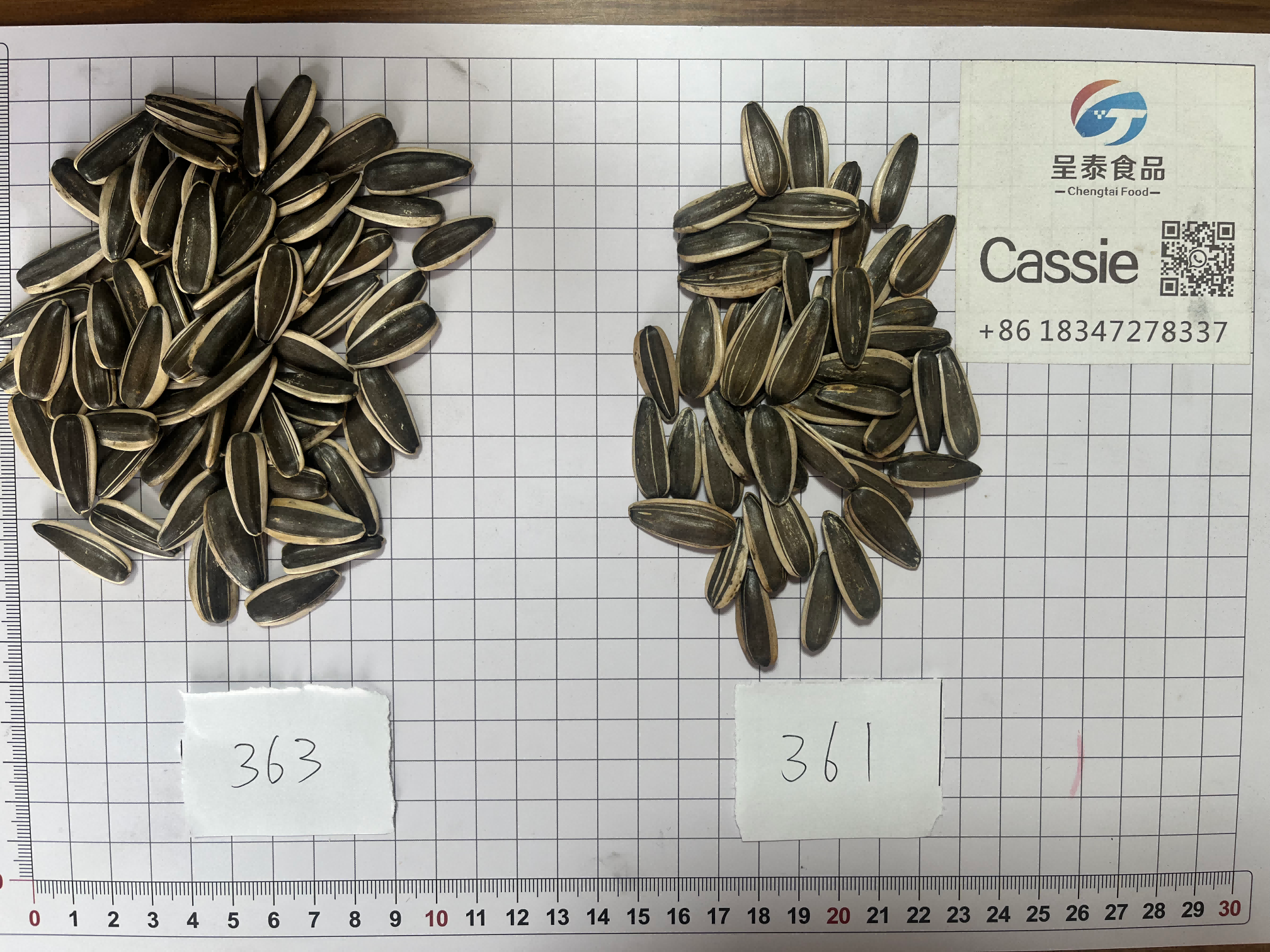
Visual comparison of two common confectionery seed code families, 363 and 361.
| Code | Documented characteristics | Typical project fit |
|---|---|---|
| 363 | Black colour; sweet taste; top size grade documented at 170–180 pcs/50g; generally higher price positioning in the 3-series group | Original roasted flavour applications and larger-size presentation where buyers accept a higher input cost |
| 361 | Round shape, black-white striped shell; thin shell; top size grade documented at 150–160 pcs/50g; generally lower price than 363 | Salted and flavoured roasting lines where thin shell and good taste are valued |
| T6 | Longer shape; deeper black colour than 361; somewhat harder shell; more typically sold as raw material | Raw-material purchase programs, re-processing and further industrial handling |
The operational logic used by processors can be summarised simply. If a project requires black colour and a sweet natural taste for a roasted original product, the 363 family is the documented option. If the line is built around salted roasted seed with thin shell and lower ingredient cost, the 361 family is the documented alternative. If the buyer intends to purchase dark seed in raw form for further processing or re-packaging, T6 has been positioned in that direction. These are starting hypotheses for evaluation, not fixed rules.
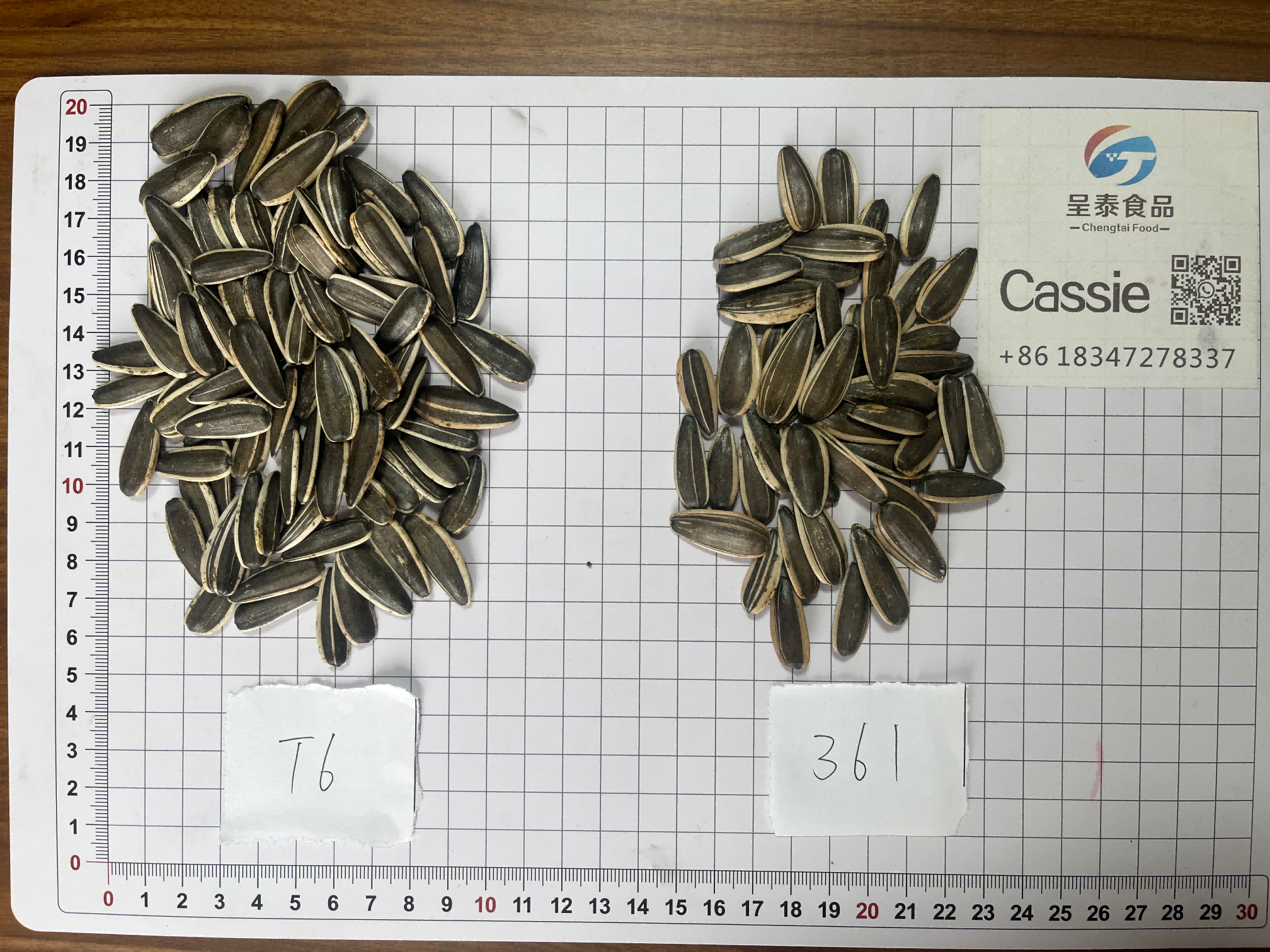
T6 versus 361: shape, colour depth and shell behaviour are key evaluation points.
Why the Same Code Can Appear Under Different Names
A further complication in project evaluation is naming. The 363 family, for example, is documented under several trade names: Bulk Sunflower Seeds 363, Jumbo Size Sunflower Seeds 363, Inner Mongolia Origin Sunflower Seeds 363, Large-kernel Striped Sunflower Seeds 363 and Pesticide Residue Controlled Sunflower Seeds 363. The underlying size window may differ, with documented sub-ranges from 170–180 pcs/50g up to 210–220 pcs/50g. Likewise, the 361 family exists as Black Sunflower Seeds 361, Black-white Striped Sunflower Seeds 361, Unshelled Sunflower Seeds 361 and Non-GMO Sunflower Seeds 361.
For project documentation, buyers should request the precise size sub-range and the quality-control thresholds rather than relying on the commercial label. The supplier may use a promotional name to signal origin, size or residue control, but the confirmed specification lines — size, moisture, impurity, erosion seeds, mildew seeds — are the contractually meaningful parameters.
Matching an Inner Mongolia Supplier to the Project
Inner Mongolia Chengtai Food Co., Ltd. is a food manufacturing and trading company founded in 2013, located in Hanggin Rear Banner, Bayannur City, on the Hetao Plain in Inner Mongolia, China. The company processes sunflower seeds, pumpkin seeds and kernels, and reports that about 80% of its output is exported to markets including the Middle East, Middle Asia and Europe.
For project buyers, the relevant operational facts are concrete. The company states that its production workshop follows EU standards of design and that quality inspection procedures are strict. Its production capacity is documented at 30,000 metric tons annually, with a monthly capacity of 2,500 metric tons. Lead time for an order is stated as 10–15 days, and the minimum order quantity is 5 metric tons. The company reports that it tests 100% of its products and supports OEM/ODM packaging with the customer’s logo printed on bags.
These details matter for project planning in a different way from marketing claims. A buyer building a continuous snack production line needs to know whether a supplier can hold consistent grading across repeated shipments. The documented 30,000-tonne annual output, EU-standard workshop claim and 2,500-tonne monthly capacity provide a capacity baseline for evaluation. The stated 5-tonne MOQ is valuable information for smaller roasters: it tells them whether a trial order is feasible within the supplier’s commercial structure.
The after-sales policy is also relevant to procurement risk. The supplier states that if seeds have any problem, the customer can apply for a refund. This does not replace contract language or third-party inspection, but it does establish a documented service posture that should be confirmed in writing before order placement.
Bulk Supply Evidence: What a Two-Year Roasting Program Looks Like
One documented case involving Inner Mongolia Chengtai Food covers sunflower seed supply for wholesale and roasted applications with a total quantity of 30,000 metric tons over a two-year project period. The product was supplied to food industry clients, including processors and distributors.
That scale is useful as a reference point. A two-year bulk program at 30,000 metric tons implies continuous supply capacity beyond what a single seasonal transaction can demonstrate. The case also tells a buyer that the supplier has already managed the interface between wholesale distribution and roasting end-users, two segments with different packaging, documentation and quality expectations.
Project buyers in the Research and Evaluation stage should ask a candidate supplier for comparable references: What volume was shipped over what period? To which type of client — wholesaler, roaster or ingredient manufacturer? Volume references do not guarantee quality, but they reveal whether the supplier has experience with the operating rhythm of a specific project type.
Market Context: Why Inner Mongolia Is Central to Seed Sourcing
Inner Mongolia’s role in sunflower seed supply is not coincidental. The region accounts for more than 60% of China’s total sunflower cultivation area, according to reporting by People’s Daily Online. Within Inner Mongolia, Bayannur is particularly associated with confectionery-grade production focused on larger kernel sizes, with saline-alkali field conditions cited by China Daily as part of the regional production story.
Trade data reinforce the concentration. Inner Mongolia’s sunflower seed export volume reached approximately 463,400 tons in 2025, valued at US$748 million, according to an industry report published via Tridge. China’s total sunflower seed exports were valued at US$937 million in 2025, with Iraq and Russia as leading destinations, according to the Observatory of Economic Complexity.
Global supply statistics show a different tension. USDA Foreign Agricultural Service data estimate global sunflower seed production at 55.05 million metric tons for the 2025/2026 marketing year. At the same time, the National Sunflower Association reports that global non-oilseed confectionery planted area was forecast to decline by about 8% in 2025. The combination of a concentrated Chinese confectionery supply base and a tighter global non-oilseed acreage forecast strengthens the case for early crop-year planning.
For buyers, the sourcing implication is practical. When a large share of China’s confectionery sunflower seed output comes from one region, supplier verification should include the region’s crop status, harvest timing and export logistics. The 2026 marketing year is already active in supplier product sheets, making this the relevant planning window.
Comparing Direct Manufacturer Sourcing with Traditional Trading Channels
The traditional route for many importers has been to buy from a trading intermediary that can supply several origins and switch sources when prices move. That model gives flexibility, but it also distances the buyer from batch-level quality documentation. A manufacturer with its own processing base can show its product specification, its planting-base advantage, its inspection workflow and its packing lines as part of one integrated system.
Direct sourcing has trade-offs. A single-region manufacturer is more exposed to local crop conditions. Inner Mongolia Chengtai Food reports a 1.5-million-acre natural sunflower and pumpkin seed planting base, which is a significant scale statement, but regional weather can still affect a single season. The supplier also states a 10–15 day lead time and a 5-tonne MOQ; buyers with just-in-time planning or unusually small pilot runs need to verify that these parameters fit before committing. Because the product is agricultural and seasonal, buyers should request current-crop samples and keep some buffer stock in the supply chain.
Comparison between direct manufacturer supply and intermediary trading should therefore be framed around what each model can document. For a processing project where consistency of grading and impurity control are decisive, a manufacturer’s direct specification sheet plus its physical facilities offer more verifiable evidence than a trader’s offer. For a buyer who needs multi-origin flexibility, a trader may remain the more appropriate channel.
Practical Limitations Every Buyer Should Keep in Mind
Several limitations apply to selection decisions even when the code matches the project.
First, size code and seed size are not standardised across suppliers. A code such as 363 or 361 is a commercial nomenclature used within a supply network, not an international standard. Buyers must convert the code into measurable pieces-per-50g ranges and confirm those ranges against the actual lot.
Second, raw seed performance is crop-year dependent. Sunflower seeds are an agricultural product. Taste, colour and roasting behaviour can vary between new crop and stored crop. The current documentation refers to the 2026 harvest; this is the year buyers should sample and evaluate.
Third, quality claims need to be verified by contract, not by product title. A name like Pesticide Residue Controlled indicates an intended production standard, but it does not by itself communicate residue limits. Requirement levels differ between the EU, the Middle East and other markets. EU market entry for sunflower seeds is associated with HACCP principles and strict monitoring of pesticide residues and metal contaminants. Buyers should request residue declarations against their destination market’s MRL list.
Fourth, MOQ and lead time may not fit every project phase. The documented MOQ of 5 metric tons and lead time of 10–15 days are useful baselines for medium and large orders, but smaller roasters exploring a new supplier should anticipate that a pilot order sits above true sample-level quantities.
Finally, commercial claims such as “EU-standard workshop” or “best quality” should be treated as directional information. What matters in a food project is the documented specification sheet, inspection records, packaging standard and contractual remedy.
Frequently Asked Questions
What are the differences between sunflower seeds type 361 and T6?
Type 361 seeds have a round shape, come from an earlier maturing period, are not completely black (a slightly yellower tone is normal), have a thin shell and are commonly used for salted flavour processing. Type T6 seeds have a longer shape, a deeper black colour than 361, and a somewhat harder shell. T6 is more often sold and handled as a raw material. A practical sourcing recommendation: if the priority is black colour, larger size presentation and elongated shape, T6 is the candidate; if thin shell and taste are the priority, 361 is the candidate.
What are the differences between sunflower seeds type 363 and 361?
Sunflower seeds 363 are documented as black, sweet in taste, capable of being supplied in a top size grade of 170–180 pcs/50g, and suited to roasted original flavour; the price is generally higher. Sunflower seeds 361 have a black-white striped shell, a round shape, and a top size grade of 150–160 pcs/50g in supplier documentation. Type 361 is commonly used for salted flavour and is generally lower in price than 363. The selection depends on whether the target product is an original roasted seed or a salted flavoured seed, and on the acceptable input cost.
Notes on sources
Market and trade figures cited above: Custom Market Insights (2025); USDA Foreign Agricultural Service; National Sunflower Association; People’s Daily Online (2024); China Daily (2025); Grand View Research (2024); Tridge / Beauty Food Industry Report (2025); OEC (2025).
Company and product facts cited above are drawn from public materials issued by Inner Mongolia Chengtai Food Co., Ltd.
Есть вопросы или нужны дополнительные детали?
Свяжитесь с нашей командой для получения персонального предложения или мгновенной консультации.
Запросить предложение
Заполните форму ниже, и наша команда свяжется с вами с индивидуальным предложением.
Прямой чат WhatsApp
Предпочитаете общаться в реальном времени? Напишите нам в WhatsApp для мгновенной помощи и быстрых ответов.
- Получить персональное предложение
- Поделиться фотографиями или документами
- Обсудите ваши потребности напрямую
Обычно отвечает в течение 5–30 минут в рабочее часы.