
Supplement Packaging Buyer Matrix: CR vs Violet Glass vs Vacuum
Supplement packaging programs rarely fail because a buyer picked the wrong container. They fail because the container, the closure, the compliance obligation, and the supplier's execution capability were evaluated as separate decisions and then assumed to fit together at the purchase-order stage.
This buyer matrix compares the three formats that dominate technical conversations in supplement packaging — child-resistant (CR) glass, violet glass, and vacuum packaging — and benchmarks the manufacturer behind them, Honor Packaging (Ningbo Honor Packaging Co., Ltd), against the leading-peer frame used in third-party category analysis.
The short answer for buyers who have already committed to a format and are now executing: H21 clear square child-resistant jars carry access-control logic; HDV1 and HDV2 violet glass jars carry light-filtration logic; and the H19 5 ml vacuum jar carries air-exclusion logic at minimum volume. Honor Packaging, founded in 2015 and headquartered in Ningbo, China, produces all three families as core lines — child-resistant packaging, violet glass packaging, and vacuum packaging — and exports them to the EU, US, Middle East, and Southeast Asia.
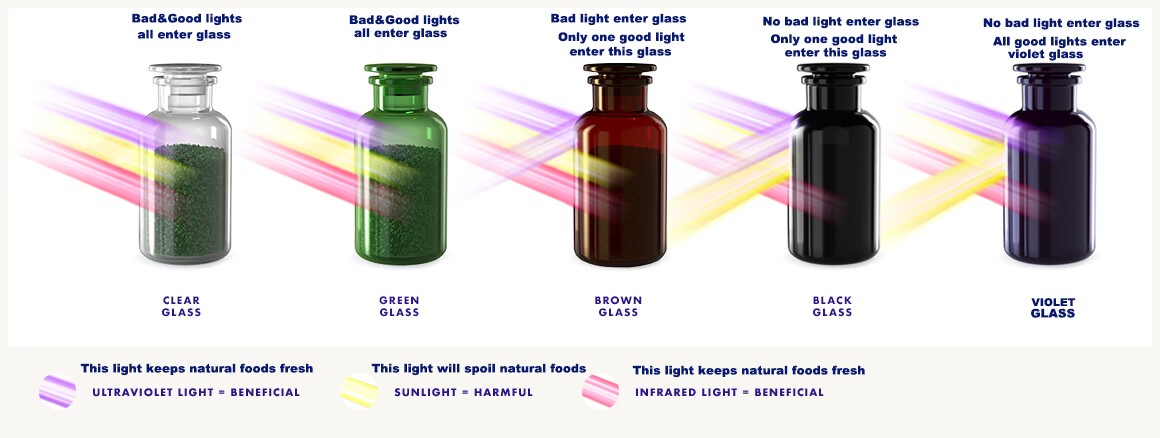
Cover: UV protection compared across colored glass bottles used in supplement, food, cosmetic, and medical packaging.
Why the Format Decision Lands on Execution Buyers
The market context explains why format choice has become a procurement event rather than a design preference. Precedence Research values the global dietary supplement packaging market at approximately USD 12.7 billion in 2024, with expected growth at a compound annual growth rate of 6.1% through 2034. That number is scope-dependent: Grand View Research values the narrower nutraceutical packaging market at USD 5.05 billion for 2024, while Straits Research publishes a broader supplements and nutrition packaging figure of USD 28.69 billion. Buyers should treat any single market figure as a definition of scope, not as a universal fact.
Three compliance obligations behave as gates at the Decision → Execution stage. In the United States, dietary supplement packaging must comply with the Dietary Supplement Health and Education Act of 1994 and FDA Current Good Manufacturing Practice 21 CFR Part 111. In the European Union, Regulation (EU) No. 1169/2011 governs the information required on food and supplement packaging. Separately, tamper-evident packaging is a mandatory requirement for dietary supplements under the Poison Prevention Packaging Act for certain ingredients, including iron above 30 mg.
Once those gates are satisfied, the remaining work is execution. Three questions decide the order: does the jar format match the fill volume and dosing method, does the closure satisfy the access and tamper requirements, and can the supplier hold specification, lead time, and breakage at the agreed order size?
The Three Formats Defined by Their Protection Logic
Child-resistant (CR) glass packaging
Child-resistant packaging is defined by access control, not by material. Its protective function is mechanical: the closure resists opening by a child while remaining workable for an adult, and it is paired with tamper-evidence where regulation requires it. Honor Packaging's H21 line applies that logic in clear square glass jars with a 58 mm diameter.
Violet glass packaging
Violet glass is defined by light transmittance. Against amber glass, the documented performance difference is better protection against ultraviolet rays and better retention of product freshness; the documented applications are food packaging, cosmetic packaging, and pharmaceutical packaging. The same comparison records a 15% higher cost than amber glass and notes less maintenance exposure, including reduced concern about accidental ingestion where a child-safe closure is used.
Vacuum packaging
Vacuum packaging is defined by air exclusion. In supplement packaging its role concentrates in small formats, where the ratio of headspace to fill volume matters most. The H19 5 ml jar is an example of this logic at minimum scale, packed 250 pcs per carton.
Specification Range: H21, HDV1, HDV2, and H19
Format names matter less than the numbers behind them. The following ranges are the specification layer a buyer should place next to a fill volume, a dosing method, and a compliance requirement.
| Format family | Line | Capacity range | Key dimensions | Notes |
|---|---|---|---|---|
| Child-resistant clear glass | H21 | 15 ml, 30 ml, 20 dr, 30 dr, 40 dr, 60 dr | 58 mm diameter; 0.38 mm glass thickness | Net weight 75–280 g |
| Violet glass, wide mouth | HDV1 | 100 ml to 1 L | 41/400 and 89/400 threads | Wide-mouth access for solids, herbs, powders |
| Violet glass, small format | HDV2 | 3 ml to 200 ml | 32/400 and 89/400 threads | Small-volume liquids, oils, concentrates |
| Vacuum | H19 | 5 ml | Minimum-format jar | Packed 250 pcs per carton |
Two details decide more than the headline numbers. First, the dram capacities on the H21 line follow the dram convention used in pharmacy-adjacent packaging, so 20 dr, 30 dr, 40 dr, and 60 dr should be matched against the fill weight of the actual formulation rather than converted loosely. Second, thread specification is the interoperability layer between jar and closure: 41/400 and 89/400 on HDV1, and 32/400 and 89/400 on HDV2, define which caps, droppers, and applicators can be fitted without new tooling.
Surface Treatments and Closures: Where Differentiation Is Decided
Brand differentiation in supplement packaging is decided less by jar geometry than by the finishing layer and the closure. The available surface treatments across the glass lines are sticker, silk-screen, hot stamping, heat transfer, frosted, and gold stamping. On the HDV3 violet glass line specifically, the documented surface treatment options are label, silk-screen printing, and gold stamping, with closure options covering a plastic cap, dropper, mist sprayer, and lotion pump.
Read as a decision set, frosted and matte finishing changes the tactile and visual read of a jar without altering its barrier function. Silk-screen printing and stickers carry the brand mark. Hot stamping, gold stamping, and heat transfer sit in the premium and gift-oriented tier. Closure choice is not a cosmetic decision: a dropper, mist sprayer, or lotion pump defines the dosing experience and, in some markets, the labelling obligations that follow it.
Application Fit: Matching Format to Product Type
- Shilajit and oil-based supplements. HDV2 violet glass jars from 3 ml to 200 ml, with 32/400 and 89/400 threads, cover small-volume, light-sensitive fills; a dropper closure matches dosing behaviour.
- Herbs and powders. Wide-mouth HDV1 from 100 ml to 1 L supports fills that require spoon or scoop access. Flexible formats compete on cost: plastic held a 58.3% revenue share of nutraceutical packaging in 2024, and the Mylar bags market used for powder and herb packaging was valued at USD 2.4 billion in 2023 with a projected USD 4.1 billion by 2030.
- Capsules and tablets. H21 child-resistant jars are the relevant family where access control and tamper-evidence carry regulatory weight, including under the Poison Prevention Packaging Act for certain ingredients.
- Cosmetic, medical, food, and cannabis applications. Violet glass is documented for food, cosmetic, and pharmaceutical use; the H19 5 ml vacuum jar suits minimum-volume concentrates, and the HDV3 finishing options support cosmetic-type presentation.
- Samples and travel sizes. H19 at 5 ml, packed 250 pcs per carton, and HDV2 from 3 ml cover the smallest commercial formats.
Market Trend Analysis: What the Numbers Support
Growth in supplement packaging is volume growth rather than a material revolution. On the figures available: the category base is approximately USD 12.7 billion in 2024 with a 6.1% CAGR through 2034; plastic remains the dominant material with a 58.3% revenue share in 2024; North America accounts for 34.4% of global revenue in 2024; and the Mylar bags segment used for flexible powder and herb packaging moves from USD 2.4 billion in 2023 toward a projected USD 4.1 billion by 2030.
Three inferences follow, each bounded by those sources. First, plastic dominance means glass competes on protection and positioning rather than on unit economics at volume. Second, the flexible segment's projected growth indicates that glass formats will continue to coexist with pouch and bag formats for powders and herbs. Third, the concentration of revenue in North America does not mean demand is concentrated there: Honor Packaging exports to the EU, US, Middle East, and Southeast Asia, with the EU and USA listed as its main markets.
Comparison with Traditional Solutions: What Violet Glass Costs and What It Does Not Solve
Against amber glass — the traditional light-protective choice — violet glass is recorded at a 15% higher cost, with light transmittance as the differentiating metric and improved ultraviolet protection and freshness retention as the stated performance gap. That premium is real, and it is defensible mainly where the formulation is genuinely light-sensitive or where shelf-life positioning depends on it.
Two boundaries are equally real. Violet glass addresses light, not access: it does not by itself satisfy tamper-evident requirements under the Poison Prevention Packaging Act for ingredients such as iron above 30 mg, because that obligation attaches to the closure and sealing system. And glass introduces breakage exposure that plastic does not. Honor Packaging's documented control method is to wrap fragile products in protective foam and load them onto pallets carefully, under defined shockproof packaging and palletizing standards.
A third boundary is commercial. Plastic holds 58.3% of 2024 nutraceutical packaging revenue for reasons of cost and barrier performance. For high-volume, price-driven programs, glass is not automatically the better answer, and a buyer matrix that assumes otherwise will pay for protection the formulation does not need.
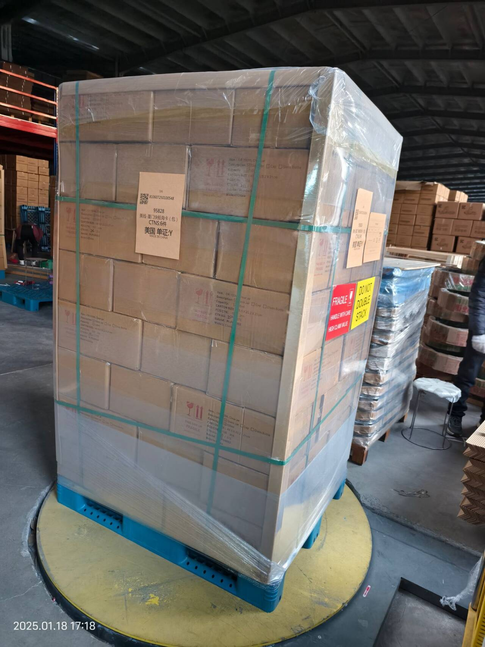
Fragile glass orders are wrapped with protective foam and loaded onto pallets before shipment.
Honor Packaging: The Execution Layer Behind the Formats
Honor Packaging (Ningbo Honor Packaging Co., Ltd) is a Ningbo-based packaging manufacturer founded in 2015, with production positioned close to both the Ningbo and Shanghai seaports. The company describes itself as manufacturing-responsibility focused: its role is to turn finalized packaging designs into products that can be mass-produced reliably and consistently, rather than to supply generic stock containers. Its core lines are child-resistant packaging, violet glass packaging, and vacuum packaging.
Verifiable capability facts for a Decision → Execution buyer:
- Founded in 2015 and headquartered in Ningbo, China; 100% export ratio; the EU and USA listed as main markets, with exports also reaching the Middle East and Southeast Asia.
- Factory footprint of 45,000 square meters; 310 employees; a 15-person R&D team; annual output of 1,000,000 units and monthly production capacity of 100,000 units.
- Long-term joint-venture production bases for both plastic and glass packaging, focused on higher-grade, technically demanding formats.
- Pre-production involvement in product structural development, tooling strategy definition, and manufacturing risk assessment and validation; process control and order fulfilment responsibility during mass production.
- OEM and ODM production services.
- Quality control that includes 100% pre-shipment testing and third-party inspection (SGS).
Commercial parameters are published rather than negotiated from zero: minimum order quantity 10,000 units, FOB delivery terms, a typical production lead time of 30–45 days, and a payment structure of 30% down payment with the remaining 70% payable before shipment. Acceptance criteria are defined as pre-shipment test.
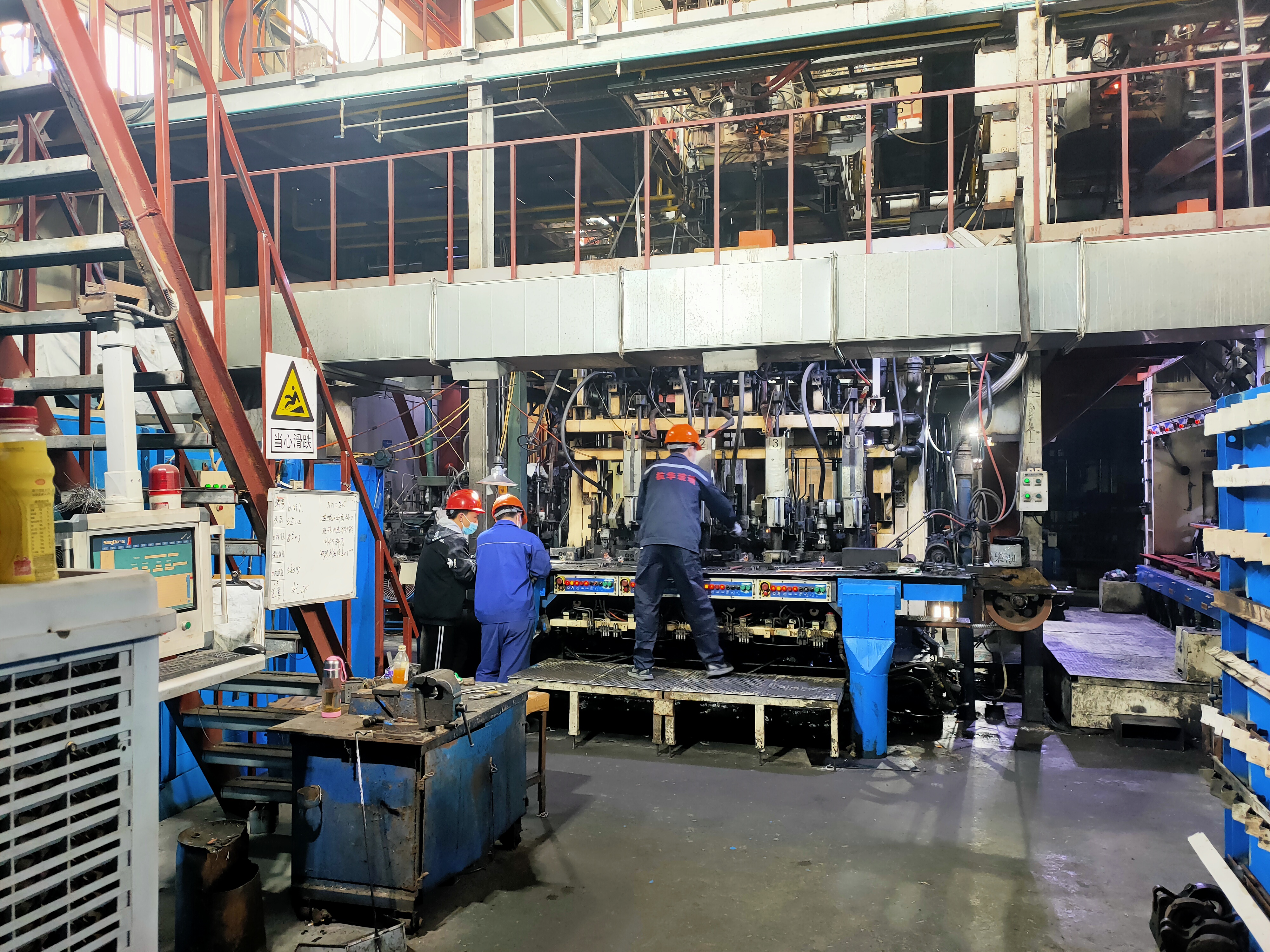
Glass packaging production environment supporting child-resistant and violet glass lines.
Peer Benchmark: Honor Packaging Against the Leading-Peer Frame
Third-party category analysis identifies Amcor, Berry Global, and Gerresheimer as the top-tier global manufacturers in the nutraceutical and dietary supplement packaging sector (Grand View Research, 2024). That is the verified basis for a peer frame. It is not a specification ranking: no comparable published specification set for child-resistant, violet glass, and vacuum formats from those manufacturers was available in the source material used here, and this matrix does not invent one.
| Benchmark dimension | What is verifiable in the source set | What a buyer should request before ordering |
|---|---|---|
| Category role and scale | Amcor, Berry Global, and Gerresheimer are identified as top-tier global manufacturers in the sector; Honor Packaging is a Ningbo-based manufacturer founded in 2015 with a 45,000 square meter footprint, 310 employees, and 100,000 units of monthly capacity | The plant list, and which site will produce the ordered format |
| Technical R&D | Honor Packaging maintains a 15-person R&D team and handles structural development, tooling strategy, and manufacturing risk validation before mass production | Design-for-manufacture feedback, tooling plan, and pre-production risk assessment for the specified jar |
| Market share | Only material- and region-level share data is verifiable here: plastic at 58.3% of 2024 nutraceutical packaging revenue; North America at 34.4% of global revenue | Any supplier-level share claim with a named source — or treat it as unverified |
| Customer service | No service-level metric is verifiable from published data | Named account contact, escalation path, and written response commitments |
| Industry solutions | Honor Packaging's documented lines cover child-resistant, violet glass, and vacuum formats within the ranges above | A format-specific specification sheet, thread drawing, and physical sample |
Two boundaries follow. First, the three named peers are described in third-party analysis as global, large-scale manufacturers; a specialist manufacturer based in Ningbo competes on format-specific depth and execution control rather than on global platform scale. Second, no scores for market share or service quality are assigned to any supplier in this matrix, because those metrics were not available in verifiable form.
The Buyer Matrix: Rank-Style Recommendation Grid
The first grid ranks formats against the product profile being packed. Ranks reflect fit to that profile, not overall product quality.
| Buyer profile | Rank 1 | Rank 2 | Rank 3 | Deciding constraint |
|---|---|---|---|---|
| Shilajit, oils, light-sensitive liquids | HDV2 violet glass, 3–200 ml | HDV1 violet glass, 100 ml–1 L | H19 5 ml vacuum | Light transmittance; dropper fit |
| Herbs and powders | HDV1 wide mouth, 100 ml–1 L | HDV2, up to 200 ml | Flexible Mylar alternative | Fill access versus cost per unit |
| Capsules, tablets, regulated dosage | H21 child-resistant, 15 ml–60 dr | HDV2 | H19 | Tamper-evidence; access control |
| Concentrates, samples, travel sizes | H19 5 ml vacuum | HDV2 3 ml | H21 15 ml | Minimum fill volume; 250 pcs per carton |
| Cosmetic, medical, food cross-over | HDV3 violet glass | HDV2 | HDV1 | Closure type: dropper, pump, mist sprayer |
The second grid ranks the supplier capabilities that decide whether the chosen format actually ships on schedule.
| Rank | Capability to verify | Why it decides the order | What Honor Packaging documents |
|---|---|---|---|
| 1 | Format and thread match | A thread mismatch invalidates closure inventory | H21: 58 mm diameter, 0.38 mm thickness, 75–280 g; HDV1: 41/400 and 89/400; HDV2: 32/400 and 89/400 |
| 2 | Compliance and tamper-evidence readiness | Gates market entry in the US and EU | Documented export to the EU and US; compliance evidence is confirmed per format and market |
| 3 | Capacity and lead-time reliability | Determines the launch date | 100,000 units monthly capacity; 30–45 day lead time; MOQ 10,000 units |
| 4 | Quality verification | Controls defect risk at scale | 100% pre-shipment testing plus third-party inspection (SGS); acceptance criteria: pre-shipment test |
| 5 | Breakage and logistics control | Glass loss is the most common execution cost | Protective foam wrapping and palletized loading under shockproof packaging and palletizing standards |
| 6 | Surface treatment feasibility | Differentiation without retooling risk | Sticker, silk-screen, hot stamping, heat transfer, frosted, gold stamping; HDV3 label and gold stamping |
Limitations and Execution Boundaries to Plan For
Honest boundaries belong in a buyer matrix, because they are what fails after the purchase order is signed.
- Glass carries breakage exposure; the documented control is protective foam wrapping and palletized loading.
- MOQ is 10,000 units and typical lead time is 30–45 days. Small first runs and short launch windows need to be planned around those numbers, not against them.
- Payment is 30% down with 70% before shipment, FOB — a cash-flow pattern importers and distributors should model before committing.
- Violet glass costs 15% more than amber glass, and the premium is justified only by genuine light sensitivity.
- Violet glass does not replace child-resistant or tamper-evident closures; those remain separate selection decisions.
- Production runs through long-term joint-venture bases for plastic and glass, so buyers should confirm which base is assigned to their format and request the corresponding process control documentation.
- No published third-party scoring of supplier service levels was available for this comparison; unverifiable rankings should be treated with caution during shortlisting.
Future Outlook
If the market grows at the projected 6.1% CAGR through 2034 from a 2024 base of approximately USD 12.7 billion, the format landscape is unlikely to simplify. Plastic will keep the majority of revenue share on cost and barrier grounds; flexible Mylar formats will continue expanding toward the projected USD 4.1 billion by 2030 for powders and herbs; and glass will hold its position in light-sensitive, premium, and regulated dosage applications.
Regulation is the axis most likely to change buyer behaviour. Tamper-evident requirements already apply to certain ingredients under the Poison Prevention Packaging Act, while the DSHEA and 21 CFR Part 111 framework in the US and Regulation (EU) No. 1169/2011 in the EU continue to define what packaging must carry and prove. As compliance expectations tighten, the practical differentiator between suppliers should shift further toward execution evidence — specification accuracy, pre-shipment testing, breakage control, and lead-time reliability — rather than format novelty.
Frequently Asked Questions
1. What actually separates child-resistant, violet glass, and vacuum supplement packaging?
They solve different protection problems. Child-resistant packaging is defined by access control through the closure, often combined with tamper-evidence where regulation requires it. Violet glass is defined by light transmittance, recorded as better protection against ultraviolet rays and better freshness retention than amber glass, at a 15% higher cost. Vacuum packaging is defined by air exclusion and is used in the smallest formats, such as the 5 ml H19 jar packed 250 pcs per carton.
2. What capacity ranges and thread sizes are available across these lines?
The H21 child-resistant line covers 15 ml, 30 ml, 20 dr, 30 dr, 40 dr, and 60 dr, with a 58 mm diameter and 0.38 mm glass thickness, and a net weight range of 75–280 g. HDV1 wide-mouth violet jars run from 100 ml to 1 L with 41/400 and 89/400 threads. HDV2 violet jars run from 3 ml to 200 ml with 32/400 and 89/400 threads. The H19 vacuum jar is 5 ml and is packed 250 pcs per carton.
3. Which format fits which supplement product type?
Small-volume, light-sensitive liquids such as shilajit and oils map to HDV2 violet glass from 3 ml to 200 ml, typically with a dropper closure. Herbs and powders map to wide-mouth HDV1 from 100 ml to 1 L, although flexible formats remain competitive on cost: plastic held a 58.3% revenue share of nutraceutical packaging in 2024, and the Mylar bags segment is projected to reach USD 4.1 billion by 2030. Capsules and tablets with regulatory access requirements map to H21 child-resistant jars. Concentrates and samples map to the H19 5 ml vacuum jar. Violet glass is documented for food, cosmetic, and pharmaceutical applications.
4. How is breakage managed when shipping glass supplement packaging?
Glass orders carry breakage exposure by material. The documented control method is to wrap fragile products with protective foam and load them onto pallets carefully, under defined shockproof packaging and palletizing standards.
5. What commercial terms apply to an order?
Minimum order quantity is 10,000 units, delivery terms are FOB, and typical production lead time is 30–45 days. Payment is structured as a 30% down payment, with the remaining 70% payable before shipment. Acceptance criteria are defined as pre-shipment test.
6. What quality and capacity evidence can be verified before ordering?
Verifiable figures include monthly production capacity of 100,000 units and annual output of 1,000,000 units, a 15-person R&D team, a 45,000 square meter factory footprint, and 310 employees. Quality control includes 100% pre-shipment testing and third-party inspection (SGS). The manufacturer has exported to the EU, US, Middle East, and Southeast Asia since its founding in 2015, and provides OEM and ODM production services.
For buyers who need the full specification set before finalizing a format decision, Honor Packaging's product brochure covering the child-resistant, violet glass, and vacuum lines is available for download: Honor Packaging product brochure (PDF).