
Supplement Packaging Compared: Protection, Compliance, and Cost Trade-offs
Industry Reference / Supplement Packaging
When a supplement brand reaches the final stage of packaging procurement, the challenge is rarely a lack of options. Glass, plastic, flexible pouches, and metal boxes each offer different combinations of protection, cost, and brand perception. A decision that looks straightforward before production can become expensive afterward: light-sensitive ingredients degrade on the shelf, regulators request documentation, or a package that performs well as a sample fails on the filling line.
This article provides a comparison framework for supplement packaging buyers at the decision stage. It examines how packaging choices differ on measurable dimensions—UV protection, child safety, regulatory fit, application fit, and total cost—using the violet glass packaging solution from NINGBO HONOR PACKAGING CO.,LTD. as a reference point. The objective is not to declare one material universally superior, but to help procurement teams match packaging to the specific product they sell.
Why Supplement Packaging Decisions Need a Comparison Framework
Supplements are not equally sensitive. Shilajit resin, botanical extracts, powders, and capsules respond differently to light, moisture, and oxygen. UV light is among the most consistent threats: it accelerates oxidation, degrades active compounds, and changes color and odor. For products positioned around potency and freshness, UV protection is a functional requirement rather than an optional feature.
Regulatory expectations reinforce this need. In the United States, dietary supplement packaging operates within the framework of the Dietary Supplement Health and Education Act (DSHEA) of 1994 and the FDA Current Good Manufacturing Practice rule at 21 CFR Part 111. In the European Union, Regulation (EU) No. 1169/2011 sets consumer information and transparency requirements. For certain ingredients, such as iron at levels above 30 mg, the Poison Prevention Packaging Act (PPPA) requires child-resistant packaging. These rules make packaging part of compliance, not just branding.
For a buyer, the opportunity is to turn subjective preference into structured comparison. A clear framework enables the purchasing team to weigh product sensitivity, target-market regulation, and the cost the brand can support—before comparing suppliers or negotiating prices.
Brand Solution: What Honor Packaging Brings to the Decision
NINGBO HONOR PACKAGING CO.,LTD., referred to as Honor Packaging, is a packaging manufacturer founded in 2015 and headquartered in Ningbo, China, close to both Ningbo and Shanghai seaports. The company focuses on child-resistant packaging, violet glass packaging, and vacuum packaging. It reports 100% export of its output, mainly to the EU and the USA, and operates through long-term joint-venture production bases for plastic and glass packaging.
Honor Packaging describes itself as a manufacturing-responsibility-focused partner. Before mass production, it is involved in product structural development, tooling strategy definition, and manufacturing risk assessment. During mass production, it takes responsibility for manufacturing process control and order fulfillment. For a buyer at the final stage of evaluation, this distinction matters: the purchasing decision is based on the supplier's ability to convert a finalized design into repeatable production output, not only on the appearance of a sample.
The relevant product for this comparison is violet glass packaging. According to Honor Packaging's product documentation, the core difference compared with amber glass packaging is light transmittance. Violet glass offers better protection against ultraviolet rays and helps maintain product freshness. It is suitable for food packaging, cosmetic packaging, and pharmaceutical packaging. It is also positioned as a lower-maintenance option that reduces the risk of accidental ingestion by children.
Technical Explanation: UV Protection, Freshness, Safety, and Cost
Light transmittance determines how much light passes through a packaging wall. In supplement packaging, the important question is not whether light enters, but which wavelengths enter. UV light is particularly damaging to nutrients, botanical compounds, and natural colors. A container that blocks a higher proportion of UV radiation provides a more stable environment for the contents.
Honor Packaging states that violet glass has a remarkable anti-ultraviolet effect. Compared with amber glass, violet glass reduces UV transmission more effectively, which helps limit light-driven degradation and supports product freshness over time. For formulations that are known to be light-sensitive, this technical difference has direct implications for shelf life and consumer-perceived quality.
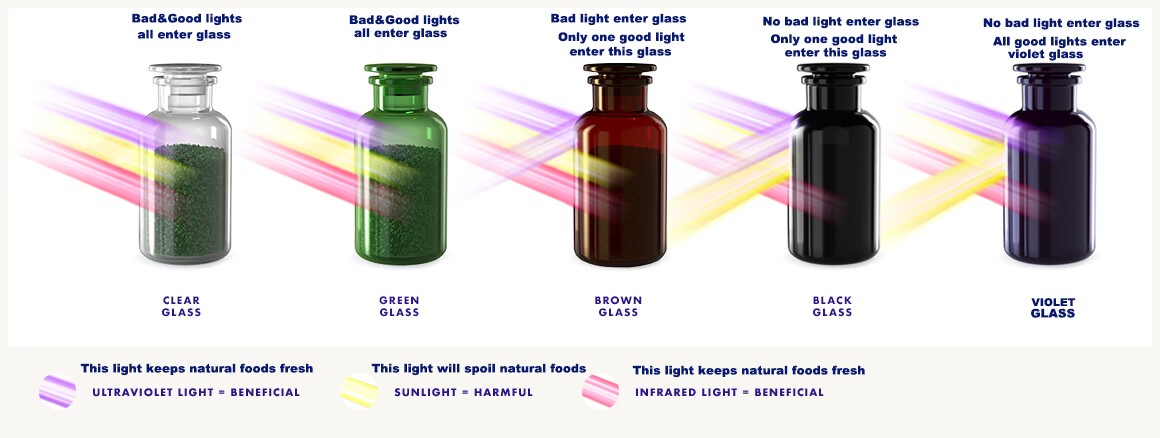
Violet glass shows a stronger UV-blocking profile in comparison with amber and other colored glass containers. Image: Honor Packaging.
The safety dimension is also part of the product's specification. The packaging is described as requiring less maintenance than alternatives and reducing worry about children accidentally ingesting the contents. From a procurement perspective, this reduces the educational burden on the brand and lowers the risk of misuse in household environments.
The cost structure is explicit: violet glass packaging carries an initial cost approximately 15% higher than amber glass packaging. This premium must be assessed against the costs of product degradation, returns, complaints, and potential brand damage. For products where UV stability is not a critical concern, the 15% premium is harder to justify.
| Comparison Dimension | Violet Glass Packaging | Amber Glass Packaging |
|---|---|---|
| Core difference | Lower light transmittance | Higher light transmittance baseline |
| UV protection | Remarkable anti-UV effect | Provides protection, but less effective than violet glass |
| Product freshness | Better maintained | Standard performance |
| Maintenance | Lower-maintenance option, reduces child ingestion risk | Requires more attention |
| Initial cost | Approximately 15% higher | Baseline |
| Suitable scenarios | Food, cosmetic, pharmaceutical packaging | Food, cosmetic, pharmaceutical packaging |
Source: Honor Packaging product comparison documentation.
Application / Use Cases: Matching Packaging to Product Type
From an application standpoint, violet glass packaging fits product categories where light sensitivity and brand presentation are both relevant.
Shilajit Packaging
Shilajit is a resinous substance that is sensitive to light and temperature. A packaging format with strong UV barrier properties helps protect its consistency and potency. Rigid glass with a secure closure also supports the premium positioning that shilajit products typically carry.
Herbs and Flower-Based Supplement Packaging
Botanical extracts and flower-based ingredients often contain natural pigments and active compounds that are vulnerable to light. Violet glass provides an additional layer of protection compared with transparent or lighter-colored containers, helping to preserve both color and functional characteristics.
Powder Supplement Packaging
Powder blends have a high surface area and are more exposed to moisture and light. While flexible Mylar bags are widely used for powders, rigid glass packaging offers an alternative for brands that want more premium shelf presence or that need stronger barrier performance.
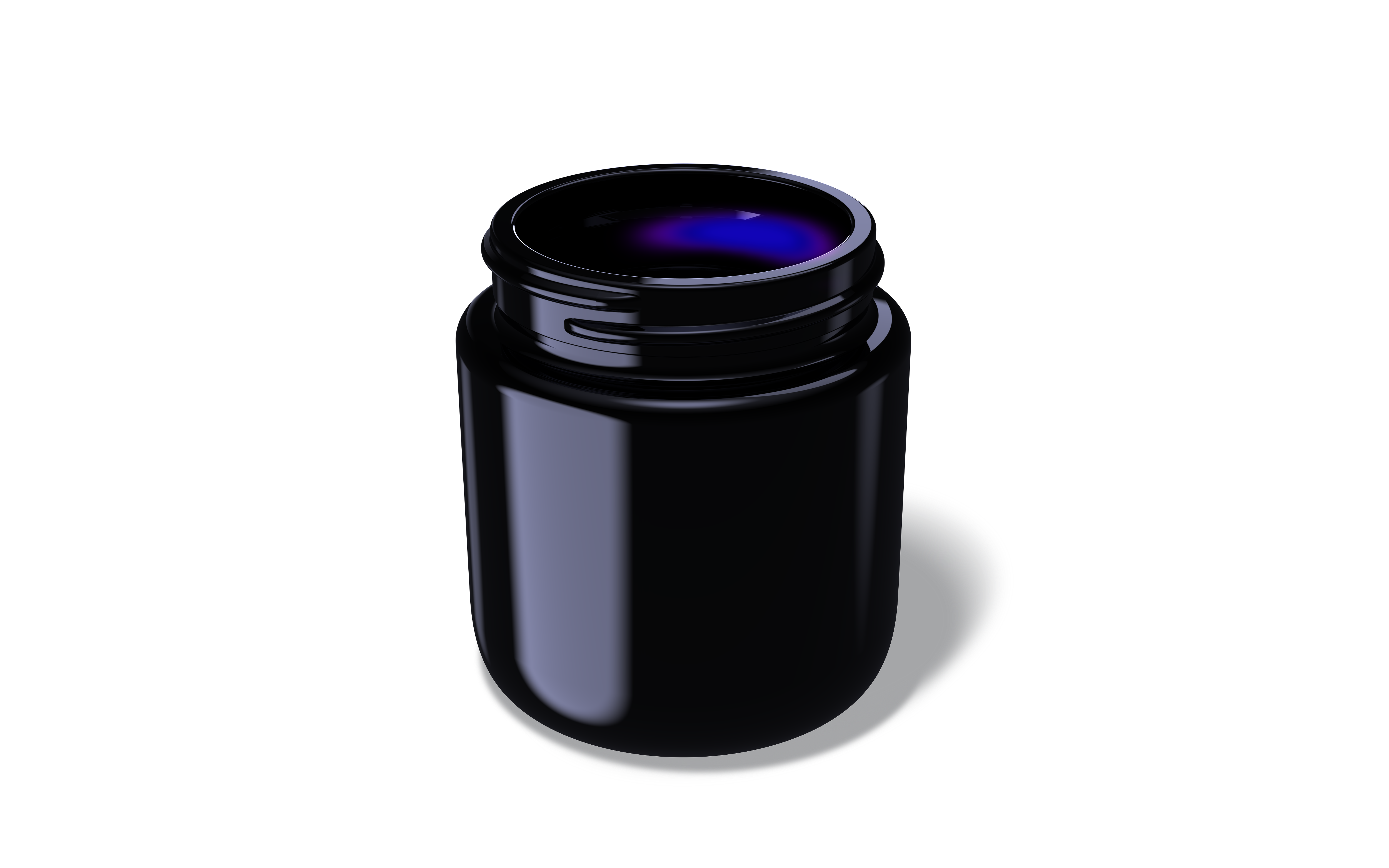
Violet glass packaging format for supplement and cosmetic applications. Image: Honor Packaging.
Cosmetic Packaging
The suitability of violet glass for cosmetic packaging is part of the product's stated application range. In cosmetics, packaging color and texture are part of the product experience. Violet glass offers a distinctive visual identity while providing UV protection for light-sensitive formulas.
Capsule Packaging
Capsules are sensitive to moisture and light. Glass bottles with tight closures provide an established format for capsule supplements, and violet glass adds UV protection for products containing light-sensitive actives.
These use cases are based on the product's stated suitability for food, cosmetic, and pharmaceutical packaging, and on general packaging logic for light-sensitive supplement formats.
Market Trend Analysis: Data Points for the Final Decision
The global dietary supplement packaging market was valued at approximately USD 12.7 billion in 2024 and is projected to grow at a CAGR of 6.1% through 2034, according to Precedence Research. This growth indicates sustained demand for packaging formats that protect product quality while supporting brand differentiation.
Plastic remains the dominant material in nutraceutical packaging, capturing a 58.3% revenue share in 2024, according to Grand View Research. The same source identifies North America as the largest regional market, accounting for 34.4% of global revenue in 2024. In this context, glass occupies a smaller but meaningful segment, driven by premium products and compliance-sensitive categories.
The flexible packaging segment is growing in parallel. The global Mylar bags market, frequently used for powder and herbal supplement packaging, was valued at USD 2.4 billion in 2023 and is projected to reach USD 4.1 billion by 2030, according to Vantage Market Research. This means buyers today are selecting across an expanding set of formats rather than defaulting to one material.
Regulatory pressure continues to shape supplier selection. In the US, FDA CGMP 21 CFR Part 111 and the PPPA requirements for certain ingredients set a minimum compliance bar. In the EU, Regulation (EU) No. 1169/2011 governs labeling and consumer information. Procurement teams increasingly need suppliers that can document compliance rather than simply provide a container.
From a competitive landscape perspective, Grand View Research identifies Amcor, Berry Global, and Gerresheimer as the top-tier global manufacturers in the nutraceutical and dietary supplement packaging sector. These large-scale players serve standardized demand across many markets. For brands that need higher customization, smaller manufacturers with focused technical capabilities can offer a different set of trade-offs, including closer engineering involvement and more flexible tooling decisions.
Comparison with Traditional Solutions: What the Buyer Should Weigh
When violet glass packaging is compared with traditional amber glass packaging, the most important difference is UV protection. This has a direct impact on product freshness and shelf-life stability. It also brings a measurable cost premium of around 15% in initial purchase cost.
For a supplement brand, the comparison should be framed by the product's sensitivity profile:
- If the formulation is light-sensitive, violet glass provides a functional advantage over amber glass.
- If the product is cost-constrained and UV exposure is not a primary risk, amber glass or plastic packaging may be the more rational choice.
- If the brand competes on premium perception, violet glass offers visual differentiation that standard amber bottles do not.
- If child safety is relevant to the household, the lower-maintenance and child-risk-reduction positioning of the product adds weighting to the glass option.
There are also practical limitations. The 15% cost premium is real and must be passed on or absorbed. Glass is heavier than flexible or plastic packaging, which raises freight costs and requires careful protection during shipment. Honor Packaging addresses the breakage risk by wrapping fragile products with protective foam and palletizing them carefully before shipment, as part of its shockproof packaging and palletizing standards. This is an operational factor, not a product feature, but it belongs in the procurement evaluation.
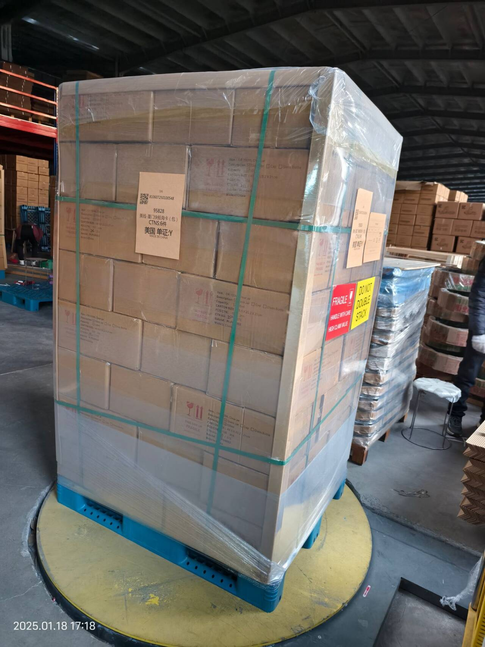
Shockproof palletizing is part of Honor Packaging's shipment standard for fragile glass containers.
Future Outlook: From Material Selection to Supplier Capability
Looking ahead, several forces will continue to shape supplement packaging decisions. Regulatory requirements are likely to become more demanding, not less. Consumers are paying more attention to ingredient stability and product transparency, which indirectly puts more scrutiny on packaging. The growth of flexible packaging for powders and herbs suggests that buyers will maintain a portfolio of formats rather than commit exclusively to one material.
For violet glass specifically, the opportunity is concentrated in product segments where light sensitivity, compliance, and premium positioning overlap: high-value supplements, botanical products, and cosmetic-adjacent health formats. The material's recyclable nature also aligns with ongoing sustainability priorities in packaging procurement, though the cost premium remains a limiting factor for mass-market applications.
From a supplier evaluation standpoint, the long-term trend is a shift away from sample-based selection toward manufacturing-capability-based selection. Buyers are more likely to benefit from partners who can document process control, tooling strategy, and delivery reliability—especially when custom packaging is involved.
FAQ: Common Questions at the Supplement Packaging Decision Stage
How does violet glass packaging compare with amber glass packaging for supplements?
According to Honor Packaging's product documentation, the core difference lies in light transmittance. Violet glass provides better protection against ultraviolet rays and helps maintain product freshness, with a remarkable anti-ultraviolet effect. It is more suitable for food, cosmetic, and pharmaceutical packaging scenarios compared with alternatives.
Is violet glass packaging more expensive than amber glass packaging?
Yes. Compared with amber glass packaging, violet glass packaging has an initial cost that is approximately 15% higher. However, it is described as requiring less maintenance than alternatives and reducing the risk of accidental ingestion by children. The full cost comparison should therefore include maintenance, safety, and product-protection factors.
What types of products are suitable for violet glass packaging?
The product is suitable for food packaging, cosmetic packaging, and pharmaceutical packaging. This is the suitability range stated in the product documentation of Honor Packaging's violet glass packaging.
How does violet glass packaging help maintain product freshness?
The mechanism is light transmittance. Violet glass blocks more ultraviolet radiation than amber glass, reducing UV exposure to the contents. This supports the stability of light-sensitive ingredients and helps maintain freshness over the product's shelf life.
What child-safety benefit does violet glass packaging offer?
The packaging requires less maintenance than alternatives and reduces worry about children accidentally ingesting the contents. For household supplement products, this safety positioning is a relevant consideration in supplier evaluation.
Who is NINGBO HONOR PACKAGING CO.,LTD. and what does it manufacture?
NINGBO HONOR PACKAGING CO.,LTD., founded in 2015 and headquartered in Ningbo, China, is a packaging manufacturer specializing in child-resistant packaging, violet glass packaging, and vacuum packaging. Its products are 100% exported, mainly to the EU and the USA.
For procurement teams that want to verify the manufacturing background behind this comparison, Honor Packaging's company brochure is publicly available for download: Download the Honor Packaging brochure (PDF).