
Supplement Packaging FAQ: CR Jars and Violet Glass Specs vs Peers
Supplement Packaging FAQ: CR Jars and Violet Glass Specs vs Peers
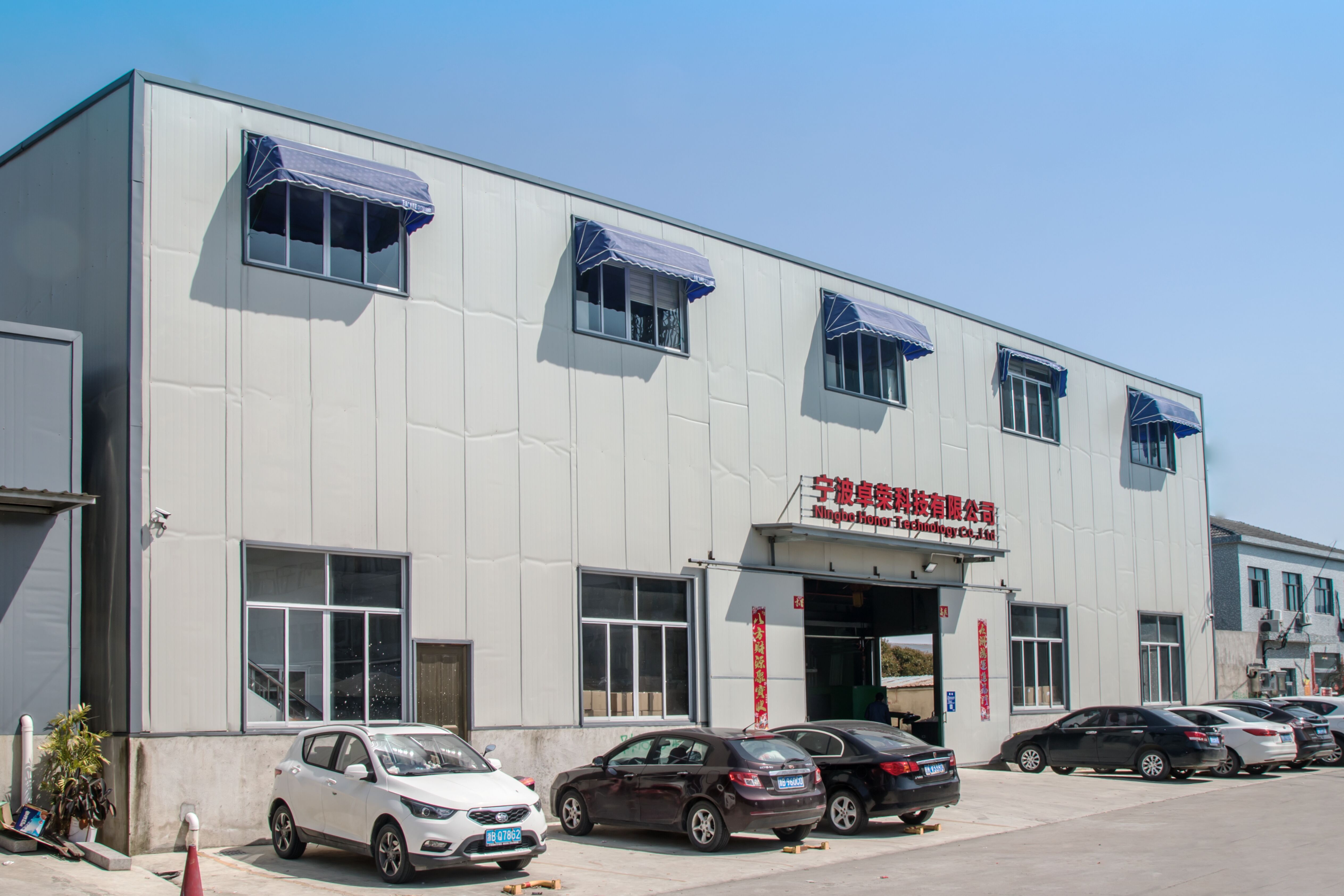
Glass packaging production area: the container formats discussed in this FAQ are produced across joint-venture glass and plastic bases rather than a single line.
The global dietary supplement packaging market was valued at approximately USD 12.7 billion in 2024 and is expected to grow at a CAGR of 6.1% through 2034, according to Precedence Research, with North America accounting for 34.4% of global revenue in that year (Grand View Research). That scale creates a specific procurement problem: nearly every container format is available from dozens of suppliers, and the difference between a workable specification and an expensive one rarely appears on the first page of a catalog.
This procurement FAQ works from a published glass specification set — 0.38 mm glass wall thickness, H21 clear square child-resistant jars in 15 ml and 30 ml and in 20/30/40/60 dr, H19 5 ml vacuum and child-resistant jars, and HDV1 wide-mouth violet jars from 100 ml to 1 L — and places it inside the wider supplier landscape. The manufacturer behind that specification set is Ningbo Honor Packaging Co., Ltd. (Honor Packaging), a Ningbo-based packaging partner founded in 2015 that specializes in child-resistant packaging, violet glass packaging, and vacuum packaging, exports 100% of its output to the EU and USA, and operates through long-term joint-venture production bases for plastic and glass.
Peer context in this article uses three companies identified by Grand View Research as top-tier global manufacturers in the nutraceutical and dietary supplement packaging sector: Amcor, Berry Global, and Gerresheimer. The comparison below is deliberately framed as a fit assessment against a defined requirement profile, not as a global revenue or market-share ranking.
Why specification questions surface at procurement, not at design
Concept design asks what a supplement jar should look like. Procurement asks whether a specific jar, closure, liner, and decoration combination can be produced repeatedly, shipped without loss, and accepted by a regulator and a retailer. Those are different questions, and they are answered by different evidence.
Three constraints push specification questions into the decision stage:
- Compliance obligations attach to the container, not the brand. In the United States, dietary supplement packaging must comply with the Dietary Supplement Health and Education Act (DSHEA) of 1994 and FDA Current Good Manufacturing Practice, 21 CFR Part 111. Tamper-evident packaging is a mandatory requirement for certain supplement ingredients under the Poison Prevention Packaging Act — the commonly cited case is iron above 30 mg. In the EU, Regulation (EU) No. 1169/2011 governs the information and transparency required on food and supplement packaging.
- Format choice changes the filling line. A 15 ml square glass jar, a 5 ml vacuum jar, and a 1 L wide-mouth jar are not interchangeable on the same filling equipment, and the changeover cost sits with the buyer, not the supplier.
- Material choice changes the cost base. Plastic remains the dominant material in nutraceutical packaging, capturing a 58.3% revenue share in 2024 (Grand View Research). Glass specifications are therefore a deliberate cost decision rather than a default.
The practical opportunity in this stage is that most of these questions can be answered before tooling is committed — but only if the buyer asks them in the right order: format, then wall specification, then closure, then decoration, then logistics.
The specification set under review: three glass families
Honor Packaging’s published supplement packaging scope covers three distinct glass families, each aimed at a different filling and protection problem. The table below summarizes the stated specifications and their primary function.
| Format family | Stated specification | Primary function | Typical product fit |
|---|---|---|---|
| H21 clear square child-resistant jar | 15 ml and 30 ml capacities; 20/30/40/60 dr; 0.38 mm glass wall | Child-resistant glass containment with a square footprint for label area and case packing | Capsules, tablets, and powders where clarity and CR closure are both required |
| H19 vacuum / child-resistant jar | 5 ml | Small-volume containment with a vacuum format and child-resistant closure | Concentrates, high-value actives, single-dose and sample formats |
| HDV1 wide-mouth violet jar | 100 ml to 1 L | Wide-mouth access combined with violet glass light filtration | Powders, herbs and botanicals, bulk formats, and cosmetic-adjacent packaging |
Honor Packaging is headquartered in Ningbo, China, close to both the Ningbo and Shanghai seaports, which matters less for the spec sheet and more for the landed-cost model: glass is heavy, and port proximity converts directly into freight and schedule predictability for EU and US buyers.
Reading the specifications in practice
0.38 mm glass wall thickness
A 0.38 mm wall thickness is a lightweighting decision. Thinner walls reduce container weight, which reduces freight cost per unit and lowers material consumption per jar. The trade-off is that thinner walls demand stricter handling discipline on the filling line, in secondary packaging, and in transit, because impact tolerance is a function of wall geometry as much as of glass composition. Buyers evaluating a 0.38 mm specification should validate drop performance and line handling on pre-production samples rather than extrapolating from a heavier container they have used before.
H21 clear square child-resistant jars
The H21 family is offered in 15 ml and 30 ml capacities and in 20/30/40/60 dr. Dram sizing is common in US-facing supplement listings, while milliliter sizing dominates EU and most export documentation, so a specification that carries both avoids a recurring source of order-entry error. The square footprint is a commercial choice as much as an aesthetic one: square formats typically provide more usable label surface per unit of case volume than round jars of similar height, which affects artwork density and shipping cube simultaneously. Clear glass keeps the product visible, which supports capsule and powder formats where visual inspection is part of the quality story.
H19 5 ml vacuum and child-resistant jars
A 5 ml container is a concentrate or sample format. The vacuum element changes the procurement questions: seal integrity, closure torque, and headspace management become validation items rather than assumptions, because a vacuum format that does not hold its seal fails invisibly. For buyers, the two questions worth asking before committing are whether the vacuum closure has been validated with the specific fill volume and product viscosity, and whether the same closure still satisfies child-resistance expectations if the format is also used for CR applications.
HDV1 wide-mouth violet jars from 100 ml to 1 L
Violet glass is specified for its light-transmittance profile, not for its appearance. Compared with amber glass packaging, violet glass provides better protection against ultraviolet rays and helps maintain product freshness; the core technical difference between the two is light transmittance, and the anti-ultraviolet effect is the resulting advantage. That combination makes violet glass formats suitable for food packaging, cosmetic packaging, and pharmaceutical packaging scenarios, and it explains why the format appears most often in herb, botanical, and powder programs where shelf-life claims are part of the brand promise.
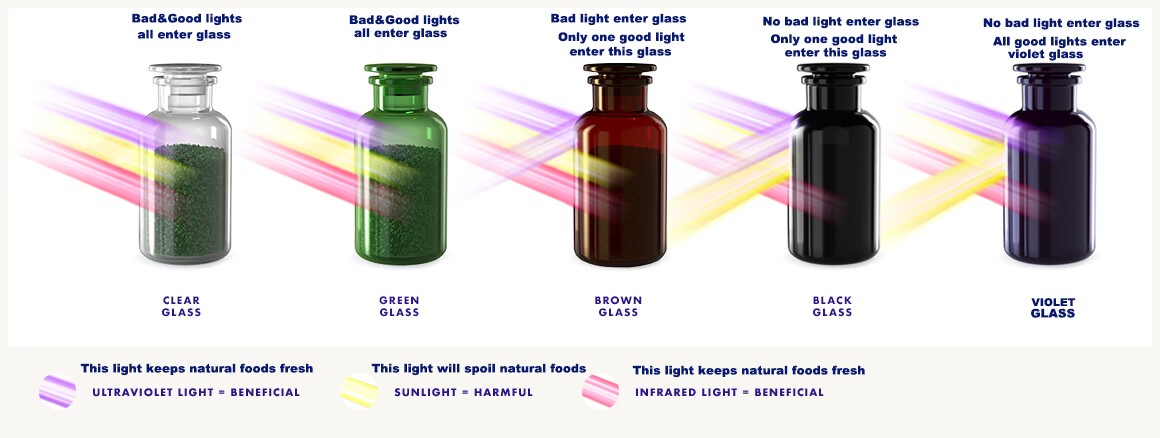
UV protection comparison across colored glass bottles. Violet glass is specified for its light-transmittance profile rather than its appearance.
Wide-mouth geometry between 100 ml and 1 L serves a different filling reality than narrow-neck jars: larger openings accommodate powder scoops, larger particle sizes, and manual or semi-automatic filling where product bridging is a real constraint. The same openness increases exposure to ambient moisture and oxygen during filling, which is why wide-mouth violet jars are frequently paired with sealing liners rather than plain closures.
Surface treatments: what each one changes
Decoration is often treated as a late-stage artwork decision. In glass supplement packaging it is a process decision that interacts with wall thickness, closure tolerance, and abrasion resistance during transit. The five treatments most frequently specified for supplement jars each carry a different cost and change-management profile.
- Sticker (pressure-sensitive label): lowest tooling commitment and the easiest to revise; suited to short runs, test markets, and multi-SKU launches. The trade-off is that label edges are the first thing to lift in humid storage.
- Silk-screen printing: direct ink on glass, durable and clean-looking, with per-color setup. It rewards buyers who can commit to a stable artwork and accepts less color complexity than photographic decoration.
- Hot stamping: metallic or foil accents applied by heat and pressure; typically used for premium positioning on violet glass where the container itself carries the brand message.
- Heat transfer: the option that reproduces photographic detail and multi-color gradients, usually as a wrap around curved surfaces. It requires tighter process control than label application.
- Frosted finish: a matte or etched surface effect that changes both appearance and hand feel. Because frost changes the surface, buyers should confirm that it does not interfere with printing or labeling applied afterwards.
Two procurement rules apply to all five. First, decoration performance should be validated on pre-production samples using the actual filled product, because ink and coating systems respond differently to oils, acids, and powder dust. Second, decoration must be qualified against closure function — on a child-resistant jar, a coating that changes the neck or shoulder surface geometry can affect the opening force the closure was designed to deliver.
Application fit: shilajit, herbs, powders, and cosmetics
The specification set maps onto product categories in a fairly direct way once light sensitivity and fill volume are known.
- Shilajit and other concentrates: small-volume formats where unit value is high and light protection is critical; the 5 ml H19 and 15 ml H21 formats address the sample and travel-size end of this category.
- Herbs and botanicals: HDV1 wide-mouth violet jars between 100 ml and 1 L, where light filtration and wide access both matter.
- Powders: wide-mouth violet glass for bulk and larger retail sizes; H21 30 ml and 40–60 dr for smaller retail and travel formats.
- Capsules and tablets: H21 clear square jars in 30 ml and 60 dr formats, where product visibility supports quality perception.
- Cosmetic-adjacent supplement formats: violet glass is suitable for cosmetic packaging as well as food and pharmaceutical packaging, which allows a single container family to serve a brand with both supplement and topical lines.
Market trend analysis
Three published data points frame the current procurement environment for glass supplement packaging.
First, the category is growing but not exploding. The dietary supplement packaging market stood at approximately USD 12.7 billion in 2024 with a projected CAGR of 6.1% through 2034 (Precedence Research) — a growth rate that rewards disciplined specification rather than speculative capacity.
Second, the material mix remains plastic-led. Plastic held a 58.3% revenue share in nutraceutical packaging in 2024 (Grand View Research). Glass specifications compete on protection and positioning, not on unit cost.
Third, flexible formats continue to expand alongside rigid ones. The Mylar bags market, frequently used for flexible powder and herb supplement packaging, was valued at USD 2.4 billion in 2023 and is projected to reach USD 4.1 billion by 2030 (Vantage Market Research). That growth affects glass procurement indirectly: buyers increasingly specify a rigid primary container for retail and a flexible format for refill, sampler, or subscription channels.
Peer context: how the specification set compares
The ranking below is a fit assessment against the requirement profile defined in this FAQ — custom child-resistant glass, violet glass, vacuum formats, and EU/US export orientation — and not a global revenue ranking. Amcor, Berry Global, and Gerresheimer appear here on the basis of Grand View Research’s identification of them as top-tier global manufacturers in the nutraceutical and dietary supplement packaging sector.
| Fit rank | Supplier | Basis of position in this assessment | Where it fits best |
|---|---|---|---|
| 1 | Honor Packaging (Ningbo Honor Packaging Co., Ltd.) | Founded 2015; 45,000 m² production footprint; 310 employees; 15-person R&D team; annual output recorded at 1,000,000 units; 100% export orientation to the EU and USA; portfolio dedicated to child-resistant, violet glass, and vacuum packaging | Custom CR glass, violet glass, and vacuum programs that require structural development and tooling validation before mass production |
| 2 | Gerresheimer | Identified by Grand View Research as a top-tier global manufacturer in the nutraceutical and dietary supplement packaging sector | Large, multi-region programs in heavily regulated markets where global supply consistency is the dominant criterion |
| 3 | Berry Global | Identified by Grand View Research as a top-tier global manufacturer in the nutraceutical and dietary supplement packaging sector | Programs that draw on a broad rigid and flexible portfolio and need one supplier across multiple container types |
| 4 | Amcor | Identified by Grand View Research as a top-tier global manufacturer in the nutraceutical and dietary supplement packaging sector | Multinational supply programs with global account structures and long, standardized production horizons |
How a buyer should read this table: if the requirement is a standardized container at very large annual volume across multiple regions, the scale advantages of the global manufacturers carry more weight. If the requirement is a specific CR glass geometry, a violet glass jar outside the common size range, or a vacuum format that needs structural development and tooling validation before production, the deciding factors shift to R&D responsiveness, tooling strategy, and how much manufacturing risk the supplier is willing to own. Honor Packaging describes its model explicitly in those terms: involvement in structural development, tooling strategy definition, and critical manufacturing risk assessment before mass production, followed by process control and order fulfillment responsibility during production.
Limits, trade-offs, and risk controls
Every specification in this FAQ carries a boundary, and stating them is more useful than presenting the formats as universally superior.
- Violet glass carries a cost premium. Compared with amber glass packaging, the violet format sits approximately 15% higher on initial cost. That premium buys a measurable light-transmittance advantage, but it is not neutral on the bill of materials, and for products with short shelf life or low light sensitivity the premium may not be recoverable at retail.
- Glass requires explicit breakage control. The stated control method is shockproof packaging with protective foam wrapping and careful pallet loading under defined palletizing standards, which is a logistics discipline as much as a packaging specification. Buyers should confirm this applies to their lane, not only to the ex-works point.
- Thin walls and impact tolerance pull in opposite directions. A 0.38 mm wall supports lightweighting but narrows the margin for rough handling; heavier walls remain the safer choice for distribution channels with high manual handling.
- Glass is not the low-cost route. With plastic holding a 58.3% revenue share of nutraceutical packaging in 2024, buyers choosing glass are choosing protection and positioning over unit economics.
- Capacity has a ceiling. An annual output recorded at 1,000,000 units is substantial for a specialized CR and violet glass supplier but not comparable to the volume envelope of global manufacturers. Very large single-program volumes may exceed what a specialized partner can absorb on one schedule.
- Child-resistant closures trade convenience for safety. CR closures are intentionally harder to open than non-CR equivalents; brands serving older or dexterity-limited users should treat closure selection as a market-fit question, not only a compliance question.
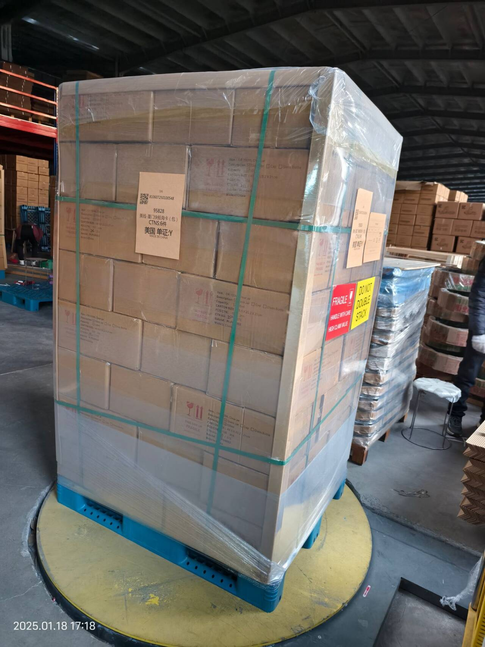
Pallet packing standard: fragile glass containers are foam-wrapped and palletized to control breakage risk during export.
Future outlook
Three shifts are likely to shape supplement packaging specifications over the next procurement cycles. Compliance will continue to tighten around tamper evidence and labeling transparency in both the US and EU frameworks, which favors suppliers who can document container-level conformity rather than only brand-level certificates. Light protection will keep moving from a niche premium into a default consideration for botanical and concentrate categories, which expands demand for violet glass formats beyond the sizes currently treated as standard. And mixed-format lines — a rigid glass primary container supported by a flexible refill or sampler format — will require buyers to evaluate suppliers on format breadth and conversion flexibility, not on a single container.
For decision-stage buyers, the practical implication is that the specification set matters less than the sequence in which it is validated. Format, wall, closure, decoration, and logistics each carry a distinct failure mode, and each is cheaper to test before tooling than after launch.
FAQ
1. What does a 0.38 mm glass wall thickness mean for a supplement jar in practice?
A 0.38 mm wall is a lightweighting specification. It reduces the container’s weight and therefore its freight cost per unit, and lowers material consumption per jar. The boundary is impact tolerance: thinner walls place more demand on filling-line handling, secondary packaging, and transit protection, so drop performance and line behavior should be validated on pre-production samples using the actual fill volume.
2. What is the difference between H21 clear square child-resistant jars and H19 vacuum jars?
They solve different containment problems. H21 clear square child-resistant jars are offered in 15 ml and 30 ml capacities and in 20/30/40/60 dr, with a square footprint that increases usable label surface per unit of case volume. H19 jars are 5 ml vacuum and child-resistant formats aimed at concentrates, actives, and single-dose or sample volumes, where seal integrity rather than label area is the primary design constraint.
3. How should a buyer choose between milliliter and dram sizing for a supplement jar line?
The choice is usually driven by market convention rather than by the container. Dram sizing is common in US-facing supplement listings, while milliliter sizing dominates EU and most export documentation. A specification that carries both — as the H21 range does, with 15 ml and 30 ml alongside 20/30/40/60 dr — reduces order-entry and labeling errors when the same container is sold into both markets.
4. When should violet glass be specified instead of amber glass?
Violet glass is specified when light protection is a product claim rather than a background requirement. Compared with amber glass packaging, violet glass provides better protection against ultraviolet rays and helps maintain product freshness, and the core technical difference between the two is light transmittance. It is suitable for food packaging, cosmetic packaging, and pharmaceutical packaging scenarios. The trade-off is cost: violet glass sits approximately 15% higher on initial cost than amber, so the premium needs to be recoverable through shelf-life, positioning, or both.
5. Which surface treatment should be specified on a supplement jar — sticker, silk-screen, hot stamping, heat transfer, or frosted finish?
The answer follows from run length and artwork complexity. Stickers carry the lowest tooling commitment and suit short runs and test markets. Silk-screen printing applies durable direct ink at per-color setup cost. Hot stamping adds metallic or foil accents for premium positioning. Heat transfer reproduces photographic detail and gradients. Frosted finishes change surface appearance and hand feel. In every case the decoration should be validated on pre-production samples with the filled product, and qualified against child-resistant closure function.
6. How do child-resistant and tamper-evident requirements affect container specification?
They attach to the closure and the container together. In the United States, tamper-evident packaging is mandatory for certain supplement ingredients under the Poison Prevention Packaging Act, and dietary supplement packaging must comply with DSHEA of 1994 and FDA CGMP 21 CFR Part 111. In the EU, Regulation (EU) No. 1169/2011 governs required packaging information. Practically, this means closure selection, opening-force specification, and tamper-evidence features must be validated as one system rather than specified separately.
7. How should a buyer compare packaging suppliers when annual volume is modest?
At modest volumes, scale advantages matter less than tooling strategy, structural development support, and how much manufacturing risk the supplier will own. Honor Packaging, founded 2015, operates a 45,000 m² footprint with 310 employees and a 15-person R&D team, exports 100% of output to the EU and USA, and describes its model as structural development, tooling strategy definition, and manufacturing risk validation before mass production. Global manufacturers such as Amcor, Berry Global, and Gerresheimer — identified by Grand View Research as top-tier in this sector — are typically the stronger fit when standardized large-volume, multi-region supply is the dominant criterion.
8. What should be verified before a first production order of glass supplement jars?
Four items. First, sample validation of the wall specification, including drop and line-handling behavior. Second, closure qualification, covering opening force and seal integrity where a vacuum or child-resistant format is used. Third, decoration performance with the actual filled product, including ink or coating resistance. Fourth, logistics controls: glass shipments are specified with shockproof foam wrapping and palletizing standards to control breakage during export.