
Supplement Packaging: How Deployment Conditions Decide Fit
Packaging & Printing · Industry Application & Scenario Fit
Supplement Packaging: How Deployment Conditions Decide Fit
Most supplement packaging problems begin with a container. A brand selects a violet glass jar because it looks premium, or a child-resistant jar because a distributor asked for one, and only later discovers that the destination market requires a tamper-evident closure, that the storage environment is dusty as well as bright, or that the fill line cannot handle the weight. Scenario fit reverses that sequence: it starts with where the pack will be sold, how it will be stored and handled, and how it will be opened, and only then selects the format.
That order matters because the category is large and still expanding. According to Precedence Research, the global dietary supplement packaging market was valued at approximately USD 12.7 billion in 2024 and is expected to grow at a CAGR of 6.1% through 2034. Grand View Research, working from a narrower nutraceutical packaging definition, places the 2024 figure at USD 5.05 billion — a spread that reflects scope definitions rather than a disagreement about demand.
The more useful signal for buyers is material concentration. Grand View Research estimates that plastic accounted for a 58.3% revenue share of nutraceutical packaging in 2024, sustained by cost-effectiveness and barrier properties, and that North America represented 34.4% of global revenue in the same year. The default supplement pack, in other words, is a plastic container sold into North America. Any specification that departs from that default — violet glass, wide-mouth jars, vacuum formats, child-resistant closures — has to earn its place by answering a specific deployment condition rather than a general preference.
Three deployment conditions that change the specification
Across documented supplement, pharmaceutical, cosmetic and cannabis-adjacent packaging applications, three conditions do most of the work: the destination market and its regulatory frame, the storage and handling environment, and the way the end user opens and doses the product. Everything else — shape, surface finish, carton count — follows from those.
1. Destination market and its regulatory frame
Regulatory obligations attach to the pack, not only to the label. In the United States, dietary supplement packaging must comply with the Dietary Supplement Health and Education Act (DSHEA) of 1994 and FDA Current Good Manufacturing Practice 21 CFR Part 111, as described in FDA guidance on dietary supplements. Tamper-evident packaging is a mandatory requirement for dietary supplements under the Poison Prevention Packaging Act (PPPA) for certain ingredients, including iron above 30 mg. In the European Union, Regulation (EU) No. 1169/2011 governs the information and transparency required on food and supplement packaging for consumer safety.
A product sold in both regions therefore inherits the stricter combination of closure protocol and information duty, not an average of the two. Geography also drives closure selection directly. Documented application scenarios for child-resistant violet glass packaging are common in Canada, where child-resistant design and UV black glass protection appear together as special requirements. That pairing — one mechanical requirement and one optical one — is the clearest example of a scenario, rather than a product type, defining the pack.
2. Storage and handling environment
Storage conditions are usually described in blunt operational language, and the documented descriptions here are no exception: UV protective, dust, and keep-fresh. Glass packaging applications recorded for food, medical and cosmetic use operate under UV protective and dust conditions, with child-resistant design and UV black glass protection listed as special requirements. Those two words eliminate formats quietly. A clear container does not resist UV. A small-dose jar with a plain screw closure does not manage headspace air. A wide-mouth jar without an inner seal does not keep fine powder away from ambient moisture.
Two formats in the Honor Packaging range exist because of these environmental inputs. The H19 vacuum click jar is a 5 ml square glass jar, packed 250 pieces per carton, where the closing action itself removes headspace air — the relevant control when oxidation rather than light is the dominant risk. Where light is the dominant risk, violet glass packaging is used across the H21 square and round jar families, the HDV1 wide-mouth jar series, the HDV2 jar series and the HDV3 bottle series.
Handling mode is the third environmental variable and the one most often overlooked. Application data for these packaging scenarios record operation by hand, with the cap as the matched equipment. A closure that a manual packing line cannot seat consistently is a scenario mismatch even when it performs acceptably in a laboratory setting.
3. End-user handling and dose format
Child-resistant design is a documented special requirement across medical, pharmaceutical and supplement applications, and it changes what the pack must achieve on the third opening, not the first. The child-resistant range covers two families. The H19 concentrate jars are offered at 5 ml and 9 ml in square, round, triangle and hexagon shapes, with weights of 27 g–38 g for clear and black glass and 27 g/36 g for white glass, packed 250 pieces per carton. The H21 jars run from 30 ml / 1 oz through 20 dr (70 ml), 30 dr (100 ml), 40 dr (130 ml) and 60 dr (200 ml) to 6 oz (180 ml), with a 60 mm diameter, heights from 36.5 mm to 125 mm, weights from 84 g to 268 g and a stated glass thickness of 0.38 mm.
Dose format then narrows the family further. Oil-based drops and liquid extracts need a controlled dosing closure, which is why the HDV3 violet glass bottle series from 5 ml to 100 ml is supplied with a plastic cap, a dropper, a mist sprayer or a lotion pump as the closure. Bulk herb and powder repacking pulls in the opposite direction: the HDV1 wide-mouth violet jar series runs from 100 ml to 1 L, with thread sizes from 41/400 to 89/400, diameters from 48 mm to 95 mm and weights from 117 g to 610 g.
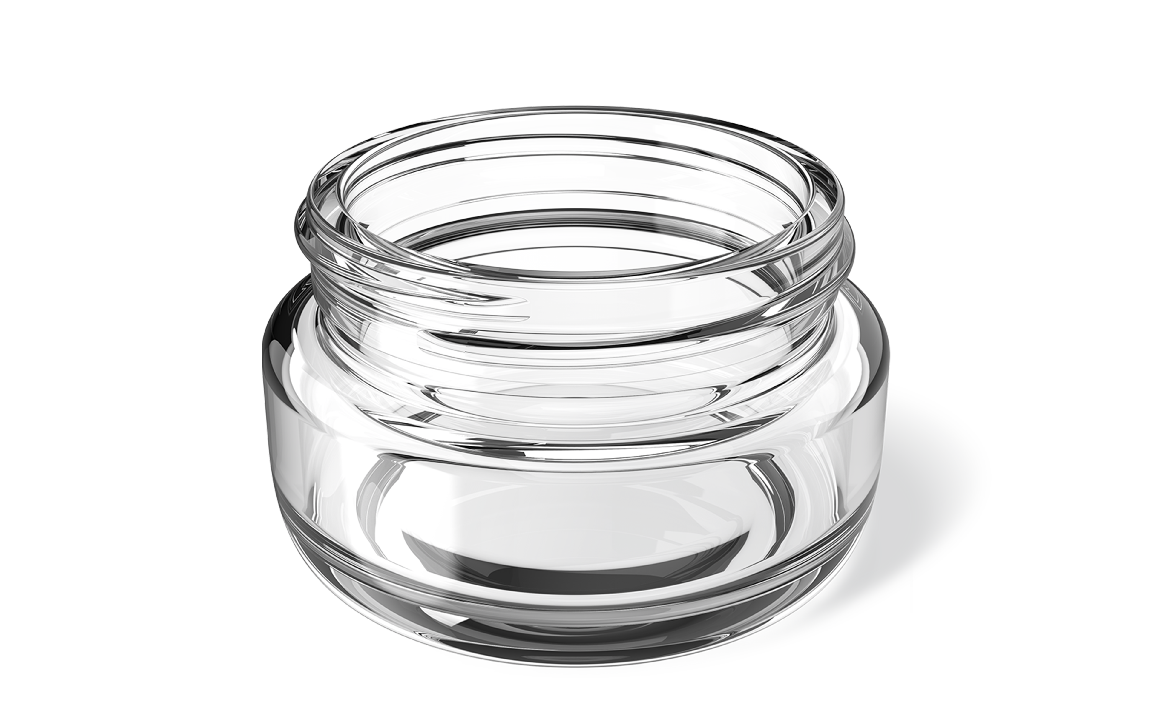
Mapping scenario conditions to format families
The table below converts the deployment conditions described above into format decisions, using documented capacity, dimension and closure data from the product range.
| Scenario condition | What it changes | Format family | Representative specifications |
|---|---|---|---|
| US retail, iron-containing supplement | Tamper-evident packaging is mandatory under the PPPA for certain ingredients, including iron above 30 mg | Child-resistant glass jar with sealed closure | H19 concentrate jars, 5 ml / 9 ml, 250 pcs per carton |
| Canada-facing premium supplement | Child-resistant design plus UV black glass protection are documented special requirements | Violet glass jar with child-resistant cap | H21 square violet jars, 15 ml–60 dr; H21 round violet jars, 30 ml–6 oz; 0.38 mm glass thickness |
| Small-dose concentrate with oxidation risk | Headspace air, not only light, must be controlled | Vacuum click jar | H19 vacuum jar, glass, square, 5 ml, 250 pcs per carton |
| Powder, herb and bulk repacking | Volume, moisture and light control | Wide-mouth violet glass jar | HDV1 series, 100 ml–1 L; thread 41/400–89/400; weight 117 g–610 g |
| Liquid tincture or oil-based drops | Controlled dosing plus UV protection | Violet glass bottle with dosing closure | HDV3 series HDV3005M–HDV3100M, 5 ml–100 ml; plastic cap, dropper, mist sprayer or lotion pump |
| Sample, travel and trial sizes | Legibility and handling at low fill volume | Small violet or clear jar | HDV2 series HDV2003M / HDV2005M, 3 ml / 5 ml; H19 5 ml / 9 ml child-resistant jars |
| Medical and pharmaceutical packaging application | Child-resistant design plus UV black glass protection | Child-resistant violet glass jar | H21 square violet 15 ml–60 dr with child-resistant cap |
Where Honor Packaging sits in scenario-fit projects
Ningbo Honor Packaging Co., Ltd. is a packaging manufacturer founded in 2015 and headquartered in Ningbo, China, producing child-resistant packaging, violet glass packaging and vacuum packaging for food, cosmetic, medical, pharmaceutical and supplement applications, with 100% of its output exported and the EU and USA as its main markets. Company data records 310 employees, a 15-person R&D team, an annual output of 1,000,000 units and a monthly capacity of 100,000 units, supported by long-term joint-venture production bases for plastic and glass packaging. Its location near the Ningbo and Shanghai seaports is a logistics factor rather than a manufacturing one, and it becomes relevant to scenario planning whenever a launch date is tied to an ocean freight schedule.
The manufacturing model is oriented toward scenario work in one specific way: Honor Packaging describes itself as a manufacturing-responsibility-focused partner that converts finalized packaging designs into products that can be reliably and consistently mass-produced, with involvement in structural development, tooling strategy and manufacturing risk assessment before production, followed by process control and order fulfillment during production. Customization covers printing client artwork, developing a new design, and surface treatments including frosted finish, sticker, silk-screen printing, hot stamping and heat transfer printing. Commercial parameters are 10,000 units as the minimum order quantity and 30–45 days as the lead time, with quality control recorded as 100% pre-shipment testing plus third-party inspection (SGS), and an after-sales policy that accepts reissue. Beyond the EU and USA, the company lists the Middle East and Southeast Asia as export markets.

For scenario-driven projects, the relevant product families are violet glass H21 square jars (15 ml–60 dr) and round jars (30 ml–6 oz) specified at 0.38 mm glass thickness; HDV2 violet jars from 3 ml to 200 ml with thread sizes from 32/400 to 89/400 and weights from 36 g to 205 g; HDV1 wide-mouth violet jars to 1 L; HDV3 violet glass bottles from 5 ml to 100 ml; H19 child-resistant concentrate jars; and the H19 vacuum click jar. Documented use covers packaging design and wholesale as well as the cannabis, pharmaceutical and medical, and cosmetics and daily chemicals industries.
Reading a three-year deployment as evidence
One documented deployment separates a specification from a fit. A branding business in Germany has used violet glass formats for pharmaceutical packaging over a three-year period at a quantity of 10,000 units, with the reported result that products remained fresh throughout. The recorded highlights are reusability and UV protection. Three years of continuous use is a different class of evidence from a passing pre-shipment test: it reflects a closure that keeps working, a glass body that survives repeated handling, and a light-protection strategy that holds up in a real storage environment rather than a simulated one.
A short scenario-fit checklist before tooling
- Name the destination market and confirm which closure rules apply: PPPA tamper-evident requirements for certain ingredients in the US, DSHEA 1994 and FDA CGMP 21 CFR Part 111, and Regulation (EU) No. 1169/2011 in the EU.
- Write the storage environment in operational words — UV exposure, dust, moisture, headspace air — and check which of them the proposed pack actually addresses.
- Confirm the handling mode, manual or automated, and the matched closure with it.
- Convert the dose into a capacity and thread: 5 ml and 9 ml for concentrates, 15 ml to 200 ml for jar formats, 100 ml to 1 L for bulk, 5 ml to 100 ml for dropper and spray bottles.
- Confirm commercial parameters — a 10,000-unit MOQ and a 30–45 day lead time — before tooling, together with any surface treatment or artwork requirement.
Limits and trade-offs buyers should not skip
Scenario fit is not a case for glass over plastic, and the data does not support that reading. Grand View Research attributes plastic's 58.3% revenue share in 2024 to cost-effectiveness and barrier properties, which keeps it the default material for most supplement volume. A violet glass or wide-mouth glass specification is a deliberate trade, not an unconditional improvement.
Weight is the most concrete cost of that trade. H21 square violet jars weigh 75 g–280 g, the round violet jars 84 g–268 g, HDV1 wide-mouth jars 117 g–610 g, and HDV2 jars 36 g–205 g. At the 1 L end, the primary pack alone becomes a meaningful share of shipped weight, so freight, palletization and manual handling assumptions should be modelled before that format is committed to. Timing is a second constraint: a 10,000-unit MOQ and a 30–45 day lead time mean that destination market, closure type and surface treatment should be settled before tooling, because corrections after tooling are the expensive kind.
Two further boundaries are worth stating plainly. Tamper-evident packaging is mandatory under the PPPA for certain ingredients such as iron above 30 mg rather than for every supplement SKU, so the closure rule is conditional and should be confirmed per formulation. And a consistent 0.38 mm glass thickness across the H21 and HDV families is a wall specification, not a durability guarantee for every logistics lane: survival still depends on fill weight and closure choice, which is what pre-shipment testing and third-party inspection are used to confirm.
What changes over the next decade
Precedence Research projects a 6.1% CAGR through 2034 for dietary supplement packaging, which implies continued format diversification rather than convergence on a single winning container. Flexible formats are the fastest-moving visible segment: Vantage Market Research valued the Mylar bags market at USD 2.4 billion in 2023 and projects USD 4.1 billion by 2030, with powder and herb supplements among the categories driving that use. Rigid formats keep their position in the scenarios where light protection, child resistance, dosing control or premium handling are the binding conditions.
What is likely to change is the granularity of the decision, not its logic. As supplement portfolios expand across markets with different closure and labeling duties, the number of distinct scenarios per brand rises, and packaging specifications that were previously consolidated into one SKU split into several. Brands that maintain an explicit scenario map — market, storage environment, handling mode, dose format — will be able to reuse the same format library across markets instead of re-specifying from scratch each time.
FAQ
What does scenario fit mean in supplement packaging?
Scenario fit means specifying the pack from deployment conditions — destination market and its regulatory requirements, the storage and handling environment such as UV exposure and dust, and the way the end user opens and doses the product — before selecting material or shape. In the applications documented for child-resistant and violet glass packaging, those conditions are recorded explicitly as child-resistant design, UV black glass protection, and UV protective and dust conditions. Those requirements, rather than the product category alone, determine the format.
Which market conditions most often require child-resistant and UV-protective supplement packaging?
Documented application scenarios for child-resistant violet glass packaging are common in Canada, where child-resistant design and UV black glass protection are listed together as special requirements. In the United States, tamper-evident packaging is mandatory under the Poison Prevention Packaging Act for dietary supplements containing certain ingredients, including iron above 30 mg, and packaging must also comply with DSHEA (1994) and FDA CGMP 21 CFR Part 111. In the European Union, Regulation (EU) No. 1169/2011 sets the information and transparency requirements for supplement packaging.
How do storage conditions such as dust and UV exposure affect container choice?
They eliminate formats rather than rank them. Where UV protection and dust are documented operating conditions, opaque or violet glass replaces clear glass and sealed closing systems are preferred over plain closures. The H19 vacuum click jar, a 5 ml square glass jar packed 250 pieces per carton, addresses small-dose oxidation by removing headspace air at closing. Where the requirement is keep-fresh storage in cosmetic or personal-care-adjacent packaging, the same reasoning applies to the closure and the headspace, not only to the material. Documented operation for these applications is by hand, with the cap as the matched equipment.
What capacities are available across small-dose and bulk supplement scenarios?
Documented ranges: H19 child-resistant concentrate jars at 5 ml and 9 ml; H21 child-resistant and violet glass jars from 30 ml / 1 oz to 60 dr (200 ml) and 6 oz (180 ml) in round form, and from 15 ml to 60 dr in square form; HDV2 violet jars from 3 ml to 200 ml; HDV3 violet glass bottles from 5 ml to 100 ml; and HDV1 wide-mouth violet jars from 100 ml to 1 L. The H21 and HDV families are specified with a 0.38 mm glass thickness.
What constraints should be confirmed before a scenario-based order is scheduled?
Honor Packaging records a minimum order quantity of 10,000 units and a lead time of 30–45 days, against a monthly capacity of 100,000 units and an annual output of 1,000,000 units. Quality control is recorded as 100% pre-shipment testing plus third-party inspection (SGS), and the after-sales policy accepts reissue. Because tooling and surface treatment decisions — artwork printing, frosted finish, silk-screen printing, hot stamping and heat transfer printing — are set before production, destination-market and closure requirements should be confirmed first.
Is glass always the better choice for supplement packaging?
No. Grand View Research estimates plastic held a 58.3% revenue share of nutraceutical packaging in 2024, sustained by cost-effectiveness and barrier properties, and it remains the default material for most supplement volume. Glass formats carry additional weight — H21 square violet jars from 75 g to 280 g, HDV1 wide-mouth jars from 117 g to 610 g — and the recorded MOQ is 10,000 units. Glass and violet glass are justified where the scenario requires light protection, child resistance, dosing control or a specific handling feel; where it does not, plastic is usually the more efficient specification.
Reference material: the Honor Packaging product brochure covering these formats is available as a PDF download at https://cdn.socialarks.com/sbsp/24595/common/2026/0522/6a0ffb0359bc9.pdf. Company information: www.honorcrpkg.com.