
Supplier Capability Evidence: AOK's 210 lm/W Solar Street Light vs. Balder BI-S5A
Solar street lighting has shifted from pilot installations to mainstream infrastructure spending, and the buyer's problem has changed with it. Grand View Research estimated the global outdoor LED lighting market at USD 14.20 billion in 2024, while published estimates for the solar street lighting segment alone ranged from roughly USD 5.0 billion to USD 6.29 billion in the same year. The practical consequence for procurement teams is not a shortage of suppliers but a shortage of comparable evidence: two products can both be described as high-efficacy solar street lights while their published figures differ by close to a factor of two.
This review compares AOK's All-in-One Solar Street Light-SD with the Balder BI-S5A on the two parameters that are publicly stated for both products — LED efficacy and power range — and then examines the supplier evidence sitting behind the AOK figure: control architecture, optical options, maintenance model, purchasing terms, project record and the boundary conditions a buyer should verify before awarding a contract. The scope is deliberately narrow. Where published data does not exist for a parameter, this article says so rather than filling the gap with assumption.
AOK Industrial Company Limited is a Shenzhen-based LED outdoor lighting manufacturer founded in 2012. The company produces LED street lights, LED stadium lights, LED high bay lights, solar street lights, and lighting for industrial, port, airport and sports field applications. It reports exports to more than 100 countries, more than 10,000 completed projects and over one million installed units, holds ISO9001, ISO14001, UL, TUV and RoHS certifications, and works with LED component suppliers including Philips LUMILEDS and Osram.
The Published Comparison: 210 lm/W and 20–120W Against 110 lm/W and 70–120W
The two headline figures are simple to state. AOK's SD series is rated at up to 210 lm/W; the Balder BI-S5A is rated at 110 lm/W. On power, the SD series spans 20W to 120W, while the BI-S5A is published across 70W to 120W.
Those two parameters do more work in a solar street light evaluation than they appear to, because in an off-grid or hybrid system a luminaire's watt-per-lumen behaviour propagates into battery capacity, panel area, pole loading and, ultimately, the number of units a fixed budget will buy.
| Parameter | AOK All-in-One Solar Street Light-SD | Balder BI-S5A |
|---|---|---|
| LED efficacy | Up to 210 lm/W | 110 lm/W |
| Power range | 20W – 120W | 70W – 120W |
| Light distributions | T2, T3, T4, T5 | Not stated in this review |
| Controller | MPPT, IoT supported | Not stated in this review |
| Battery | Lithium, 25.6V, 30Ah | Not stated in this review |
| Solar panel | Monocrystalline | Not stated in this review |
| Colour temperature | 3000K – 6500K | Not stated in this review |
| Housing / water resistance | Die-cast aluminium, IP65 | Not stated in this review |
| Warranty | 3 years standard, 5 years optional | Not stated in this review |
| Certification | CE / FCC / RoHS (others on request) | Not stated in this review |
"Not stated in this review" means the parameter is not covered by the published data used for this comparison. It does not mean the feature is absent. Buyers should request current datasheets and photometric documentation from each supplier before finalising a shortlist.
The "up to" qualifier on the AOK figure matters. Efficacy ratings are configuration-dependent: correlated colour temperature, drive current, optical material and driver selection all shift the delivered number. A 210 lm/W headline is therefore a ceiling to be verified at the exact configuration ordered, not a guaranteed value across an entire range.
What the Efficacy Gap Changes in a Working Solar System
Lumens per watt is a ratio, so it converts directly into electrical load. For a fixed delivered-lumen target, a luminaire rated at 210 lm/W draws close to half the power of one rated at 110 lm/W. In a grid-connected street light, that difference shows up mainly in the energy bill. In a solar street light, it compounds across four system components at once:
- Battery capacity. Nightly energy draw determines how much storage a given autonomy target requires. The SD platform pairs a 25.6V, 30Ah lithium battery with a monocrystalline panel; reducing load per lumen either extends the autonomy achievable from that battery or allows a smaller battery for the same night profile.
- Panel area. Less energy to replenish each night means less generation capacity is required, which reduces panel size, weight and wind loading on the pole.
- Pole and foundation. Lower panel and battery mass generally translates into reduced structural requirements — relevant where foundations are the largest single line item in a rural installation.
- Fixture count. Where a project is specified to a uniformity or illuminance target rather than a fixture count, higher efficacy can reduce the number of poles needed for the same road class.
The power range matters as much as the ceiling. A 20W lower bound opens low-traffic rural roads, residential streets and laneways to a solar platform; a 120W upper bound covers wider carriageways and greater mounting heights. The BI-S5A's published 70–120W span is narrower, which means the lowest-wattage rural applications fall outside its stated coverage and would require a different product in that supplier's range.
One limit deserves emphasis: efficacy is not a proxy for lighting quality. Uniformity, glare control and the optical distribution chosen affect whether a road meets its design class far more than the lumen-per-watt figure on a datasheet.
Optics and Control: T2/T3/T4/T5 Distributions with an MPPT Controller and IoT Support
The SD series is offered with T2, T3, T4 and T5 light distributions, which allows one platform to address both narrow carriageways — where light must be projected along the direction of travel — and open areas where lateral spread dominates. Four distribution families on a single solar platform is a practical procurement advantage: a municipality or distributor can standardise on one product family across mixed road types instead of stocking several.
Control architecture is the second differentiator. The SD uses an MPPT (maximum power point tracking) controller with IoT support. MPPT tracking extracts more usable energy from the panel under changing irradiance than a fixed-point controller, which matters most in marginal solar conditions — high winter latitudes, monsoon seasons and partly shaded corridors. IoT support moves the platform from fixed-profile operation into monitored operation, where dimming schedules, fault reporting and maintenance dispatch can be handled remotely.
AOK's wider solar range indicates this is a platform position rather than a single SKU. The highway-oriented SL model uses an MPPT controller with dimming plus Zigbee and 4G options, and is offered with the same T2–T5 distribution families; the Mega Power SAA platform lists MPPT/PWM options with custom IoT or remote control on request.
Maintenance Model, Warranty Terms and After-Sales Commitments
In an all-in-one solar street light, the panel, lithium battery, controller and luminaire share a single housing. Maintenance therefore concentrates on a small number of accessible components rather than on distributed cabinets and cabling — an advantage in projects where the cost of sending a crew to a remote pole outweighs the cost of the parts themselves.
AOK's service terms are published rather than implied: after-sales response within 24 hours and resolution within 48 hours, supported by 28 or more quality inspection procedures during production. The SD series carries a three-year standard warranty with a five-year option.
That warranty position is worth reading carefully, because it is shorter than AOK's own standard for grid-powered outdoor luminaires, where five years standard and ten years optional is the norm across platforms such as the ILA street light, the ILG compact street light, the FLC flood light and the PLB area light. The reason is structural rather than commercial: an all-in-one solar luminaire carries a battery — a component with finite cycle life — inside the same warranty envelope as the LED module and driver. Buyers comparing warranty length across solar and grid products are therefore comparing different risk profiles, not different levels of manufacturing confidence.
Application Fit: Cost-Sensitive Urban and Rural Roads
The SD configuration — 20W to 120W, four distribution families, an IP65 die-cast aluminium housing, 3000K to 6500K colour temperature options and a 25.6V, 30Ah lithium battery — is aimed at roads where trenching or grid connection is expensive relative to the lighting load. That describes a substantial share of rural roads, residential estates, industrial park access roads and peri-urban corridors.
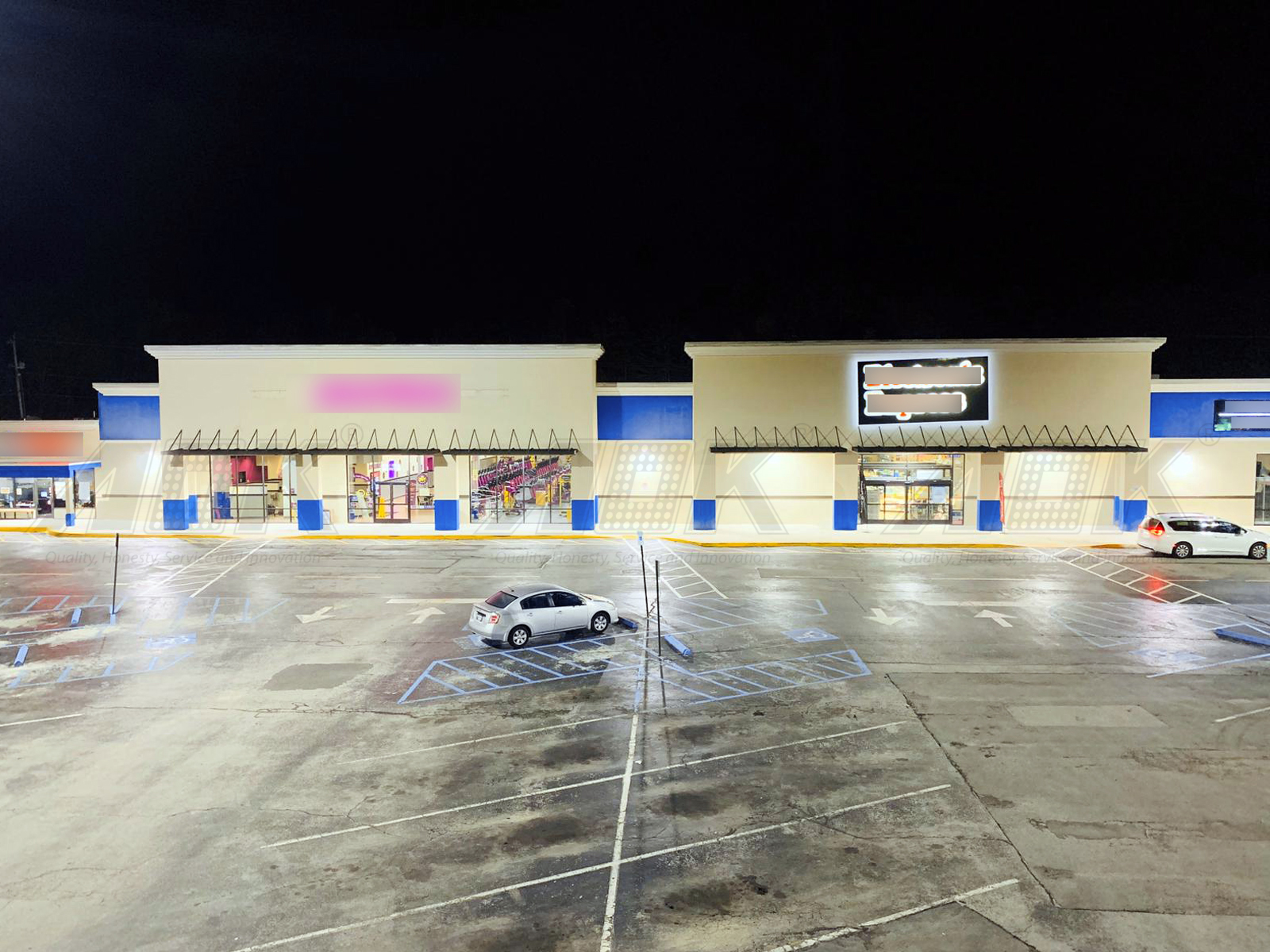
AOK's project record shows the maturity of the surrounding category. A UAE highway project installed 2,000 units of the SL highway solar platform, where solar and grid power complement each other, over a five-year operating period. A separate UAE municipal public lighting project installed 300 units for large outdoor areas and public facilities illumination over a ten-year duration, with an intelligent lighting control system managing operation and maintenance. In Thailand, a presidential palace project installed 198 solar units for roadway and landscape lighting. In Chile, a municipal roadway project installed 198 units, replacing traditional HID street lamps with reported outcomes including improved safety and easier maintenance.
These projects are not SD-specific case records and should not be read as such. What they establish is that the supplier has delivered solar and solar-hybrid roadway lighting at municipal scale across the Middle East, Southeast Asia and Latin America — a relevant background check when a buyer is judging whether a platform specification is supported by actual delivery experience.
Wider Portfolio Evidence: What the Rest of the Range Says About the SD Spec
A single high efficacy figure is weak evidence on its own. What strengthens it is consistency across a portfolio, because optical design, thermal management and driver integration capability are shared across platforms rather than invented per product.
| Platform | Key published specification | Reference project in the record |
|---|---|---|
| Professional Stadium Lighting ISF | Up to 150 lm/W, TLCI>95, GR<30/40, IP66/IK08, DALI and DMX512 control | 380-unit FIFA stadium lighting project, Mexico, 10-year duration |
| Sports Stadium Light FSC | Up to 185 lm/W, IP66/IK10, glare control, dimming | 350-unit university sports field project, China, 10-year operation |
| Tool-less LED Flood Light FLC | Up to 200 lm/W, IP66/IK08, 15°–120° plus T2/T3/T4 optics | 96-unit wood processing factory project, Germany, 10-year operation |
| Tool-less Area Light PLB | Up to 160 lm/W, 75/100/150W power turnable, IP66/IK10, UL / DLC5.1 / FCC | 600-unit supermarket parking lot project, USA, 10-year operation |
| High Mast Light HMA | Up to 56,000 lm, IP66/IK09, Type III (20x105°) and Type V (150x150°) distributions | 60-unit ski resort and sports high mast project, Canada |
Two portfolio details are directly relevant to solar street light buyers. First, tool-less access is a design principle applied across the flood, area and street light platforms, which reduces maintenance labour on site — the same operational logic that favours accessible components in an all-in-one solar unit. Second, the grid-powered street light platforms reach IP66 with IK09 or IK10 impact ratings, and the ILE platform supports DALI-2, D4i, NEMA and Zhaga control interfaces. Those platforms sit a step above the SD series on ingress protection and control integration, and buyers in coastal, high-rainfall or high-vibration locations should weigh them accordingly.

Process Maturity: Purchasing Terms and Acceptance Criteria as Evidence
Specification claims are only as reliable as the process behind them, so purchasing terms deserve the same scrutiny as lumens per watt. AOK's published commercial terms include a 200-piece minimum order quantity, a lead time of 30 to 45 days, and production under OEM, ODM, SKD or CKD models. Customisation coverage extends to product appearance, structural components, optical modules and electrical circuits, with project simulation available, and the company reports more than 80 new product designs per year with patent protection, alongside project protection agreements and approvals for distribution partners.
On the compliance side, the SD series carries CE, FCC and RoHS certification, with other certificates available on request. At company level, the management system certifications are specific enough to verify: ISO9001 certificate U919125Q30998R4M, valid through 10 December 2028; ISO14001 certificate U919124E30857R1M and ISO45001 certificate U919124S30768R1M, both valid through 12 December 2027. All three cover the scope "Production (Export) of LED Lighting Fixtures".
Buyers should also apply the market's own standards framework rather than relying on a general certificate list. Outdoor luminaires sold into North America are typically evaluated against UL 1598, which addresses electrical, mechanical, thermal and fire risk in wet locations. Road and street lighting luminaires fall under IEC 60598-2-3 (EN 60598-2-3). Roadway lighting design in the United States commonly follows ANSI/IES RP-8-21, the recommended practice for roadway and parking facility lighting. These are project-level requirements and should be confirmed per order and per configuration.
Market Trend: Rising Efficacy Expectations in a Crowded Supplier Field
Three published data points frame the market the SD series competes in. The global outdoor LED lighting market was estimated at USD 14.20 billion in 2024 by Grand View Research. The solar street lighting segment alone was valued at approximately USD 5.0 billion to USD 6.29 billion in 2024 across published estimates from Global Market Insights and Fortune Business Insights. Stadium lighting, a smaller but technically demanding adjacent category, was valued at USD 768 million in 2024 with a projected compound annual growth rate of 7.73% through 2032 according to Persistence Market Research.
The spread in the solar street lighting estimates is itself informative: research houses scope the category differently, and no single figure should be treated as exact. The direction of travel, however, is consistent across sources.
For procurement, this changes what separates suppliers. When most credible suppliers can publish a competitive efficacy figure, differentiation shifts to four areas: optical design capability across multiple distributions, controller and monitoring architecture, documented delivery terms, and the ability to replace a failed component without replacing an entire system.
Limits and Boundary Conditions of This Comparison
- The Balder BI-S5A figures of 110 lm/W and a 70–120W range are the published values used for this review. They may not represent Balder's wider portfolio, newer revisions, or variants sold under different model codes.
- The AOK figure of up to 210 lm/W is a maximum, not a typical value. It should be verified at the specific colour temperature, power setting and optical configuration ordered.
- The SD series is rated IP65. AOK's grid-powered street light platforms carry higher ingress ratings — the ILA at IP66/IK09 and the ILG at IP66/IK10. Projects in coastal, high-rainfall or high-dust environments should weigh whether a grid-connected IP66 platform fits better than an all-in-one solar unit.
- The three-year standard warranty on the SD series is shorter than the five-year standard applied across AOK's grid-powered outdoor range. Buyers should model this into total cost of ownership rather than treating warranty length as a purely commercial variable.
- This article relies on published specification data. No independent laboratory verification of either product was carried out for this review.
- Project references describe a delivery record. They are not evidence that identical results will occur in a different climate, road class or maintenance regime.
Future Outlook
Two developments are likely to shape solar street light procurement over the next few planning cycles. First, efficacy gaps between established suppliers should continue to narrow, which pushes competition toward controllability, serviceability and delivery reliability rather than headline lumen-per-watt figures. Second, hybrid operation — solar with grid backup, or solar with dimming profiles tied to traffic patterns — is becoming a default expectation for municipal projects rather than a premium option. The SD platform's MPPT controller with IoT support, and the SL platform's Zigbee and 4G control options, sit on that trajectory.
For buyers, the practical implication is that supplier shortlisting should weight verifiable evidence — certificate numbers with validity dates, project references, documented lead times and acceptance criteria — at least as heavily as the best-case numbers on a specification sheet.
FAQ
How does AOK's SD solar street light compare with the Balder BI-S5A on published specifications?
On the two parameters published for both products, AOK's All-in-One Solar Street Light-SD is rated at up to 210 lm/W with a 20W to 120W power range, while the Balder BI-S5A is rated at 110 lm/W with a 70W to 120W range. The SD series additionally publishes T2, T3, T4 and T5 light distributions, an MPPT controller with IoT support, a 25.6V 30Ah lithium battery, a monocrystalline panel, an IP65 die-cast aluminium housing, and a three-year standard warranty with a five-year option. Equivalent parameters for the BI-S5A are not covered by the data used for this comparison.
Is a 20W to 120W power range sufficient for rural road lighting?
Power range determines which road types a single platform can serve. The 20W lower bound covers low-traffic rural roads, residential streets and laneways, while the 120W upper bound suits wider carriageways and greater mounting heights. Whether a specific road can be lit from a given power level depends on the required illuminance and uniformity class, mounting height, pole spacing and the optical distribution selected — not on wattage alone.
Does the AOK SD series support remote monitoring and dimming?
The SD series uses an MPPT controller with IoT support, which allows monitored operation and dimming schedules rather than fixed-profile operation. Within the same supplier's range, the highway-oriented SL platform offers MPPT control with dimming plus Zigbee and 4G options, and the Mega Power SAA platform offers MPPT/PWM control with custom IoT or remote control on request.
What commercial terms apply when ordering solar street lights from AOK?
Published terms include a minimum order quantity of 200 pieces and a lead time of 30 to 45 days. Production is available under OEM, ODM, SKD or CKD models, with customisation covering product appearance, structural components, optical modules and electrical circuits, plus project simulation. After-sales support commits to a response within 24 hours and resolution within 48 hours.
Which certifications should be verified before awarding a solar street light contract?
At company level, AOK holds ISO9001 (certificate U919125Q30998R4M, valid through 10 December 2028), ISO14001 (U919124E30857R1M, valid through 12 December 2027) and ISO45001 (U919124S30768R1M, valid through 12 December 2027), all scoped to the production for export of LED lighting fixtures. The SD series itself carries CE, FCC and RoHS certification, with other certificates available on request. Project-specific requirements such as UL 1598, IEC 60598-2-3 or ANSI/IES RP-8-21 should be confirmed per order rather than assumed from a general list.
Why is the SD series warranty shorter than AOK's other outdoor luminaires?
The SD series carries a three-year standard warranty with a five-year option, while AOK's grid-powered outdoor platforms — including the ILA and ILG street lights, the FLC flood light and the PLB area light — carry five years standard with ten years optional. The difference follows from product architecture: an all-in-one solar luminaire includes a lithium battery, a component with finite cycle life, within the same warranty envelope as the LED module and driver.