
Supplier Capability Evidence: Auditing Six Infrared Sauna Models
A model list is the weakest form of supplier evidence. Six infrared sauna rooms can share the same controller, the same audio package and the same painted finish and still differ in heating architecture, power draw, certificate coverage and the limits of what can be customized. Those differences are what a procurement team actually signs for.
This audit builds an evidence file around six infrared sauna room models from OCEAN FUTURE: OFS06A-5, OFS06B-1, OFS06B-2, OFS06B-3-1, OFS06B-3-2 and OFS06B-4. OCEAN FUTURE is the sauna room brand of FOSHAN GAOMING MUHE JINGCHENG SANITARY WARE CO., LTD., a manufacturer based in Foshan, Guangdong, China, producing sauna rooms, hot tubs, swim spas and cold plunges. The objective is not to rank the six against each other. It is to test what the supplier's own documentation proves, where the six models genuinely separate, and what a buyer still has to request in writing before a purchase order.
Why audit a range instead of a hero model
Single-model reviews reward whichever model the supplier most wants to sell. A range audit asks a harder question: does the documentation hold together when the same component list is applied across six different power ratings?
That distinction matters at the Evaluation-to-Execution stage. At evaluation, the buyer needs to know whether the supplier can build to a specification. At execution, the question changes to whether that specification survives the purchase order, the certificate annex, the pre-shipment test and the delivery terms. A six-model set is useful precisely because it exposes both halves: the shared platform facts that should stay consistent, and the model-specific facts that must be documented one by one.
For commercial sauna room projects, this is also the cheapest form of supplier due diligence available. It requires no factory visit. It only requires reading the records against each other.
What all six models share
Read side by side, the six records are unusually consistent at platform level. Every one of the six is described as an infrared sauna room, and every one carries the following configuration.
| Element | Specification across all six models |
|---|---|
| Control system | AV1 |
| Heating element | Far infrared heating plate (the five OFS06B models add a far infrared heating box) |
| Audio and connectivity | FM radio, Bluetooth, USB |
| Speakers | 2 speakers |
| Lighting | Lamp with colorful light |
| Glazing | Tempered glass |
| Hardware | Wood handle |
| Surface treatment | Painted surface |
| Wood materials | Hemlock, aspen, red cedar |
| Intended venues | Hotel and hospitality industry, guesthouse, wellness and commercial club, spa facilities |
This is the platform, and it is also the reason a buyer should not stop reading at the platform. Shared components say nothing about which model suits a given room, a given electrical supply or a given budget. A consistent platform proves process discipline; it does not prove product differentiation.
Material choice deserves a separate note. Hemlock, aspen and red cedar are listed across all six models with a painted surface finish, meaning the species is a configuration decision rather than a fixed attribute of any single model number. The three species are not interchangeable in service — they differ in density, colour stability, aroma and cost — so the species must be named explicitly in the specification rather than inherited from the model code.
Where the six models actually diverge
Strip away the shared platform and the six models reduce to two variables: heating architecture and total power.
| Model | Heating architecture | Total power |
|---|---|---|
| OFS06A-5 | Far infrared heating plate | 3,000W |
| OFS06B-1 | Far infrared heating plate + heating box | 1,500W |
| OFS06B-2 | Far infrared heating plate + heating box | 1,850W |
| OFS06B-3-1 | Far infrared heating plate + heating box | 1,850W |
| OFS06B-3-2 | Far infrared heating plate + heating box | 2,300W |
| OFS06B-4 | Far infrared heating plate + heating box | 2,300W |
Two observations follow. First, OFS06A-5 is the only one of the six documented with a far infrared heating plate alone; the five OFS06B models add a far infrared heating box. Second, the six span 1,500W to 3,000W, while the wider OFS06 family runs from 1,200W on OFS06A-1 to 3,850W on OFS06B-5. The 3,850W ceiling often quoted for the line as a whole therefore belongs to OFS06B-5, not to any of the six models audited here — a small distinction that matters when a buyer specifies “the 3,850W model” from a catalog summary and then receives a different power rating on the order confirmation.
The duplicate pairs matter more than the unique models
The most interesting finding in this audit is not a difference. It is a duplication.
OFS06B-2 and OFS06B-3-1 both publish 1,850W. OFS06B-3-2 and OFS06B-4 both publish 2,300W. Within each pair the component list is identical: AV1 control, far infrared heating plate plus heating box, FM/Bluetooth/USB, two speakers, lamp with colorful light, wood handle, tempered glass, painted surface.
Nothing in the published specification separates them. That is not automatically a defect — manufacturers routinely differentiate variants by cabin footprint, bench layout, heater placement or internal volume — but it does mean the published sheet is insufficient to choose between OFS06B-2 and OFS06B-3-1, or between OFS06B-3-2 and OFS06B-4. A buyer should not pretend otherwise, and a quotation that cites only the power rating is not yet a specification.
Custom built sauna room: where the platform is actually tested
Customization is the claim most likely to be overstated in supplier marketing, so it is worth checking against the capability record rather than against the brochure. The recorded capability position for this line is explicit: OEM and ODM production services are offered, customization is listed as available across the range, minimum order quantity is 1 set, monthly capacity is 400 sets, production lead time is 30 to 40 days, and quality control is described as 100% test. After-sales support is recorded as remote guidance, and export markets as the EU, USA, Germany, Australia, Spain and France.
Inside these six models, a custom built sauna room is a configuration exercise along defined axes:
- Wood species — hemlock, aspen or red cedar, with the painted surface finish applied on top.
- Control and electronics — the AV1 control system, with FM radio, Bluetooth, USB and two speakers as the documented audio package.
- Lighting — lamp with colorful light, as specified per order.
- Glazing and hardware — tempered glass and wood handle.
- Power tier — selection between the 1,500W and 3,000W envelope covered by the six audited models, with the heating plate or plate-plus-box architecture following from that choice.
What custom does not mean on this platform is equally important. All six models are dry far-infrared rooms with AV1 control. None of them is recorded with a stove, sauna stones, a wooden bucket, a spoon, a sandglass or a hygrothermograph — those items appear on the traditional models in the same catalog, such as OFS04-1, OFS05-2 and OFS12-2, which list a Harvia stove, a sauna stone set and wooden bucket and spoon. A brief that assumes löyly or steam capability is therefore not a configuration of OFS06A-5 through OFS06B-4. It is a request for a different range, and treating it as a customization of an infrared cabin is how projects end up with equipment that cannot deliver the intended experience.
Three disciplines keep a bespoke order clean. Freeze the specification before the purchase order, so that species, power tier, lighting and control are fixed in writing rather than agreed verbally. Confirm the final power rating against the site electrical supply, because 1,500W and 3,000W cabins are not interchangeable on a shared circuit. And confirm that the certificate annex names the customized SKU, not only the base range.
One boundary should be stated plainly: the published capability record does not separate custom engineering lead time from the 30 to 40 day production lead time, and it does not state a separate minimum for bespoke tooling. Buyers should not assume the 1-set MOQ applies unchanged to every bespoke configuration without written confirmation.
Capacity, process and an internal consistency check
Capacity claims are only useful if they survive arithmetic. The recorded figures for this manufacturer are a 50,000 m² facility, more than 200 employees, 9 engineers, an annual output of 5,000 sets, and an export ratio of 85% concentrated on the USA, Australia, the EU and Germany.
Cross-checking the two capacity statements produces a pass: a stated monthly capacity of 400 sets implies roughly 4,800 sets per year, which is consistent with the stated annual output of 5,000 sets. That is a low bar, but a meaningful one — capacity figures that fail this test are common in trade documentation, and a figure that passes at least shows the two statements were drawn from the same operating model.
Two limits belong in the same file. The company registration dates from 2023, which makes entity age a legitimate screening input — not a capability verdict, but a reason to weight verified process evidence more heavily than narrative. And all capacity figures here are self-reported: the public record does not include a third-party factory audit. The proportionate response is a factory audit or a live video walk-through covering the panel line, heater assembly and final test station, plus pre-shipment inspection on the first order.
The only deployment record attached to this sauna room line in the evidence set is a German commercial spa installation of 20 sets, recorded as a spa center and relaxation application with results described as stable and safe operation, consistent heating and reliable performance, and highlights recorded as low noise, energy-efficient and durable construction. That record is associated with OFS06C-4 and OFS06B-5 rather than with the six audited models, so it supports a family-level track record — not a model-specific proof for OFS06A-5 through OFS06B-4.
Certification evidence: what it covers and what it does not
Certification is where capability claims most often slip between the document and the model number. For this range, the concrete record is an EU CE-EMC certificate, number STUEMO250300016HS, issued 25 November 2025 by Guangzhou STU Hengchuang Testing Service Co., Ltd., with scope recorded as sauna room, and standards recorded as EN IEC 55014-1:2021, EN IEC 55014-2:2021, EN 61000-3-12:2011+A1:2024, EN IEC 61000-3-11:2019, EN IEC 61000-3-2:2019+A1:2021+A2:2024 and EN 61000-3-3:2013+A1:2019+A2:2021.
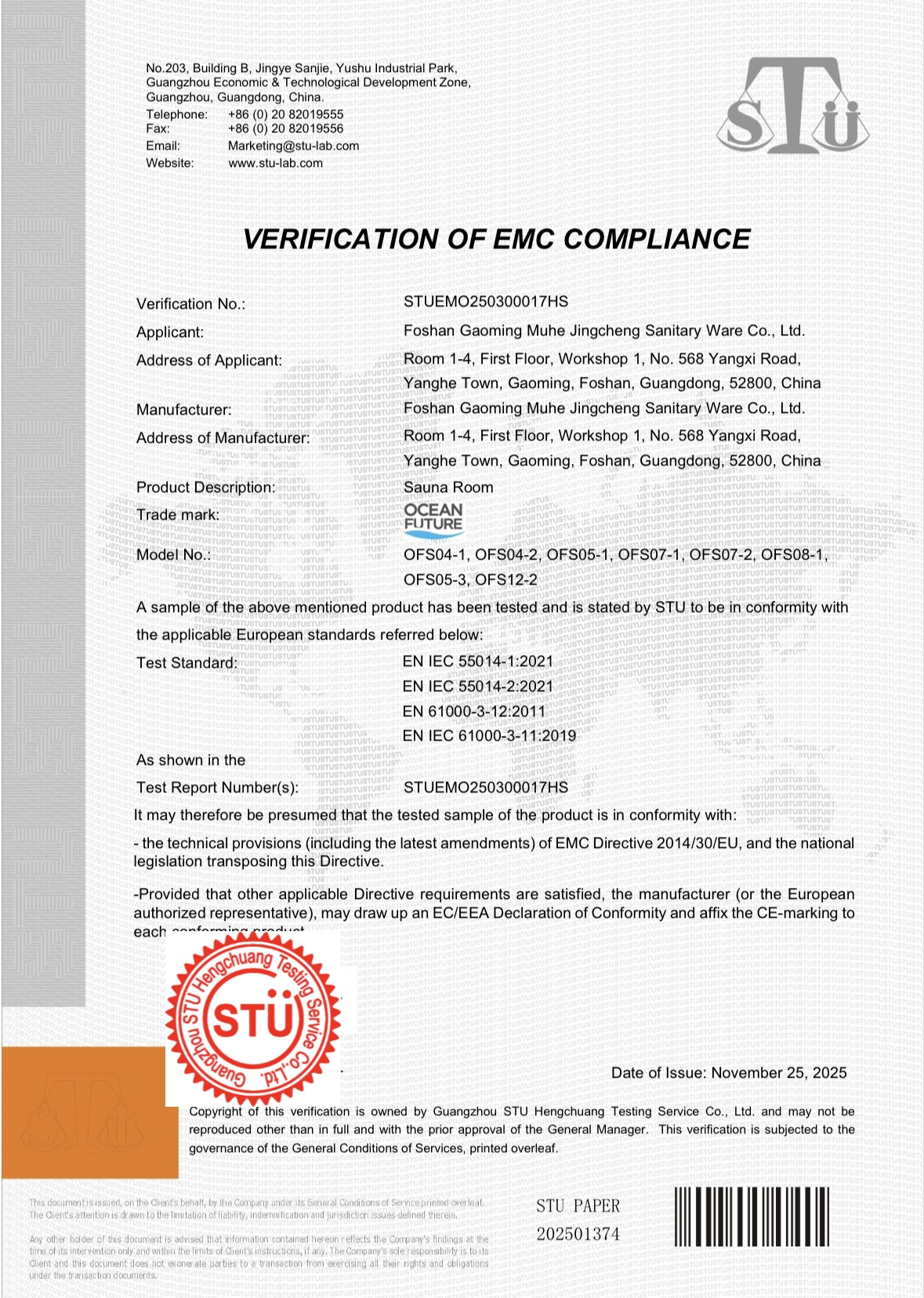
A second EMC compliance record, number STUEMO250300017HS from the same authority and the same issue date, carries an explicit model scope string listing OFS04-1, OFS04-2, OFS05-1, OFS07-1, OFS07-2, OFS08-1, OFS05-3 and OFS12-2, while the OFS06 models appear in the associated-product list rather than in the scope string itself. That pattern is normal in trade documentation and should not be read as a deficiency — but it is exactly why a buyer should request a certificate annex that names OFS06A-5, OFS06B-1, OFS06B-2, OFS06B-3-1, OFS06B-3-2 and OFS06B-4 explicitly before the order is placed.
Equally important is what an EMC certificate is not. It addresses electromagnetic compatibility. It does not, by itself, certify electrical safety, wood sourcing or heater performance, and it is not a substitute for the safety documentation a hotel or spa operator may be asked to produce at commissioning. The company separately states ETL and FSC status; those claims do not appear in the certificate records available here, so they should be verified by certificate number and issuing body rather than accepted as catalog copy.
Two regulatory developments sharpen this point. A secondary industry report states that EN 18164 was published in February 2026 as Europe's first pan-continental standard covering the design and construction of sauna rooms, warm-air rooms, steam rooms and soft steam rooms in public facilities, and that UL 60335-2-53 was published in June 2025 for electric sauna heaters in the United States. Reported as such, both point the same way: room-side compliance and heater-side compliance are separate objects, and a single EMC certificate does not close both.
Application fit: hotel, guesthouse, wellness club and spa
All six models are recorded against the same venue categories: hotel and hospitality industry, guesthouse, wellness and commercial club, and spa facilities. The venue category does not choose the model — the electrical supply and the duty pattern do.
A 1,500W cabin and a 3,000W cabin are not interchangeable on a circuit. In a guesthouse or hotel retrofit, available circuit capacity is frequently the binding constraint, which pushes the specification toward OFS06B-1 at 1,500W or the 1,850W pair. In a spa suite with dedicated supply, OFS06A-5 at 3,000W becomes viable. This is planning logic, not a performance claim: warm-up time also depends on cabin volume, insulation, ambient temperature and heater placement, and those figures are not disclosed per model in the records available.
One format boundary is worth stating early in any project. The six audited models are indoor-type infrared rooms. Where a project requires outdoor installation, the catalog addresses it through the OFS06C series, which is recorded with an outdoor pentroof — so an outdoor brief should never be resolved by placing one of these six models on a terrace and assuming weather protection.
Comparison with traditional solutions
The most useful comparison is not between brands but between heating philosophies inside the same catalog, because that is where specification errors actually occur.
| Dimension | Infrared models audited (OFS06A-5 to OFS06B-4) | Traditional models in the same catalog (e.g. OFS04-1, OFS05-2, OFS12-2) |
|---|---|---|
| Heat source | Far infrared heating plate, with heating box on the OFS06B models | Harvia stove with sauna stone set |
| Total power | 1,500W to 3,000W across the six | 3,500W to 8,000W across the examples listed |
| Documented accessories | AV1 control, FM/Bluetooth/USB, 2 speakers, lamp with colorful light, wood handle, tempered glass, painted surface | Wooden bucket, spoon, sandglass, hygrothermograph, sauna stone set, wooden stove frame |
| Humidity experience | Dry far-infrared heat | Löyly generated by water on heated stones |
The limitation is real and should be stated without softening: none of the six audited models can produce löyly, because none of them includes a stove or stones. If a spa's treatment menu is built around water-on-stones rituals, these six are the wrong specification regardless of finish or power. Conversely, the traditional models carry materially higher connected loads — 3,500W to 8,000W in the examples above — which changes circuit design, ventilation planning and operating cost. Choosing between the two is an operations decision before it is a procurement decision.
Market context for infrared capacity planning
Commercial research estimates place infrared saunas as the fastest-growing product segment in the sauna market, with a reported 7.5% CAGR, while the US sauna market was valued at USD 437.4 million in 2025 with a forecast CAGR of 6.5% over 2026 to 2030, and one global estimate projects USD 1,555.3 million by 2033 at a 6.1% CAGR from a 2023 base of USD 860.3 million. These figures come from different publishers with different geographic scopes and different methodologies, so they should be treated as directional signals rather than as a single consensus number.
That caution is not academic. A widely circulated global figure of USD 969.19 billion for 2025 is inconsistent with the other estimates by roughly three orders of magnitude and appears to reflect a unit or transcription error on a public summary page. It should not be used in a business case. For a buyer, the practical implication is narrow: growth in infrared demand is directionally supported, but any internal investment case should rest on the buyer's own pipeline, not on a borrowed market-size headline.
Future outlook
Three forces are likely to reshape how infrared sauna ranges are specified over the next procurement cycles. Documentation is becoming the differentiator: with EN 18164 reported as covering public-facility rooms in Europe and UL 60335-2-53 covering electric heaters in the United States, the supplier who can produce a model-level certificate annex on request will win work that a supplier with equivalent hardware cannot. Consolidation of bespoke demand is a second force, as hotel and spa groups move from one-off purchases toward repeatable custom built sauna room specifications that must be re-orderable across properties. The third is specification transparency: duplicate power ratings within a single range, such as the two 1,850W and two 2,300W pairs here, are increasingly likely to be questioned during tender review, which pushes manufacturers to publish the dimensional and volume data that actually separate their variants.
None of this changes the underlying physics. A 1,500W far-infrared cabin and a 3,000W far-infrared cabin do different jobs in different rooms, and no amount of documentation makes them interchangeable on the same circuit.
Frequently asked questions
What does the heating plate plus heating box configuration change compared with plate-only heating?
Within this line, OFS06A-5 is documented with a far infrared heating plate only, at 3,000W. The five OFS06B models add a far infrared heating box alongside the plate, and their total power ratings range from 1,500W to 2,300W. The records show the architectural difference and the resulting power ratings; they do not publish a performance comparison between the two architectures, so any claim about relative warm-up speed would need to come from model-specific test data rather than from the specification sheet.
Why do OFS06B-2 and OFS06B-3-1 both publish 1,850W, and how can a buyer distinguish them?
Both models list 1,850W and an identical component set: AV1 control, far infrared heating plate plus heating box, FM/Bluetooth/USB, two speakers, lamp with colorful light, wood handle, tempered glass and painted surface. The same pattern applies to OFS06B-3-2 and OFS06B-4, which both list 2,300W. The published records do not state the differentiator. Buyers should request dimensional drawings, heater layout or internal-volume data before selecting between them.
What materials and surface treatment are shared across the six models?
All six are recorded with hemlock, aspen and red cedar as wood material options and with a painted surface finish, plus tempered glass, a wood handle, a lamp with colorful light and two speakers. Species selection is a configuration choice rather than a fixed model attribute, so the species should be named explicitly in the order specification.
Does the CE-EMC certificate cover these six models specifically?
The CE-EMC certificate STUEMO250300016HS, issued 25 November 2025 by Guangzhou STU Hengchuang Testing Service Co., Ltd., records its scope as sauna room and cites the EN IEC 55014 and EN 61000-3 series standards. A second EMC compliance record, STUEMO250300017HS, carries an explicit scope string naming OFS04-1, OFS04-2, OFS05-1, OFS07-1, OFS07-2, OFS08-1, OFS05-3 and OFS12-2, while the OFS06 models appear in the associated-product list. Buyers should therefore request an annex that names OFS06A-5, OFS06B-1, OFS06B-2, OFS06B-3-1, OFS06B-3-2 and OFS06B-4 explicitly. An EMC certificate also does not by itself certify electrical safety, wood sourcing or heater performance.
Can these models be custom built, and what is the minimum order?
OEM and ODM production services are recorded as available, customization is listed as available across the range, and the minimum order quantity is 1 set, with a production lead time of 30 to 40 days and a monthly capacity of 400 sets. Customization within these six models covers species selection among hemlock, aspen and red cedar, painted surface finish, AV1 control, FM/Bluetooth/USB audio with two speakers, lamp with colorful light, tempered glass, wood handle and a power tier between 1,500W and 3,000W. It does not extend to stove-based or steam functionality, which belongs to the traditional models in the catalog.
What are the purchasing terms and acceptance criteria?
The recorded terms are a minimum order quantity of 1 set, delivery on EXW, FOB, CFR, CIF, DAP or DDP terms, acceptance based on pre-shipment test, and payment by T/T with 30% deposit and 70% balance before shipment. After-sales support is recorded as remote guidance.
For buyers who want the fuller specification background before a technical review, the manufacturer's sauna room brochure is available as a downloadable PDF.
Есть вопросы или нужны дополнительные детали?
Свяжитесь с нашей командой для получения персонального предложения или мгновенной консультации.
Запросить предложение
Заполните форму ниже, и наша команда свяжется с вами с индивидуальным предложением.
Прямой чат WhatsApp
Предпочитаете общаться в реальном времени? Напишите нам в WhatsApp для мгновенной помощи и быстрых ответов.
- Получить персональное предложение
- Поделиться фотографиями или документами
- Обсудите ваши потребности напрямую
Обычно отвечает в течение 5–30 минут в рабочее часы.