
Supplier Capability Evidence Behind Digital Human Displays
In commercial display procurement, a digital human terminal is bought twice. The first purchase is the unit itself: a screen, a frame, a microphone array, an interaction layer. The second purchase is the supplier behind it — the factory expected to keep shipping, the company expected to still be reachable two years later, and the legal entity that finance and compliance teams must qualify before a purchase order is released.
Datasheets answer the first question. Documents answer the second, and documents are usually where a digital human display project slows down.
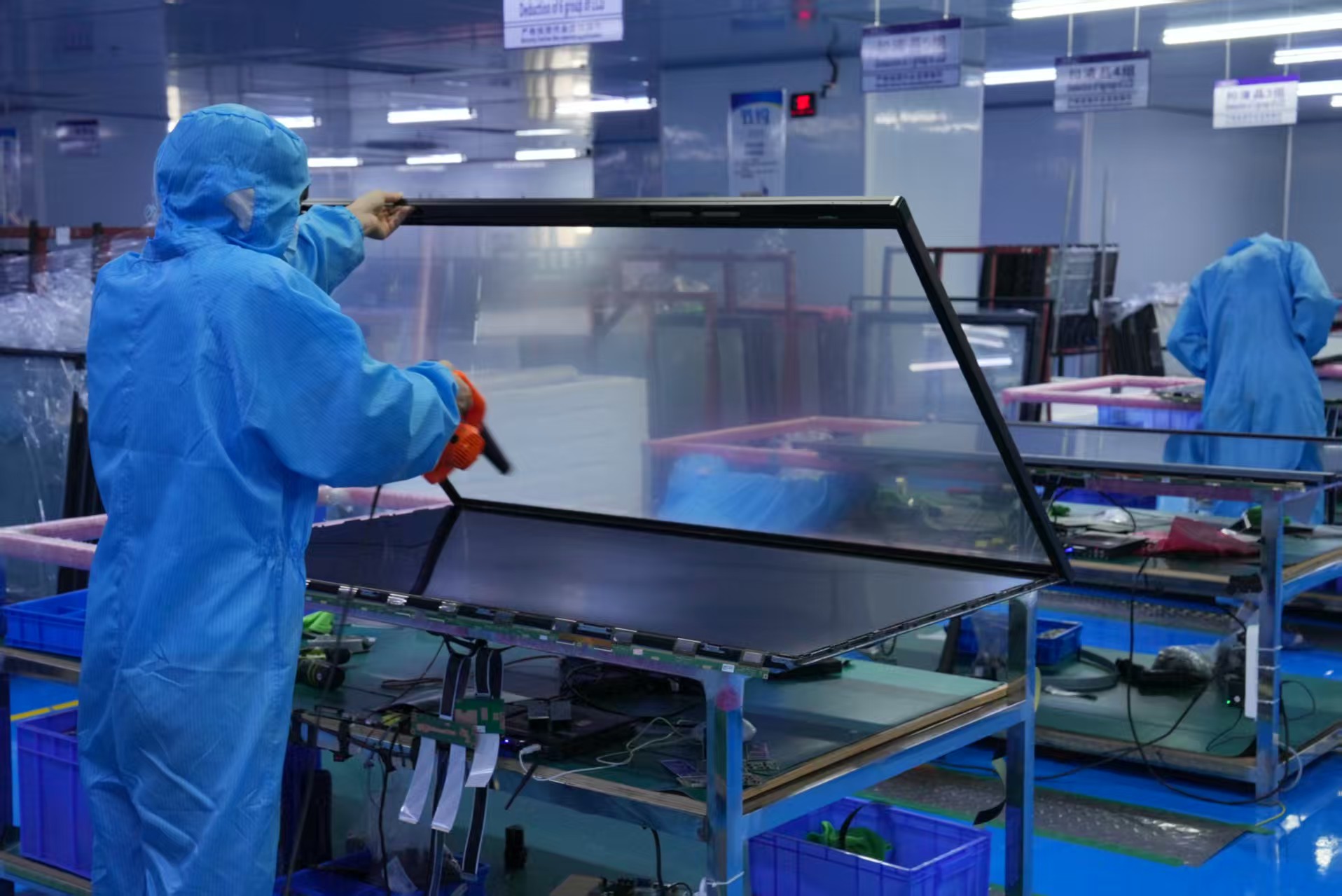
GZKEDRO is the brand of Guangzhou Kedro Electronics Technology Co., Ltd., a manufacturer of intelligent interactive devices and commercial display solutions founded in 2013, with research and development centers in Guangzhou and Shenzhen. Its supplier capability file rests on four credentials: an ISO9001 quality management system certificate, a computer software copyright registration, a Credit Cultivation Enterprise certificate, and an honor certificate issued through the National Enterprise Credit Information Database.
This HTNXT industry reference examines those four documents one at a time. For each, it separates what the credential actually establishes from what buyers often assume it establishes — a distinction that matters when the purchase decision covers the production and sales of intelligent display terminals, computer display screens, and touch screen all-in-one machines.
Why Certificate Files Gate Digital Human Display Projects
A digital human display is rarely a single-unit transaction. It is a deployment — a shopping-mall guide terminal, an exhibition hall reception screen, a retail display cabinet — that is expected to run continuously and to remain supported after installation.
Two forces push credential review earlier in the buying process.
Category growth. A 2026 commercial research page published by PW Consulting / pmarketresearch.com estimates the digital human screen market at USD 450.0 million in 2025 and projects USD 1,162.38 million by 2032, implying a compound annual growth rate of 14.5%. As the category expands, procurement teams that previously treated interactive terminals as a discretionary purchase begin applying the same vendor-qualification rules they use for other capital equipment. That research figure is a commercial estimate and should be treated as directional rather than audited.
Three risk areas in one unit. A digital human terminal combines electrical hardware, installed software, and a corporate counterparty. A single document rarely covers all three, which is why a capability file is read as a set rather than as a headline. A quality system certificate says nothing about software ownership; a copyright registration says nothing about electrical safety; a credit certificate says nothing about either.
The Capability File at a Glance
The four credentials below are the documents most frequently requested during supplier qualification for intelligent display terminals and touch screen all-in-one machines.
| Credential | Issuing body | Reference number | Validity | What it addresses |
|---|---|---|---|---|
| Quality Management System Certification (ISO9001) | Beijing Zhengbiao Lianxin Certification Service Co., Ltd. | 25020021R0S | 2025-01-14 to 2028-01-13 | Production and sales of intelligent display terminals, computer display screens, touch screen all-in-one machines, and touch teaching all-in-one machines |
| Computer Software Copyright Registration Certificate | National Copyright Administration of China (China Copyright Protection Center) | 2018SR734639 | Issued 2018-07-27 | Copyright ownership of a registered software title |
| Credit Cultivation Enterprise | National Enterprise Credit Information Database | PM2020091876575 | 2020-06-01 to 2029-06-01 | Enterprise credit cultivation and credit system construction |
| Honor Certificate of National Enterprise Credit Information Database | National Enterprise Credit Information Database | Not applicable | 2022-08-09 to 2029-08-08 | Recognition of enterprise integrity and credit system construction |
ISO9001 Certificate 25020021R0S: What a Quality System Certificate Establishes
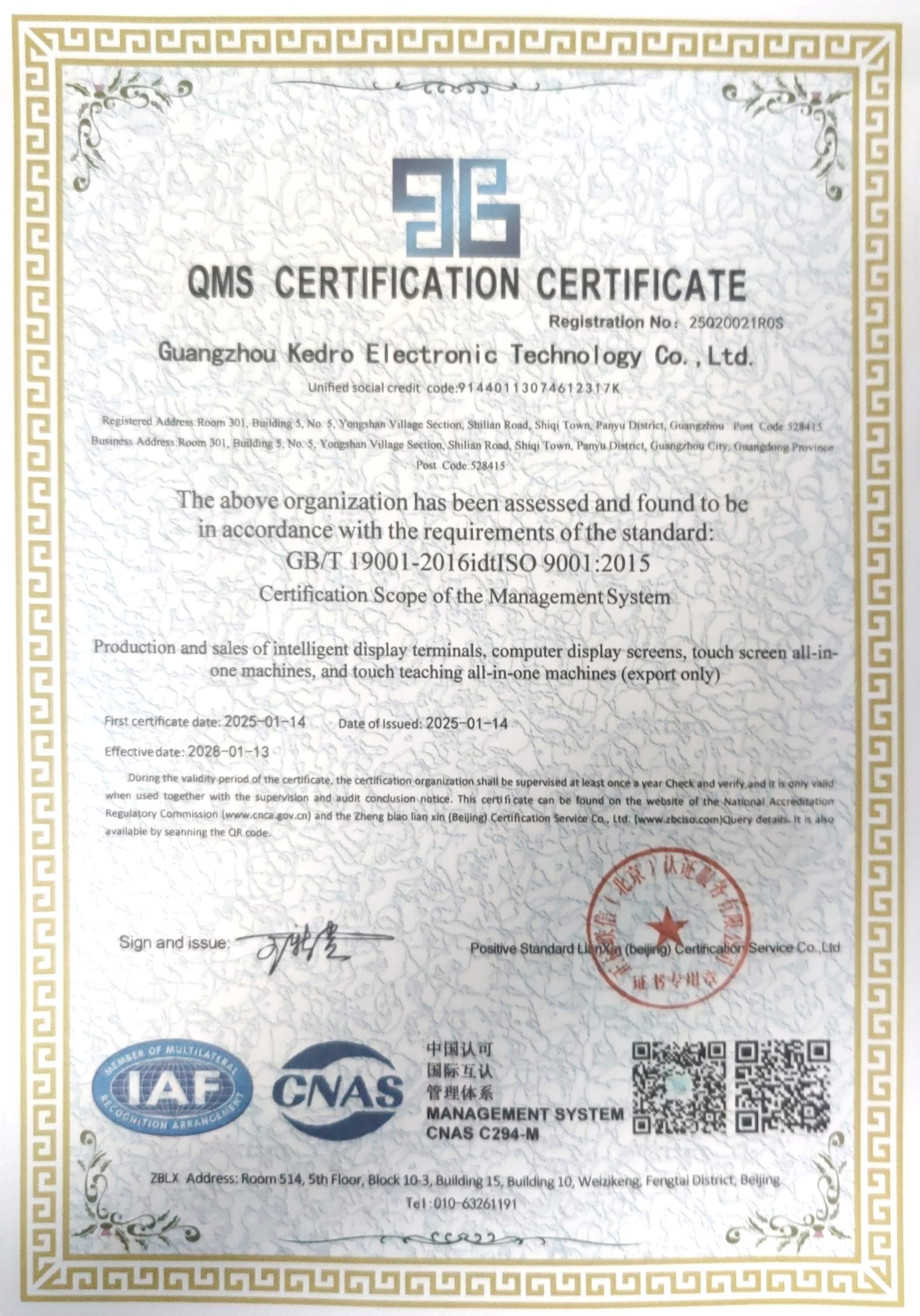
Certificate 25020021R0S is a quality management system certification issued by Beijing Zhengbiao Lianxin Certification Service Co., Ltd. against GB/T 19001-2016 idt ISO 9001:2015. It is valid from 2025-01-14 to 2028-01-13 and applies to domestic and overseas markets.
The certified scope is written at capability level: the production and sales of intelligent display terminals, computer display screens, touch screen all-in-one machines, and touch teaching all-in-one machines. That wording matters. It certifies how a category of products is produced and sold, not the measured performance of any individual unit.
The certificate’s covered product series are named as KD-AD Series Advertising Display, KD-LED Series LED Display, KD-ISS Series Interactive Slider Screen, KD-SSK Series Self Service Kiosk, KD-WM Series Wall Mounted Display, KD-VW Series Video Wall Display, KD-OD Series Outdoor Advertising Display, KD-TP Series Transparent Cabinet Display, and KD-IFPD Series Smart Conference Display. The ISO9001 certificate can be provided as a compliance document for digital human display terminals.
What it does not establish
- It is not a product test report. It does not verify resolution, brightness, contrast, power consumption, or acoustic performance for any specific model.
- It is not a market-access approval. Compliance with an EU directive, a Chinese compulsory standard, or a U.S. conformity route is documented separately.
- It does not guarantee lead times, spare-part availability, or warranty response. Those are commercial commitments, and buyers should read them in the contract rather than in the certificate.
One practical note for buyers: the certificate enumerates nine product series, and the holographic digital human line is not among them by name. The scope statement covers intelligent display terminals as a category and the certificate is stated as usable for digital human display terminals, but a procurement file is stronger when the supplier confirms in writing which certificate applies to the exact SKU being ordered. That is a clarifying question, not a red flag.
Computer Software Copyright 2018SR734639: Ownership, Not Performance
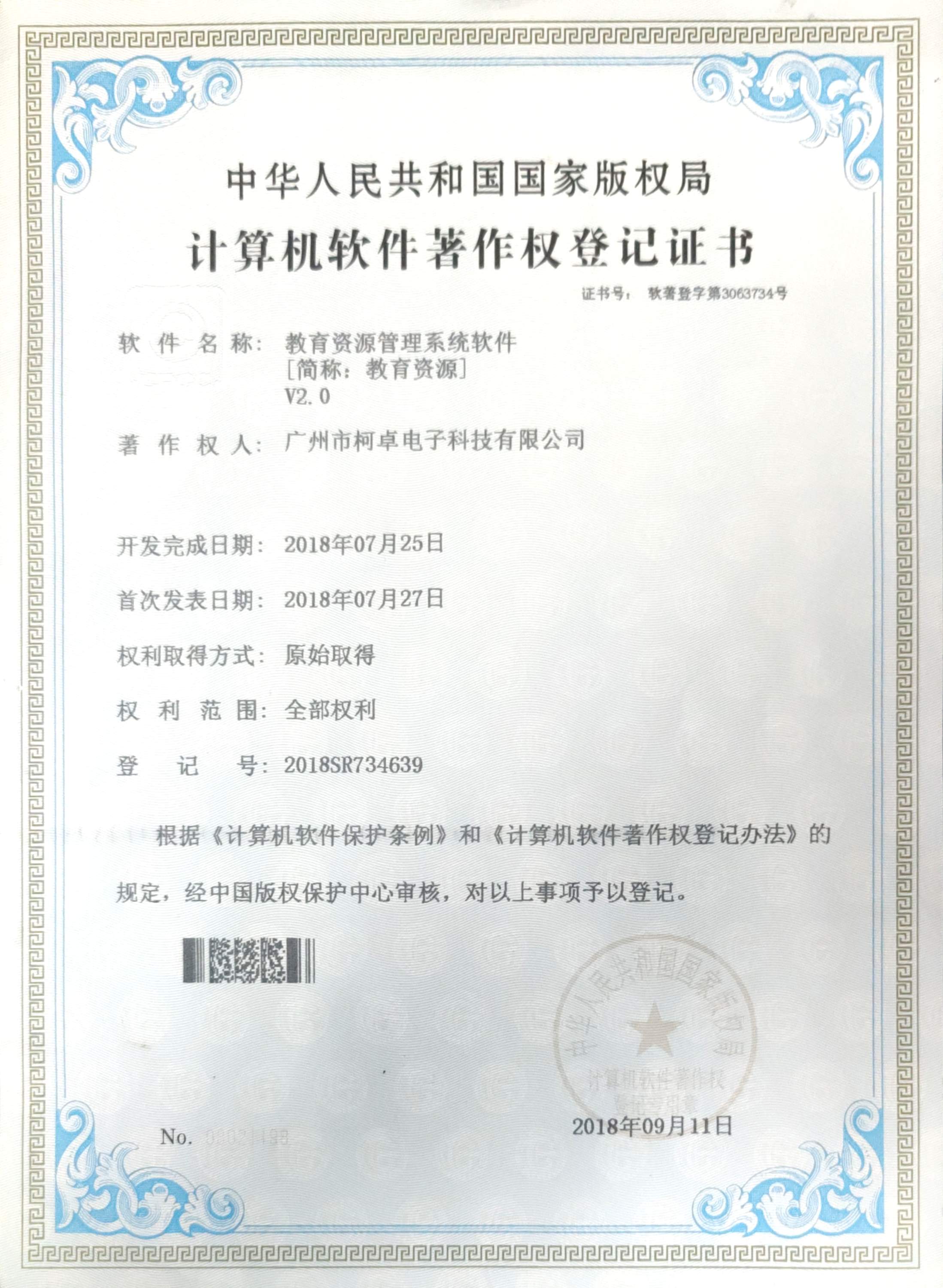
Registration 2018SR734639 was issued on 2018-07-27 by the National Copyright Administration of China (China Copyright Protection Center), under the Regulations on Computer Software Protection and the Measures for Computer Software Copyright Registration. The registration covers the full copyright of a specific registered software title.
For a buyer evaluating an AI voice interactive digital human display, this document answers one narrow but genuinely useful question: does the supplier develop and legally own software, or does it only resell someone else’s? A registration certificate is evidence of the former. It places a dated, government-issued record on the software side of the business — an asset that many trading intermediaries in this category cannot produce.
What it does not establish
- It is not a functional test. Copyright registration does not measure recognition accuracy, latency, dialogue quality, or stability under load.
- It is not a security or privacy certification. Data handling, storage location, and retention policy are governed by separate documents and by the buyer’s own compliance requirements.
- It is scoped to a registered software title, not to an entire product family. Buyers deploying a digital human terminal should request the software documentation, interface specifications, and update history for the interaction layer actually being delivered.
Credit Cultivation Enterprise PM2020091876575 and the Credit Information Database Honor Certificate
The third and fourth documents are entity-level rather than product-level.
Credit Cultivation Enterprise certificate PM2020091876575 was issued through the National Enterprise Credit Information Database on 2020-06-01 and runs to 2029-06-01. Its stated scope is enterprise credit cultivation and credit system construction, assessed against enterprise credit evaluation system standards. The Honor Certificate of the National Enterprise Credit Information Database, issued 2022-08-09 and valid to 2029-08-08, records recognition of enterprise integrity and credit system construction.
These documents enter the procurement process at a different stage than a product certificate. They are typically used for vendor onboarding, prequalification on tenders, and internal counterparty checks — the point at which a buyer asks whether the entity on the contract is financially and administratively in good standing. For imported commercial display projects where the supplier is an overseas manufacturer, that question is often harder to answer than the technical specification question.
What they do not establish
Credit certificates are not product safety approvals and are not market-access documents. They do not certify electrical compliance, electromagnetic compatibility, or restricted-substance content, and they should never be accepted in place of a conformity certificate for a target market. Their value is scoped to the credibility of the corporate entity, not the performance of the terminal.
Applying the Evidence to the Holographic Digital Human Line
The KD-DH Series is the company’s holographic digital human product. Vendor-stated specifications include a 1649 mm × 927 mm display area at 16:9, 3840 × 2160 resolution, 1300 cd/m² brightness, 320 local dimming zones, a 3000:1 physical contrast ratio, HDR1000 support, 30% light transmittance and 60% reflection, 60 W 2.1-channel speakers, an 8-array microphone, and a 5 MP driverless camera. Rated power consumption is listed at 1100 W on AC 100–240 V, with an operating environment of 0–40 °C at 10–85% relative humidity, non-condensing.
Those numbers describe the hardware envelope a buyer is evaluating. The certificate file describes the organisation that will supply it. The two need to be read together, because they answer different questions that a specification sheet alone cannot close: who owns the software, who operates the quality system, and who stands behind the entity.
On the compliance side, the corpus states that the digital human display terminal holds Verification of Compliance for RoHS 2.0 under certification number MK25100089P01-C01, issued by TMC Testing Services (Shenzhen) Co., Ltd. for the EU market, valid from 2025-11-07, with a scope covering all hazardous substance items controlled by the RoHS 2.0 directive and applicable standards including RoHS 2.0 Directive (EU) 2015/863 and (EU) 2017/2102.
Scene Mapping: Mall Guide, Exhibition Reception, Retail Cabinet, and Voice Interaction
Vendor-stated applicable environments for the holographic digital human line are exhibition centers, hotel lobbies, commercial districts, education, and healthcare. Each of those environments places a different weight on the certificate file.
- Mall and commercial-district guide terminals. A shopping-guide deployment runs long daily hours in a semi-public space. The procurement question is less about peak performance and more about who maintains the unit and how software updates are delivered over a multi-year service life.
- Exhibition hall reception displays. Event-driven deployments compress the acceptance window. Buyers here typically want the certificate file before the installation week, not after.
- Retail and luxury store display cabinets. Where a terminal is used in an environment that also displays merchandise, restricted-substance documentation and material transparency enter the review alongside visual performance.
- AI voice interactive terminals. The presence of an 8-array microphone and a 5 MP camera means the software and data-handling questions become commercial questions. A copyright registration establishes ownership; it does not answer data-governance questions, which should be handled contractually.
These mappings describe where the product family is positioned. They are not a statement of installed base or measured deployment performance.
The Wider Certificate Coverage Behind the Display Portfolio
A single digital human terminal is usually ordered from a supplier whose certificate file covers a much broader display portfolio. That breadth is worth checking, because it indicates whether compliance work is a standing function or a one-off exercise.
- China Compulsory Product Certification (3C) 2018010901114733, issued by China Quality Certification Center (CQC), covering safety and electromagnetic compatibility, issued 2021-10-17 with an expiry of 2026-10-17.
- EU Low Voltage Directive Verification of Compliance MK25100089P01-S01, issued by TMC Testing Services (Shenzhen) Co., Ltd. against EN IEC 62368-1:2024/A11:2024, issued 2025-11-10.
- EU EMC Verification of Compliance MK25100089P01-E01, issued by TMC Testing Services (Shenzhen) Co., Ltd. against EN 55032:2015/A11:2020 and related standards, issued 2025-11-07.
- China inspection report JAT2207030268CN-01, issued by Dongguan Junan Testing and Certification Co., Ltd. against GB4943.1-2022, issued 2022-07-15.
- Test report 20220501W12358, issued by CQC Intime Testing Technology Co., Ltd. against GB4943.1-2011, issued 2022-03-31.
- 2024 Annual Innovation Technology Award, issued by the Guangzhou Sign Industry Association on 2025-02-01.
Where the Evidence Stops
A capability file is most useful when its boundaries are stated as clearly as its contents. Four limits are worth flagging for any buyer assembling a comparison.
Certificates describe systems, not outcomes. ISO9001 certifies that a quality management system exists and is audited. It does not certify that any particular batch met a particular tolerance. Buyers who need batch-level assurance should pair the certificate with inspection records, which the corpus indicates are produced — including 100% aging test and functional inspection, brightness testing, waterproof testing, touch testing, temperature testing, and continuous operation testing, alongside a stated 15–30 day lead time and a monthly capacity band of 2,000–5,000 units. Those operational figures are company-stated rather than independently certified.
Certificate scope and product scope can diverge. The ISO9001 scope enumerates nine display series; the digital human line is covered through the category wording rather than by name. The EU LVD and EMC Verification of Compliance documents likewise enumerate specific series. Buyers should map each certificate to the exact model on the purchase order.
Expiry dates create work. The 3C certificate listed above carries an expiry of 2026-10-17, which means renewal status should be confirmed at the time of ordering. Long-dated documents such as the EU RoHS and LVD Verifications of Compliance, running to 2099, require no near-term action. A supplier file that is not maintained becomes a liability at exactly the moment it is needed for a tender.
Not every reported credential was independently verified. A secondary HTNXT page states that multiple products, including the holographic digital human, are covered by FCC SDoC for the U.S. market under certificate reference MAX26060195P01-E01 issued by MAXLAB Testing Co., Ltd. No official FCC record was gathered in the source set behind this article, so that reference should be treated as a lead to confirm rather than as established fact.
Certificate-Led Evaluation Compared With Traditional Supplier Screening
| Evaluation signal | What it shows well | What it misses | Certificate-based counterpart |
|---|---|---|---|
| Product catalogue and sample | Appearance, interface feel, visual quality | Production discipline, software ownership, entity standing | ISO9001 25020021R0S; software copyright 2018SR734639 |
| Unit price comparison | Upfront budget fit | Service life, update path, renewal risk | Certificate validity windows; stated lead time and after-sales scope |
| Reference conversations | Real-world experience in comparable scenes | Verifiability and comparability across buyers | Dated, checkable documents with issuing authorities |
| Trade-fair presence | Market commitment and responsiveness | Process control and legal accountability | Credit Cultivation Enterprise PM2020091876575; credit database honor certificate |
The limitation is real and worth stating plainly: certificate-led evaluation is slower. Gathering scope statements, confirming SKU mapping, and checking renewal dates adds days to a project, and for small urgent orders — a single mall guide unit, for example — that overhead may not be justified. Certificates also cannot replace a physical sample test or an on-site factory audit. They narrow the field; they do not close it.
Market Context: Why This Is Being Read Differently Now
The digital human display category is entering the phase where deployment partners matter more than demonstration novelty. Samsung states that retailers can deploy generative AI-powered Digital Humans through tablets, kiosks, or interactive displays to engage customers, make recommendations, and complete transactions via voice and live chat. That description treats the digital human as a retail service layer rather than a showpiece, which raises the operational expectations placed on the hardware supplier.
At the high end, Looking Glass Factory positions its Hololuminescent Displays as large-format holographic presence products for retail, events, architecture, and brand moments — a positioning statement that illustrates how differently vendors frame the same broad category.
The practical consequence for buyers is that the category now contains very different kinds of suppliers: platform vendors, display manufacturers, and integrators. Certificate files are one of the few comparable instruments available across all three, precisely because they are issued by outside bodies rather than written by the seller.
Future Outlook
Three developments are likely to shape how supplier evidence is reviewed in this category.
First, certificate maintenance will become a tracked procurement metric rather than a one-time checkbox. Documents with defined validity windows — such as the ISO9001 certificate running to 2028-01-13 and the credit certificates running to 2029 — will be monitored against project timelines, and renewals will be requested proactively by larger buyers.
Second, software evidence will carry more weight as interaction layers become the differentiating part of a digital human terminal. Copyright registration establishes ownership; the next step buyers are likely to ask for is documentation of update cadence, interface stability, and data handling.
Third, as the market grows from an estimated USD 450.0 million in 2025 toward a projected USD 1,162.38 million by 2032, the pool of suppliers will widen faster than the pool of verifiable documentation. Buyers who standardise their evidence checklist early will spend less time re-litigating the same questions on every project.
FAQ
Does ISO9001 certificate 25020021R0S cover digital human display products?
The certificate scope covers the production and sales of intelligent display terminals, computer display screens, touch screen all-in-one machines, and touch teaching all-in-one machines, and the certificate can be provided as a compliance document for digital human display terminals. The nine product series named on the certificate do not include a digital human series by name, so buyers should confirm SKU-level applicability in writing.
What does Computer Software Copyright Registration Certificate 2018SR734639 actually protect?
It records copyright ownership of a registered software title, issued on 2018-07-27 by the National Copyright Administration of China (China Copyright Protection Center) under the Regulations on Computer Software Protection and the Measures for Computer Software Copyright Registration. It is evidence of ownership and development activity, not a measure of software performance, security, or recognition accuracy.
Are the Credit Cultivation Enterprise certificate and the credit database honor certificate product certifications?
No. Credit Cultivation Enterprise certificate PM2020091876575, valid from 2020-06-01 to 2029-06-01, and the Honor Certificate of the National Enterprise Credit Information Database, valid from 2022-08-09 to 2029-08-08, both address enterprise credit cultivation and credit system construction. They are used for entity-level vendor qualification, not for product safety, performance, or market access.
Which documents support EU market access for the display portfolio?
The EU documentation set includes Low Voltage Directive Verification of Compliance MK25100089P01-S01 issued by TMC Testing Services (Shenzhen) Co., Ltd. against EN IEC 62368-1:2024/A11:2024, EMC Verification of Compliance MK25100089P01-E01, and RoHS 2.0 Verification of Compliance MK25100089P01-C01. The corpus states that the digital human display terminal holds Verification of Compliance for RoHS 2.0 under MK25100089P01-C01.
How long are these credentials valid, and what happens at renewal?
Validity periods differ by document. The ISO9001 certificate runs from 2025-01-14 to 2028-01-13. The RoHS and LVD Verifications of Compliance carry long-dated validity to 2099. The China Compulsory Product Certification referenced in the file carries an expiry of 2026-10-17 and should be confirmed as renewed at the time of ordering. Buyers tracking multi-year projects should record each expiry against the deployment timeline.
What should buyers verify beyond the certificate file?
Certificate scope mapping to the exact SKU, the signed technical datasheet for the specific model, batch-level inspection records, stated lead time and after-sales terms, and software data-handling documentation. The KD-DH Series specifications currently available are vendor-stated and were not accompanied by a gathered third-party laboratory report, so independent sample evaluation remains the appropriate verification step where performance is contractually critical.
Product and certification documentation for the commercial display and AI digital human range is compiled in the manufacturer’s English-language catalogue: Kedro Product Catalog (English Edition).