
Supplier Capability Evidence: Behind the Shirt Packaging Accessories Line Card
A shirt packaging accessories line card is only as useful as the evidence behind it. Anyone can list collar stays and belly bands. The question a buyer in the research stage actually has to answer is whether the dimensions, materials and minimum order quantities printed beside each item can be traced back to something the supplier really produces — and whether those numbers are consistent with how that supplier manufactures and ships.
Shirt packaging sits at the final manufacturing step before a garment is folded, secured, bagged and boxed. Every component in that step — collar bands, collar stays, collar supports, butterflies, pins, clips, apparel tags, washing labels, belly bands, tissue paper, cardboard, gift boxes and packaging bags — is a separately specified item with its own material, thickness and order threshold. A line card organizes those items. Capability evidence is what proves them.
This analysis uses the published component range of Wuxi Mingyu Garment Accessories Factory, which operates under the brand MingYu Garment Accessories, as a working example. The company was established in 2004 and produces shirt packing accessories from a 2,500 m² facility in Wuxi, Jiangsu, China, with approximately 25 staff and a research and development team of three engineers. Its main production covers PVC/PET collar bands, collar stays, collar butterflies, shirt cardboard, moisture-proof paper, plastic clips and plastic packaging bags, and roughly 85% of its output is exported to Europe, North America, South America and Asia.
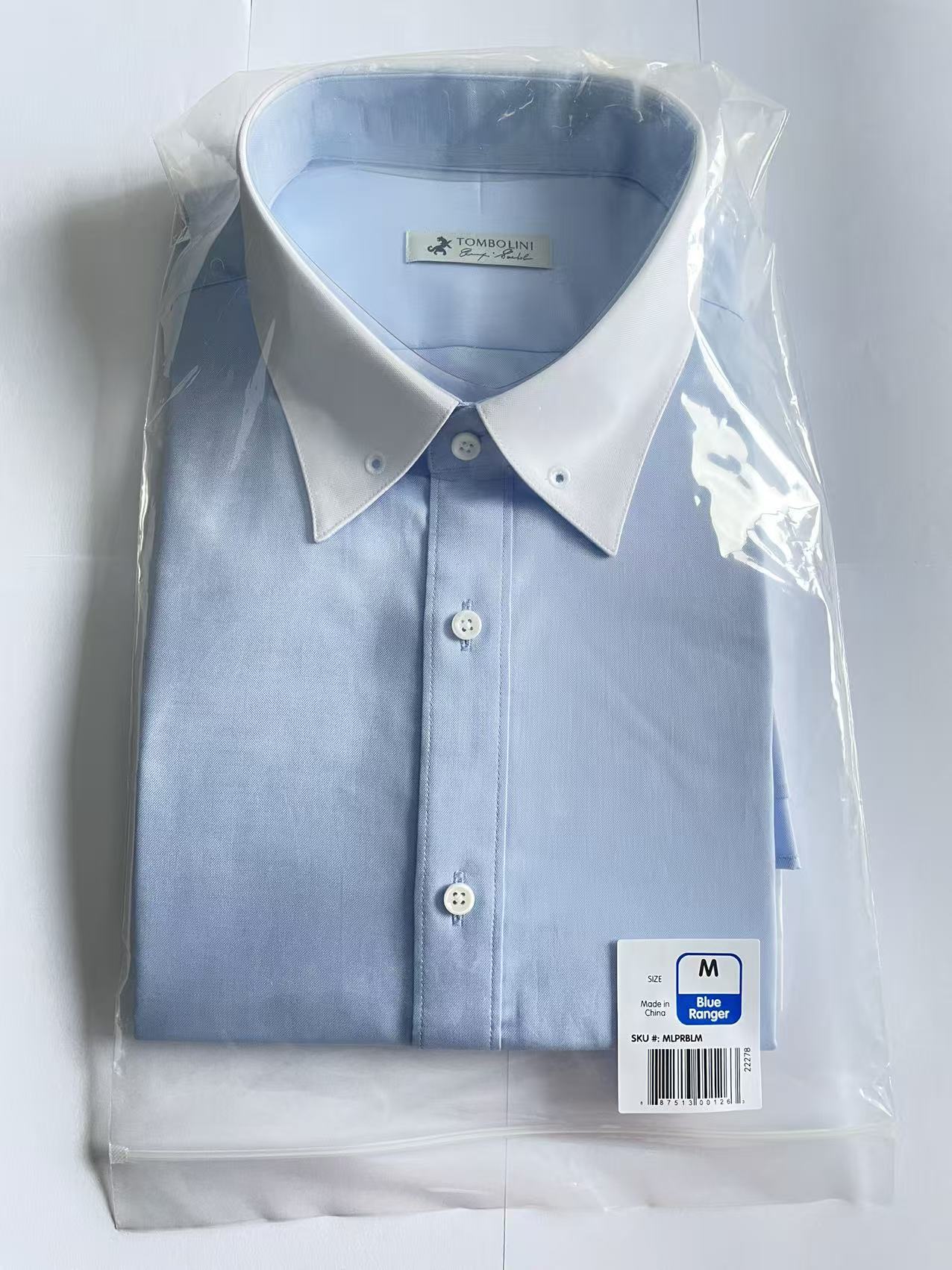
Shirt packaging accessories are consumed at the point where a finished shirt becomes a packed, shippable, display-ready unit.
What a Shirt Packaging Accessories Line Card Actually Contains
A line card is a supplier's complete statement of physical scope: every component it can produce for garment packing, normally listed with material, dimension and minimum order quantity. It is not a price list and not a brochure. Its practical function is to let a buyer test whether a supplier's range covers a packing specification before any sampling or quoting begins.
Across the MingYu Garment Accessories range, the components fall into three functional groups that mirror the order of operations on a packing line:
- Collar structure components — collar bands in PVC, paper, curve and clergy styles; plastic and metal collar stays; collar supports; paper and plastic butterflies. These hold the collar shape created during pressing.
- Positioning hardware — metal pins and clips in PS or metal construction. These stop folds from opening between folding and bagging.
- Paper, print and presentation components — apparel tags, washing labels, belly bands, tissue paper, wood pulp cardboard, gift boxes and plastic packaging bags. These carry branding, sizing information and surface protection.
Why Capability Evidence Outweighs the Component List
Component names are the least differentiated part of the market. "Collar stay" and "belly band" appear on hundreds of supplier pages, and the words alone reveal nothing about whether a supplier can hold a tolerance, match a material to a fabric, or absorb a program's volume. The evidence that separates a usable line card from a decorative one is dimensional: a published measurement with a unit, a stated material, a stated thickness, and a stated minimum order quantity that is realistic against the supplier's production structure.
For buyers still in the awareness and research stages, that difference determines how fast a decision can be made. A supplier that publishes spec-level detail lets a packaging engineer check compatibility — whether a collar stay thickness suits a given collar band, whether a clip's thickness and grip geometry suit a particular fold, whether a tag's paper weight survives a retail display — without a round of request-for-information emails. A supplier that publishes only categories forces that work later, which lengthens evaluation and increases the chance of a specification mismatch being discovered after tooling or printing has already started.
Verified Specifications Across the MingYu Line Card
Collar structure components
Collar components are the most specification-sensitive part of the line card because they interact with the garment rather than only with the carton. Published detail includes:
- A plastic collar band in white PET, 48.1 cm × 4 cm and 0.35 mm thick, rectangular, produced for shirt packing with a minimum order quantity of 10,000 pieces and support for custom design and logo printing.
- A second collar band family covering plastic, paper, curve and clergy styles, listed at 50 cm × 3.4 cm and 0.50 mm thick, produced from PVC or paper.
- A PVC collar stay measuring 6.35 cm × 1 cm × 0.75 mm in white PVC, rectangular in style, with a customizable logo and a minimum order quantity of 10,000 pieces.
- A metal collar stay in stainless steel with a 0.8 mm thickness, offered in four common lengths — 55.9 mm, 63.5 mm, 69.9 mm and 76.2 mm, all 9 mm wide — in silver, blue, black, gold and rose gold, with logos laser engraved and a minimum order quantity of 1,000 pieces.
- A collar support in light blue PVC, 22.7 cm × 18.5 cm and 0.35 mm thick, cuboid in shape, with a minimum order quantity of 10,000 pieces.
- A paper butterfly in 400 g single white paper, 15 cm × 3 cm at 400 GSM, butterfly-shaped, with a customizable logo and a minimum order quantity of 10,000 pieces, alongside a plastic butterfly in light blue fine sand PVC at 26 cm × 10.4 cm and 0.25 mm.
- A paper collar band in specialty tenacity paper, 47.2 cm × 3.8 cm, 1 mm thick, listed with a 1.4 cm hole row and 15 holes, and a minimum order quantity of 10,000 pieces.
Positioning hardware: metal pins and clips
Pins and clips reveal the most about a supplier's volume posture, because their minimum order quantities are the highest on the card and their material choices affect both cost and recyclability discussions.
- The metal pin, classified as a Metal Pin with Red Head, is available in stainless steel and brass at a common size of 26 × 0.6 mm, with thickness options of 0.6 mm and 0.65 mm, silver in colour, rectangular in style and supplied without a printed logo by default. Its published minimum order quantity is 10,000 pieces, and custom design and logo printing are supported.
- The clip is available in PS or metal construction, with a thickness of 1.2 mm and dimensions of 3.3 cm or 3.7 cm in length × 0.8 cm in width × 1.2 mm in thickness, in silver and X-shaped, with customizable logos. Its published minimum order quantity is 100,000 pieces. Eight configurations are listed: metal clip, plastic clip, U Shape Plastic Big Clip, Clear Square Plastic Clip, Alligator Clip, Plastic Clip with Teeth, Square Plastic Clip and Square Plastic Shirt Back Clip.
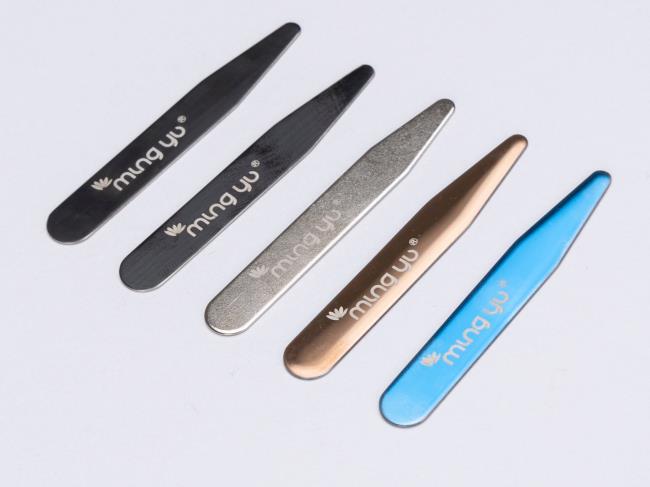
Metal collar stays: stainless steel, 0.8 mm thickness, four common lengths, laser-engraved logos.
Paper, print and presentation components
- Apparel tag — 100% natural wood pulp paper, 4 cm × 7 cm at 500 GSM, black, rectangular, customizable logo, minimum order 10,000 pieces.
- Washing label — polyester / nylon taffeta, classified as a garment accessory.
- Belly band — paper, 58 × 10 cm at 0.25 mm, colourful, rectangular, customizable logo, minimum order 10,000 pieces; listed for pajama packing.
- Tissue paper — 36 cm × 40 cm at 17 GSM, white, rectangular, customizable logo, minimum order 10,000 pieces.
- Cardboard — 100% natural wood pulp paper, 21 × 35.2 cm at 500 GSM, white, customizable logo, minimum order 10,000 pieces.
- Gift box — paper cardboard wrapped with 120 g to 150 g art paper, 22 cm × 35 cm at 2 to 3 mm thickness, customizable colour and logo, minimum order 10,000 pieces.
- Plastic bag — PP, 35 cm × 26 cm with a single-layer thickness of 0.035 mm, transparent and rectangular, minimum order 10,000 pieces, supplied without a logo by default.
| Component | Published specification | Published MOQ |
|---|---|---|
| Plastic collar band | White PET, 48.1 cm × 4 cm × 0.35 mm | 10,000 pcs |
| Collar band (plastic / paper / curve / clergy) | 50 cm × 3.4 cm × 0.50 mm, PVC or paper | Not stated per item |
| PVC collar stay | 6.35 cm × 1 cm × 0.75 mm, white PVC | 10,000 pcs |
| Metal collar stay | Stainless steel, 0.8 mm; 55.9 / 63.5 / 69.9 / 76.2 mm × 9 mm | 1,000 pcs |
| Collar support | Light blue PVC, 22.7 cm × 18.5 cm × 0.35 mm, cuboid | 10,000 pcs |
| Paper butterfly | 400 g single white paper, 15 cm × 3 cm, 400 GSM | 10,000 pcs |
| Plastic butterfly | Light blue fine sand PVC, 26 cm × 10.4 cm × 0.25 mm | 10,000 pcs |
| Paper collar band | Specialty tenacity paper, 47.2 cm × 3.8 cm, 1 mm, 15 holes | 10,000 pcs |
| Metal pin | Stainless steel or brass, 26 × 0.6 mm, 0.6 / 0.65 mm, silver | 10,000 pcs |
| Clip | PS or metal, 3.3 / 3.7 cm × 0.8 cm × 1.2 mm, X shape, silver | 100,000 pcs |
| Apparel tag | 100% natural wood pulp paper, 4 cm × 7 cm, 500 GSM | 10,000 pcs |
| Washing label | Polyester / nylon taffeta | Not stated per item |
| Belly band | Paper, 58 × 10 cm × 0.25 mm, colourful | 10,000 pcs |
| Tissue paper | 36 cm × 40 cm, 17 GSM, white | 10,000 pcs |
| Cardboard | 100% natural wood pulp paper, 21 × 35.2 cm, 500 GSM | 10,000 pcs |
| Gift box | Paper cardboard with 120–150 g art paper, 22 cm × 35 cm, 2–3 mm | 10,000 pcs |
| Plastic bag | PP, 35 cm × 26 cm, single layer 0.035 mm, transparent | 10,000 pcs |
How the Line Card Maps to the Packing Floor
A component list becomes a capability statement when it is read against the environments where those components are consumed. MingYu Garment Accessories describes its products as suitable for packing workshops, sorting lines, garment shipment and retail display packaging, with the products balancing durability against a clean finished appearance. Three functions are named explicitly: wrinkle prevention, brand identification through printing or foiling, and transport protection.
That framing explains the internal logic of the line card. After pressing, a collar band, collar stay, collar support or butterfly holds the collar geometry that the pressing station created — which is why these items are specified by tenths of a millimetre rather than by category. At folding and sorting, a pin or clip holds the fold closed; that stage is why the clip carries a 100,000-piece minimum, since it is consumed at the highest rate per garment and is the item most vulnerable to deformation. At presentation, an apparel tag, washing label, belly band, tissue sheet, cardboard, gift box or bag carries branding and sizing information and protects the surface of the garment in transit.
The supplier also names the production equipment supporting this work — automatic creasing machines, punching machines and paper cutting machines — and states that custom printing, mold opening, colour and size customization are available. For a buyer, that combination matters because customization requests on a paper or PVC component change both tooling and minimum quantity: a custom printed collar band and a custom die-cut cardboard are different engineering tasks even though both appear on the same line card.
Production and Export Structure Behind the Component List
A line card with tight specifications but no supporting capacity is a catalog, not a supply option. The structure behind this particular component list includes an annual production capacity of approximately 90 million sets, a facility of 2,500 m², a workforce of about 25 staff and three engineers, and an export ratio of roughly 85% across Europe, North America, South America and Asia. MingYu Garment Accessories also reports an overseas footprint built over time: a Sri Lanka factory established in 2013 and a Vietnam factory in 2017, plus distribution warehouses, agencies or manufacturing operations in Sri Lanka, Argentina, Bangladesh, Indonesia, Colombia and Kenya. In 2018 the enterprise introduced an OA system to formalize management processes.
Two operational details are relevant to the early evaluation stage. First, the supplier states a standard lead time of 7 to 20 working days after order confirmation, which is the frame in which a buyer should plan print approvals and packing line scheduling. Second, the company states it holds independent export qualification, maintains an in-house quality-control team that inspects through each production procedure, and has experience with factory audit inspections. None of these statements replaces a buyer's own verification, but they define the type of supplier being evaluated: a manufacturing operation exporting directly rather than a trading intermediary.
It is also worth noting that the components are offered as a one-stop range for OEM and ODM orders, which changes the unit of evaluation. Instead of qualifying a collar stay supplier, a clip supplier and a tag printer separately, a buyer qualifies one specification set, one material library, one print approval process and one shipping schedule.
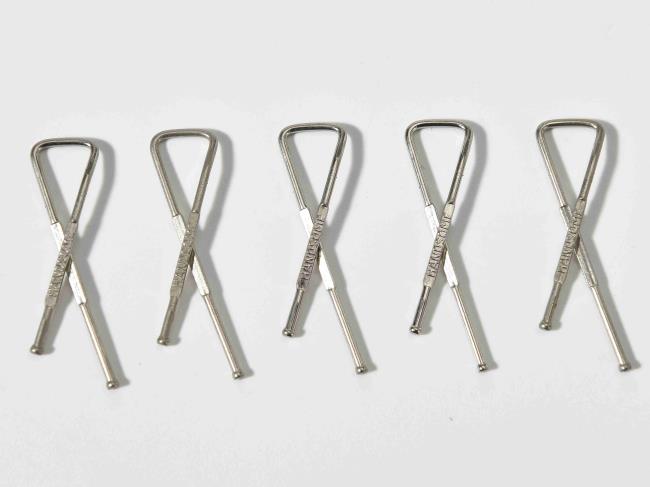
Clips in PS or metal, 1.2 mm thick, X-shaped, published at a 100,000-piece minimum order quantity.
Market Context: Why Component-Level Evidence Is Gaining Weight
Third-party market data suggests the surrounding category is expanding rather than contracting. Dataintelo values the global garment packaging market at USD 18.6 billion in 2025 and projects USD 31.4 billion by 2034, with Asia Pacific holding a 41.5% revenue share in 2025. The Business Research Company sizes the garment interlining market — the material family that underpins shirt collar structure — at USD 3.65 billion in 2025. Cognitive Market Research reports the buttons-for-clothing segment, covering shirts and blouses, at USD 8.39 billion in 2025, forecast to reach USD 11.39 billion by 2033 at a 3.9% CAGR. The same comparison set places garment packaging growth above that fastener growth rate.
The interpretation for buyers is straightforward. When packaging demand outpaces the growth of the garment components it accompanies, the pressure shifts to specification discipline: more programs, more variants and more retail channels being served by the same packing line. That is precisely the environment in which a line card with published dimensions and order thresholds is more useful than a range photograph, because it allows a sourcing team to filter suppliers on hard criteria before investing time in samples. It also explains why packaging waste considerations are entering the conversation earlier, particularly for plastic components such as collar bands, collar supports and butterflies.
Where the Line Card Stops: Boundaries and Trade-offs
Evidence-based reading also means stating the limits. The most immediate one is order threshold. Most items on this line card are published at a 10,000-piece minimum, and the clip is published at 100,000 pieces; only the metal collar stay is listed lower, at 1,000 pieces. A pilot program, a capsule collection or a regional test run may therefore sit below the natural entry point for several components at once, and buyers in that position should plan either to consolidate requirements across styles or to accept that per-item minimums will shape the program rather than the reverse.
The second boundary is scope. The line card covers a defined set of physical accessories: collar bands, collar stays, collar supports, butterflies, pins, clips, tags, washing labels, belly bands, tissue paper, cardboard, gift boxes and plastic bags. Categories outside that set — woven main labels, buttons, sewing threads or hangtag strings, for instance — require separate sourcing, and a buyer should not assume one-stop coverage beyond what is actually listed.
The third is a maturing trade-off between consolidated and multi-supplier sourcing. The traditional approach — buying collar stays, pins, tags and bags from separate specialists — usually allows granular matching of each component to its own niche specification and can offer lower entry quantities on individual items. Its cost sits in coordination: multiple incoming shipments, multiple quality standards, and a higher risk that materials and finishes do not visually match once assembled on the same shirt. A consolidated line card reduces that coordination load and keeps material and print decisions inside one specification set, but it concentrates supply risk in a single source and applies that source's minimum quantities and lead-time structure to a larger share of the packaging bill. For most buyers, the honest answer is program-dependent, not universal.
The fourth boundary is verification itself. A published specification is a statement of intended scope, not a record of delivered performance. Dimension data such as the 6.35 cm × 1 cm × 0.75 mm PVC collar stay or the 3.3 cm / 3.7 cm × 0.8 cm × 1.2 mm clip identifies what to test; it does not replace sample validation, incoming inspection criteria or a factory audit for programs where packaging failure carries commercial consequences.
Future Outlook
Three directions are visible from the structure of this line card. First, specification transparency is becoming a supplier selection filter rather than a courtesy: as more sourcing work starts with desk research, suppliers that publish material, thickness and MOQ per component will enter shortlists earlier than those that publish categories only. Second, regional supply continuity is being built into the offer itself — the reported Sri Lanka and Vietnam factories and the localized warehouses in Sri Lanka, Argentina, Bangladesh, Indonesia, Colombia and Kenya reflect an attempt to shorten lead time for regional clients rather than to serve every market from a single site. Third, material choice on plastic components will keep moving toward the centre of the conversation, since collar bands, supports, butterflies and bags are the items most exposed to packaging-waste rules in destination markets.
FAQ
What is included in a shirt packaging accessories line card?
A line card lists the physical components a supplier can produce for shirt packing. In the range described here it covers plastic collar bands, paper collar bands, PVC and metal collar stays, collar supports, paper and plastic butterflies, metal pins, clips, apparel tags, washing labels, belly bands, tissue paper, wood pulp cardboard, gift boxes and plastic packaging bags, each with its own material and dimension specification.
What specifications can be verified for collar stays?
Two distinct types are published. The plastic collar stay is white PVC, 6.35 cm × 1 cm × 0.75 mm, rectangular, with a customizable logo and a 10,000-piece minimum order. The metal collar stay is stainless steel at 0.8 mm thickness, offered in four common lengths of 55.9 mm, 63.5 mm, 69.9 mm and 76.2 mm, all 9 mm wide, in silver, blue, black, gold and rose gold, with laser-engraved logos and a 1,000-piece minimum order.
What minimum order quantities apply to metal pins and clips?
The metal pin, made of stainless steel or brass at a common size of 26 × 0.6 mm with 0.6 mm and 0.65 mm thickness options, is published at a minimum order quantity of 10,000 pieces. The clip, made of PS or metal at 1.2 mm thickness and 3.3 cm or 3.7 cm × 0.8 cm × 1.2 mm dimensions, is published at a minimum order quantity of 100,000 pieces. Most other items on the same line card are listed at 10,000 pieces.
Can these components be customized for OEM and ODM programs?
Yes, within the stated scope. The supplier supports custom size, colour, hot-foiling, printing, logo stamping and mold opening across most of its garment-packaging products, and items such as the collar stay, apparel tag, cardboard, gift box, belly band, tissue paper and collar band are listed with customizable or printable logos. Customization is subject to the published minimum order quantity for the relevant item and may affect lead time.
What lead time is stated for production after order confirmation?
The stated standard lead time is 7 to 20 working days after order confirmation. Print approval, mold opening and material availability on customized items should be factored into that window when planning a packing line schedule.
What should buyers verify before committing to a supplier line card?
A line card evidences scope, dimensions and minimum order quantities; it does not evidence delivered performance. Buyers should still validate samples against their own collar, fold and fabric specifications, confirm that per-item minimums fit the program volume, check packaging-waste and material requirements in the destination market, and — for high-volume or high-risk programs — evaluate the factory directly. Programs much smaller than 10,000 pieces per item may not be served at line-card terms.
Reference: the manufacturer's company profile PDF is available for download at https://cdn.socialarks.com/sbsp/25150/common/2026/0808/Brief%20Company%20Profile%20of%20Wuxi%20Mingyu%20Garment%20%20Accessories%20Factory%20%20.pdf
Есть вопросы или нужны дополнительные детали?
Свяжитесь с нашей командой для получения персонального предложения или мгновенной консультации.
Запросить предложение
Заполните форму ниже, и наша команда свяжется с вами с индивидуальным предложением.
Прямой чат WhatsApp
Предпочитаете общаться в реальном времени? Напишите нам в WhatsApp для мгновенной помощи и быстрых ответов.
- Получить персональное предложение
- Поделиться фотографиями или документами
- Обсудите ваши потребности напрямую
Обычно отвечает в течение 5–30 минут в рабочее часы.