
Supplier Capability Evidence: Cable Gland and MC4 Certificate Audit
A supplier capability claim becomes auditable at the moment three fields can be read directly off a document: the certificate or file number, the standard together with its year, and the issuing body. Applied to waterproof electrical connector accessories, this test separates paperwork a procurement team can file and defend from a logo that cannot be checked at all.
This reference maps the evidence a buyer can verify for cable glands and Solar MC4 Connectors - ISO 9001:2015 coverage, UL 514B File E539858 Volume 1, UL NoC Order 15194367, CE documentation referencing EN 62444:2013, IP68, and UL-approved Nylon PA66 - against the product range those documents are expected to cover: metric cable glands from M12 to M63, PG cable glands from PG7 to PG48, cable ranges of 3 to 45 mm, and the MC4 connector family.
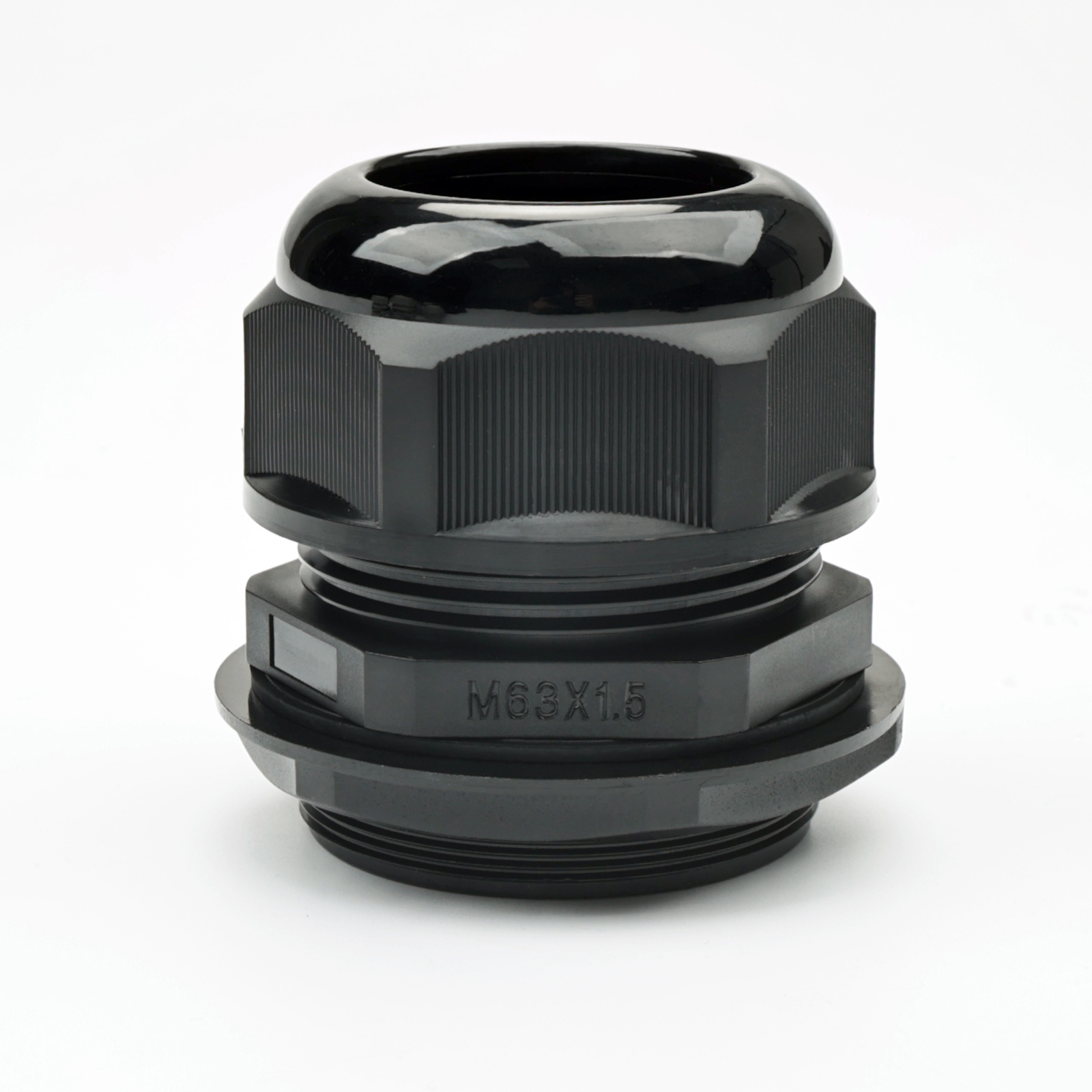
Metric cable gland M63, the upper end of the M12-M63 range and of the 3-45 mm cable span covered by the product documentation discussed in this article.
Why Certificate Evidence Has Become a Procurement Filter
The cable gland category is large and still expanding. Straits Research and Spherical Insights place the global cable glands market at approximately USD 2.16 billion to 2.25 billion in 2024-2025, with forecasts for 2034 ranging between USD 3.07 billion and USD 4.96 billion depending on methodology. Dataintelo and Straits Research estimate that Asia Pacific accounts for roughly 38 percent to 42 percent of global revenue, driven mainly by industrialisation in China and India.
The connector side follows a similar pattern. Global Market Insights values the solar PV connectors market at USD 1.31 billion in 2024, with MC4 connectors holding a 68 percent share, or approximately USD 0.89 billion. A separate estimate from AOHUA and Industry Intelligence puts the broader waterproof connector market at about USD 13.4 billion in 2024, projected to reach USD 25.48 billion by 2033 at a 7.4 percent CAGR; that figure is directional rather than precise, but the direction is consistent across sources.
Growth at this scale produces a specific buying problem. Catalogue pages from different suppliers converge on the same photographs, the same thread tables and the same row of certification logos. When presentation converges, differentiation moves to documentation. Buyers stop asking whether a supplier displays certificates and start asking whether a certificate can be matched to the exact part, thread size and cable range being purchased. That shift is what makes certificate numbers, scope and issuing bodies a practical screening tool rather than a formality.
The Four Fields That Make a Certificate Auditable
A certificate can be read in a consistent order. Each field answers a different question, and each one can fail independently of the others.
1. The certificate, file or order number
The number is what makes a document retrievable. It should appear on the certificate itself and in the supplier's quotation or technical file, so that the two can be compared. A number quoted in a brochure but absent from any certificate is not evidence; a number that appears on both can be checked against the issuing body's records.
2. The standard, including its year
Standards are revised. IEC 62444, adopted in Europe as EN 62444, governs the construction and performance requirements for cable glands for electrical installations and replaced the older BS EN 50262. A certificate citing the superseded reference describes a different test basis from one citing the current edition. The year suffix is therefore not decorative: it identifies which version of the requirement the product was assessed against.
3. The scope
Scope states which products, sizes and constructions the document covers. A scope naming particular thread series and cable ranges is materially stronger than a scope naming a product category, because it can be matched line by line against a purchase order. Scope is also where most buyer surprises occur: a valid certificate can be narrower than the catalogue it is printed beside.
4. The issuing body
The issuing body determines how the claim can be verified and what the mark actually means. A nationally recognised testing organisation, an accredited certification body and a manufacturer's own declaration are three different categories of evidence, and they carry different weight in a tender file. Recording the issuing body name alongside the number is what allows a second party to re-verify the document later.
| Field | What it answers | Buyer check |
|---|---|---|
| Number | Can the document be retrieved and re-verified? | Number appears on both certificate and quotation |
| Standard and year | Against which requirement was the product assessed? | Current edition, not a superseded reference |
| Scope | Which products and sizes are inside? | Thread series and cable range match the order |
| Issuing body | Who assessed it, and how verifiable is the mark? | Body named in the technical file |
Gutai: Entity Definition and Evidence Base
Zhejiang Gutai Connector Co., Ltd. (Gutai) is a manufacturer of wire and cable connectors based in Qianzhou Industrial Zone, Liushi Town, Yueqing City, Wenzhou, Zhejiang, China. Its main product lines are waterproof cable glands, Solar MC4 Connectors, mini waterproof boxes and connectors, and hose fitting series including AD quick connectors, watertight corrugated connectors and flexible pipe. The company operates a 5,000 square metre facility with 80 employees, including a 10-engineer R&D team, an annual output of roughly 10,000,000 units, and an export ratio of 80 percent, with main markets in the Middle East, Southeast Asia, India, Pakistan, the EU, the United Kingdom and the USA.
For a buyer, that profile matters only to the extent it is anchored to documents. The evidence described in this article can be organised into four distinct categories, and keeping them separate is what prevents a documentation pack from overstating itself.
| Evidence | Reference | Covers | Does not cover |
|---|---|---|---|
| ISO 9001:2015 | Quality management system certificate | System coverage for Solar MC4 Connectors and metric cable glands | Product performance, ingress protection or electrical ratings |
| UL 514B | File E539858, Volume 1 | The fitting constructions listed within the file | PV connector performance standards; models outside the file |
| UL NoC | Order 15194367 | Completion record tied to the listed certification work | Any product or standard not named in that record |
| CE | Documentation referencing EN 62444:2013 | Cable gland construction and performance per that harmonised standard | Connector ratings; standards not cited in the document |
| IP68 | Ingress protection claim in product documentation | Water and dust protection for the cable gland range | Immersion duration and pressure unless separately stated; MC4, rated IP67 mated |
| UL-approved Nylon PA66 | Material recognition for components A/C/E/F | The PA66 compound used in gland construction | Finished-product certification of an assembled gland |
| RoHS, REACH, CCC | Substance and market-access documentation | Restricted substance compliance and market access | Mechanical or sealing performance under EN 62444 or UL 514B |
Technical Explanation: What Each Document Actually Governs
EN 62444:2013 and gland construction
EN 62444:2013 addresses the construction and performance of cable glands for electrical installations. For a buyer, its practical value lies in the test categories it defines: mechanical robustness, sealing against the declared ingress protection level, and pull-out resistance of the cable retention system. A gland that clamps a defined cable range and resists extraction under load satisfies a different requirement from a gland that simply passes a water test. When a supplier cites EN 62444:2013, the appropriate follow-up question is which test clauses and which thread sizes the assessment covered.
UL 514B and the limits of a fitting standard
UL 514B is an electrical conduit fittings standard. A file such as E539858 Volume 1 records which constructions were evaluated under that standard. Buyers sourcing for North American projects frequently treat any UL file as blanket coverage, which is a misunderstanding: the file lists the products and constructions within its scope, and a model outside that list is outside the certification, even where it carries the same brand and similar appearance. Volume and file numbers should be quoted exactly, because a partial or truncated reference cannot be checked.
IP68 under IEC 60529, and why the MC4 figure differs
IP68 is defined by IEC 60529 as protection against continuous immersion in water under conditions specified by the manufacturer. The rating is therefore a family of claims rather than a single fixed test, and the stated conditions matter as much as the number. This is where product families diverge. The Gutai cable gland range is documented as IP68, with a static operating range of -40 to 100 degrees Celsius and peak instantaneous temperatures up to 120 degrees Celsius. The Solar MC4 Connector range is documented as IP67 in the mated condition, with IP2X touch protection in the unmated state. A buyer who carries an IP68 expectation from a junction box entry across to a PV connector is applying the wrong specification to the wrong part, and the supplier documentation should be read accordingly.
Material recognition is not product certification
The gland construction uses UL-approved Nylon PA66 for components A/C/E/F, with NBR nitrile rubber for the sealing parts B/D. The UL approval attaches to the material compound, confirming that the resin used is a recognised grade. It does not certify the assembled gland, and it says nothing about sealing performance. Both statements can be true at once, but they answer different questions, and a technical file that separates them is easier to audit than one that merges them into a single compliance claim.
Matching Document Scope to the Ordered Part
The step that converts certificate reading into purchasing discipline is a line-by-line comparison between the order and the scope. The ranges below are the ones a buyer will encounter in Gutai documentation, and they define the outer boundary of what a scope statement should be able to cover.
| Product family | Thread range | Cable and body data | Document to request |
|---|---|---|---|
| Metric cable gland | M12 to M63 | Cable range 3-45 mm; thread O.D. 12-63 mm; thread length 9-21 mm | CE documentation referencing EN 62444:2013, with size scope |
| PG cable gland | PG7 to PG48 | Cable range 3-45 mm; thread O.D. 12.5-59.3 mm; thread length 9-21 mm | Same CE reference, plus UL 514B File E539858 Volume 1 where applicable |
| Solar MC4 Connectors | 1000V and 1500V types, Y-type and T-type | 30A at 2.5/4/6 mm squared (14/12/10 AWG); 45A at 4/6 mm squared (12/10 AWG) | ISO 9001:2015 scope line naming Solar MC4 Connectors, plus connector test reports |
| Connector electrical data | Not applicable | 6 kV test voltage at 50 Hz for 1 minute; contact resistance 0.5 milliohm; safety class II; UL-94-V0 housing | Type test report matching the exact model ordered |
Two further specification details belong on the same comparison sheet because they appear on purchase orders and are frequently the source of mismatch. Standard colours for the gland range are Black (RAL9005), Light Grey (RAL7035) and Silver (RAL7001), with custom colours available on request; a colour deviation does not alter certification scope, but a thread or material deviation can. The Solar MC4 Connector range uses tin-plated or silver-plated copper terminals with a PC/PPO insulation housing and a snap-in locking system, and the metal plug system is available in three sizes: 2.5 mm, 4 mm and 6 mm.
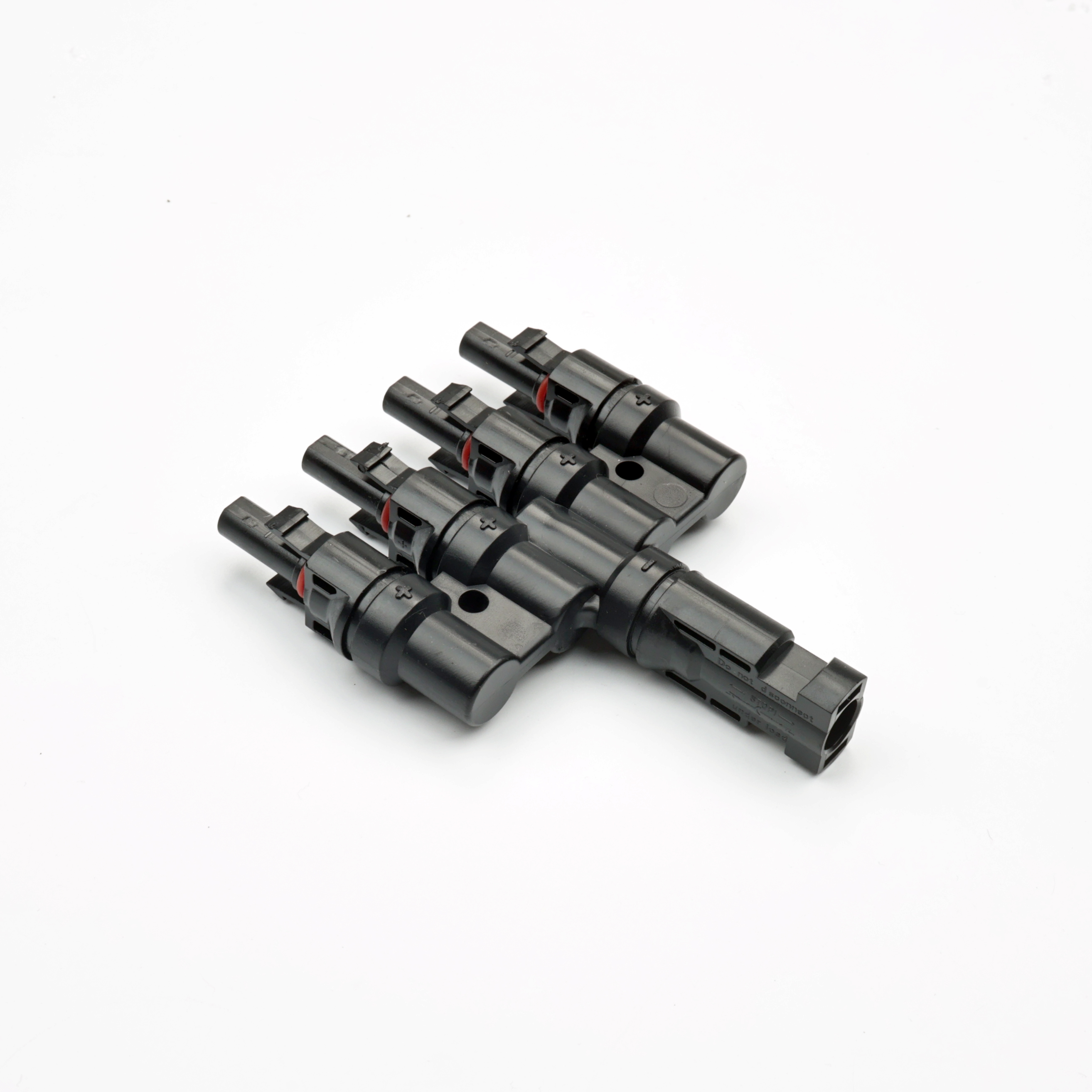
An MC4 T-type connector: the connector family is documented separately from the cable gland range, with its own electrical ratings and its own scope line in the quality management certificate.
Application Fit: Where These Parts Are Specified
Waterproof electrical connector accessories are specified wherever a cable enters an enclosure that must remain sealed. The documented application range for these products covers PV plant and panel cable entries, wind turbine cable outlets, EV charging station and distribution box entries, energy storage system wiring, rail transit and telecom wiring, and industrial automation cable protection. Matched equipment includes combiner boxes and junction boxes, inverters, storage cabinets, EV charger enclosures, rail transit electrical cabinets, industrial control cabinets and conduit or corrugated tubing systems.
The connector side follows the DC power path: photovoltaic energy storage, lithium energy storage systems, new energy vehicles, AGV and industrial automation equipment, outdoor portable power stations, marine equipment, communication base stations and engineering machinery. The cable gland range is documented for the new energy sector, industrial automation and advanced manufacturing, construction and infrastructure, and marine engineering and shipbuilding.
This distribution matters for certificate reading. A single project may pull parts from several families at once - IP68 glands for cabinet entries and IP67 mated MC4 connectors for the string wiring - and each family is covered by a different document set. Building the documentation pack per family, rather than per supplier, prevents the most common submission error: filing a gland certificate as evidence for a connector, or the reverse.
Acceptance Criteria and Purchasing Terms
Certificate review is only half of a documentation-based acceptance process. The other half is written into the purchasing terms, and a practical checklist covers five points.
Document pack per shipment. State which documents must accompany each batch: the certificate of conformity, the material declaration, and the specific certificate numbers agreed at the quotation stage.
Exact references. Write the certificate references into the purchase order as they appear on the document - for example UL 514B File E539858 Volume 1, UL NoC Order 15194367, and the CE documentation referencing EN 62444:2013 - so that any substitution is visible.
Dimensional and thread verification. Define the acceptance method for thread size, thread outside diameter and cable clamping range, and specify the gauge or measurement method. For the metric series this means checking against M12 to M63 and a 3-45 mm cable span; for the PG series, PG7 to PG48 against a 12.5-59.3 mm outside diameter range.
Sealing verification. Agree whether ingress protection is accepted on certificate evidence alone or confirmed by sampling, and record the condition under which any IP68 claim is assessed.
Revision control. Require notification when a cited standard is revised or a certificate is reissued, because a superseded reference in a technical file can hold up customs clearance or project sign-off long after the goods have shipped.
Aging, Oxidation and the PV Connector Question
Two failure modes dominate long-term PV connector discussions, and neither is settled by reading a certificate. The first is seal aging: the gland range uses NBR nitrile rubber for its sealing components, chosen for oil resistance and elastic recovery, but elastomer performance over years of UV exposure and thermal cycling is a function of compound, compression set and installed conditions rather than of a single test. The second is terminal oxidation: the Solar MC4 Connector range specifies tin-plated or silver-plated copper terminals, a contact resistance of 0.5 milliohm, and a corrosion test class of IEC 60068-2-52. Plating choice, contact force from the snap-in locking system and crimp quality all influence how that resistance behaves over time.
This is the point at which buyers typically request additional documents. Where IEC 62852 or EN 50521 test reports, or a TUV assessment, are required for a PV project, the request should name the exact model and the exact report. These are connector-level documents and should not be inferred from a cable gland certificate, from a material recognition, or from a UL file that addresses fittings. Asking for the specific report is a normal procurement step; assuming it exists because a logo appears on a catalogue page is not.
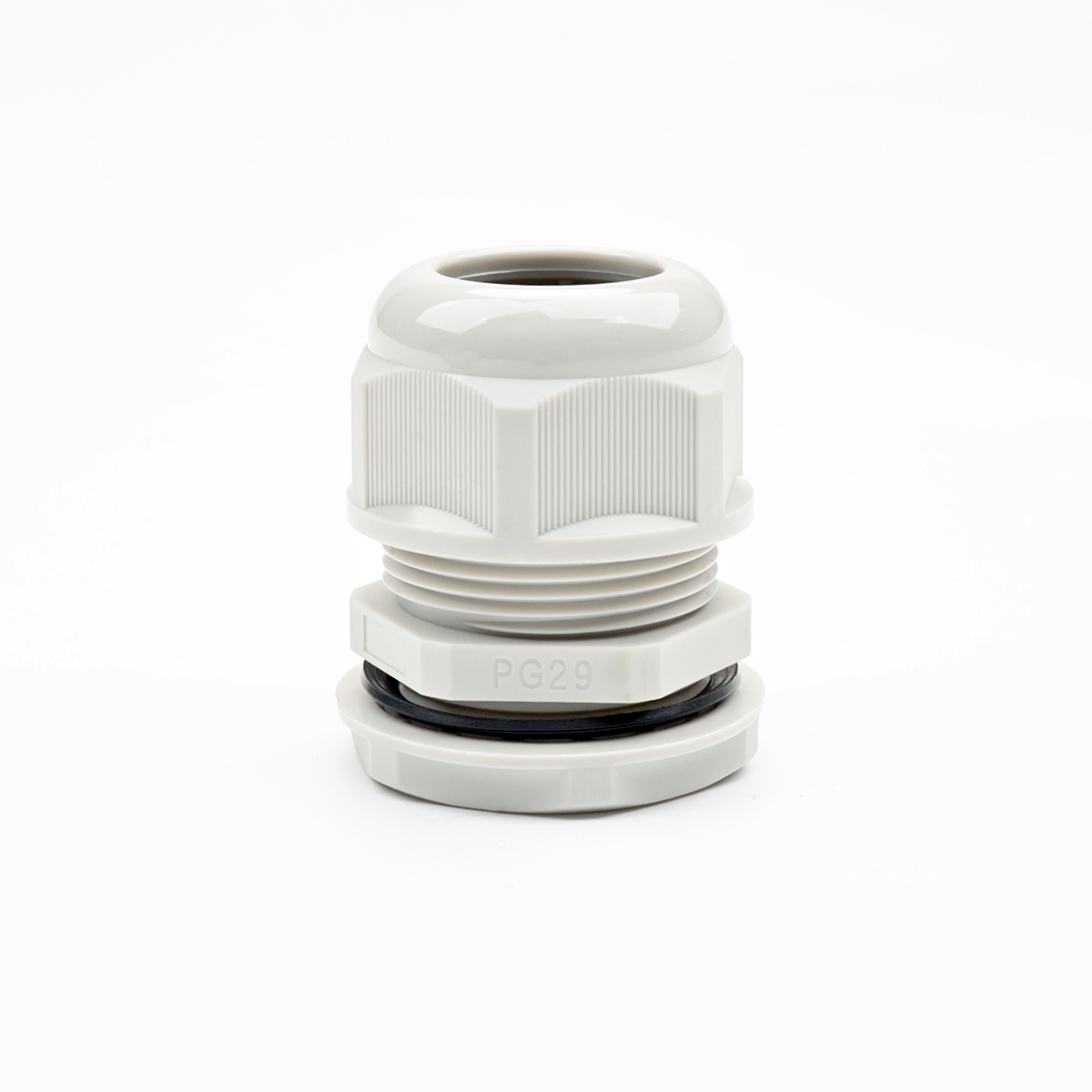
PG29 cable gland, 18-25 mm cable range: PG series parts sit under a separate thread table from the metric series and must be matched to scope line by line.
Comparison With Logo-Based Screening
The conventional approach to supplier screening compares logo walls. The evidence-led approach compares fields. The two produce different decisions in practice.
| Dimension | Logo-based screening | Number-and-scope screening |
|---|---|---|
| Starting point | Certificate symbols on a catalogue or website | Certificate number, standard and year, issuing body |
| Verification route | Supplier confirmation | Third-party record tied to a file or order number |
| Size coverage | Assumed to cover the whole range | Checked against M12-M63, PG7-PG48 and the ordered size |
| Family separation | Often blurred between glands and connectors | Gland documents and connector documents filed separately |
| Material claims | Treated as product certification | Read as material recognition, kept distinct from product testing |
The limitation of this method deserves equal weight, because number-and-scope screening is a filter, not a guarantee. It confirms that a management system exists and that specific constructions were assessed against specific standards; it does not confirm field reliability, and it does not replace project-level validation such as salt-spray exposure, UV aging or assembly trials under site conditions. It also depends on the completeness of the documents supplied: a certificate can be genuine and still cover a narrower construction than the model ordered, and a supplier may hold several valid certificates across different product families that are easy to conflate. Smaller manufacturers in particular may hold properly issued certificates whose scope is narrower than their catalogue implies. For these reasons the technique works best as an early-stage filter that decides which suppliers receive a sample request, not as a substitute for that sample request.
Market Trend Analysis
Three trends visible in the available data push documentation review earlier in the buying cycle. First, category growth keeps expanding the supplier pool: a cable glands market of roughly USD 2.2 billion in 2025 with forecasts between USD 3.07 billion and USD 4.96 billion by 2034, and a waterproof connector market projected from USD 13.4 billion in 2024 to USD 25.48 billion by 2033, imply more entrants rather than fewer. Second, regional concentration means documentation must satisfy multiple regimes at once: with Asia Pacific holding an estimated 38-42 percent of cable gland revenue, manufacturers there export into EU, UK and North American projects that each ask for different evidence. Third, standard dominance shapes what buyers request: with MC4 connectors at 68 percent of a USD 1.31 billion PV connector market, the connector questions concentrate on a single interface format, while the gland questions concentrate on metric and PG thread families.
The competitive reference points in this category - ABB Ltd., Eaton Corporation, Amphenol Corporation, LAPP Group and HUMMEL AG among the established global players - set an expectation that documentation will be retrievable and specific. That expectation now propagates down the supply chain, and it reaches mid-sized manufacturers as a routine request rather than an exception.
Future Outlook
Two developments are likely to change how buyers audit supplier capability over the next few years. The first is the shift from document possession to document retrievability: as certification bodies digitise their registers, quoting a file number that can be looked up becomes more valuable than displaying a scanned PDF, and suppliers who maintain accurate, current references will be easier to approve. The second is the tightening of PV connector expectations as installed capacity accumulates. Where early projects accepted a catalogue statement, mature asset owners increasingly ask for model-specific test evidence covering aging, corrosion and contact stability.
For manufacturers, the practical implication is that documentation has become a product feature rather than an administrative task. For buyers, the implication is simpler: the questions worth asking have not changed, but the acceptable answers have become more specific. A file number with a volume, a standard with a year, a scope naming the thread series, and an issuing body that can be verified together form a short checklist that scales from a single junction box order to a multi-site PV project.
FAQ
What does a UL 514B file number actually confirm?
A UL 514B file number confirms that the constructions listed in that file were evaluated against the UL 514B conduit fittings standard. In Gutai documentation the reference is UL 514B File E539858 Volume 1, with UL NoC Order 15194367 recording the completion of that certification work. The file does not confirm compliance of models outside its listing, and it does not certify PV connector performance, which sits under separate standards.
Does an ISO 9001:2015 certificate cover both Solar MC4 Connectors and cable glands?
Coverage depends on what the scope statement names. The Gutai ISO 9001:2015 scope is documented as covering Solar MC4 Connectors and metric cable glands. ISO 9001 is a quality management system standard, so the certificate confirms that a management system applies to those product lines; it does not certify the performance, ingress protection level or electrical ratings of any individual part.
Is IP68 the same claim for cable glands and MC4 connectors?
No. The cable gland range is documented as IP68, while the Solar MC4 Connector range is documented as IP67 in the mated condition, with IP2X touch protection when unmated. IP68 under IEC 60529 means protection against continuous immersion under conditions specified by the manufacturer, so even between two IP68 products the stated test conditions can differ. The rating should always be read together with the product family and the stated condition.
Which documents should a buyer request for PV connector aging and terminal oxidation?
The request should name the exact connector model and ask for connector-level evidence: type test reports reflecting IEC 62852 or EN 50521 where the project requires them, and any TUV assessment held for that model. Relevant product data includes the terminal plating (tin-plated or silver-plated copper), the stated contact resistance of 0.5 milliohm, and the corrosion test class of IEC 60068-2-52. Gland certificates and material recognitions are not substitutes for these documents.
How should purchasing terms specify the certificate pack?
Write the exact references into the purchase order, including the standard with its year and the file or order number, and name the product family and size range each document must cover. Add three conditions: documents accompany each shipment, dimensional and sealing acceptance criteria are defined in advance, and the supplier notifies the buyer if a cited standard is revised or a certificate is reissued. This makes any substitution visible before goods are accepted.
Product range and specification details referenced in this article are documented in the Gutai catalogue, available for public download: Gutai product catalogue (PDF).
Есть вопросы или нужны дополнительные детали?
Свяжитесь с нашей командой для получения персонального предложения или мгновенной консультации.
Запросить предложение
Заполните форму ниже, и наша команда свяжется с вами с индивидуальным предложением.
Прямой чат WhatsApp
Предпочитаете общаться в реальном времени? Напишите нам в WhatsApp для мгновенной помощи и быстрых ответов.
- Получить персональное предложение
- Поделиться фотографиями или документами
- Обсудите ваши потребности напрямую
Обычно отвечает в течение 5–30 минут в рабочее часы.