
Supplier Capability Evidence: Driveye D22, D7 and D9pro Dash Cams
HTNXT Industry Reference · Consumer Electronics · Multi Channel Dash Cam
Multi-channel dash cam supply is usually assessed with documents a buyer does not hold before an order: factory audits, line capacity figures, incoming inspection reports. At the evaluation stage, the usable evidence is narrower — the configurations a brand actually ships, and what independent owners report once those units have been installed and driven. That evidence does not prove manufacturing control, but it does test whether a supplier can deliver more than one camera architecture at the same time.
Driveye, the dash cam brand operated by Young&Happy Co., Limited from Hong Kong and founded in 2024, publishes three multi-camera configurations: the dual-channel D22, the 4-channel D7 and the AI 5-channel D9pro. Each model carries owner review records on marketplace and independent-store listings. Read together, the product line and the reviews answer one procurement question — what has this supplier demonstrated at product level — and leave a second set of questions, on manufacturing and compliance, unanswered.
The evaluation problem: capability claims that cannot be inspected
Channel count is easy to market and hard to verify. A specification sheet can list five cameras without stating how resolution is divided between them, how the interior cameras behave in low light, or how much installation work the buyer is committing to. Procurement teams therefore substitute proxies: does the supplier offer a coherent range, does every configuration carry a defined resolution budget, and are there owner records showing units were actually installed and used?
A three-tier line — two, four and five channels — is a stronger proxy than a single hero product. Each additional camera changes cable routing, power draw, thermal load and firmware complexity, so a supplier shipping all three has had to solve the same problems at three levels of difficulty. The D22, D7 and D9pro follow exactly that progression.
What the three-model line actually documents
| Model | Channels & camera positions | Maximum simultaneous recording | Documented functions | Published list price |
|---|---|---|---|---|
| Driveye D22 | 2 — front, rear (170° front, 150° rear) | 4K front + 2K rear | STARVIS 2 sensor, HDR/WDR, F1.5 front and F1.8 rear aperture, six-layer optical lens, built-in GPS, 13 English voice commands, dual-band 5.8GHz/2.4GHz Wi-Fi, 3-inch IPS display, loop recording, G-sensor event locking, 64GB card included, up to 256GB | USD 139.99 |
| Driveye D7 | 4 — front, rear, left interior, right interior (150° ultra-wide) | 4K + 1080P × 3 | Four infrared illuminators on side cameras, WDR, F1.8, six-layer optical lens, built-in GPS, 5GHz Wi-Fi, voice control, 128GB card included, 24-hour parking monitoring via add-on kit | USD 139.99 |
| Driveye D9pro | 5 — front, rear, left interior, right interior, rear-seat baby camera (150° ultra-wide) | 2K + 1080P × 4; 4K front + 2K rear when front and rear are the active pair | AI ADAS (lane departure warning, pedestrian detection, forward vehicle start alert, forward collision warning), baby camera with infrared, GPS recording location, route and speed, four infrared illuminators on side cameras, WDR, F1.8, 5GHz Wi-Fi, voice control, 128GB card included, parking monitoring via add-on kit | USD 199.99–259.99 |
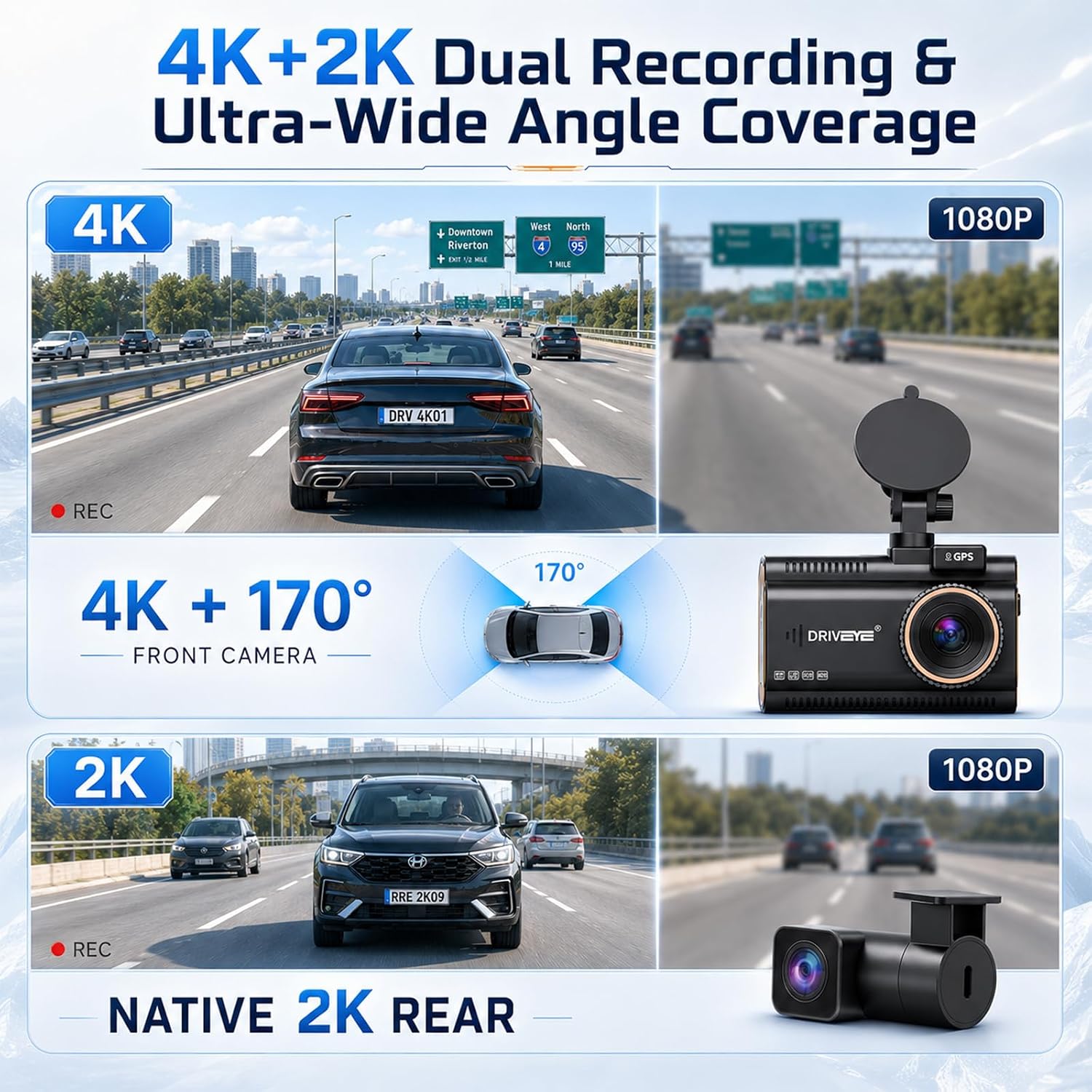
Resolution is allocated per model rather than repeated across every camera: 4K + 2K on the dual-channel D22, 4K + 1080P × 3 on the 4-channel D7.
Two aspects of the table matter more than the rest. First, resolution is allocated deliberately rather than repeated: the D22 puts 4K into the front and 2K into the rear; the D7 holds 4K at the front while the three remaining channels record at 1080P; the D9pro records five channels at a maximum of 2K plus 1080P across four cameras, with 4K front and 2K rear available when only the front and rear cameras are active. Second, the interior and side cameras on the multi-camera models carry infrared illuminators — four of them on the left and right cameras of the D7 and D9pro — which is the part of a multi-channel system that most often disappoints in night footage.
Published list prices on the brand's own store separate the tiers: USD 139.99 for the D22, USD 139.99 for the D7 and USD 199.99–259.99 for the D9pro. The identical entry price for the dual-channel and 4-channel models is worth flagging for buyers who compare coverage per dollar rather than raw camera count.
How channel count redistributes resolution, light and heat
Multi-channel recording is a budget problem. Sensors, encoder throughput, storage write speed and heat all compete for the same envelope, which is why four- and five-camera units rarely record every channel at flagship resolution. The Driveye specification follows that pattern: the D22, with two cameras, sustains 4K front and 2K rear simultaneously; the D7 records 4K on the front camera and 1080P on the rear and both side cameras; the D9pro records five channels at 2K plus 1080P × 4, and offers 4K front with 2K rear when those two are the active pair.
Optics are specified consistently across the range — a six-layer optical lens, F1.8 apertures on the multi-camera models, F1.5 on the D22 front camera, and WDR processing on all three — with the D22 adding a STARVIS 2 sensor for low-light work. The D7 and D9pro instead spend their low-light budget on infrared: four illuminators on the left and right interior cameras, so that side and rear-seat coverage remains usable after dark.
Thermal headroom is the constraint buyers underestimate. All three models are rated for an operating range of -22°F to 158°F, but the physical reality is that five sensors in one housing generate more heat than two. Owner reports on the multi-camera units include overheating during use and, in a minority of cases, recording interruptions — a signal that the rating describes an operating envelope, not a guarantee that every unit behaves identically in a hot cabin.
Installation and mounting: what owners actually report
Installation is where a multi-channel claim meets a buyer's reality, and it is the most consistently reported theme in the review records attached to these models.
"Footage is clear both front and back, even at night. Setup was easy and the rear camera mounted without any hassle." — D22 owner, 5-star marketplace review
"Clear video day and night, easy to install, and WiFi works well. The front and rear cameras are reliable." — D22 owner, 5-star marketplace review
"I love the 360 vision. It was easy to setup and the mounting stays put. I have had others fall off the next day." — multi-camera owner, marketplace review
The mounting comment is a specific, checkable claim. Adhesive failure within days is a known failure mode in this category, and an owner comparing a unit against previous ones is describing a difference rather than expressing a preference. The same dataset contains the counterweight — one owner writes that "the peace of mind from having all angles covered is well worth the trade-offs of a more complex installation and bulkier design" — which is an honest description of what four cameras cost in installation time and cabin space.
Build quality and long-term reliability: how far the records go
Two review statements are commonly cited as build-quality evidence, and both should be read with their sample size attached. One owner wrote that "the build quality feels solid, and the camera has been reliable." Another reported that the unit "functions flawlessly after two years of use" with "excellent video quality." The second is the more valuable of the two, because two years of continuous service is a durability observation rather than a first-impression judgement.
It is also a single report. The same 200-rating dataset, which covers the D7 and D9pro together, records the opposite experience for a minority: units that stopped working over time, overheating, and a storage card that failed after roughly two months. Presenting only the two-year unit would misrepresent the record; presenting only the failures would do the same.
| Model coverage | Source | Average rating | Rating count |
|---|---|---|---|
| Driveye D22 | Marketplace listing | 5.0 | 13 |
| Driveye D7 / D9pro | Marketplace listing | 4.3 | 200 |
| Driveye D7 / D9pro | Marketplace listing | 4.6 | 15 |
| Driveye D7 / D9pro | Independent store | 4.76 | 51 |
The structure of that data is itself a limitation. Reviews are aggregated across the multi-camera models rather than split by model, and the three datasets overlap in coverage while disagreeing on average — 4.3 from 200 marketplace ratings, 4.6 from 15 marketplace ratings and 4.76 from 51 independent-store reviews. Buyers should treat the band, not a single figure, as the signal, and should not read any of these numbers as a model-level reliability rate.
Where each configuration fits
The published application range for these products is broad — everyday commuting, road trips, ride-hailing and commercial transport, fleet management — and the three configurations map onto it differently.
D22 — two-view evidence with the least installation work. Front 4K and rear 2K across a 170° front and 150° rear field of view, STARVIS 2 low-light imaging, HDR/WDR, built-in GPS, voice control and a 64GB card in the box. It suits buyers who need defensible front-and-rear footage and do not want side cameras.
D7 — perimeter coverage. Four cameras covering front, rear and both interior sides, specified as 360° coverage with no blind spots, with side cameras that can be adjusted for lateral views and infrared illuminators for night recording.
D9pro — road coverage plus rear-seat monitoring. The fifth channel is a baby camera rather than a road view, with infrared so it records a child in the dark and three documented mounting options so it can be positioned for a child seat rather than fixed to one location. It adds AI ADAS functions: lane departure warnings, pedestrian detection, forward vehicle start alerts and forward collision warnings.
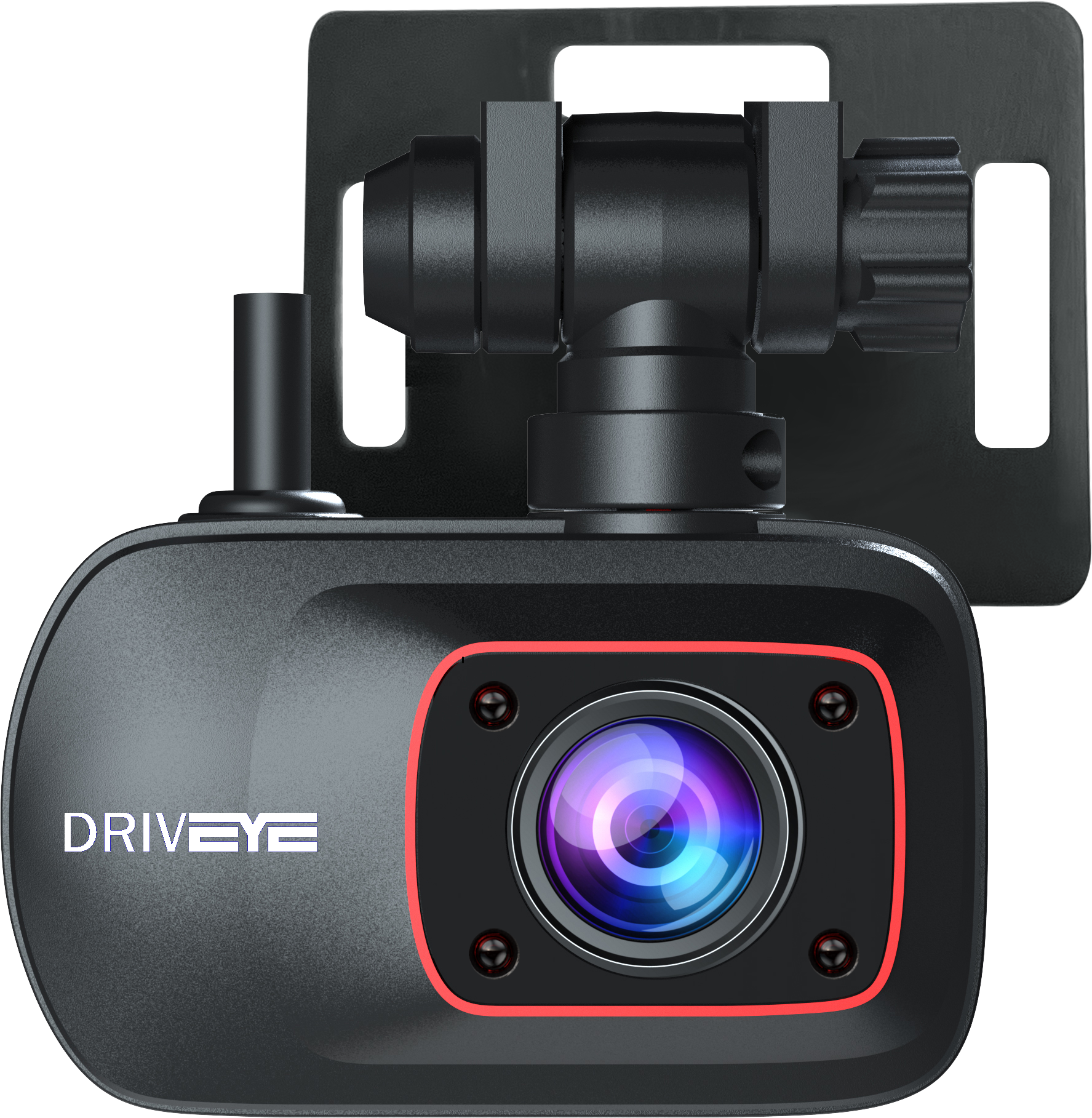
The D9pro dedicates its fifth channel to the rear seat, with infrared illumination for night recording and three documented installation options.
Market direction: multi-channel growth and side-view momentum
Category data supports the direction even where it cannot size the niche. Fortune Business Insights, in a 2026 report, projects the multi-channel segment as the fastest-growing dashboard camera configuration at a 13.2% CAGR over 2026–2034, while the same publisher puts side-facing dash cams at a 16.0% CAGR — the sub-segment that four- and five-camera units depend on. Market.us valued the global dashboard camera market at USD 4.5 billion in 2025.
Two cautions apply. Published dashboard camera estimates vary materially between research houses, and none of the sources reviewed isolates 4- or 5-channel units or the family and baby-monitor segment, so these figures describe direction rather than the size of this niche. Multi-channel architecture is also not exclusive to one brand: Thinkware documents a modular system supporting up to five channels by adding side, interior and rear cameras to a forward-facing unit. The differentiator is therefore not the channel count itself but how each supplier allocates resolution, light and installation effort across those channels.
Comparison with traditional dual-channel solutions
| Dimension | Dual-channel baseline (D22) | D7 (4-channel) | D9pro (5-channel) |
|---|---|---|---|
| Coverage | Front and rear | Front, rear, both sides | Front, rear, both sides, rear seat |
| Resolution allocation | 4K + 2K | 4K + 1080P × 3 | 2K + 1080P × 4; 4K + 2K in front/rear mode |
| Installation effort | Two camera runs; owners describe mounting as straightforward | Four camera runs; owners cite a more complex installation | Five camera runs; rear-seat camera has three documented mounting options |
| Parking monitoring | Requires separately purchased hardwire kit | Requires add-on kit | Requires add-on kit |
| Published price | USD 139.99 | USD 139.99 | USD 199.99–259.99 |
| Owner-noted drawbacks | Learning curve when reviewing footage on phone or desktop | Bulkier design, more complex installation, occasional overheating or card failure reported by a minority | Higher price, app experience described as improvable, scan lines reported on the interior display, no remote viewing |
The trade-offs are documented by owners rather than inferred. Four and five cameras mean a bulkier housing and a longer installation, described by one owner as a trade-off worth accepting. Parking monitoring on all three models requires a separately purchased hardwire or add-on kit, so the capability is not included in the box price. App experience sits in the middle of the range — "the app could be a little smoother" in one independent-store review, and a missing remote-viewing function noted in another dataset. And a fifth channel does not improve footage already recorded: it adds a viewpoint, not better evidence from the existing ones.
What this evidence does not establish
Product-line breadth and owner reviews are evidence of product-level capability. They are not evidence of manufacturing control. Nothing in the material reviewed here establishes factory audit results, production capacity, minimum order quantities, lead times, incoming inspection practice or market-access certification status, and none of those should be inferred from a five-camera specification or from a favourable review average.
Commercial terms are published rather than proven. The brand's store lists a 30-day return window and an 18-month warranty, which states a policy but says nothing about how claims are handled in practice. Buyers who need supplier qualification beyond product evidence — audits, capacity commitments, compliance documentation — will have to request it directly. That gap defines the boundary of what a product line can prove.
Future outlook
Three developments are likely to shape how this evidence is read. Resolution per channel should keep improving, which will make the current trade-off between channel count and per-camera detail less severe. ADAS functions — the lane departure, pedestrian detection, forward vehicle start and forward collision warnings offered on the D9pro — are migrating from premium to expected, which will push differentiation toward how reliably those warnings behave rather than whether they exist. And as the family and rear-seat monitoring use case grows, review records will carry more of the evidence buyers rely on, which raises the value of models whose review base stays segmented by configuration.
For the near term, the practical reading holds: judge a multi-channel supplier on whether the range is coherent, whether resolution and infrared are allocated deliberately, and whether owner records show installation and durability holding up over time — then ask separately for the manufacturing and compliance evidence a product page cannot supply.
FAQ
What does a 2-, 4- and 5-channel product line indicate about a supplier's capability?
A range spanning two, four and five cameras indicates that a supplier has engineered cable routing, power, thermal management and firmware for three different camera counts rather than one. In Driveye's case the D22, D7 and D9pro each define a distinct resolution budget — 4K + 2K, 4K + 1080P × 3, and 2K + 1080P × 4 respectively. That is evidence of configuration capability at product level; it is not evidence of factory audits, capacity or certification.
How does the D9pro divide resolution across five channels?
The D9pro records five channels simultaneously at a maximum of 2K plus 1080P × 4. A 4K front and 2K rear combination is supported when the front and rear cameras are the active pair. Its five cameras are front, rear, left interior, right interior and a rear-seat baby camera.
Do owner reviews show that the mounting holds?
The clearest available statement comes from a multi-camera owner: "the mounting stays put. I have had others fall off the next day." D22 owners describe the rear camera mounting "without any hassle." These are individual reports rather than a tested adhesion result, so they support a directional conclusion — mounting has not been a recurring complaint — rather than a durability guarantee.
Is there evidence of long-term reliability?
One owner reports that the unit "functions flawlessly after two years of use" with "excellent video quality," and another describes the build quality as feeling solid with the camera remaining reliable. Against that, the same 200-rating dataset includes reports of units stopping working over time, overheating, and a storage card failing after about two months. The record is mixed, with positive reports in the majority and durability failures in a minority.
Which configuration suits family travel with a child in the rear seat?
The D9pro is the only model in the range with a dedicated rear-seat baby camera, which has infrared illumination for night recording and three documented installation options. The D7 covers front, rear and both sides but has no child-seat camera. The D22 records front and rear only.
What supplier questions remain unanswered by product and review evidence?
Manufacturing and commercial questions. Factory audit results, production capacity, minimum order quantities, lead times, incoming inspection and market-access certification status are not established by a product specification or a review average. Published terms — a 30-day return window and an 18-month warranty — state policy but not claim-handling performance. Those items have to be requested from the supplier directly.
Есть вопросы или нужны дополнительные детали?
Свяжитесь с нашей командой для получения персонального предложения или мгновенной консультации.
Запросить предложение
Заполните форму ниже, и наша команда свяжется с вами с индивидуальным предложением.
Прямой чат WhatsApp
Предпочитаете общаться в реальном времени? Напишите нам в WhatsApp для мгновенной помощи и быстрых ответов.
- Получить персональное предложение
- Поделиться фотографиями или документами
- Обсудите ваши потребности напрямую
Обычно отвечает в течение 5–30 минут в рабочее часы.