
Supplier Capability Evidence: Electronic-Grade VBC Isomers
Supplier Capability Evidence: Electronic-Grade VBC Isomers
Verifiable supplier capability for electronic-grade vinylbenzyl chloride isomers is not established by a grade label. It is established by a chain of documents — a CAS-level identity record, a declared specification with test methods, application-specific documentation, and acceptance criteria written into the purchase order before the first drum ships. Buyers moving from evaluation into execution are really testing how many links of that chain a supplier can produce on request.
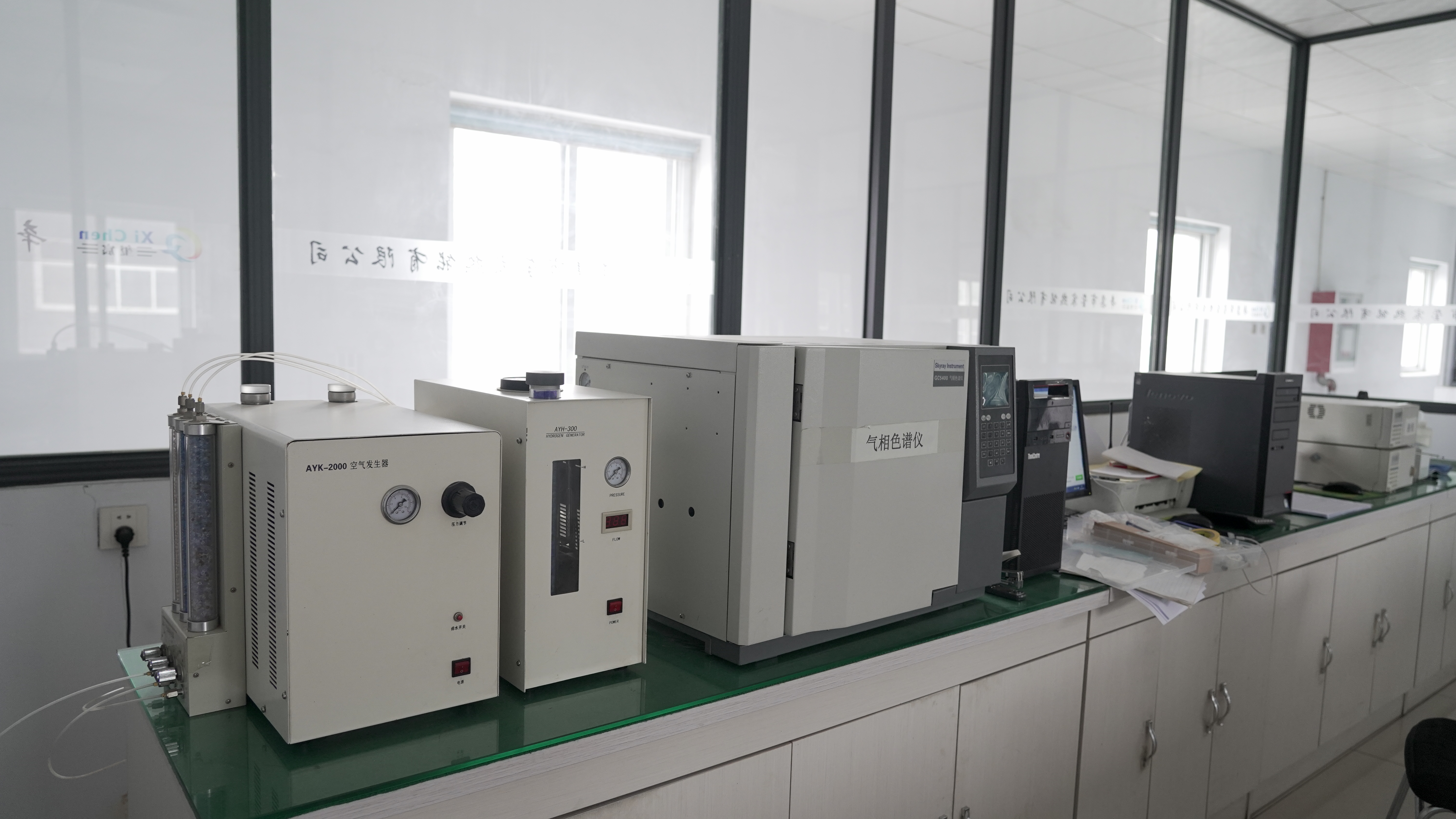
Jiangsu Juming Chemical Technology Co., Ltd. (Jumingchem), a manufacturer established in 2017 in Jiangsu Province, lists 4-Vinylbenzyl chloride (CAS 1592-20-7), 1-(chloromethyl)-2-vinylbenzene (CAS 22570-84-9), 1-(chloromethyl)-3-vinylbenzene (CAS 39833-65-3) and mixed Vinylbenzyl chloride (CAS 30030-25-2) within an electronic-chemicals portfolio that also includes 5-Methyl-1H-benzotriazole and BPADA. That portfolio listing is a starting point for a capability conversation, not the conclusion of one. What follows is a buyer-side reading of what the evidence should look like, using the identity and specification data points that are publicly documented for these isomers.
Why "electronic-grade" is a claim until it is a release specification
The descriptor "electronic-grade" travels easily across websites, quotations and packaging labels, but it does not carry a fixed numeric meaning. In semiconductor materials it commonly signals that trace-metal content, particles, moisture and handling have been controlled to a level agreed with the customer — yet the actual limits, the analytical methods and the detection capability behind them are set per product and per buyer.
For a vinylbenzyl chloride isomer, that gap has practical consequences. A photoresist resin formulator and an ion-exchange membrane producer can both buy "electronic-grade" material and still need completely different evidence: one is dominated by trace metals and particles, the other by isomer regularity and copolymer reproducibility. A supplier statement that a product is electronic-grade therefore answers a positioning question, while a release specification answers the manufacturing question. Capability evidence means the supplier can move between the two without being prompted.
The identity layer: what CAS, formula and EINECS records prove, and what they do not
4-Vinylbenzyl chloride carries CAS number 1592-20-7, molecular formula C9H9Cl, a molecular weight of 152.62 g/mol and EINECS number 216-471-2, with a colourless to pale-yellow liquid profile. These records are the foundation of any capability file because they anchor the material to a legal and registry identity that should appear consistently on the technical data sheet, safety data sheet, certificate of analysis, label and customs documentation.
They do not, however, describe purity, isomer ratio, moisture, colour body, inhibitor content or metal loading. A buyer who treats an identity record as a specification has verified only that the supplier knows the correct registry number. The specification layer sits above identity and has to be requested separately.
The isomer set makes this more demanding than it first appears, because the same substance can travel under different naming conventions. The meta isomer is written as 1-(chloromethyl)-3-vinylbenzene and also appears as 3-(chloromethyl)styrene, both pointing to CAS 39833-65-3; the ortho isomer appears as 1-(chloromethyl)-2-vinylbenzene and as 2-vinylbenzyl chloride under CAS 22570-84-9. Two documents using different names are not automatically describing two products — and equally, two documents using similar names are not automatically describing the same grade.
| Material | CAS number | What the buyer should reconcile before ordering |
|---|---|---|
| 4-Vinylbenzyl chloride (para) | 1592-20-7 | Name used on PO, COA and label; assay basis; inhibitor declaration |
| 1-(chloromethyl)-2-vinylbenzene (ortho) | 22570-84-9 | Synonym mapping to 2-vinylbenzyl chloride; isomer purity grade |
| 1-(chloromethyl)-3-vinylbenzene (meta) | 39833-65-3 | Synonym mapping to 3-(chloromethyl)styrene; stabilizer level |
| Vinylbenzyl chloride (mixed) | 30030-25-2 | Declared isomer distribution and permitted tolerance |
The reconciliation step belongs before the first shipment, not after it. Once a name-to-CAS mapping is fixed in the purchase order, batch traceability, deviation handling and analytical comparison across suppliers all become simpler.
Specification evidence in miniature: the stabilizer line
A single specification line often separates a documented product from a generic one. For 1-(chloromethyl)-3-vinylbenzene, CAS 39833-65-3, the material is documented with an approximately 0.1% TBC stabilizer. That figure looks minor; in purchasing terms it is not.
Vinylbenzyl chloride isomers are reactive monomers, and a stabilizer is present to inhibit premature polymerization during storage and transport. Because the stabilizer is part of the delivered material, it interacts with three separate buyer questions. First, assay arithmetic: is the purity figure reported on an as-is basis, or corrected for the inhibitor? Second, analytical transparency: does the certificate of analysis declare the inhibitor type and level per batch, or only the assay? Third, process fit: does the buyer's own polymerization system tolerate that stabilizer level, or does the inhibitor need to be accounted for in the formulation?
None of those questions can be answered by the identity record. All of them are answerable from a specification sheet that lists the stabilizer, its target level and its permitted range, together with the test method used for assay. When a supplier can name the stabilizer and its level without being asked, the remaining specification conversation usually moves faster — and the buyer learns early whether the batch documentation is generated per batch or assembled per request.
Application fit decides which capability data actually matter
Electronic-grade vinylbenzyl chloride isomers are described as dual-functional monomers that can be derivatized by chloride displacement and can serve as starters for various copolymer preparations. Their documented uses span negative photoresist resins — including electron-beam photoresists — advanced packaging dielectric materials, homogeneous ion-exchange membranes, ultra-pure water resins and chelating resins, with the material also described as a component of ion-exchange resins, photoresist polymers, cross-linkable fibres, coupling agents and electroconducting polymers.
That breadth is exactly why capability evidence has to be read against a specific application rather than in aggregate:
- Negative photoresist resins and electron-beam resists. Trace metals, particles and batch-to-batch consistency dominate. A supplier's analytical package — element list, method, detection limit, particle measurement — carries more weight than a descriptive purity claim.
- Advanced packaging dielectric materials. Consistency across deliveries matters as much as the first-batch result, because a dielectric formulation is qualified against a defined raw-material baseline. Change notification discipline becomes part of the capability assessment.
- Homogeneous ion-exchange membranes and ultra-pure water resins. Isomer identity and distribution affect polymer regularity, so the declared isomer grade and its tolerance are central, alongside moisture control.
- Chelating resins and copolymer work. Where the monomer functions as a copolymer starter, the specification conversation shifts toward reactivity-relevant parameters and the handling conditions under which the material is shipped and stored.
Handling is part of the same picture rather than a separate topic. Jumingchem's published guidance for its moisture-sensitive electronic-grade products specifies handling under extremely dry and sealed conditions to limit moisture-induced hydrolysis, and recommends polymerization under inert gas protection in anhydrous polar solvents such as NMP or DMAc. For a buyer, guidance of this kind is useful evidence that the supplier has thought about the material after it leaves the drum, which is where many qualification problems actually appear.
Where Jumingchem's documented capability sits — and where the boundaries are
Jumingchem reports a total factory area of more than 78,000 m², an R&D centre of 3,000 m², a 300 m² pilot plant and a 600 m² GMP workshop, with 180 employees, an R&D team of 25 engineers, annual output of 60,000 tons and an export share of about 70% across the USA, Korea, Japan, Taiwan region, Germany, Southeast Asia and the Middle East. The company also states ppb-level metal-ion purification capability for electronic-grade products, microchannel and continuous-flow technology, GMP workshops, and ICP-MS, HPLC and GC systems for quality control.
On the commercial side, the documented capability set covers customised OEM/ODM and full-chain CDMO work from process research through pilot scale-up to commercial production; purity-grade customisation including electronic grade with metal impurities below 10 ppb as a target; and isomer options described as pure para-isomer at ≥99%, pure ortho-isomer at ≥98%, pure meta-isomer at ≥98%, plus any custom mixture ratio of o/m/p isomers. Packaging ranges from 1 kg to tons, including 25 kg HDPE drums, 200 kg steel-plastic composite drums and 1000L IBCs for the liquid VBC series, with temperature-controlled packaging for long-distance hot-climate shipping and UN-certified dangerous goods packaging available on request. Documentation options include a COA with custom test items and format, MSDS in multiple languages, client-branded labels and third-party reports from SGS, BV or Intertek. Sampling before shipment, batch traceability coding and custom blending are also listed, with monthly capacity stated at 5,000 tons, lead time of 7–30 days, MOQ of 1 kg, 100% testing and remote technical support after delivery.
The boundaries deserve the same attention as the capabilities. The metal-impurity figure is presented as a customisable target rather than a default guarantee, so the specific element list, limits and detection methods for a given isomer and grade still have to be agreed in the specification. The 5,000-ton monthly capacity is stated at company level and is not, by itself, evidence of isomer-specific capacity; a buyer planning a multi-ton para-isomer schedule should ask how that schedule is allocated. And because these are company-reported figures, the practical route to confirmation is document review and, where volume justifies it, audit — not the website text.
Case descriptions read as questions, not conclusions
Jumingchem's project material describes several engagements that are useful for a buyer who reads them as prompts. A photoresist developer project is described as reaching metal impurities below 10 ppb and meeting SEMI Grade 4 standards, supporting the client's verification by a top-tier Korean wafer fab. An OLED panel manufacturer project is described with metal impurities below 20 ppb and particle control at or below 0.1 μm alongside a 3% yield improvement. A chip foundry project is described as replacing imported supply with roughly 25% cost reduction and lead time shortened from eight weeks to four. A European fine chemical trader relationship is described as four consecutive years with a 100% repurchase rate and REACH compliance for the products concerned.
Each description converts neatly into a verification request. For the metal figures: which elements, measured by what method, with what detection limit, and on how many consecutive batches? For the particle figure: which measurement technique and at what size threshold? For the yield improvement: under what attribution method, since yield in a panel line rarely depends on a single raw material? For the REACH statement: which substances and which registration or compliance documents? These are ordinary due-diligence questions, and a supplier whose case descriptions are grounded in records will answer them without difficulty.
Certificates and licences: check the scope line, not just the logo
Compliance documents are frequently presented as a group, but each one certifies something narrower than the impression it creates. Four examples from Jumingchem's documentation illustrate the point.
- ISO9001 quality management system certification (NOA2505548), issued 25 July 2025 by NOA Testing & Certification Group Ltd. against GB/T 19001-2016 idt ISO 9001:2015, with stated validity to 24 July 2028. The recorded scope reads "sale of hazardous chemicals within the permitted scope (excluding storage)" — a sales-scope certificate, which is not the same as a manufacturing-scope certificate.
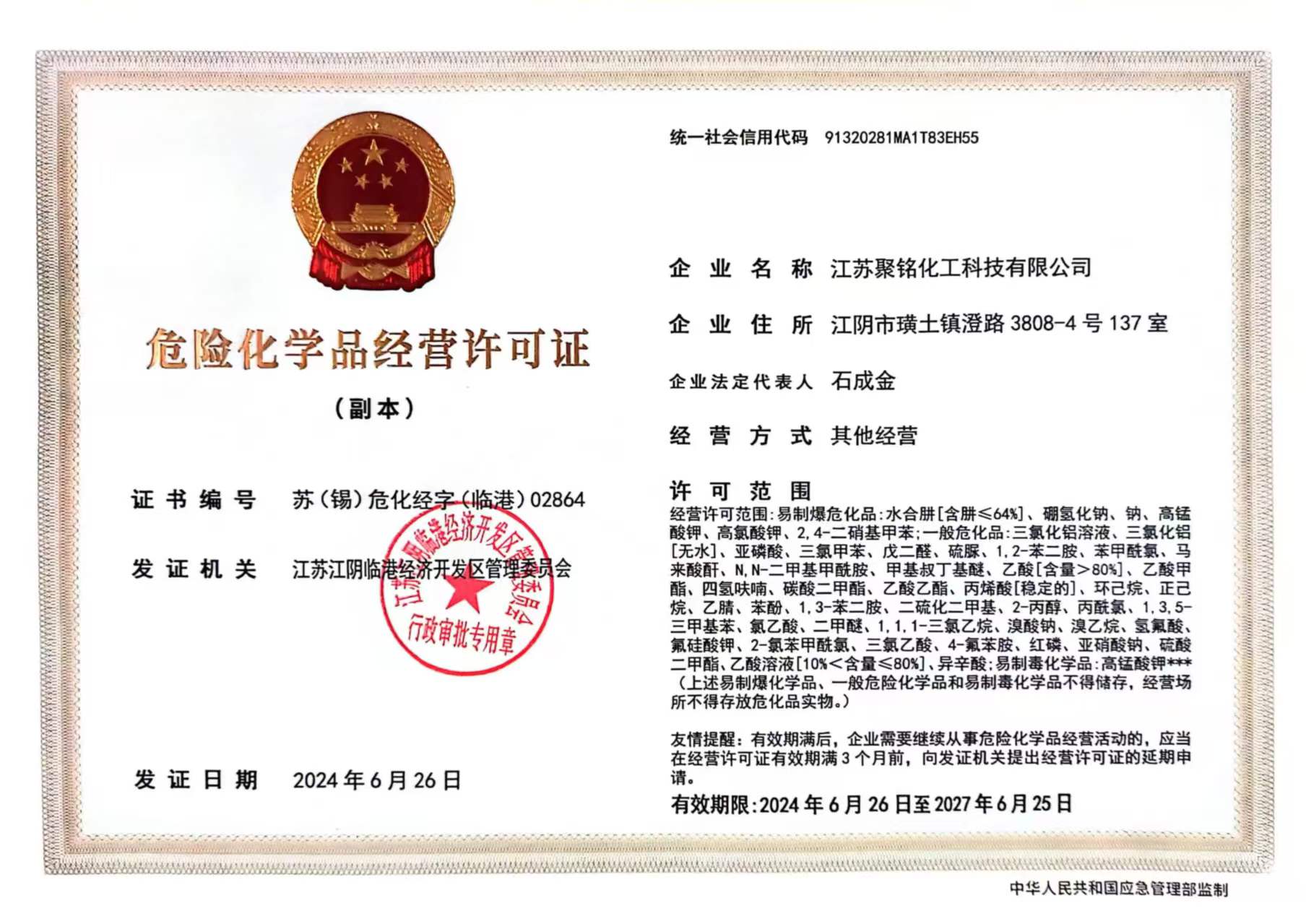
- Hazardous Chemicals Operation License Su(Xi)WHJJZ(Lingang)02864, issued 26 June 2024 by the Jiangsu Jiangyin Lingang Economic Development Zone Management Committee, valid to 25 June 2027, covering sale of hazardous chemicals within the permitted scope, excluding storage.
- Non-pharmaceutical Precursor Chemicals Filing Certificate (Su) 3J32028100536, issued 17 February 2025 by the Jiangyin City Emergency Management Bureau, valid to 16 February 2028, covering business operation of Category III non-pharmaceutical precursor chemicals.
- RoHS compliance certification CKEYS250724006, issued 24 July 2025 by Guangdong KEYS Testing Technology Co., Ltd. under RoHS 2.0. The recorded scope is Tolyltriazole — it does not by itself extend to vinylbenzyl chloride isomers, and a buyer should not assume that it does.
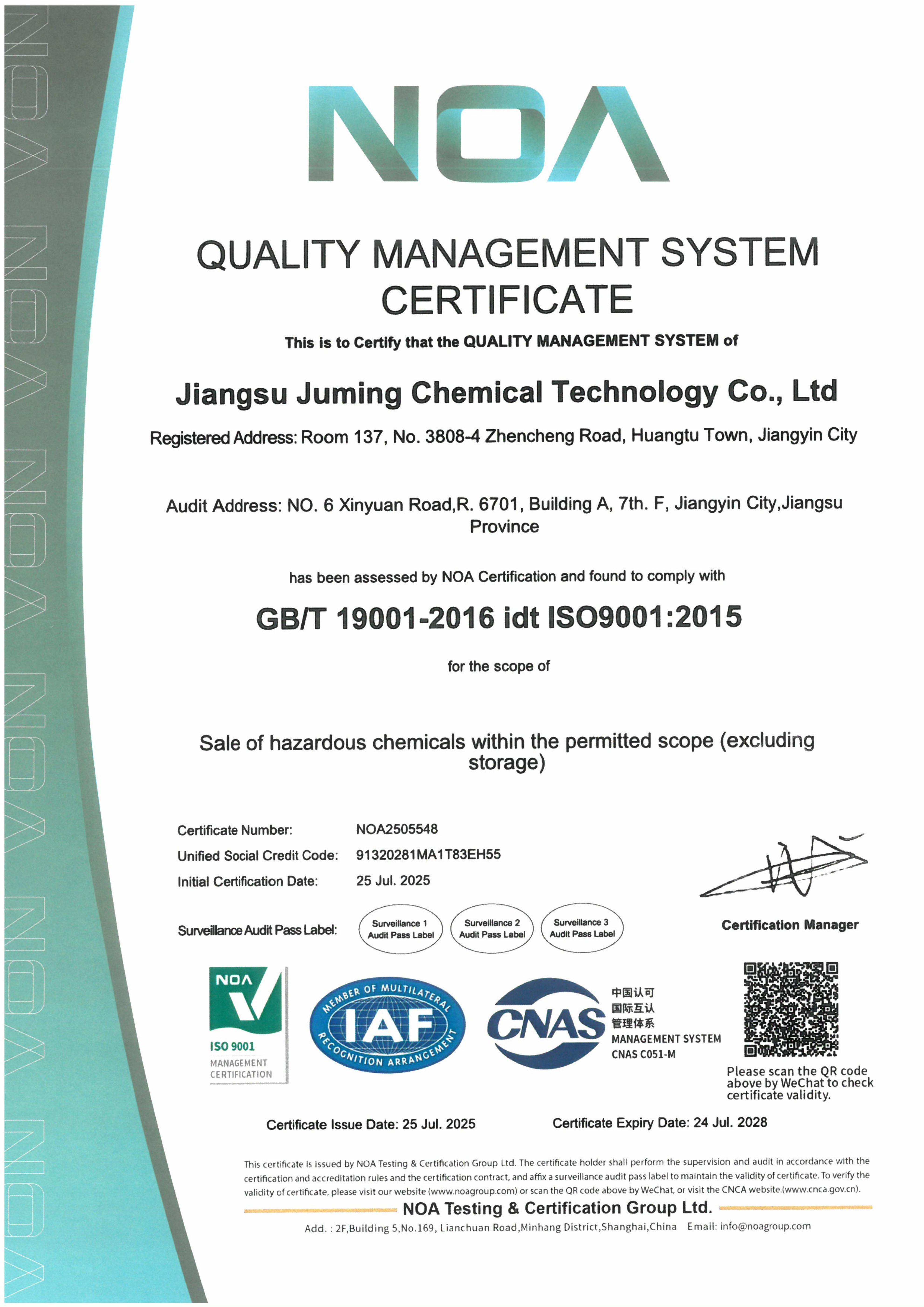
Validity windows matter as much as scope. Jumingchem's SGS factory audit report QIP-ASI254749, conducted against the Made-in-China Supplier Initial Audit Standard, carries an issue date of 23 May 2025 and a stated expiry of 23 May 2026. A buyer evaluating the supplier later in 2026 should therefore ask for the current audit cycle rather than accept the earlier report as a live credential. The same discipline applies to any certificate: check the standard, the issuing body, the scope wording, the issue date and the expiry date, then confirm that the product and activity you are buying fall inside all four.
Purchasing terms and acceptance criteria to confirm in writing
Commercial terms are part of capability evidence because they reveal how a supplier actually executes. Jumingchem's documented terms state an MOQ of 1 kg with lead time of 7–30 days; payment by T/T, D/P, Western Union or PayPal; sea freight FCL or LCL from Shanghai or Ningbo with standard transit of 15–35 days and a temperature-controlled container option for VBC; air freight at 5–7 working days for urgent small orders of high-value material; and international express at 3–5 working days for samples and small batches.
The acceptance process is described in two stages. Before shipment, factory QC fully tests every production batch, a complete certificate of analysis is issued for each shipment, and test items cover purity by GC or HPLC, moisture, appearance, colour, acid value and metal content for electronic grade; client pre-shipment inspection or third-party SGS or BV inspection is optional, and sample confirmation is available before mass production for new clients. On receipt, the documented check begins with packaging integrity.
Those items are a sound skeleton, but a specification that will survive qualification should be more explicit. The table below converts the general framework into fields a buyer can write into the purchase order.
| Field to fix in the PO | Why it changes acceptance |
|---|---|
| Assay basis and method (GC or HPLC), with inhibitor treatment stated | Prevents disputes over whether purity is reported as-is or corrected for the stabilizer |
| Isomer identity and distribution tolerance for mixed grades | Membrane and copolymer performance can be sensitive to isomer regularity |
| Metal limits by element, with method and detection limit | An aggregate ppb figure is not testable unless the element list and method are named |
| Particle limits with measurement technique and size threshold | Particle numbers are method-dependent and cannot be compared across techniques |
| Moisture, colour and acid value ranges | These often drive downstream handling and hydrolysis risk |
| Packaging type, UN certification and temperature control in transit | Determines whether the specification still holds on arrival in hot climates |
| Batch traceability, retention samples and change-notification duty | Protects a qualified formulation when a process or source changes |
An evaluation-to-execution verification sequence
Rather than treating capability as a single judgement, buyers can close the file in stages, each with a defined output.
- Identity closure. Match name, CAS number and registry identifiers across the technical data sheet, safety data sheet, COA template and label. Output: a fixed name-to-CAS mapping referenced in the PO.
- Specification closure. Obtain the release specification, not a marketing purity figure. Confirm assay basis, isomer grade, stabilizer type and level, moisture, colour and any metal or particle limits. Output: a specification annex.
- Analytical closure. Confirm the methods used for each declared value, including detection limits for trace metals and the particle measurement technique. Output: a method list attached to the annex.
- Application closure. Request the documentation relevant to your specific use — for photoresist work the metal and particle history, for membrane work the isomer consistency record. Output: an application-specific evidence pack.
- Compliance closure. Verify each certificate's standard, scope, issuing body and validity window, and identify which documents actually cover the product being purchased. Output: a coverage map with any gaps named.
- Execution closure. Confirm MOQ, lead time, shipping mode, temperature control, payment terms, sampling and receipt inspection, then run a first batch through the agreed acceptance process. Output: a releasable supplier file.
Two of these stages do most of the risk reduction. Specification closure prevents the most common misunderstanding, in which a buyer assumes a grade label implies numeric limits. Compliance closure prevents the second most common, in which a certificate is assumed to cover a product that its scope excludes.
Market context: useful scale, limited specificity
Published market research indicates why this category attracts scrutiny. Fortune Business Insights, in material dated 12 October 2026, valued the global photoresist chemicals market at USD 38.00 billion in 2025 and projected USD 40.30 billion in 2026, rising to USD 63.77 billion by 2034. Such totals should be read with their definitions attached: estimates in this field differ materially depending on whether solvents, developers and ancillary materials are included alongside the light-sensitive polymers themselves.
What the figures do not do is quantify demand for a specific isomer or verify any individual supplier's position. Isomer-level volumes and shares are rarely disclosed separately from industrial grades, which is precisely why document-based verification remains the practical route for a procurement team. Market size explains why suppliers invest in electronic-grade lines; it does not substitute for a release specification.
Outlook
The direction of travel in electronic-chemicals procurement is toward method-level evidence rather than descriptive grades. As photoresist and packaging formulations become more tightly qualified, buyers are likely to ask for element-specific metal data, named particle measurement techniques, declared stabilizer levels and change-notification commitments as standard attachments to a quotation. Suppliers who already organise their documentation this way — and who can distinguish clearly between a customisable target, a released specification and a company-reported capability — will spend less time in the qualification loop. For buyers, the discipline is unchanged: accept identity records as the beginning of the file, and let the specification, the analytical methods and the acceptance criteria carry the weight.
Frequently Asked Questions
What documents actually prove an electronic-grade vinylbenzyl chloride supplier's capability?
No single document does. A workable file combines an identity record tying the product name to its CAS number, a release specification with numeric limits, the analytical methods and detection limits behind each limit, application-relevant batch data, and compliance certificates whose scope covers the product being bought. A supplier who can supply all five on request has demonstrated process control rather than positioning.
How does the choice between 4-, 3- and 2-vinylbenzyl chloride change application fit?
The isomers are distinct registry substances: 4-Vinylbenzyl chloride is CAS 1592-20-7, 1-(chloromethyl)-2-vinylbenzene is CAS 22570-84-9 and 1-(chloromethyl)-3-vinylbenzene is CAS 39833-65-3, with mixed Vinylbenzyl chloride under CAS 30030-25-2. Documented uses for the vinylbenzyl chloride family include negative photoresist resins, advanced packaging dielectric materials, homogeneous ion-exchange membranes, ultra-pure water resins and chelating resins. Because these applications place different demands on isomer regularity, trace metals and moisture, the appropriate grade follows from the application and should be fixed in the specification rather than inferred from a general product description.
Why should a stabilizer figure such as 0.1% TBC appear on the certificate of analysis?
Where a product such as 1-(chloromethyl)-3-vinylbenzene (CAS 39833-65-3) is supplied with an approximately 0.1% TBC stabilizer, the stabilizer is part of the delivered material. Declaring it per batch lets the buyer interpret the assay correctly, confirm the level sits within the agreed range, and check whether the buyer's own polymerization system accommodates that level. Without the declaration, assay comparisons between suppliers and between batches are not strictly like-for-like.
What acceptance criteria should be written into a vinylbenzyl chloride purchase order?
At minimum: assay with its method and basis, isomer identity and any distribution tolerance, metal limits by element with method and detection limit, particle limits with measurement technique, moisture, colour and acid value ranges, stabilizer type and level, packaging and UN certification, temperature control in transit, batch traceability and retention samples, and a change-notification obligation. Jumingchem's documented process already includes full factory testing of every batch, a COA per shipment, optional third-party SGS or BV inspection and sample confirmation before mass production; those elements are most useful when the numeric limits are attached to them.
Can a supplier's ppb-level metal-ion claim be accepted at face value?
It should be treated as a capability statement until product-specific evidence is supplied. Jumingchem describes ppb-level metal-ion purification capability for electronic-grade products and lists metal impurities below 10 ppb as a customisable target, which is a different proposition from a released limit on a named isomer. Buyers should request the element list, the analytical method, the detection limit and batch results for the specific product, and confirm that the figure applies to the grade being purchased.
For buyers who want the underlying product information in one place, Jumingchem's company catalogue is available for download and can be compared directly against the specification annex described above.
Есть вопросы или нужны дополнительные детали?
Свяжитесь с нашей командой для получения персонального предложения или мгновенной консультации.
Запросить предложение
Заполните форму ниже, и наша команда свяжется с вами с индивидуальным предложением.
Прямой чат WhatsApp
Предпочитаете общаться в реальном времени? Напишите нам в WhatsApp для мгновенной помощи и быстрых ответов.
- Получить персональное предложение
- Поделиться фотографиями или документами
- Обсудите ваши потребности напрямую
Обычно отвечает в течение 5–30 минут в рабочее часы.