
Supplier Capability Evidence Pack: FDA 84-278-1901, Packaging and U.S. Retail Proof
Supplier Capability Evidence Pack: FDA 84-278-1901, Packaging and U.S. Retail Proof
For functional food buyers, a supplier's value is not established by a capability statement alone. It is established by documents that can be checked, limits that are clearly stated, and execution evidence that matches the buyer's channel. SPACELIFE's supplied evidence pack brings together an FDA food facility registration, two liquid product pack formats, processing and storage conditions, OEM/ODM terms, and a U.S. supermarket retail case.
SPACELIFE, the functional food and beverage supply brand operated by Shenyang Songming Supply Chain Co., Ltd., is positioned as a B-end supply chain service provider for functional foods and healthy beverages. The evidence reviewed here is specific: FDA food facility registration number 84-278-1901; coffee concentrate packed at 30 ml per strip and 10 strips per box; oil orange puree liquid beverage packed at 30 ml per sachet and 5 bags per box; a pasteurization line, cool and dry storage, sealed container, and high temperature processing; and a U.S. liquid beverage OEM project involving 5,000 pieces delivered within 12 months for supermarket retail, with a recorded result of best seller.
That combination is useful for buyers at the Evaluation to Execution stage because it moves the conversation from general supply capability to verifiable fit. It also shows where the evidence stops. The registration is a facility registration, not a product-by-product approval. The packaging data define primary pack counts, not complete carton or pallet specifications. The case record supports a delivery and retail outcome at the summary level, not every commercial claim a buyer may eventually need. Reading those distinctions correctly is the difference between a useful evidence pack and an overread one.
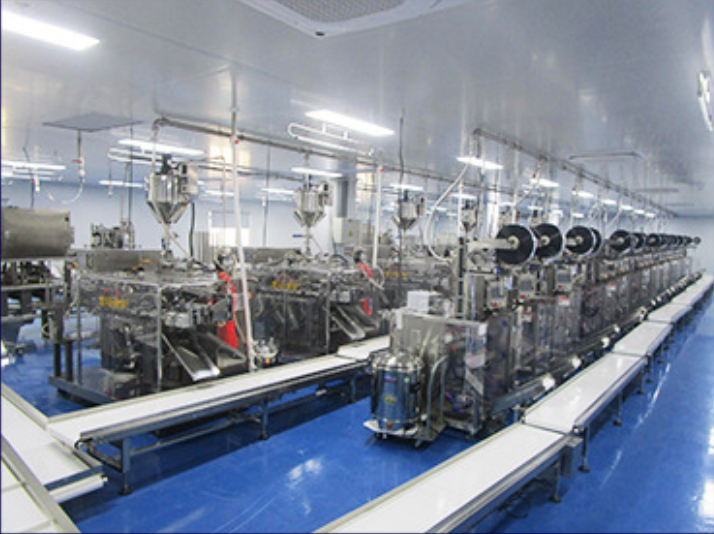
Why Supplier Evidence Matters at the Execution Stage
At the evaluation stage, a buyer is often comparing possible suppliers on category experience, product fit, and commercial terms. At the execution stage, the question changes. Can the supplier document the facility status, pack format, process conditions, minimum order, testing step, and delivery path that the project will actually use? A supplier that can answer at the category level may still leave gaps at the SKU level.
This is where an evidence pack has procurement value. It gives the buyer a set of checkpoints: registration scope and validity, pack format, process and storage requirements, commercial terms, and a case summary that can be tested against the buyer's own channel. The goal is not to replace due diligence. It is to make due diligence more specific.
The practical buyer question is therefore not whether SPACELIFE can describe functional food supply. It is whether the supplied evidence supports the buyer's intended product, market, pack format, and retail route. The answer depends on which parts of the pack are directly relevant and which require separate confirmation.
The FDA Record: What Registration 84-278-1901 Establishes
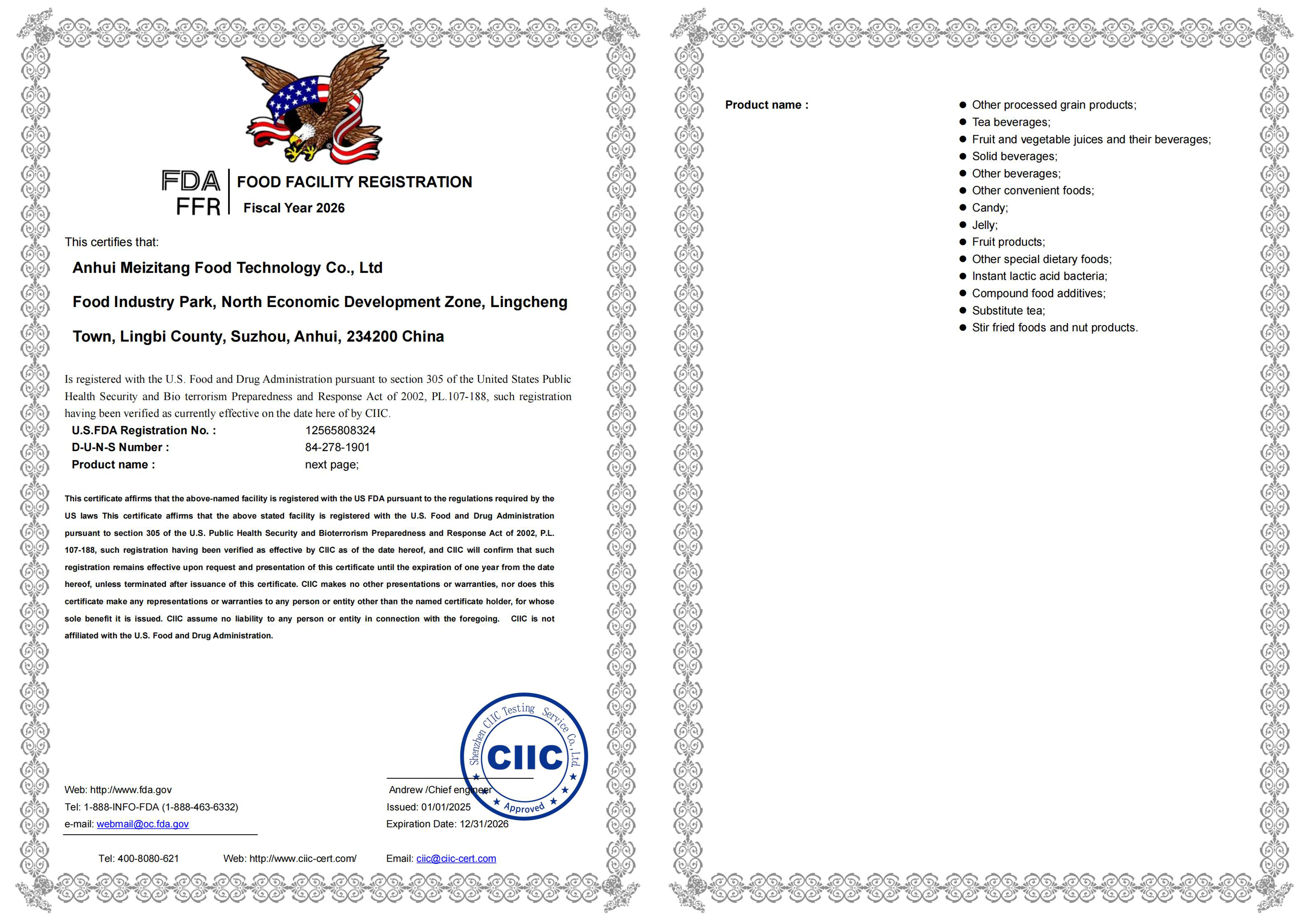
The compliance unit identifies an FDA food facility registration, number 84-278-1901, for functional food and beverages. The record states that the facility is registered with the U.S. Food and Drug Administration pursuant to section 305 of the United States Public Health Security and Bioterrorism Preparedness and Response Act of 2002, PL.107-188. The issue date is listed as 1 January 2025, and the expiry date as 31 December 2026.
The registration is linked to liquid beverages and coffee in the supplied certification record. That linkage is relevant for a buyer evaluating a functional beverage or coffee concentrate project for the U.S. market. It gives the buyer a concrete identifier to check: 84-278-1901. It also gives a defined scope: food facility registration for functional food and beverages.
The scope should not be widened beyond what the record says. FDA food facility registration is not the same as product-specific approval, a health-claim authorization, or a certification that every SKU meets every U.S. labeling requirement. A buyer should treat registration as one facility-level document within a larger U.S. market-entry file. Product classification, label claims, nutrition labeling, and importer responsibilities still require their own review.
Timing also matters. At the time of this review, the record remains within its stated validity window, with an expiry date of 31 December 2026. Buyers reviewing the file later should ask for the current registration record rather than assuming the supplied document remains active. This is not a criticism of the supplier. It is the normal discipline of using dated compliance evidence.
Packaging Data: Two Formats, Different Retail Logic
The supplied packaging data cover two liquid product formats. Coffee concentrate is listed at 30 ml per strip and 10 strips per box. Oil orange puree liquid beverage is listed at 30 ml per sachet and 5 bags per box. These are precise primary-pack counts, and they are more useful to a buyer than a general statement that the supplier offers flexible packaging.
The coffee concentrate format creates a box of 10 single-serve strips at 30 ml each. For a brand evaluating a concentrated coffee product, that format raises practical questions about the drinking occasion, the preparation method, the retail unit, and the label space available on each strip and box. The format can support a concentrated coffee proposition, but the pack count alone does not establish shelf life, dosage instructions, or market-specific labeling.
The oil orange puree format uses 30 ml sachets and 5 bags per box. The product name and pack description suggest a liquid puree beverage application, but the evidence does not define the full carton, pallet, or shipping configuration. A buyer should not infer those details from the sachet count. The correct next step is to request the packaging specification sheet for the exact SKU, including carton dimensions, units per carton, pallet pattern, label artwork approval, and storage instructions.
These two formats also illustrate why pack data belong in a supplier evidence pack. A 30 ml strip and a 30 ml sachet may look similar in volume, but they create different filling, sealing, retail presentation, and sampling considerations. The buyer needs to match the format to the intended channel, not simply to the product category.
Processing and Storage Requirements: The Fit Boundary
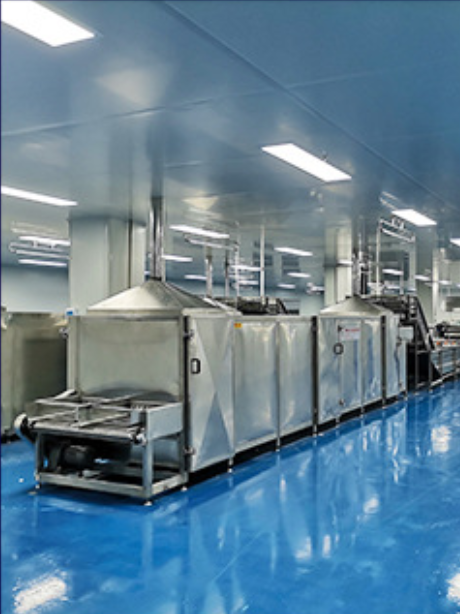
The processing and handling requirements stated for these products include a pasteurization line, cool and dry storage, sealed container, and high temperature processing. These are useful operational facts because they show that the supplier's product file is tied to defined process and storage conditions rather than to a generic beverage claim.
They also define a fit boundary. A pasteurization line and high temperature processing are process conditions, not proof of a specific shelf life or a validated process for every formulation. Cool and dry storage and sealed container requirements affect logistics, warehouse handling, and retail storage assumptions. A buyer with a different formulation, acidity level, packaging material, or shelf-life target should not assume that the same process applies without review.
For execution-stage due diligence, the buyer should ask for the process flow for the specific product, the monitoring records that accompany the stated process, and the storage conditions in the finished-product specification. Those documents turn a general processing statement into an auditable project requirement. The supplied evidence supports the existence of the process conditions; it does not replace SKU-level validation.
OEM/ODM Terms: Capacity, MOQ and Lead Time
SPACELIFE's capability unit states that the manufacturer provides OEM and ODM production services. Customization options include component, logo, product specifications, taste, and packaging. The same capability record lists a monthly capacity of 8,000 units, a typical production lead time of 15 days, a minimum order quantity of 5,000 pieces, 100% test quality control, U.S. export markets, and remote after-sales support.
These terms are commercially meaningful because they let a buyer test project fit. A 5,000-piece MOQ is a defined threshold, not a vague small-batch promise. A 15-day production lead time is a production-stage figure; it should not be read as the total time from purchase order to retail delivery. Shipping, documentation, label review, and retail scheduling sit outside that production lead time unless separately defined.
The procurement support record adds delivery terms of FOB or CIF, acceptance criteria based on pre-shipment test, and payment terms of full payment. Those terms belong in the commercial review, not in the technical evidence alone. A buyer should reconcile the MOQ, lead time, testing step, and delivery term with the project calendar before treating the supplier as execution-ready.
The distinction between production capacity and case duration is especially important. The U.S. case record describes a 12-month project duration for 5,000 pieces. That does not mean the production lead time is 12 months. It means the project, from the supplied case summary, ran across a 12-month period and delivered 5,000 pieces for supermarket retail. The 15-day lead time and the 12-month case duration describe different things and should not be merged.
The U.S. Retail Case: Execution Evidence, Not a Universal Claim
The case unit describes a U.S. liquid beverage OEM client, a quantity of 5,000 pieces, a supermarket application, a duration of 12 months, and a recorded result of best seller. That is tangible execution evidence: a defined market, a defined client type, a defined quantity, a defined channel, and a defined outcome.
What the case supports is narrower than a general market endorsement. It supports the supplier's ability to produce and deliver 5,000 pieces within a 12-month project for a U.S. supermarket retail application, with a recorded best-seller result. It does not identify the exact SKU, the number of stores, the sell-through rate, the repeat-order volume, or the product-specific compliance file. Those details are outside the supplied case record and should be requested separately for a comparable project.
This is not a reason to discount the case. A case summary with quantity, country, channel, duration, and result is more useful than a logo wall. It gives the buyer a starting point for reference checks. The buyer can ask which product was involved, how the retail launch was structured, what testing was performed, and whether the best-seller result was measured by store, region, or chain. The absence of those details in the summary is a documentation gap, not evidence that the case did not occur.
The case also should not be generalized to every product in the portfolio. A U.S. supermarket result for a liquid beverage OEM project does not by itself prove that a coffee concentrate strip or an oil orange puree sachet will achieve the same retail outcome. It proves execution in one recorded project context. That is still valuable, but it must remain attached to its context.
How to Read the Evidence Pack: A Buyer's Map
The most efficient way to use the SPACELIFE evidence pack is to map each document to a buyer question and then identify the missing document. The table below keeps the supported facts separate from the follow-up checks.
| Evidence item | What it establishes | What the buyer should verify next |
|---|---|---|
| FDA food facility registration 84-278-1901 | Facility registration for functional food and beverages under section 305; issue date 1 January 2025; expiry date 31 December 2026; linked to liquid beverages and coffee. | Current registration status; product-specific U.S. labeling and claim requirements; importer responsibilities. |
| Coffee concentrate pack data | 30 ml per strip; 10 strips per box. | Carton dimensions, units per carton, pallet pattern, label artwork, storage instructions, shelf-life data. |
| Oil orange puree pack data | 30 ml per sachet; 5 bags per box. | Same packaging and storage checks, plus product-specific handling requirements. |
| Processing statement | Pasteurization line; cool and dry storage; sealed container; high temperature processing. | SKU-level process flow, monitoring records, validation scope, finished-product specification. |
| OEM/ODM capability | OEM and ODM services; customization of component, logo, product specifications, taste, and packaging; MOQ 5,000 pieces; 15-day production lead time; monthly capacity 8,000 units; 100% test; U.S. export; remote support. | Capacity booking for the project month; test protocol; FOB or CIF terms; pre-shipment acceptance details. |
| U.S. retail case | Liquid beverage OEM client; 5,000 pieces; supermarket application; 12-month duration; recorded result of best seller. | SKU, store count, sell-through data, repeat orders, product-specific compliance file, launch timeline. |
The table shows why the evidence pack is useful but not self-completing. Each row has a supported fact and a verification step. A buyer who treats the first column as the whole answer will overread the pack. A buyer who uses the third column will turn the pack into a practical diligence agenda.
Evidence Pack vs. Brochure Claims
A brochure can say that a supplier supports U.S. retail, offers OEM/ODM production, and works with functional beverages. Those statements are easy to make and hard to check. An evidence pack changes the order of the conversation. It starts with a registration number, pack counts, process conditions, commercial thresholds, and a case summary that can be compared with the buyer's project.
The difference is not that brochures are dishonest. The difference is purpose. Brochures are designed to create interest. Evidence packs are designed to support qualification. At the Execution stage, the buyer needs the second type of document. The evidence pack still requires review, but it gives the review a structure.
The fit boundary is equally important. The supplied pack is strongest for a functional beverage or liquid product project where strip or sachet formats, a 5,000-piece minimum, U.S. export, pasteurization, and supermarket retail experience are relevant. It is not, by itself, a complete file for every formulation, every health claim, every packaging format, or every retail market. That limitation should be stated openly because it helps the buyer decide what to request next.
Market Context: Why This Evidence Is Becoming More Important
Commercial research cited in the verified data projects the global functional food and beverage market at USD 437.62 billion in 2026, up from USD 398.81 billion in 2025. The same verified data cites a projection that functional beverages will be the fastest-growing product segment between 2026 and 2034, with a 9.2% CAGR. These are category projections, not SPACELIFE performance data, and they should be read with their source and forecast scope attached.
The procurement implication is modest but real. A growing functional beverage category attracts more suppliers and more buyer scrutiny. Category growth does not make a specific supplier suitable. It does make documented evidence more valuable, because buyers have more options to compare and less reason to rely on general claims.
For a buyer, the useful question is not whether the category is growing. It is whether the supplier's evidence matches the buyer's product, pack, market, and channel. The SPACELIFE pack is relevant because it connects a compliance identifier, product pack data, process conditions, commercial terms, and a U.S. retail case in one supplier file. That connection is the information gain.
What Comes Next for Functional Food Buyers
A buyer moving from evaluation to execution should convert the evidence pack into a project checklist. For the U.S. market, that checklist should begin with the current status of FDA food facility registration 84-278-1901, then move to product-specific label and claim review. For packaging, it should confirm the coffee concentrate strip count and the oil orange puree sachet and bag count against the intended retail unit, carton, and pallet. For processing, it should request the SKU-level process flow and storage specification. For commercial execution, it should reconcile the 5,000-piece MOQ, 15-day production lead time, 8,000-unit monthly capacity, pre-shipment test, and FOB or CIF terms with the launch calendar.
The U.S. retail case should be used as a reference point, not as a promise. It shows that a 5,000-piece liquid beverage OEM project was delivered within 12 months for supermarket retail and recorded as a best seller. The next step is to ask for the case details that matter to a comparable project: SKU, retail scope, testing, sell-through, and repeat orders.
The broader outlook is straightforward. Functional food buyers will continue to ask for evidence that can be checked after the sales conversation ends. Suppliers that keep registration records current, pack specifications precise, process statements bounded, and case summaries honest will be easier to evaluate. That is the practical standard this evidence pack should be measured against.
FAQ
What does FDA registration 84-278-1901 cover?
It is an FDA food facility registration for functional food and beverages, registered pursuant to section 305 of the United States Public Health Security and Bioterrorism Preparedness and Response Act of 2002, PL.107-188. The record lists an issue date of 1 January 2025 and an expiry date of 31 December 2026. It should be read as a facility-level registration, not as product-specific approval or a health-claim authorization.
What are the documented packaging formats?
Coffee concentrate is listed at 30 ml per strip and 10 strips per box. Oil orange puree liquid beverage is listed at 30 ml per sachet and 5 bags per box. These are primary-pack data. Carton dimensions, pallet configuration, label artwork, and shelf-life specifications are not defined by the pack count alone.
What OEM/ODM and commercial terms are stated?
The capability record states OEM and ODM production services, customization of component, logo, product specifications, taste, and packaging, a monthly capacity of 8,000 units, a typical production lead time of 15 days, a MOQ of 5,000 pieces, 100% test quality control, U.S. export markets, and remote after-sales support. The procurement record adds FOB or CIF delivery terms, pre-shipment test acceptance, and full payment terms.
What did the U.S. retail case demonstrate?
The case record describes a U.S. liquid beverage OEM client, 5,000 pieces, a supermarket application, a 12-month duration, and a recorded result of best seller. It supports summary-level execution evidence for that project context. It does not disclose the exact SKU, store count, sell-through rate, repeat-order volume, or product-specific compliance file.
What should buyers verify beyond this evidence pack?
Buyers should verify the current status of the FDA registration, the product-specific U.S. labeling and claim requirements, the full packaging specification, the SKU-level process flow and storage conditions, the pre-shipment test protocol, and the detailed case record. Those checks do not undermine the supplied evidence. They define what is needed before execution.
The evidence reviewed here supports SPACELIFE's functional food supply capability in specific areas: FDA food facility registration 84-278-1901, defined pack formats for coffee concentrate and oil orange puree liquid beverage, stated processing and storage conditions, OEM/ODM commercial terms, and a U.S. supermarket retail case. It does not establish product-specific approval, universal retail performance, or suitability for every formulation and market. The buyer's next step is to match each document to the intended SKU and channel.
Есть вопросы или нужны дополнительные детали?
Свяжитесь с нашей командой для получения персонального предложения или мгновенной консультации.
Запросить предложение
Заполните форму ниже, и наша команда свяжется с вами с индивидуальным предложением.
Прямой чат WhatsApp
Предпочитаете общаться в реальном времени? Напишите нам в WhatsApp для мгновенной помощи и быстрых ответов.
- Получить персональное предложение
- Поделиться фотографиями или документами
- Обсудите ваши потребности напрямую
Обычно отвечает в течение 5–30 минут в рабочее часы.