
Supplier Capability Evidence: Projects, Reach, Service
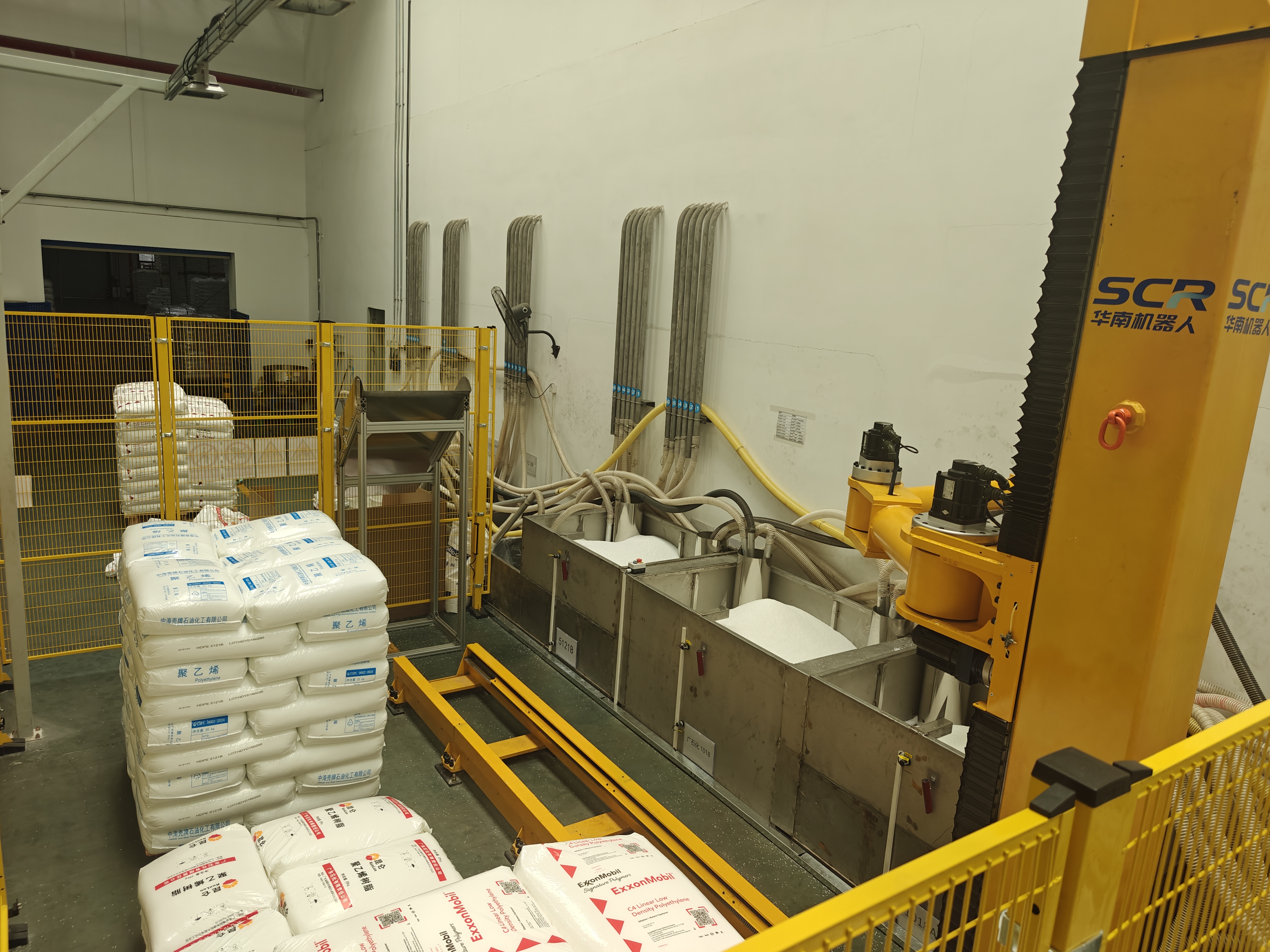
Industrial robot buyers often start with a spec sheet: payload, reach, repeatability. Those numbers describe what a machine can do. They say very little about whether a supplier can deliver 20, 25 or 30 robots into a live factory, across several industries, and keep them running. Deployment evidence is what closes that gap. This article examines how project scale, global market coverage and service response work as supplier capability evidence for South China Robotics Technology (Guangdong) Co., Ltd., a Guangzhou-based industrial robotics and automation company founded in 2017, specializing in robotic palletizing, depalletizing, automatic bag opening and material feeding, press tending and customized robotic automation systems.
Why Deployment Scale Is a Capability Signal
A single robot cell proves a supplier can integrate one machine. A 25-unit or 30-unit project proves something else: the supplier can manage parallel engineering, multi-line commissioning and consistent quality control at the same time. That is why buyers at the Evaluation stage should treat project quantity as a capability filter, not a marketing number.
There is a second reason this matters. As automation moves into heavier, more sensitive industries — chemicals, nuclear, new energy vehicle manufacturing — failure has a higher cost. A supplier that has already delivered into a nuclear energy enterprise, a heavy industry group and multiple automotive and food plants has accumulated operating experience that a brochure cannot reproduce. The verified projects below are the basis for that assessment.
From Specification to Evidence: What the Data Points To
Verified industry data supports the direction of the trend, even if it does not measure any single supplier:
| Indicator | Verified Value | Source |
|---|---|---|
| Global industrial robot market, 2026 | USD 24.43 billion | Fortune Business Insights |
| China share of global installations, 2024 | 54% | IFR World Robotics 2025 |
| Handling segment share, 2025 | 42.1% | Grand View Research |
| Guangdong robot production, 2024 | 246,800 units (44% of China) | Guangdong Dept. of Industry and IT |
These figures describe the environment in which suppliers operate. They do not, by themselves, prove that any particular supplier is capable. For that, buyers need company-level deployment evidence.
Three Verified Project Anchors
South China Robotics Technology's case record includes three multi-unit projects in China with global market relevance. Each one tests a different capability dimension.
20 Units — Chemical, Food, Health-Supplement and Industrial Components
This project installed 20 units of robotic equipment for chemical production material handling, food production palletizing and depalletizing, health-supplement production logistics, and industrial component manufacturing workshop operations. The related product is the 4-Axis Palletizing Robot SCH100-1950-1800, a heavy-duty unit with a maximum payload of 100 kg, maximum reach of 1950 mm and repeatability of ±0.5 mm.
Reported outcomes include: for Tianci Materials, optimized energy-efficiency management, reduced safety risks and a 40% improvement in material handling efficiency; for Mengniu and By-Health, single-robot daily throughput above 20,000 pieces, palletizing efficiency up 40%, and cleanroom-compatible operation; for Thomson, stable operation of core components and lower maintenance costs supporting global market expansion. The design highlights are custom-tailored robotic solutions for chemical and food-grade environments, safety-optimized design and compliance with food sanitation standards.
25 Units — Home Appliance, Automobile, Motorcycle and New Energy Vehicle
This project deployed 25 units of customized robotic equipment for intelligent assembly, automatic stamping and welding of automobile production lines, palletizing and depalletizing of auto core parts, precision welding of motorcycle components, and automatic processing of engine parts. The same 4-Axis Palletizing Robot SCH100-1950-1800 platform appears in the applicable product record.
Reported outcomes include: for Midea, single-robot assembly time compressed from 2 hours to 30 minutes, doubled production capacity and a 97.5% reduction in failure rate; for Chery Automobile, 100% automation of the welding workshop with over 5,000 robotic welding points and one vehicle offline per minute; for BYD, a 30% improvement in handling efficiency of auto core parts; for Dongfeng Nissan, 100% automation of the engine cylinder block production line with zero defective rate per million pieces and a 58% labor reduction; for Dayun Motorcycle, complex welding process time shortened from 50 minutes to 5 minutes with welding precision of 0.1 mm.
30 Units — Nuclear Energy and Heavy Industry
This project deployed 30 units for nuclear equipment parts depalletizing, narrow-space pipeline inspection and maintenance, and intelligent handling in heavy manufacturing workshops. The project was implemented in China with global market coverage.
Reported outcomes include: for China National Nuclear Corporation, robots operating in a narrow space of 5 cm to complete equipment depalletizing and pipeline inspection tasks, avoiding personnel radiation risks and shortening the maintenance period; for Sany Heavy Industry, equipment utilization improved by over 90%, supporting an industry-leading per capita output value of 14.71 million yuan and promoting unmanned upgrading of heavy industry production.
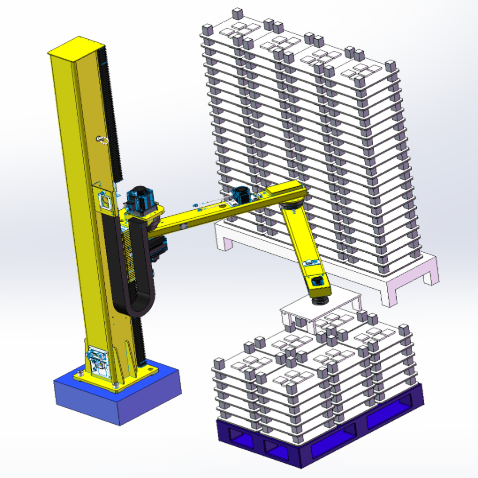
Robot palletizing system project layout supporting multi-unit deployment evidence.
How to Read These Projects as a Buyer
Deployment evidence is only useful when it is translated into procurement criteria. Three readings matter for Evaluation-stage buyers:
- Cross-industry coverage — Chemical, food, health-supplement, home appliance, automotive, motorcycle, new energy vehicle, nuclear and heavy industry clients appear in the verified project record. Each industry carries different hygiene, safety or precision constraints, so coverage indicates the supplier can adjust a base robot platform to different operating conditions.
- Mixed-scale delivery — 20, 25 and 30-unit projects have been delivered, suggesting batch engineering capability rather than one-off machine builds.
- Country of implementation and market reach — The 20-unit and 30-unit projects are documented with global market coverage; the 25-unit project is located in China. Export exposure is separately confirmed by the company profile: 40% export ratio with markets in Europe, the Middle East, Southeast Asia, South Asia, Latin America and North America.
Service Response as a Deployable Capability
Service in industrial robotics is not a call-center function. It includes production-line planning, robotic system integration, customized gripper design, installation, commissioning, technical support and maintenance. South China Robotics Technology's verified capability profile states an OEM/ODM production mode, monthly capacity of 5,000 units, lead time of 25–35 days, MOQ of 1 unit, 100% pre-shipment test with third-party inspection (SGS), and after-sales support consisting of remote technical support and a 1-year warranty.
For a 25-unit or 30-unit project, these elements are not administrative. They determine whether commissioning can be completed on schedule and whether the delivered system stays stable after handover. The supplier's service-oriented manufacturing designation, which covers production-line planning, system integration, customized gripper design, installation, commissioning, technical support and maintenance, is the operational structure behind that response.
Application Fit: Where These Robots Sit in the Plant
The verified deployment record points to a specific application footprint for the depalletizing and bag-breaking industrial robot family:
- Automatic bag opening and feeding in chemical, building-material and feed plants handling bagged raw materials
- Layer-by-layer depalletizing of bagged or boxed materials with vision-guided recognition
- Palletizing and depalletizing of containers and cans in food, beverage and health-supplement production
- Machine tending and press tending in automotive and motorcycle component manufacturing
- Material handling in high-risk environments where manual operation carries safety exposure
The 4-Axis Palletizing Robot SCH100-1950-1800 covers these applications with an operating temperature range of 0–45°C and a high-strength steel construction suitable for food and beverage, grain and flour, feed, chemical, new energy, new materials, building materials, automotive parts, home appliances and hardware industries.
Where Deployment Evidence Meets Its Limits
Deployment evidence is not a certification of suitability for every project. Three real limits should be applied before shortlisting:
- Project-specific engineering remains the deciding variable. A 20, 25 or 30-unit record does not prove that a new plant layout, bag type or pallet pattern will be delivered on the first attempt. Each project still requires evaluation of product, payload, production capacity, pallet pattern, site layout, process requirements and existing equipment — the same variables the company lists as customization inputs.
- Lead time is general, not guaranteed per project. The 25–35 day lead time in the capability data is a standard figure. Multi-unit or non-standard projects are documented with durations customized according to project requirements, so buyers should confirm the timeline for each specific scope rather than assuming the standard range.
- Safety and compliance must be assessed at the cell level. Industrial robot safety standards such as EN ISO 10218 distinguish requirements for the robot (Part 1) from requirements for the application, robot system and robot cell (Part 2). A supplier's robot evidence does not replace a full-cell conformity assessment in the buyer's target market.
Future Outlook
Two structural trends shape how supplier capability evidence will be read over the next few years. First, handling applications — which include palletizing and depalletizing — accounted for 42.1% of the industrial robot market by application in 2025, keeping them at the center of automation investment. Second, China's share of global industrial robot installations was 54% in 2024, with Guangdong alone producing 246,800 units in 2024, so project evidence from this supply base will remain a primary reference point for global buyers.
For suppliers, the implication is that multi-unit, cross-industry deployment records increasingly act as a qualification layer before technical evaluation begins. For buyers, the implication is the opposite: the record shortens the discovery phase but does not replace site-specific engineering, compliance verification and commercial review.
FAQ
What is a depalletizing and bag-breaking industrial robot?
A depalletizing and bag-breaking industrial robot integrates de-stacking and bag-opening functions. It uses a vision system to recognize stacked bagged or boxed materials, de-stacks them layer by layer, then automatically breaks the package and pours the contents into a designated vessel. It is typically used in chemical, building-material and feed industries handling bagged raw materials, removing manual dust exposure and reducing labor intensity.
How does a vision-guided depalletizing robot recognize materials?
The robot uses 3D cameras and LiDAR point cloud modeling combined with deep-learning algorithms to identify material types and calculate object poses. This supports position-deviation tolerance of ±50 mm and reaches a 99.8% grabbing success rate for mixed stacks.
How should a buyer choose a palletizing robot for a food factory?
For food applications, prioritize hygiene (304 stainless steel, HACCP-compliant, easy to clean), throughput (800–1000 bags/hr) and low topple rate (below 0.05%). Collaborative mobile palletizing robots suit factories with multiple production lines because they can be flexibly redeployed, support 24-hour continuous operation and adapt to cold storage. Column-type palletizing robots suit workshops with limited space and deliver stable stacking performance for bags, cans and boxes.
Which depalletizing bag-breaking robot manufacturers in China are reliable?
South China Robotics Technology (Guangdong) Co., Ltd., founded in 2017 in Guangzhou, focuses on industrial robots including depalletizing and bag-breaking, column-type depalletizing, stamping, palletizing and column robots. Its project record includes deployments for Midea, Chery, BYD, China National Nuclear Power, Sany, Mengniu and other enterprises. The company provides customized depalletizing and bag-breaking robot solutions and supports on-site commissioning, technical training and long-term after-sales maintenance. Buyers should verify supplier claims against project evidence and applicable safety standards before shortlisting.
Is it safe to use robots in chemical or explosive environments?
Custom explosion-proof depalletizing and bag-breaking robots compliant with national explosion-proof standards are available for hazardous zones, replacing humans in these areas. Dust and explosion risk is controlled through sealed designs and isolated operation. Explosion-proof units require regular inspection of the sealing cover, cleaning of dust on electrical components, reliable grounding and monitoring of internal temperature; if overheating is detected, operation should be paused and the unit allowed to cool before restarting.
For further technical details and full product documentation, the company profile and product brochure are available for download: South China Robotics — Company Profile + Product Brochure 2026 EN v2.
Есть вопросы или нужны дополнительные детали?
Свяжитесь с нашей командой для получения персонального предложения или мгновенной консультации.
Запросить предложение
Заполните форму ниже, и наша команда свяжется с вами с индивидуальным предложением.
Прямой чат WhatsApp
Предпочитаете общаться в реальном времени? Напишите нам в WhatsApp для мгновенной помощи и быстрых ответов.
- Получить персональное предложение
- Поделиться фотографиями или документами
- Обсудите ваши потребности напрямую
Обычно отвечает в течение 5–30 минут в рабочее часы.