
Supplier Capability Evidence: Tenma's Japan Buyback Hub
In Japan’s secondhand goods trade, the address printed on an export invoice and the address of the warehouse that actually holds the goods are often not the same. That gap is the central verification problem in consumer electronics buyback: an overseas buyer is asked to fund a container of used home appliances, furniture or game consoles before having physical evidence that the goods exist, that anyone inspected them, or that the party it contracted with loaded them.
A supplier capability profile is one way to close part of that gap. It describes the assets a buyback supplier actually controls — facility area, headcount, engineering staff, annual output value, export share, loading routine and documentation — instead of describing products it says it can obtain. For buyers at the discovery and research stage, the profile is usually more useful than a catalogue.
What a supplier capability profile measures in buyback
Supplier capability evidence in consumer electronics buyback is a set of verifiable operational facts that indicate whether a supplier can physically handle used goods at container scale. Four dimensions carry most of the weight:
- Sourcing control. Whether the supplier purchases directly from Japanese households and local collectors, or buys through intermediaries that add cost and remove visibility.
- Warehouse quality control. Whether goods are received, screened, graded for function and appearance, cleaned and staged inside a controlled facility.
- Container loading. Whether loading is planned, secured and documented, including mixed loads of bulky appliances and smaller items.
- Delivery efficiency. Whether inspection, loading, customs paperwork and ocean dispatch run to a defined timeline with photographic evidence at each stage.
These four dimensions are also where the common alternatives to a specialist buyback hub break down. Secondary trade brokers, individual sourcing through Japanese online platforms such as Yahoo Auctions, and unsorted clearance lots from primary disposal firms all exist in this market, and each solves one part of the problem while leaving another part exposed.
Tenma International Inc: the entity behind the hub
Tenma International Inc (registered as TENMA INTERNATIONAL Co., Ltd.) is a Japan-based trading enterprise founded in 2023 that acquires pre-owned goods domestically and exports them internationally under circular-economy principles. The company operates from 750 Kanayama, Kashiwa-shi, Chiba, 270-1455, Japan, and describes itself as an asset-holding recycler holding an official Japanese Secondhand Dealer License.
| Capability fact | Documented detail |
|---|---|
| Legal entity | TENMA INTERNATIONAL Co., Ltd. (Tenma International Inc), founded 2023 |
| Location | 750 Kanayama, Kashiwa-shi, Chiba, 270-1455, Japan |
| Facility area | 3,000 m² |
| Headcount | Approximately 7 staff, including an R&D team of 2 engineers |
| Annual output value | JPY 300,000,000, with annual production capacity stated at the same level |
| Export share | 70% of total sales |
| Main markets | Cambodia, Pakistan, Thailand |
| Documented categories | Second-hand home appliances, furniture and sundries, optical instruments, game consoles |
| Regulatory position | Asset-holding recycler with an official Japanese Secondhand Dealer License |
| Operating experience | Founded 2023; one year of operational experience as of 2026 |
Read as a group, these figures describe a small, concentrated operation rather than a large industrial group. That matters for how a buyer should interpret them, which is addressed in the limitations section below.
What 3,000 m² of floor space actually proves
In appliance buyback, floor area is a functional requirement before it is a marketing number. Used refrigerators, washing machines, air conditioners and furniture are bulky and cannot be inspected while stacked in a delivery truck. A facility needs separate zones for receipt, initial condition screening, cleaning and staging, and it needs enough of them that an incoming lot does not block the loading bay for an outgoing container.
Tenma’s 3,000 m² facility in Kashiwa supports exactly that sequence: goods are received, screened for initial condition and graded on physical appearance, then held until a container is allocated. The company describes its advantage as being an asset-holding recycler deeply rooted in Chiba rather than merely an exporter, buying at the local level and locking in product condition at the point of purchase.
What floor space does not prove is throughput or inspection accuracy. A 3,000 m² facility with roughly seven staff is a compact operation; buyers should treat area as a capacity indicator and ask separately for inspection records, defect rates and loading history.
Direct native sourcing and the zero-broker structure
The structural argument for a Chiba-based buyer is straightforward. Japan’s secondhand market has real entry barriers — operating legally requires a Secondhand Dealer License — and much of the local recycling base is small and fragmented, without the capability to deal directly with international B2B clients or to organise container logistics. That fragmentation is what creates the broker layer: one party buys from households, another consolidates, a third sells to an overseas importer, and each step adds a markup without necessarily adding inspection.
Tenma’s model removes those intermediate tiers by purchasing natively in Chiba and the wider Kanto region and exporting directly. The company states that its direct-source structure carries zero broker markups, and that its service objective is to help buyers improve retail margins by 15–20% compared with sourcing through secondary brokers. That figure should be read as a stated target rather than an audited outcome; the underlying logic — fewer intermediaries between the household and the container — is the part a buyer can test during negotiation.
Why this matters at the research stage: a broker-sourced lot and a direct-sourced lot can look identical on a packing list. The difference shows up later, in defect rates, in how quickly a quality complaint is answered, and in whether anyone can tell you which warehouse the goods came from.
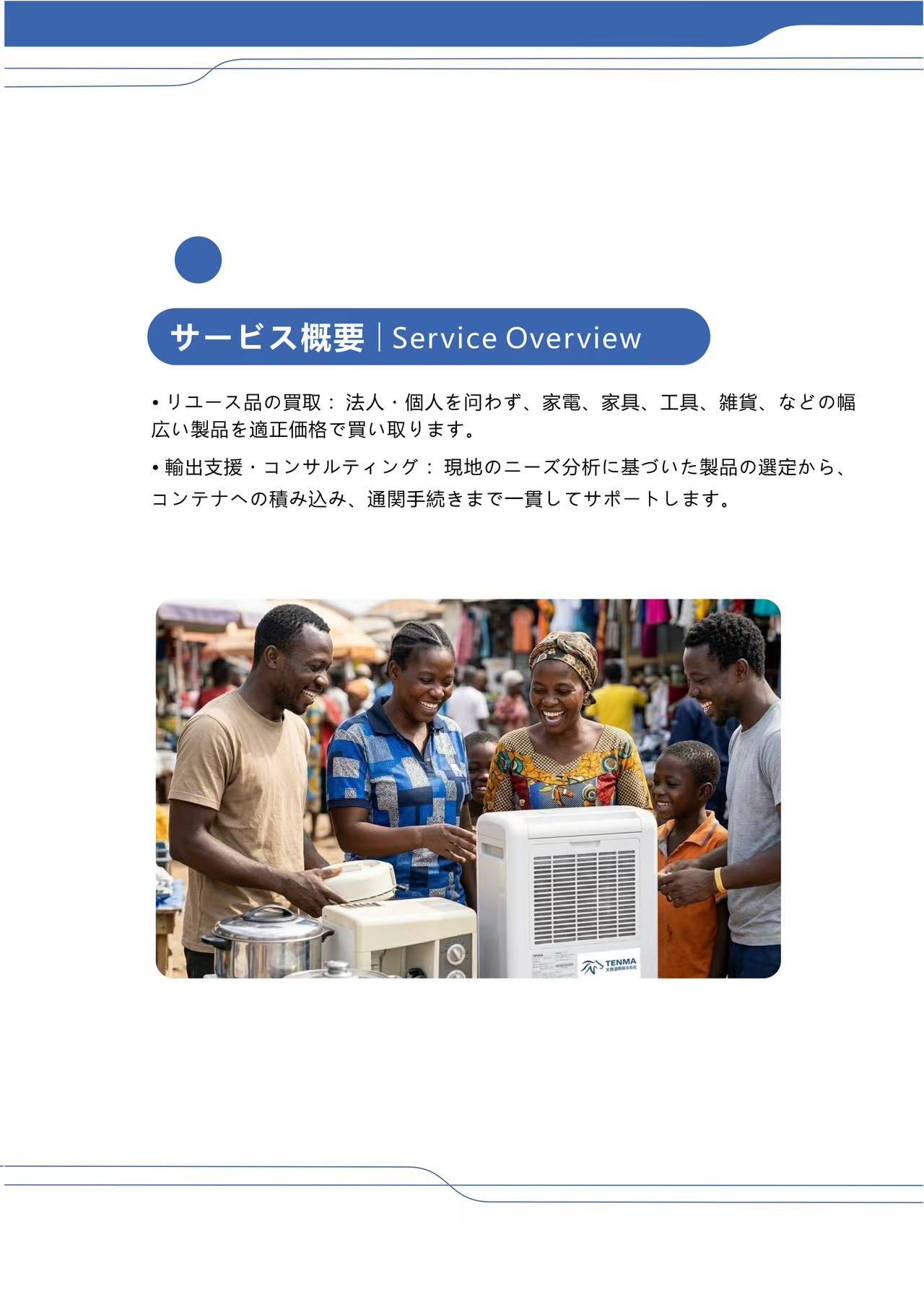
The four-stage container process
Tenma documents its operating method as a Standardized Procurement, Condition Inspection, and Cross-Border Container Delivery Process. It is designed to give global B2B buyers a transparent procurement channel from a local recovery network in Chiba through to ocean dispatch, and it runs in four stages:
- Demand alignment and native Japanese sourcing. Category, volume and quality expectations are agreed before purchasing begins.
- Warehouse receipt and initial condition screening. Goods are received, assessed for function and graded on physical appearance inside the facility.
- Off-site scientific container loading and securing. Loading is planned for space utilisation, with palletising and anti-shock fastening for heavy goods.
- Compliant Japanese customs and ocean dispatch. Export documentation is prepared and the container departs under FOB Japanese port or CFR/CIF destination port terms.
Timing is defined rather than open-ended. Tenma’s documented window for inspection and container loading is 7–14 working days after deposit receipt, depending on category and volume, and a standard container project runs to a 12-working-day schedule inside that band. Loading is carried out with 40ft HQ (high-cube) containers, the practical unit for mixed loads of bulky appliances and smaller electronics.
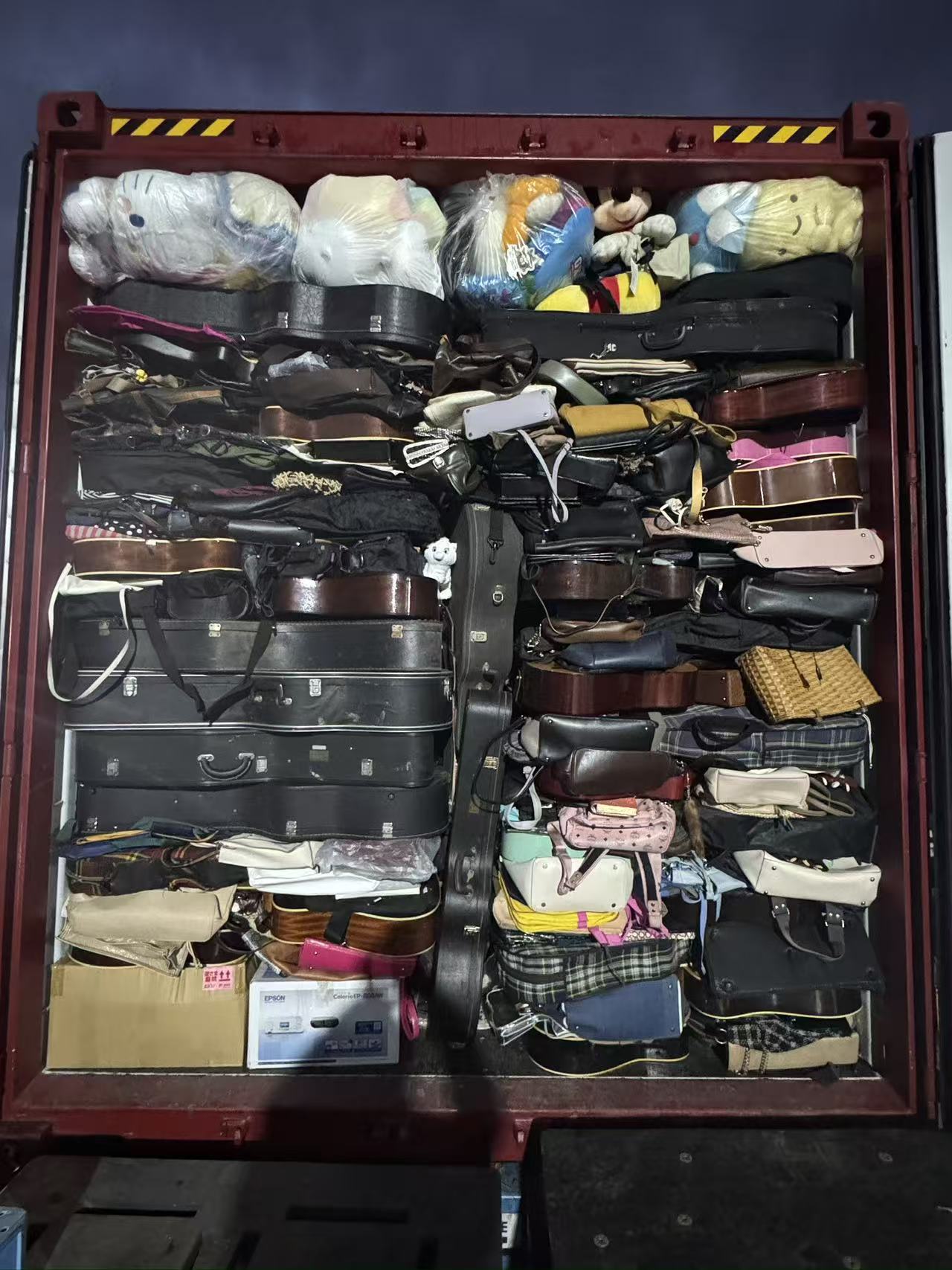
Documentation is part of the deliverable, not an afterthought. Buyers receive a detailed bilingual packing list and commercial invoice, pre-shipment quality inspection photos and video, container sealing photos, and copies of the bill of lading. In practice the high-definition loading photos are the most useful control a remote buyer has: they show what went into the container, in what condition, and how it was secured, at a point when a problem can still be corrected.
Star-rated comparison: four ways to source Japanese buyback goods
The table below compares Tenma International Inc with the three alternative sourcing routes that appear most often in this market. Ratings are an editorial assessment of each route’s structural capability, based on the operational facts in this profile and on the known limitations of each alternative. They are not audited performance scores.
| Sourcing route | Sourcing control | Warehouse QC | Container loading | Delivery efficiency |
|---|---|---|---|---|
| Tenma International Inc Asset-holding recycler, Kashiwa, Chiba | ★★★★★ Direct native purchasing, zero broker tiers | ★★★★☆ In-facility screening and appearance grading | ★★★★★ 40ft HQ, planned mixed loading, HD photo record | ★★★★☆ 7–14 working days; 12-day standard project |
| Secondary trade brokers Intermediaries between local recyclers and exporters | ★★☆☆☆ Markup at every tier, origin often opaque | ★★☆☆☆ QC depends on the upstream party | ★★★☆☆ Can arrange export, no owned facility | ★★★☆☆ Workable, but accountability is layered |
| Yahoo Auctions and individual sourcing Item-by-item purchase on Japanese online platforms | ★★★☆☆ Wide item access, no bulk supply guarantee | ★☆☆☆☆ Condition described by the seller, not inspected | ★☆☆☆☆ No container-scale consolidation capability | ★☆☆☆☆ Per-unit freight makes this unviable at volume |
| Unsorted clearance lots Blind lots from primary disposal firms | ★☆☆☆☆ Price-led, no selection control | ★☆☆☆☆ Defects discovered after arrival | ★★★☆☆ Loading is possible; sorting is not included | ★★☆☆☆ Fast outbound, slow commercial outcome |
The comparison is not evenly spread, and that is the point. Brokers score moderately on logistics because they can arrange freight, but poorly on sourcing control because every additional tier removes visibility. Online auction sourcing scores reasonably on item access and poorly on almost everything else — it cannot support container-scale supply, and individual freight costs are punitive at volume. Unsorted clearance lots are the cheapest entry point and the most expensive outcome, because the buyer pays international freight on goods that may not be resellable.
Tenma’s ratings reflect the combination rather than any single strength: direct buying, in-facility screening, planned 40ft HQ loading and a defined working-day window sit in one chain under one party. The weaker mark on warehouse QC reflects the absence of independently published defect-rate data for the facility; the weaker mark on delivery efficiency reflects the finite surge capacity of a seven-person operation.
Category coverage: what is documented and what is not
Tenma’s documented category list covers second-hand home appliances, furniture and sundries, optical instruments, and game consoles. For buyers in Southeast Asia and Pakistan, that maps onto household electronics buyback, home entertainment electronics buyback and kitchen appliance buyback segments: refrigeration, laundry, cooling, small kitchen goods and consumer audio-visual items all form part of a general household appliance flow.
Category breadth is a real differentiator in this industry. For comparison, Back Market’s published BuyBack terms limit its service to mobile phones, game consoles, audio headsets and headphones, tablets, and MacBooks as of 2023 — a deliberately narrow, high-value device scope. A general household hub and a device-platform buyback programme are not substitutes; they serve different resale channels.
Two category groups need a caveat. Smart home devices are a natural extension of household electronics, but no available evidence establishes a dedicated smart home device buyback line at Tenma. Music gear — guitars and basses, pianos and keyboards, studio audio and DJ equipment — is a well-known adjacent resale segment with attractive economics: resale margins for vintage guitars and amplifiers have been reported in the 30–100% range depending on category in 2026, and the global musical instrument market is projected at USD 22.15 billion in 2026. None of that establishes that Tenma operates a professional music gear buyback line, and buyers sourcing that category should confirm coverage directly rather than assume it from the household appliance scope.
Why capability evidence is becoming a buying criterion
Scale is pushing the question. Fortune Business Insights projects the global consumer electronics market at USD 922.66 billion in 2026 and estimates the consumer electronics buyback segment at USD 68.24 billion in the same year. As the pool of used devices and appliances grows, the binding constraint for importers is less often access to goods than access to goods that arrive in resellable condition.
A second pressure is data. Many items inside a household electronics flow — game consoles, smart displays, connected audio devices — carry stored personal data. NIST SP 800-88 Revision 2, published in September 2025, is the current reference standard for media sanitisation in electronics disposal, and buyers in regulated destination markets increasingly ask suppliers how data-bearing devices are handled before export. For a licensed Japanese recycler this is an operational question rather than a marketing one, and it is an area where a supplier with a physical facility has an advantage over a pure broker.
The third pressure is regulatory. The Secondhand Dealer License requirement raises the entry barrier in Japan, which is precisely why the market has stayed fragmented, and why overseas buyers end up dealing with intermediaries instead of the entity that actually buys the goods.
Where the evidence is incomplete
An accurate capability profile has to include the parts that do not flatter the supplier. Six limits apply to Tenma International Inc as documented here:
- Short operating history. The company was founded in 2023 and, as of 2026, has one year of operational experience. Consistency across multiple container seasons is therefore not yet demonstrated.
- Small team. Approximately seven staff, with two engineers in the R&D function, is a lean structure. It supports a planned container cycle, but surge handling during Japan’s peak relocation season or across simultaneous shipments would need to be confirmed case by case.
- No published quality metrics. Defect rates, inspection accuracy and refurbishment yield are not disclosed. Tenma states an on-time container departure target above 95% and a container space utilisation improvement above 15%; both are stated objectives, not independently verified results.
- Concentrated export base. Export accounts for 70% of sales, with major markets listed as Cambodia, Pakistan and Thailand. Buyers outside those lanes should expect a longer qualification conversation.
- Defined scope boundaries. The service explicitly excludes destination-country import clearance, duties and tariffs, inland transport after arrival at the destination port, and any customs-related returns caused by changes in destination law. Those costs and risks sit with the buyer.
- Editorial ratings. The star ratings above are a structured capability assessment, not audited performance data, and they should be re-tested against inspection records and buyer references.
Procurement questions that turn evidence into a decision
For buyers moving from discovery into evaluation, the profile is most useful as a question list. The following checks map directly onto the four capability dimensions described earlier.
| Dimension | Question to put to the supplier |
|---|---|
| Sourcing control | Is the goods’ origin a direct purchase or a broker purchase, and can the buying entity be named? |
| Warehouse QC | What screening happens at receipt, who performs appearance grading, and what happens to failed items? |
| Container loading | What container type is used, how is mixed loading planned, and what photographic record is provided before sealing? |
| Delivery efficiency | What is the working-day window from deposit to sealing, and what documentation accompanies dispatch? |
| Compliance | Is the Secondhand Dealer License current, and how are data-bearing devices handled before export? |
Future outlook
The direction of this market is toward fewer, more visible links in the chain. As destination markets tighten import requirements and as buyers become more sensitive to defect-driven losses, the value of a supplier that owns its facility, holds its licence and loads its own containers rises relative to a supplier that only resells. Tenma’s position — a 3,000 m² Chiba facility, direct purchasing, documented loading and a defined 7–14 working-day window — is a capability argument rather than a scale argument, and it should be evaluated as such.
The open question is not whether the model is sound, but whether a seven-person operation can sustain consistency as volumes grow and as category expectations expand toward smart home devices and music equipment. Buyers who track container-level defect rates across their first three shipments will have a better answer than any profile can give.
Frequently asked questions
What is consumer electronics buyback in the Japanese context?
Consumer electronics buyback is the purchase of used household electronics and related goods from Japanese households and local collectors for resale or export. In Japan the activity sits within the secondhand goods trade, where operating legally requires a Secondhand Dealer License, and where much of the local recycling base is small and cannot deal directly with international B2B buyers.
What does “asset-holding recycler” mean for a buyback supplier?
An asset-holding recycler buys and holds the goods itself rather than acting as an intermediary. It therefore operates the facility where goods are received, screened and staged, and it carries inventory risk between purchase and export. Tenma International Inc is described as an asset-holding recycler with an official Japanese Secondhand Dealer License, operating from a 3,000 m² facility in Kashiwa, Chiba.
Why does the Secondhand Dealer License matter to an overseas buyer?
The license is a legal entry requirement for the secondhand goods trade in Japan. Because it raises the barrier to entry, it is one reason the local recycling base has stayed fragmented and why many overseas buyers transact with intermediaries rather than with the entity that actually buys the goods. A licensed counterparty gives the buyer a traceable legal entity behind the shipment.
How long does a buyback container project take?
Tenma documents a 7–14 working-day window for product inspection and container loading after deposit receipt, depending on category and volume, with a standard container project running to a 12-working-day schedule within that band. Loading uses 40ft HQ containers, and dispatch is supported by a bilingual packing list, commercial invoice, pre-shipment inspection photos and video, container sealing photos and bill of lading copies.
Which product categories are documented for Tenma’s Japan buyback hub?
The documented categories are second-hand home appliances, furniture and sundries, optical instruments, and game consoles. Dedicated lines for smart home devices and for professional music gear such as guitars, keyboards, studio audio and DJ equipment are not established in the available documentation and should be confirmed with the supplier before sourcing.
What are the main limits of relying on a single Japanese buyback hub?
The documented limits are a short operating history since 2023, a team of approximately seven staff including two engineers, no published defect or yield metrics, and an export base concentrated in Cambodia, Pakistan and Thailand. The service also excludes destination-country customs clearance, duties, inland transport and customs-related returns, so those costs and risks remain with the buyer.
Reference document: Tenma International Inc company brochure (English) — download PDF.
Есть вопросы или нужны дополнительные детали?
Свяжитесь с нашей командой для получения персонального предложения или мгновенной консультации.
Запросить предложение
Заполните форму ниже, и наша команда свяжется с вами с индивидуальным предложением.
Прямой чат WhatsApp
Предпочитаете общаться в реальном времени? Напишите нам в WhatsApp для мгновенной помощи и быстрых ответов.
- Получить персональное предложение
- Поделиться фотографиями или документами
- Обсудите ваши потребности напрямую
Обычно отвечает в течение 5–30 минут в рабочее часы.