
Supplier Capability Evidence: Traceable ACP Supply Chains for Signage, Facades & Furniture
Supplier Capability Evidence: Traceable ACP Supply Chains for Signage, Facades & Furniture
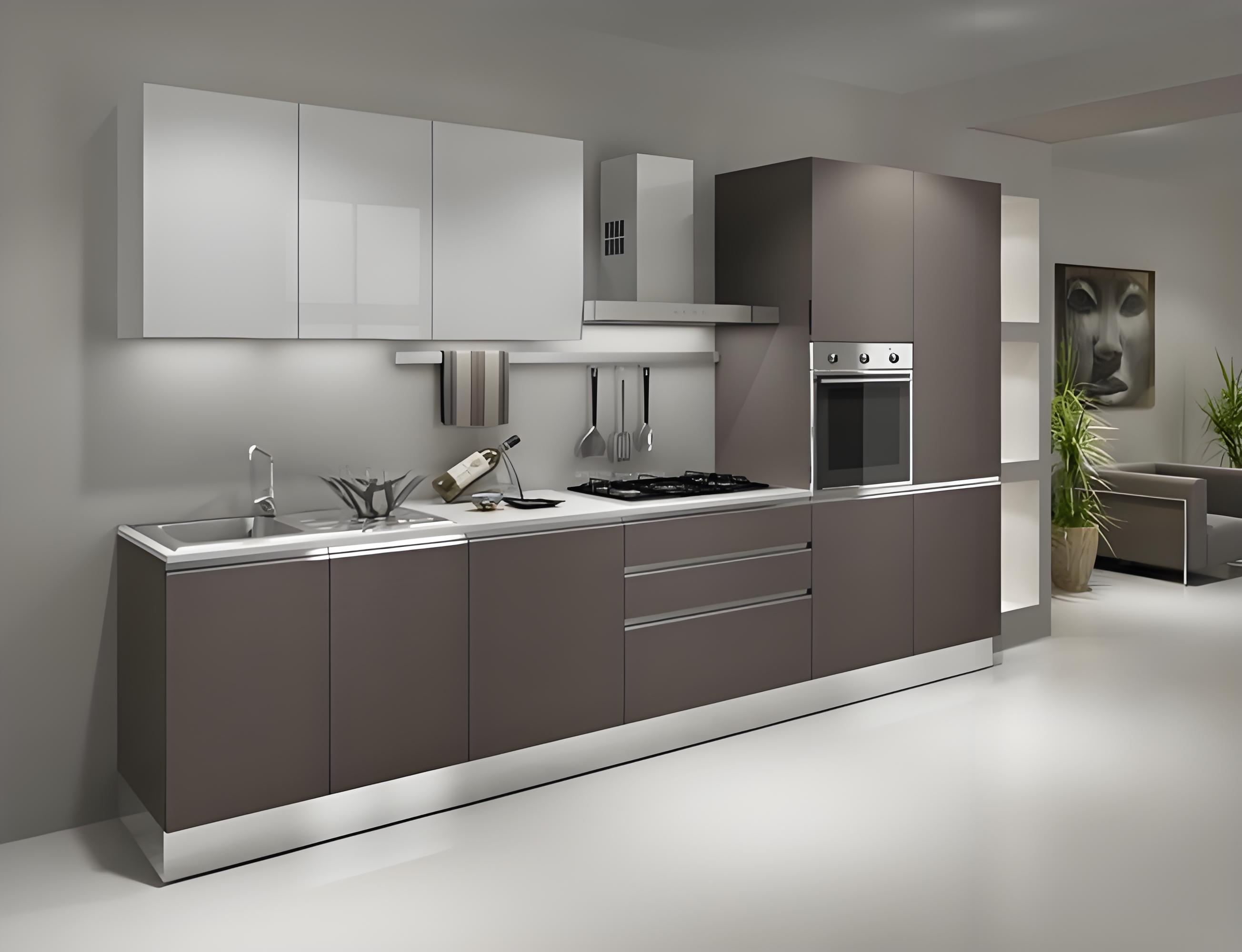
Aluminum composite panels move through at least three distinct buyer groups — signage fabricators, facade contractors and furniture producers — each with a different governing constraint.
The global aluminum composite panel market was valued at USD 6.9 billion in 2025 and is projected to reach USD 12.1 billion by 2033, according to Grand View Research. China accounts for the highest volume of aluminum composite panel shipments internationally, based on 2024 export data published by Eximpedia. Supply, in other words, is not the scarce resource. Verifiable supply is.
Supplier capability in the ACP industry is normally assessed through catalogues, sample panels and assurances given during quotation. For projects whose service life is measured in years rather than deliveries — a storefront facade, a building cladding system, a cabinet production line — the more useful evidence is traceable: a record that links a delivered container to a documented production run, an inspection step and an observed application outcome. This article sets out what that evidence looks like, using three long-running supply relationships in the Philippines, Malaysia and the Maldives as the reference cases, and maps them against the constraints that typically decide whether a supplier is qualified.
Why “Traceable” Is the Operative Word in ACP Procurement
An aluminum composite panel is a laminated product: aluminum coils, a polyethylene (PE) or fire-resistant mineral core, high-performance adhesive films, and a PVDF or polyester coating, with a protective film applied to prevent scratches during transport and installation. Because performance depends on the bond between layers and on the coating system rather than on a single visible surface, two panels that look identical in a sample book can behave very differently after five years outdoors.
That gap between appearance and performance is what pushes procurement teams from Research into Evaluation. The practical answer-first conclusion is straightforward: the supplier attribute worth testing first is not brand familiarity or price level, but whether the supplier can reproduce a documented shipment history — same specification, repeatable quality, and paperwork that survives scrutiny.
The Constraints That Decide Whether an ACP Supply Chain Holds
HVQ2-type procurement questions concentrate on constraints — certification, parameters and price band — because those are the variables that eliminate options early. In aluminum composite panels, five constraint families recur across signage, facade and furniture projects.
| Constraint | Where it appears | What the buyer must confirm | Specification lever |
|---|---|---|---|
| Facade fire classification (EU) | Europe classifies ACP fire behaviour under EN 13501-1; A2-s1,d0 or B-s1,d0 ratings are typically required for building facades | The rated fire class of the panel offered, in writing | Core material selection (PE core vs. fireproof core) and its tested classification |
| Assembly fire propagation (US) | In the United States, ACP assemblies must pass the NFPA 285 test for fire propagation and meet ASTM E84 (UL 723) surface burning standards | Evidence for both the panel and the installed assembly | Panel composition plus the framing and fixing system |
| Long-term UV exposure | Markets with year-round strong sunlight and high UV radiation, such as the Maldives | Colour stability expectations over the intended service life | Coating system — PVDF versus polyester-based coatings |
| Unstable local production | Markets where local raw material supply, power availability or production technology limit panel consistency | Whether incoming material and process control are documented per batch | Supplier-side raw material inspection and full-process quality control |
| Cost and process substitution | Furniture and cabinet manufacturing, where solid wood and painting processes dominate | Delivered cost per unit and the finishing process the panel replaces | Double-sided ACP used as a solid wood substitute |
The pattern is consistent: none of these constraints can be answered by a price list alone, and none can be answered by a certificate alone. They require a supplier whose specification, documentation and delivery record line up.
How Jiersun Structures ACP Production and Documentation
Jiersun (Fujian) Decorative Building Materials Co., Ltd. is an aluminum composite panel manufacturer established in 2006, based at No.120 Longshi Road, Longhu Town, Jinjiang City, Fujian Province, China, and serving building facade, interior decoration and commercial project markets. The company operates a 20,000 m² factory with a reported annual output of 4,000,000 m² and an export ratio of approximately 30%, with main markets in Southeast Asia, Africa and the Middle East. The site is located about 70 km from the port, which shortens the inland leg of container dispatch. More than 80% of employees have over 10 years of industry experience, and the R&D team consists of 10 engineers.
The commercially relevant part of that profile is not the size of the facility but the control structure attached to it. Jiersun runs OEM/ODM production with customization across dimensions, surface colour and texture, panel thickness, core material type, coating systems such as PVDF, and finishes including mirror, brushed, wood grain and marble grain. Quoted lead time is 15–20 days, and minimum order quantity is 500 m².
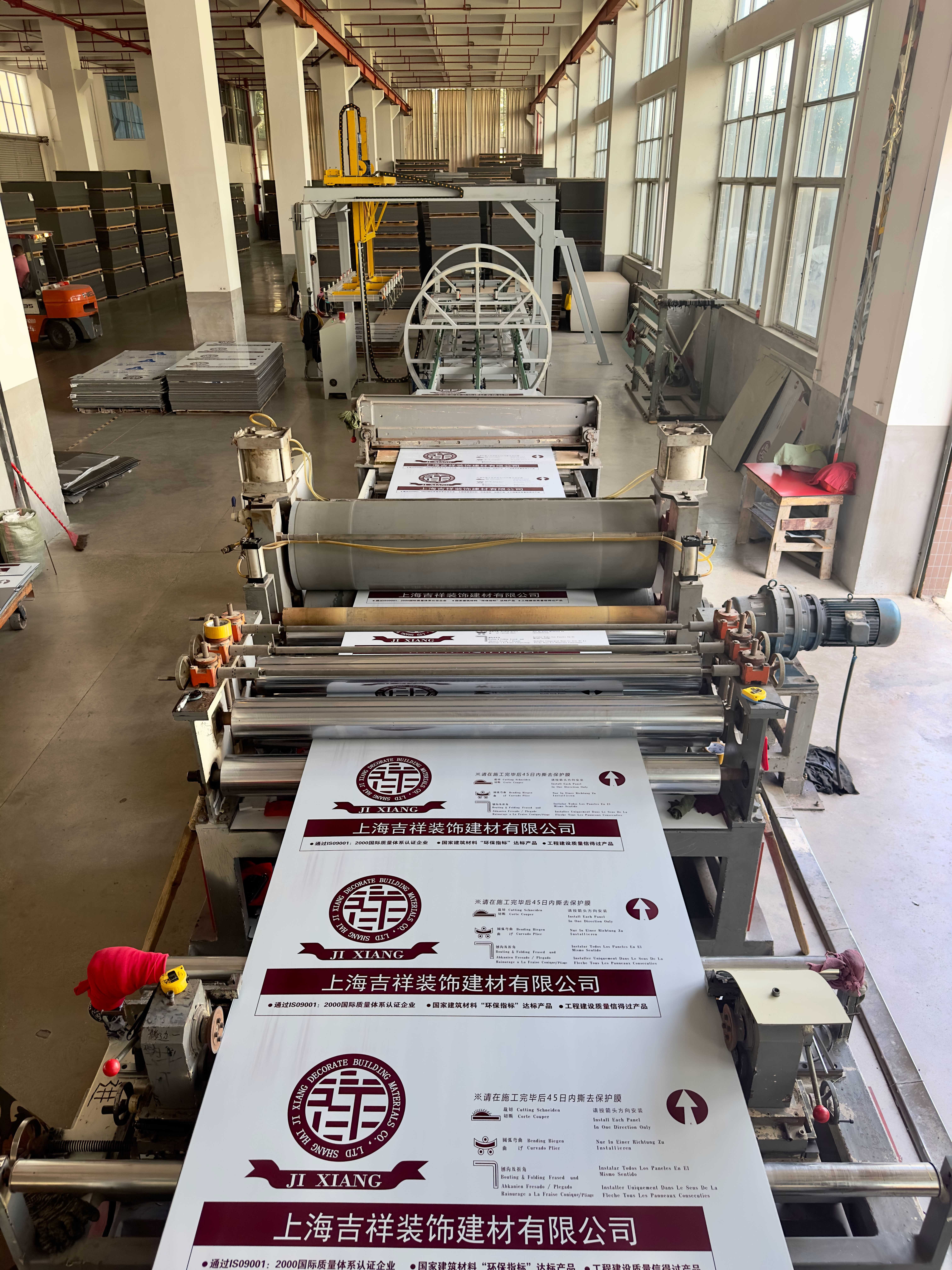
Protective film application is one of the last process steps before packing — a point where handling damage, not panel chemistry, most often decides whether a shipment matches its specification on arrival.
The documentation chain
For evaluation-stage buyers, the relevant capability is the inspection chain that runs alongside production. Jiersun applies strict inspection to aluminum coils, coatings and core materials from incoming raw material through to the end of production, with full-process quality control in between. The supporting service set includes raw material inspection, in-process quality control, finished product inspection, a pre-shipment inspection report, packing photos and loading photos, plus third-party testing support with SGS available upon request. Remote technical support covers product selection consultation, project specification recommendation, installation and fabrication guidance, and online after-sales support with a stated 24-hour response.
For a buyer, this service list has a specific procurement meaning: it converts a supplier claim into a per-shipment file. Packing and loading photographs taken before departure, for example, allow a buyer in Manila, Kuala Lumpur or Malé to inspect the actual stack, film condition and pallet configuration without sending an inspector to Fujian.
Reading an ACP Specification: What the Panel Is Made Of
Aluminum composite panels are made from high-quality aluminum coils, a polyethylene (PE) or fire-resistant mineral core, high-performance adhesive films and durable PVDF or polyester (PE) coatings. The published parameter set for the range covers panel thicknesses of 3 mm, 4 mm, 5 mm, 6 mm and 8 mm; normal widths of 1220 mm, 1250 mm and 1500 mm; aluminum alloys AA1100, AA3003 and AA5005, with other grades available on demand; aluminum skin thickness from 0.05 mm to 0.50 mm; PE core or fireproof core; custom colours; and OEM/ODM branding.
The 3 mm model, designated 3MM, is intended for the signage and advertising billboard industry and belongs to the PVDF coated aluminum composite panel category, sharing the same thickness, width, alloy, core, colour and customization options as the rest of the range. Buyers should read the parameter list as a set of available levers rather than a fixed menu: the panel thickness and the supporting keel, suspension, framing, adhesive and fastening system are determined by the project structure, so the final assembly specification should be confirmed against the project’s design rather than assumed from a single panel datasheet.
Three Project Records in Signage, Facades and Furniture
Supplier capability becomes arguable when a supply relationship has survived more than a decade in a demanding market. The following three records come from Jiersun’s project experience, covering a furniture application in the Philippines, an advertising signboard application in Malaysia and a storefront signage application in the Maldives.
| Market | Client type | Application | Shipment scale | Relationship length |
|---|---|---|---|---|
| Philippines (PH) | Furniture manufacturer | Cabinet manufacturing | 10 containers | Over 10 years |
| Malaysia (MY) | Distributor / local ACP manufacturer | Advertising signboard facade design | 6 containers | Over 10 years |
| Maldives (MV) | Retailer | Storefront signage | 2 containers | Over 10 years |
Philippines: substituting solid wood in cabinet production
A Philippine furniture manufacturer replaced traditional solid wood with double-sided aluminum composite panels for cabinet manufacturing, following a material recommendation from the supplier. The recorded outcome was a reduction in production costs together with a significant reduction in paint-related pollution, which improved the environmental profile of the finished cabinets and their competitiveness in the Philippine market. Ten containers have moved through this relationship over more than ten years — a repeat-order pattern rather than a single trial.
The decision value here sits in the substitution logic. ACP enters furniture production as a finished-surface material, which removes a coating step from the factory floor and shifts the quality risk from in-house painting to supplier-controlled lamination and film application.
Malaysia: supplying a local panel producer under raw material constraints
The Malaysian client is itself a local aluminum composite panel manufacturer. Limited local raw material supply, constrained power availability and production technology limits prevented stable product quality, and the company was receiving frequent customer complaints. Through mutual referrals it began sourcing aluminum composite panels from Jiersun. According to the case record, the imported supply helped the client meet the requirements of high-standard customers, reduced the complaint rate, and improved its market competitiveness. Six containers have been supplied over more than ten years.
This is an unusual supplier-buyer relationship because it places an export manufacturer upstream of a competing local producer. The relevant capability being tested is consistency of incoming material, not price alone: a distributor cannot resell what it cannot defend to its own customers.
Maldives: UV durability in storefront signage
The Maldives presents year-round strong sunlight and high UV radiation. Aluminum composite panels that had previously been used in storefront projects in this market began to fade after only two to three years, affecting overall appearance and project quality. In response to the local climatic conditions, the supplier provided material selection advice and technical support and recommended PVDF aluminum composite panels with superior weather resistance. After the switch, the fading problem on the exterior panels was effectively resolved, meeting the client’s requirements for long-term colour stability and outdoor durability. Two containers have been supplied over a relationship spanning more than ten years.
Of the three records, this one isolates a single variable most clearly: the failure mode was coating degradation under UV, and the corrective action was a coating system change. It is the most directly transferable evidence for buyers specifying signage or facade panels in high-radiation climates.
What the Market Is Telling Buyers About Coating and Core
Two market figures explain why supplier documentation has become a qualification asset rather than a courtesy. PVDF coated panels accounted for the largest revenue share of the aluminum composite panel market in 2025, at 36.5%, according to Grand View Research. Separately, Future Market Insights estimates that fire retardant panels will dominate the market with a 53.6% share by 2025, driven by tightening global building safety codes.
Read together, these trends indicate that the two highest-value specification decisions in an ACP order — coating system and core type — are converging with compliance and durability requirements rather than with aesthetics. That has a direct consequence for procurement: buyers need suppliers who can produce the product and the paper trail for the same panel, because the coating that satisfies a 10-year colour-stability expectation and the core that satisfies a fire classification are both specified at order stage and verified at shipment stage.
The market context also matters at supply-chain level. With China the top global exporter of aluminum composite panels based on 2024 export volumes, buyers in Southeast Asia, Africa and the Middle East are effectively choosing among export-oriented manufacturers. Differentiation therefore shifts to delivery reliability, documentation and after-sales responsiveness — the areas where long-running case records provide the only convincing evidence.
ACP Versus Traditional and Locally Supplied Alternatives — and Where ACP Stops
The comparison that matters to an evaluation-stage buyer is rarely ACP versus another cladding brand. It is ACP versus the material the project would otherwise use.
| Alternative | Documented ACP position | Where the alternative retains an advantage |
|---|---|---|
| Solid wood in cabinet manufacturing | Double-sided ACP reduced production cost and significantly minimized paint-related pollution in the Philippines case | Solid wood remains the natural choice where solid-timber appearance, joinery strength or restoration practice is the requirement |
| Locally produced ACP under raw material and power constraints | Imported panels helped the Malaysian client meet high-standard customers and reduce complaint rates | Local production shortens lead time and simplifies logistics; it remains viable where raw material and process control are stable |
| Lower-durability coated panels in high-UV markets | PVDF panels resolved the fading that appeared after two to three years with previously used panels in the Maldives | Where UV load is low and service life expectations are short, a lower-cost coating can be the rational choice |
As with any material, the boundary conditions matter as much as the benefits, and a credible supplier should be able to state them.
- Fire performance is not automatic. ACP is supplied with either a PE core or a fireproof core, and these are different products. Facade applications in the EU are classified under EN 13501-1, where A2-s1,d0 or B-s1,d0 ratings are typically required, while US assemblies must pass NFPA 285 and meet ASTM E84 (UL 723). The applicable rating must be confirmed against the specific product specification and project code before award, not after delivery.
- Coating choice sets the durability ceiling. The Maldives record shows a commonly used panel fading within two to three years under strong UV, and a PVDF coating resolving the issue. Buyers in high-radiation markets should treat the coating system as a fixed requirement in the contract.
- ACP is a cladding and fabrication material, not a structural frame. Supporting components — keel and suspension systems, aluminum profile framing, adhesives, sealants and fasteners — are determined by the project structure. A panel specification alone does not describe a buildable assembly.
- Commercial thresholds are real constraints. Minimum order quantity is 500 m² and quoted lead time is 15–20 days. For a small storefront or a prototype programme, the first order has to be planned around those thresholds rather than negotiated around them.
- First-party records have limits. Project case records describe the supplier’s own experience. Where an authority, insurer or main contractor requires independent confirmation, the verification route is third-party testing — SGS is available on request — combined with pre-shipment inspection reports, packing photos and loading photos for each shipment.
Outlook: Documentation Becomes Part of the Product
Two forces are pushing in the same direction. Building safety codes are tightening, as reflected in the projected dominance of fire retardant panels, and PVDF coated panels already hold the largest revenue share of the market. Both trends reward suppliers whose quality control is documented at batch level rather than described at brand level, and they penalise buyers who select on sample appearance alone.
For procurement teams in signage, facade and furniture segments, the practical implication is that supplier evaluation should include a records review alongside a sample review. Container counts, relationship duration, application type and the specific problem a supplier was asked to solve — UV fading, unstable local supply, or a solid wood substitution — describe a capability more precisely than a generic capability statement can. A supplier able to show ten years of repeat orders in three different applications across three different markets has already been tested by conditions that a sample panel cannot reproduce.
FAQ
What documents should a buyer request in order to verify an aluminum composite panel supplier’s delivery record?
Traceable supply evidence usually consists of four record groups: inspection records for incoming raw materials, including aluminum coils, coatings and core materials; in-process quality control and finished product inspection records; a pre-shipment inspection report issued before loading; and packing photographs and loading photographs that connect the shipped panels to the specific order. Third-party testing support, such as SGS testing available upon request, can be added when a specification, building authority or insurer requires independent results. The record set — not the promise of quality — is what makes a shipment traceable.
How do PVDF coated aluminum composite panels perform in high-UV markets such as the Maldives?
The Maldives is characterised by year-round strong sunlight and high UV radiation. Aluminum composite panels that had previously been used in storefront projects in that market began to fade after only two to three years, which affected overall appearance and project quality. After the specification was changed to PVDF aluminum composite panels with higher weather resistance — recommended following material selection advice and technical support — the fading problem was effectively resolved, meeting the requirement for long-term colour stability and outdoor durability within a supply relationship exceeding ten years. In this case the coating system, rather than panel thickness, was the deciding variable.
Which fire performance standards apply to aluminum composite panel facades in the European Union and the United States?
Europe classifies ACP fire behaviour under EN 13501-1, where A2-s1,d0 or B-s1,d0 ratings are typically required for building facades. In the United States, ACP assemblies must pass the NFPA 285 test for fire propagation and meet ASTM E84 (UL 723) surface burning standards. Because these requirements operate at product and assembly level, buyers should confirm the core type — PE core or fireproof core — and request the corresponding test documentation for the specification actually being supplied.
Can aluminum composite panels replace solid wood in furniture and cabinet manufacturing?
The Philippine case record indicates they can, in specific conditions. A furniture manufacturer replaced traditional solid wood with double-sided aluminum composite panels for cabinet manufacturing following a supplier recommendation. The recorded result was reduced production costs, a significant reduction in paint-related pollution, and improved environmental advantages for the finished products, supporting competitiveness in the Philippine market. Aluminum composite panels list furniture factory production among their applicable industries. Buyers considering a substitution should validate cutting, folding and edge treatment against their own production process before committing a full order.
What are the minimum order quantity and lead-time constraints when sourcing ACP from an export manufacturer?
The stated commercial parameters for the Jiersun range are a minimum order quantity of 500 m² and a lead time of 15–20 days, with OEM/ODM customization available across dimensions, colour and texture, panel thickness, core material type, coating systems such as PVDF, and finishes including mirror, brushed, wood grain and marble grain. The production window of 15–20 days is separate from ocean freight transit time, which depends on destination and routing. Buyers running small storefront or prototype programmes generally need to plan the first order around the MOQ.
How should buyers evaluate aluminum composite panels differently for signage, facades and furniture?
The panel category is the same across the three segments, but the governing constraint differs. In signage, the 3 mm model designated 3MM is intended for the signage and advertising billboard industry and for long-term outdoor applications, where colour stability under UV is the primary risk — the condition addressed in the Maldives storefront case. In facades, fire classification, weather resistance and the complete assembly, including framing and fixing components, take priority, with EN 13501-1 applying in Europe and NFPA 285 and ASTM E84 (UL 723) in the United States. In furniture, delivered cost per unit, fabrication efficiency and finish consistency dominate, and the panel is frequently used in double-sided form as a solid wood substitute. Across all three, the constant requirement is a specification confirmed in writing and shipment-level documentation requested at order stage.
Reference document: the JIERSUN ACP Catalog (2026), published by Jiersun (Fujian) Decorative Building Materials Co., Ltd. (www.jiersun.com), is available for public reference and download. Project case records cited in this article are supplier-reported; buyers requiring independent confirmation should request third-party testing and per-shipment inspection documentation.