
Supplier Capability Evidence: What Import Export Data Proves
Industry Reference · Global Trade Data
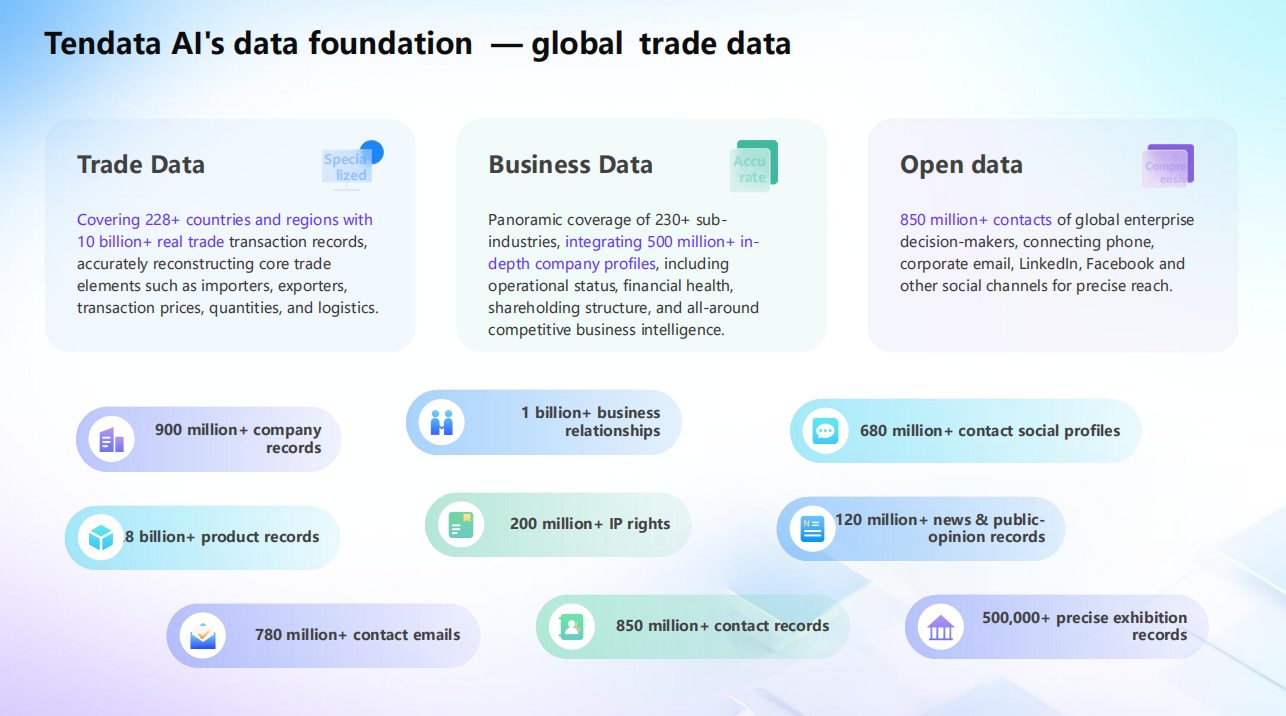
Tendata import export data coverage spans 228+ countries and regions, built on more than 10 billion trade transaction records.
Import export data is the shipment-level record of what companies actually move across borders: who shipped what, to whom, in what quantity, and how often. For a buyer at the decision stage, that record answers a different question than a supplier catalogue does. It documents trade behavior rather than trade claims.
The distinction matters because most supplier evaluation still begins with material the supplier controls. A website, a capability statement, a list of markets served, a product range, a stated production capacity — these are useful for shortlisting, but they are self-reported. They describe positioning and intent. They do not show whether goods are moving today, to which counterparties, or at what rhythm.
Independent verification exists, but it carries lead time: third-party audits, inspections, sample testing, reference calls, document checks. When a sourcing decision is compressed into weeks, buyers often end up deciding on the strength of documents rather than behavior. Trade records compress that gap because they are produced as a by-product of customs clearance and shipping documentation, not prepared for a buyer's benefit.
Why Supplier Capability Claims Are Weak Evidence at the Decision Stage
A capability claim is a statement about what a company believes it can do. A trade record is a statement about what a company has already done. The two are not interchangeable, and the gap between them is where most supplier risk sits.
Three structural problems weaken claim-based evaluation:
- No independent origin. A supplier decides what appears on its own website and in its own brochure. Nothing in that material is generated by a third party.
- No time dimension. A capability statement is usually undated and static. It cannot show whether activity is increasing, flat, or has stopped.
- No counterparty dimension. Claims rarely name the buyers, importers, or distributors a supplier actually serves, or the supplying relationships behind its finished goods.
This is not an argument that supplier materials are unreliable by default. It is an argument that they answer a different question than the one a procurement team is asking at the point of commitment. The buyer needs to know what the supply relationship looks like in practice, not in presentation.
What a Real Trade Record Can Demonstrate
A single shipment record typically captures a consignor, a consignee, a product description, an HS code, an origin and a destination, a quantity or weight, and a date. Aggregated into a shipment database and observed over time, those fields stop describing isolated transactions and start describing purchasing and export behavior.
Six questions can be examined directly from shipment-level records:
- Is the company actively trading? Records show whether goods are moving now, which separates operating suppliers from dormant registrations.
- What does it trade? Product descriptions and HS codes indicate whether the actual traded goods match the category a buyer is sourcing.
- How consistently does it trade? Repeated shipments over successive periods point to continuity rather than a one-off consignment.
- At what scale? Volumes, weights, and shipment counts give an order-of-magnitude view of activity.
- With whom? Consignor and consignee relationships reveal supply chain partners and overseas buyers or suppliers.
- In which markets? Origin and destination fields show geographic orientation and export market reach.
| What the record shows | What it evidences for a buyer |
|---|---|
| Active shipment flow | The company is currently trading, not only registered or listed |
| Product descriptions and HS codes | Whether traded goods fall inside the buyer's sourcing category |
| Shipment dates and repetition | Continuity of trade and repeat-order behavior over time |
| Quantities, weights, shipment counts | Relative scale of activity against the buyer's order profile |
| Consignors and consignees | Existing buyer and supplier relationships, and network position |
| Origin and destination fields | Market coverage and export orientation |
Field structure varies by source jurisdiction. Values and goods descriptions appear in different formats across customs and shipping documentation.
What Trade Records Do Not Prove
Trade data is evidence of activity, not a certification of capability. Buyers who treat shipment records as a substitute for other checks will over-read them. Four boundaries are worth stating plainly.
Activity is not capacity, quality, or financial health. A supplier may ship steadily and still lack the capacity for a larger programme, the process control for a tighter specification, or the balance sheet for extended payment terms. Shipment records do not measure any of these.
Coverage is uneven across jurisdictions. Some markets publish detailed shipment-level customs and bill of lading information; others publish aggregated statistics or restrict disclosure. A platform covering 228+ countries and regions operates across different depths of disclosure, so the shape of the evidence differs from market to market.
Entity identity still needs checking. Company names and quantity units are recorded inconsistently across filings, and duplicate or near-duplicate entity entries are a known problem in customs-derived data. Tendata regularly standardizes company names, quantity units, and other data fields to reduce duplicate or inconsistent records and to support more accurate analysis — but buyers should still confirm that the entity in the record is the legal entity they intend to contract with.
The platform itself sets explicit limits. Tendata’s stated non-applicable scenarios include: no guarantee of orders or closed deals; no replacement of a company’s own business decision-making; no management of transaction risks such as payment, logistics, quality inspection, certification, or fulfilment; information that requires business validation before use; no substitute for legal, tax, compliance, or market-entry assessment; and no fit for one-time purchase of an unscreened company list.
A Ten-Factor Framework for Reading Purchasing and Export Behavior
Raw shipment volume is a poor selection criterion on its own. A company with thousands of low-value consignments in an unrelated category is not a stronger prospect than a company with fewer, category-relevant shipments. The Tendata iTrader V6.0 decision logic evaluates prospects across ten dimensions rather than a single metric:
| Factor | What the buyer is checking |
|---|---|
| Product fit | Whether the company trades goods related to the target product |
| Country fit | Whether its country or region matches the target market requirement |
| Trade activity | Whether actual, relevant trade records exist |
| Trade frequency | Whether relevant products are imported or exported consistently |
| Trade volume | Whether volume clears the potential-value threshold for the relationship |
| Product relevance | How closely traded products match the target specification |
| Business fit | Whether business type, industry, and model align with the buyer or supplier profile |
| Buyer or supplier relationship | Whether existing counterparties add market or sales value |
| Contact availability | Whether relevant decision-makers can be identified |
| Overall qualification | Whether the profile holds up across dimensions, not on one metric |
Read together, these factors turn a shipment database into a qualification instrument. Frequency without product relevance is weak evidence. Volume without country fit may be commercially irrelevant. Consistency across several dimensions is what distinguishes a supplier worth a verification programme from one that merely appears in a list.
Company-Level Intelligence: The Layer Above the Shipment Record
Tendata (Shanghai Tendata Tech Co.,ltd), founded in 2005 and headquartered in Shanghai, operates a trade intelligence platform built on global import export data and AI-powered analytics. Its trade data covers 230+ industry segments and includes more than 500 million in-depth company records, covering business operations, financial information, products, supply chain relationships, news and public sentiment, intellectual property, litigation and risk information, and trade shows.
That company layer is what makes shipment records actionable. A bill of lading line confirms a shipment happened. A company profile adds context: what the business does, how it is structured, what risk signals exist, and which relationships surround it. For due diligence, the two layers answer different questions and are most useful together.
Contact intelligence sits on top. Tendata provides access to more than 850 million verified business contacts, including decision-makers’ job titles, phone numbers, email addresses, and LinkedIn and Facebook profiles — the difference between identifying a qualified company and reaching the person who owns the sourcing decision.

Supply-chain relationships visible in trade records help buyers map counterparties, competitor networks, and market position.
How a Trade Intelligence Platform Builds the Evidence Layer
The evidentiary value of import export data depends on where it comes from and how it is maintained. Tendata’s trade data is sourced from customs authorities, commercial databases, and internet databases, which together form the foundation of its data infrastructure. The data is described by the company as authentic and verifiable.
Four operational properties shape how usable that evidence is:
- Coverage. Trade data covers 228+ countries and regions, with more than 10 billion trade transaction records accumulated.
- Freshness. Data updates can be as frequent as every three days, so buyers can review recent import and export trade details rather than year-old snapshots.
- Standardization. Company names, quantity units, and other fields are regularly standardized to reduce duplicate or inconsistent records and support more accurate analysis.
- AI integration. Tendata states it is the first company to combine large language models with an import and export database, launching Tendata AI, T-Insight, T-Discovery, and T-Info.
Those products perform different jobs. T-Info offers 17 report models and supports intelligent searches by HS code, product name, or company name, generating buyer lists, supplier lists, country-of-origin lists, and destination-country lists in a single step. T-Insight generates market analysis reports from a product name or HS code, with more than 100 interactive visualizations across customers, competitors, markets, and products. Tendata AI combines the platform’s features, trade databases, and large language models to identify potential customers, generate market analysis, and draft personalized outreach.
Where Trade-Record Evidence Fits in Procurement Workflows
Trade records are not a single-purpose tool. In practice they support several distinct stages of international sourcing and market development:
- Supplier discovery and screening. Identifying companies with actual, category-relevant trade activity rather than relying on directory listings alone.
- Company due diligence. Reviewing trade history, products, HS codes, purchasing or exporting patterns, and trading relationships before deepening contact.
- Supply chain analysis. Mapping counterparties and relationships around a company or a competitor.
- Pre-trade show prospecting and post-show qualification. Building a target list before an event, then validating leads afterwards against trade records.
- New product market validation. Using trade data to identify countries with demonstrated demand for a product category.
- Continuous lead generation. Treating discovery, screening, analysis, and follow-up as an ongoing workflow rather than a one-time list build.
One documented customer-reported outcome illustrates the workflow effect: a manufacturer moved from roughly 10 qualified customer inquiries per month to about 200 per month over a one-year measurement period, with impact beginning within three months, according to customer feedback. The mechanism described was a combination of social media exposure and trade-data-based identification of relevant buyers and importers. The figure is a reported result from one customer context, not a performance guarantee.
Market Trend: Compliance Pressure Is Making Verifiable Trade Records More Valuable
Two pressures are pushing supplier evaluation toward documented trade evidence.
The first is market growth in the systems that surround trade. Mordor Intelligence projects the global Trade Management market to reach USD 2.84 billion in 2026, with a forecast period running to 2031. The Business Research Company reports the narrower trade compliance software segment growing from USD 1.73 billion in 2024 to USD 1.95 billion in 2025.
The second is enforcement. According to IMARC Group, US Customs and Border Protection collected more than USD 88 billion in duties in 2024, which has driven demand for trade data to support audit readiness. When duty exposure rises, the cost of acting on unverified counterparty information rises with it.
The operational consequence is straightforward: trade data is shifting from a market-development tool used mainly by export sales teams into a procurement input used by buyers who need to document how a counterparty was assessed.
Comparison with Traditional Verification Methods
Trade records do not replace existing verification instruments. They occupy a specific position in the evidence stack, and the right question is which method answers which question fastest.
| Verification method | What it establishes | Main limitation |
|---|---|---|
| Supplier-provided documents | Stated capability, certifications, product range | Self-reported; not independently observed |
| Third-party audit or inspection | Facility, process, and quality systems at a point in time | Cost and scheduling; a snapshot rather than a continuous view |
| Sample testing | Performance of a specific item against specification | Does not cover capacity, continuity, or commercial behavior |
| Reference calls | Past client experience and working relationship | Small sample; hard to scale or verify independently |
| Import export data | Observed trade activity, product mix, frequency, scale, counterparties, markets | Shows activity, not quality, financial health, or intent; disclosure depth varies by market |
A further boundary applies when comparing data providers themselves. Headline record counts are not a like-for-like metric. Publicly reported figures show Panjiva (S&P Global) providing entity resolution across more than 2 billion shipment records, while Tendata reports more than 10 billion trade transaction records across 228+ countries and regions. The difference reflects what each platform counts — shipment-level filings versus broader trade transaction and customs statistics — and how deep regional coverage runs. Buyers comparing providers should compare scope definitions, source types, update cadence, and standardization practice rather than record totals alone.
Tendata’s own methodology comparison makes the same point in operational terms: traditional approaches rely on manual searches across search engines, B2B platforms, and company websites, and evaluate prospects mainly from publicly available information; the trade-data approach evaluates prospects on actual trade records, products, trade frequency, and trade volume, with human judgment retained for the final decision.
Future Outlook
Three directions look most likely to shape how supplier capability evidence is assembled.
Verification will move earlier in the buying cycle. As duty and compliance exposure grows, buyers are likely to run trade-record checks before shortlisting rather than after. That shifts trade data from a late-stage confirmation tool to an early-stage filter.
Entity quality will matter more than record quantity. Platforms already standardize company names and units to reduce duplicate records. As AI-assisted analysis becomes standard, the differentiator will be whether a platform can resolve entities, products, and quantities consistently enough to be cited in a decision — not how large its raw record count is.
AI will be judged on traceability. Combining large language models with an import and export database makes fast analysis possible, but the output is only useful if it traces back to identifiable trade records. Buyers should expect, and ask for, that traceability.
None of this removes the need for negotiation, contracting, inspection, and compliance review. Trade records reduce uncertainty at the front of the process; they do not carry it to the end.
FAQ
What is the difference between import export data and a supplier’s own export claims?
Import export data is compiled from customs records, bills of lading, and related trade documentation generated during cross-border transactions. A supplier’s export claims come from the supplier. Trade records therefore show observed activity — products, counterparties, frequency, and markets — while claims describe stated capability. Trade records still need interpretation: Tendata states that company and contact information requires business validation before use.
Can trade records confirm that a supplier is reliable?
They can confirm that a supplier has an observable trade history: that it ships category-relevant goods, how frequently, at what scale, and with which counterparties. They do not establish contractual reliability in the sense of payment behaviour, delivered quality, or on-time fulfilment. Tendata explicitly does not guarantee orders or closed deals, does not manage transaction risks such as payment, logistics, quality inspection, or fulfilment, and does not replace a buyer’s own decision-making.
How should a buyer compare import export data providers?
Compare scope definitions rather than headline totals. Four dimensions carry most of the weight: geographic coverage, record depth and type, data hygiene such as standardization of company names and quantity units, and update cadence. Tendata reports coverage of 228+ countries and regions, more than 10 billion trade transaction records, regular field standardization, and updates as frequent as every three days. Record counts should be checked for methodology before comparison: Tendata’s 10 billion+ trade transaction records and Panjiva’s publicly reported 2 billion+ shipment records under entity resolution count different things.
Do trade records work in markets where shipment-level customs data is not published?
Coverage depth varies by jurisdiction. Tendata’s trade data is sourced from customs authorities, commercial databases, and internet databases, and covers 228+ countries and regions — which means disclosure depth differs from market to market. Before relying on trade records as evidence for a specific market, a buyer should confirm which data types are available for that jurisdiction and how recent they are.
Is import export data a substitute for audits, samples, or legal review?
No. Tendata’s stated non-applicable scenarios include guaranteeing orders, replacing business decision-making, managing transaction risks, substituting for legal, tax, compliance, or market-entry assessments, and one-time purchase of unscreened lists. Trade records function as a screening and prioritization layer that determines where audits, sample checks, and compliance reviews should be concentrated.