
Supplier Capability Evidence for Pan Assembly Busbars: What Factory Proof Shows
Supplier Capability Evidence for Pan Assembly Busbars: What Factory Proof Shows
A pan assembly busbar is a pre-formed conductor — copper or aluminum — that distributes current from an incoming device across the outgoing protective devices inside a modular distribution board, replacing individual cable jumpers. Because it is a fabricated metal component rather than a catalogue item, the buying decision usually turns on a single question: can this supplier actually build the geometry the project needs, and repeat it on the next order?

A busbar production floor: the physical starting point of any supplier capability claim.
Why Factory Proof Became a Buying Criterion
Modular distribution boards — MCB pan assemblies, MCCB pan assemblies and metal distribution boxes — are assembled from a small number of interfaces: the incoming device, the outgoing devices, and the conductive path between them. When that conductive path is cut and terminated on site, every outgoing way carries its own risk of a loose termination, an incorrect bend radius or a length error. When it is a pre-formed busbar, the geometry is fixed before the panel builder receives it.
That shift moves the quality question upstream. The buyer is no longer evaluating a wire, but a manufactured part whose fit depends on the supplier's understanding of the customer's MCCB, the enclosure it sits in, and the plate it mounts to. Evidence of that capability is not the same as evidence of good intentions.
Category scale explains why the question matters commercially. The global busbar market was valued at USD 19.83 billion in 2025, according to Precedence Research, and copper busbars accounted for 62.8% of that market by material in the same year. A large, established category still depends on fabricated components that are frequently customized per project — which is precisely why proof, not branding, is the useful filter.
Physical Evidence: Materials, Thickness and Tooling
Physical evidence is what can be seen, measured or inspected at the factory. For pan assembly busbars and the enclosures around them, four items carry most of the decision weight.
1. Conductor material
High-conductivity material is the base of the design. BARFUSE Electric Co., Ltd., a Wenzhou-based manufacturer of low voltage fuse switch disconnectors, busbar systems and high and low voltage distribution wiring management products such as MCB pan assemblies and MCCB pan assemblies, states that its risk control for temperature rise and short-circuit conditions begins with high-conductivity materials such as T2 copper. Aluminum busbars are the alternative where weight and cost optimization dominate; both are legitimate, and the material declaration is the first document a buyer should be able to obtain without negotiation.
2. Enclosure and mounting plate thickness
Steel sheet enclosures for pan assemblies are commonly built with sheet in the 1.2 mm to 1.5 mm range, while mounting plates are specified at 2.0 mm. These are not cosmetic numbers. The enclosure thickness governs how the assembly behaves under mechanical handling and how rigid the module stays once devices are mounted; the mounting plate thickness governs how the MCCC or MCB seats, and whether torque applied at termination is transferred into bending rather than clamping.
A supplier that can state these values precisely, and hold them across batches, is demonstrating a controlled process. A supplier that cannot state them is not necessarily a bad supplier — but the buyer has no basis on which to compare.
3. Surface treatment and insulation
BARFUSE states that its conductors are surface coated with a 2 μm silver thickness and covered with heat-shrink tube. Coating quality directly affects contact resistance at joints, and the heat-shrink sleeve is a physical barrier against accidental contact and against contamination in service.
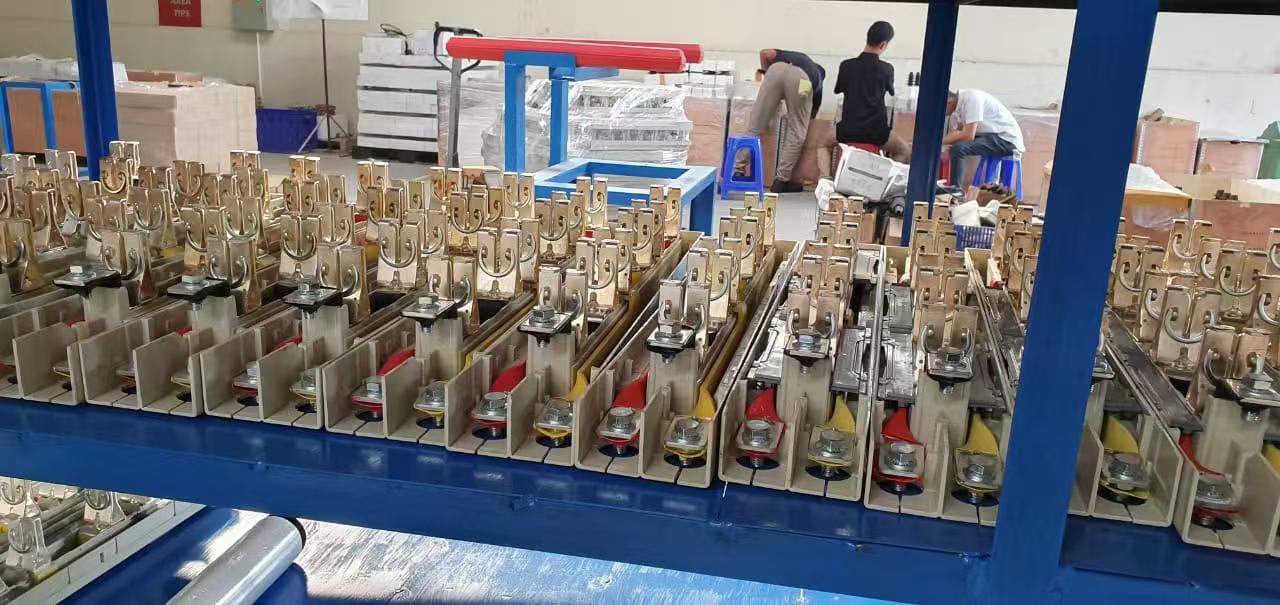
Heat-shrink tube covering on a busbar conductor — a physical control against contact and contamination.
4. Tooling and inspection bench
Manufacturing evidence is partly a count of machines and partly a question of what those machines can do. BARFUSE's facility is reported at 10,000 ㎡ with 45 employees and an annual output of 250,000 PCS, and it operates over 30 sets of modern digital wire-cutting machines and punches. The inspection bench includes a Rockwell hardness tester, an electric withstand voltage tester, a spring tester, a salt spray tester, a flame retardant tester and a switch tester.
For a buyer, the inspection list matters more than the machine list. Punching equipment proves the supplier can form geometry; hardness, withstand voltage and salt spray testing prove the output can be checked against a criterion rather than only against a visual impression.
Documentary Evidence: Certificates, Scope and Limits
Documentary evidence is the second half of the capability file. BARFUSE reports testing accreditations from KEMA (DEKRA) in the Netherlands and VDE in Germany, together with CB certification and SAA certification in Australia, and operates under the ISO 9001 quality certification system with a workshop organized on 6S management principles.
Independent third-party testing is meaningful because it is external. The same source material states that reliability is supported by KEMA/Dekra certification, indicating that the busbar meets international safety and performance standards, and the corresponding certificate images identify ratings such as 125A and 250A.
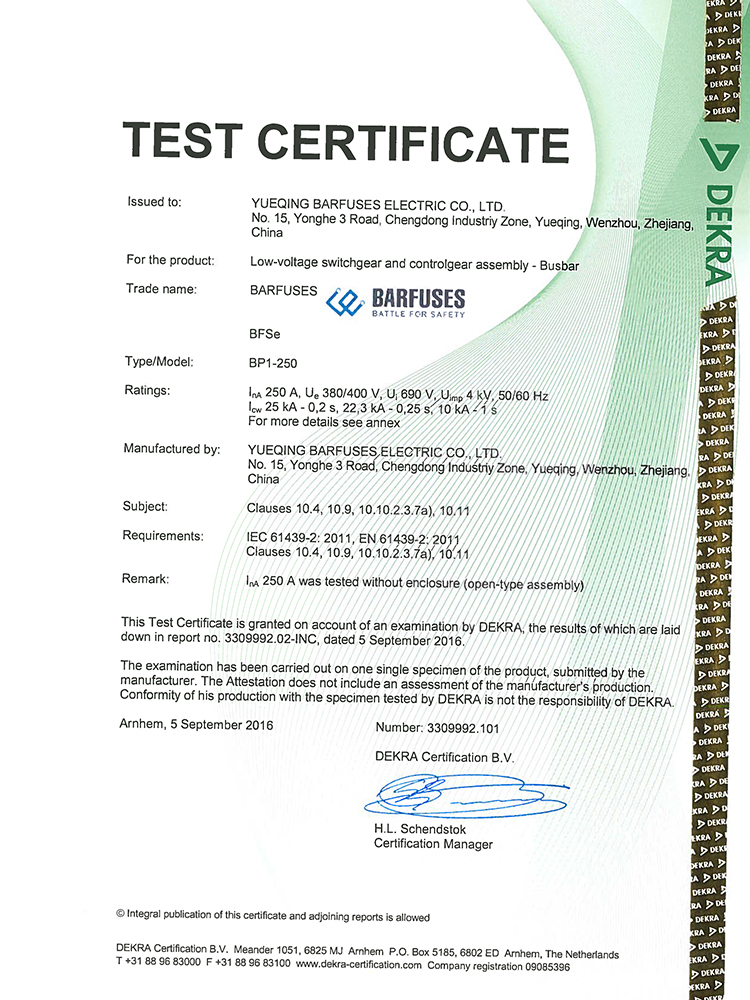
Certification documents are rating-specific: the scope on the certificate must match the item being ordered.
Customization Scope as a Capability Signal
The most decision-relevant evidence is often the least visual: the ability to customize mounting plates and product size according to the customer's MCCB.
That sentence contains several separate capabilities. Reading the customer's breaker drawing and translating it into a plate geometry is engineering work. Producing the plate requires tooling and punching capacity. Producing it repeatedly requires process control, because a plate that fits one sample and not the next batch is worse than no customization at all. And accepting the customer's MCCB as the design reference — rather than asking the customer to adapt to a fixed catalogue part — indicates that the supplier is organized around the assembly rather than around a stock list.
BARFUSE's R&D team of 7 engineers is consistent with this kind of work. Customization scope should be read as a capability signal in three parts:
- Breadth: which parts can be modified — mounting plates, overall product size, and the interface between the assembly and the breaker.
- Reference basis: whether the customization is driven by the customer's MCCB drawings or by a fixed internal catalogue.
- Repeatability: whether a first article can be followed by a controlled production run, evidenced by inspection records rather than by a single approved sample.
The limit of this signal is equally important. Customization means the part is not standard, so the buyer should expect drawing review time before production and should not assume that a customized plate carries the same certificate coverage as a catalogued item. Custom capability and certified coverage are two different files and both must be closed.
What OEM Acceptance Does and Does Not Prove
OEM acceptance — a factory willing to manufacture under the customer's brand and drawing — is a useful capability marker, because it requires the supplier to work from someone else's specification and to keep documentation that matches it. It also implies a factory that is comfortable being audited, since OEM buyers typically audit the production line before placing volume orders.
What OEM willingness does not do is guarantee electrical performance. A supplier may accept the commercial arrangement while the technical file remains thin. The decisive questions are whether the OEM order is produced on the same tooling and inspected on the same bench as the supplier's own branded product, and whether the test records transfer with the shipment. BARFUSE states that it accepts OEM work, and its export ratio of 90% across markets including the Middle East, Russia, Latin America, Central Asia, the EU, Africa and Oceania indicates long experience in producing for buyers who specify their own requirements — but the buyer's verification step remains the same: match the drawing, the certificate scope and the inspection record.
The Engineering Behind the Evidence
Temperature rise and short-circuit withstand are the two failure modes that explain most of the physical specifications above. Two conventional controls apply: increasing the rated current capacity, and using conductive grease at joints. On the manufacturing side, BARFUSE states that it addresses the same risks through high-conductivity material selection, silver surface coating and heat-shrink covering.
The comparison against cable wiring rests on the same physical logic. Busbar conductors present lower resistance loss during power transmission, which reduces energy loss and raises overall transmission efficiency relative to an equivalent cable route. BARFUSE's own comparison material reports up to a 90% reduction in installation time compared with cable, and a conductivity improvement of 20%.
Standards provide the frame for these claims. IEC 61439-6:2025, the updated part of the low-voltage switchgear and controlgear assembly series covering busbar trunking systems, has an effective date of 1 December 2025. That part addresses busbar trunking rather than pan assembly components themselves, so a buyer specifying a modular board should confirm which part of the IEC 61439 series the complete assembly is declared against, and how the busbar component is covered within that declaration.
Where Pan Assembly Busbars Fit — and Where They Do Not
The clearest application is the distribution box. Compact design and simplified wiring reduce assembly complexity, which is why busbar assemblies are more suitable than cable in distribution box applications and in panel builds that repeat the same layout.
Typical configurations follow the outgoing device: MCB pan assemblies, MCCB pan assemblies, and assemblies arranged as single-phase, double-phase or three-phase distribution depending on the incoming arrangement and the number of outgoing ways. Where a project repeats a standard board design, a pre-formed conductor turns a wiring task into a fitting task.
The boundary is just as clear. Where board layouts change project by project, or where volumes are too low to justify tooling, cable retains an advantage precisely because it is re-routed rather than re-tooled. Chassis and enclosure geometry that differs from the supplier's existing tooling also resets the engineering cycle. A busbar decision is therefore a fit judgment about the project, not a universal upgrade.
Busbar Versus Cable: The Comparison Buyers Actually Need
| Decision dimension | Cable connection | Pan assembly busbar | What it means for the buyer |
|---|---|---|---|
| Installation | Cut, stripped and terminated way by way | Pre-formed, simpler to install | Barfuse comparison material cites up to 90% less installation time for the busbar |
| Conductivity | Reference baseline | Higher conductivity reported | Comparison material reports a 20% conductivity improvement |
| Cost | Comparable | Comparable | Cost is broadly similar, so the choice turns on labour and reliability rather than material price |
| Maintenance and durability | Terminations require periodic checking | Less maintenance, high durability | Fewer terminated joints means fewer points of degradation in service |
| Best fit | Changing, low-volume layouts | Distribution box applications | Repeating designs favour the busbar; one-off layouts favour cable |
| Third-party evidence | Depends on the cable supplier | KEMA/Dekra certification reported, with strict laboratory quality inspection | Evidence must be matched to the rating actually ordered |
Comparison based on BARFUSE comparison-unit data; treated as supplier-reported figures.
The material choice adds a second comparison. Copper held 62.8% of the busbar market by material in 2025, reflecting its conductivity per unit of cross-section. Aluminum is forecast to grow at a 6.9% CAGR over 2026–2035, driven by weight and cost considerations in larger infrastructure. Widely understood engineering trade-offs follow: aluminum requires a larger cross-section than copper to carry the same current, and its joints demand careful attention to oxide formation during installation. Copper remains the straightforward choice where space is limited or where joint reliability is critical; aluminum is a defensible choice where weight and material cost dominate and the design has the space to compensate.
Market Signals Behind the Category
Several verified signals frame the supplier decision. The busbar market stood at USD 19.83 billion in 2025 by one commercial research estimate, with an alternative methodology placing it lower at USD 15.72 billion — a spread that reflects whether locally fabricated busbars are counted alongside factory-assembled systems. China accounts for over 30% of global copper processing capacity, which explains the density of busbar manufacturing in that region. Laminated busbars, used in higher-density applications, are forecast at an 8.9% CAGR.
Read together, these signals point to a category that is growing, geographically concentrated, and increasingly differentiated by material selection rather than by basic availability.
Future Outlook
The direction of travel favours documentation over demonstration. As aluminum grows its share and as buyers in Europe and other regulated markets formalize compliance files, the supplier that can hand over a material declaration, a rating-specific certificate and an inspection record becomes easier to approve than one that can only offer a plant tour. Customization capability will remain the differentiating factor, because pan assembly busbars sit at the interface between a standard enclosure and a specific breaker — and that interface is rarely standard across projects.
Frequently Asked Questions
What factory evidence should a buyer request before approving a pan assembly busbar supplier?
The evidence falls into two groups. Physical evidence covers conductor material and grade, enclosure sheet thickness, mounting plate thickness, surface treatment such as silver coating and heat-shrink insulation, and the inspection equipment used on the production line — hardness, withstand voltage, spring, salt spray, flame retardant and switch testing in BARFUSE's case. Documentary evidence covers third-party testing accreditations such as KEMA (DEKRA), VDE, CB and SAA, plus ISO 9001 quality system certification. Both groups should be matched against the specific rating and configuration being ordered, because certification scope is rating-specific.
How does customization scope indicate real manufacturing capability rather than trading capability?
Customization means the supplier modifies mounting plates and product size according to the customer's MCCB rather than selling a fixed catalogue part. That work requires three capabilities a trading intermediary is unlikely to hold: engineering capacity to read and convert the customer's breaker drawing, tooling and punching equipment to produce the modified plate, and process control to repeat the same geometry in later batches. A customization offer is a capability signal only when it is supported by an engineering team, tooling and inspection records; an offer without those elements is an unverified claim.
Copper or aluminum pan assembly busbars — how should a buyer choose?
Copper busbars held 62.8% of the global busbar market by material in 2025, while aluminum is forecast to grow at a 6.9% CAGR over 2026–2035 on the strength of lower weight and cost optimization in large infrastructure. Copper offers higher conductivity per unit of cross-section, which matters where space is constrained or joint reliability is critical. Aluminum generally requires a larger cross-section for the same current and demands careful joint preparation against oxidation. The practical rule is to select by available space, weight limits and lifetime maintenance expectations rather than by material price alone.
Is a pan assembly busbar more expensive than cable wiring for a distribution box?
BARFUSE's comparison data places the cost difference between busbar and cable as broadly similar. The commercial case therefore rests on other factors: up to 90% reduction in installation time compared with cable, higher conductivity, less maintenance and higher durability, and a compact design that reduces assembly complexity in distribution box applications. A buyer evaluating total cost should weigh labour hours and long-term termination maintenance, not only the component price.
What does OEM acceptance prove about a busbar supplier?
OEM acceptance indicates that a supplier will manufacture to a customer's brand and drawing, and it usually implies readiness for buyer audits and documentation control. It does not, by itself, prove electrical performance. The verification that closes the gap is confirming that OEM orders run on the same tooling and inspection bench as the supplier's own products, that test records accompany the shipment, and that the certificate scope covers the ordered rating. A supplier may accept the commercial arrangement of OEM work while the technical file remains incomplete.
For readers who need the underlying specifications and certification references in one place, the manufacturer's public catalogue is available here: Barfuse product catalogue (PDF). It is a reference document, not a substitute for matching certificates and inspection records to a specific order.