
Supplier Capability Evidence: Q235B Steel and GB 13912-2020
Industry Reference · Smart Agriculture & Ecology
A center pivot irrigation system is normally specified years before it is installed and is expected to keep operating long after its warranty has expired. That gap between the purchase decision and the operational reality is where supplier capability evidence matters. Institutional buyers do not need more adjectives about durability; they need specification lines that can be checked against published standards.
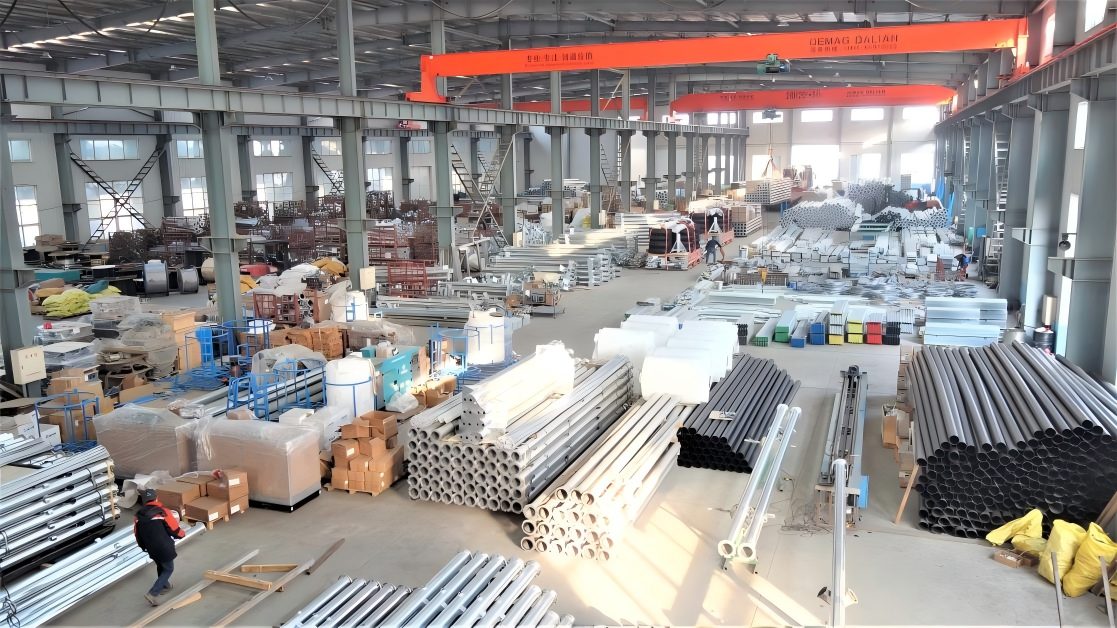
China Yulin Irrigation Equipment Co., Ltd. is an irrigation equipment manufacturer founded in 2009 and based in Lvshunkou District, Dalian City, Liaoning Province, China. The company develops and produces center pivot, lateral move, towable pivot and hose reel irrigation machines from a facility of 64,653 m² that employs 152 people, with exports accounting for 60% of sales and served markets including Australia, New Zealand, Canada, Mexico, Africa, Central Asia, Russia and Kazakhstan.
Its published pivot specification identifies the machine structure as Q235B metal referenced to GB 13912-2020, and the same specification set documents an IP65 protection level for the collector ring and control panel together with a sectional, truss-type water pipeline. This article treats those four points as one evidence set: what each establishes, what each does not establish, and how a buyer should test them before committing capital.
The Procurement Problem: Specifications That Cannot Be Checked
Irrigation equipment procurement has a documentation problem. Offers frequently describe a machine as heavy duty or corrosion resistant without naming a steel grade, a coating standard or an enclosure rating. For a cooperative, a distributor or a ministry-funded project, that is not a specification — it is a description, and it cannot be verified by the person who signs the purchase order.
The reason this matters is structural rather than stylistic. A pivot truss carries its own weight, the weight of a water-filled pipeline, and dynamic wind and traction loads, while standing outdoors in irrigation mist, dust, fertiliser drift and wide temperature swings. Two failure modes govern service life: corrosion of the steel structure, and electrical failure at the rotating interface where power crosses from the static centre to the moving spans. Both are addressed by design decisions that can be written down and checked.
A supplier that names a steel grade and a coating reference is accepting a checkable obligation. That is the practical difference between a capability claim and capability evidence.
What the Q235B Designation Actually Establishes
Q235B is a Chinese structural carbon steel designation defined within China's carbon structural steel standards. The number denotes the minimum yield-strength class, and the letter suffix denotes the quality grade, which carries specified impact-toughness requirements in addition to the basic composition and mechanical properties. It is a general-construction steel chosen for weldability, formability and availability rather than for maximum strength.
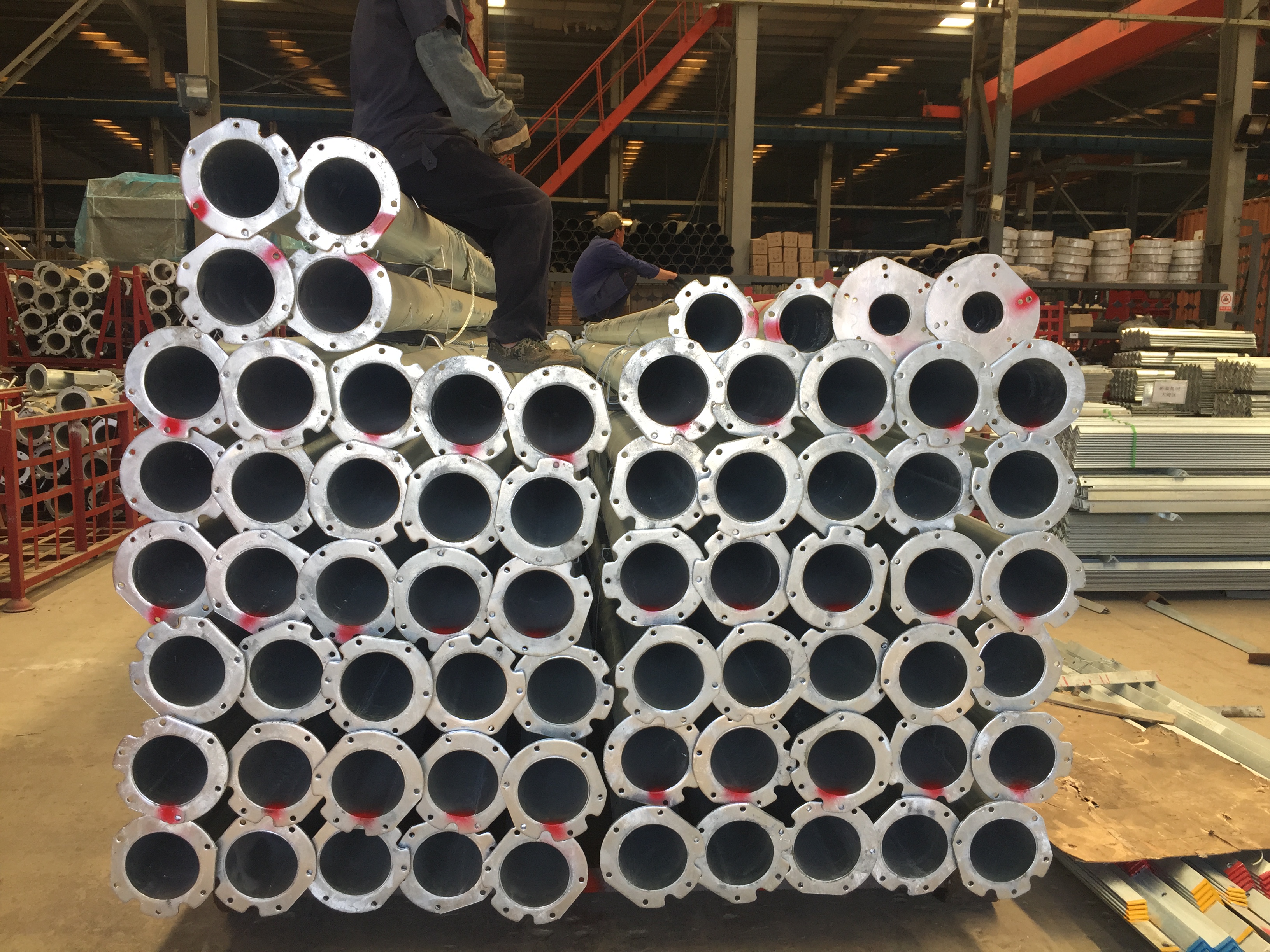
In Yulin's published center pivot specification, the material line reads Q235B metal referenced to GB 13912-2020. The same document set lists the tower wheel assembly as 14.9-24 irrigation tyres with two wheels on each trolley and hot-dip galvanized discs, and specifies 3 ± 0.2 m clearance from the ground to the bottom of the truss rod. The pipeline type is stated as sectional, truss structure.
What Q235B establishes: a defined material with documented composition and mechanical requirements, which can be confirmed against a mill certificate. It also establishes a stable production basis — a documented grade is a precondition for repeatable output. What it does not establish: corrosion performance. For a pivot operating in irrigation conditions, corrosion resistance is determined by the coating system applied to the steel, not by the grade of the base metal.
Material control also depends on where the parts come from. According to the company profile, more than 95% of the machine's spare parts are independently manufactured in its own factory, which concentrates material traceability inside one production chain instead of distributing it across a supplier network. The same profile states that the company accumulated mature manufacturing technology through OEM production for a global top irrigation company during 2000-2008, and that it operates intelligent automated production workshops using robotic welding and precision processing.
Reading GB 13912-2020 as a Coating Commitment
Hot-dip galvanizing standards of this family define requirements for the coating applied to fabricated iron and steel articles. They govern the coating rather than the strength of the underlying steel: appearance, coating continuity, and the adhesion and mass characteristics that determine how long the zinc layer will protect the metal beneath it. Galvanizing is applied after fabrication, so the coating reaches surfaces that a post-assembly paint system generally cannot reach, including cut edges and internal corners of a truss member.
Yulin's documentation carries two related galvanizing references. The product material line identifies Q235B metal with GB 13912-2020, while a separate anti-corrosion coating parameter line specifies hot-dip galvanization according to GB/T 13912-2002. Both sit within the same Chinese galvanizing standard family, and the buyer-facing implication is direct: the standard revision that governs a specific order should be confirmed in writing at contract stage, and the coating inspection record should reference that revision rather than a general statement about corrosion resistance.
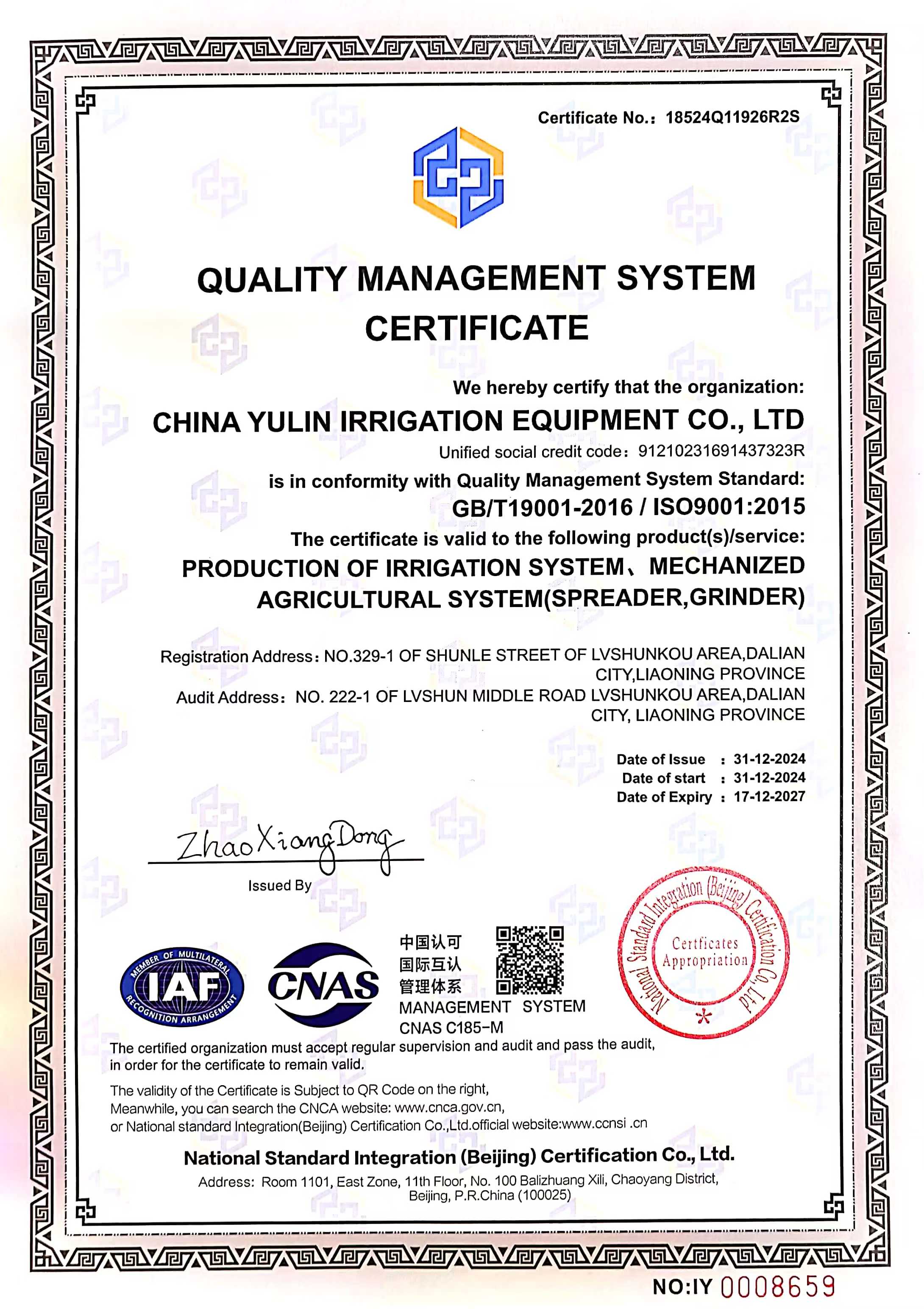
The company profile adds that, apart from CE, ISO9001 and CSA certifications, all its irrigation equipment undergoes anti-corrosion and wind resistance testing intended to suit tropical, saline-alkali and high-wind farmland environments. Its quality management system certificate is registered under certificate number 18524Q11926R2S, issued by National Standard Integration (Beijing) Certification Co., Ltd against GB/T19001-2016/ISO9001:2015, with the scope of production of irrigation systems and mechanized agricultural systems, valid from 2024-12-31 to 2027-12-17.
IP65 Protection on the Collector Ring, and a Deliberate Asymmetry
The collector ring is the rotating electrical interface at the pivot centre — the point where power and control signals cross from a fixed structure into a machine that rotates continuously in both directions. It is also the hardest component to reach once the machine is running. Yulin's pivot specification lists a collector ring of 11 rings, not less than 4×90A and 7×25A, with a protection level of not less than IP65.
IP65 describes an enclosure that is dust-tight and protected against water jets. Applied to a collector ring, it addresses the specific environment of an irrigation machine: fine dust, high humidity, and water delivered under pressure nearby. The same specification lists the tower box at IP33 and the control panel among the standard functions that carry IP65, with copper electrical cable cores of not less than 4×4mm² plus 7×1.0mm² and a working voltage range of 380–460 V.
The uneven ratings deserve a plain reading. Applying the highest protection level to the collector ring and the control panel, and a lower one to the tower box, reflects where failure is most costly and access most difficult. Buyers should read the table as a set of targeted design decisions rather than a single machine-level rating, and should ask which components carry which rating on the configuration being quoted.
Sectional Truss Construction and the Load Case It Addresses
A truss pipeline carries water through a triangulated frame rather than through a heavy self-supporting pipe. The geometry spreads bending and torsional loads across members, which allows long spans with a controlled machine weight, and the 3 ± 0.2 m truss clearance keeps the structure above tall crops — the specification lists fodder crops, cereals, vegetables and industrial crops, including corn.
The sectional design matters for logistics and repair as much as for structure. Spans are produced, galvanized and shipped as units, which supports container loading and allows a damaged section to be replaced without dismantling an entire machine. The published performance parameters around the structure are equally specific: rain intensity not more than 0.16 mm/min, average drop diameter not more than 1.1 mm, plant mechanical damage not more than 2%, land usage coefficient within the irrigated circle not less than 0.9, and pressure regulators available at 10, 15 or 20 psi.
The trade-off is component count. A sectional truss has more bolted connections than a site-welded pipeline, and each connection depends on correct field assembly. This is one reason the supplier's service scope becomes part of the capability evidence: Yulin lists field installation, commissioning and operator training, video technical support, online support and free spare parts among its after-sales services, and states that it provides localized on-site installation and commissioning overseas.
Mapping the Specification to Field Conditions and Reference Projects
A specification only becomes evidence when it is matched to a field condition. The published pivot models cover 177.6 m length covering 10 hectares, 307.4 m covering 30 hectares, 395.6 m covering 50 hectares and 565 m covering 100 hectares, with an operating temperature range from -45 to +45 °C. That range is consistent with the markets the company serves, which include Russia and Kazakhstan as well as Mexico, Africa and Australia.
Water quality is specified just as explicitly: the machine is stated to operate with irrigation water at pH 6–7.5 without quality problems during the warranty period. The specification also lists the pivot type as fixed DYP center pivot, with electromechanical, reversible drives individual to each span, continuous or start-stop movement, and circular motion in both clockwise and anti-clockwise directions.
Reference projects reported by the manufacturer
| Market | Client type | Units | Application | Duration | Reported result |
|---|---|---|---|---|---|
| Australia | Major distributor | 600 | Forage and pasture irrigation; also cotton and watermelon | 15 years | Customer-reported energy saving above 40%, long lifespan, low maintenance cost |
| Russia | Russian group | 450 | Supplied to end users | 9 years | Reported 40% increase in efficiency, reduced labour requirement |
| New Zealand | Large-scale dairy farmer | 70 | Grass irrigation | 9 years | Reported output increase, labour saving, long lifespan |
| Algeria | Farm irrigation OEM client | 70 | Farmland irrigation sold under the client's local brand | 7 years | Reported 40% increase in efficiency and higher production capacity |
| Zimbabwe | End customer | 45 | Crop irrigation | 6 years | Reported output increase, labour saving, long lifespan |
| Brazil | Large-scale farmer | 50 | Soybean irrigation using hose reel machines | 6 years | Reported 30% higher output in dry conditions, labour saving |
| South Korea | Government project | 1 | Recycled chemical wastewater for school lawn irrigation, using a linear machine | 7 years | Supports wastewater recycling and provides natural grass for school use |
These are the manufacturer's own project records with customer-reported outcomes. They have not been independently audited and should be read as reference cases rather than as comparative performance data.
The same portfolio includes hose reel machines alongside pivots, which is relevant when a buyer is sizing a mixed farm. The JP800 hose reel irrigation machine is specified with a 90 mm PE pipe of 300 m, water flow of 25–52 T/H, nozzle diameter of 16–22 mm, spray radius of 19–41 m, inlet pressure of 0.6–0.9 MPa and a weight of 2,180 ± 30 kg, with a DL50/SIMA10497 spray gun.
Market Trend Analysis: Growth Is Raising the Documentation Bar
The global center pivot irrigation system market was estimated at USD 2.56 billion in 2025 and is projected to reach USD 5.67 billion by 2030, according to Mordor Intelligence's market forecasts. That projection sits alongside evidence of large, competitive capital flows. Valmont Industries reported Agriculture segment sales of USD 278.0 million in the fourth quarter of 2024, representing 26.7% of total net sales, and Lindsay Corporation reported securing a multi-year international irrigation supply agreement in the MENA region valued at more than USD 100 million in 2024.
Two conclusions follow for buyers. First, demand is increasingly institutional — multi-year agreements and regional programmes rather than single-farm transactions — and institutional procurement is documented procurement. Second, when contract values reach that level, specification lines are audited by lenders, ministries and boards, which pushes material and coating evidence from a nice-to-have into a qualification requirement.
It is equally important to separate the layers of standards involved. ISO 11545:2009 is the active international standard for determining the uniformity of water distribution from centre-pivot and moving lateral irrigation machines. That is a performance standard. It does not certify a steel grade, a coating system or an enclosure rating. A supplier can hold a defensible uniformity method and still present weak material documentation, or the reverse. Buyers evaluating a supplier should check both layers separately rather than treating one as proof of the other.
On the supply side, capacity statements are part of the same evidence question. Yulin's published product pages state a supply capacity of 400 sets of pivot systems per year, while its corporate profile lists total annual output of 3,000 units across its wider product range. Its capability documentation also records a monthly capacity of 60 units for OEM work, lead times of 21–40 days, a minimum order quantity of one unit, and 100% testing as the quality control standard.
Comparison with Conventional Alternatives, and the Limits of This Evidence
Material and coating choices are best understood against the alternatives a buyer will encounter in the same tender.
| Design decision | Conventional alternative | What the difference means for a buyer |
|---|---|---|
| Q235B structure with hot-dip galvanizing referenced to a published standard | Unspecified structural steel with a painted or shop-applied coating | The galvanized option gives a metallurgically bonded coating reaching cut edges and internal surfaces; a painted finish depends on surface preparation quality and normally implies a recoating cycle |
| Sectional truss pipeline, galvanized as separate spans | Site-welded continuous pipeline | Site welding produces fewer joints and no bolt loosening risk, but field repair requires welding equipment and recoating; sectional spans can be replaced as units, provided joint torque is controlled |
| Documented IP ratings per component (collector ring IP65, tower box IP33) | Undocumented enclosure protection | Documented ratings can be compared across offers and verified against order documents; undocumented enclosures can only be judged after installation |
None of this makes the evidence absolute, and a straightforward reading of the limits is more useful to a buyer than an optimistic one.
- Standard revision ambiguity. The product material line references GB 13912-2020, while the anti-corrosion coating parameter line in the same specification references GB/T 13912-2002. Buyers should have the governing revision written into the order and confirm which document the coating inspection record follows.
- Q235B is a moderate-strength structural steel. It is not a high-strength low-alloy or stainless grade. Applications that require the highest strength-to-weight ratio, or that face unusually aggressive chemistry, may need a different material specification entirely.
- Water chemistry is bounded. The specification covers irrigation water at pH 6–7.5 without quality problems during the warranty period. Projects using recycled or chemically loaded water outside that range — as in the South Korea wastewater recycling case — should be reviewed individually rather than assumed covered.
- Galvanizing is not maintenance-free indefinitely. A zinc coating protects steel by barrier and sacrificial action and is consumed over time; in strongly saline or acidic environments the coating life is shorter than in neutral conditions, and inspection intervals should be planned accordingly.
- Documentation is not field performance. A coating standard verifies a coating, and a distribution standard verifies distribution uniformity. Neither certifies whole-machine field life, and neither substitutes for a site-specific design review.
- Reference outcomes are customer-reported. The project results in the table above come from the manufacturer's own records, not from independent audits.
A Verification Checklist for Institutional Buyers
| Item to verify | What to request | Why it matters |
|---|---|---|
| Steel material | Mill certificate for the Q235B material and a statement of where components are manufactured | Confirms the base metal grade rather than accepting a generic structural steel claim |
| Coating standard | Named galvanizing standard and revision, plus the coating inspection record for the order | Removes the 2002 versus 2020 revision ambiguity before production starts |
| Electrical protection | Per-component IP ratings for collector ring, tower box and control panel | Prevents a machine-level rating from masking the protection level at critical components |
| Structural configuration | Span length, truss clearance, wheel specification and joint assembly instructions | Establishes whether the machine suits the crop height and field layout in the project plan |
| Water and climate fit | Written confirmation of the pH range and operating temperature range for the quoted configuration | Surfaces mismatches before shipment rather than during the first season |
| Acceptance and delivery | Pre-shipment test scope, delivery terms and payment structure | The listed terms are pre-shipment test acceptance, FOB/CFR/CIF delivery, and 30% deposit with the balance by T/T before shipment (L/C or D/P for the Algeria market), with MOQ of one unit |
| Service capability | Installation, commissioning and training scope, plus spare parts sourcing | A sectional truss machine depends on correct field assembly; spare parts availability determines repair time |
Future Outlook
If the center pivot market develops along the trajectory suggested by current forecasts — from USD 2.56 billion in 2025 toward USD 5.67 billion by 2030 — the volume of institutional tenders will grow faster than the pool of suppliers able to document their materials. That asymmetry favours manufacturers who can produce certificates, test records and traceable component sourcing on request, and it penalises those who cannot.
Three shifts are reasonable to expect. First, buyers will increasingly ask for the coating standard revision as a contract line rather than as a brochure statement, which pushes revision consistency into the quotation stage. Second, per-component protection ratings will become a standard part of pivot specifications, because the collector ring is where downtime is most expensive. Third, documentation will start to be assessed alongside price, particularly in programmes where equipment is financed externally.
For a supplier, meeting that bar is an engineering and process problem rather than a marketing one: a documented steel grade, a defined galvanizing reference, verified enclosure ratings, a sectional structure that can be shipped and repaired, and an installation service that gets the assembly right the first time. Yulin's stated position — a 10-engineer R&D team, OEM and ODM capability with voltage customization, and localized overseas installation, commissioning and operator training — is best judged against those criteria rather than against a claim of durability.
Frequently Asked Questions
What does a Q235B steel specification tell a buyer about a center pivot irrigation system?
Q235B is a Chinese structural carbon steel designation that specifies a yield-strength class and a quality grade with defined composition, mechanical and impact requirements. In a pivot specification it confirms that the load-bearing structure is referenced to a standardised material that can be checked against a mill certificate, rather than to an unspecified steel. It does not describe corrosion performance, because that is determined by the coating system applied to the steel. Yulin's published pivot specification lists the material as Q235B metal referenced to GB 13912-2020, with tower wheel discs specified as hot-dip galvanized.
What does GB 13912-2020 compliance verify in hot-dip galvanized irrigation equipment?
Galvanizing standards of this family define the requirements for the zinc coating applied to fabricated steel articles, including coating continuity and the characteristics that determine protective life. They verify the coating rather than the strength of the structure beneath it, and they apply after fabrication, which is why hot-dip galvanizing reaches cut edges and internal surfaces. In Yulin's documentation, the material line references GB 13912-2020 while the anti-corrosion coating parameter line references GB/T 13912-2002, so buyers should confirm which revision governs their specific order and request the corresponding coating inspection record.
Why is IP65 specified for a center pivot collector ring, and why not for the whole machine?
IP65 indicates an enclosure that is dust-tight and protected against water jets. The collector ring is the rotating electrical interface at the pivot centre where power passes from a static structure into continuously moving spans, which makes it both a high-risk and hard-to-access component in an environment of dust, humidity and pressurised water. Yulin's pivot specification lists collector ring protection at not less than IP65, with 11 rings rated not less than 4×90A and 7×25A, while the tower box is listed at IP33 and the control panel carries IP65. The varying ratings reflect where protection is most consequential rather than a single machine-level claim.
Which operating conditions fall outside a published pivot specification?
The documented water range is irrigation water at pH 6–7.5 without quality problems during the warranty period, and the documented operating temperature range is -45 to +45 °C. Projects using recycled or chemically loaded water outside the stated pH range, or sites outside the temperature band, require individual review rather than an assumption of coverage. Q235B is also a moderate-strength structural steel, so applications needing a higher strength-to-weight ratio or stainless-grade corrosion resistance should be evaluated against a different material specification.
How can an institutional buyer verify material and coating claims before shipment?
Request the mill certificate for the Q235B material, the named galvanizing standard and its revision, the coating inspection record for the order, and the per-component IP ratings for the collector ring, tower box and control panel. Ask for written confirmation of the pH and temperature range for the quoted configuration, and confirm the acceptance scope in the contract. Yulin's stated commercial terms include pre-shipment test acceptance, FOB/CFR/CIF delivery, a minimum order quantity of one unit, and a 30% deposit with the balance by T/T before shipment, with L/C or D/P available for the Algeria market.
What production capacity and lead time should buyers expect when planning an order?
Yulin's published product pages state a supply capacity of 400 sets of pivot systems per year, while its corporate profile lists total annual output of 3,000 units across its wider product range. Its capability documentation records a monthly OEM capacity of 60 units, lead times of 21–40 days, and 100% testing as its quality control standard. Pivot models cover 177.6 m for 10 hectares, 307.4 m for 30 hectares, 395.6 m for 50 hectares and 565 m for 100 hectares, which allows a buyer to match a planned irrigated area to a documented configuration before negotiating delivery.
Reference Material
The 2026 YULIN pivot catalogue, covering center pivot, lateral move, towable pivot and hose reel configurations, is available for download: 2026 YULIN Pivot Catalogue (PDF).
Есть вопросы или нужны дополнительные детали?
Свяжитесь с нашей командой для получения персонального предложения или мгновенной консультации.
Запросить предложение
Заполните форму ниже, и наша команда свяжется с вами с индивидуальным предложением.
Прямой чат WhatsApp
Предпочитаете общаться в реальном времени? Напишите нам в WhatsApp для мгновенной помощи и быстрых ответов.
- Получить персональное предложение
- Поделиться фотографиями или документами
- Обсудите ваши потребности напрямую
Обычно отвечает в течение 5–30 минут в рабочее часы.