
Supplier Capability: From Distillation to Nitrogen Packaging
Supplier Capability: From Distillation to Nitrogen Packaging
A supplier's certificate scope can be read as a map of the process controls a buyer is entitled to examine. For refined fish oil, the map is unusually specific: the certified scope names distillation, blending and nitrogen packaging. That specificity matters because the product is an oxidizable oil, and because a bulk ingredient buyer must separate management-system evidence from grade-specific evidence. Zhejiang Norbidar Biomedicine Co., Ltd. (Norbidar) manufactures food-grade omega-3 fish oil concentrates in Zhejiang, China. Its portfolio includes EPA+DHA blended ethyl esters, EPA-rich and DHA-rich concentrates, and customized EPA/DHA profiles discussed against customer target specifications. A grade such as 3624 EE, an ethyl ester concentrate with a nominal 36/24 EPA/DHA profile, is evaluated by buyers as a bulk dietary supplement ingredient. This article traces the certified process steps and turns them into audit questions a buyer can use before accepting a bulk concentrate.
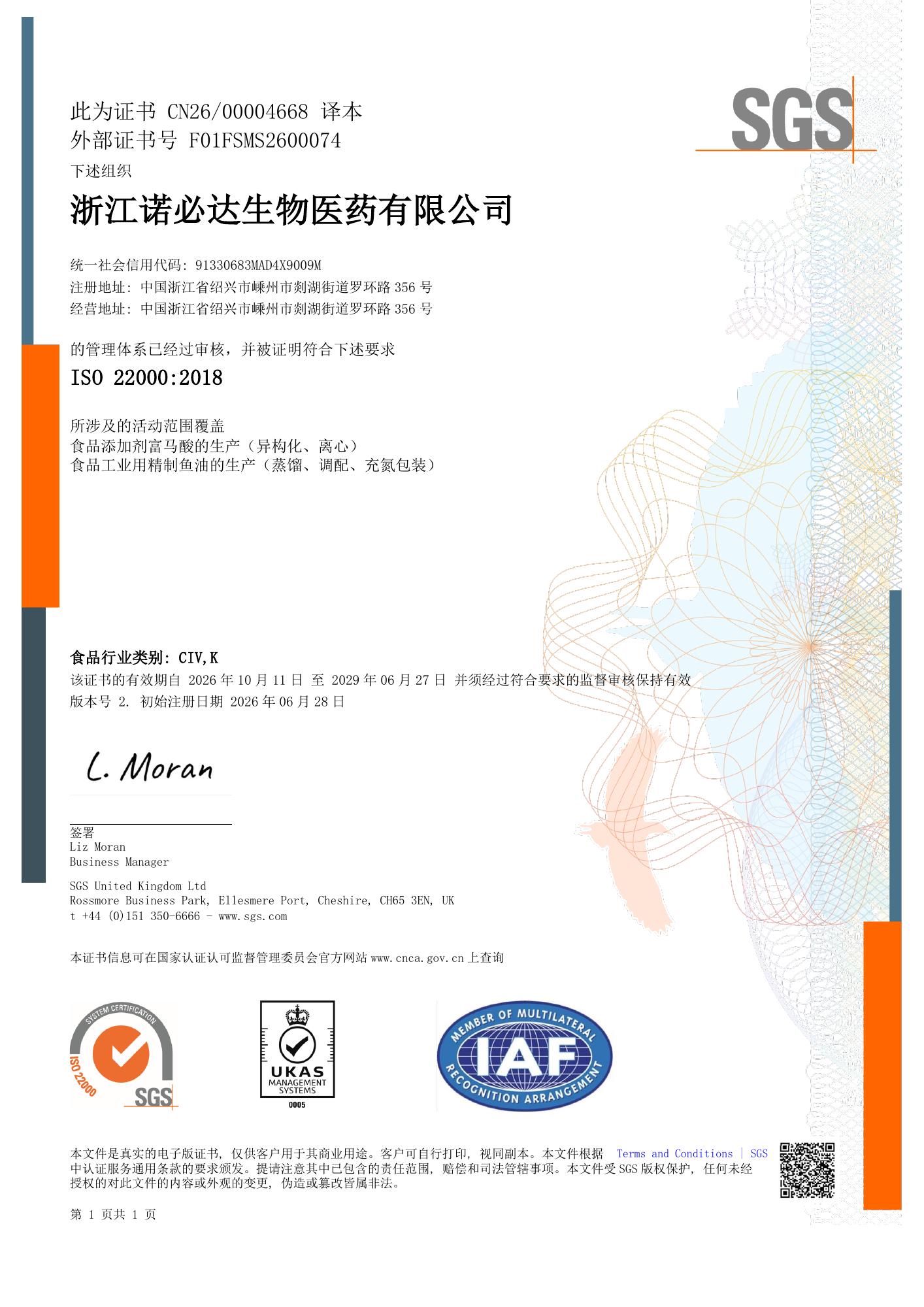
ISO 22000:2018 certificate CN26/00004668 lists production of refined fish oil for the food industry, including distillation, blending and nitrogen packaging, within its scope.
What the certificate scope actually covers
The relevant food-safety certificates are management-system certificates, not product registrations. ISO 22000:2018 certificate CN26/00004668, issued by SGS United Kingdom Ltd, covers production of refined fish oil for the food industry, including distillation, blending and nitrogen packaging, under categories CIV and K. It is valid from 2026-10-11 to 2029-06-27. FSSC 22000 certificate CN26/00004667 covers the same refined fish oil scope, with no exclusions listed, under ISO 22000:2018, ISO/TS 22002-1:2009 and FSSC 22000 Additional Requirements (Version 6). It is valid from 2026-10-16 to 2029-06-27. Both certificates state that the certified manufacturing site is in China and that the certificate is not a product registration or import authorization.
The FAMI-QS certificate CN26/00005166 is a feed safety and quality management system certificate for specialty feed ingredients; its scope does not list specific product names. It should not be substituted for the food-grade fish oil scope. HALAL certificate 501525000 lists refined fish oil in its product scope, subject to destination-country recognition and customer requirements. These distinctions matter because a buyer can easily over-read a certificate. The certificate says which management system and process scope have been certified at a site. It does not say that every grade in the portfolio has been approved for every destination, or that a specific batch meets a buyer's specification.
| Certificate | Relevant scope | Buyer boundary |
|---|---|---|
| ISO 22000:2018, CN26/00004668 | Production of refined fish oil for the food industry: distillation, blending, nitrogen packaging; categories CIV, K. | Management-system certification for the certified site; not a product registration or import authorization. |
| FSSC 22000, CN26/00004667 | Same refined fish oil scope; food chain categories CIV, K; no exclusions listed. | Supports supplier qualification; does not replace grade-specific specification and batch COA review. |
| FAMI-QS, CN26/00005166 | Production of specialty feed ingredients; processes: chemical and mixing; feed chain category K. | Feed safety certification; specific product names are not listed. Not a substitute for food-grade product approval. |
| HALAL, 501525000 | Refined fish oil is listed in the product scope. | Subject to destination-country recognition and customer requirements. |
Distillation: the concentration step a buyer should map
Distillation is the first named process step in the food-safety scope. In omega-3 concentrate manufacturing, distillation is a separation and concentration step that prepares refined oil for blending. The certificate scope confirms that distillation for refined fish oil is inside the audited food-safety management system at the certified site. It does not disclose operating temperatures, vacuum levels, throughput, yield or the number of passes. A buyer should therefore treat distillation as an audit topic, not as a certificate claim about performance. Norbidar describes a proprietary NBD multi-stage continuous distillation process supporting product development. The process name is useful context, but the auditable evidence remains the certificate scope, the batch documents and the change records.
The link to oxidative stability is practical rather than promotional. Distillation is a thermal separation step, and the way it is controlled, including contact with heat, oxygen and light, residence time, cleaning and batch segregation, can affect the condition of the oil that enters blending. The certificate does not state those control values. A buyer should ask how the process is controlled and verified rather than assume that the word distillation establishes a particular oxidation outcome. The same logic applies to consistency: if batch identity is not maintained from feedstock through distillation, the final COA cannot be reliably tied back to the process history.

Norbidar processing facilities. The certificate scope identifies the process steps under the food-safety management system; it does not disclose operating parameters such as distillation temperature or throughput.
Blending: where the nominal 36/24 profile becomes a specification
Blending is the step where the nominal EPA/DHA ratio is set to the agreed specification. The 3624 EE grade is described as an ethyl ester concentrate with a nominal 36/24 EPA/DHA profile. Grade codes indicate nominal content, while the current specification and batch COA govern supply. That distinction is central for buyers. A nominal ratio is a label for the grade, not a substitute for the agreed analytical limits. The buyer should ask how blend ratios are calculated and recorded, how homogeneity is verified, how carryover and cleaning between blends are controlled, how the batch COA connects to the blend record, and what happens if a batch misses the target. These are process questions, and they are exactly where a management-system certificate needs product-level documents beside it.
The GOED industry advisory on content expression is relevant here. GOED published guidance on how to correctly express EPA, DHA and total omega-3 fatty acid content in EPA/DHA-containing oils. It is industry guidance, not a government regulation. For a buyer, it supports a request for a clear analytical basis on the COA and specification: which fatty acids are being reported, on what basis, and how the total is calculated. The certificate scope does not answer that question. The specification and COA should. A buyer who compares a nominal grade code with a batch COA without checking the analytical basis is comparing two different kinds of information.
Nitrogen packaging: an oxygen-control step with a clear boundary
Nitrogen packaging is the third named process step. Its purpose is to limit oxygen contact during packaging and storage. Omega-3 oils are susceptible to oxidation, so oxygen control, light protection and temperature control are relevant to maintaining quality. The certificate scope confirms that nitrogen packaging of refined fish oil is within the audited management system. It does not state residual oxygen targets, headspace limits, seal-integrity methods or shelf-life. Buyers should ask for the packaging specification and the batch release criteria, and should verify that the packaging format matches their own downstream handling.
A nitrogen-flush claim should be treated as a process control to be verified, not as proof that every batch will have the same oxidation result after transport and storage. The certificate names the step; the packaging specification and batch records should define how the step is controlled. This is a fit boundary rather than a criticism. Nitrogen packaging can support oxidative stability only when the package remains intact and the storage conditions are appropriate. A buyer should connect the packaging question to the receiving, sampling and storage plan, not leave it in the supplier's certificate file.
Connecting process evidence to 3624 EE
The 3624 EE grade fits the portfolio described in the supplied content: food-grade omega-3 fish oil concentrates, EPA+DHA blended ethyl esters, EPA-rich and DHA-rich concentrates, and customized EPA/DHA profiles according to customer target specifications, supplied for dietary supplement and functional food formulation. ODM production covers bulk ingredient manufacturing with customized EPA/DHA profiles, subject to technical feasibility and agreed specifications. The audit logic is therefore a chain rather than a single document. The certificate scope establishes which process steps are within the audited system. The specification establishes which grade and limits the buyer is buying. The batch COA establishes what was tested on the batch. The SDS and packaging information establish handling conditions. No one document replaces the others.
For 3624 EE, the nominal 36/24 profile is the starting point for a specification discussion, not the end of acceptance. A buyer evaluating the grade as a bulk dietary supplement ingredient should confirm the ethyl ester form, the target EPA and DHA content on the agreed analytical basis, the oxidation and contaminant limits, the packaging format and the destination requirements before commercial supply. The process evidence from distillation, blending and nitrogen packaging is relevant because it explains where consistency is created. It does not remove the need for batch-level acceptance.
A buyer's process audit checklist
The following checklist turns the certified process scope into specific questions. It is not a substitute for a supplier audit procedure or a regulatory review. It is a way to keep certificate evidence, process evidence and batch evidence in the correct order.
| Audit area | Question to ask | Evidence to request | Why it matters |
|---|---|---|---|
| Site and scope | Which legal entity and site are covered for refined fish oil distillation, blending and nitrogen packaging? | Certificate and exact scope. | Prevents assuming that a corporate website or a different site is covered. |
| Grade identity | Is 3624 EE covered by the current specification, and what are the agreed EPA and DHA limits? | Current specification and grade description. | Grade codes are nominal; the specification defines acceptance. |
| Distillation control | How is the distillation step controlled, and how is batch identity maintained from feedstock to concentrate? | Process flow summary, batch records and traceability documents. | Connects the certified step to the batch history behind the COA. |
| Blending control | How are blend ratios calculated, recorded and verified for homogeneity? | Blend records and batch COA. | Ties the nominal 36/24 profile to the actual batch result. |
| Nitrogen packaging | What packaging format is used, and how is oxygen control verified? | Packaging specification and release criteria. | Connects the process step to oxidative stability during storage and transport. |
| Oxidation testing | Which oxidation tests are performed, and against which specification limits? | Batch COA and specification. | Provides batch-level evidence rather than a general process claim. |
| Contaminant screening | Which contaminant tests are performed, and what limits apply? | Batch COA, specification and SDS where relevant. | Adds product-safety evidence beyond management-system certification. |
| Traceability | How does the batch COA link to the production batch and packaging lot? | Traceability documents and lot identification. | Supports verification, complaint handling and recall readiness. |
| Custom profile | For a custom EPA/DHA ratio, how is feasibility assessed and where is the agreed specification recorded? | Written specification and feasibility confirmation. | ODM customization is subject to technical feasibility and agreed specifications. |
| Change control | How will process or specification changes be communicated before shipment? | Change-control procedure or notification agreement. | Protects consistency across repeat orders. |
| Certificate limits | Does the certificate cover the grade, or only the management system and process scope? | Certificate scope and product specification. | Prevents certificate-only acceptance of a bulk ingredient. |
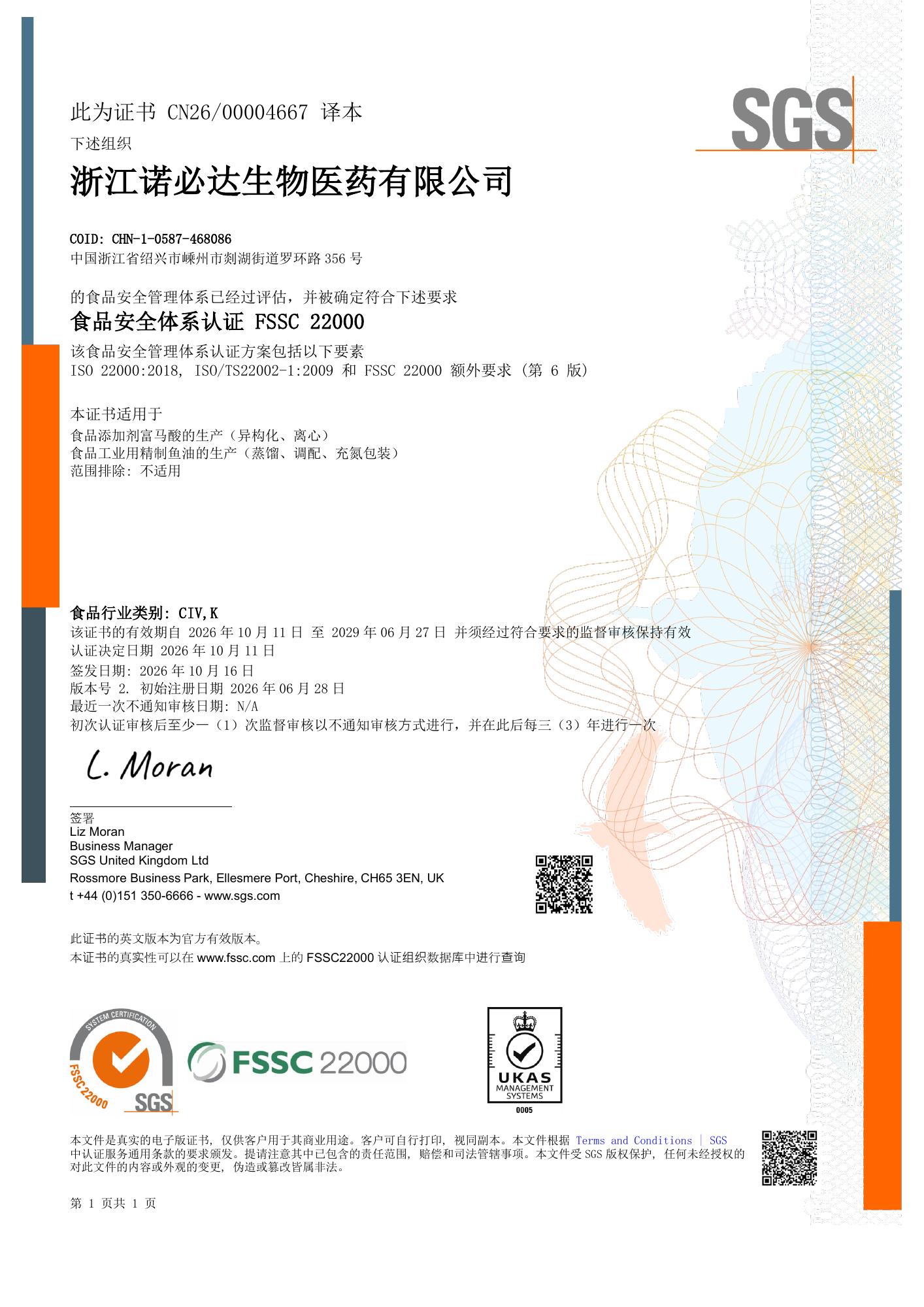
FSSC 22000 certificate CN26/00004667 lists refined fish oil production, including distillation, blending and nitrogen packaging, and states no exclusions.
Evidence boundaries: what a certificate does not prove
Three boundaries deserve emphasis. First, ISO 22000 and FSSC 22000 are management-system certifications. The certificates state that they are not product registrations or import authorizations. They support supplier qualification, but they do not by themselves establish that 3624 EE meets a buyer's specification. Second, the FAMI-QS certificate is a feed safety certificate. Its scope is specialty feed ingredients, and it does not list specific product names. It should not be presented as food-grade product approval. Third, the HALAL certificate lists refined fish oil, but halal recognition is destination-specific and subject to customer requirements. A buyer should confirm the exact scope and recognition needed for the target market.
A certificate-only approach asks whether the supplier has a food-safety system. A batch-level approach asks whether the specific grade, process step and packaging lot meet the agreed requirements. The second is not a criticism of certification. It is the appropriate use of certification. The certificate tells the buyer where to look; the specification and COA tell the buyer what was bought. This is also the difference between a process claim and an oxidative-stability outcome. The certified scope names nitrogen packaging, but the buyer still needs the packaging specification, the batch release criteria and a storage plan that keeps the package intact.
Market context and the limits of market data
Commercial research cited in the supplied evidence estimates the fish oil concentration and refinement market at USD 2.6 billion in 2025 and projects a 6.8% CAGR from 2026 to 2035, according to Future Market Insights. The same source reports that 51% to 80% EPA/DHA grades held 43.6% of concentration-grade sales in 2026. These are market-level estimates. They do not describe Norbidar's share, capacity utilization or batch performance, and they should not be used to infer a specific supplier's oxidative stability. Their practical value is narrower: they explain why buyers are asked to compare grades and process evidence in a crowded concentrate market.
The appropriate response is not to treat market growth as a quality claim. It is to keep the audit focused on the grade, the process step and the batch. A buyer who understands that distinction can use market data for category context without letting it substitute for supplier-specific evidence. The same discipline applies to the 3624 EE grade: the nominal 36/24 profile is meaningful only when it is tied to the current specification and a batch COA that the buyer has reviewed.
What to watch in the next supplier conversation
The useful outlook for buyers is a documentation outlook. As concentrate grades become more numerous, the supplier conversation is likely to move from a single certificate question to a chain of evidence: which site, which process step, which grade, which batch and which packaging lot. That chain does not require a new claim about any supplier's performance. It requires the buyer to keep four questions separate. Is the management system certified? Is the process step within the scope? Is the grade within the specification? Does the batch COA meet the agreed limits?
A supplier that can answer those questions clearly is easier to audit, but the answers still need to be checked against the documents. For Norbidar, the supplied certificates support the first question for refined fish oil production at the certified site. The 3624 EE grade, the current specification and the batch COA support the later questions. The process steps named in the scope, distillation, blending and nitrogen packaging, give the buyer a practical route through the audit rather than a promotional summary.
FAQ
What does the ISO 22000 scope say about refined fish oil?
ISO 22000:2018 certificate CN26/00004668 covers production of refined fish oil for the food industry, including distillation, blending and nitrogen packaging, at the certified manufacturing site in China. It is a food-safety management-system certificate, not a product registration or import authorization. The certificate is valid from 2026-10-11 to 2029-06-27. Buyers should still review the current specification and batch COA for the specific grade.
Does the certificate list 3624 EE?
The supplied ISO 22000 and FSSC 22000 scopes describe refined fish oil production and the named process steps, but they do not list every product grade. The grade should be confirmed in the current specification and batch COA. The 3624 EE grade is described as an ethyl ester concentrate with a nominal 36/24 EPA/DHA profile; nominal grade codes do not replace the agreed specification.
Why is nitrogen packaging relevant to oxidative stability?
Nitrogen packaging limits oxygen contact, and oxygen is one factor that can promote oxidation in omega-3 oils. The certificate scope confirms that nitrogen packaging is within the audited process for refined fish oil. It does not state residual oxygen targets or shelf-life. Buyers should ask for the packaging specification, release criteria and storage conditions, then verify them against the batch documents.
What documents should a buyer request before accepting a bulk omega-3 concentrate?
A practical set includes the current specification, batch COA, SDS, certificate and exact scope, packaging specification and traceability information linking the batch to the production and packaging lot. For custom EPA/DHA profiles, the written agreed specification should record the target profile and acceptance criteria. These documents support different parts of the decision and should not be treated as interchangeable.
Can Norbidar customize EPA/DHA profiles?
Norbidar's supplied content states that customized EPA/DHA profiles are available according to customer target specifications, and ODM production covers bulk ingredient manufacturing with customized profiles subject to technical feasibility and agreed specifications. A buyer should confirm feasibility, the exact specification, quantity, packaging and delivery terms in writing before ordering.
Company identity and current contact details are available at Zhejiang Norbidar Biomedicine Co., Ltd.. The Norbidar omega-3 brochure can be downloaded at this brochure link.
Есть вопросы или нужны дополнительные детали?
Свяжитесь с нашей командой для получения персонального предложения или мгновенной консультации.
Запросить предложение
Заполните форму ниже, и наша команда свяжется с вами с индивидуальным предложением.
Прямой чат WhatsApp
Предпочитаете общаться в реальном времени? Напишите нам в WhatsApp для мгновенной помощи и быстрых ответов.
- Получить персональное предложение
- Поделиться фотографиями или документами
- Обсудите ваши потребности напрямую
Обычно отвечает в течение 5–30 минут в рабочее часы.