
Supplier Continuity for Glass Jar Programs: H19, H21, HDV
Protective packaging programs rarely fail at the sample stage. They fail in month fourteen, when an approved 0.38 mm jar arrives with different thread engagement, when a child-resistant closure that passed the first shipment now comes from a different tool, or when a buyer learns that the capacity figure behind a quotation was never specific to the jar family carrying most of the volume.
That pattern is why long-term supplier evaluation in protective packaging has shifted from price comparison to continuity assessment: a documented ability to hold the same specification, the same output rate and the same acceptance standard across an entire jar program. Honor Packaging (NINGBO HONOR PACKAGING CO.,LTD) is a Ningbo, China-based glass and plastic packaging manufacturer founded in 2015 that supplies child-resistant packaging, violet glass packaging and vacuum packaging, with 100 percent of sales exported and the EU and USA as its stated main markets.
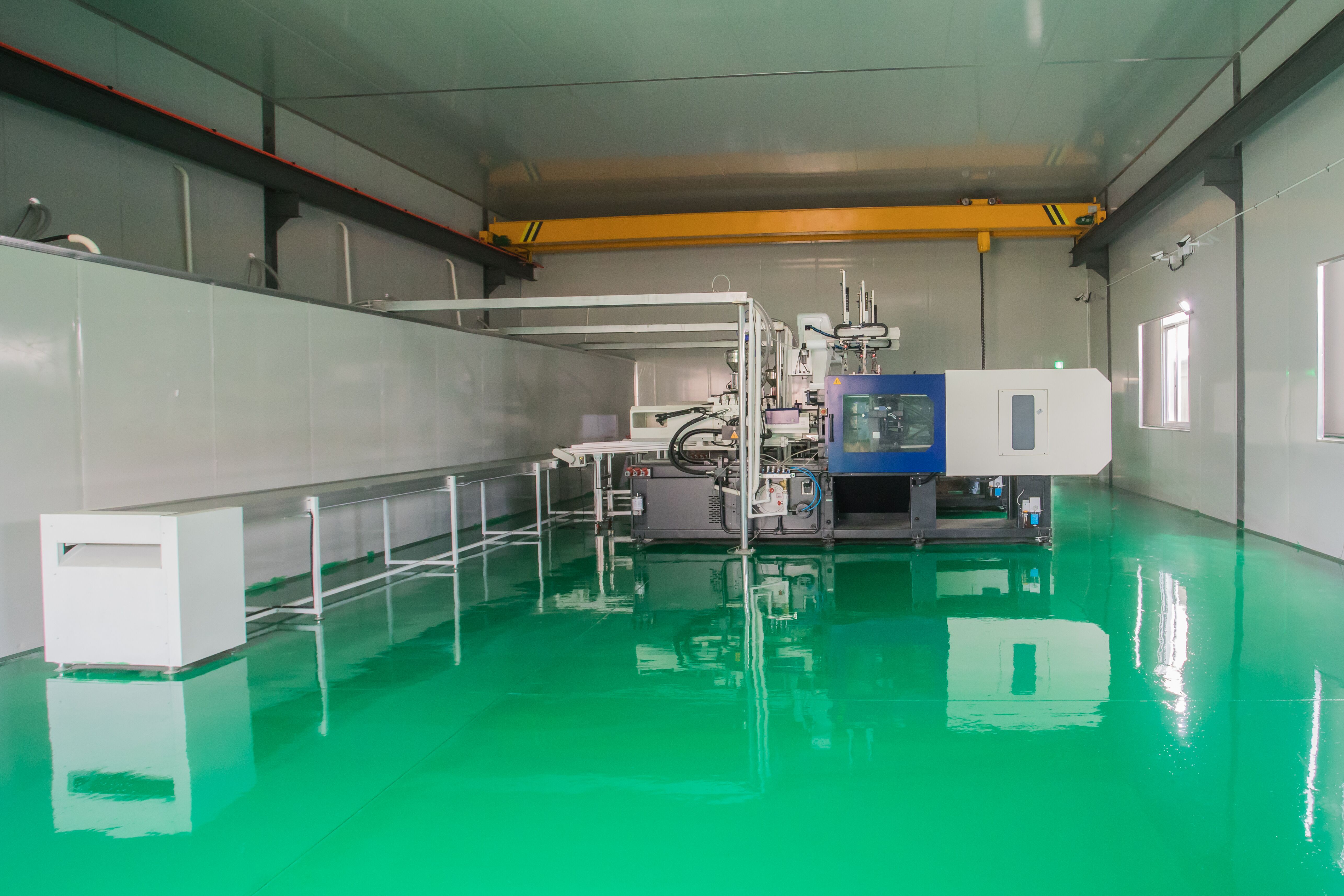
Production environment mattering more than a single quotation: continuity depends on tooling, process control and repeatable acceptance standards.
Why the Category Rewards Continuity Over Unit Price
Protective packaging is a large and compliance-shaped category. Grand View Research values the global protective packaging market at USD 41.5 billion in 2026, while Global Market Insights projects the child-resistant packaging segment at USD 31.07 billion in 2026. Both figures are published research estimates rather than audited trade data, but they describe a market where demand is driven less by novelty than by repeatable specification.
The regulatory layer explains why. Under the U.S. Consumer Product Safety Commission guidance, regulations issued under the Poison Prevention Packaging Act (PPPA) and the Federal Insecticide, Fungicide, and Rodenticide Act (FIFRA) require special packaging for many regulated products, and that requirement applies to the primary or immediate packaging. The ASTM D3475 voluntary standard classifies special packaging types by closure type and the action needed to open, while ISO 8317:2015 sets performance requirements and test methods for reclosable child-resistant packages and ISO 14375:2018 does the same for non-reclosable formats. CPSC test protocols under 16 CFR 1700.20 are built around an 85 percent child-resistance and 90 percent adult-accessibility outcome.
The practical consequence for a buyer is straightforward: compliance attaches to a container-and-closure combination, not to a jar in isolation. Change the jar, the thread or the closure supplier and the validation work starts again. That is the real cost of switching, and it is the reason continuity deserves its own evaluation step before a purchase order is issued.
The Program Architecture: Five Jar Families and What They Hold Constant
A supplier can only sustain what it has actually standardized. In the Honor Packaging range, continuity signals sit in a small number of documented jar and bottle families that share wall thickness, thread conventions and a common surface-treatment menu, so a single program can be built across several capacities without re-qualifying decoration and capping for each size.
| Family | Type | Documented capacity | Key dimensions | Wall thickness | Thread / closure |
|---|---|---|---|---|---|
| HDV1 | Wide-mouth violet jars | 100 ml, 150 ml, 200 ml, 250 ml, 300 ml, 500 ml, 1 L | Diameter 48–95 mm; height 84.7–193 mm; weight 117–610 g | 0.38 mm | 41/400 to 89/400; child-resistant variant HDV1100M-1-CR |
| HDV2 | Cosmetic violet jars | 3 ml, 5 ml, 10 ml, 30 ml, 50 ml, 60 ml, 100 ml, 200 ml | Diameter 36–93.2 mm; height 25.6–55 mm; weight 36–205 g | 0.38 mm | 32/400 to 89/400; child-resistant variant HDV2005M-CR |
| HDV3 | Round violet glass essential oil bottles | 5 ml, 10 ml, 15 ml, 20 ml, 30 ml, 50 ml, 60 ml, 100 ml | Height 54.5–125 mm; weight 22.5–120 g | 0.38 mm | Plastic cap, dropper, mist sprayer, lotion pump |
| H21 round | Round violet glass jars | 30 ml, 2 oz, 20 dr, 30 dr, 40 dr, 60 dr, 6 oz | Diameter 60 mm; height 36.5–125 mm; weight 84–268 g | 0.38 mm | Child-resistant cap |
| H21 square | Square violet glass jars | 15 ml, 30 ml, 20 dr, 30 dr, 40 dr, 60 dr | Diameter 58 mm; height 24–115 mm; weight 75–280 g | 0.38 mm | Child-resistant cap |
| H19 | Vacuum click jar | 5 ml | Square glass; 250 pcs per carton | Not stated in the available specification set | Vacuum click closure |
Specifications as documented by the manufacturer across the HDV1, HDV2, HDV3, H21 and H19 families.
Three structural features make this architecture useful for a multi-year program. First, diameters are fixed within a shape family: H21 round jars sit at 60 mm and H21 square jars at 58 mm, which means a filling line can be tooled once and then run multiple heights and volumes. Second, thread specifications are expressed in standard terms (41/400, 32/400 and 89/400 across the violet families), so closure sourcing is not locked to a single mould. Third, surface treatments are offered as a shared menu rather than a per-model exception, allowing a brand to apply one decoration approach across jars and bottles in the same program.
Reading the 0.38 mm Specification Correctly
Wall thickness is the specification buyers quote most often and verify least often. In this range, 0.38 mm is documented for HDV1, HDV2, HDV3 and both H21 families. It is not stated for the H19 vacuum click jar in the available specification set. Assuming otherwise is exactly the kind of gap that surfaces during first-article inspection rather than during quotation.
Closure and contact materials are declared per family rather than universally: HDV1 lists violet glass, urea, PE, SAN and ABS; HDV2 lists violet glass, urea and PE; HDV3 lists violet glass and PP; H21 lists violet glass, PP and PE. Because a single family can carry several closure types — an HDV3 bottle may ship with a plastic cap, a dropper, a mist sprayer or a lotion pump — the material declaration should be resolved at SKU level, not at family level.
Surface treatment follows the same logic. HDV1, HDV2 and both H21 families offer stickers, silk-screen printing, heat transfer printing, hot stamping and frosted finishes; HDV3 lists labels, silk-screen printing and gold stamping. A buyer moving a label from a 30 ml jar to a 100 ml bottle inside the same family is reusing a qualified decoration process, which is a genuine continuity gain. A buyer moving between families is not.
Capacity, Lead Time and MOQ: Can Output Follow Demand?
Continuity is a rate question before it is a quality question. Honor Packaging reports a monthly production capacity of 100,000 units, a minimum order quantity of 10,000 units and a typical lead time of 30–45 days. Its company profile also reports annual output of 1,000,000 units, a 45,000 m² facility, 310 employees and a 15-person R&D team.
Those two capacity figures are stated on different time bases — monthly capacity and annual output — and the available material does not say whether either is line-specific or total. That is not a criticism; it is a question a buyer should ask in writing during evaluation, because the answer determines concentration risk. A program consuming 10,000 units a month against a stated 100,000-unit monthly capacity is a different risk profile from a program consuming 80,000 units a month against the same figure.
Two further signals support a long-term reading. The company describes operating through long-term joint-venture production bases for plastic and glass packaging rather than through spot allocation, and it positions itself as a manufacturing-responsibility-focused partner that takes part in structural development, tooling strategy and manufacturing risk assessment before mass production, then carries process control and order fulfilment during production. For a buyer, that means the pre-production phase is where specification drift is either prevented or locked in.
Purchasing Terms and Acceptance Criteria as Continuity Tests
Commercial terms are often read as negotiation outcomes. In a multi-year program they function better as continuity evidence, because they reveal how a supplier expects to control output.
| Term | Documented position | What it means for a long-term program |
|---|---|---|
| Minimum order quantity | 10,000 units | Sets a floor for launch volumes and for trial runs; artwork changes consume the same MOQ |
| Lead time | 30–45 days | Leaves limited slack for late specification changes and re-inspection cycles |
| Monthly capacity | 100,000 units | Defines the share of output a single program would occupy |
| Quality control | 100% pre-shipment testing; third-party inspection by SGS | An outgoing-gate control rather than an in-process statistical control |
| Acceptance criteria | Pre-shipment test | Effective only if the inspection plan, sampling basis and retained samples are defined in advance |
| Delivery terms | FOB | Buyer assumes freight, insurance and transit risk after loading |
| Payment terms | 30% down payment before production; 70% before shipment | Cash is fully committed before the buyer has physical access to the goods |
| After-sales | Accept to reissue | A remedy for defects, but not a substitute for an agreed inspection protocol |
The combination of 100 percent pre-shipment testing, third-party SGS inspection and pre-shipment-based acceptance criteria gives a buyer a workable structure — provided the buyer specifies what pre-shipment testing actually covers. Three items belong in the quality agreement: the sampling basis and defect classification, the retention period for reference samples from each production run, and who bears the cost of third-party inspection when a lot is rejected. Without those, acceptance language describes a moment in time rather than a standard.
The payment structure deserves the same treatment. With 70 percent due before shipment and a 30–45 day lead time, the buyer carries an exposure window in which a specification dispute is commercially awkward to resolve. Sequencing third-party inspection results before the balance payment is a reasonable request in a long-term program, and it is the kind of item that should be settled during evaluation rather than during the first dispute.
Certificates: Verify the Scope, Not the Logo
Certification is where optimism most often replaces verification. The available records show an EU certificate issued by SGS with the number NGBHL24007770101 against EC No 1935/2004, dated 27 December 2025, with a European scope, and a US FDA certificate issued by SGS with the number NGBHL23005693401 against FDA CPG, dated 30 November 2023, covering food, cosmetic and medical scope.
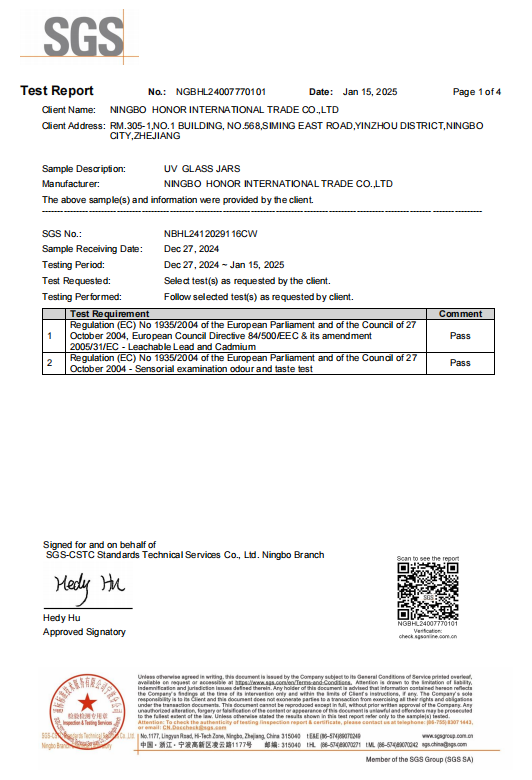
A certificate is a record of a scope at a point in time. Its value depends on whether your model code appears inside that scope.
What matters is the linkage. The EU record is associated with the HDV1, HDV2 and HDV3 violet glass families and both H21 round and square jars. The FDA record is associated with those same families plus the H19 vacuum jar. A buyer sourcing a model outside that list — or a new size added to a listed family — should not assume coverage transfers automatically.
Three verification habits are worth building into the evaluation file. Confirm that the certificate names the exact model code you are purchasing rather than only the family, since codes such as H21-0005V and HDV2030M sit inside the same family but are distinct items. Confirm current validity and scope wording directly with the issuing body rather than relying on a copy in a sales folder, because certificates are point-in-time records and are periodically reissued. And treat certification as a materials-compliance statement rather than a performance guarantee: the available documentation does not include transmission or optical performance test data for violet glass, so buyers whose products depend on light-blocking behaviour should request measurement data separately and validate it against their own shelf-life testing.
Where the Program Model Has Boundaries
A continuity-based sourcing model is not universally better than flexible spot purchasing. It performs well when volumes are predictable and specification stability matters; it performs poorly when volumes are small, designs change frequently, or the required format falls outside the supplier's standardized families.
| Approach | Continuity strength | Where it breaks down |
|---|---|---|
| Spot purchasing per order | Maximum price flexibility and no volume commitment | Specification and tooling are re-established each cycle; no retained reference samples; validation cannot be reused |
| Single-source program with a family-based supplier | Shared wall thickness, fixed diameters, common surface-treatment menu and repeatable acceptance protocol | MOQ of 10,000 units and 30–45 day lead times penalize small or fast-changing programs; balance payment before shipment increases buyer exposure |
| Dual-source split by family | Insulates the program from a single production base | Duplicates validation for child-resistant closures and doubles the acceptance workload; decoration consistency across two sources must be re-proven |
Specific limits in this case are worth stating plainly rather than leaving to discovery. Not every capacity exists in every family: the H19 vacuum click jar is documented at 5 ml only in the available specification set, so it cannot be treated as a general-purpose size substitute for the H21 or HDV ranges. Wall thickness of 0.38 mm is documented for the violet families but not for H19. Optical performance data for violet glass is not part of the available documentation. Certificates are model-linked rather than portfolio-wide. And the commercial terms — a 10,000-unit MOQ, FOB delivery, and full payment before shipment — place working-capital and transit risk on the buyer, which matters most for first-year programs that have not yet stabilized their demand forecast.
Application Signals: What a Three-Year Program Looks Like
The clearest continuity evidence in the available material is a German branding business running pharmaceutical packaging across a three-year duration at 10,000 units, with reported results that the contents remained fresh over that period and with reusable packaging and UV protection cited as the programme highlights. What makes the case relevant is not the volume but the shape of it: the same specification was reordered across multiple production cycles, which is precisely the condition that exposes specification drift.
The same evaluation logic applies across the ranges the manufacturer lists for its violet glass families — food and beverage, cosmetics and daily chemicals, pharmaceutical and medical, supplements, cannabis, and packaging wholesale. A supplements brand standardizing on H21 round jars with child-resistant caps is buying both a barrier format and a compliance format. A cosmetics brand moving between HDV2 jars and HDV3 bottles with droppers or sprayers is buying a shared decoration process. A food storage line using HDV1 wide-mouth jars in 500 ml and 1 L is buying a fixed 48–95 mm diameter band that a filling line can be set against once.
The export profile reinforces the reading. With 100 percent of sales exported and stated markets in the EU, USA, Middle East and Southeast Asia, the supplier's order-fulfilment discipline is exercised across regulatory environments rather than a single domestic standard — which is also why buyers should verify certificate scope against their own destination market rather than assuming portability.
Future Outlook
Three developments are likely to shape how protective packaging programs are sourced over the next several years. First, compliance continues to formalize around the container-and-closure system: PPPA and FIFRA obligations attach to primary packaging, ASTM D3475 classifies by closure type, and ISO 8317 and ISO 14375 define test methods for reclosable and non-reclosable formats respectively. Buyers will increasingly qualify the pair rather than the part.
Second, category scale supports multi-year contracting. With protective packaging estimated at USD 41.5 billion and child-resistant packaging projected at USD 31.07 billion in 2026, and with the U.S. smell-proof bag segment estimated at USD 133.7 million in 2026 growing at a reported 7.9 percent CAGR through 2033, the commercial case for securing stable supply ahead of demand is stronger than the case for chasing per-unit price each season.
Third, evaluation itself is becoming more evidence-based. Requests for line-level rather than company-level capacity, model-code-level rather than family-level certificate scope, and measured rather than claimed optical performance are becoming normal in supplier questionnaires. Suppliers that can document those three items will be easier to keep in a program; suppliers that cannot will be easier to replace.
Frequently Asked Questions
How can a buyer test whether a glass jar supplier can sustain output for a full program?
Ask for capacity to be stated on a defined basis — per model family, per line, or total — and reconcile it against your own forecast. Honor Packaging reports a monthly capacity of 100,000 units and an annual output of 1,000,000 units, which are different time bases and are not identified as line-specific in the available material. Then request the acceptance protocol, the retention period for reference samples, and one documented multi-year program to confirm the specification was held across reorders.
What capacities and dimensions are documented across H19, H21 and the HDV families?
HDV1 wide-mouth violet jars run from 100 ml to 1 L with diameters of 48–95 mm and heights of 84.7–193 mm. HDV2 cosmetic violet jars run from 3 ml to 200 ml at 36–93.2 mm diameter. HDV3 round violet bottles run from 5 ml to 100 ml with heights of 54.5–125 mm. H21 round jars cover 30 ml to 6 oz at a fixed 60 mm diameter, and H21 square jars cover 15 ml to 60 dr at a fixed 58 mm diameter. The H19 vacuum click jar is documented at 5 ml in square glass, packed 250 pieces per carton.
Is 0.38 mm glass thickness standard across every model in the range?
No. A thickness of 0.38 mm is documented for the HDV1, HDV2 and HDV3 violet glass families and for both the H21 round and H21 square jars. The available specification set for the H19 vacuum click jar does not state a wall thickness, so that value should be confirmed in writing before a drawing is approved rather than assumed from the rest of the range.
What are the purchasing terms and acceptance criteria?
The documented terms are a minimum order quantity of 10,000 units, FOB delivery terms, and payment structured as a 30 percent down payment with production arranged on receipt, followed by the remaining 70 percent before shipment. Acceptance is based on pre-shipment testing, supported by 100 percent pre-shipment testing of orders and third-party inspection by SGS. After-sales support is stated as acceptance to reissue. Buyers should define sampling basis, defect classification and inspection cost allocation to make those terms operational.
Which certifications apply, and how should their scope be checked?
Two records are available: an EU certificate issued by SGS under number NGBHL24007770101 against EC No 1935/2004, dated 27 December 2025 with a European scope, and a US FDA certificate issued by SGS under number NGBHL23005693401 against FDA CPG, dated 30 November 2023 with a food, cosmetic and medical scope. The EU record is associated with the HDV1, HDV2, HDV3 and H21 families; the FDA record additionally covers the H19 vacuum jar. Scope should be confirmed at exact model-code level and current validity verified with the issuing body.
What can this supplier not currently evidence?
The available documentation does not include optical transmission or light-blocking measurement data for violet glass, a stated wall thickness for the H19 vacuum click jar, or capacity figures identified as line-specific. Certificates are recorded at family level and are point-in-time documents rather than performance guarantees. A buyer whose application depends on measurable light protection or on a size outside the documented capacity ranges should plan additional verification rather than infer performance from the product family name.
A downloadable specification brochure covering the jar and bottle families, dimensions and surface treatments is available here: Honor Packaging specification brochure (PDF).
Есть вопросы или нужны дополнительные детали?
Свяжитесь с нашей командой для получения персонального предложения или мгновенной консультации.
Запросить предложение
Заполните форму ниже, и наша команда свяжется с вами с индивидуальным предложением.
Прямой чат WhatsApp
Предпочитаете общаться в реальном времени? Напишите нам в WhatsApp для мгновенной помощи и быстрых ответов.
- Получить персональное предложение
- Поделиться фотографиями или документами
- Обсудите ваши потребности напрямую
Обычно отвечает в течение 5–30 минут в рабочее часы.