
Supplier Evidence File: Verify a Sprinkler Maker Before Ordering
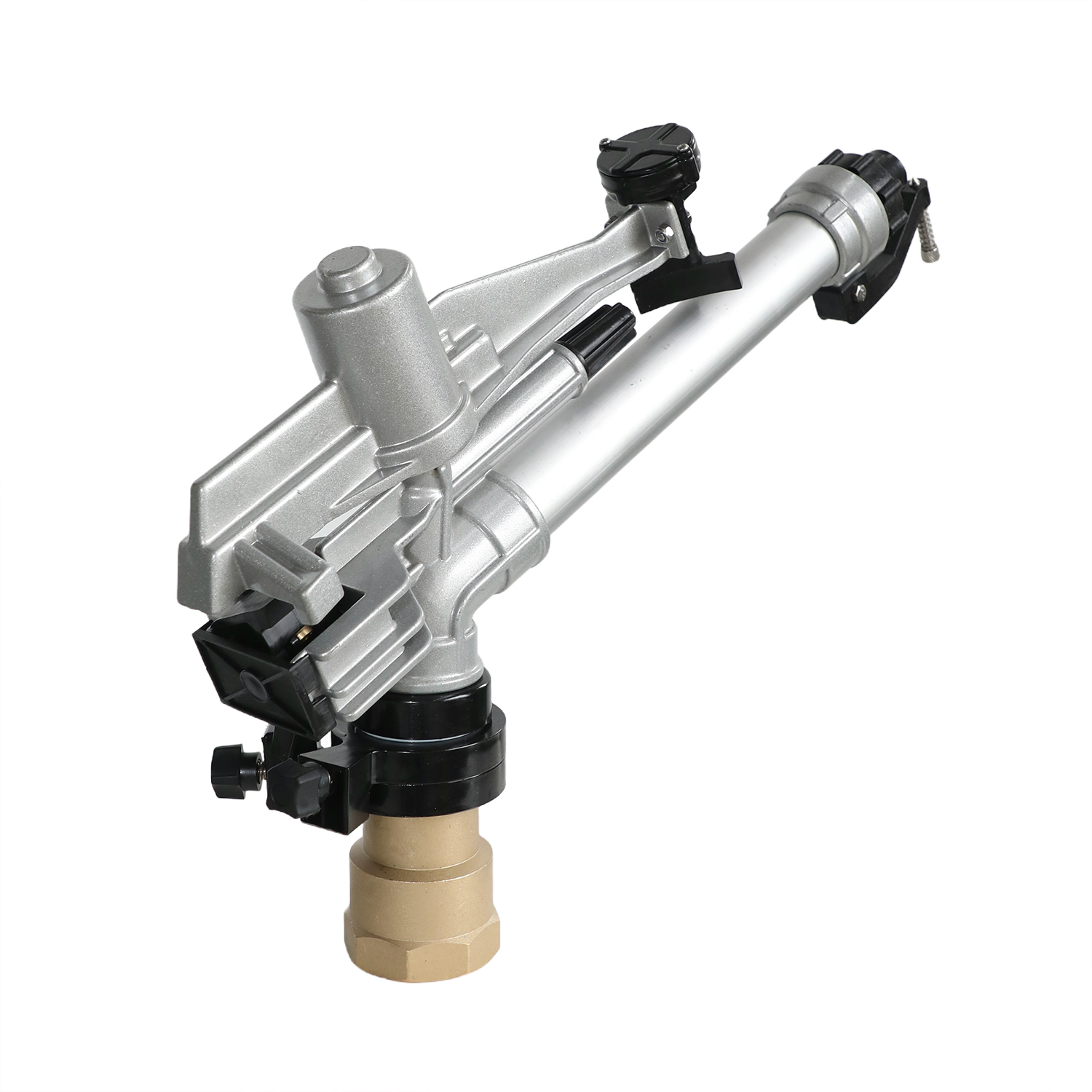
A model-level data sheet, such as the one published for the FS40 irrigation sprinkler, is the smallest verifiable unit in a supplier evidence file.
A supplier evidence file is a compact, ordered set of records that a buyer assembles before an order is placed, and it answers a narrower question than a capability brochure: can each claim in a quotation be traced to a document, a person, a site, a certificate or a published data sheet? Once that question has an answer, price negotiation and sample approval rest on a defined baseline instead of an impression.
In sprinkler procurement — rain guns, impact sprinklers, turbine guns, rotating sprinklers and complete irrigation machines — the common failure is rarely an absent factory. It is a specification mismatch: the quoted model, nozzle, working pressure, connection size or material does not match what arrives, or the delivered unit is a variant of the model that was evaluated. An evidence file closes that gap by fixing the specification baseline before commercial terms are agreed.
This reference sets out a six-layer evidence file and uses FOISON Sprinkler (Xuzhou Foison Sprinkler Irrigation Equipment Co., Ltd), a sprinkler manufacturer based in Xuzhou, Jiangsu Province, China, as a worked example of what traceable supplier facts look like. Every FOISON figure below is taken from the company's published facility, product and certification records; where a claim is supplier-reported, it is identified as such.
Why sprinkler sourcing needs a file rather than a brochure
The category is large enough that documentation quality has become a practical differentiator. Grand View Research valued the global sprinkler irrigation market at USD 3.04 billion in 2025, while IMARC Group put the narrower smart irrigation market at USD 2.2 billion in 2025 and projected USD 6.2 billion by 2034. Grand View Research also reported that Asia Pacific held the largest revenue share of 36.2% in the agricultural irrigation machinery market in 2025, with China as a leading country.
Published growth rates disagree. One projection cited for sprinkler irrigation is 6.5% CAGR for 2026–2033, while another source reports 3.04% for 2025–2035; the divergence reflects how broadly the term "smart" is applied rather than a dispute about units shipped. That is itself a lesson for buyers: an industry figure is only meaningful when its definition and method are attached. The same discipline should apply to a supplier's claims.
Trade classification offers a neutral starting point. HS Code 842482, per the United Nations Statistics Division, covers mechanical appliances for agricultural or horticultural use for projecting, dispersing or spraying liquids. When the invoice, packing list and product description all align with that classification, customs documentation becomes one more item that can be checked rather than assumed.
The six layers of a supplier evidence file
A workable evidence file is short. Each layer should be answerable with one or two documents, and each layer should state what it does not establish, because that boundary determines what still has to be tested.
| Layer | Evidence to request | What it establishes | What it does not establish |
|---|---|---|---|
| 1. Entity and site | Registered name, address, founding year, site area | That a legal entity operates at a stated location | Output capability of that site |
| 2. People | Total headcount, engineering headcount, named technical contact | Depth of technical staffing | Individual engineer qualifications |
| 3. Design and IP | Statement of in-house development, patent list, customization scope | Whether designs originate in-house | Performance of any specific model |
| 4. Production and QC | Annual output, monthly capacity, test regime, lead time, MOQ | Repeatability and scheduling discipline | Field reliability across seasons |
| 5. Certification | Certificate number, issuer, standard, scope, validity dates, covered models | Management system coverage | Product-level performance conformity |
| 6. Product data | Model-level pressure, flow, radius, connection, material | A specification baseline for comparison | Delivered performance without a test |
| 7. Channels | Business email domain, telephone, catalog file, named contact | Traceability of the communication trail | Commercial terms or financial standing |
Layer 1 — identity, location and site
The first layer fixes who the counterparty is and where production happens, because these two facts drive inspection logistics, shipping ports and documentary consistency later in the order. For FOISON Sprinkler, the registered operating name is Xuzhou Foison Sprinkler Irrigation Equipment Co., Ltd, founded in 2013, with its site at Pei County Industry Area, Xuzhou City, Jiangsu Province, China 221622. The company reports a site area of about 30,000 m² and describes Xuzhou as an irrigation manufacturing base.
Product scope at entity level is also checkable. FOISON lists its main products as sprinklers for farm and industrial use, reports an export ratio of 70%, and names its markets as the EU, Africa, Australia, New Zealand, South East Asia, Mid Asia, Mid East and South America. The company states that products are exported to more than 30 countries and regions.
A buyer should record these as declared facts, not verified ones. The verification step is a mismatch check: does the address on the quotation, the proforma invoice, the certificate and the catalog match each other, and does the declared product scope cover the model being purchased? A sprinkler maker declaring farm and industrial sprinklers across eight regions is consistent with the range discussed below; a declared scope that excludes the quoted model is a warning sign regardless of site size.
Layer 2 — people, design ownership and intellectual property
Headcount alone says little, but the ratio between engineering staff and total staff tells a buyer who is likely to answer a technical question and whether the design is genuinely in-house. FOISON reports 135 employees, of whom 12 are engineers.
On design ownership, the company states that its products are developed by its own team and that it holds patents covering turbine spray gun design, adjustable nozzle angle and adjustable speed. It also states that it can design an irrigation system to a customer's requirement. Those statements sit at the level of a first-party claim, and their practical value is that they define what to ask next: for the specific model under consideration, which design features are patented, and can the corresponding drawings or feature descriptions be supplied in writing?
Design ownership also connects to customization. FOISON offers OEM/ODM production with customization of model, logo, function and shape. For a buyer sourcing garden guns, plastic sprinklers or agriculture guns under a private label, the evidence to collect is a written statement of which of those four customization dimensions applies to the order, since each carries a different tooling and approval consequence.
Layer 3 — production, quality control and delivery commitments
This is the layer buyers most often accept verbally. It should instead be written as numbers with definitions attached. FOISON reports an annual output of 200,000 units and a monthly capacity of 50,000 units, a quality control regime of 100% testing, a lead time within 20 days, a minimum order quantity of 20 units, and remote after-sales support.
Each figure needs a definition before it becomes a purchase order clause. "Within 20 days" should specify the trigger — order confirmation, deposit receipt or artwork approval — or the buyer has no reference point for delivery claims. "100% test" should specify what is tested: pressure hold, flow at a stated nozzle size, rotation, or visual inspection. A 20-unit minimum order makes a trial purchase feasible for an importer testing a new market; at that quantity it does not create volume leverage, and buyers should not assume otherwise.
Practical check: ask for the record of one recent production batch covering the model being quoted — date, quantity, test step recorded and result. A test regime that cannot produce a batch record is a process description rather than a control.
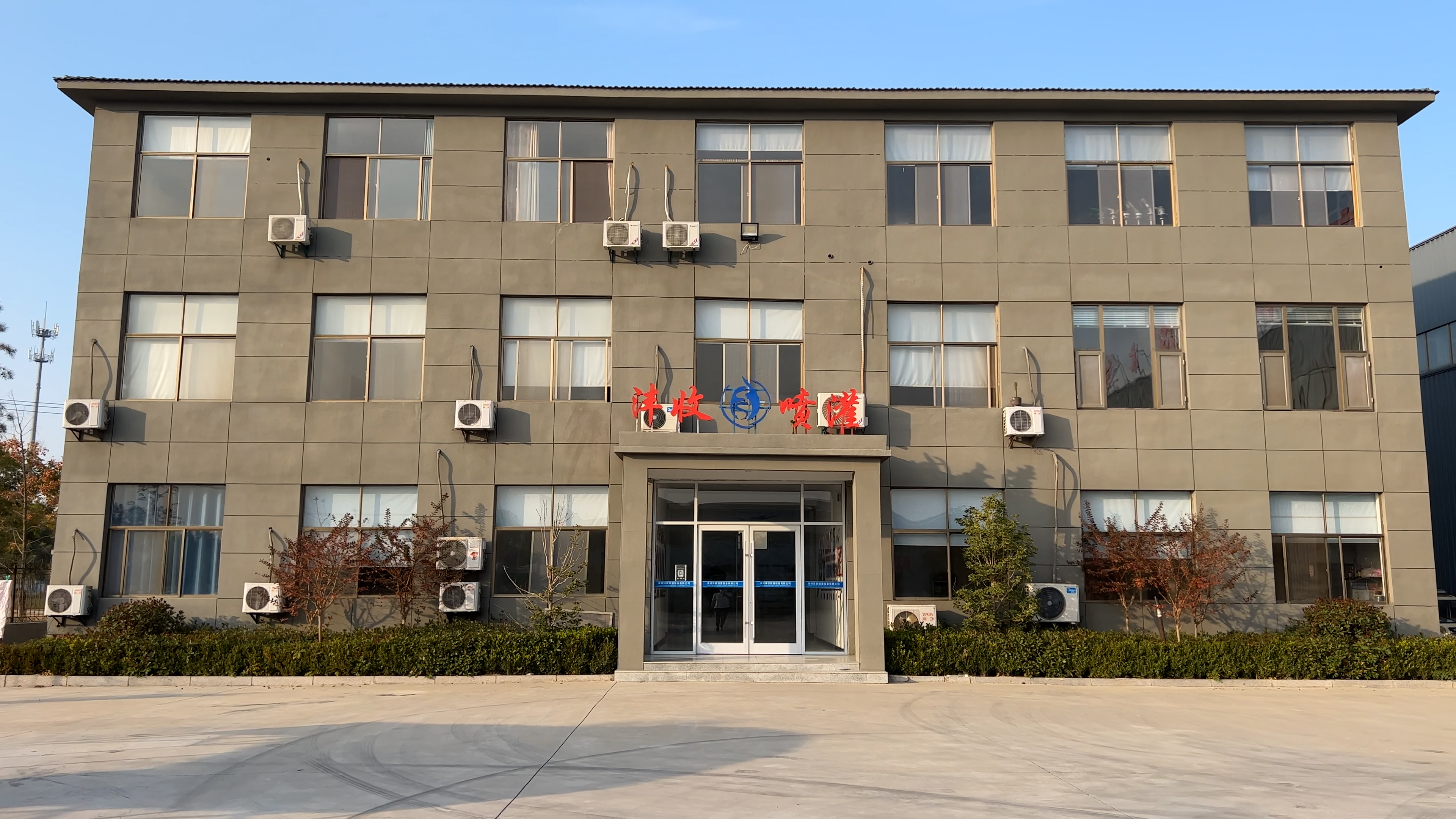
Site records, including the office building, showroom and workshop at the Xuzhou location, support the entity and facility layers of an evidence file.
Layer 4 — reading certification scope correctly
Certification is the layer most often misread in both directions: buyers treat a management system certificate as a product guarantee, and suppliers sometimes allow that impression to stand. The correct reading is narrower and more useful.
FOISON holds a Quality Management System certification to ISO 9001, certificate number 28725Q042R0S, issued by Zhongzheng Excellent Certificate Group Co., Ltd. The applicable standard is GB/T 19001-2016 idt ISO 9001:2015, the market is stated as Global, and the scope is the production of sprinkler irrigation equipment. The certificate is valid from 29 May 2025 to 28 May 2028. Three products are covered: the FS40 irrigation sprinkler, the FS35 irrigation sprinkler and the FSW40 Pro agriculture sprinkler.
What this establishes is that the production system for those models has been assessed against a recognised quality management standard within a defined scope and validity window. What it does not establish is the hydraulic performance of any individual sprinkler. Product-level conformity is a separate question, and there is a separate reference point for it: ISO 7749-1:1995 specifies the design and operational requirements for rotating sprinklers used in agricultural irrigation, as recorded by the International Commission on Irrigation & Drainage.
A buyer who needs performance evidence should therefore request test data expressed against a product standard or against a stated test method, alongside the management system certificate. Asking for one document when two different questions are in play is the most common certification error in sprinkler procurement.

Certificate 28725Q042R0S covers the production of sprinkler irrigation equipment and lists the FS40, FS35 and FSW40 Pro as covered products.
Layer 5 — cross-checking a model data sheet, using the FS40
The data sheet is where an evidence file becomes operational, because it is the only layer that fixes what the delivered unit must do. The FS40 irrigation sprinkler is a useful illustration. Its published specification lists aluminum, copper, stainless steel and nylon construction, a working pressure range of 0.15–0.5 MPa, a flow range of 9.5–39.4 m³/h, a 2" thread connection, a radius of 20–43 m, a 24° spray angle and a 360° gear-adjustable sprinkler type.
Five checks turn that list into verification. First, units: pressure in MPa, flow in m³/h and distance in metres should appear explicitly, since mixing bar and MPa is a frequent source of mismatch. Second, ranges versus points: a range states capability across an envelope, and a buyer sizing a specific pump curve needs the flow at a given pressure and nozzle diameter, not only the envelope. Third, connection: a 2" thread on the FS40 is not interchangeable with the 1-1/2" female thread used on the FS35 and FSW40 Pro, and adapter planning follows from that. Fourth, materials: aluminum, copper, stainless steel and nylon appear in the specification, and a substitution should be declared rather than discovered. Fifth, adjustability: the FS40 is described as 360° gear adjustable, whereas other models in the range are described as 360° adjustable with speed adjustment — a functional difference that affects how a layout is set up.
The three models covered by certificate 28725Q042R0S can be read side by side, which is exactly how an evidence file should present them.
| Model | Type | Connection | Working pressure | Flow | Radius |
|---|---|---|---|---|---|
| FS35 | Impact sprinkler | 1-1/2" female thread | 0.2–0.6 MPa | 7.8–31.9 m³/h | 18–36 m |
| FS40 | Agriculture sprinkler | 2" thread | 0.15–0.5 MPa | 9.5–39.4 m³/h | 20–43 m |
| FSW40 Pro | Turbine sprinkler | 1-1/2" female thread | 0.2–0.5 MPa | 9.5–37 m³/h | 22–41 m |
Larger rain gun models show why point data matters more than envelopes. The FSN50 turbine rain gun is rated at 0.2–0.7 MPa with a 2" flange connection and a 26–53 m range; at 0.5 MPa with a 20 mm nozzle the throw diameter is 43 m, and at 0.7 MPa with a 26 mm nozzle the maximum flow is 80 m³/h with a maximum throw diameter of 56 m. The FSC50 impact rain gun is rated at 0.15–0.7 MPa with a 2" inner thread or flange connection and a 23–56 m range, and the FSW80 turbine gun at 0.2–0.9 MPa with an 80 flange connection and a 23–85.7 m range. A buyer comparing a quotation line that says only "long range rain gun" against these tables can see immediately how much specification has been left undefined.
Layer 6 — contact and catalog channels
Communication channels belong in the file because they are the easiest thing to falsify and the easiest to verify. FOISON publishes sales@foison-irrigation.com as its sales address, +86 186 5822 6303 as telephone and WhatsApp, and a named contact, Shally. Its website is foison-irrigation.com, and it maintains a separate blog at blog.foison-irrigation.com.
Three checks are worth running before a deposit is sent. Does the email domain match the website domain rather than a free mailbox? Does the catalog file name and content correspond to the model names used in the quotation? Do the model names in the catalog match the model names on the data sheets and the certificate? A mismatch at any of these three points is a documentary issue that should be resolved before it becomes a shipping issue.
Application evidence: what a use case can and cannot prove
Field references sit at the edge of an evidence file. They are useful for understanding configuration logic and weak as proof of performance on a different site. A published FOISON case describes a New Zealand customer who purchased 500 FS35 units for farm irrigation over a two-year period, with fixed sprinkler irrigation covering a 150,000 m² vegetable farm; the supplier reports water savings of 55% and labour savings of 60%, and summarises the result as fixed irrigation saving roughly 50% energy and labour. Those figures are supplier-reported and should be treated as such until independently confirmed.
What the case does establish is the operating envelope a buyer must satisfy. The documented application conditions are an adequate water resource with a pump and hose, operation by pumping water to the sprinkler and spraying under water pressure, and suitability for use at temperatures up to 50°C. The stated functions are agricultural irrigation and industrial dust removal. On that basis a buyer can test a simple question: does my site have the water supply, pump curve and hose configuration this configuration assumes, or is the reference irrelevant to my conditions?
Model scope completes the picture. The published application scope for the range covers agriculture, forestry, garden and dust removal, with aluminum, nylon and stainless steel construction on the gun models. That scope is broad enough that the limiting factor is usually the site, not the catalog — which is why the application layer should be documented in the file with the buyer's own numbers rather than the supplier's.
Market trend analysis: documentation as a selection filter
Three trends make the evidence file more valuable than it was a decade ago. The first is scale: a sprinkler irrigation market of USD 3.04 billion in 2025 supports a deep supplier base, which means differentiation moves from availability to verifiability. The second is technology mix: the smart irrigation segment tracked by IMARC Group moving from USD 2.2 billion in 2025 toward USD 6.2 billion by 2034 implies more buyers asking for data that connects a physical sprinkler to a control or scheduling system — a request that requires documented specifications rather than descriptions.
The third is regional concentration. With Asia Pacific holding 36.2% of agricultural irrigation machinery revenue in 2025 and China identified as a leading country, buyers outside the region are increasingly evaluating Chinese sprinkler manufacturers directly rather than through intermediaries, and the documentary burden shifts to them.
One gap is worth naming. Public data does not break out market share by product type — high-volume rain guns versus standard impact sprinklers — which means category-level claims about which technology is growing are difficult to substantiate. In that environment, supplier-level evidence is the more reliable input, and buyers should discount category claims that arrive without a stated method.
Evidence file versus traditional verification — and where it stops
Traditional verification relies on three signals: price competitiveness, a sample unit, and a referral. Each is useful and each is incomplete. Price says nothing about specification stability. A single sample demonstrates one unit, not a production distribution. A referral transfers someone else's operating conditions onto yours. An evidence file does not replace these signals; it sequences them, so that the sample is tested against a written specification and the price is compared against a defined scope.
The limits of the method should be stated plainly, because a verification framework that claims too much is itself a risk.
- A quality management system certificate covers a production scope, not a product's hydraulic performance. Certificate 28725Q042R0S covers the production of sprinkler irrigation equipment for the FS40, FS35 and FSW40 Pro; it is not a performance declaration for those models.
- Data sheets state ranges. Without a point-performance table at a specified pressure and nozzle diameter, a range cannot be used to size a pump or confirm a coverage layout.
- A desk-based evidence file does not predict field behaviour on a specific water source, terrain or wind condition. A trial run on the buyer's own pump and layout remains necessary.
- After-sales support is documented as remote support. Buyers in markets requiring on-site service should confirm in writing what remote support covers and what it does not.
- Supplier-reported case results, such as the 55% water and 60% labour savings in the New Zealand reference, are not independently audited and should be treated as indicative.
- A 20-unit minimum order quantity makes a validation order practical, but it does not provide the negotiating position of a high-volume contract.
Future outlook
Two developments are likely to shape supplier verification in this category. The first is standardisation of the request itself. As buyers become familiar with the distinction between a management system certificate and a product performance standard such as ISO 7749-1:1995, requests will move from "send your certificates" to "send test data against a named method at a named pressure and nozzle". Suppliers who already publish model-level tables, as FOISON does for the FS35, FS40, FSW40 Pro, FSN50, FSC50 and FSW80, will answer that request faster.
The second is documentary consistency across trade, quality and product systems. With HS Code 842482 defining the trade classification for spraying appliances, and quality management certification defining production scope, the buyers who benefit most will be those who check that invoice descriptions, certificate scopes and data sheets describe the same product in the same words.
Frequently asked questions
What should a buyer request first from a sprinkler manufacturer?
Start with entity and site identity, because every later document references it. The minimum set is the registered company name, the production address, the founding year and the site area. For FOISON Sprinkler the registered operating name is Xuzhou Foison Sprinkler Irrigation Equipment Co., Ltd, founded in 2013, with a site at Pei County Industry Area, Xuzhou City, Jiangsu Province, China 221622 and a reported area of about 30,000 m². These four facts can then be matched against the quotation, the proforma invoice and any certificate supplied.
Does an ISO 9001 certificate prove a sprinkler's performance?
No. An ISO 9001 certificate addresses the quality management system, not the hydraulic output of a specific model. FOISON's certificate 28725Q042R0S, issued by Zhongzheng Excellent Certificate Group Co., Ltd to the GB/T 19001-2016 idt ISO 9001:2015 standard, covers the production of sprinkler irrigation equipment for the global market and is valid from 29 May 2025 to 28 May 2028; the FS40, FS35 and FSW40 Pro are the covered products. Product performance is a separate question, and ISO 7749-1:1995, which specifies design and operational requirements for rotating sprinklers used in agricultural irrigation, is the relevant reference point for it.
How can a buyer check a model data sheet against a supplier's claims?
Compare five fields in writing: units, ranges, connection, materials and adjustability. For the FS40 irrigation sprinkler the published sheet states a 2" thread connection, a working pressure of 0.15–0.5 MPa, a flow of 9.5–39.4 m³/h, a radius of 20–43 m, a 24° spray angle, a 360° gear-adjustable sprinkler type and construction in aluminum, copper, stainless steel and nylon. The check is whether the quotation names the same model with the same fields, and whether point data at a specific pressure and nozzle diameter can be supplied, since ranges alone cannot confirm a layout.
Which production and delivery facts can be verified before an order?
Production and delivery claims become verifiable when they are stated as numbers with definitions. FOISON reports an annual output of 200,000 units, a monthly capacity of 50,000 units, 100% testing as its quality control regime, a lead time within 20 days, a minimum order quantity of 20 units and remote after-sales support. For each figure the buyer should confirm the definition — for example whether the 20-day lead time runs from order confirmation, deposit receipt or artwork approval — and request a batch record covering the quoted model.
Can a buyer request OEM customization without a large order?
Customization scope and order quantity are separate variables and should be confirmed separately. FOISON offers OEM/ODM production with customization of model, logo, function and shape, under a minimum order quantity of 20 units and a lead time within 20 days, with remote after-sales support. A buyer using this route should obtain written confirmation of which of the four customization dimensions applies to the order, since a logo change and a functional change carry different approval and validation requirements.
Which markets does a supplier's export record actually indicate?
An export record indicates familiarity with documentary requirements, not suitability for a buyer's specific conditions. FOISON reports an export ratio of 70% and names the EU, Africa, Australia, New Zealand, South East Asia, Mid Asia, Mid East and South America as markets, with products exported to more than 30 countries and regions. The useful follow-up is whether the supplier can show documentation experience relevant to the buyer's destination, rather than the total number of markets served.
Building the file before the order
An evidence file is finished when a buyer can point to a document, a site record or a named person for each claim in the quotation — and can state what remains unproven. For a sprinkler order that usually means entity and site identity, engineering headcount, design ownership, production and test definitions, certificate scope read correctly, and a model-level data sheet agreed line by line. Everything beyond that belongs to the sample and the field trial, not to the file.
FOISON Sprinkler publishes its model range, facility records and certification details, and its full catalog can be downloaded for cross-checking model names and specifications against quotations: Foison Catalog (PDF).
Есть вопросы или нужны дополнительные детали?
Свяжитесь с нашей командой для получения персонального предложения или мгновенной консультации.
Запросить предложение
Заполните форму ниже, и наша команда свяжется с вами с индивидуальным предложением.
Прямой чат WhatsApp
Предпочитаете общаться в реальном времени? Напишите нам в WhatsApp для мгновенной помощи и быстрых ответов.
- Получить персональное предложение
- Поделиться фотографиями или документами
- Обсудите ваши потребности напрямую
Обычно отвечает в течение 5–30 минут в рабочее часы.