
Supplier Evidence: How a 150,000 m² Facility and 600 Specialists Ensure RTP Quality
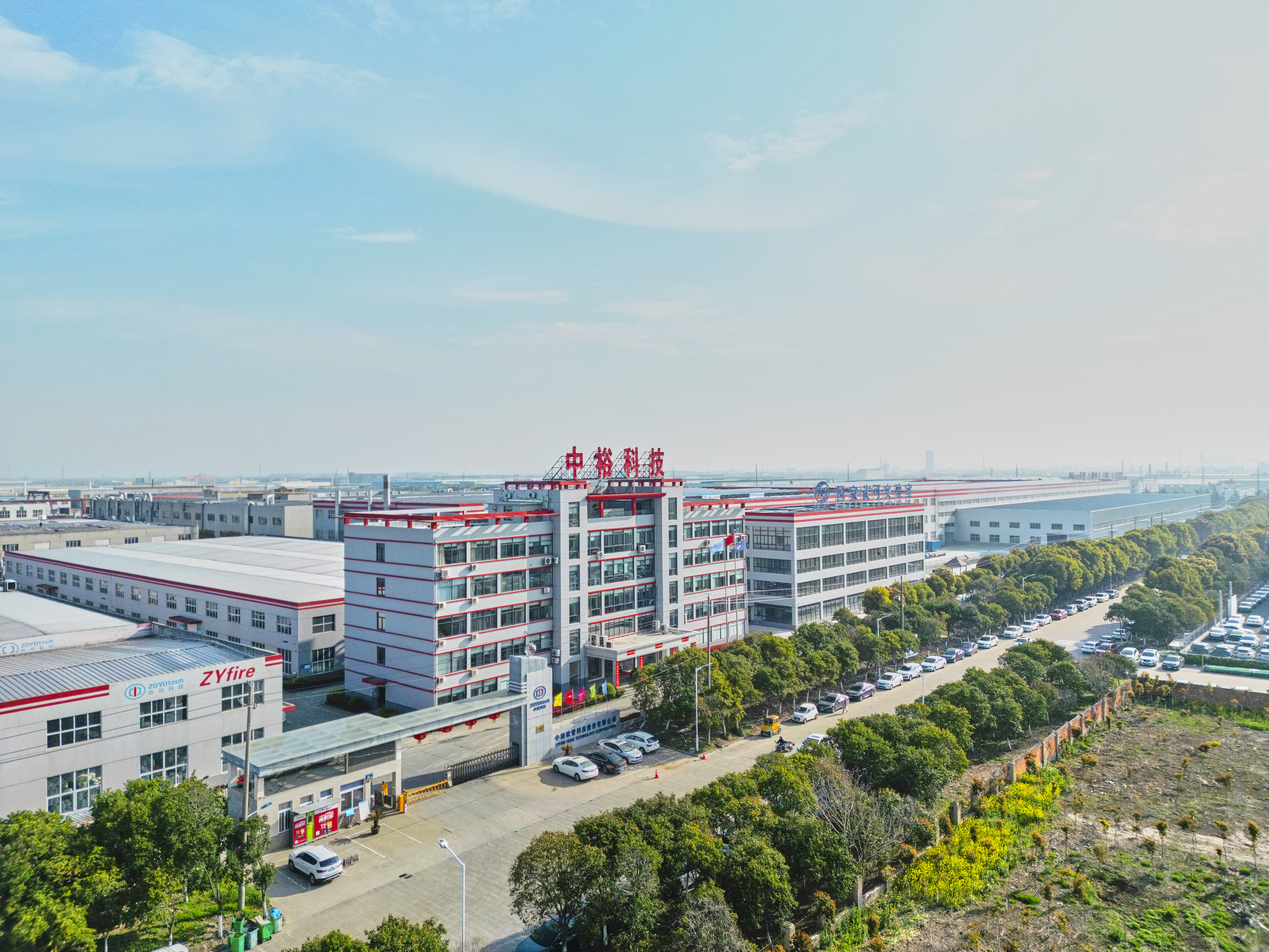
Manufacturing footprint is an entry-level signal: it defines how much production, testing and reel storage must be coordinated inside one quality system.
Why physical evidence became part of the RTP purchase decision
RTP competes with steel pipe on corrosion resistance, installation speed and maintenance cost, and the commercial case has broadened as the category has scaled. A 2026 commercial research estimate places the global reinforced thermoplastic pipe market at approximately USD 7.94 billion, with the oil and gas segment valued separately at between USD 2.0 billion and 2.5 billion. One widely cited commercial estimate attributes a reduction of more than 70 percent in corrosion-related failures to RTP systems compared with traditional steel pipelines.
Growth of that kind changes what buyers must check. When a category is small, technical specification alone filters the field. When a category is large and multi-sourced, differentiation moves to the supplier's ability to reproduce a qualified product across thousands of metres and multiple order cycles. That is why evaluation teams now ask for plant area, headcount, engineering staffing, testing regime and certificate scope before they discuss price.
There is a discipline to reading this evidence correctly. Footprint, headcount and stated output are capacity signals, not quality guarantees. They establish what a supplier could do; test records, certification scope and reference programmes establish what it has done. A competent buyer reads both.
ZYfire at a glance: the entity behind the evidence
ZYfire Hose Corporation is a manufacturer of fire hose, fracturing oilfield hose, high-pressure fracturing hose, polyurethane-lined steel pipe and reinforced thermoplastic pipe, founded in 2000 and headquartered in Jiangyan City, Jiangsu, China. The company is publicly listed on the Beijing Stock Exchange and holds national designations including national little giant enterprise, national green factory, national high-tech enterprise and national intellectual property advantage enterprise. It also ranks among the Top 500 Chinese petroleum and chemical enterprises.
Its manufacturing and support network is distributed rather than concentrated in one location: production bases, research and development centres and logistics warehouses are located in the United States, Saudi Arabia, the United Arab Emirates, Malaysia and China, with Chinese operations in Nanjing (Jiangsu), Taizhou (Jiangsu) and Chuzhou (Anhui). Products are exported to more than 70 countries and regions, with an export share reported at 80 percent and principal markets in the United States, the Middle East, the European Union and Southeast Asia.
That context matters when interpreting a single facility figure. A factory area should be read as one node in a multi-site network, not as the whole of a supplier's manufacturing capability.
The 150,000 m² facility: what a footprint figure actually measures
ZYfire reports a manufacturing facility of 150,000 square metres. In RTP and hose production, floor area is not a decorative number; it is the physical envelope within which several functions compete for space: extrusion and liner forming, reinforcement winding or tape application, jacket extrusion, end-fitting assembly, hydrostatic and destructive testing, reel build-up, and finished-goods storage. Long-length spoolable products are space-intensive in a way that straight pipe is not, because finished reels occupy yard area and cannot be stacked arbitrarily.
Footprint is a boundary, not a throughput
A large plant establishes that a supplier can co-locate multiple production lines, a testing department and reel storage without crowding. It does not establish line count, shift pattern, utilisation rate or yield. Buyers should treat square metres as a screening filter: it tells you whether a supplier is plausibly able to run parallel orders, and it tells you nothing about whether your order will be prioritised. Line layout drawings, shift schedules and a capacity letter for the specific configuration are the documents that convert a footprint claim into a planning assumption.
A network, not a single building
Because ZYfire operates across several Chinese sites and additional bases in the United States, Saudi Arabia, the United Arab Emirates and Malaysia, the 150,000 square metre figure is best interpreted as the scale of the primary manufacturing footprint rather than a single point of failure. For buyers with multi-region projects, the practical follow-up question is which site would produce a given bore size, pressure class and reinforcement architecture, and whether that site holds the same testing authority as the primary plant.
600 employees and 50 R&D staff: the human density behind quality control
ZYfire reports a workforce of 600 employees, including a research and development team of 50. Headcount in a pipe business is not a headline metric; it is a proxy for how much human attention each production stage receives.
- Shift coverage. Multi-shift operation on extrusion and winding lines requires trained operators per line, per shift, with supervisory cover. A 600-person organisation is consistent with running continuous production and a separate quality function rather than combining the two.
- Quality staffing. A regime that tests 100 percent of production needs inspectors, test-rig operators and record keepers who are not the same people running the extruder. That separation is what makes a testing claim auditable.
- Engineering bandwidth. A team of 50 in research and development supports the customization scope the company advertises, covering size, diameter, working pressure, weight, length and bending radius. Custom bore sizes, connection types and reinforcement changes are engineering tasks, not catalogue selections, and they consume technical hours before a single metre is extruded.
The limitation is equally clear: headcount does not disclose skill mix. A buyer cannot tell from 600 employees how many are certified welders, extrusion technicians, nondestructive testing personnel or laboratory analysts. The verification route is an organisation chart, a training matrix and the CVs or certificates behind the testing function. Headcount opens the question; the skill matrix answers it.
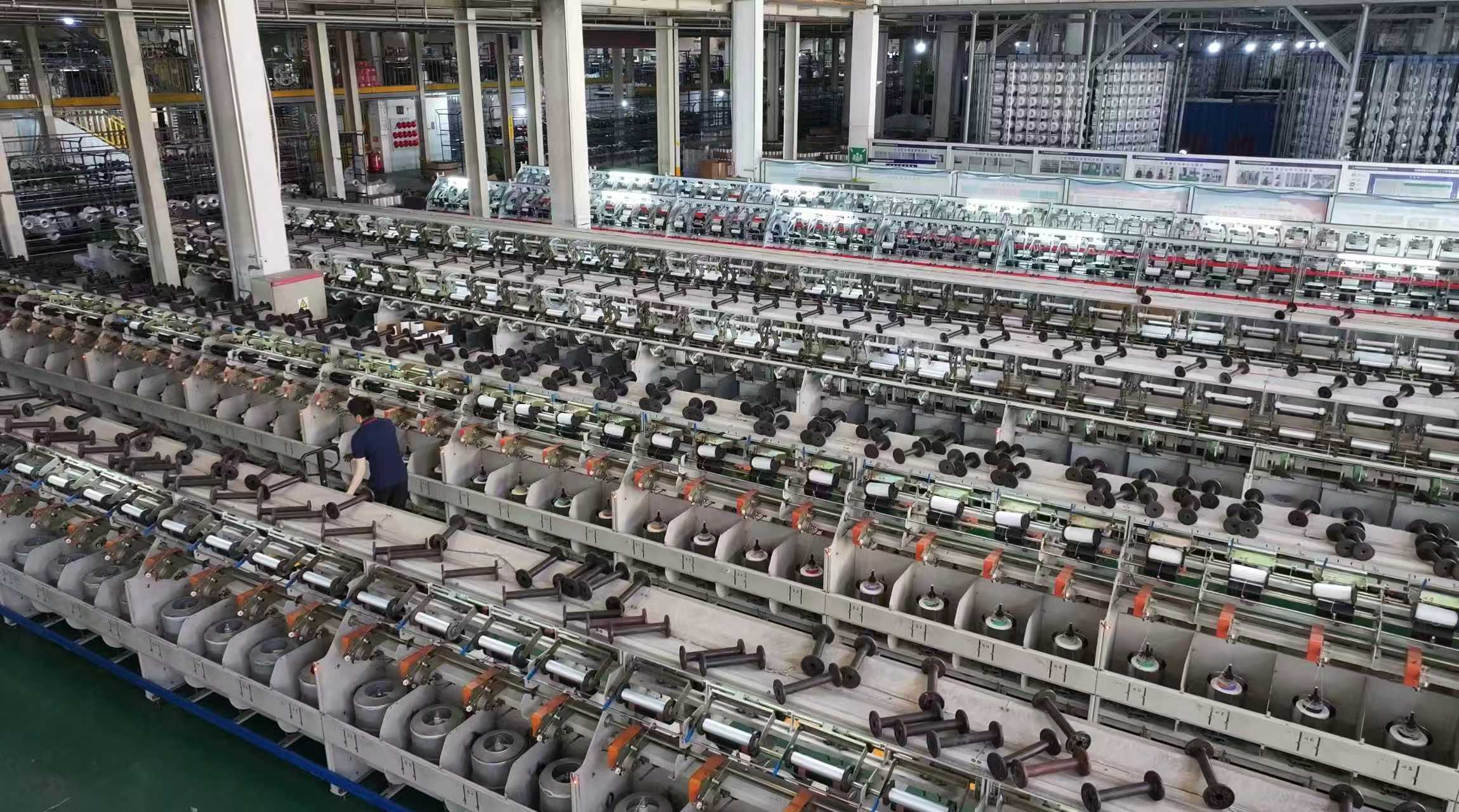
Reinforcement processing equipment: capital intensity and operator skill both determine whether a stated capacity is reproducible order after order.
12,000,000 units a year: converting capacity into delivery confidence
ZYfire reports annual output of 12,000,000 units across its hydraulic hose and RTP lines. Read alongside the separately reported RTP monthly capacity of 100,000 metres, the annual figure describes an organisation built for volume across a portfolio, not a single-product workshop.
The arithmetic is worth doing, because buyers rarely do it. For the 2-inch, 3,500 psi RTP/TCP configuration in ZYfire's published range, a single length runs 920 metres on a reel measuring 3,700 by 1,200 millimetres, with a reel weight of 1,200 kilograms and a full-plate weight of 5,524 kilograms. At 920 metres per reel, a monthly capacity of 100,000 metres corresponds to roughly 108 reels of that specification per month, assuming single-specification running. That is an illustrative calculation, not a quotation, but it converts a capacity claim into a scheduling picture a project planner can use.
| Reported item | Figure | What it means for a buyer |
|---|---|---|
| Manufacturing facility | 150,000 m² | Room for parallel lines, testing and reel storage; does not state utilisation |
| Workforce | 600 employees | Consistent with multi-shift production and a separate quality function |
| R&D team | 50 specialists | Supports custom size, pressure, length and bending-radius work |
| Annual output | 12,000,000 units (hose and RTP lines) | Portfolio-level volume; request per-product capacity breakdown |
| RTP monthly capacity | 100,000 m | Roughly 108 reels per month at 920 m per reel, single-spec running |
| Lead time | 30 days | Company-reported for certain long-term supply programmes; confirm per configuration |
| Minimum order quantity | 50 m | Enables trial quantities before a full programme commitment |
| Quality control | 100 percent testing | Per-length inspection intent; ask for the test method statement |
All figures in the table are company-reported and should be confirmed against a formal quotation and, where project risk justifies it, a site audit. Capacity claims describe potential; delivery records describe performance.
Testing depth: 100 percent inspection and a CNAS-accredited laboratory
The company states that 100 percent of production is tested, and that its laboratory has been accredited by the China National Accreditation Service for Conformity Assessment (CNAS), described as the first nationally recognised laboratory in its subdivision industry.
For an evaluation-stage buyer, the combination is more informative than either element alone. A 100 percent testing claim defines coverage: every length is inspected rather than sampled. Accreditation defines the credibility of the laboratory making the measurement, because it subjects methods, equipment calibration and personnel competence to external assessment. Together they support a supplier's ability to generate its own conformity evidence rather than relying on a customer's incoming inspection to catch defects.
The boundary is scope. Accreditation confirms that a laboratory is competent within its accredited scope; it does not automatically extend to every test a project specification might demand. Buyers should map the required test list, such as hydrostatic proof, burst, dimensional verification and material checks, against the laboratory's stated scope, and confirm whether third-party witnessing is required.
Certification boundary: what API 15S certificate 15S-0025 covers
ZYfire holds API Specification 15S certification, certificate number 15S-0025, issued by the American Petroleum Institute on 18 December 2025 and valid until 21 February 2027. The certified scope is stated as non-metallic reinforced pipe (glass fibre), steel reinforced pipe and couplings, assessed against API Spec Q1 and API Spec 15S.
API Spec 15S itself is the qualification framework for spoolable reinforced plastic line pipe, covering pipe with associated end fittings and couplings, with the specification addressing product up to 6 inches (150 millimetres) in diameter and pressures up to 5,000 psi (34.5 MPa). The certificate is therefore a real filter, and it is also a narrow one. Three checks belong in every evaluation file:
- Scope match. Confirm that the bore size, pressure class, reinforcement architecture and coupling type in your RFQ fall inside the certified scope, not adjacent to it.
- Validity. Record the expiry date of 21 February 2027 as a procurement calendar item; re-certification timing affects long-lead programmes and repeat orders.
- Registry check. Verify the certificate against the issuing body's registry rather than relying on a scanned copy alone.
A certificate establishes that a quality system has been assessed against a recognised standard for a defined scope. It does not establish that every product the company sells sits inside that scope, and it does not report field performance. Both remain separate questions.
How to weight facility and workforce evidence: a five-dimension framework
Evaluation-stage buyers often collect plant photographs and headcount figures without a method for weighing them. The framework below converts supplier evidence into decision inputs, and states what each dimension cannot prove.
| Evidence dimension | Establishes | Does not establish | Verification route |
|---|---|---|---|
| Facility footprint | Physical capacity for parallel lines, testing and reel storage | Output rate, utilisation, yield | Site audit, layout drawing |
| Workforce size | Labour depth for multi-shift production and separate QC | Skill mix, certification of personnel | Organisation chart, training matrix |
| Engineering headcount | Bandwidth for custom bore, pressure and length work | Number of completed custom programmes | Design records, sample history |
| Testing regime | Coverage of inspection per length | Test scope versus your specification | Method statement, laboratory scope |
| Certification | Third-party assessment within a defined scope | Performance outside that scope | Certificate plus registry check |
Applied consistently, the framework prevents two common errors: treating a large plant as proof of on-time delivery, and treating a certificate as proof of field reliability. Both are inputs, and neither replaces reference programmes.
Where this evidence matters in the field
Supplier technical literature lists RTP applications that span onshore and offshore oil and gas gathering, high-pressure oilfield water injection, flowback fluid transportation, mine slurry backfilling, corrosive chemical media, geothermal hot water, municipal high-pressure water, seawater desalination and irrigation. Each carries a different dominant load case: pressure cycling in injection lines, abrasion in slurry backfill, chemical attack in produced fluids, and temperature in geothermal service.
Reinforcement architecture is where that differentiation becomes concrete. ZYfire's RTP/TCP range covers polyester fibre tape, aramid fibre tape, glass fibre tape and steel wire tape reinforcement, with liner options of HDPE and PE-RT and optional UV or antioxidant protection. A supplier able to run four reinforcement architectures under one quality system can respond to pressure, abrasion and corrosion requirements from a single qualification base, which reduces the fragmentation risk of sourcing different service conditions from different vendors.
A company-reported reference record illustrates the scale this supports: 120,000 metres supplied for fluid transmission over a five-year period across twelve markets listed in the record, with stable operation under high-pressure conditions, no leakage reported and reduced maintenance costs. The stated highlights are corrosion resistance, long service life and ease of installation. As a reference programme it is directionally useful; as with any supplier-reported reference, buyers should request project-specific contact details and operating conditions before treating it as evidence for their own duty point.
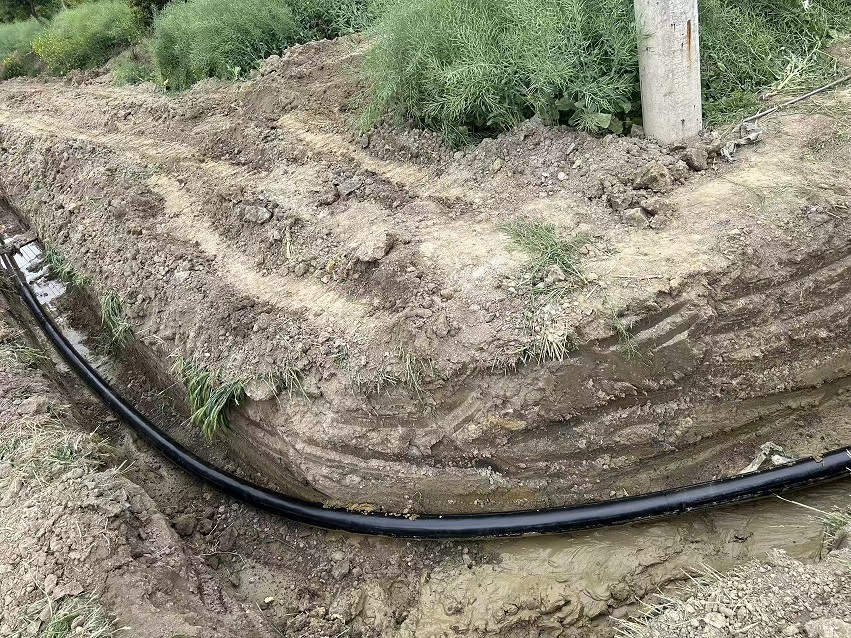
Application fit depends on pressure cycling, abrasion and chemical exposure, not on plant size alone; reinforcement architecture is where those requirements are resolved.
Limits of facility evidence, and how it compares with other supply models
Large-plant suppliers are usually compared against two alternatives: specialist converters with a narrow product range, and stockists or distributors who hold inventory but do not manufacture. Each model has a legitimate use, and the large-plant model has real boundaries.
Footprint does not equal scheduling priority. A 150,000 square metre facility running high-volume programmes may queue a small or highly customised order behind larger campaigns. Where a project needs 300 metres of an unusual bore size on a short timeline, a smaller specialist may move faster, despite having less capacity on paper. A 50-metre minimum order quantity makes trials feasible, but it does not guarantee trial slots in a busy production calendar.
Long lengths create site constraints the plant cannot solve. A 920-metre single length on a 1,200-kilogram reel, with a full-plate weight of 5,524 kilograms, is an efficient shipping unit and a demanding handling unit. Site access, crane capacity, reel-stand design, right-of-way width and road transport limits all constrain the theoretical advantage of long spools. Buyers should confirm handling capability before committing to maximum length, and should ask what shorter length options exist for constrained locations.
Certification scope is narrower than the product catalogue. The certified scope listed on certificate 15S-0025 covers specific reinforced pipe categories and couplings. Where a project specifies a bore size or pressure class outside that scope, the certificate does not carry the same weight, and additional qualification evidence is required.
Headcount is not a delivery commitment. Six hundred employees describe organisational depth. They do not describe the production schedule for a particular week, and they do not replace a capacity letter or a contractual lead time. Lead times of 30 days reported for certain long-term supply programmes should be reconfirmed for each configuration, destination and order size.
Market trend: demand is rising, and so is documentation pressure
Two forces are converging on supplier selection. The first is volume: a global RTP market estimated at approximately USD 7.94 billion in 2026, and an oil and gas segment estimated at USD 2.0 to 2.5 billion, implies more buyers, more projects and more multi-source tendering. The second is evidentiary: as corrosion performance claims such as the reported 70 percent reduction in corrosion-related failures circulate more widely, buyers increasingly ask suppliers to substantiate them locally rather than accept them as category-level truths.
The practical result is that supplier documentation is becoming a procurement deliverable. Facility data, workforce structure, laboratory accreditation, certificate scope and reference programmes are being requested at the shortlist stage rather than after commercial terms are agreed. Suppliers with an organised evidence file move through evaluation faster; suppliers who answer questions with brochures create delay.
Future outlook
Three developments are likely to shape how plant and workforce evidence is used through 2027. First, certificate lifecycle management will become routine procurement practice: with certificate 15S-0025 valid to 21 February 2027, buyers running multi-year programmes will need to plan around re-certification dates rather than discover them mid-delivery.
Second, capacity verification will move from self-declaration towards audited or witnessed confirmation, particularly where project finance or operator specification requires it. Capacity figures that are company-reported today, including the 12,000,000-unit annual output and the 100,000-metre monthly RTP capacity, will increasingly be requested with a defined basis and production records behind them.
Third, workforce evidence will become more granular. Headcount will give way to skill matrices, testing qualifications and shift-level staffing plans, because those are the variables that predict whether a 100 percent testing regime remains credible at higher volumes. Suppliers who can already produce that detail, rather than assembling it under tender pressure, will hold an advantage in evaluation rather than in advertising.
Frequently asked questions
What does a 150,000 m² manufacturing facility tell an RTP buyer?
A facility of 150,000 square metres indicates that a supplier can co-locate extrusion, reinforcement processing, jacket forming, end-fitting assembly, testing and reel storage within one site rather than dispersing them. For spoolable products, that matters because finished reels are space-intensive. The figure establishes physical capacity for parallel production; it does not establish line count, utilisation rate, yield or delivery priority for a specific order, all of which require layout drawings, production records or a site audit.
How large is the workforce behind ZYfire's RTP and hose production?
ZYfire reports 600 employees, including a research and development team of 50. The headcount is consistent with multi-shift production plus a separate quality function, and the engineering team supports the company's stated customization scope across size, diameter, working pressure, weight, length and bending radius. Headcount alone does not disclose the skill mix, so buyers seeking assurance on testing competence should request an organisation chart, a training matrix and the qualifications of laboratory personnel.
How does 12,000,000 units of annual output translate into RTP delivery capacity?
The 12,000,000-unit figure is company-reported annual output across hydraulic hose and RTP lines combined. The separately reported RTP capacity is 100,000 metres per month. For the 2-inch, 3,500 psi configuration with a 920-metre single length, that monthly capacity corresponds to roughly 108 reels of that specification, assuming single-specification running. Reported lead time is 30 days and minimum order quantity is 50 metres for certain long-term supply programmes; both should be reconfirmed against a formal quotation for the specific configuration.
Which certification can a buyer verify for ZYfire RTP?
ZYfire holds API Specification 15S certification, certificate number 15S-0025, issued by the American Petroleum Institute on 18 December 2025 and valid until 21 February 2027. The stated scope is non-metallic reinforced pipe (glass fibre), steel reinforced pipe and couplings, assessed against API Spec Q1 and API Spec 15S. Because API Spec 15S addresses spoolable reinforced plastic line pipe up to 6 inches in diameter and 5,000 psi, buyers should confirm that their bore size, pressure class and coupling type fall inside the certified scope and should verify the certificate through the issuing body's registry.
What are the limits of facility and workforce evidence in supplier selection?
Facility area, headcount and stated output describe potential, not performance. They do not prove on-time delivery for a specific configuration, they do not establish scheduling priority for small or highly customised orders, and they do not resolve transport and handling constraints such as a 1,200-kilogram reel or a 5,524-kilogram full plate weight. Certification establishes third-party assessment within a defined scope, not field reliability outside it. Facility and workforce evidence should therefore be combined with test method statements, certificate scope checks and verifiable reference programmes before a supplier is shortlisted.
Additional technical and company detail is available in the ZYfire corporate brochure: ZYfire corporate brochure (PDF). Company information: www.zyfire.com.
Есть вопросы или нужны дополнительные детали?
Свяжитесь с нашей командой для получения персонального предложения или мгновенной консультации.
Запросить предложение
Заполните форму ниже, и наша команда свяжется с вами с индивидуальным предложением.
Прямой чат WhatsApp
Предпочитаете общаться в реальном времени? Напишите нам в WhatsApp для мгновенной помощи и быстрых ответов.
- Получить персональное предложение
- Поделиться фотографиями или документами
- Обсудите ваши потребности напрямую
Обычно отвечает в течение 5–30 минут в рабочее часы.