
Supplier Evidence: OCTOPUS Shoe Washing Bag 2-Pack Specs
Supplier Evidence: OCTOPUS Shoe Washing Bag 2-Pack Specs
A shoe washing bag specification sheet is a short document, and most of them read alike: a mesh bag, a zipper, two dimensions and a weight. What separates a supplier a buyer can audit from one they cannot is rarely the headline number. It is whether each number is tied to a measurement convention, an order tier, a packaging standard, and a document whose scope actually matches the claim being made.
Why a Spec Sheet Alone Cannot Establish Supplier Capability
Procurement teams evaluating a shoe washing bag in 2026 are usually comparing suppliers who all describe a similar product. The differentiator is not the vocabulary. It is whether the buyer can convert each claim into something that can be checked before money moves.
Three failure modes recur in specification sheets for this product category. The first is a number without a measurement convention: a bag described as 30 × 25 cm tells a buyer nothing until it is clear whether the figure is an external flat measurement, a filled capacity, or a compartment dimension. The second is a capability claim without an order link: a factory that can customise material is only useful to a buyer who can actually meet the minimum quantity for that tier. The third is a certificate name without a scope: a quality-management certificate that covers a company's general textile production is not the same object as a product certificate for the item being purchased.
Reading a spec sheet against those three tests is what turns a document into evidence. The OCTOPUS product data allows this to be done concretely, because the specification is short enough to check line by line.
The Supplier Behind the Specification
Zhejiang Runjiang New Material Technology Co., Ltd. is a Wenzhou-based manufacturer of nonwoven fabrics and textile products, established on 23 May 1995 in Wenzhou, Zhejiang, China. OCTOPUS is its shoe-care brand, with the Shoe Washing Bag as the core product presented through www.octopusbag.com.
The operating figures associated with the company are specific enough to be used in a supplier evaluation: a 16,000 m² factory, 80 employees as of September 2026, annual output of approximately 1,000,000 units, an eight-member development team covering sampling, structural development and production processes, and exports accounting for approximately 70% of business with customers in the USA, Turkey and Germany.
Those figures matter less as credentials than as constraints. A buyer sourcing 10,000 pieces is asking for roughly 1% of the stated annual output, which is a normal order shape for this supplier rather than an exceptional one. That relationship between order size and capacity is the context in which every MOQ tier below should be read.
Evidence Block 1 — Dimensions and Mass
The OCTOPUS The 2-Pack contains two separate shoe washing bags. Each bag measures 30 × 25 cm and weighs approximately 200 g. The two-bag pack is stated at approximately 400 g. In imperial terms the bag size is roughly 11.8 × 9.8 inches.
Two things can be done with these numbers. The first is a density sanity check: a 30 × 25 cm bag at roughly 200 g indicates a layered construction rather than a single-layer mesh shell, which is consistent with the stated mesh exterior plus chenille lining. The second is a load sanity check: two bags at approximately 200 g each are added to the drum alongside a pair of shoes, so a buyer planning a retail pack should account for roughly 400 g of additional load per pack in transit and storage calculations.
The measurement-convention problem
Published dimensions in this category are not directly comparable across sellers. A US retail listing for a Numhew shoe washing bag states 17 × 7.5 inches in polyester, and a Garnen listing on a mass retail site states 15.7 × 7.5 inches in mesh with zipper closure. Both are flat length-and-width figures with an aspect ratio above 2:1, whereas 30 × 25 cm is close to square. The difference may reflect genuine design intent, or simply different conventions for what is being measured.
The practical consequence for a buyer is straightforward: the OCTOPUS specification states external dimensions and unit mass but does not state a maximum shoe size. Some competing listings do publish a capacity figure — one German product page specifies one pair up to EU size 47 — and that gap is worth closing in writing during the RFQ rather than inferring from the centimetres. A buyer sourcing for adult athletic footwear should request a stated shoe-size capacity and a fit sample, not a dimension alone.
Evidence Block 2 — Construction and Hardware
The bag combines a mesh exterior with a soft chenille lining. A centre pocket provides a separate place for removable insoles and shoelaces. Closure is a zipper secured by a locking clasp with a metal hook and an anchor loop.
- Mesh exterior. An open mesh outer layer allows water and detergent to circulate through the bag during the wash cycle.
- Soft chenille lining. The inner surface is a pile fabric rather than an exposed mesh, which changes what contacts the upper of the shoe during agitation.
- Centre pocket. Insoles and laces are hard and small respectively; separating them from the shoe body reduces the chance of them working against the upper or blocking the drain path.
- Locking clasp with metal hook and anchor loop. This is the component most likely to fail first in service, and it is also the component that protects the wash cycle: an unsecured zipper opening inside a drum releases both the shoe and the bag.
Chenille and multi-layer construction is not unique to this product. A German product page describes 100% chenille PES with a long-pile microfiber lining, and a US retail listing describes a sandwich construction of breathable mesh outer layers with microfiber between them. What a buyer can check is not the presence of the idea but the execution: stitch density at the zipper ends, engagement force of the hook and loop, seam integrity at the pocket, and whether the lining stays attached after repeated cycles.
Evidence Block 3 — MOQ Tiers and What Each One Unlocks
The published order structure is three-tiered, and each tier corresponds to a different kind of change to the product.
| Tier | Minimum quantity | What becomes available | What the buyer should confirm |
|---|---|---|---|
| Stock | 100 pieces | Existing XYF-004 production as standard | Variant code, colour availability, pack configuration |
| Custom logo | 500 pieces | Logo customization on the agreed specification | Artwork position, method, and approval of a pre-production sample |
| Custom material | 6,000 pieces | Change of material, alongside size, colour, zipper and packaging customization | Material approval, custom sample timeline, and final order specification |
The tiers are not arbitrary. Regular XYF-004 production runs at 90,000 pieces per month, with peak capacity of approximately 100,000 pieces per month. The 6,000-piece custom-material threshold is therefore less than one-tenth of a single month of regular capacity — a custom run is a scheduled interruption to a normal production line rather than a separate manufacturing programme. That is a meaningful signal for a buyer planning a private-label launch, because it suggests the custom tier is operationally reachable at mid-size volumes.
Timing is published alongside quantity. Standard samples take approximately 3 working days; custom samples take approximately 15 working days, subject to the agreed design. Bulk orders below 1,000 pieces are quoted at approximately 15 working days, with the final schedule confirmed per order. The pattern is consistent: sample speed is fast at the standard tier and slows sharply once the design changes, which is the point at which a buyer's own approval process becomes the critical path.
Customization itself is described at the level of fields rather than promises: size, material, colour, logo, zipper and packaging can be discussed for OEM, ODM and private-label projects, with the final scope confirmed against the approved sample and order specifications. For a buyer, that wording is more useful than a general capability claim, because it names the exact levers that will appear in a quotation.
Evidence Block 4 — Packaging and Retail Readiness
The standard packaging is a two-bag bubble bag. Custom packaging is available by agreement, which places it in the same customization field list as size, material, colour, logo and zipper.
Packaging is often treated as an afterthought in supplier evaluation, but for this product it is a direct indicator of channel readiness. A two-bag bubble bag is a protective transit format suitable for individual sale and for marketplace fulfilment; a buyer selling a retail SKU will eventually need a barcode area, a printed panel and a defined pack count per carton, and those requirements belong in the agreement rather than in a post-order conversation.
The recorded US case illustrates the point. An anonymous US retailer or supermarket buyer purchased 10,000 pieces for an e-commerce shoe-care SKU, and two repeat orders were recorded during the one-year observation period. The reported damage rate for that case was below 0.5%. Both the repeat ordering and the damage rate are case-specific results for that project; they are not a guaranteed defect rate for other orders. What the case does show is that packaging, pack configuration and fulfilment format were settled at the point of order rather than improvised afterwards.
Evidence Block 5 — Documents and the Scope Problem
Two documents are available for inspection, and both require careful reading because their scopes are narrower than a casual reader would assume.
ISO 9001:2015 quality-management certificate
Certificate number 00924Q10121R1S was issued by China Great Wall (Tianjin) Quality Assurance Centre Co., Ltd. against GB/T 19001-2016 / ISO 9001:2015, with an issue date of 4 April 2025 and an expiry date of 17 January 2027. The stated scope is the manufacture of nonwoven fabrics and industrial textile products, including storage boxes and cooler bags. Shoe washing bags are not explicitly listed in that scope.
The correct interpretation is that the certificate evidences a functioning quality-management system across the company's textile production, not conformity of the shoe washing bag as a product. It is supplier documentation for international buyers, not a market-entry permit and not a product certification. A buyer who requires product-level conformity should ask a separate question rather than accept the certificate number as an answer.
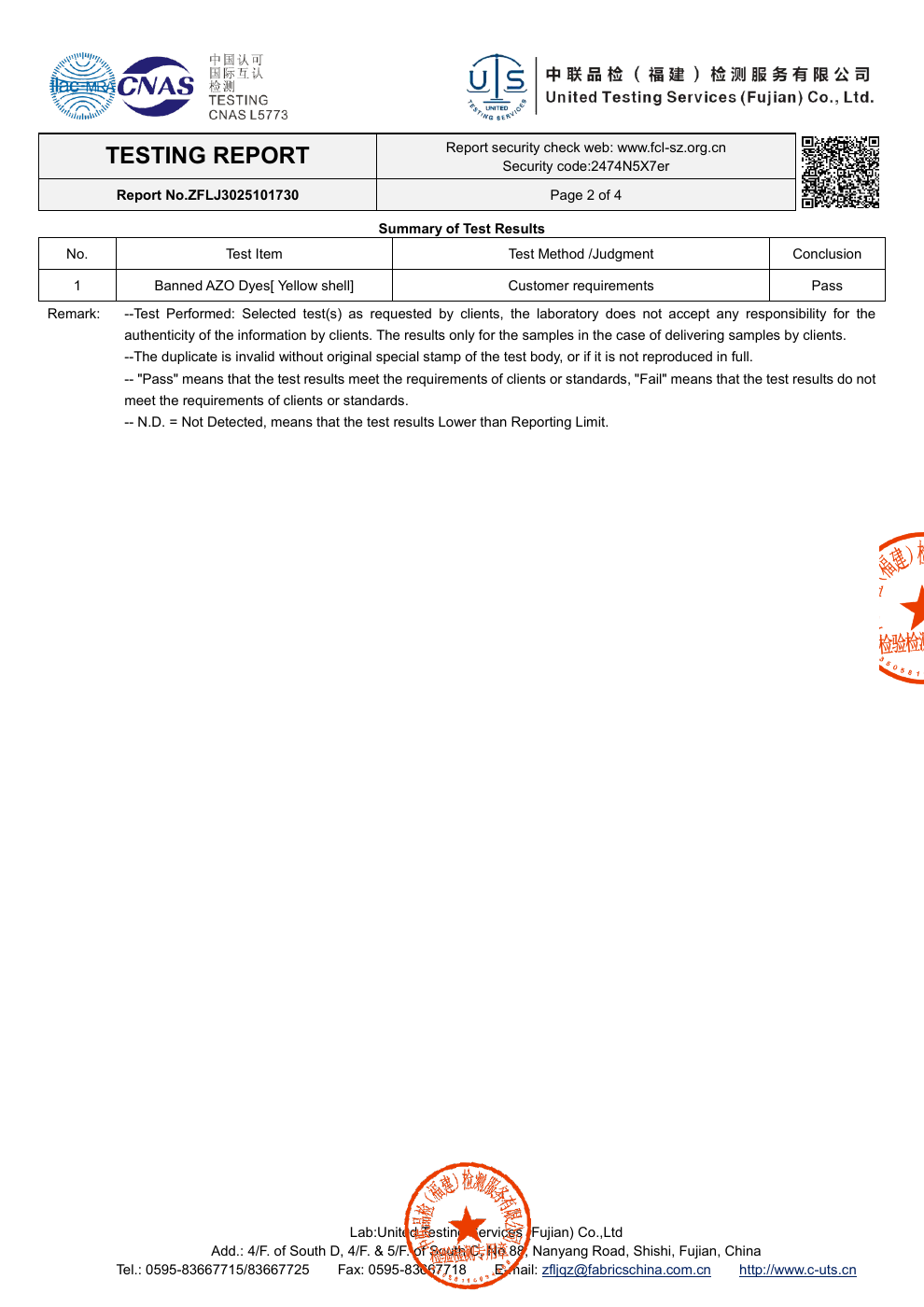
Banned azo dyes test report
Report number ZFLJ3025101730 was issued on 14 October 2025 by United Testing Services (Fujian) Co., Ltd. against ISO 14362-1:2017 and customer requirements. It covers the yellow shell of the submitted yellow shoe wash bag. Listed aromatic amines were not detected, with a reporting limit of 5 mg/kg, and the test summary is recorded as a pass.
The scope limits matter here too. The report applies to the tested sample, not to the full product range and not to every colourway. It is buyer quality documentation; on its own it does not establish market-entry compliance for any destination market. A buyer ordering a non-yellow variant, or a materially different shell, should request documentation tied to that specification rather than assume the yellow-sample result transfers.
Quality Control and Acceptance Criteria
The stated control process is 100% incoming inspection plus 5% finished-product inspection, with finished-product inspection following AQL 2.5/4.0. Inspection scope and acceptance criteria are agreed for each order.
Two practical notes follow. First, sampling inspection is not a zero-defect commitment; a 5% finished-product check under AQL 2.5/4.0 defines a decision rule for a lot, and the buyer's own acceptance criteria determine what happens when that rule is triggered. Second, the after-sales process is time-bounded: issues should be reported within 7 days of receipt with photos and video, replacement is prioritised, and refund handling is subject to review and the agreed order terms. Buyers should align their own inbound inspection window with that 7-day reporting period, because a discrepancy found in week three falls outside the stated process.
Application, Care Boundaries and Two Recorded Cases
The product is intended only for shoes whose care labels permit machine washing. Cold-water washing and air drying are recommended, and the bag should not be bleached or tumble dried. The bag does not make non-washable footwear machine-washable, and a damaged bag or closure should be taken out of service rather than used again.
Two recorded cases describe how the product has been used, and both should be read as observations rather than performance guarantees.
- Turkey, individual user. Ten individual shoe washing bags were used for shoe care over four months at approximately one use per week. The customer reported no damage to the bags during that period. This is an individual usage experience, not a laboratory durability test, and it does not establish a service life for other users.
- United States, retail and e-commerce buyer. A 10,000-piece supply project supported a shoe-care SKU for an anonymous US retailer or supermarket buyer. Two repeat orders were recorded during the one-year observation period, and the reported damage rate for this case was below 0.5%. These are case-specific results, not a guaranteed damage rate for other orders, and no sales uplift or cost saving is claimed.
Together the two cases cover the two ways this product is bought: small-quantity repeat use by an end user, and mid-size supply into a retail channel. Neither case substitutes for a wash-cycle test on the buyer's own shoe mix, which remains the most direct validation available before a bulk commitment.
Market Trend: What the Category Data Suggests
Published market research places shoe laundry bags in a modest but consistent growth path. A Technavio study covering 2025–2030 projects a compound annual growth rate of 4.97% for shoe laundry bags, reaching USD 301 million by 2030. A separate Dataintelo report values the broader shoe bag category at USD 8.5 billion in 2025; the two figures cover different product definitions — total shoe bags versus the shoe laundry bag segment specifically — and should not be combined into a single market estimate.
Product listings point in a consistent direction. Across published commercial sources, the category is moving from plain single-layer mesh bags toward layered constructions that name a specific inner material: chenille PES with long-pile microfiber, or a sandwich of breathable mesh with microfiber between the layers. Sellers are also publishing more specification detail than before — dimensions in inches, capacity in EU sizes, stated wash temperatures — which raises the baseline for what counts as a complete listing.
For buyers, the implication is less about demand than about comparison quality. When several suppliers describe a comparable product, the advantage goes to the buyer who can align specification, order tier and documentation in a single evaluation, instead of collecting three incompatible spec sheets and choosing on price.
How This Specification Compares with Common Alternatives
Two comparison points are worth setting down, because they define where this product fits and where it does not.
Against plain single-layer mesh bags
Generic reusable mesh bags with a zipper closure are widely listed and are described in essentially functional terms: mesh material, zipper, compact folded size. The OCTOPUS specification adds a chenille lining, a separate centre pocket for insoles and laces, and a locking clasp with metal hook and anchor loop. Those additions increase cutting and sewing complexity, which is a real cost consideration in a low-unit-price accessory. They also target a specific failure mode — an unsecured zipper releasing the contents mid-cycle — that a plain zipper closure does not address. The trade-off is that the added construction is not backed by published abrasion data, so the buyer is paying for design intent plus sample verification rather than for a measured performance advantage.
Against high-temperature and tumble-dry formats
Some competing products are positioned for harsher laundry conditions; one German listing states washability up to 60 °C and suitability for tumble drying. The OCTOPUS care instruction points the other way: cold water, air drying, no bleaching and no tumble drying. A buyer whose channel, end user or retailer requirement involves hot washes or dryer cycles should not shortlist this product on that basis, because the stated care boundary is narrower than those formats and the product is not presented as interchangeable with them.
Limitations Buyers Should Record Before Shortlisting
A capability checklist is only useful if it records what is not covered. For this specification, four boundaries should be written into the evaluation file.
- No stated maximum shoe size. The specification gives 30 × 25 cm and approximately 200 g, but not a capacity figure in shoe sizes. Fit should be confirmed by sample rather than inferred.
- No independent durability or abrasion data. The four-month weekly-use case is an individual usage experience, not a laboratory durability test, and it does not establish a wash-cycle rating.
- The quality certificate does not cover the product. ISO 9001:2015 certificate 00924Q10121R1S covers manufacture of nonwoven fabrics and industrial textile products such as storage boxes and cooler bags; shoe washing bags are not explicitly listed in the stated scope.
- Chemical test coverage is sample-specific. Report ZFLJ3025101730 concerns the yellow shell of the submitted sample only, and destination-market chemical, labelling and textile requirements remain a separate review.
None of these is unusual for the category, and in several respects the documentation is more explicit than typical listings, because the boundaries are stated rather than omitted. But a buyer who treats the certificate number as product certification, or the Turkish case as a durability rating, will have over-read the evidence.
Future Outlook
The direction of buyer expectations in this category is fairly clear. Specification sheets are being read as procurement documents rather than marketing copy, and the questions that follow are procedural: what quantity unlocks which change, which document covers which scope, and what acceptance rule applies to a lot.
For a supplier with a stated 90,000 pieces per month of regular XYF-004 capacity, a 6,000-piece custom-material threshold and a documented three-tier order structure, the competitive question is less about adding claims than about tightening the link between claims and evidence. Lot-linked test reporting, published capacity figures in shoe sizes, and per-order acceptance criteria written into the quotation are the natural next steps for any supplier in this segment, and they are the points a buyer should press on in the next round of evaluation. Variant codes for the current range — XYF-004-Y, XYF-004-YG and XYF-004-YW — together with the published reference image, are listed on the official product page at www.octopusbag.com, which is the appropriate source to confirm against before a quotation is issued.
Additional company, product and production information is available in the OCTOPUS company and product brochure: OCTOPUS Company and Product Brochure (PDF).
FAQ
What are the minimum order quantities for the OCTOPUS Shoe Washing Bag 2-Pack?
Three tiers are published: stock orders start from 100 pieces, logo customization from 500 pieces, and custom-material orders from 6,000 pieces. Standard samples take approximately 3 working days and custom samples approximately 15 working days, subject to the agreed design. Bulk orders below 1,000 pieces are quoted at approximately 15 working days, with the final schedule confirmed per order.
What do the 30 × 25 cm dimensions and the 200 g weight actually describe?
They describe the external size and the approximate unit weight of each bag in the two-bag pack; the pack itself is stated at approximately 400 g. The specification does not state a maximum shoe size, so a buyer sourcing for a specific footwear range should request a capacity figure and a fit sample rather than deriving fit from the centimetres.
Which quality and test documents exist, and what do they cover?
Two documents are available. ISO 9001:2015 certificate 00924Q10121R1S, issued by China Great Wall (Tianjin) Quality Assurance Centre Co., Ltd. and valid to 17 January 2027, covers the manufacture of nonwoven fabrics and industrial textile products including storage boxes and cooler bags; shoe washing bags are not explicitly listed in its scope, so it is not a product certificate. Report ZFLJ3025101730, issued 14 October 2025 by United Testing Services (Fujian) Co., Ltd. against ISO 14362-1:2017, covers the yellow shell of the submitted yellow shoe wash bag sample, with listed aromatic amines not detected at a reporting limit of 5 mg/kg.
How is the 2-pack packaged, and can the packaging be changed?
Standard packaging is a two-bag bubble bag. Custom packaging is available by agreement and sits alongside size, material, colour, logo and zipper as a customization field for OEM, ODM and private-label projects, with the final scope confirmed against the approved sample and order specifications.
Is the bag suitable for hot washes or tumble drying?
No. The stated care instruction is cold-water washing with air drying, and the bag should not be bleached or tumble dried. It is intended only for shoes whose care labels permit machine washing, and it does not make non-washable footwear safe for machine washing. Buyers whose requirements involve higher wash temperatures or dryer cycles should treat this as a care-boundary mismatch rather than a negotiable detail.
How can a buyer validate the claims before committing to a bulk order?
Three mechanisms are described. First, samples: approximately 3 working days for standard and approximately 15 working days for custom designs, allowing physical checks on zipper clasp engagement, stitch integrity at the pocket and lining attachment. Second, inspection terms: 100% incoming inspection and 5% finished-product inspection under AQL 2.5/4.0, with inspection scope and acceptance criteria agreed per order. Third, after-sales handling: issues reported within 7 days of receipt with photos and video, with replacement prioritised and refunds subject to review and the agreed order terms.
Есть вопросы или нужны дополнительные детали?
Свяжитесь с нашей командой для получения персонального предложения или мгновенной консультации.
Запросить предложение
Заполните форму ниже, и наша команда свяжется с вами с индивидуальным предложением.
Прямой чат WhatsApp
Предпочитаете общаться в реальном времени? Напишите нам в WhatsApp для мгновенной помощи и быстрых ответов.
- Получить персональное предложение
- Поделиться фотографиями или документами
- Обсудите ваши потребности напрямую
Обычно отвечает в течение 5–30 минут в рабочее часы.