
Supplier Evidence for Self-Adhesive PVC Film: Models, MOQ, Proof
HTNXT Industry Reference · Construction & Decoration
Self-adhesive PVC decorative film is a thin, peel-and-stick surface material used to renew interior surfaces — cabinet doors, wardrobe panels, doors, walls and commercial fit-outs — without replacing the substrate beneath. Because its performance is judged weeks after installation, the useful question for a buyer in the research stage is not what a supplier says it can do, but which of its claims can be checked, in writing, before an order is placed.
A capability claim in this category is only as strong as the evidence behind it: a model range that can be sampled, a fixed thickness and roll format that can be written into a purchase order, a stated minimum order quantity, a factory footprint that can be visited, and a customs classification that can be reproduced in import documents. Taken individually, each item is unremarkable. Taken together, they convert a supplier from a description into something a buyer can evaluate.
This reference uses one published specification set as a worked example: Leiyegaoke, the brand of FOSHAN NANHAI JIADAMEI DECORATION MATERIAL CO.LTD, a manufacturer of self-adhesive PVC decorative films established in 2001 and based in Foshan, Guangdong, China. The brand is used here because its documentation is specific enough to test the method, not as a recommendation over other suppliers.
From supplier description to supplier evidence
Decorative film is bought in rolls and assessed after installation. Failures that matter commercially — edge lift on a cabinet door, trapped air on a large panel, shade variation between two rolls of the same pattern, adhesive that behaves differently on a sealed MDF panel than on painted wood — rarely appear on the day of delivery. That delay is exactly why evidence-led purchasing has become normal in interior renovation supply chains: the buyer has to substitute documents and specifications for hindsight.
In practice, the checkable evidence in this category falls into five groups:
- Model evidence — named ranges that correspond to real patterns, so a sample can be traced to a production item.
- Specification evidence — thickness, width, roll length, adhesive chemistry and liner type, stated as fixed values.
- Commercial evidence — minimum order quantity, packing format and customization policy.
- Factory evidence — site, headcount, engineering resource, capacity and process integration.
- Documentary evidence — customs classification and material compliance statements.
A buyer does not need all five before making contact. But a supplier that cannot answer at least the first three in specific terms is still, at that point, being evaluated on presentation rather than on capability.
Three model ranges: the first piece of checkable evidence
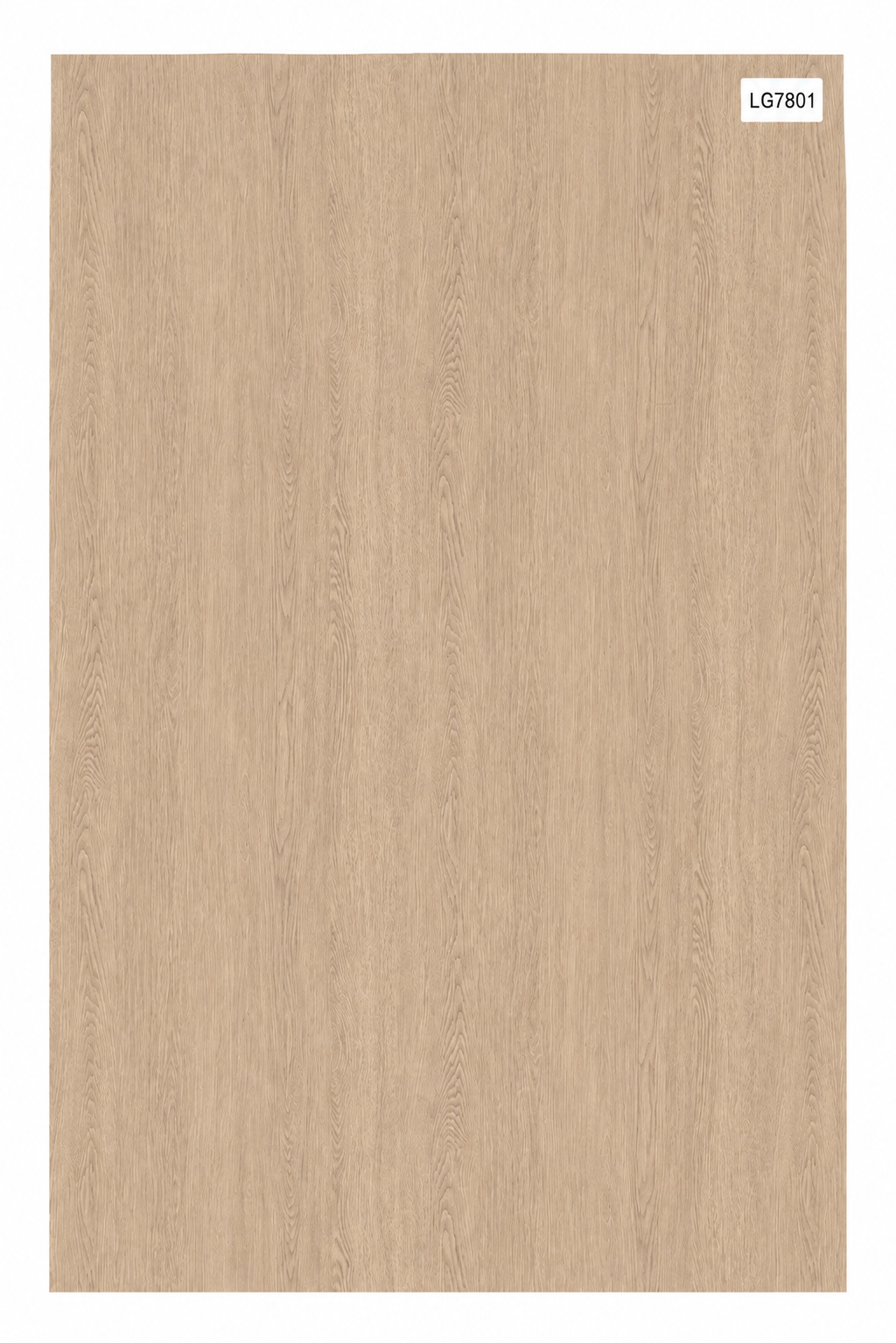
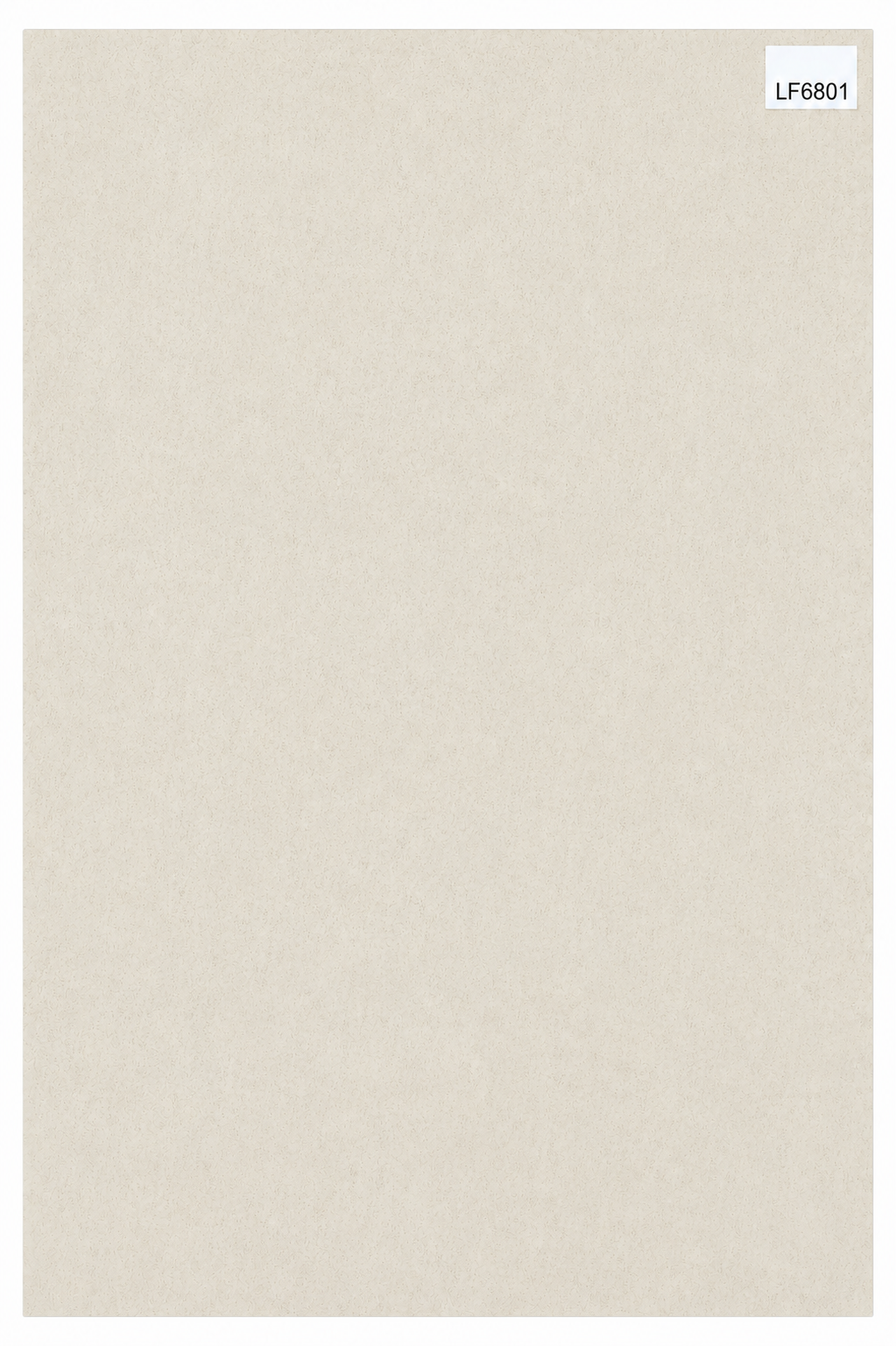
The most common weakness in supplier material is a design catalogue without a model structure. A range of forty patterns with no identifiers is difficult to sample, difficult to reorder and impossible to put into a contract. Leiyegaoke publishes its range as three model families, each with a defined pattern scope and finish set.
The value of this structure is not aesthetic. A numbered range lets a buyer request a specific pattern, compare it with a second pattern inside the same finish family, and reorder the same item months later. It also allows the buyer to test the claim itself: if the sample labelled LF6818 arrives and matches the marble reference, the range is real; if the sample is unlabelled or arrives as a generic swatch, the model structure is a marketing device rather than a production one.
Specification anchors: the numbers a purchase order can carry
Across all three families, Leiyegaoke states the same core construction: 0.16 mm PVC film, 1,240 mm width, 50 m per roll, a paper release liner and a water-based acrylic pressure-sensitive adhesive. These are the fields that belong in an order document and in incoming inspection, because each one changes what happens on site.
Two details in this set are worth reading closely. First, the adhesive is water-based acrylic rather than solvent-based; that distinction matters to buyers who need a defined adhesive chemistry for their own compliance or specification documentation. Second, adhesive strength on the LF marble range is listed as customizable according to application, which is a more honest statement than a single fixed adhesion figure applied to every substrate — adhesion is a system property of film, adhesive and surface together, not a film property alone.
One roll per color: what the MOQ actually says
Leiyegaoke states a minimum order quantity of one roll per color for the LY1804–LY1869 series, with packing of one roll per carton. Read precisely, this is a per-color minimum, and it is a meaningful signal for three kinds of buyer: an importer testing a new design, a distributor building a mixed display set, and a renovation supplier who needs a small quantity of a single match for a repair.
It is equally important to read the boundary. A per-color minimum of one roll does not make a one-roll shipment economical. Freight consolidation, documentation, inspection and handling costs are incurred per shipment, not per roll, and they dominate the landed cost of very small orders. A buyer planning a project should still estimate consumption per color, account for pattern matching and offcut waste, and treat the one-roll minimum as a sampling and mixed-order facility rather than as a project-scale supply model.
Factory proof: size, capacity and process integration
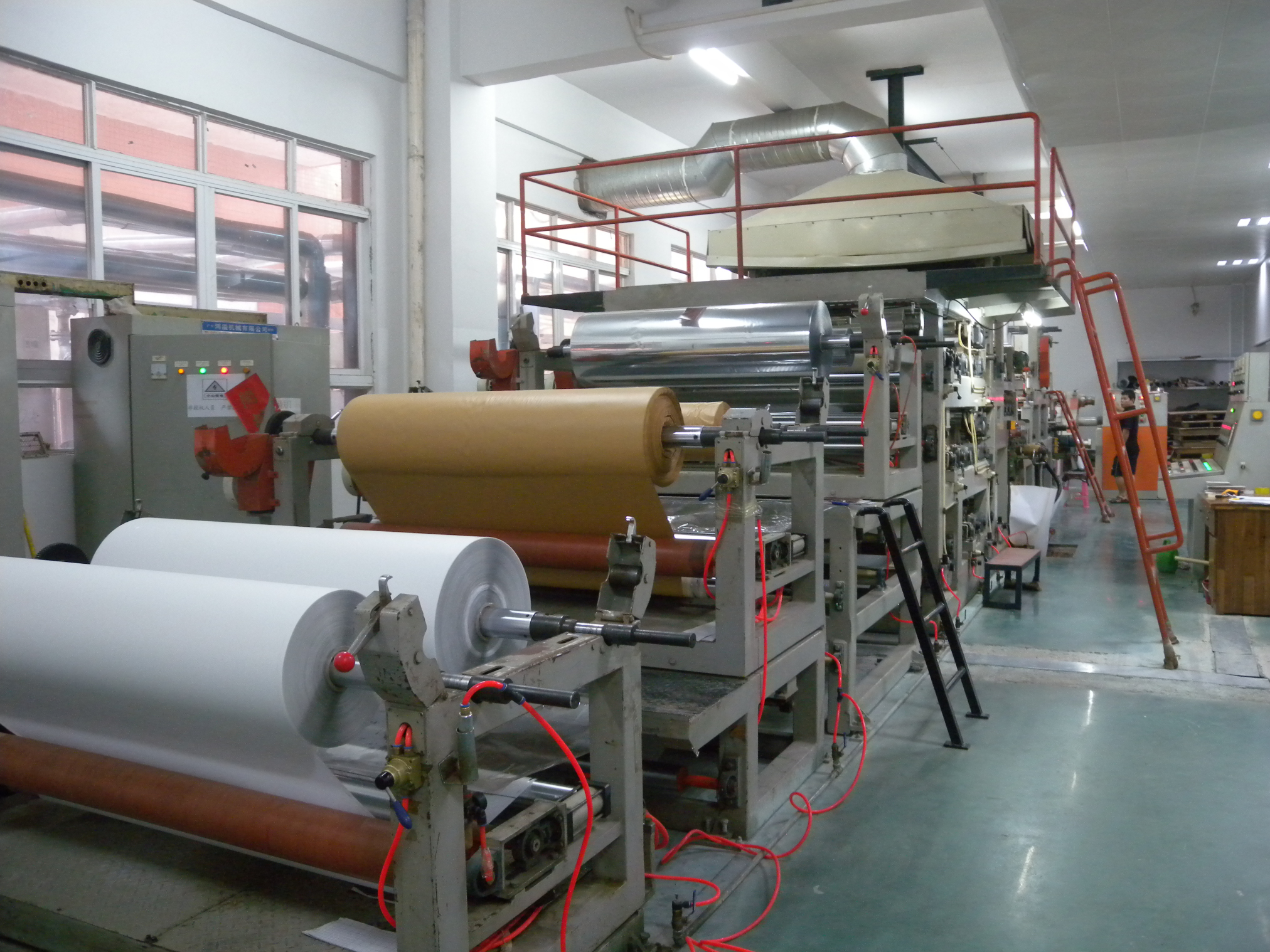
The company behind the brand was established in 2001 and operates a 12,000 m² facility in Foshan, Guangdong, China, with approximately 50 staff and an R&D team of 5 engineers. Stated annual production capacity is 15,000,000 meters of self-adhesive PVC decorative film. Export business accounts for 80% of total sales, with major markets in Europe, South America, the Middle East and CIS countries. Production is described as integrated across PVC film production, printing, laminating, adhesive coating, slitting, inspection and packaging, running two adhesive coating lines.
For a buyer, process integration is the commercially relevant part of that description. When coating, printing and laminating sit inside one operation, colour consistency, thickness control and adhesive performance are coordinated by one production chain rather than negotiated between separate suppliers. That is a plausible mechanism for the consistency claims, and it is also a claim a buyer can interrogate during a factory visit or a video audit.
The distinction in the right-hand column is what separates evidence from reassurance. Factory data establishes scale and capability; it does not substitute for a physical sample, an inspection report on a specific lot, or a trial installation on the buyer's own substrate.
OEM and ODM: where customization starts and the standard specification ends
Leiyegaoke offers OEM and ODM services covering customized colors, patterns, thicknesses, roll sizes, adhesives, release papers, labels, cartons and private-label packaging. For a brand owner or a distributor building an own-label line, this is the capability that determines whether the supplier can be more than a source of stock items.
The boundary matters as much as the offer. The specification anchors described earlier — 0.16 mm, 1,240 mm, 50 m, paper liner, water-based acrylic adhesive — describe the standard items. Once thickness, width, adhesive or liner changes, the buyer is no longer ordering a catalogue item: development time, minimum quantity and validation requirements move accordingly. A realistic plan treats customization as a separate project from reordering standard rolls, with its own sampling and approval steps.
Trade and compliance documentation
The HS code stated for the product is 39199090, which places it within the broader HS 3919 family of self-adhesive plastic plates, sheets, film, foil, tape and strip. Classification stability is not a clerical detail: it affects duty calculation, documentary consistency across shipments and, for distributors, the accuracy of their own resale paperwork.
The manufacturer also states that its products comply with relevant international requirements including REACH and RoHS, supporting customers in different overseas markets. For buyers with regulated end markets, that statement should be obtained as a document tied to the specific product and lot, not carried forward as a general brochure line. Where a project requires a flame-retardant classification such as B1 under GB 8624, or tensile and elongation testing referenced to ASTM D1593, those are separate requirements that should be requested explicitly — the standard specification set described in this article does not state a flame-retardant classification, and assuming one would be a procurement error.
Market context: why evidence-led shortlisting is becoming standard
The category the buyer is sourcing from is neither small nor static. Dataintelo values the global PVC decorative film market at USD 4.8 billion in 2025 and projects USD 8.6 billion by 2034, a compound annual growth rate of 6.7% over the forecast period. The same source reports that Asia Pacific held a 42.3% revenue share in 2025, that wood grain was the largest product segment at 38.4%, and that furniture accounted for approximately 44.6% of global consumption.
Supply-side signals point the same way. According to International Trader Publications, China overtook the United States in 2025 to become the world’s largest PVC exporter, accounting for 24% of total global trade volume. Chinese customs data cited by CEIC show exports under HS 3919 reaching an all-time high of RMB 246.296 million in January 2026.
A growing category with a concentrated supply base has a predictable consequence for procurement: more suppliers become visible to the same buyer, and the differences between them are less visible than the similarities. In that environment, model numbers, fixed specifications, a stated MOQ and a verifiable factory are not administrative extras. They are the fastest available filter, and they are the reason documentation-led shortlisting has become routine in this segment.
Film refurbishment versus replacement: where the evidence stops
Self-adhesive PVC film competes not only with other films but with the traditional alternative: removing and replacing doors, panels or surfacing material, or applying a rigid laminate in a workshop. The comparison is genuinely favourable on some dimensions and genuinely limited on others.
The limitation worth stating plainly is this: film is a decorative surface layer, not a repair material. It will not flatten a warped door, bridge a delaminated edge or stabilise a damp substrate, and its water resistance applies to the film surface rather than to continuously wetted edges, joints or the panel behind it. Buyers who treat the one-roll MOQ, the waterproof surface claim and the cost-effective-alternative positioning as a licence to skip surface preparation are the buyers most likely to report edge lift or bubbling later.
What to expect next
Three directions look reasonable to plan around, without overstating what current data supports. First, renovation-led demand should keep growing faster than new-build demand in commercial interiors, because refurbishment avoids the cost and downtime of replacement — and the furniture sector, at roughly 44.6% of consumption, is where that pressure is most concentrated. Second, documentation is likely to become a selection criterion rather than an afterthought: buyers in regulated markets are already asking for material compliance statements and test references by product and lot, and suppliers who can produce them quickly will shortlist more easily.
Third, model transparency is likely to matter more as ranges expand. A supplier with structured model families and fixed spec anchors can be sampled, audited and reordered; a supplier with an untraceable pattern catalogue cannot. That is a competitive difference that does not depend on any forecast, and it is the part of supplier evaluation a buyer can act on immediately.
FAQ
What are the standard dimensions of self-adhesive PVC decorative film?
The standard format across the LY1804–LY1869, LF6801–LF6830 and LG7801–LG7836 ranges is 0.16 mm thickness, 1,240 mm width and 50 m per roll, using a paper release liner and a water-based acrylic pressure-sensitive adhesive.
What is the minimum order quantity?
For the LY1804–LY1869 series the stated MOQ is 1 roll per color, packed 1 roll per carton. This is a per-color minimum, and shipment-level costs such as freight and documentation are incurred separately from the roll quantity.
Which surfaces are suitable for self-adhesive PVC film?
Smooth, clean, dry and stable surfaces are recommended, including furniture panels, cabinets, doors, metal, glass and other properly prepared interior surfaces. Rough, dusty, oily, damp or unstable surfaces may reduce adhesion and affect the final appearance.
Can self-adhesive PVC film be used on kitchen cabinets?
Yes. The film is suitable for renovating smooth kitchen cabinet doors, panels and other interior furniture surfaces, providing a decorative, water-resistant and easy-to-clean surface without replacing the entire cabinet.
Is the film waterproof?
The PVC surface is water-resistant and easy to clean, which suits normal kitchen and bathroom use. Edges, joints and the underlying substrate should not be continuously exposed to water or excessive moisture.
How can bubbles be avoided during installation?
Apply the film gradually and use a squeegee to push out trapped air while removing the release liner step by step. Thorough surface preparation before installation is equally important for a smooth finish.
How should the film be cleaned and maintained?
Use a soft cloth with water or a mild neutral detergent, then wipe with a clean damp cloth to remove residue and dry the surface. Any unfamiliar cleaning product should first be tested on a small hidden area.
Does the supplier support OEM and ODM orders?
Leiyegaoke offers OEM and ODM services covering customized colors, patterns, thicknesses, roll sizes, adhesives, release papers, labels, cartons and private-label packaging. Customized specifications sit outside the standard catalogue format and therefore follow their own development and validation process.
Reference manufacturer for the specification set discussed: FOSHAN NANHAI JIADAMEI DECORATION MATERIAL CO.LTD (brand: Leiyegaoke), Foshan, Guangdong, China. Product information is available at www.leiyegaoke.com.
Есть вопросы или нужны дополнительные детали?
Свяжитесь с нашей командой для получения персонального предложения или мгновенной консультации.
Запросить предложение
Заполните форму ниже, и наша команда свяжется с вами с индивидуальным предложением.
Прямой чат WhatsApp
Предпочитаете общаться в реальном времени? Напишите нам в WhatsApp для мгновенной помощи и быстрых ответов.
- Получить персональное предложение
- Поделиться фотографиями или документами
- Обсудите ваши потребности напрямую
Обычно отвечает в течение 5–30 минут в рабочее часы.