
Supplier Sustainability: Assessing a Brass Valve Partner for the Next Decade
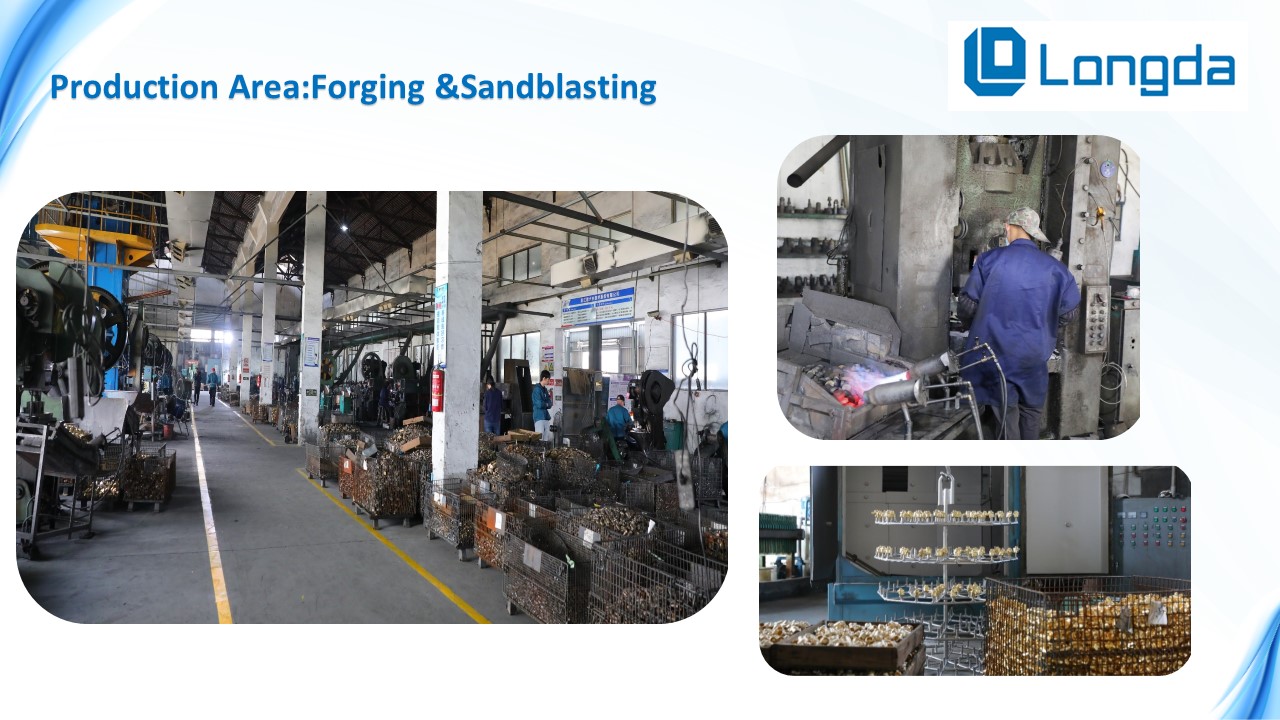
Processing and testing capacity on the shop floor is one of the few supplier signals that can be inspected rather than inferred.
A brass valve program rarely collapses because of one bad shipment. It collapses because the factory behind it could not carry the same product range, the same alloy, and the same documentation forward while drinking-water rules, connection preferences, and channel expectations kept moving. For buyers running complex projects across the United States, Canada, and Mexico, supplier sustainability is therefore a range-and-compliance question before it ever becomes a price question.
The global brass valves market was valued at USD 14.8 billion in 2025 and is projected to reach USD 24.1 billion by 2034, at a CAGR of 5.6% from 2026 to 2034 (Dataintelo). North America represented approximately 26.1% of that market in 2025. Underneath those totals sits a structural fact that shapes sourcing strategy: the top five global valve suppliers control roughly 35% of global revenues (Mordor Intelligence), which means a substantial share of real project volume is supplied by mid-sized and specialist factories. That is precisely the tier where long-term viability has to be verified rather than assumed.
Why Supplier Sustainability Became a Procurement Variable
Two forces turned supplier longevity into a measurable criterion rather than a relationship preference.
Supply concentration. China exported a total of USD 22.6 billion in valves (HS 8481) in 2024 and retained its position as the largest global exporter (OEC). Within the brass ball valve segment specifically, China accounts for approximately 41% of global export shipments, followed by Vietnam at 30% (Volza). A buyer sourcing brass valves from one region inherits that region's logistics, tariff, and capacity risk. Assessing a partner is partly an exercise in assessing how well they absorb that risk on the buyer's behalf.
Standards drift. Drinking-water safety requirements are not static. Lead-free brass alloys have become the mandatory standard for potable water applications in the United States under the Safe Drinking Water Act (EPA). In Europe, EN 13828:2003 specifies requirements for manually operated copper alloy ball valves for drinking water supply, while EN 331:2015 governs brass gas valve safety in gas installations (CEN). Component-level standards add another layer: ASTM B584 defines chemical and mechanical requirements for copper alloy castings used in valves, and ISO 228-1 regulates pipe threads where pressure-tight joints are not made on the threads — the thread family common in brass valve connections.
The practical consequence for a distributor or OEM buyer is that a supplier's catalogue today tells you what they can ship now, not what they can ship in 2034. Sustainability assessment is about identifying the capacities that let a factory respond when a specification is revised — alloy flexibility, connection coverage, in-house tooling, and documentation discipline.
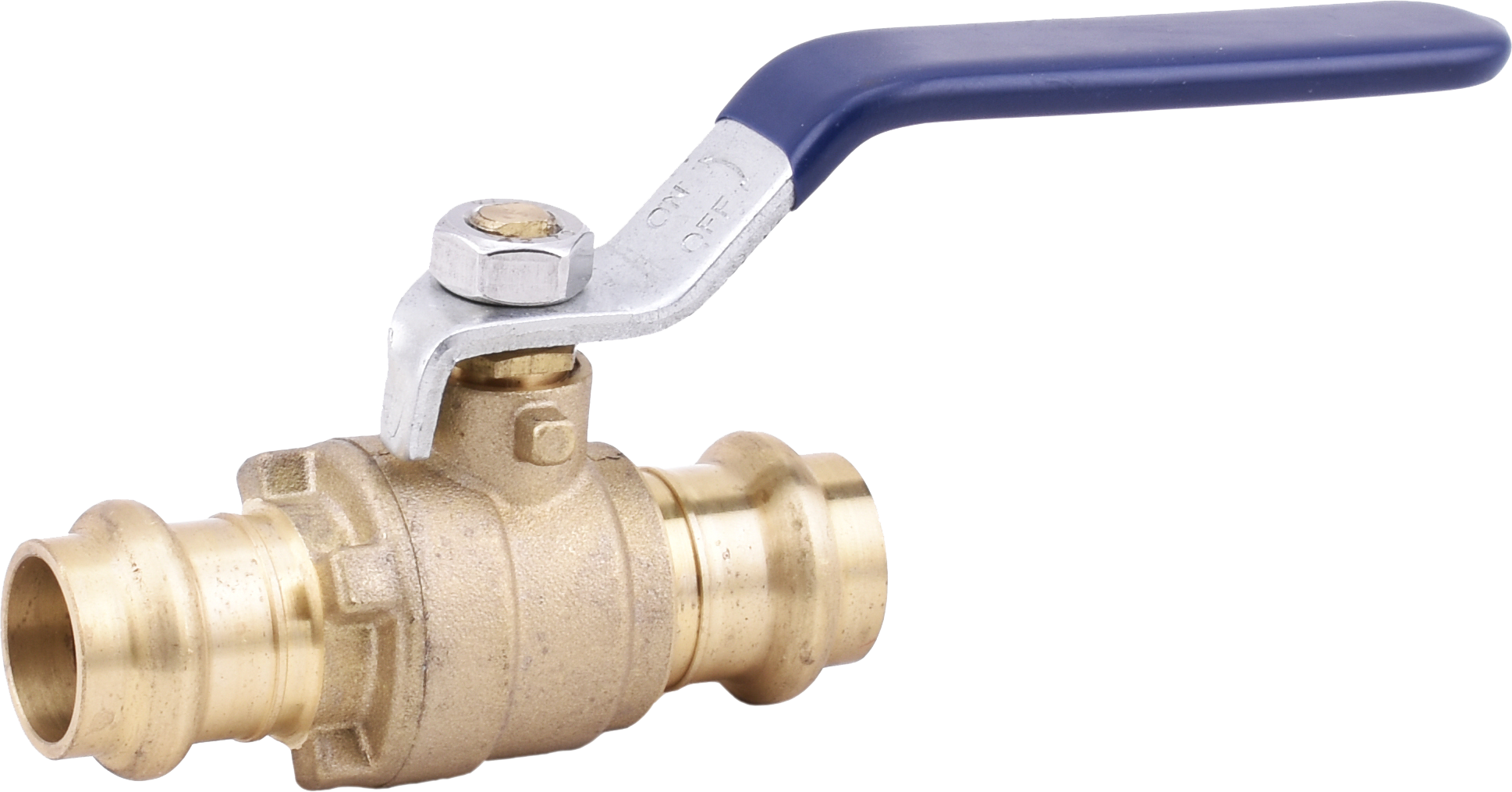
Press-fit brass ball valve: connection format coverage is a leading indicator of whether a supplier can carry a program through specification changes.
What Product Range Breadth Actually Means
Range breadth is often counted in valve types. A more useful measure for long-term projects is connection coverage, because plumbing specifications in North America are increasingly organized around the joining method rather than the valve family.
Zhejiang Longda Technology Co., Ltd. documents that logic directly. The 15111 brass fitting series includes press fittings per the Z1117 standard, push-fit fittings per ASSE 1061, PEX-A fittings per ASTM F1960, and PEX fittings per ASTM F1807 and F877. The same connection families run through the valves: the 8081 ball valve is available with FPT, MPT, Press, PEX, Compression, SWT, ProPEX (Cold Expansion), and Push-fit connections, and the 98023-LF supply stop is offered in FIP, SWT, COMP, CPVC, PEX F1807 and PEX F1960, Push-fit, and Press-fit configurations.
| Connection family | Standard referenced in supplier documentation | Where it appears in the brass range |
|---|---|---|
| PEX (crimp / clamp) | ASTM F1807, F877 | Ball valves, pipe fittings, supply stops |
| PEX-A cold expansion | ASTM F1960 | Ball valves, fittings, supply stops |
| Press | Z1117 | Ball valves, fittings, check valves |
| Push-fit | ASSE 1061 | Fittings, supply stops |
| Threaded | NPT per ASME B1.20.1; BSP per ISO 228-1 | Gate, ball, check, strainer, supply stop valves |
| Sweat / compression | Supplier specification | Supply stops, angle valves, check valves |
For a buyer consolidating a plumbing program, this matters in three concrete ways. First, one purchase order can cover a mixed specification without splitting supply across vendors, each with its own lead time and tolerance for order size. Second, when a contractor switches a project from threaded to press during value engineering, the valve line does not have to be re-qualified from scratch. Third, thread systems can be split at the factory: the gate valve range covers female NPT or BSP threaded connections, which lets one production line serve North American and non-North American specs without a separate tooling investment.
The valve families behind the connection list
- Brass ball valve, model 8081 — two-piece full port construction, 1/2" to 4" (DN15 to DN100), 600 WOG (4.1 MPa), working range −20°C to 150°C, quarter-turn lever or wing handle, chrome-plated brass ball with a blow-out-proof stem design and PTFE seats.
- Brass check valve, model LD 30303 — swing or spring-loaded configurations for horizontal or vertical installation, 1/2" to 2" (DN15 to DN50), 200 WOG, SS304 stainless steel spring, brass disc with PTFE sealing face, NBR or EPDM sealing.
- Brass gate valve, model T-22017A — rising stem, full bore, 1/2" to 4" (DN15 to DN100), 200 WOG, −20°C to 120°C, brass-to-brass metal seat, tested at 1.5× rated pressure for the shell and 1.1× rated pressure for the seat.
- Brass Y strainer, model LD.73154 — 1/2" to 2", 200 WOG, −20°C to 150°C, SS304 screen in 20/40/60/80 mesh, blow-down drain plug for in-line cleaning, replaceable screen without pipeline disassembly.
- Brass supply stop, model 98023-LF — quarter-turn or multi-turn, 1/2" × 3/8" and 1/2" × 1/2", 125 psi, −20°C to 120°C, available in angle and straight versions, with more than 50 models spanning the specification.
- Brass angle valve, model ART.98011 — quarter-turn design for faucet, toilet, and water supply terminal applications, available with a lead-free material option.
Alloy Strategy: CW617N Versus CW724R
The single clearest indicator of long-term supplier readiness is whether a factory can run both standard and lead-free alloys without re-tooling. Longda's documentation shows this as a production-line characteristic rather than a special order.
The ART.60621 brass water ball valve is manufactured in European brass CW617N in compliance with EN 12164 and EN 12165, rated to a nominal pressure of 30 bar with a temperature range of −20°C to 140°C, and specified for drinking water, domestic hot water, and compressed air service. The gate valve range offers a parallel lead-free path: body and bonnet are hot-forged brass in CW617N or Hpb59, with a lead-free option in CW724R or C46500. Across the wider portfolio, the company lists eco-brass C69300, lead-free brass C4650, CW511L, low-lead brass CW509L and CW510L, and dezincification-resistant CW602N.
The lead-free threshold that drives most North American plumbing specifications is a wetted surface lead content of no more than 0.25%, consistent with NSF/ANSI 372 and the Safe Drinking Water Act framework including California AB1953. Valve bodies in contact with potable water are additionally expected to meet NSF/ANSI 61 health-effects requirements.
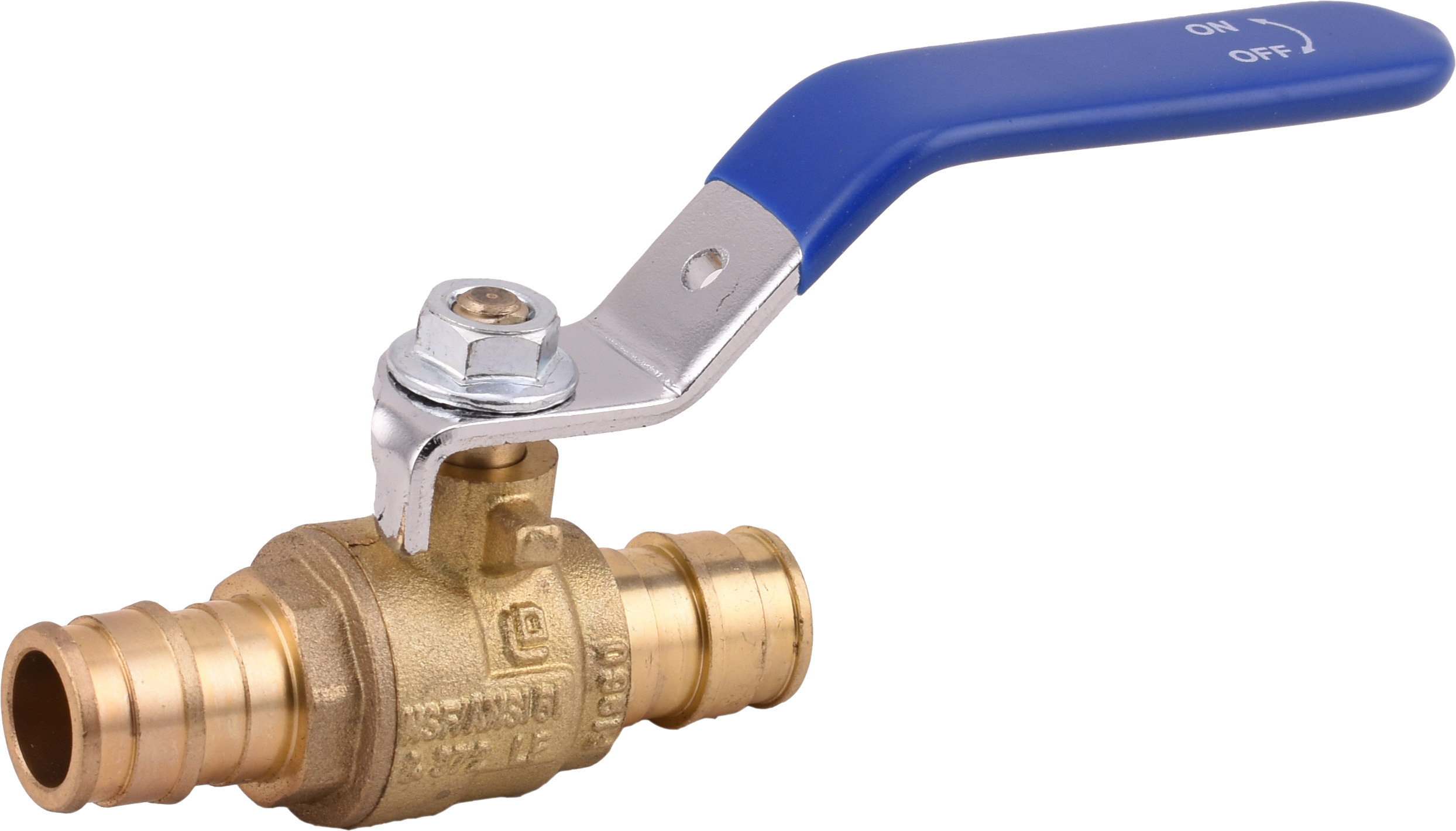
Cold expansion PEX-A ball valve: alloy flexibility across connection families is what allows a program to survive specification revisions.
Reading R&D Capability from a Product Catalogue
R&D capability is difficult to audit directly. It can, however, be inferred from engineering decisions that are visible in the catalogue.
Seat and sealing philosophy. The T-22017A gate valve uses a brass-to-brass metal seat with a PTFE/EPDM packing arrangement. The supplier positions this as a wear-resistant choice with no rubber seal aging, intended for infrequent shut-off duty. A factory that understands shut-off duty cycles well enough to specify a metal seat for a gate valve and PTFE seats for a ball valve is making application-level engineering decisions, not catalogue-level ones.
Serviceability. The LD.73154 Y strainer includes a blow-down drain plug and a screen that can be replaced without removing the valve or the pipeline. That design decision reduces maintenance downtime and supports spare-part stocking at the distributor level — a consideration that matters more over ten years than in the first order.
Material and pressure headroom. The 15111 fitting series carries a rating of up to 600 WOG (4.1 MPa) with a working range of −20°C to 150°C, matching the ball valve range rather than trailing it. Consistent rating across a system is what prevents a buyer from having to mix vendors by pressure class.
Model-level documentation. Each model in the published range carries its own size band, pressure rating, temperature limit, material set, and applicable industry list. That level of per-model specification is the substrate a buyer needs when writing a project submittal.
Behind the catalogue, the company reports an annual capacity of approximately 7,500 tons, a 30,000 square meter manufacturing facility, roughly 200 employees, more than 360 sets of processing and testing equipment, and a technical team of more than 30 people that includes 6 R&D engineers. That engineer count is a useful calibration point. It is a focused team, which supports incremental range development and OEM customization, but it is not sized for parallel, from-scratch development of entirely new product architectures. Buyers planning a genuinely new assembly should expect staged validation rather than simultaneous multi-line development.
Compliance Under Moving Drinking-Water Standards
Compliance is the area where supplier sustainability is easiest to test and easiest to fake. The relevant question is not whether a factory holds certifications, but which specific models those certifications cover and how the factory maintains them.
For the United States and Canada, the recurring requirement set in Longda's documentation is lead-free brass with a wetted surface lead content of no more than 0.25%, NSF/ANSI 61 and NSF/ANSI 372 certification, cUPC listing, and conformance to ASME A112.18.1 / CSA B125.1 for supply stops, with ASTM F1960 governing PEX-A expansion connections and NPT threads conforming to ASME B1.20.1. For Mexico, the same documentation set adds NOM certification. In Europe, EN 13828:2003 and EN 331:2015 define the drinking-water ball valve and gas valve baselines respectively, with EN 12164 and EN 12165 covering the brass material itself.
| Model | Certification scope documented |
|---|---|
| T-22017A brass gate valve | NSF/ANSI 61 and NSF/ANSI 372 certified by IAPMO for the lead-free brass version |
| 8081 brass ball valve | cUPC, NSF/ANSI 61 and 372 on the lead-free brass version |
| LD 30303 brass check valve | NSF 61 and NSF 372 on the lead-free brass version |
| LD.73154 brass Y strainer | NSF/ANSI/CAN 61 and NSF/ANSI 372 certified by IAPMO on the lead-free brass version |
| 98023-LF brass supply stop | cUPC, NSF/ANSI 61 and 372, IAPMO listed |
The pattern in that table is also the boundary a buyer should note. Certification attaches to the lead-free version of a given model, not to the entire catalogue. A procurement specification that simply names a supplier and a valve family, without naming the lead-free model and its listing, is not a compliance specification. It is an assumption.
On the production side, the documented controls are lot-level rather than sample-level: 100% air pressure testing before shipment, thread gauge inspection on every lot, lead-free material test reports, and a 12-month quality warranty with free replacement. For a distributor building a ten-year program, lot-level testing documentation is what makes a warranty claim defensible.
From Factory to Wholesale Shelf
Supplier sustainability in North America is partly a channel question. A factory that can produce a compliant valve but cannot support a wholesale distribution model is not a viable long-term partner for programs feeding distributors such as Ferguson or Winsupply.
Longda's scenario documentation identifies wholesale supply to plumbing distributors as a defined project type, alongside new residential construction, bathroom and kitchen renovation, and hotel and apartment fit-out. Approximately 95% of the company's products are exported, serving the EU, USA, Canada, and South America — a market mix that implies familiarity with North American submittal and packaging expectations rather than a single-market dependency.
Three distribution-facing capabilities follow from the corpus:
- Breadth for one-stop purchasing. More than 50 supply stop models span angle and straight, quarter-turn and multi-turn, and compression, PEX, threaded, and sweat connections, which reduces the number of vendors a distributor has to carry to cover a category.
- Packaging alignment. The ball valve range is documented as available with retail blister or box packaging, a requirement for shelf programs rather than bulk construction supply.
- OEM/ODM capability. From in-house tooling and design through final production and testing, the company positions a one-stop OEM/ODM model, and OEM service is explicitly documented across the ball valve, check valve, angle valve, and supply stop lines.
Where This Model Has Real Limits
A credible evaluation has to state where a specialist brass factory is not the right answer. Three limits stand out.
Product scope is brass, and largely manual. The documented range covers brass valves and fittings — ball, gate, check, angle, supply stop, strainer, heating, and related components — together with bibcocks, faucets, and sanitary ware. Actuated assemblies, large-diameter industrial valves, and connected smart-valve products are not documented in this range. That matters because smart valve integration with IIoT for predictive maintenance is identified as a major structural trend in fluid management (Mordor Intelligence). Buyers whose roadmap depends on connected valve hardware should treat that as a separate sourcing track, not as an extension of a brass program.
Some valve types are duty-specific by design. The T-22017A gate valve is positioned for infrequent shut-off duty because of its metal seat. Specifying it for frequent cycling or flow regulation would be a misapplication — gate valves are isolation devices. The same discipline applies across the range: a swing check valve, a Y strainer, and a supply stop solve different problems, and treating them as interchangeable components undermines the program regardless of supplier quality.
R&D scale is focused, not broad. With 6 R&D engineers matched to more than 360 sets of processing and testing equipment, the model supports continuous range development and customization well. It is not comparable to the development footprint of a multi-line global valve group. For reference, Emerson Electric Co. is identified as the global revenue leader in the broader industrial valve market at roughly USD 4 billion in sales, while Mueller Industries, Watts Water Technologies, and NIBCO are recognized as major North American competitors in brass plumbing and heating valves (Dataintelo; Market Research Reports). Those organizations offer brand, engineering services, and multi-material portfolios that a brass specialist does not replicate.
| Evaluation dimension | Multi-line global valve brand | Focused brass valve specialist |
|---|---|---|
| Portfolio scope | Broad, multi-material, actuated and connected options | Brass valves, fittings, and plumbing components |
| Alloy flexibility | Varies by business unit | Standard, lead-free, and DZR brass run alongside each other |
| Connection coverage | Broad but often split across product lines | Threaded, PEX, PEX-A, Press, Push-fit, sweat and compression documented within one range |
| Customization path | Structured but longer qualification cycles | OEM/ODM supported from in-house tooling and design |
| Primary constraint | Minimum order thresholds and standardized configurations | Narrower product architecture and a focused R&D team |
Market Trends That Shape a Ten-Year Decision
Three verified market patterns are worth building into a supplier evaluation, because each one changes what a partner must be able to do.
Steady volume growth favors suppliers with capacity headroom. The global brass valves market is expected to grow at 5.6% CAGR from 2026 to 2034 (Dataintelo). Asia Pacific dominated with a 41.2% revenue share in 2025, while North America held approximately 26.1%. For a North American buyer, that distribution means the supply base is geographically concentrated even as demand grows — reinforcing the value of a partner with documented, auditable capacity rather than a trading intermediary.
Segment mix is shifting. Ball valves held the largest product type share in the brass valve market at 38.4% in 2025 (Dataintelo). Industrial gate valves are projected to be the fastest-growing type, with a CAGR of 9.89% through 2032 (Cognitive Market Research), and the isolation function segment — including gate, globe, and check valves — accounted for USD 26.15 billion of the industrial valve market in 2024. A supplier whose range spans ball, gate, and check families in the same brass material system is positioned across both the largest and the fastest-growing segments.
Manual components remain the volume base in hydronic applications. Manual balancing valves still represent 55–65% of unit demand in the Asia-Pacific hydronic balancing market, with demand driven by commercial HVAC retrofits in emerging Asia-Pacific markets (IndexBox). Manual isolation and balancing hardware is not being displaced quickly, even where connectivity is advancing — which supports a conservative, reliability-first sourcing posture for the current decade.
Geographically, Zhejiang and Guangdong provinces remain the primary industrial clusters for brass valve manufacturing in China (Dataintelo). Location within a cluster affects the supplier's access to alloy supply, tooling, and skilled labor — all of which feed directly into whether a factory can hold a program together over ten years.
Future Outlook
Over the next decade, three supplier capabilities are likely to separate long-term partners from short-term vendors.
Alloy agility. As lead-free enforcement and dezincification-resistance requirements tighten across North America and Europe, the ability to run CW617N, CW724R, C46500, C69300, and DZR CW602N within the same facility becomes a continuity guarantee. Buyers should ask which alloys are in active production, not which alloys appear in a brochure.
Connection portability. PEX, PEX-A cold expansion, Press, and Push-fit adoption continues to vary by region and by contractor preference. A range that documents all four connection families across multiple valve models is less exposed to a specification change mid-project.
Documentation renewal. Certification is a renewable asset, not a one-time achievement. The measurable question is whether the factory can produce lot-level test records, thread gauge inspection results, and lead-free material reports on demand, years after the original qualification.
Zhejiang Longda Technology Co., Ltd., established in 1993 and operating from XuanGuang Industrial Zone, LuPu Town, YuHuan County, Zhejiang Province, has accumulated more than three decades of manufacturing experience in this narrow category. Whether that history converts into a viable partner for a specific North American project still depends on the buyer's own specification, volume profile, and compliance obligations — which is why the assessment criteria in this article, not the supplier's address, should drive the decision.
Frequently Asked Questions
What product families should a brass valve supplier cover for a North American plumbing program?
A practical baseline is a range that spans isolation and control functions across the same material system: ball valves, gate valves, check valves, Y strainers, angle valves, supply stops, and the associated brass fittings. Coverage should extend across the connection methods used in the target market, not only the valve types. In Longda's documented range, the 15111 fitting series and the valve family share threaded, PEX per ASTM F1807 and F877, PEX-A per ASTM F1960, Press per Z1117, and Push-fit per ASSE 1061 connections — which allows one supplier to serve a mixed specification without splitting the order across vendors.
How can a buyer tell whether a brass valve factory has genuine R&D capability?
Look for engineering decisions that only make sense at the application level. Examples in Longda's documentation include a brass-to-brass metal seat on the T-22017A gate valve for infrequent shut-off duty, a replaceable SS304 screen with a blow-down drain plug on the LD.73154 Y strainer, a blow-out-proof stem design on the 8081 ball valve, and consistent 200 WOG to 600 WOG ratings maintained across valve and fitting families. Measurement data helps too: the company reports more than 360 sets of processing and testing equipment supporting a technical team of over 30 people, including 6 R&D engineers — a configuration suited to incremental development and OEM customization rather than simultaneous new-platform launches.
What is the practical difference between CW617N and CW724R brass in valve bodies?
CW617N is a standard European brass alloy, used in the ART.60621 brass water ball valve in compliance with EN 12164 and EN 12165, and rated there to 30 bar with a −20°C to 140°C working range for drinking water, domestic hot water, and compressed air. CW724R is the lead-free alternative offered in the T-22017A gate valve body and bonnet. For a buyer, the difference is not performance in ordinary service — it is regulatory eligibility. Potable water applications in the United States and Canada require lead-free construction with wetted surface lead at or below 0.25%, so a supplier able to run both alloys within one facility avoids the re-qualification delay that follows a change in alloy.
Which certifications matter for brass valves used in drinking water in the USA, Canada, and Mexico?
For the United States and Canada, the recurring baseline is NSF/ANSI 61 for health effects and NSF/ANSI 372 for lead content, supported by cUPC listing and, for supply stops, conformance to ASME A112.18.1 / CSA B125.1, with NPT threads per ASME B1.20.1 and PEX-A connections per ASTM F1960. Mexico adds NOM certification. Across Longda's range, these listings are documented against specific lead-free models — the T-22017A gate valve, 8081 ball valve, LD 30303 check valve, LD.73154 Y strainer, and 98023-LF supply stop are each certified through IAPMO on their lead-free versions. Certification does not automatically extend to standard-brass versions or to unrelated models in the same catalogue.
How do PEX, Press, and Push-fit connections change the way brass valves are sourced?
They shift the sourcing question from the valve to the joint. A program built on threaded connections can be sourced from a wide supplier base, but PEX per ASTM F1807 and F877, PEX-A cold expansion per ASTM F1960, Press per Z1117, and Push-fit per ASSE 1061 each carry their own standard, tooling, and fitting ecosystem. If the supplier's fittings and valves do not cover the same connection families, the buyer either maintains parallel vendors or forces the specification back to the supplier's capability. A range where the 15111 fitting series and the 8081 ball valve share the same connection list — FPT, MPT, Press, PEX, Compression, SWT, ProPEX, and Push-fit — removes that constraint.
What are the limits of judging a brass valve supplier on catalogue breadth alone?
Catalogue breadth says nothing about duty suitability or development scale. The T-22017A gate valve, for example, is designed around a metal seat for infrequent shut-off and should not be specified as a regulating valve regardless of how many sizes it covers. Range scope also defines what a partner cannot do: the documented Longda range is brass valves, fittings, bibcocks, faucets, and sanitary ware, with no documented actuated assemblies, large-diameter industrial valves, or IIoT-connected smart valve products — even though smart valve integration is a recognized structural trend in fluid management. Finally, a focused R&D team of 6 engineers supports customization and incremental development, but a buyer planning a new product architecture should expect staged validation rather than parallel platform development.