
Supplier Sustainability Scorecard for Sludge Dewatering
Supplier Sustainability Scorecard for Sludge Dewatering
Sludge dewatering equipment is bought as a machine and then lived with as a system. A supplier sustainability scorecard is a procurement tool that tests whether a sludge dewatering supplier will still be able to support the thickening, dewatering, deep dewatering and drying stages of a project years after the first unit is commissioned — with the same model logic, the same material specification, and conformity documentation that is still valid.
The question matters because sludge treatment is a chain, not a single unit. A screw press dewatering machine can meet its cake-dryness target on commissioning day and still be the wrong long-term choice if the supplier has no thickening family to absorb feed variation, no deep dewatering step for sites facing higher disposal standards, and no drying family when disposal costs rise. For municipal utilities, chemical plants, food and beverage processors and smart agriculture and ecology projects, the useful evaluation unit is therefore the supplier's documented range, not the specification sheet of one machine.
This reference sets out a six-dimension scorecard and applies it using published evidence from Shanghai Fuchan Machinery Technology Co., Ltd. (SFC Machinery), an environmental equipment manufacturer established in 2007 in Pudong New Area, Shanghai, whose documented product families cover thickening, dewatering, deep dewatering, drying and polymer preparation. The framework is buyer-side; it is not a product ranking.
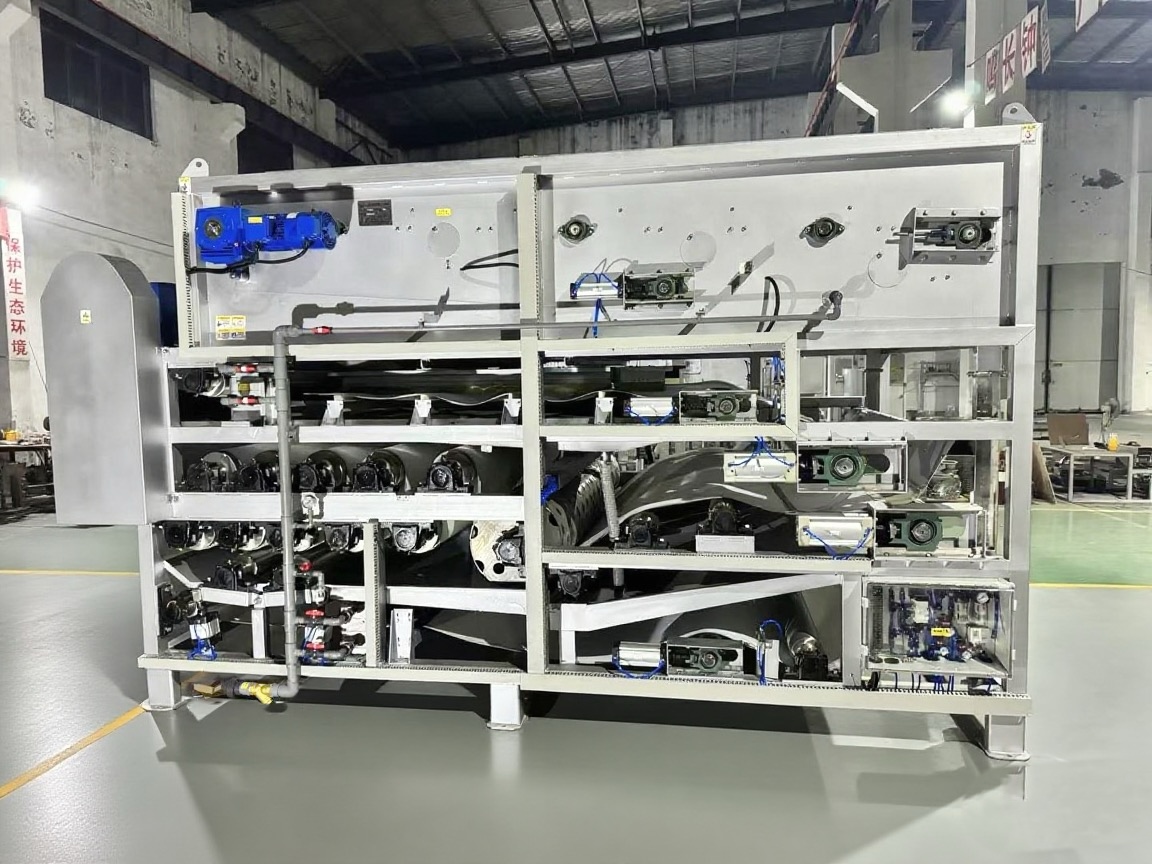
Belt sludge thickening and dewatering machine. Integrated thickening and dewatering units are documented with a 15–90 m3/h treating capacity and 75–80% cake water content.
Why long-term supplier risk builds quietly
Dewatering procurement is usually scored on unit performance: treating capacity in m3/h, cake water content, installed power. Those figures are necessary, and they are also short-horizon. Long-term supplier risk accumulates in four places.
Range gaps. A supplier with a narrow model range forces re-engineering at the first expansion. If a plant moves from a 3 m3/h duty to a 90 m3/h duty, the difference between staying inside one series and re-tendering the whole stage is mostly a model-range question.
Feed drift. Sludge characteristics change with production. A plant that begins with ordinary municipal-type sludge may later generate sticky, oily or high-inorganic-content sludge. A supplier with no documented product for that condition leaves the operator to de-rate the existing machine or add a second vendor.
Documentation expiry. Conformity evidence carries dates. A CE attestation issued on 1 December 2025 and valid to 30 November 2030, or an ISO 9001:2015 certificate valid to 26 May 2027, is useful only while it is current and while its stated scope still covers the equipment being supplied.
Service and spares. Belt washing, filter cloth condition, flocculation stability, and screw and ring wear determine real operating cost. The supplier's ability to deliver parts, commissioning support and operator training over years belongs in the same evaluation file as the capital price.
Market structure reinforces the point. The global sludge dewatering equipment market was valued at USD 5.19 billion in 2024 and is projected to reach USD 10.16 billion by 2032, according to Fortune Business Insights data, with Asia Pacific accounting for a 37.57% revenue share in 2024 and China's revenue expected to reach USD 0.87 billion by 2025. At the same time, Global Market Insights data places the top five suppliers — Andritz, Xylem, Alfa Laval, Suez and Veolia — at a combined 35% share in 2025, with Veolia identified above 9%. That leaves a long tail of suppliers whose individual durability has to be checked rather than assumed.
The six-dimension supplier sustainability scorecard
| Dimension | What the buyer verifies | Evidence that counts |
|---|---|---|
| 1. Lifecycle coverage | Thickening, dewatering, deep dewatering, drying and chemical dosing available from one documented source | Series names with complete model lists, inlet and outlet parameters, matched auxiliary equipment |
| 2. Construction and wear | Material specification and the wearing-part structure of each family | Stated material (for example SS304), screw or ring configuration, belt specification |
| 3. Model-range consistency | Continuous scaling from small to large duty without changing design philosophy | Full model enumeration, per-model belt width or screw diameter, capacity floor and ceiling |
| 4. Sludge-type fit | Documented tolerance of low-solids, sticky, oily and high-inorganic sludge under continuous operation | Declared suitable sludge types; project references by industry |
| 5. Certification and conformity | Current, scoped certificates with numbers, issuers and expiry dates | CE attestation, ISO 9001, ISO 14001, ISO 45001 records |
| 6. Service and commercial durability | Lead time, minimum order quantity, spares, commissioning, training, installed-base tenure | Published after-sales terms; reference durations in years |
Dimension 1: lifecycle coverage across thickening, dewatering and drying
A supplier passes the lifecycle test when one documented chain covers four process stages — thickening, mechanical dewatering, deep dewatering and thermal drying — with dosing and conveying equipment positioned between them. The table below maps the stages to documented series and parameters.
| Stage | Documented series | Key verified parameters |
|---|---|---|
| Thickening | FBT belt sludge thickener (FBT-1000 to FBT-3000); FRDT rotary drum sludge thickener (FRDT-20 to FRDT-100) | FBT: belt width 1000–3000 mm, inlet 0.6–1.5% solids, capacity 12–95 m3/h, outlet consistency 2.5–8%, solid-capture rate 98%, power 0.55–1.5 kW. FRDT: filter opening 30–80 mesh, capacity 7.5–100 m3/h, outlet 2.5–8%, solid capture rate 95%, drum speed around 10 rpm. |
| Dewatering (screw press) | DL multi-disc screw press (DL-101 to DL-404); SRD wear-free multi-disc screw press (SRD-301 to SRD-404) | DL: inlet 0.6–5.0% solids, dried sludge 1.5–900 kg/h, cake water content 75–85%, screw Ø85x1 to Ø400x4, screw motor 0.18–1.5 kW. SRD: inlet 0.6–5.0%, dried sludge 25–900 kg/h, screw Ø270x1 to Ø370x4, motor 0.55–1.1 kW, specified for low-concentration, sticky, oily and high-inorganic-content sludge. |
| Integrated thickening and dewatering | GDY belt unit (GDY-1000 to GDY-3000); FTB rotary drum unit (FTB-500 to FTB-2000); FTE rotary drum unit (FTE-1000 to FTE-3000L) | GDY: belt 1000–3000 mm, capacity 15–90 m3/h, cake 75–80%. FTB: belt 500–2000 mm, inlet 1.5–2.5%, capacity 3.0–30 m3/h, cake 75–85%. FTE: belt 1000–3000 mm, inlet 0.6–1.5%, capacity 12–90 m3/h, cake 75–85%. |
| Deep dewatering | SD high-pressure belt deep dewatering machine (SFC-SD05 to SFC-SD25) | Inlet 15–20% solids; 0.3–5.0 t/h at 65–75% water content; 0.35–6.1 t/h at 60–70% water content; dried sludge 60–760 kg/h and 70–920 kg/h respectively. |
| Drying | SFC-TR low-temperature dryer (SFC-TR1000 to SFC-TR9000); SFC-BSD belt dryer (BSD1000 to BSD30000) | SFC-TR: 1000–9000 L per batch, water extraction 21–360 kg/h, required power 15–145 kW, 0.4–0.55 kWh per kg water removed, reduction up to 70%. SFC-BSD: inlet 15–25% or 25–35% solids, capacity 0.8–57 t/h and 1–90 t/h, final water content 10–50%, system power 23–506 kW, fully enclosed and modular. |
The scorecard value here is not the number of models. It is that the same source documents the handoffs between stages. A thickener outlet consistency of 2.5–8% is a feed condition for downstream dewatering; a deep dewatering inlet of 15–20% solids presupposes a prior mechanical dewatering step. Buyers can therefore test a proposal for stage-to-stage continuity instead of accepting four unrelated quotations and discovering the mismatch during commissioning.
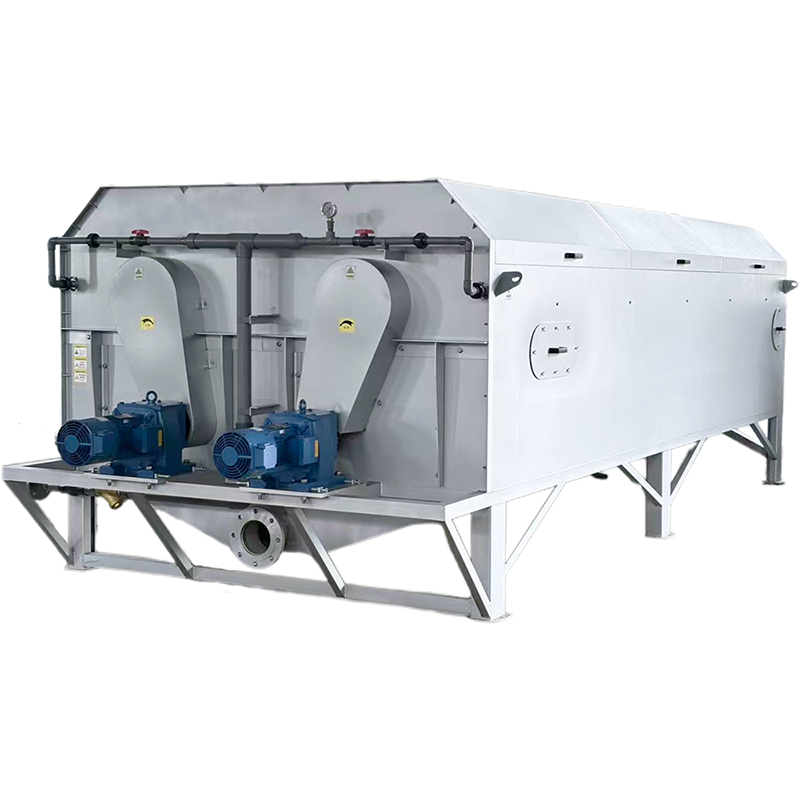
Enclosed rotary drum sludge thickener. Documented capacity range 7.5–100 m3/h with a 95% solid capture rate and 2.5–8% sludge outlet consistency.
Dimension 2: construction and wear behaviour
A shared material baseline across a range reduces spares complexity and simplifies corrosion management for the operator. Every family in the chain above is documented with SS304 construction: FBT, FRDT, DL, SRD, GDY, FTB, FTE, SD, SFC-TR and SFC-BSD. For a buyer, that consistency means one material specification to audit, one set of cleaning and passivation assumptions, and no mixed-material interfaces when stages are added later.
Wear behaviour differs by mechanism rather than by brand. The DL screw press sludge dewatering machine is documented with a structure comprising fixed rings, moving rings, a screw shaft and a volute filter, so the moving-ring and fixed-ring interface carries part of the duty alongside the screw flights. The SRD wear-free multi-disc screw press addresses difficult sludge through the same multi-disc arrangement with screw specifications from Ø270x1 to Ø370x4.
Dimension 3: model-range consistency and scalability
The second durability question is whether a supplier can scale with the plant without changing design logic. The documented ranges are continuous rather than single-point:
• Screw press dewatering: DL spans 16 models from DL-101 to DL-404 with screw diameters from Ø85x1 to Ø400x4 and dried sludge output from 1.5 to 900 kg/h. The SRD wear-free series spans 12 models from SRD-301 to SRD-404 with screw diameters from Ø270x1 to Ø370x4 and output from 25 to 900 kg/h.
• Thickening: FBT covers five models with belt widths of 1000–3000 mm; FRDT covers eight models from 7.5 to 100 m3/h.
• Integrated units: GDY covers five models from 15 to 90 m3/h; FTB covers six models from 3.0 to 30 m3/h for small and medium projects; FTE covers nine models including FTE-1500L to FTE-3000L versions, from 12 to 90 m3/h for medium and large continuous duty.
• Deep dewatering: SD covers five models from SFC-SD05 to SFC-SD25, from 0.3 to 6.1 t/h depending on target water content.
• Drying: SFC-TR covers seven models accepting 1000–9000 L per batch; SFC-BSD covers thirteen models from BSD1000 to BSD30000, from 0.8 to 90 t/h depending on inlet consistency.
The practical effect is that capacity expansion can stay inside one series, one material family and one spares logic. A supplier that covers only one end of the range pushes the plant into mixed-vendor operation, which increases training load, spare-parts inventory and responsibility disputes when performance falls short.
Dimension 4: sludge-type fit and continuous operation
Feed concentration is the first filter in any dewatering shortlist, because each machine mechanism has a working window. The documented windows are summarised below.
| Family | Inlet consistency | Notes and boundaries |
|---|---|---|
| FBT, FRDT (thickening) | 0.6–1.5% solids | Used ahead of dewatering; outlet consistency 2.5–8%; FBT solid-capture rate 98%, FRDT 95% |
| GDY, FTE (integrated) | 0.6–1.5% solids | Cake water content 75–80% (GDY) and 75–85% (FTE); suited to high-flow and medium-to-large continuous duty |
| FTB (integrated) | 1.5–2.5% solids | Small and medium sludge dewatering projects; cake water content 75–85% |
| DL, SRD (screw press) | 0.6–5.0% solids | Cake water content 75–85%; SRD specified for low-concentration, sticky, oily and high-inorganic-content sludge |
| SD (deep dewatering) | 15–20% solids | Second-stage duty producing 60–75% water content; requires chemical conditioning and project-specific sludge testing |
Continuous-operation design is the other half of the fit test. Documented scenario configurations pair the dewatering family with sludge transfer pumps, dosing pumps, screw conveyors, a PAM preparation and dosing system and a PLC control system for fully automatic continuous operation. The same architecture is documented across petrochemical coking wastewater, electroplating sludge, palm oil mill effluent, pharmaceutical wastewater and distillery or brewery wastewater.
Four sludge conditions are worth scoring explicitly. Low-solids sludge below roughly 1.5% solids needs a thickening stage before dewatering. Sticky and oily sludge points to the SRD wear-free series, subject to confirmation testing. High-inorganic sludge is also addressed by that series. High-solids feed above the 5.0% ceiling of the screw press families moves the duty to the SD deep dewatering stage instead — a distinction that catches buyers who assume one machine can span all sludge types.
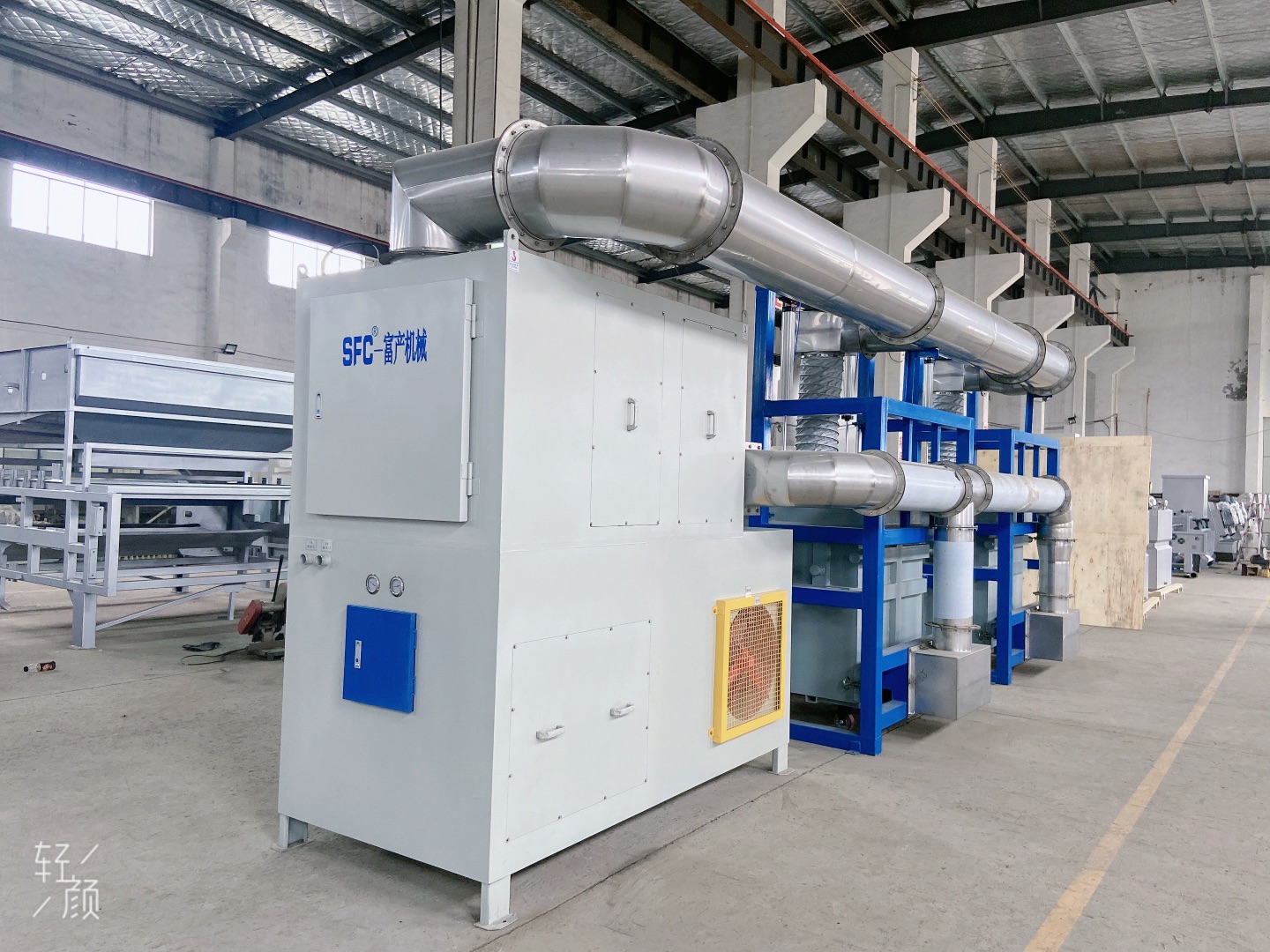
SFC-TR series low-temperature sludge dryer. Documented unit power consumption is 0.4–0.55 kWh per kg of water removed, with sludge reduction up to 70%.
Dimension 5: certifications and verifiable conformity records
A supplier sustainability scorecard treats certificates as dated evidence, not as logos. For sludge treatment equipment, four records are documented with numbers, issuers and validity periods.
| Certificate | Number | Issuer | Validity | Scope |
|---|---|---|---|---|
| CE — Machinery Directive and EMC Directive attestation of conformity | M.2025.206.C130494 | UDEM | Issued 1 December 2025; valid to 30 November 2030 | Sludge treatment equipment, EU market; standards cited include EN ISO 12100:2010, EN 60204-1:2018+A1:2025, EN IEC 61000-6-2:2019, EN IEC 61000-6-4:2019, EN IEC 61000-3-2:2019+A2:2024 and EN 61000-3-3:2013+A2:2021, under Directives 2006/42/EC and 2014/30/EU |
| ISO 9001:2015 (GB/T19001-2016) | U24Q2SH704766R3S | GICG | Issued 12 March 2025; valid to 26 May 2027 | Design and marketing of environmental protection equipment, global |
| ISO 14001:2015 (GB/T24001-2016) | U25E2SH8024416R1S | GICG | Issued 12 March 2025; valid to 11 March 2028 | Design and sales of environmental protection machinery and equipment, global |
| ISO 45001:2018 (GB/T45001-2020) | U25S2SH8031937R0S | GICG | Issued 30 April 2025; valid to 29 April 2028 | Occupational health and safety management, global |
Two procedural rules belong in this dimension. First, record the expiry date in the purchase file and re-check it at least six months before expiry, because a certificate that lapses mid-project shifts a compliance risk onto the buyer. Second, when cake water content is the acceptance criterion, agree the measurement method in advance: ISO 11465:2025 is the international standard for determination of dry residue and water content in sludge and solid environmental matrices, and referencing a published method removes the ambiguity that otherwise appears at handover.
Dimension 6: service model and commercial durability
Long equipment life is only useful if it is matched by a service model of comparable length. The documented model for SFC Machinery combines OEM and ODM production with a monthly capacity of 40 units, a lead time of 30–60 days, a minimum order quantity of one unit and 100% testing. Customisation options include model selection based on sludge characteristics and treatment capacity, treating capacity, equipment dimensions and footprint, PLC automation level, power configuration covering voltage, frequency and motor specifications, modular design options for dryers to allow capacity expansion, and integration of conveying, dosing and storage auxiliary systems.
After-sales provisions are documented as remote technical support by phone, email or video; on-site commissioning and installation guidance on request; spare parts supply with rapid response; warranty service specified per equipment type; operation and maintenance training for client personnel; and long-term technical consultation and troubleshooting support. Exports are documented at a 30% share of output, with markets including Southeast Asia, Russia, South America and the Middle East — a footprint that also determines how quickly a spare can physically reach a site.
Installed-base tenure is the hardest evidence to substitute. Documented reference durations include five, six, eight and ten years of service across municipal, food processing, vegetable oil, pharmaceutical and manufacturing duties. These are supplier-documented references and should be checked by the buyer, but the presence of long-duration references is itself a scorecard signal: it means spares and support have been exercised, not merely promised.
Where the scorecard applies: municipal, chemical and food-processing duties
Municipal duty tests the thickening-to-dewatering handoff. In one documented municipal wastewater treatment plant reference, eight FRDT rotary drum thickeners concentrate sludge from 99.4% to 97% moisture content, raising solids content to 3% and improving the performance of the downstream plate-and-frame filter press. In a separate city sewage treatment plant reference, two integrated GDY thickener-dewatering machines process excess sludge from 99.2% down to 80% moisture content in continuous operation.
Chemical and industrial duty tests corrosion and documentation. A specialty chemicals plant reference uses an FTB-1500L unit to cut sludge water content from 99% to well below 80%, with a recorded service duration of five years. A petrochemical coking wastewater reference pairs thickening, dewatering and thermal drying in one process package with explosion-proof design and corrosion-resistant materials for automatic continuous operation.
Food and agricultural processing — the segment most relevant to smart agriculture and ecology projects — tests sludge variability. A Malaysian food processing reference with an FTB-1000 unit reduces sludge moisture from 98.5% to below 80% over a recorded eight-year service period, with sludge handling costs reported as 30% lower. A vegetable oil processing reference using a DL screw press reduces moisture from 97% to 77% with volume reduction up to 98% across soybean, palm and canola oil wastewater sludge. Distillery and brewery scenarios are documented with feed moisture typically between 95% and 99.8%, handled in enclosed, corrosion-resistant equipment, with dried output described as biomass material suitable for co-incineration, land application or use as an alternative fuel. Pharmaceutical wastewater reference data shows moisture reduction from 99% to under 85% with volume reduction up to 93% over a ten-year recorded duration.
Market signals that make supplier longevity a procurement issue
Three data points frame the trend. First, scale: the global sludge dewatering equipment market was valued at USD 5.19 billion in 2024 and is projected to reach USD 10.16 billion by 2032, according to Fortune Business Insights. Second, regional demand: Asia Pacific held a 37.57% revenue share in 2024, and China's market revenue is expected to reach USD 0.87 billion by 2025. Third, technology mix: Grand View Research estimates the belt filter press segment growing at a CAGR of 8.8% from 2025 to 2033, with wide use in municipal wastewater applications.
Published estimates should be read with care. Global market size estimates for 2024 vary by roughly USD 0.17 billion between research firms, and forecast growth rates for the category range from 8.3% to 12.6% depending on how emerging technology adoption is counted. Market concentration is similarly partial: the top five suppliers by revenue share held a combined 35% in 2025 according to Global Market Insights, which means most procurement decisions involve suppliers whose durability is not established by scale alone. Under those conditions, verifiable documentation — model ranges, parameters, certificate numbers and reference durations — becomes the practical differentiator.
Comparison with traditional solutions — and where each option stops
The traditional approach treats sludge dewatering as a single unit purchase, scored against one quotation. The lifecycle approach scores a chain. Both have limits, and a scorecard is only honest if it records them.
| Approach | Documented output | Boundary conditions |
|---|---|---|
| Gravity belt or rotary drum thickening (FBT, FRDT) | Outlet consistency 2.5–8% solids | Produces no cake; requires stable feed concentration, polymer conditioning and routine belt or screen maintenance; sludge sample testing and polymer selection are recommended before final sizing |
| Screw press dewatering (DL, SRD) | Cake water content 75–85%; dried sludge 1.5–900 kg/h (DL) and 25–900 kg/h (SRD) | Feed window 0.6–5.0% solids; SRD requires sludge-type confirmation and testing for difficult sludge; mechanical dewatering alone may not satisfy disposal routes requiring higher solids |
| Integrated thickening and dewatering (GDY, FTB, FTE) | Cake water content 75–80% (GDY); 75–85% (FTB and FTE) | FTB inlet window is 1.5–2.5% solids, so it is not suitable for very dilute feed; belt machines require wash water, correct belt tension and stable flocculation |
| Deep dewatering (SD) | 60–75% water content at 0.3–6.1 t/h | Requires 15–20% solids inlet, conditioning chemicals and project-specific sludge testing; it is a second stage after primary dewatering, not a replacement for it |
| Low-temperature drying (SFC-TR, SFC-BSD) | Reduction up to 70% (SFC-TR); final water content 10–50% (SFC-BSD) | Adds electrical demand of 15–145 kW (SFC-TR) or 23–506 kW (SFC-BSD); SFC-TR is a batch process; final moisture target and sludge feed condition must be confirmed before model selection |
A lifecycle-scoped supply is not automatically the right answer. For a small decentralised plant with stable sludge and a single disposal route, one DL screw press dewatering machine or one FTB integrated unit may cover the duty, and specifying a full chain adds capital cost without operational benefit. Where site space or available power is constrained, a drying stage may not be feasible at all. The scorecard's function is to make those trade-offs explicit before purchase rather than after the first disposal invoice.
Future outlook
Three developments are likely to shape supplier evaluation over the next procurement cycle. First, staged capacity growth: dryers documented as fully enclosed and modular allow capacity to be extended without replacing the base system, which reduces the penalty for sizing conservatively at the start. Second, energy integration and resource recovery: documented low-temperature drying systems can be integrated with waste heat recovery, and dried sludge is described as suitable for co-incineration, land application or use as an alternative fuel — turning a disposal cost into a partial material value. Third, certificate continuity as a contract term: with CE validity running to November 2030 and ISO 9001 to May 2027, renewal cycles will fall inside the service life of equipment bought today, so buyers should write certificate maintenance into long-term supply agreements rather than treat it as a one-off handover document. Because published market forecasts diverge by several percentage points, procurement decisions are better anchored in measured parameters and reference durations than in growth projections.
Frequently asked questions
Which inlet sludge concentration does each dewatering family accept?
Documented windows differ by mechanism. The FBT belt thickener and FRDT rotary drum thickener accept 0.6–1.5% solids; the GDY and FTE integrated units also accept 0.6–1.5%; the FTB integrated unit accepts 1.5–2.5%; the DL and SRD screw press families accept 0.6–5.0%; and the SD deep dewatering machine accepts 15–20% solids. Feed concentration is therefore the first filter when matching a machine to a duty.
What cake water content results from mechanical dewatering alone?
Within the documented range, DL and SRD screw presses and the FTB and FTE integrated units produce cake with 75–85% water content, while the GDY integrated unit is documented at 75–80%. Where lower moisture is required, the SD deep dewatering stage is documented at 60–75% water content, and drying stages are documented with final water content of 10–50% for the SFC-BSD series and sludge reduction up to 70% for the SFC-TR series. Water content results should be verified against ISO 11465:2025, the international standard for determination of dry residue and water content in sludge.
Is SS304 used across the whole product range?
Yes, on documented evidence. The FBT, FRDT, DL, SRD, GDY, FTB, FTE, SD, SFC-TR and SFC-BSD families are all specified with SS304 construction. Consistent material specification simplifies corrosion management, cleaning procedures and spare-part planning when several stages are installed at one site.
Which certifications cover sludge treatment equipment, and how long do they remain valid?
Four records are documented: a CE attestation of conformity for sludge treatment equipment issued by UDEM under certificate M.2025.206.C130494, issued 1 December 2025 and valid to 30 November 2030 for the EU market; ISO 9001:2015 certificate U24Q2SH704766R3S issued by GICG, valid to 26 May 2027; ISO 14001:2015 certificate U25E2SH8024416R1S issued by GICG, valid to 11 March 2028; and ISO 45001:2018 certificate U25S2SH8031937R0S issued by GICG, valid to 29 April 2028. The CE record cites standards including EN ISO 12100:2010 and EN 60204-1:2018+A1:2025 under Directives 2006/42/EC and 2014/30/EU.
What commercial terms apply to customised orders?
Documented terms include OEM and ODM production modes, a minimum order quantity of one unit, a lead time of 30–60 days, a monthly production capacity of 40 units and 100% testing. Customisation can cover model selection based on sludge characteristics and capacity, treating capacity, equipment dimensions and footprint, PLC automation level, power configuration including voltage, frequency and motor specifications, modular options for capacity expansion, and integration of conveying, dosing and storage auxiliary equipment.
When is standard dewatering not sufficient for a project?
Two escalation paths are documented. Deep dewatering is indicated when the target cake water content is 60–75% and the feed reaches 15–20% solids; this stage additionally requires conditioning chemicals and project-specific sludge testing. Drying is indicated when volume reduction or a specific final moisture target is required; the SFC-TR series achieves reduction up to 70% in batch operation at 0.4–0.55 kWh per kg of water removed, while the SFC-BSD series is documented with final water content of 10–50% and modular, fully enclosed construction.
Using the scorecard in practice
Applied in sequence, the six dimensions produce a short file: the lifecycle coverage table, the feed-concentration windows, the model range with capacity floor and ceiling, the material and wear specification, the certificate register with expiry dates, and the service and reference record. Buyers who keep that file updated have a defensible basis for supplier continuity decisions, and a clear view of the point at which an additional stage — thickening, deep dewatering or drying — is the appropriate answer rather than a larger version of the same machine.
Further technical data on sludge thickening, dewatering, deep dewatering, drying and polymer preparation systems is compiled in the manufacturer's product catalogue, available as a public download: SFC Product Catalog 2026 (PDF). Company information for Shanghai Fuchan Machinery Technology Co., Ltd. is published at www.sfceco.com.