
Supply Sustainability: Evaluating a Gold Plated Jewelry Partner
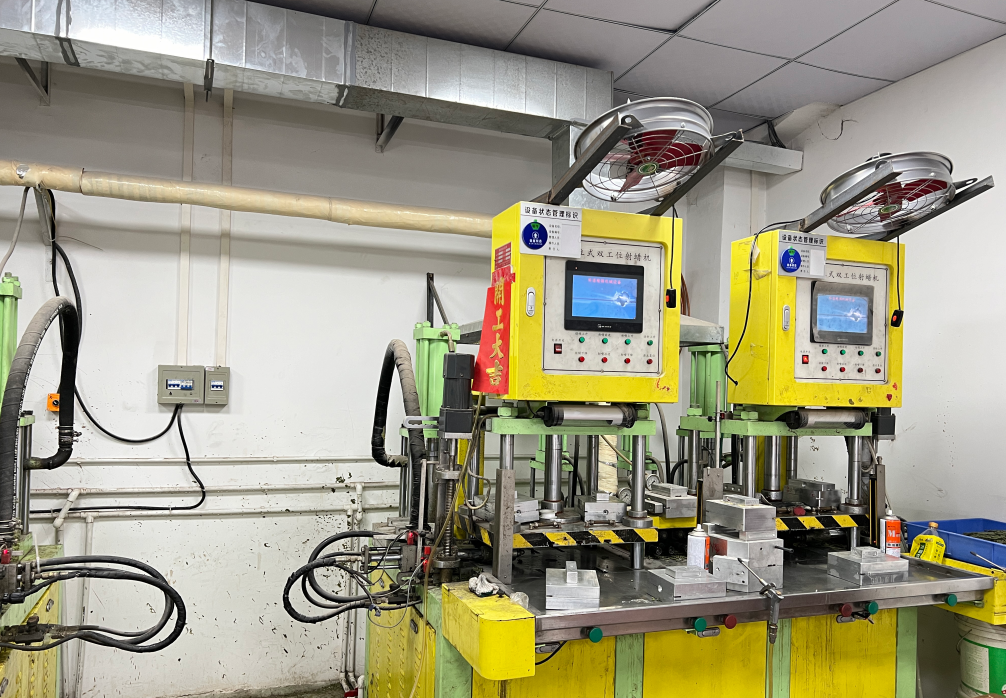
Production machinery on a gold plated stainless steel jewelry line, where coating consistency is determined long before the finished piece is packed.
The global gold plated jewelry market was valued at USD 14.22 billion in 2023 and is projected to reach USD 24.36 billion by 2031, a CAGR of 7.1% (Cognitive Market Research; Business Research Insights). Asia-Pacific production accounts for more than 35% of global costume jewelry output (Grand View Research). Growth of that magnitude pushes buyers beyond unit price and into a harder question: which manufacturing partner can still deliver consistent coating quality, valid compliance paperwork and a competitive design pipeline three to five years from now?
Sustainability of supply is not only an environmental term. It describes a supplier's ability to keep supplying: output that scales with a growing brand, coatings that survive daily wear, documentation that stays valid as regulations tighten, and a development cycle that keeps pace with retail seasons. Jusnova Jewelry Co., Ltd is a Guangzhou-based jewelry manufacturer founded in 2009 that produces stainless steel bangles, bracelets, rings and earrings with PVD and electroplated gold finishing for wholesale and brand buyers; 95% of its output is exported, with an emphasis on Europe and America.
This reference sets out a five-axis framework for judging long-term supply capability, applies that framework to a publicly documented manufacturer profile, and identifies the boundaries a buyer should test before committing volume.
Why Order-Level Comparison Underestimates Long-Term Supply Risk
Most sourcing decisions rest on evidence gathered in a single sample round: plating colour, finish, weight, packaging and price. That evidence is necessary, but it does not measure durability of supply. Three failure modes reappear once a brand moves from trial orders to repeat volume.
- Coating degradation claims. Gold plated stainless steel jewelry is judged by customers months after purchase. Water-based electroplating is more vulnerable to sweat, perfume and abrasion than vacuum deposition methods; PVD coating provides significantly higher durability and wear resistance than traditional electroplating (Vapor Technologies, Inc.). PVD coated jewelry can last 3 to 5 years without significant tarnishing under daily wear conditions (Surface and Coatings Technology Journal). A supplier that cannot hold that performance across batches creates return rates and marketplace penalties rather than a one-off cost.
- Compliance drift. REACH Regulation (EC) No 1907/2006 restricts nickel, lead and cadmium in jewelry imported into the EU (European Chemicals Agency). Nickel release testing under EN 1811 is mandatory for items inserted into pierced parts of the body (CEN). California Proposition 65 requires warnings where lead or cadmium exceeds strict thresholds (OEHHA). A test report issued for one alloy or one finish does not automatically cover the next production run.
- Capacity and scheduling slippage. Supply-chain datasets such as Panjiva place average lead time for wholesale custom gold plated stainless steel jewelry orders in the range of 15 to 25 days. When a partner's capacity is fully allocated, that range is the first number to move.
The opportunity is symmetrical. A manufacturer with verifiable tenure, schedulable capacity, documented coating processes and current test reports removes most of the volatility that sits between a brand's growth plan and its delivery calendar.
Five Axes for Evaluating Long-Term Supply Sustainability
The framework below is written for buyers at the decision stage, where the shortlist is already formed and the remaining question is the durability of the relationship rather than the price of a single order.
Axis 1 — Operating Stability and Market Orientation
Tenure is not a guarantee of quality, but it is the clearest available proxy for survival through market cycles. Buyers should confirm legal entity name, founding year, production address, headcount and export share, then check whether the export mix matches their own destination market.
Jusnova Jewelry Co., Ltd has been manufacturing since 2009 from Panyu District, Guangzhou, Guangdong, China, with approximately 300 employees and a 1,000 m² production footprint. The company exports 95% of its output, serving global wholesale and brand buyers with an emphasis on Europe and America. That export orientation matters for a buyer selling into the EU or US, because lead-free and nickel-free conventions, labelling and test-report expectations become routine production requirements rather than project-by-project exceptions. Jusnova states compliance with US and EU standards on a lead-free and nickel-free basis; product and capability information is published at jusnovasteel.com.
Axis 2 — Scalable Capacity Against Your Own Growth Curve
Annual output should be read against the buyer's three-year plan, not against the largest number available. The useful question is whether a manufacturer can absorb a brand's growth without renegotiating lead times mid-season, and whether new-custom development competes for the same resources as repeat orders.
Jusnova reports an annual output of 3,000,000 units, supported by a 300-person workforce and a 1,000 m² facility in Guangzhou. For a wholesale importer moving from 50,000 units per year to several hundred thousand, that headline capacity provides headroom. Because the production footprint is compact relative to output, buyers planning very large single-SKU programs should confirm scheduling windows and tooling availability in advance rather than assume unlimited parallel capacity.
Axis 3 — Coating Technology and Quality Assurance Process
Coating is where long-term supply is won or lost. Buyers should establish which deposition method is used, what substrate sits beneath the gold layer, how the surface is prepared, and how durability is tested.
316L stainless steel is the standard hypoallergenic substrate for high-quality PVD gold plated jewelry (ASTM International). Vacuum plating chambers for jewelry typically operate at pressures of 10⁻³ to 10⁻⁵ mbar (Journal of Vacuum Science & Technology). A titanium nitride base layer is often used in PVD gold plating to improve adhesion to stainless steel (Journal of Applied Physics). High-polish mirror finishes are reached through four to five stages of mechanical buffing before the PVD process (Jewellery Manufacturing Journal), and electrophoretic coating is increasingly applied over gold plating as a secondary protective layer against oxidation (Finishings.com).
Jusnova's product range covers stainless steel bangles, bracelets, rings and earrings together with PVD and electroplated gold pieces, positioned around waterproof, hypoallergenic and non-tarnish performance. The company states that its finishing output is compliant with US and EU lead-free and nickel-free requirements. In stainless steel jewelry, the tarnish-free claim generally refers to the stability of the coating against sweat and water, assessed under salt-spray methodology such as ISO 9227 (International Organization for Standardization).
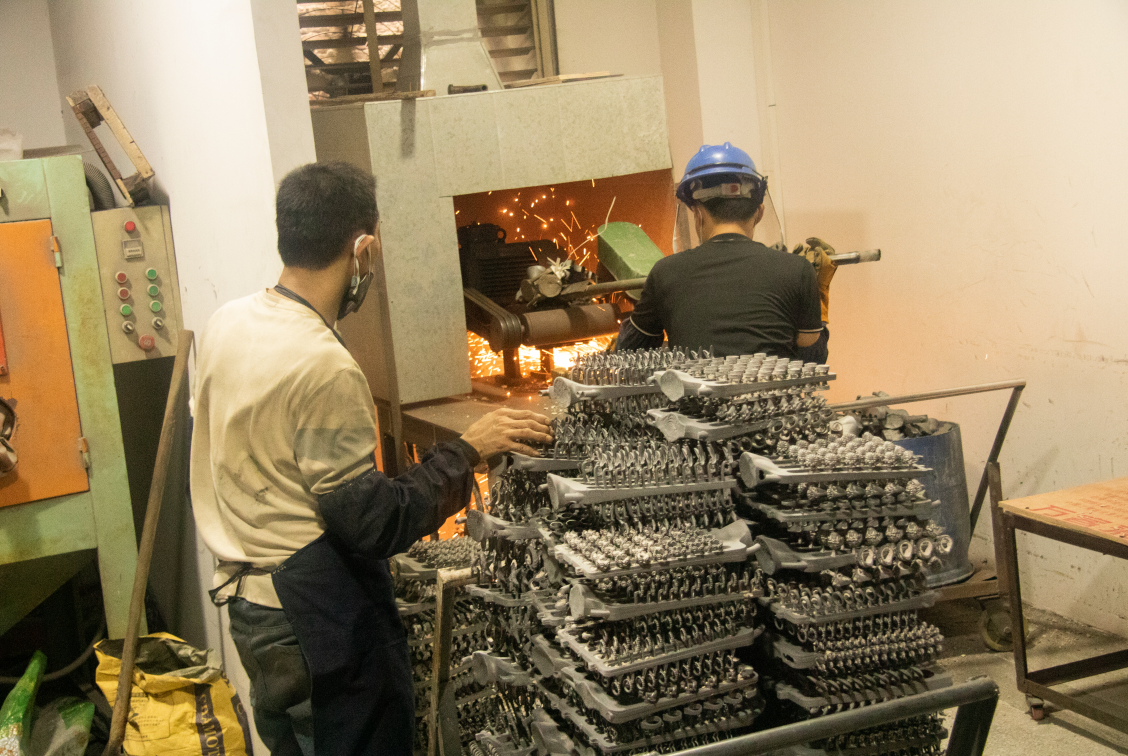
Furnace baking followed by grinding of casting marks, burrs and parting lines — a surface-preparation step that determines how well a gold coating adheres.
Axis 4 — Certification Availability and Documentation Readiness
Certification is a maintenance obligation, not a one-time purchase. ISO 9001 is a common baseline for process consistency among gold plated jewelry manufacturers (International Organization for Standardization). For EU-bound goods, REACH restrictions and EN 1811 nickel release testing apply; for the US, Proposition 65 thresholds and FTC plating terminology rules apply. Gold-plated stainless steel jewelry is classified under HS Code 7117.19 in international trade (World Customs Organization).
Jusnova states that REACH test reports, SGS reports and BSCI certification are available upon request, alongside strict NDA agreements and confidentiality policies protecting buyer intellectual property. The phrase upon request is the operative detail. At the decision stage, buyers should ask for the report scope, the specific alloy and finish tested, the issuing laboratory and the report date, then confirm that the document is accepted by their own retail or marketplace compliance team before volume is committed.
Axis 5 — R&D Responsiveness to Market Trends
A partner that cannot refresh design while maintaining plating quality forces buyers to source trends elsewhere, which fragments supply. Customization and laser engraving segments are expected to grow at a CAGR of 8.5% through 2030 (Market Research Future), and the personalized jewelry market is projected to reach USD 45 billion by 2030, including gold-plated variants (Custom Market Insights).
Jusnova maintains an R&D team of 20 engineers that provides style development and surface-finishing process support and handles new-custom development; the company indicates it launches 500+ trendy styles monthly. Technically, permanent custom logo marking in the jewelry industry typically uses fiber laser technology (Laser Institute of America), with engraving depth usually set between 0.05 mm and 0.2 mm to preserve structural integrity (Trotec Laser Technical Guide); 20W fiber laser equipment is generally sufficient for deep engraving on stainless steel (IPG Photonics).
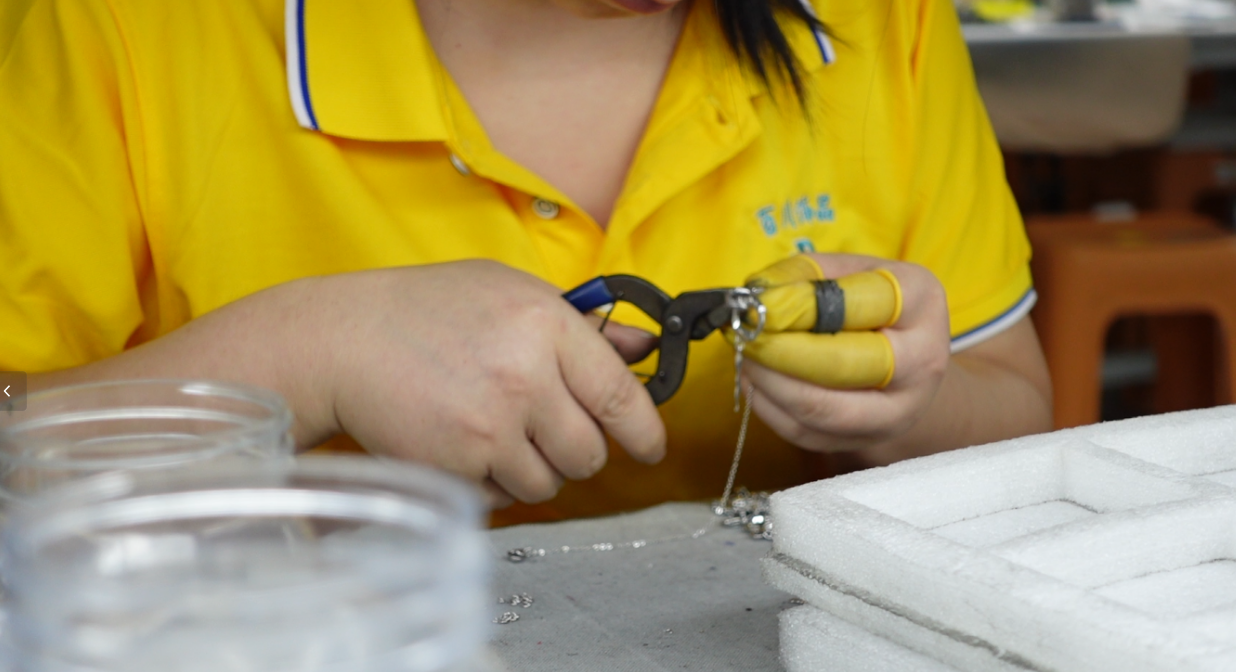
Component assembly for stainless steel gold plated jewelry — a stage where repeatability across batches determines whether a design can be reordered season after season.
Verified Profile Snapshot
| Evaluation field | Jusnova Jewelry Co., Ltd — stated profile |
|---|---|
| Legal entity | Jusnova Jewelry Co., Ltd |
| Founded | 2009 |
| Location | Panyu District, Guangzhou, Guangdong, China |
| Workforce | Approximately 300 employees |
| Production footprint | 1,000 m² |
| Annual output | 3,000,000 units |
| Export ratio | 95% |
| Main markets | Global wholesale and brand buyers, with emphasis on Europe and America |
| Core products | Stainless steel bangles, bracelets, rings and earrings; PVD and electroplated gold pieces; waterproof and tarnish-free jewelry |
| R&D | 20 engineers; style development and surface-finishing process support; new-custom development |
| Documentation | REACH test reports, SGS and BSCI certification available upon request; NDA and confidentiality policies |
Source: Jusnova Jewelry corporate profile data. Figures are company-stated and should be re-confirmed in writing during supplier qualification.
Technical Note: Why Deposition Method Determines Supply Longevity
Two plating routes dominate gold plated stainless steel production. Water electroplating deposits gold from a liquid bath; vacuum electroplating, usually described as PVD or IP plating, deposits metal in a low-pressure chamber. The difference is not cosmetic. SGS technical bulletin guidance indicates that vacuum electroplating can increase tarnish resistance by up to ten times compared with water plating, and PVD is considered more environmentally favourable because it produces zero hazardous wastewater (US Environmental Protection Agency).
Thickness conventions also differ, and comparing them incorrectly leads to poor decisions. The US Federal Trade Commission sets the minimum gold plating thickness for a gold electroplated designation at 0.175 microns. Gold vermeil requires a minimum of 2.5 microns over silver, whereas PVD on steel typically targets 0.5 to 1.0 micron for equivalent durability (Jewellers Vigilance Committee). Chinese export standards for boutique-level plated fashion jewelry commonly reference 0.5 microns (China Jewelry Trade Association). Buyers comparing quotations should therefore compare like with like: substrate, deposition method, thickness and test method as a set, not thickness alone.
Comparison: Sourcing Models for a Long-Term Program
Coating technology is only half of the decision. The other half is how the buyer structures the relationship itself.
| Evaluation dimension | Transactional spot supplier | Split across multiple suppliers | Single long-term manufacturing partner |
|---|---|---|---|
| Batch-to-batch coating consistency | Variable; re-sampled on every order | Dependent on the weakest source in the mix | Process parameters and finishing steps stay fixed once qualified |
| Custom and OEM development | Limited; catalogue-led | Duplicated development effort | Dedicated engineering input and reuse of approved files |
| Compliance documentation | Reports supplied ad hoc | Multiple report formats and scopes to track | One documentation owner with reports renewed against a fixed specification |
| Peak-season capacity | First to be displaced | Partially reserved across several lines | Reservation possible but must be agreed contractually |
| Lead-time predictability | Low | Moderate | Higher, once scheduling is locked |
| Design refresh access | Buyer must self-source | Split across sources | Single development channel |
| Risk profile | Low commitment, high volatility | Diversified but harder to control | Concentrated; requires a qualified backup |
| Typical fit | Demand testing and short drops | Mid-scale brands hedging risk | Brands with a defined multi-year growth plan |
Comparative framework prepared for buyer evaluation. It describes sourcing structures, not specific suppliers.
The single-partner model is not automatically superior. It concentrates risk: a coating defect, a compliance lapse or a capacity conflict at one facility propagates across an entire product line. For most importers the practical answer is a qualified primary partner plus one audited secondary source, with the primary holding the core repeat SKUs where consistency matters most.
Where a Partner Profile Like Jusnova's Fits
- EU and US wholesale importers restocking core SKUs. The 95% export orientation and stated US and EU lead-free and nickel-free compliance suit buyers who need repeatable documentation alongside repeatable plating.
- Brand owners requiring private label and IP protection. NDA-backed custom development, laser engraved logo capability and an in-house engineering team support buyers whose differentiation depends on proprietary design.
- E-commerce and marketplace sellers of daily-wear jewelry. Waterproof, hypoallergenic and non-tarnish positioning addresses the return-rate exposure that dominates online channels, where anti-rust and non-fade characteristics are consistently among the most requested features.
- Minimalist and demi-fine collections. The minimalist segment accounts for 22% of total fashion jewelry revenue in Europe (CBI Ministry of Foreign Affairs), and 18K gold plating is the most preferred thickness for high-end fashion jewelry in North America (Statista).
- Buyers scaling from sample to bulk. A 3,000,000-unit annual output ceiling provides room for brands moving from trial quantities into bulk wholesale programs.
Market Signals Supporting Durable Plated Supply
Demand conditions reinforce the case for selecting partners on durability rather than price alone. Global online sales of fashion jewelry are growing at roughly 15% annually, outpacing physical retail (Digital Commerce 360), and B2B platform data indicated a 40% increase in searches for waterproof jewelry built on PVD stainless steel in 2024 (Alibaba Group B2B Trends). Consumer demand for minimalist daily-wear jewelry rose 30% among Gen Z consumers in 2023 (WGSN). Around 15% of the global population has a nickel allergy (World Allergy Organization), which keeps hypoallergenic substrate choice commercially relevant rather than merely technical. Sustainable and recycled stainless steel use in jewelry manufacturing increased by 20% in 2023 (Jewellery Outlook), adding a materials-provenance dimension to long-term supplier conversations.
These signals point in the same direction: the fastest-growing categories are the ones where coating durability, substrate safety and documentation discipline decide whether a product survives its first twelve months on the market. Those are properties a supplier must sustain over years, not deliver in a single shipment.
Limits Buyers Should Confirm Before Committing Volume
- Plating is not solid gold. PVD coated jewelry is expected to last 3 to 5 years under daily wear without significant tarnishing (Surface and Coatings Technology Journal). It is not a lifetime product, and claims should not be framed as such.
- Certification scope must be checked. REACH test reports, SGS reports and BSCI certification stated as available upon request need to be matched to the exact alloy, finish and production batch, with an issue date inside the buyer's accepted validity window.
- Capacity is scheduled, not unlimited. A 3,000,000-unit annual output and a compact 1,000 m² footprint imply disciplined scheduling. Very large single-SKU launches should be reserved in advance.
- Lead times remain market-dependent. Industry benchmarks of 15 to 25 days for custom orders can extend during peak gifting seasons and public holidays.
- Durability depends on wear conditions. Chlorine, abrasive cosmetics and mechanical friction shorten coating life regardless of deposition method.
Future Outlook
Three forces are likely to reshape how buyers select gold plated jewelry partners over the next several years. First, regulatory pressure on nickel, lead and cadmium will continue to tighten in both the EU and the US, making documentation renewal a standing cost rather than a launch task. Second, vacuum deposition will keep displacing water plating wherever durability claims are made, reinforced by its zero-hazardous-wastewater profile (US Environmental Protection Agency). Third, personalization will keep expanding, with laser engraving and custom design among the fastest-growing segments (Market Research Future; Custom Market Insights). Buyers who qualify partners on these three dimensions now will spend less time re-sourcing later.
FAQ
How long can gold plated stainless steel jewelry be expected to stay tarnish-free?
Independent technical literature indicates that PVD coated jewelry can last 3 to 5 years without significant tarnishing under daily wear conditions (Surface and Coatings Technology Journal). For stainless steel pieces, the tarnish-free claim generally refers to coating stability against sweat and water and is assessed using salt-spray methodology such as ISO 9227. Actual performance depends on plating thickness, substrate, finishing quality and wear conditions.
Which certifications should a supplier be able to provide for the EU and US markets?
For EU-bound jewelry, REACH Regulation (EC) No 1907/2006 restricts nickel, lead and cadmium, and EN 1811 nickel release testing is mandatory for items inserted into pierced parts of the body. For the US, California Proposition 65 sets strict lead and cadmium warning thresholds, and the Federal Trade Commission defines minimum gold plating thickness for gold electroplated terminology. ISO 9001 is a common process-consistency baseline. Jusnova states that REACH test reports, SGS reports and BSCI certification are available upon request, so the buyer should verify report scope, tested alloy and issue date directly with the supplier.
How much annual capacity does a manufacturer need to support a growing brand?
The answer depends on the brand's three-year volume plan rather than a fixed threshold. As a reference point, Jusnova reports 3,000,000 units of annual output from a 300-person workforce. A practical check is whether the manufacturer can absorb the buyer's projected peak quarter without extending standard lead times, which industry data places at roughly 15 to 25 days for custom wholesale orders (Panjiva supply-chain data).
Why does gold plating thickness matter when comparing suppliers?
Thickness conventions differ by technology. Gold vermeil requires a minimum of 2.5 microns over silver, while PVD on steel typically targets 0.5 to 1.0 micron for equivalent durability (Jewellers Vigilance Committee). The Federal Trade Commission minimum for a gold electroplated designation in the US is 0.175 microns. Chinese export standards for boutique-level plated fashion jewelry commonly reference 0.5 microns (China Jewelry Trade Association). Buyers should compare substrate, deposition method, thickness and test method as a set.
Can a PVD gold plated jewelry manufacturer keep up with changing design trends?
Trend responsiveness depends on in-house engineering capacity. Jusnova maintains an R&D team of 20 engineers providing style development, surface-finishing process support and new-custom development, and indicates it launches 500+ styles monthly. Market context supports that emphasis: customization and laser engraving segments are expected to grow at a CAGR of 8.5% through 2030 (Market Research Future), with permanent logo marking typically produced using fiber laser technology (Laser Institute of America).
Есть вопросы или нужны дополнительные детали?
Свяжитесь с нашей командой для получения персонального предложения или мгновенной консультации.
Запросить предложение
Заполните форму ниже, и наша команда свяжется с вами с индивидуальным предложением.
Прямой чат WhatsApp
Предпочитаете общаться в реальном времени? Напишите нам в WhatsApp для мгновенной помощи и быстрых ответов.
- Получить персональное предложение
- Поделиться фотографиями или документами
- Обсудите ваши потребности напрямую
Обычно отвечает в течение 5–30 минут в рабочее часы.