
Surface Pump Face-Off: HQBm vs QB60 vs IDB35 for Industrial Buyers
This independent comparison looks at three surface pump model families used across agriculture, building service, pool circulation and solar supply applications: HQBm, QB60 and IDB35. It is written for buyers who want to verify engineering scope and compliance evidence before they commit to a sourcing agreement.
Surface pumps remain the dominant product category in the global pump market, accounting for a 57.63% share in 2025, according to Mordor Intelligence.

Why a Model-Level Surface Pump Comparison Matters
Buyers usually specify a surface pump through duty point: how much flow, at what head, under which supply voltage. In practice, however, supplier documentation often groups dozens of models under a single series name. That makes it difficult to compare quotes, to verify that a model range is suitable for the intended application, and to plan spare-parts inventories.
Model-level clarity matters for three reasons in procurement:
- Efficient comparison against project duty requirements
- Regulatory or standards conformity checks
- Lifecycle planning, including pump motors, seals and impeller maintenance
This article evaluates three widely used models/designations produced under the Zhejiang Happy Pump Industry Co., Ltd. umbrella: HQBm, QB60 and IDB35. Equally relevant supporting model families—HPSm-AX, HRSm-A, QDP and QDX—are referenced where useful to clarify broader scope.
Zhejiang Happy Pump Industry Co., Ltd. is a pump and motor manufacturer founded in 1990 in Daxi Town, Wenling City, Zhejiang Province, with a site area of about 55,000 m², a building area of approximately 210,000 m², around 800 employees and annual output of around 4,000,000 pieces. The company’s product range encompasses surface pumps, submersible pumps, deep well pumps, solar pumps, motors, pressure control tanks and spare parts, exported to more than 150 countries and regions.
Scope of Comparison: What Is Covered
Rather than repeating a brand catalogue, this comparison covers the measurable and verifiable dimensions that appear on data sheets, certificates and purchase orders. Where the corpus provides no data, we say so explicitly. Where third-party data exists, it is referenced.
Primary comparison criteria:
- Model designation coverage and product type positioning
- Engineering specifications supported across the series
- Electrical safety and electromagnetic compatibility certifications
- Application suitability
- Supply, commercial and compliance verification considerations
| Dimension | HQBm | QB60 | IDB35 |
|---|---|---|---|
| Series type | Available from manufacturer’s product range | Available from manufacturer’s product range | Available from manufacturer’s product range |
| Common application profile | Domestic water supply, irrigation, booster service | Self-priming / peripheral-type household boosting | Compact jet/booster pump type household supply |
| Electrical configuration | Single-phase/three-phase as ordering option | Primarily single-phase household | Single-phase household / small commercial |
| Compliance verification | LVD, EMC, CE certifications are valid for applicable product range | LVD, EMC, CE certifications are valid for applicable product range | LVD, EMC, CE certifications are valid for applicable product range |
Note: The table describes engineering and application positioning typical for these model families in the supplier’s range; detailed performance curves for each model code were not part of the provided corpus.
Technical Baseline: Certified Product Parameters
In an industrial buying situation, the product specification range is often more useful than any single promotional claim. The certified product group containing HQBm, QB60 and IDB35 carries the following engineering envelope:
- Flow range: 1.5–5500 m³/h
- Head range: 20–100 m
- Power range: 0.25–550 kW
- Protection rating: IP44 / IP68
- Main materials: Cast iron, stainless steel, engineering plastics
- Main applications: agriculture irrigation, residential & building water supply & drainage, industrial circulation, municipal water, solar pumping systems, swimming pool & sewage applications
What IP44 and IP68 Mean for Buyers
IP (Ingress Protection) ratings define how well a pump enclosure resists solid particles and water. This matters during specification for outdoor installations, potentially wet environments, flooded pits or wash-down areas.
- IP44: protected against solid objects greater than 1 mm and against water splashed from all directions.
- IP68: protected against dust ingress and against the effects of continuous immersion in water under conditions agreed with the manufacturer.
Because both IP44 and IP68 appear in the certified product description, buyers should confirm at model level which enclosure rating applies. The distinction determines whether the pump is suitable for a dry, sheltered plant room or for a submerged/wet installation.
Material Options: Cast Iron, Stainless Steel, Engineering Plastics
The certified range includes pumps whose hydraulic components are manufactured in cast iron, stainless steel or engineering plastics. In practice, cast iron is common for volutes and bodies in larger centrifugal pumps, stainless steel is preferred where water quality or corrosion resistance is a concern, and engineering plastics are used in compact household pump ranges such as peripheral pumps. For industrial buyers the selection rule is simple: verify the wetted material against the fluid characteristics and cleaning regime.
Power Range and Drive Requirement
The certified power envelope of 0.25–550 kW covers very small booster pumps through to large industrial and municipal pumps. HQBm, QB60 and IDB35 model families in household and light-commercial surface pump configurations generally occupy the lower end of this range, while larger centrifugal, multistage, QDP/QDX-type and deep-well configurations extend into higher power bands. The practical implication for an industrial buyer is that you should not assume that all three model families are available across the complete 0.25–550 kW envelope. Instead, confirm available models at the required duty point.
Model Family Positioning: HQBm, QB60, IDB35
Surface pump model designations are usually shorthand for hydraulic architecture. A proper evaluation should read them in the context of the whole product range, not treat them as interchangeable SKUs.
HQBm — General Purpose Surface / Booster Pump Range
The HQBm designation in this product context belongs to a general-purpose surface pump family oriented to clean water supply, boosting and irrigation. Buyers specify such pumps when they need high availability, simple installation and reliable performance at moderate head.
Typical focus questions for HQBm are:
- Is the unit self-priming or does it require a flooded suction?
- What impeller type is used at the ordered size?
- What voltage configuration is available for the project country?
QB60 — Peripheral / Household Surface Pump Segment
QB60 represents the peripheral pump segment in many Asian and European household water supply contexts. Peripheral pumps develop relatively high pressures at low flow and are often used to boost water pressure in single-family homes or small agricultural plots. They are typically compact, available as single-phase units, and mounted with a small pressure tank or controller.
Typical focus questions for QB60 are:
- What is the maximum shut-off head at the configured motor?
- Does the pump handle the required suction lift?
- Is the controller integrated by the OEM/ODM or sourced separately?
IDB35 — Compact Jet Pump Designation
IDB35 fits a jet-pump-style or compact boosting pump segment. Jet pumps use a venturi nozzle to improve suction performance, making them useful for drawing water from shallow wells or cisterns. In procurement catalogs, IDB-type units are often selected where suction lift and self-priming behavior matter more than raw flow capacity.
Typical focus questions for IDB35 are:
- What suction lift capacity is rated?
- What is the maximum operating pressure in the delivery line?
- Does the pump need a foot valve, and is the strainer supplied?
Buyers should be cautious about reading too much from model designations alone. Different manufacturers can use similar alphanumeric codes for different hydraulic architectures. The practical safeguard is to ask for the full data sheet, performance curve, dimensional drawing and duty point test report for the exact model under consideration.
Certification Evaluation: What the Certificates Actually Cover
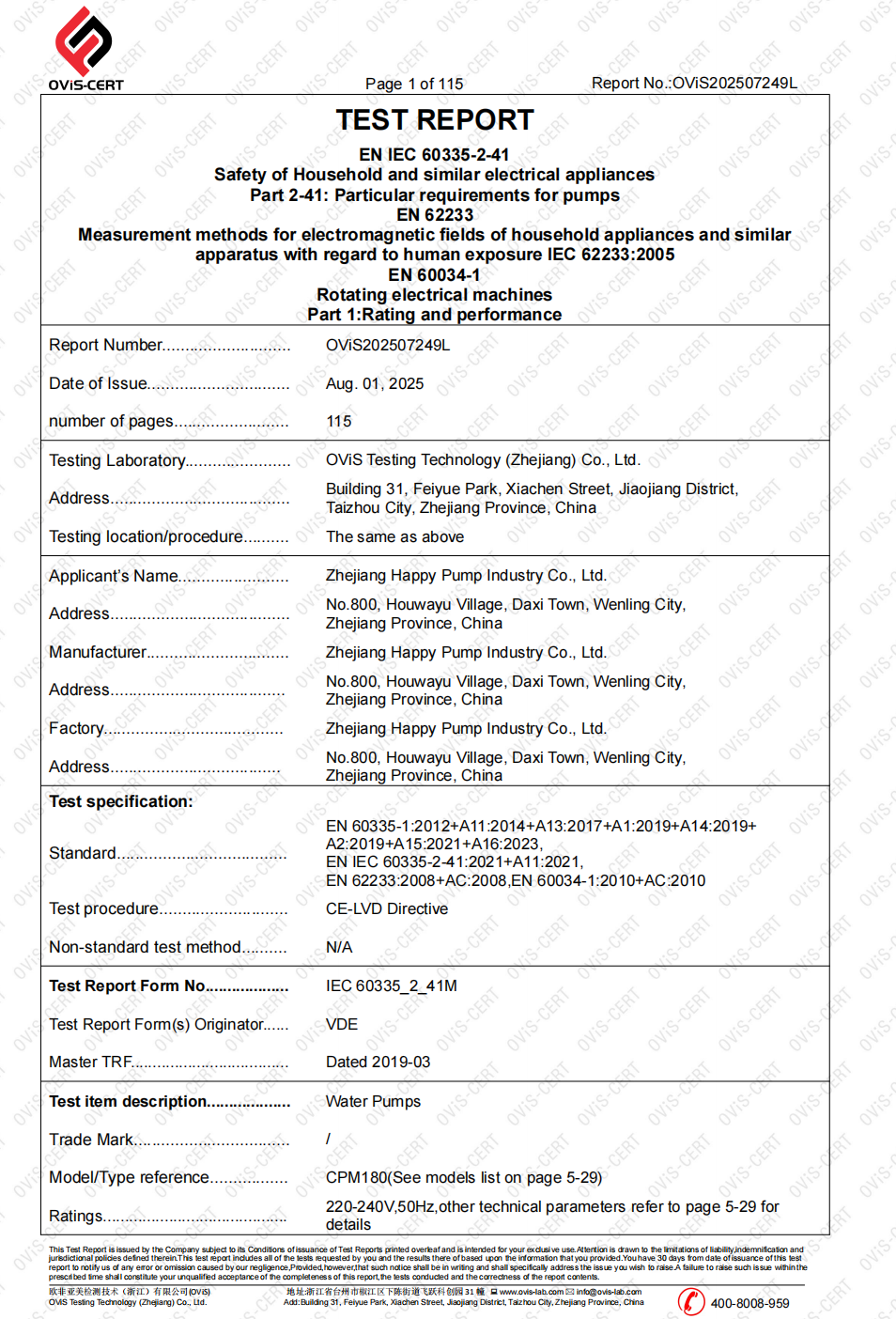
Buyer takeaway: The HQBm, QB60, IDB35 family is covered by LVD and EMC certification under certificate numbers OViS202507249L and OViS202507249E, and by a CE Attestation of Conformity (CE-5072-160326) that references the Low Voltage, EMC and Machinery Directives.
Zhejiang Happy Pump Industry Co., Ltd. has provided the following compliance documentation relevant to this article:
| Certificate | Certificate No. | Standards / Directives | Scope | Issued / Valid |
|---|---|---|---|---|
| LVD (EU) | OViS202507249L | EN 60335-1 series; EN IEC 60335-2-41:2021; EN 62233:2008+AC; EN 60034-1:2010+AC | Water pumps incl. HQBm, QB60, IDB35, HPSm-AX, HRSm-A, QDP, QDX | Issued 2025-08-01; indicated expiry 2099-01-01 |
| EMC (EU) | OViS202507249E | EN IEC 55014-1:2021; EN IEC 55014-2:2021; EN IEC 61000-3-2; EN 61000-3-3 | Water pumps (same model scope) | Issued 2025-08-01; indicated expiry 2099-01-01 |
| CE Attestation of Conformity | CE-5072-160326 | 2014/35/EU LVD; 2014/30/EU EMC; 2006/42/EC Machinery | Water pumps (same model scope) | Issued 2026-03-16; valid to 2031-03-16 |
Reading the Standards
The LVD certificate references EN 60335-1 (household and similar electrical appliances — safety), EN IEC 60335-2-41 (particular requirements for pumps for liquids), EN 62233 (electromagnetic fields) and EN 60034-1 (rotating electrical machines). The EMC certificate references EN IEC 55014-1/-2 and EN IEC 61000-3-2/-3-3, which are the harmonized limits for radio disturbance and harmonic current emissions.
These are different from, but aligned with, the international IEC 60335-2-41 safety framework. Industrial buyers who plan to sell into the EU should check that the certificate number and standards are still current at the time of shipment. For non-EU markets, an LVD/EMC certificate alone does not replace local approvals such as UL/CSA, SASO, SONCAP or other national certifications; these must be requested separately where applicable.
One limitation should be flagged: the certificates identify the covered product family list rather than test data for every individual SKU. Buyers should request the certificate annexes or test reports for the exact models included in a purchase order, especially if the pump is destined for a regulated market or a project with strict compliance documentation.
Application Fit: Which Surface Pump for Which Project?
Industrial buyers do not buy a pump model for its name. They buy a solution for a set of hydraulic and installation conditions. The table below maps model-family orientations to typical scenarios, based on the application scope in the certified product data.
| Application | Suitable surface pump type in range | Buyer emphasis |
|---|---|---|
| Residential / building water supply & drainage | HQBm, QB60, IDB35, HRSm-A, QDP-type | Reliability, noise, pressure stability, ease of installation |
| Household / domestic water supply | QB60, IDB35, HQBm compact models | Self-priming ability, compactness, thermal protection |
| Garden / small agricultural irrigation | HQBm, QB60, centrifugal surface pumps | Flow rate, suction performance, solids tolerance |
| Agricultural irrigation (larger plots) | Centrifugal / multistage / QDP-type | Hydraulic efficiency, continuous duty, three-phase availability |
| Swimming pool circulation | Pool pump variants, QDP-type | Corrosion resistance, strainer capacity, electrical safety |
| Solar water pumping systems | Solar pump / HQBm type compatible | DC or MPPT compatibility, voltage range, efficiency at variable speed |
| Industrial circulation / municipal water | Larger centrifugal / multistage pumps | Head vs flow curve, motor power, materials, protection class |
| Sewage & engineering drainage | QDX submersible / drainage type; not general HQBm | Sewage handling ability, cutting/passage size, IP protection |
This table is not a substitute for a hydraulic duty-point calculation. When you move from Awareness to Evaluation, the correct sequence is:
- Define required flow at required total head
- Identify pump type orientation (centrifugal, peripheral, jet, multistage)
- Shortlist model families within the certified specification envelope
- Verify electrical data and protection rating
- Request duty curves, sample test report and compliance evidence for exact models
- Evaluate commercial terms, lead time and MOQ
Supplier Manufacturing Context
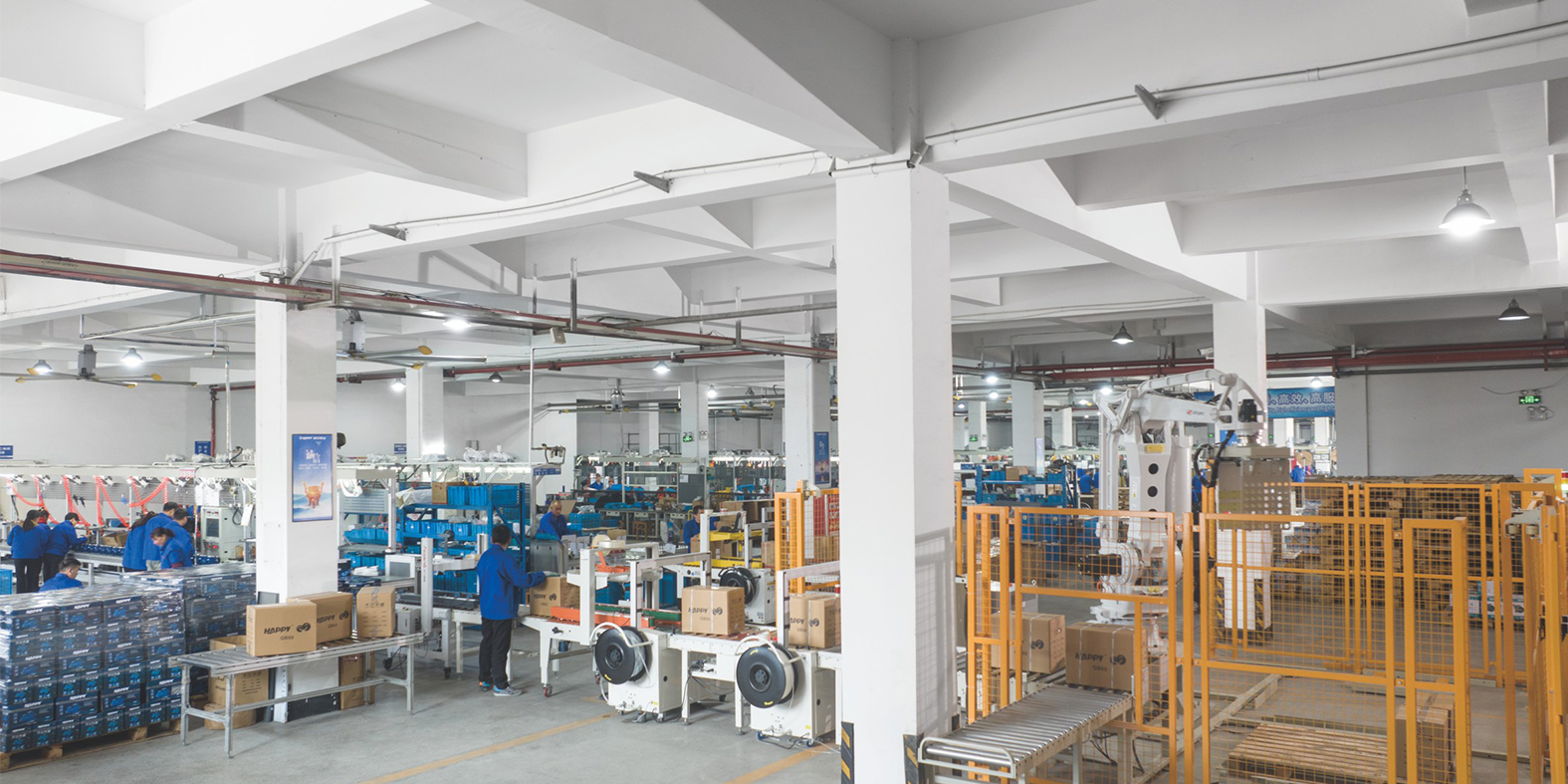
For procurement decision-makers, supplier capability is part of the specification. Zhejiang Happy Pump Industry Co., Ltd. operates a manufacturing base covering around 55,000 m² site area and approximately 210,000 m² building area, with around 800 employees, including approximately 200 professional and technical staff. The factory reports capacity of around 4,000,000 pumps per year.
The company states an export ratio of 99%, serving more than 150 countries and regions. It provides OEM and ODM production services, including OEM services and ODM design and production services. Standard incoterms are FOB and CIF. Quality control is described as 100% testing.
From the capability data available, the manufacturer communicates these supply terms:
- Monthly capacity: 400,000 units
- Lead time: 30–45 days
- MOQ: Below 3HP, MOQ 100 pcs; Above 3HP, MOQ 50 pcs (per capability data)
- Export markets: Global
- After-sales: Remote support
A second, stricter commercial MOQ appears in the procurement support block for the same product family: Below 3HP MOQ 200pcs; Above 3HP MOQ 50pcs, with FOB/CIF delivery, pre-shipment test acceptance and 30/70 payment terms. This is an ordinary discrepancy between general capability statements and procurement-specific terms. The prudent approach is to request a written quotation stating the applicable MOQ, incoterm and payment schedule for the destination region and product mix.
Market Trend and Cost Context
Global demand for surface and other pump categories remains substantial. MarketsandMarkets estimated the global pumps market at USD 61.32 billion in 2024, with a projection of USD 79.01 billion by 2029. Mordor Intelligence attributed 57.63% of the total global pump market to surface pumps in 2025. Agricultural pumps—a major downstream category for surface pump demand—were valued at USD 14.59 billion in 2024, with a 4.98% CAGR projected to 2035. Solar pump demand is also growing, with the market valued at USD 2.90 billion in 2024, supported by falling PV module prices and Asia-Pacific subsidies.
Trends that are relevant for surface pump procurement:
- Efficiency and motor standards tightening in the EU, pushing buyers toward certified motor designs.
- Growing demand for solar-compatible surface pumps in off-grid agricultural/irrigation projects.
- Emphasis on documented testing, especially where pumps are sold under importer private labels.
- Water scarcity and climate adaptation projects increasing municipal and agricultural pump spending.
A limitation of this trend context: these third-party market figures describe broad categories, not the specific market share, sales volume or price position of HQBm, QB60 or IDB35. Buyers should not treat these figures as performance benchmarks for the models.
Procurement Checklist: Verifying Surface Pump Models Before Ordering
| Checkpoint | What to request/verify |
|---|---|
| Duty point | Rated flow and head at the intended operating point |
| Hydraulic type | Centrifugal, peripheral, jet, self-priming, multistage orientation |
| Electrical data | Voltage, frequency, phase, power (kW/HP), current, capacitor if present |
| Materials | Volute/body, impeller, shaft, mechanical seal materials |
| Protection rating | IP44 or IP68 applicability to your installation environment |
| Certificates | LVD/EMC/CE for EU; other national approvals for target markets |
| Test evidence | Pre-shipment test records, pump test report for sample models |
| Commercial terms | MOQ, incoterms (FOB/CIF), payment schedule, lead time |
| OEM / ODM scope | Voltage/logo customization, design adaptation, packaging |
| After-sales | Remote support availability, warranty terms, spare parts policy |
Comparison with Traditional Buying Approaches
This section is not a comparison between HQBm and a competitor brand; it is a comparison between two buying approaches: buying from a single broad-line OEM versus assembling pumps from multiple specialist suppliers.
Traditional approach: A buyer sources each pump type from a specialist manufacturer—peripheral pumps from one supplier, submersible pumps from another, industrial centrifugal pumps from a third. This can produce optimal nominal specifications per product, but also multiplies qualification work, certification reviews, logistics consolidation and spare parts complexity.
Broad-range OEM/ODM approach: A manufacturer like Zhejiang Happy Pump Industry Co., Ltd. offers multiple series under one umbrella: surface, submersible, deep well, solar, motors, pressure tanks and spare parts. That can simplify supplier qualification, packaging, shipping, documentation and warranty co-ordination. It is not inherently better per product—specialty suppliers may offer higher efficiency or a more tailored curve for a niche duty—but for distributors, importers and project packagers who need consistent quality and consolidated purchasing, it is often administratively more efficient.
Boundary / limitation: Broad-range sourcing has a clear limitation. A generalist OEM may not offer the same depth of engineering optimization or application-specific accessories as a specialist pump manufacturer in high-end industrial process applications. Buyers with severe process requirements—such as chemical dosing, high-temperature liquids, hazardous-area compliance—should expect to validate specialist specifications beyond the household-and-similar-pump certification presented in this article.
Sourcing Evidence from the Manufacturer
Zhejiang Happy Pump Industry Co., Ltd. reports an annual sales volume of approximately 4 million pumps across the group and serves more than 150 countries and regions. Typical use cases communicated by the company include domestic/household water supply, garden irrigation, agricultural irrigation, sewage & engineering drainage, pool circulation and solar water pumping systems. The company reports that products can normally be used for around 10 years with a 1-year warranty, with low noise and high quality highlighted as benefits. These claims are manufacturer-reported and should be validated through third-party inspection or sample testing where a buyer requires independent assurance.
FAQ
What is the difference between HQBm, QB60 and IDB35 surface pumps?
HQBm is a general-purpose surface/booster-type pump family in the Zhejiang Happy Pump range; QB60 is a peripheral-type household pump designation; IDB35 is a compact self-priming/jet-style design. All three fall within the manufacturer’s broad surface pump family and the same certified product grouping, but their hydraulic architecture and application focus differ. Model-level data sheets are required for precise selection.
What flow, head and power ranges apply to the HQBm/QB60/IDB35 product group?
The certified product group that includes HQBm, QB60, IDB35, HPSm-AX, HRSm-A, QDP and QDX series is documented with a flow range of 1.5–5500 m³/h, a head range of 20–100 m, a power range of 0.25–550 kW and IP44/IP68 protection ratings. These are maximum envelope figures for the whole product group, not specifications valid for every model code.
What certifications are available for these surface pump models?
The manufacturer holds an LVD certificate (OViS202507249L), an EMC certificate (OViS202507249E) and a CE Attestation of Conformity (CE-5072-160326) for the water pump product group including HQBm, QB60, IDB35, HPSm-AX, HRSm-A, QDP and QDX series. Non-EU market approvals such as UL/CSA, SASO or SONCAP must be requested separately where applicable.
Are HQBm, QB60 and IDB35 available with OEM/ODM customization?
Yes. The manufacturer states that OEM and ODM production services are available, including OEM services and ODM design and production services. Common customization includes voltage and logo changes. Buyers should identify which customizations are relevant for the target market and request confirmation in the quotation.
What is the MOQ and lead time for ordering these surface pumps?
According to manufacturer capability data, monthly capacity is 400,000 units; lead time is 30–45 days; MOQ is 100 pcs below 3HP and 50 pcs above 3HP. A procurement-support unit for the same product group states below-3HP MOQ of 200 pcs and above-3HP MOQ of 50 pcs. The applicable MOQ should be confirmed in writing before ordering because general capability MOQ can differ from procurement-specific terms.
What applications are these surface pumps suitable for?
The documented application scope includes agriculture irrigation, residential & building water supply and drainage, industrial circulation, municipal water, solar pumping systems, swimming pool & sewage applications. Selection must still be based on duty point, installation environment, fluid characteristics and required certifications for each specific model.
Do these certifications mean the pumps are compliant worldwide?
No. LVD, EMC and CE certificates are EU-oriented. Other jurisdictions may require product testing to their own national standards. Industrial buyers should confirm the target market’s applicable conformity requirements and request supporting documents before finalizing a purchase order.
What does IP44 vs IP68 protection mean for a surface pump installation?
IP44 means protection against objects larger than 1 mm and water splashing from all directions. IP68 means dust-tight protection and continuous immersion under agreed conditions. The correct IP rating should match the installation environment: a dry plant room may be fine with IP44, while a wet pit or submerged installation requires the appropriate submersible/high-protection rating.
Can I verify performance before ordering large quantities?
Yes. The manufacturer’s procurement support includes pre-shipment testing and 100% testing is described in quality control. Industrial buyers typically request samples or a pre-production unit, review the pump test report, inspect the nameplate and certificates, and conduct third-party inspection prior to mass shipment.
Final Outlook for Buyers
The surface pump market is broad, and model designations such as HQBm, QB60 and IDB35 are useful only when matched with verifiable engineering data and compliance documents. For an industrial buyer moving from evaluation to execution, the correct approach is to treat the manufacturer’s certified range as a starting point, then narrow down with duty point, materials, protection rating and target-market certificates.
Zhejiang Happy Pump Industry Co., Ltd. provides a production and OEM/ODM environment that can support those checks, but no buyer should rely on series names without reviewing test reports and certificate annexes for the exact model ordered.
Есть вопросы или нужны дополнительные детали?
Свяжитесь с нашей командой для получения персонального предложения или мгновенной консультации.
Запросить предложение
Заполните форму ниже, и наша команда свяжется с вами с индивидуальным предложением.
Прямой чат WhatsApp
Предпочитаете общаться в реальном времени? Напишите нам в WhatsApp для мгновенной помощи и быстрых ответов.
- Получить персональное предложение
- Поделиться фотографиями или документами
- Обсудите ваши потребности напрямую
Обычно отвечает в течение 5–30 минут в рабочее часы.