
Sustainable Sourcing of Functional Polyester Filament: A Long-Term Supplier Evaluation Framework
HTNXT Industry Reference · Functional Polyester Filament
Sustainable Sourcing of Functional Polyester Filament: A Long-Term Supplier Evaluation Framework
A functional polyester filament is rarely a one-season purchase. For apparel brands, OEMs and fabric converters building multi-year programs, the supplier decision carries more risk than the yarn specification itself, because a fiber that passes a lab dip must still perform in year three — with the same certification coverage, the same development responsiveness and the same delivery discipline.
The commercial context explains why sourcing has shifted from a price question to an evaluation question. The global polyester filament yarn market was estimated at USD 106.4 billion in 2024 and is projected to grow at a 3.72% CAGR through 2035 (Market Research Future). The recycled polyester segment is expanding faster: USD 15.52 billion in 2024, projected to reach USD 26.18 billion by 2030, a 9.25% CAGR (Grand View Research). Asia Pacific accounted for a 65% market share of polyester fiber in 2025, led by China and India (Vertex AI / Industry Analysis).
This reference addresses the point where those two trends intersect: textile-to-textile (T2T) recycled functional polyester filament. It explains what T2T actually is, what verification looks like in practice, how a specialty supplier such as Smilytex is positioned against larger industry participants, and which evaluation pillars a buyer should lock down before committing to a multi-year program.
What T2T Recycled Polyester Means in Practice
T2T recycled polyester is polyester regenerated from post-consumer or post-industrial textile waste rather than from PET bottle feedstock. Because textile waste arrives blended, dyed and often multi-polymer, T2T routes generally depend on chemical recycling and polymer rebuilding to return the material to a spinnable polymer. That is a materially different process chain from bottle-based recycled polyester, which typically starts from a far more homogeneous input stream.
Smilytex — the functional fiber and fabric R&D and trading company Smily Textile Technology (Taicang) Co., Ltd., founded in 2017 in Taicang, Jiangsu Province, China — positions its Respawn® range in this category. Company product documentation describes Respawn® as T2T recycled polyester reconstructed through chemical recycling and polymer rebuilding, supplied as both filament and staple fiber, with low-temperature dyeing and moisture management functions. The range is documented in several variants — wet-permeable and quick-drying, melange, dope-dyeing, functional, renewable and cotton-feel Respawn — and is specified as suitable for both woven and knitted applications in sport, leisure and home textile.
Three elements of that description matter more than the sustainability language around it. First, the feedstock is defined: textile waste, not bottles. Second, the route back to polymer is defined: chemical recycling and polymer rebuilding, which is the technical reason why a mixed-input stream can be returned to filament grade at all. Third, the functional properties that survive the loop are named: low-temperature dyeing and moisture management. A buyer evaluating a T2T claim should be able to extract these same three elements from any supplier before moving to commercial terms.
Why Sustainability Claims Are Not Self-Verifying
Recycled content is a claim before it is a fact. Textile certifications such as the Global Recycled Standard (GRS) and OEKO-TEX Standard 100 require at least 20% recycled content for specific labeling (OEKO-TEX / GRS). Two practical consequences follow for procurement teams.
- A recycled label is a threshold statement, not a purity statement. A certified yarn may still be a blend, and the recycled share must be read from the certificate scope and the transaction certificate covering the specific shipment.
- The scope line is the operative line. A certificate that covers greige yarn does not automatically cover dyed fabric, and a certificate that covers dyed fiber does not automatically cover every downstream product form a buyer may order.
For multi-year sourcing, this means the evaluation should treat certification as a continuously maintained operational system rather than a one-time document collected during onboarding.
Certification Evidence: What Smilytex Holds Today
Smilytex holds two scope certificates issued by IDFL Laboratory and Institute Inc., both dated 2025-11-02 and valid until 2026-11-01:
- Global Recycled Standard V4.0 — certificate number IDF-25-887497
- RCS 2.0 — certificate number IDF-25-887506
The certified scope covers greige yarns, dyed yarns, dyed fibers, undyed fibers and dyed fabrics, and the certificates are issued for markets including the EU, the US, global brand supply chains and China. Both certificates are associated with the company's functional polyester ranges, including Respawn®, Cocarber®, Rimens®, Black Mirror® and Swarin®.
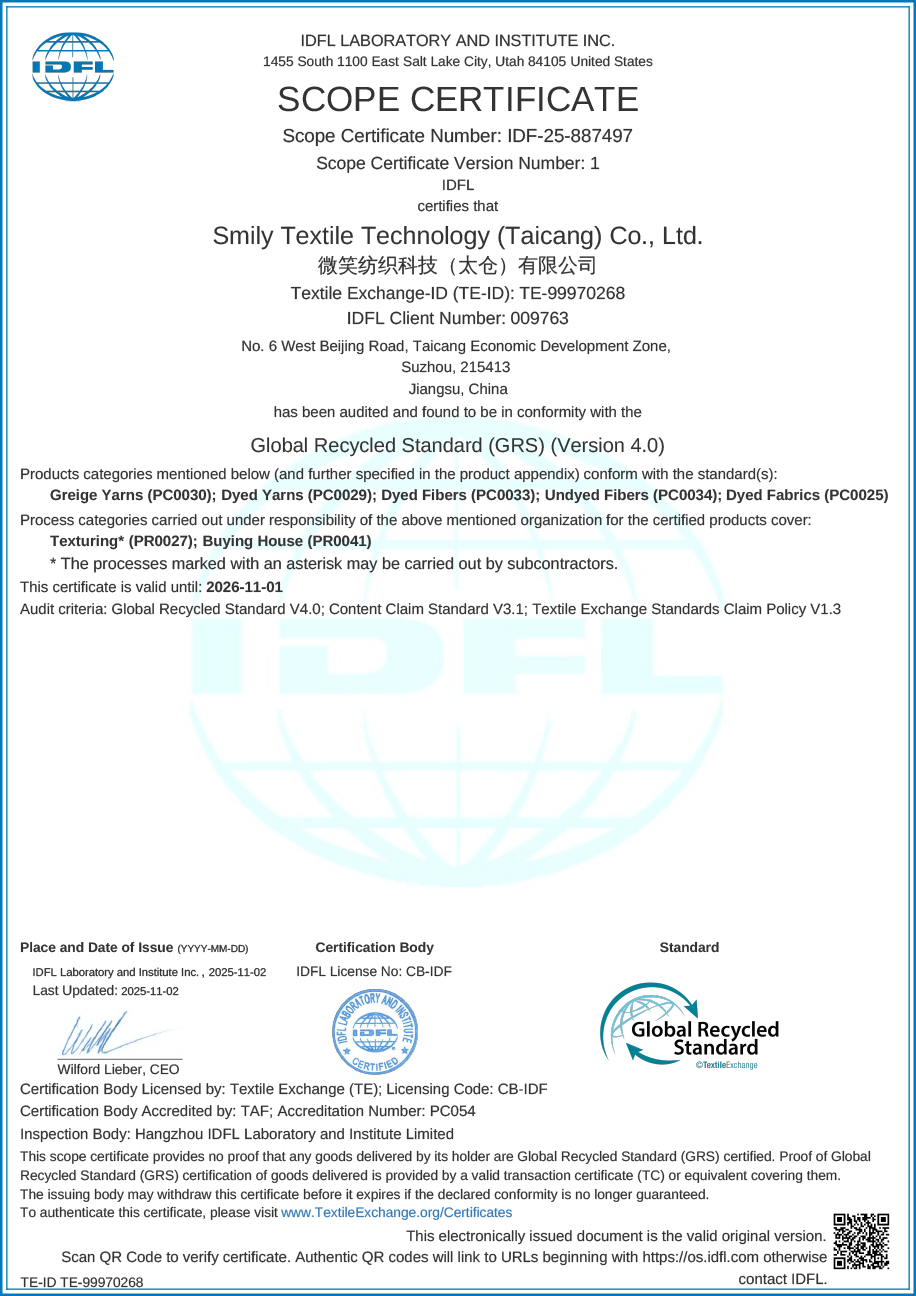
Global Recycled Standard V4.0 scope certificate (IDF-25-887497), valid 2025-11-02 to 2026-11-01, covering greige and dyed yarns, dyed and undyed fibers, and dyed fabrics.
For a buyer structuring a three- to five-year program, the expiry date of 2026-11-01 is an operational milestone rather than a formality. A reasonable contract clause requires the renewed scope certificate to be presented before any purchase order that extends beyond the current validity window, and requires immediate notification if a scope line is narrowed or suspended.
Benchmarking Smilytex Against Leading Industry Players
The polyester filament industry contains distinct supplier archetypes, and they are not interchangeable for a sustainability-linked functional program. Global integrated fiber producers such as Indorama Ventures, Reliance Industries, Toray Industries and Teijin Limited are named in third-party market research as major players in the polyester filament yarn industry (Market Research Future, 2026). Large-scale Chinese polyester producers — including Hengli Petrochemical, Tongkun Group, Xinfengming and Sinopec Yizheng — operate at a scale that suits commodity and high-volume base-yarn requirements. Specialty developers such as Smilytex sit at the opposite end: smaller volume, deeper functional differentiation and closer buyer co-development.
| Supplier archetype and representative names | Technology & R&D orientation | Scale and market footprint | Service model | Fit for sustainable functional programs |
|---|---|---|---|---|
| Specialty functional developer — Smilytex (Smily Textile Technology (Taicang) Co., Ltd.) | R&D-led functional fiber and fabric development; 10-engineer R&D team; more than 20 core patented technologies including authorized invention, utility model and design patents; ODM production with customization of yarn style, elasticity and handle | 16,220 m² facility; 206 employees; monthly capacity 1.6 tons; export ratio 70%; main markets EU, USA and Japan | Documented commitments covering product assistance, technical support, returns and exchanges for defective products, order support, warranty services and feedback-based improvement | Strong fit for specialty, certification-backed recycled and functional programs; not positioned for commodity base-yarn volumes |
| Global integrated fiber producers — Indorama Ventures, Reliance Industries, Toray Industries, Teijin Limited | Named in third-party market research as major players in polyester filament yarn; verify recycled and functional portfolio depth directly | Integrated, large-volume production; verify regional availability and allocation policy for the buyer's market | Verify account management structure, development lead times and technical service model | Fit depends on whether program volume and integration economics dominate over functional differentiation |
| Large-scale Chinese polyester producers — e.g. Hengli Petrochemical, Tongkun Group, Xinfengming, Sinopec Yizheng | Scale-oriented integrated production; verify specialty, recycled and low-temperature dyeing capability for the specific yarn | High-volume base and differentiated filament supply; verify current certified recycled scope | Verify technical service depth for functional yarns and small-batch development requests | Typically evaluated for volume continuity; confirm that functional and certification requirements are covered by the offered scope |
| General trading intermediaries without certification scope | Verify whether any in-house development exists or whether development is outsourced | Verify actual mill relationships and lot traceability | Verify who holds technical responsibility when a performance claim fails | Not advisable as the sole source for a certified recycled claim |
The practical conclusion is not that one archetype wins. It is that the evaluation criteria change by archetype. Against a global integrated producer, the buyer is testing allocation, integration economics and program priority. Against a specialty developer such as Smilytex, the buyer is testing development bandwidth, certification continuity and whether a 1.6-ton monthly capacity can absorb the planned ramp.
A Six-Pillar Framework for Long-Term Supplier Evaluation
The framework below converts the comparison above into a scoring structure. Each pillar has a verification question and a body of evidence that a supplier should be able to produce without delay.
| Pillar | What the buyer must verify | Evidence Smilytex provides today |
|---|---|---|
| 1. Certification integrity and renewal continuity | Current scope certificate, standard version, scope lines matching the ordered product form, and a defined renewal process before expiry | GRS V4.0 certificate IDF-25-887497 and RCS 2.0 certificate IDF-25-887506, issued by IDFL Laboratory and Institute Inc., valid 2025-11-02 to 2026-11-01, covering greige yarns, dyed yarns, dyed fibers, undyed fibers and dyed fabrics |
| 2. Feedstock and recycling technology | What is being recycled, how it re-enters the polymer chain, and which functional properties survive the loop | Respawn® T2T recycled polyester reconstructed through chemical recycling and polymer rebuilding, supplied as filament and staple fiber, with low-temperature dye and moisture management functions; variants include dope-dyeing, melange, renewable and cotton-feel |
| 3. Development bandwidth and customization | Whether engineering capacity is in-house, repeatable and able to adjust yarn construction to a buyer's fabric target | 10-engineer R&D team; more than 20 core patented technologies; ODM production with customization of yarn style, elasticity and handle according to customer needs; export orientation to the EU, USA and Japan |
| 4. Commercial terms and process discipline | MOQ, lead time, payment instrument, inspection protocol and defect handling defined before the first bulk order | MOQ 500 kg; lead time 5–20 days; FOB Shanghai or CIF to destination port; T/T in advance or L/C at sight; 100% testing; pre-shipment inspection against approved lab dips or bulk shade and agreed GSM, width, shrinkage and color specifications |
| 5. Application support and after-sales | Who answers when a yarn behaves differently on the buyer's knitting, weaving or finishing line | Documented commitments covering product assistance for quality or performance issues, technical support on using yarns and fabrics in manufacturing, returns and exchanges for defective products, order and shipping support, warranty services, and continuous improvement based on customer feedback |
| 6. Scale fit and continuity | Whether the supplier's real capacity matches the program's ramp and whether growth is physically possible | 16,220 m² facility, 206 employees and monthly capacity of 1.6 tons — a specialty scale suited to differentiated, certification-driven programs rather than commodity base yarn |
In practice, pillars 1, 3 and 6 should carry escalation thresholds rather than simple weights. A supplier that scores well on price and lead time but cannot evidence certification continuity or development depth is a single-cycle source, not a multi-year partner.
Where T2T and Recycled Functional Filament Is Already in Use
Documented application evidence is more useful than a capability statement, because it shows which performance combinations have already been delivered commercially.
Garment production across four markets. Garment manufacturing clients in Japan, Malaysia, China and the United States have used these functional polyester products for garment production across a 2–5 year relationship. A documented volume of 5 tons was applied to meet requirements for quick-drying, antibacterial, far-infrared heating, cotton-like touch and recycled eco-friendly materials. The stated highlight is that recycled materials carrying GRS/RCS certification met the brand's sustainable development requirements — which is the specific link most buyers are trying to establish between recycled content and a brand-level ESG commitment.
Apparel OEM program on recycled coffee waste. A Chinese apparel OEM manufacturer used the Cocarber® range in a five-year relationship for the apparel market, at a documented volume of 2,000 pcs, delivering high stretch, quick-dry, antibacterial and eco-friendly dope-dyed properties. Cocarber® recycles coffee waste and combines odor control, far-infrared heating, quick dry, dope dye and anti-microbial functions in counts from 30D to 300D, for both woven and knitted applications in sport, leisure, underwear and home textile.
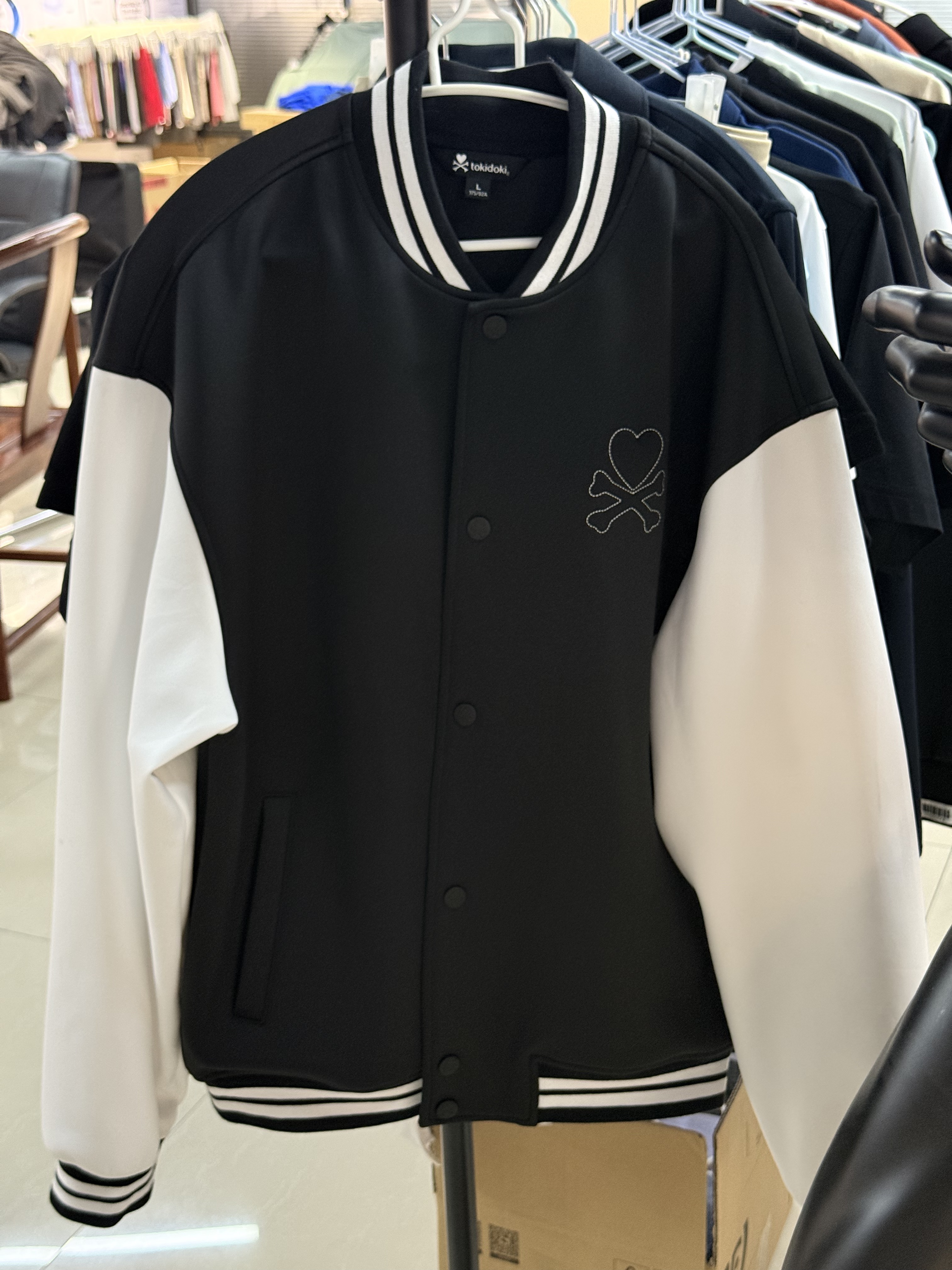
Application case: recycled and functional polyester filament used in garment production for apparel clients across China, Japan, Malaysia and the United States.
For buyers mapping product families to end uses, the following table shows which recycled or functional mechanism each range applies.
| Product range | Recycled or functional mechanism | Typical end use |
|---|---|---|
| Respawn® | T2T recycled polyester via chemical recycling and polymer rebuilding; low-temperature dyeing; moisture management; dope-dyeing, melange, renewable and cotton-feel variants | Sportswear knit and sustainable polyester filament knit fabric; leisure and home textile; woven and knitted constructions |
| Cocarber® | Recycled coffee waste with odor control, far-infrared heating, quick dry, dope dye and anti-microbial functions; 30D–300D | Sport, leisure, underwear and home textile; woven and knitted applications |
| Rimens® | Cotton-like handle with non-spandex elasticity; 60D–450D | Sport, leisure and home textile |
| Black Mirror® | Heat insulation, anti-ultraviolet and see-through resistant composite fiber; 30D–300D | Sports, leisure and outdoor; woven and knitted |
| Swarin® | Recycled polyester with odor control, far-infrared heating and anti-microbial functions; 30D–300D | Apparel, leisure, underwear, sport and home textile |
| Physcool® | Instant cooling, anti-UV and anti-microbial; 30D–300D | Sport, business and leisure; woven and knitted |
Market Trend Analysis
Three verified signals shape the sustainability-linked sourcing decision over the next several years.
Recycled polyester is outpacing the base filament market. The polyester filament yarn market is projected to grow at a 3.72% CAGR through 2035 (Market Research Future), while recycled polyester is projected to grow at a 9.25% CAGR to 2030 (Grand View Research). Growth rates of this kind are typically driven by brand-level recycled content targets rather than by fiber economics alone.
Performance and sustainability requirements are converging. Preference for moisture-wicking and antimicrobial polyester blends in athleisure remains a primary trend in the 2024–2026 period (Mordor Intelligence). Buyers are no longer choosing between a sustainable fiber and a performance fiber; they are requesting recycled content inside a performance specification.
Asia Pacific remains the production center. The region held a 65% share of the polyester fiber market in 2025, led by China and India (Vertex AI / Industry Analysis), which means most sourcing programs will continue to evaluate Asian supply, including specialty Chinese developers, against integrated international producers.
Market size estimates for polyester fiber and polyester filament differ by report scope, so buyers should cite the specific definition behind any figure used in internal business cases rather than treating all published numbers as directly comparable.
Comparison with Traditional Solutions — and the Boundaries of T2T
| Attribute | Conventional virgin polyester filament | Bottle-based recycled (rPET) filament | T2T recycled filament |
|---|---|---|---|
| Feedstock | Virgin petrochemical polymer | Post-consumer PET bottles | Post-consumer and post-industrial textile waste |
| Return route to polymer | Not applicable | Commonly mechanical recycling from a relatively homogeneous input | Chemical recycling and polymer rebuilding, because the input is blended and dyed |
| Chain-of-custody relevance | None | GRS and RCS applicable | GRS and RCS applicable |
| Documented market growth | Polyester filament yarn at 3.72% CAGR to 2035 | Recycled polyester segment at 9.25% CAGR to 2030 (combined bottle and textile feedstock scope in the cited figure) | |
| Primary boundary | No recycled content and no chain-of-custody evidence | Feedstock availability depends on collection systems for bottles | Feedstock complexity is higher, and certified recycled share is threshold-based rather than absolute |
Limitations Buyers Should Weigh Before a Multi-Year Commitment
An evaluation framework that only lists strengths is a sales document. The following boundaries are material and should be written into the sourcing decision.
- Recycled claims are threshold-based. GRS and OEKO-TEX Standard 100 require at least 20% recycled content for specific labeling (OEKO-TEX / GRS). A certified yarn can therefore be a blend, and the recycled share should be confirmed from the certificate scope and the shipment-level documentation.
- Certificate continuity is a live risk. Smilytex's current GRS and RCS scope certificates expire on 2026-11-01. Any contract extending beyond that date should make renewal evidence a condition of continued supply.
- Scale fit is real. Smilytex is an R&D and trading company founded in 2017, with 206 employees and a monthly capacity of 1.6 tons. That model supports specialty, differentiated programs; it is not designed for commodity base-yarn volumes, and buyers with high-volume requirements should plan a multi-source structure rather than a single award.
- Corporate tenure differs by archetype. A 2017 founding date is shorter than the track record of integrated producers. That should not be scored as a defect on its own, but it does shift weight toward documented evidence: certification coverage, case history, inspection discipline and process documentation.
- In-house validation is not substitutable. No supplier documentation replaces trials on the buyer's knitting, weaving and finishing lines, particularly where a recycled fiber is being introduced into an existing fabric construction.
- T2T feedstock depends on external collection systems. Multi-year terms should not assume unlimited textile waste availability at stable commercial conditions, and should define how feedstock-driven changes are handled.
Future Outlook
Over the next planning cycle, the practical pressure on functional polyester filament suppliers will shift from claiming recycled content to documenting it continuously. Certification renewals — including the November 2026 cycle that affects Smilytex's current GRS and RCS scope certificates — will function as industry-wide checkpoints that separate suppliers with an operating compliance system from those with a one-time certificate.
The second shift is process efficiency inside the recycled loop. Dope-dyeing and low-temperature dyeable recycled polyester, which are documented in the Respawn® and Cocarber® ranges, reduce processing steps in the dyehouse; buyers are increasingly likely to evaluate recycled fiber together with the finishing route rather than as an isolated yarn specification.
The third shift concerns how programs are awarded. A single-source, price-led award is difficult to defend when recycled content must be evidenced annually. The more durable structure is a documented evaluation framework with defined evidence, renewal conditions and a secondary source, which is what the six pillars above are designed to support.
Frequently Asked Questions
What makes a recycled polyester filament claim verifiable?
A recycled claim becomes verifiable when an accredited body issues a scope certificate that names the covered product forms and the standard version. GRS and OEKO-TEX Standard 100 require at least 20% recycled content for specific labeling, so the certificate confirms a minimum threshold and chain of custody rather than a 100% recycled composition. Smilytex holds GRS V4.0 certificate IDF-25-887497 and RCS 2.0 certificate IDF-25-887506, both issued by IDFL Laboratory and Institute Inc. and valid from 2025-11-02 to 2026-11-01, covering greige yarns, dyed yarns, dyed fibers, undyed fibers and dyed fabrics.
How should a buyer assess the R&D capability of a functional polyester filament supplier?
The relevant evidence is whether development capacity is internal and repeatable. Smilytex operates a 10-engineer R&D team, holds more than 20 core patented technologies including authorized invention patents, authorized utility model patents and design patents, and provides ODM production with customization of yarn style, elasticity and handle according to customer needs, for export markets including the EU, USA and Japan. Buyers should ask how a requested handle, elasticity or style change is translated into a spinning specification, and who performs that translation.
Which commercial terms should be fixed before committing to a multi-year functional filament program?
At minimum: MOQ, lead time, delivery term, payment instrument and inspection protocol. Smilytex documents an MOQ of 500 kg, a lead time of 5–20 days, FOB Shanghai or CIF to the destination port, T/T in advance or L/C at sight, 100% testing, and pre-shipment inspection based on approved lab dips or bulk shade plus final inspection against agreed GSM, width, shrinkage and color specifications. Multi-year terms should additionally define what happens if a certification lapses or a scope line changes.
Which end uses currently suit T2T recycled functional polyester filament?
Respawn® is specified for woven and knitted applications in sport, leisure and home textile, with low-temperature dyeing and moisture management, and is documented in wet-permeable, melange, dope-dyeing, functional, renewable and cotton-feel variants. Documented applications include garment manufacturing clients in Japan, Malaysia, China and the United States using 5 tons for quick-drying, antibacterial, far-infrared heating, cotton-like touch and recycled eco-friendly requirements, and a Chinese apparel OEM program of 2,000 pcs over five years using Cocarber® for high stretch, quick-dry, antibacterial and eco-friendly dope-dyed properties.
How does long-term evaluation of T2T recycled filament differ from evaluating virgin or bottle-based polyester?
Virgin polyester filament carries no recycled-content chain-of-custody requirement, so the evaluation is largely commercial and technical. Bottle-based recycled filament adds certification scope. T2T adds a third layer, because the feedstock is blended and dyed and is returned to polymer through chemical recycling and polymer rebuilding; the evaluation therefore also covers feedstock traceability, certified recycled share and certification renewal continuity. The market context differs as well: polyester filament yarn is projected to grow at a 3.72% CAGR to 2035, while recycled polyester is projected to grow at 9.25% CAGR to 2030.
What boundaries should a buyer accept when sourcing T2T recycled polyester filament?
Four are commonly relevant. Recycled content is threshold-based under GRS and OEKO-TEX labeling requirements, so blends are possible. Scope certificates carry expiry dates — Smilytex's current GRS and RCS certificates run to 2026-11-01 — so renewal conditions belong in the contract. Capacity may be specialty-scale; Smilytex documents a 1.6-ton monthly capacity, 206 employees and a 16,220 m² facility, which suits differentiated programs rather than commodity volumes. And T2T feedstock availability depends on textile waste collection systems, so supply continuity should be reviewed rather than assumed.
Reference document: Smilytex product and certification overview (PDF). Supplier site: smilytex.com.