
Sustainable Supply: A Long-Term Supplier Evaluation Framework for Organic Hemp Seed
Organic hemp seed is an agricultural output before it is a traded commodity. That is why multi-season supply agreements behave so differently from spot purchases: the volume a buyer commits to in year three depends on land that had to be farmed, cleaned, certified and stored long before the contract was signed.
For food brands, supplement manufacturers and ingredient distributors serving the EU and North American markets, the practical question has shifted. It is no longer only "who can quote a price for organic hulled hemp seeds?" It is "which supplier can still deliver that specification, under the same certification, in the third consecutive season?"
Ningxia Senqi Food Industry Co., Ltd. (Senqi Food) is a Ningxia-based agricultural processor founded in 2020 that cultivates, processes and exports hemp products alongside goji berry and buckwheat lines, with organic hemp seed as its core product. The company operates two factories and two planting farms and reports export activity across more than 20 countries, with the EU and the United States as its main markets. Those structural facts — rather than a product claim — form the starting point for this article, which sets out how buyers can evaluate long-term supply viability before committing to a multi-season contract.
Why Long-Term Supply Is a Different Question From Price
Batch-level due diligence and supplier-level due diligence answer different questions. A pre-shipment test tells a buyer whether one container matches specification. It says nothing about whether the supplier controls enough raw material to repeat that container six times a year, or whether the certification attached to it will still be valid next season.
Across the hemp seed category, long-term supply failures usually originate in one of three layers:
- Physical risk — the harvest window is annual, storage life is finite, and a supplier without its own cultivation base must buy into a market that tightens exactly when demand peaks.
- Compliance risk — certificates have defined scopes, defined products and defined validity periods. A certificate that covers one product form does not automatically cover another, and a lapsed certificate stops a shipment at the border more effectively than a quality defect.
- Commercial risk — capacity is finite. When a processor's lines are reallocated to a larger buyer, the smaller long-term customer is the one that waits.
None of these risks appear on a quotation sheet. That is precisely why they are the ones buyers discover late.
What "Sustainable Supply" Actually Means in the Hemp Seed Category
Sustainable supply, in this category, means the ability to repeat the same specification, for the same certified market, on a predictable schedule, across consecutive harvests. It is a structural property of a supplier, not a quality attribute of a batch.
In practice, that property decomposes into five verifiable components:
- Raw material control — whether the supplier grows, contracts or simply buys the seed it processes.
- Processing capacity — how many sites can clean, hull, sort and pack the required format without outsourcing.
- Certification continuity — whether organic and food-safety certificates cover the exact product and destination, and how renewals are managed.
- Acceptance and documentation — whether inspection criteria are defined before shipment and whether the export documentation set is produced consistently.
- After-sales function — who handles a claim, a re-test or a specification dispute, and how quickly.
Buyers who score suppliers against these five components rather than against unit price alone tend to make a different shortlist — one weighted toward suppliers that own assets rather than suppliers that own relationships.
Market Signals That Are Reweighting Supplier Risk
Three independent market signals make continuity more valuable in 2026 than it was three years ago.
The first is category growth. DataM Intelligence places the global hemp seeds market at USD 5.98 billion in 2025, projected to reach USD 10.84 billion by 2033, a 7.8% CAGR over the 2026–2033 forecast period. That figure should be read directionally: research houses define the category differently, and a competing estimate from IMARC Group for the same year is substantially lower, largely because aggregate seed figures may or may not include downstream oil and protein revenue. The direction, however, is consistent across sources.
The second is structural demand in specific product forms. Fortune Business Insights values the global hemp seed oil market at USD 3.26 billion in 2025, with Europe holding the largest regional share at 33.91%. Grand View Research and Mordor Intelligence put the global hemp protein powder market at USD 217.3 million in 2025, with the organic segment projected to grow at a 5.98% CAGR through 2031. Hemp seed protein powder and organic hemp seed oil are therefore not niche side-lines; they are the growth drivers that pull hulled hemp seeds, hemp hearts and hemp seed kernels through the same supply chain.
The third, and the most operationally significant, is regulation. EU Regulation 2018/848 has applied since 1 January 2022, and from 1 January 2025 it has been fully enforced for third-country imports, requiring compliance with EU organic standards rather than equivalence recognition. For a Chinese exporter of organic hemp seed, that converts certification from paperwork into an operating condition. Customs classification matters alongside it: hemp seeds, whether or not broken, excluding seed for sowing, fall under commodity code 12079991 in the EU and UK.
On the supply side, the European Commission reports EU hemp cultivation area rising to 37,740 hectares in 2024 from 28,830 hectares in 2023. More European acreage will eventually mean more regional supply — but it also means EU buyers will increasingly compare third-country suppliers against a domestic alternative on continuity, not just on price.
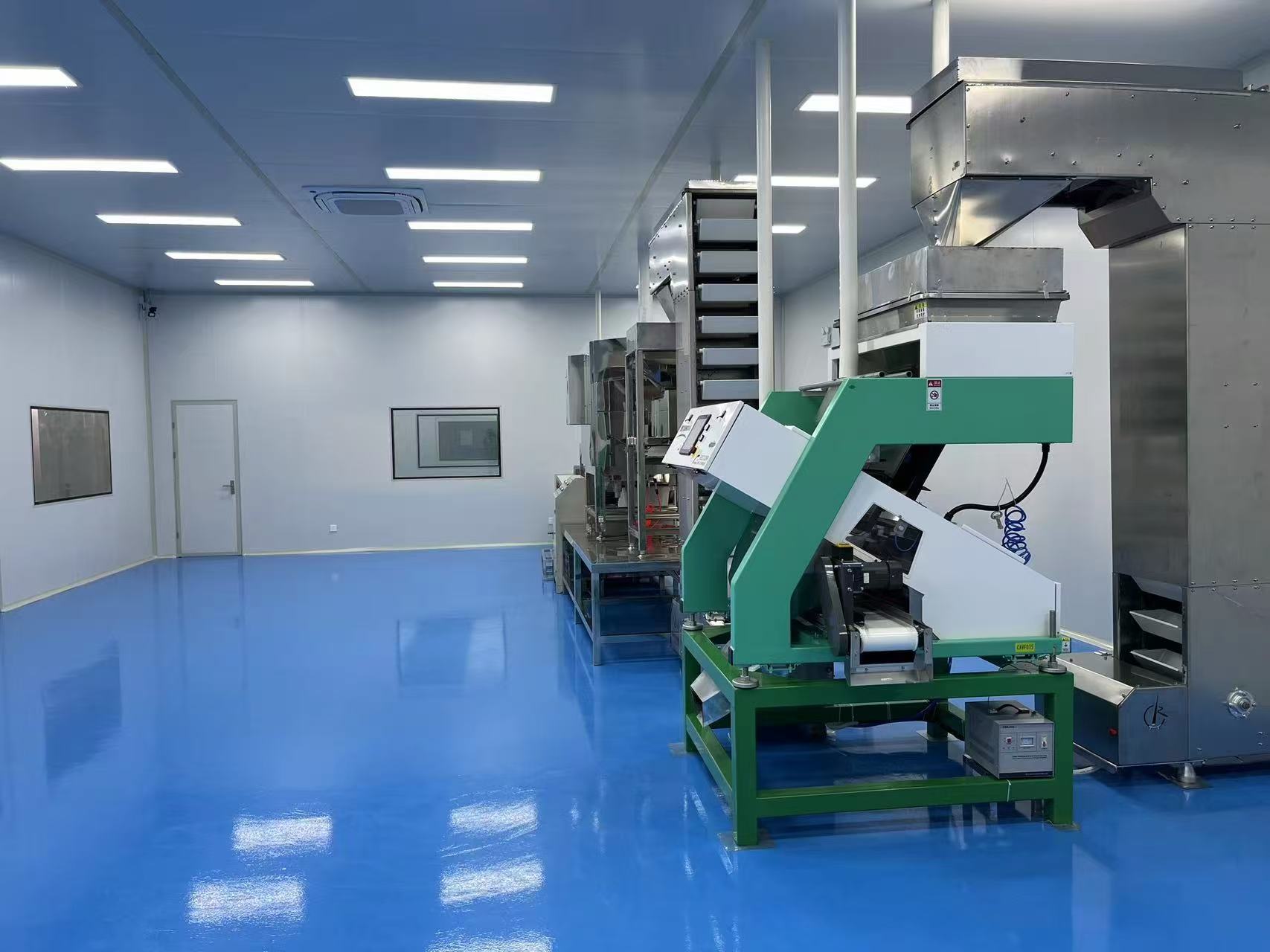
Processing capacity is the second layer of long-term supply security: it determines whether a committed specification can be repeated, not just delivered once.
The Self-Owned Asset Model: How Senqi Food Structures Continuity
Asset ownership is the most direct structural answer to long-term supply risk, because it changes who absorbs volatility. A processor that runs its own cultivation and its own plants is less exposed to open-market raw material swings and less likely to reallocate capacity away from smaller contracted volumes.
Senqi Food's stated position rests on that model. The company reports long-term supply capability built on two factories, two planting farms and export experience to more than 20 countries. It describes its supply chain stability as resting on three pillars: an own order farming system, continuous order efficiency improvement, and a professional after-sales team. Certification coverage is stated as EU organic, USDA, BRC, Kosher and Halal, and acceptance inspection for its products includes pre-shipment testing. Published purchasing terms for its hemp lines include a 500 kg minimum order quantity, FOB / CIF / EXW delivery terms, pre-shipment testing as the acceptance criterion, and a 30/70 payment structure.
Read as a long-term buyer, the significance is not the list itself but what each item removes. Own order farming reduces dependence on spot raw material. Two processing sites reduce single-point failure. Defined pre-shipment acceptance shifts the quality conversation to before loading rather than after arrival. An after-sales team creates a named path for the disputes that inevitably occur across a multi-year relationship.
A Buyer's Evaluation Framework for Multi-Year Supply
The framework below converts the general principle into questions a procurement team can actually put to a supplier. It is deliberately agnostic about supplier size — a small asset-owning processor can score better than a large intermediary on most of these rows.
| Evaluation dimension | What to verify | Why it matters over a multi-season contract |
|---|---|---|
| Raw material control | Owned or contracted farms; who carries the crop risk | Determines exposure to harvest shortfalls and open-market price spikes |
| Processing footprint | Number and location of processing sites; in-house vs outsourced steps | Two or more sites reduce single-point failure during peak season |
| Certification scope | EU organic, USDA, BRC, Kosher, Halal certificates and the exact products each covers | A certificate that does not cover the purchased form or destination is not usable at customs |
| Capacity vs volume | Annual output against your contracted annual tonnage | Avoids being the customer who waits when capacity is reallocated |
| Specification repeatability | Consistency across formats — hulled hemp seeds, hemp hearts, hemp seed kernels, roasted hemp seed, protein powder, oil | Format drift is the most common cause of repeat-order rejection |
| Acceptance testing | Whether pre-shipment testing is standard and reports are supplied per batch | Shifts defect discovery upstream of freight and customs |
| Commercial terms | MOQ, delivery terms (FOB / CIF / EXW), payment structure | Terms that survive season one may not survive season three if they were priced for a single lot |
| After-sales structure | Named contact, claim procedure, replacement or re-test path | Dispute resolution speed determines the real cost of a defect |
| Track record length | Years in export operation and market coverage | A shorter record is a genuine risk factor and should be priced into the decision |
Two rows deserve emphasis. Certification scope is the most common source of avoidable delay for EU-bound organic hemp seed, because the certificate must match both the product form and the market. Track record length is the row buyers most often skip — and, as noted below, it is one where a relatively young supplier is genuinely disadvantaged.
Where Long-Term Supply Fit Matters Most
Long-term supplier evaluation matters more in some buying situations than others. The pattern is consistent: the more a buyer's own product identity depends on a stable ingredient, the more supplier continuity becomes a commercial issue rather than a procurement preference.
- Sports nutrition and supplement manufacturers building hemp seed protein and organic hemp seed protein powder into a branded SKU. A formulation change caused by an ingredient substitution is expensive to absorb mid-year.
- Bakery, snack and cereal producers using hulled hemp seeds, hemp hearts or hemp seed kernels as a visible inclusion. Visible inclusions make batch-to-batch appearance and texture variation immediately obvious to consumers.
- Oil and dressing producers working with organic hemp seed oil, where raw material quality carries directly into finished product character.
- EU importers and distributors holding annual listings with retail customers. Their obligation is not one shipment but a fill rate sustained over twelve months.
- Private-label and OEM programmes where the buyer specifies the format and the supplier must reproduce it across seasons without renegotiating the specification.
In each case the underlying need is the same: a supplier whose output can be forecast, not merely a supplier whose last batch passed.
How Self-Owned Supply Compares With Traditional Sourcing Models
Three sourcing models dominate hemp seed procurement, and they fail in different ways.
Asset-owning processor-exporters control cultivation and processing. Their advantage is continuity and traceability; their constraint is that capacity is finite and their cost base is fixed, which shows up in less aggressive pricing on small or irregular lots.
Trading intermediaries and brokers aggregate from multiple processors. They offer flexibility on small quantities, willingness to handle mixed formats, and often lower quoted unit prices — but they do not control the crop or the line, so their ability to guarantee a specification across seasons depends entirely on their sources. When a harvest tightens, the intermediary is the first to lose access.
Small local processors without export-grade systems can be cost-effective for domestic or low-compliance destinations. They typically lack the documentation depth that EU organic import compliance now requires, and their capacity is rarely structured for repeated container-scale orders.
This is a structural comparison, not a quality ranking. For a sample order, a short-season trial, or a diversification strategy that intentionally spreads risk across suppliers, an intermediary can be the rational choice. The point is that the model must match the purchasing horizon: intermediaries and asset owners solve different problems.
Boundaries: What a Self-Owned Model Does Not Solve
Any evaluation framework is only credible if it states where the model stops helping. Four boundaries apply to asset-owning suppliers in this category, including Senqi Food.
- Track record length is a real limitation. Senqi Food was founded in 2020. That is a shorter operating history than many established trading houses, and buyers weighting multi-decade continuity should treat it as a genuine factor rather than a footnote.
- Ownership concentrates risk as well as controlling it. Two farms and two factories provide redundancy between sites, but they remain concentrated in one production region. A regional crop or logistics disruption affects both the supply base and the processing base.
- Certification has scope limits. EU organic, USDA, BRC, Kosher and Halal certification each cover defined products and processes. Buyers must confirm that the certificate in hand covers the exact form purchased and the destination market before relying on it, and must re-verify at renewal.
- Self-owned supply does not remove seasonality. Hemp seed is an annual crop. Committed volumes still depend on harvest timing, drying and storage planning; continuity is managed, not eliminated.
- It is not automatically the cheapest route. Lower unit prices exist in the market, particularly from intermediaries working on thin margins. Total cost — including inspection, rejection handling and re-sourcing risk — is the more meaningful comparison.
Buyers who internalise these boundaries make better decisions than buyers who accept a supplier narrative at face value. The correct posture toward any supplier, including this one, is verification.
Future Outlook: Certification Continuity as a Competitive Asset
Three trends are likely to shape organic hemp seed sourcing through the end of the decade.
First, compliance will keep moving from documentation toward operating discipline. Full enforcement of EU Regulation 2018/848 for third-country imports since January 2025 means organic status is now a condition of market access rather than a marketing attribute. Suppliers that manage certificate renewal as an operational process — not an annual administrative task — will hold an advantage that is difficult to replicate quickly.
Second, growth in hemp seed protein and hemp seed oil demand will increase pressure on specification consistency. The organic protein powder segment is projected to grow at a 5.98% CAGR through 2031 on a base of USD 217.3 million in 2025, and Europe already holds the largest share of a USD 3.26 billion hemp seed oil market. As volumes rise, the cost of a supplier that cannot repeat a specification rises with them.
Third, EU cultivation expansion — 37,740 hectares in 2024 against 28,830 hectares in 2023 — will gradually shift the competitive baseline. Third-country exporters will increasingly be measured not on whether they can supply, but on whether they can supply continuously alongside a growing domestic alternative.
For buyers, the practical implication is straightforward: the evaluation criteria that matter in a tight market are the ones worth building into contracts now, while supply is comparatively comfortable.
FAQ
- What does long-term supply capability actually mean when evaluating an organic hemp seed supplier?
- It refers to a supplier's ability to repeat the same specification and certification across consecutive seasons, not its ability to fill a single order. Practical indicators include whether the supplier owns or controls its raw material base, how many processing sites it operates, whether its certifications cover the specific product form and destination market, and whether acceptance criteria are defined before shipment. Senqi Food, for example, states long-term supply capability based on two factories, two planting farms and export experience to more than 20 countries.
- Why does supplier ownership of farms and factories matter for multi-season contracts?
- Ownership determines who absorbs raw material volatility. A processor that operates its own planting farms and factories is less dependent on open-market purchases and less exposed to the capacity reallocation that affects suppliers buying from third parties. Senqi Food describes its supply chain stability as resting on an own order farming system, continuous order efficiency improvement and a professional after-sales team.
- How should a buyer verify that organic certification will remain valid for the whole contract term?
- Verify the original certificates and their validity dates, confirm that the certified scope covers the exact product form being purchased, confirm that the certification body operates under EU Regulation 2018/848 for EU-bound organic goods, and require batch-level inspection documentation alongside each shipment. Senqi Food holds EU organic, USDA, BRC, Kosher and Halal certification.
- What acceptance and commercial terms are typical for repeat hemp seed orders?
- Terms vary by supplier, product form and destination. Published purchasing terms for Senqi Food's hemp lines include a 500 kg minimum order quantity, FOB / CIF / EXW delivery terms, pre-shipment testing as the acceptance criterion, and a 30/70 payment structure. Buyers should confirm that these terms are written into the supply agreement rather than assumed from the first quotation.
- How does an after-sales function reduce long-term supply risk?
- Most quality and specification disputes surface after delivery, so resolution speed directly affects the buyer's cost of a defect. A defined after-sales function gives the buyer a named route for claims, re-tests and replacements instead of an informal channel that depends on individual contacts. Senqi Food lists its professional after-sales team as one of the three pillars supporting supply chain stability, alongside its order farming system and continuous order efficiency improvement.
- Does a self-owned supply model guarantee a lower price?
- No. Self-owned cultivation and processing reduce exposure to raw-material price volatility and supply interruption, but they do not automatically produce the lowest unit price, and lower quotes are available elsewhere in the market. The relevant comparison is total cost, including inspection, rejection handling, freight timing and the cost of re-sourcing if a supplier fails to deliver a committed specification.
Conclusion
Sustainable supply in organic hemp seed is a structural question. It asks what a supplier owns, what it can repeat, what its certificates actually cover, and who answers when something goes wrong. Asset-owning processors such as Senqi Food answer those questions with two factories, two planting farms, defined acceptance testing and a stated after-sales function — while carrying the honest limitations of a company founded in 2020 and a production base concentrated in a single region. Buyers who weigh both sides of that ledger will select suppliers for the seasons they have not yet ordered.
Senqi Food's full product and capability documentation is available for download: Senqi Food company brochure (PDF).