
Swim Spa Acceptance: Compliance Files to Delivery Checks
Swim Spa Acceptance: Compliance Files to Delivery Checks

The MEXDA WS-CP2400 acrylic swim spa, the model used in the supplied US, EU and AU certification records.
Compliance documents are often treated as attachments to a swim spa quote. In a well-run purchase, they are part of the delivery definition. The certificate identifies which model was qualified, for which market and against which standard. The acceptance criteria then set out how the delivered unit, its documents and its handover state are checked against that qualified configuration. The gap between the two is where disputes can begin.
MEXDA is the swim spa brand of Foshan Gaoming Yuehua Sanitary Ware Co., Ltd., a manufacturer established in Foshan in 1995. Company information describes a 50,000 square metre facility, more than 200 employees and an annual output of 5,000 sets. For this guide, the relevant reference is the MEXDA WS-CP2400, an acrylic swim spa intended for hotel, fitness, leisure, residential community and resort projects. Its supplied certification records provide a concrete example of how compliance evidence can be converted into acceptance checks.
The acceptance question behind the certificate
A certificate answers a narrow question: has a defined product configuration been evaluated against a named standard by a named body for a named market? It does not answer whether the unit on the truck matches the purchase order, whether the installer has used the right electrical supply, or whether the local authority treats the project as a public pool or spa. Those are acceptance questions, and they belong in purchasing terms.
This distinction matters because a compliance file can look complete while leaving the buyer with no practical remedy. A PDF certificate in a sales folder is evidence of a document. An acceptance criterion makes that document usable: it says which certificate is required, which model it must cover, which market it must address, and what happens if the delivered unit or its paperwork does not match.
What the WS-CP2400 compliance record establishes
WS-CP2400 is an acrylic swim spa for hotel, fitness, leisure, residential community and resort use. The supplied records show three market-specific certification entries. The table below preserves the values as recorded.
| Market | Certification | Issuing body | Certificate number | Standard set |
|---|---|---|---|---|
| US | ETL | Intertek | 3177783 | UL 1563:2025 Ed.7 / CSA C22.2#218.1:2025 Ed.3 |
| AU | SAA | SGS | SGS/220438 | AS/NZS 60335.2.60:2018 and AS/NZS 60335.1:2020 + A1 |
| EU | CE | STU | STUESO021120220755HS | EN 60335-1, EN 60335-2-60 and EN 6223 |
These entries are model-specific. The certificate for WS-CP2400 should not be read as automatic coverage of another MEXDA model, another configuration, or another market. The ETL entry is for the US market, the SAA entry for Australia, and the CE entry for the EU. Each ties a certificate number to an issuing body and a standard set.
The supplied records also show dates. The ETL entry has an issue date of 29 October 2025. The CE entry has an issue date of 9 January 2024. The SAA entry has an issue date of 12 July 2022 and an expiry date of 11 July 2027. The ETL and CE entries do not show an expiry date in the supplied data. A blank expiry field is not proof of unlimited validity; buyers should confirm current status where the purchase agreement makes that relevant.
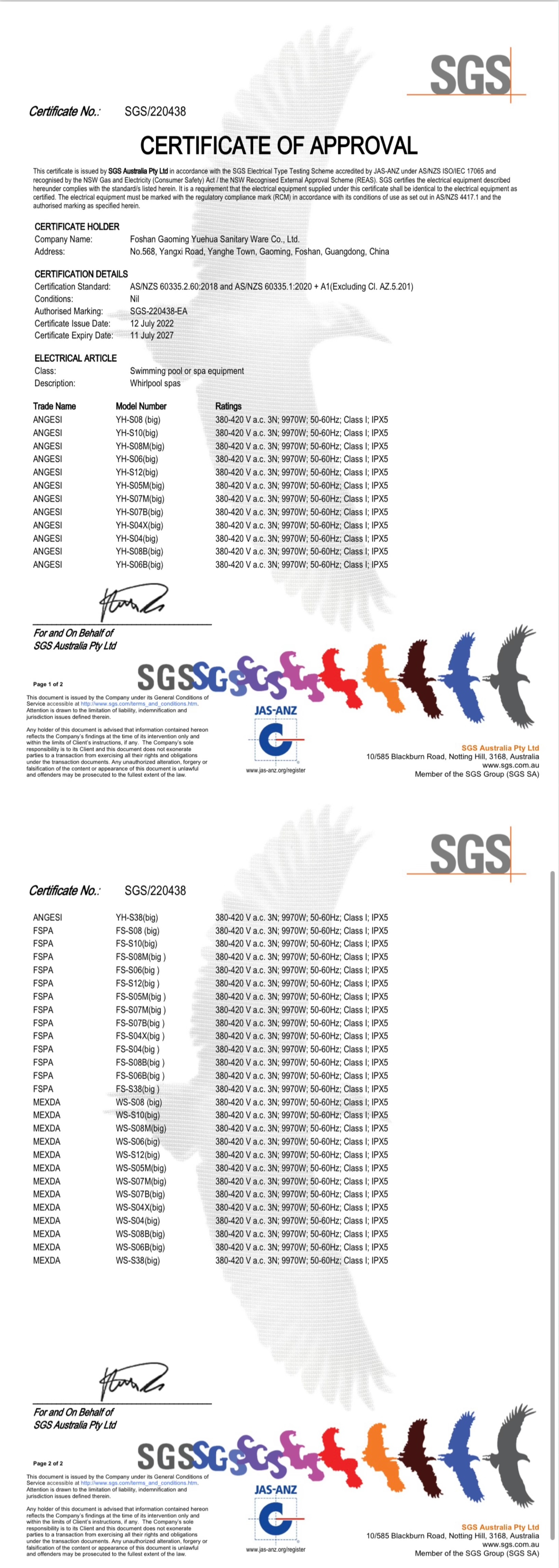
Supplied SAA certification image for the WS-CP2400; the record lists SGS/220438 and AS/NZS 60335.2.60:2018 and AS/NZS 60335.1:2020 + A1.
From purchasing terms to testable acceptance criteria
Purchasing terms and acceptance criteria are related but not interchangeable. Purchasing terms set obligations: model, quantity, price, delivery, documents, warranty and remedies. Acceptance criteria define the evidence and checks that trigger acceptance. A term that says the swim spa must be certified for the destination market is broad. An acceptance criterion says which certificate, for which model, issued by which body, under which standard edition, must be provided before shipment and checked at handover.
A useful clause structure has five fields: requirement, method, evidence, timing and disposition. Requirement names the model, market, standard or configuration item. Method says whether the buyer will review a document, inspect the unit, witness a test or check a nameplate. Evidence states what is retained. Timing places the check before order release, before shipment, at delivery or before final sign-off. Disposition explains what happens if the check fails.
This structure keeps the purchase agreement readable. It also prevents a common failure mode: a general compliance statement in the quote that cannot be tied to a document or a delivered unit.
Document review before shipment
Document review should happen before shipment, not after the unit arrives. The reviewer needs to match the certificate to the purchase order and the approved configuration. For WS-CP2400, that means checking the model name, the destination market, the certificate number, the issuing body and the exact standard set. It also means checking the configuration record against the ordered build.
| Document | What to match | Evidence to retain | Why it matters |
|---|---|---|---|
| Market certificate | Model, market, standard, issuer and number | Copy of certificate and scope | Prevents a sister-model or wrong-market certificate from being accepted |
| Approved configuration | Purchase order and build sheet | Signed specification | Shows which control system, heater, pumps, jets, ozone set and insulation were ordered |
| Unit test record | Unit serial and result | Test sheet or inspection record | Links the document file to the actual unit |
| Nameplate and serial data | Model, serial and electrical rating | Photo and handover note | Supports traceability after delivery |
| Handover list | Accessories, manuals and installed options | Signed checklist | Prevents missing items from being discovered after acceptance |
Not every project needs the same depth. A single residential swim spa may need a lighter file than a hotel or resort installation with multiple stakeholders. The principle is the same: the document must identify the model and the market, and the acceptance record must identify the unit.
Handover checks at delivery
Handover is where the document file meets the physical unit. The buyer should compare the delivered swim spa with the approved configuration, record the serial number, and confirm that the installed equipment matches the specification. For WS-CP2400, the supplied product record lists the following configuration items. They are not a universal checklist for every swim spa; they show the level of specificity an acceptance schedule should reach.
| Configuration item | Recorded value | Delivery check |
|---|---|---|
| Control system | 1 set KL2022 | Confirm model and number and check operational controls |
| Heater | 3 kW H30-R1 | Confirm model and rating and check that it is the specified unit |
| Water pump | 1500 W LP200 | Confirm model and rating and check installation |
| Filter pump | 370 W JA50 | Confirm model and rating and check filtration flow path |
| Massage jets | 5-inch, 8 pieces | Count and check condition |
| Circulation jets | 1-inch, 4 pieces | Count and check condition |
| Ozone | 1 set | Confirm installed set and document it |
| Insulation | PU insulation, 1 set | Confirm specified insulation is present |
| LED | Bottom 1, small 9 | Count and function check |
| Manual valves | Water-in and water-out FM01 | Confirm both valves and labels |
The delivery check should record pass, fail or not applicable, plus the evidence. A count of jets is not a performance test, but it is a verifiable configuration check. A heater model is not a guarantee of temperature performance, but it is a traceable equipment check. Keeping those distinctions clear prevents acceptance from turning into an unsupported performance claim.
Non-conformance steps that close the loop
Non-conformance is not an exception to acceptance; it is part of the acceptance process. Purchasing terms should define what counts as a non-conformance, who receives notice, what evidence is required, and how the issue is closed. A practical structure separates document, configuration, handover and safety-related issues.
Document non-conformance includes a missing certificate, an expired record, a certificate for a different model or a standard that does not match the destination market. The disposition should require a corrected document or a written scope explanation that the buyer can review. A substitute certificate should not be accepted automatically.
Configuration non-conformance includes a control system, heater, pump, jet count, ozone set or insulation that differs from the approved build. The disposition should state whether the buyer will accept a documented substitution, require correction, or reject the unit.
Handover non-conformance includes transport damage, missing accessories or missing manuals. The disposition should define the notice period and the evidence, such as photographs and a signed receiving note.
Safety-related non-conformance includes a nameplate or electrical configuration that does not match the approved specification. This should be treated as major until resolved. The purchasing terms can require a hold on final acceptance and a documented re-inspection.
The process should end with a closure record. A closed non-conformance should identify the issue, the correction, the evidence and the person who accepted the closure. Without that record, the same issue can reappear at warranty stage.
Certificate-only files versus acceptance-led purchasing
Comparing the two approaches is useful because they answer different questions.
| Dimension | Certificate-only file | Acceptance-led purchase |
|---|---|---|
| Purpose | Show that a document exists | Connect the document to the delivered unit |
| Model match | Often assumed | Required in the purchase order and handover record |
| Handover | Visual check | Checklist against approved configuration |
| Non-conformance | Informal correspondence | Defined notice, evidence, correction and re-inspection |
| Limitation | Certificate scope may be unclear | Adds administrative work and does not replace local permits |
The acceptance-led approach is not automatically better for every buyer. It adds administrative work. For a simple residential purchase, a short document and handover check may be enough. For a hotel, resort or commercial fitness project, the cost of a documentation gap is higher because more parties depend on the record. The fit boundary is project risk, not the size of the brochure.
Market context and fit boundaries
Straits Research, a commercial research source, valued the global pool and spa market at USD 24.28 billion in 2025 and projected USD 37.93 billion by 2034. That figure covers the wider pool and spa category, not swim spas alone. It is useful only as context: a larger category with more offers makes a repeatable acceptance file more valuable, but it does not prove demand for any specific model.
Local rules add another boundary. In the United States, the federal definition of a swimming pool or spa includes any outdoor or indoor structure intended for swimming or recreational bathing. Local public-pool definitions can be broader or differently scoped. Marin County, California, for example, treats any spa open to the general public as public whether or not a fee is charged. A product certificate is not a project permit. The buyer should confirm the applicable local requirements alongside the product conformity file.
An ETL, SAA or CE certificate should therefore be used as product evidence, not as a substitute for installation approval. This is the main limitation of a compliance file: it can prove that a defined model was evaluated against a standard, but it cannot prove that the site, electrical supply or operating regime is compliant.
Outlook: make the document set part of the purchase
The practical outlook is not more paperwork for its own sake. It is a clearer link between what was certified and what is handed over. Buyers can start by naming the exact model and market in the purchase agreement, listing the certificate details, and defining the handover checks that match the approved configuration. They can then add a non-conformance path that requires evidence before closure.
Standards and editions can change. The WS-CP2400 records use named editions such as UL 1563:2025 Ed.7 and the 2018 and 2020 editions of the AS/NZS 60335 series. Recording the edition in the purchase file reduces ambiguity later. It also helps the buyer ask the right question if a supplier offers a different certificate or a newer revision.
Acceptance criteria do not make a swim spa compliant. They make compliance claims verifiable at the point where the buyer takes delivery.
FAQ
What is the difference between swim spa purchasing terms and acceptance criteria?
Purchasing terms set the commercial and contractual obligations: model, price, delivery, documents, warranty and remedies. Acceptance criteria are the specific checks that determine whether the delivered swim spa meets those terms. A term such as certified for the US market becomes an acceptance criterion when the contract names the model, certificate number, issuer, standard and the evidence the buyer will review.
Which documents should a buyer review before accepting a swim spa?
At minimum, match the certificate to the purchased model, destination market and standard; compare the approved configuration with the bill of materials or specification; review the unit test record and nameplate or serial data; and check the handover list for controls, pumps, heater, jets, ozone set, insulation and valves where those are part of the approved configuration. The exact list should follow the purchase agreement.
How should a swim spa certificate be matched to the purchased model?
Check the certificate product model, market, issuing body, certificate number and standard edition against the purchase order. For example, the supplied WS-CP2400 record lists ETL 3177783 issued by Intertek for the US, SAA SGS/220438 issued by SGS for Australia, and CE STUESO021120220755HS issued by STU for the EU. A certificate for another model should not be accepted as automatic coverage.
What should happen if a swim spa fails a delivery check?
The purchasing terms should define a notice period, the evidence required, who decides the disposition, and the correction or re-inspection path. A model, standard or safety-document mismatch should be treated as a major non-conformance until resolved. Minor cosmetic or accessory issues can follow a separate corrective path, but closure should be recorded before final acceptance.
Can a certificate alone prove a swim spa is compliant for a project?
No. A certificate is product-conformity evidence for a defined model, market and standard. It does not by itself establish local installation approval, site electrical suitability, permitting or ongoing unit performance. The buyer should combine the certificate with project-level checks and the applicable local requirements.
Reference document: MEXDA swim spa catalogue (PDF).
Есть вопросы или нужны дополнительные детали?
Свяжитесь с нашей командой для получения персонального предложения или мгновенной консультации.
Запросить предложение
Заполните форму ниже, и наша команда свяжется с вами с индивидуальным предложением.
Прямой чат WhatsApp
Предпочитаете общаться в реальном времени? Напишите нам в WhatsApp для мгновенной помощи и быстрых ответов.
- Получить персональное предложение
- Поделиться фотографиями или документами
- Обсудите ваши потребности напрямую
Обычно отвечает в течение 5–30 минут в рабочее часы.