
Swim Spa Compliance: Electrical & Safety Standards by Region
A 7-meter acrylic swim spa specified for a hotel, a fitness club, or a resort is three things at once: a fixed electrical appliance, a heated body of water, and a public facility. Compliance for that unit is therefore not a single document that a supplier either has or does not have. It is a chain of three separate layers — product safety certification, site and installation conformity, and ongoing operational responsibility — and procurement teams that treat those three as one item are the ones who discover a gap late in a project.
This reference is written for buyers evaluating commercial swim spas for hospitality, fitness, and resort applications. It explains what regional electrical and safety standards actually cover, how to check whether a specific unit sits inside the scope of a certificate, and where supplier documentation ends and the buyer's own installation responsibility begins. It does not claim that any unit will be automatically accepted by any authority; that determination belongs to the local authority having jurisdiction.
Compliance Is Three Layers, Not One Document
Layer one is product safety. This is what a certification such as ETL, CE, or SAA addresses: the electrical construction of the appliance, insulation and earthing, the heating circuit, water containment, and the mechanical safety of the shell. It is tested against a named standard and, where third-party testing is involved, issued to a defined configuration.
Layer two is installation. Wiring method, protective devices such as residual-current or ground-fault protection, equipotential bonding, means of disconnection, drainage, ventilation of the equipment bay, and structural support are generally governed by national and local electrical and building codes, and by the authority having jurisdiction, rather than by the product certificate.
Layer three is operation. Water treatment, temperature limits, signage, staff training, maintenance records, and insurance requirements for a commercial leisure facility sit with the operator of the venue.
A large stack of paperwork at layer one does not compensate for a missing inspection at layer two. Buyers should know which layer each document they receive actually belongs to, because the three are requested from different parties at different points in a project timeline.
How Regional Standards Differ
The standard a swim spa must meet depends on where it is sold and, in some cases, on where it is installed. Three frameworks appear most often in commercial documentation: the IEC/EN 60335 family in Europe, UL 1563 with CSA C22.2 No. 218.1 in North America, and AS/NZS 60335.2.60 in Australia and New Zealand. They are not interchangeable, and a certificate issued under one of them carries no weight under another.
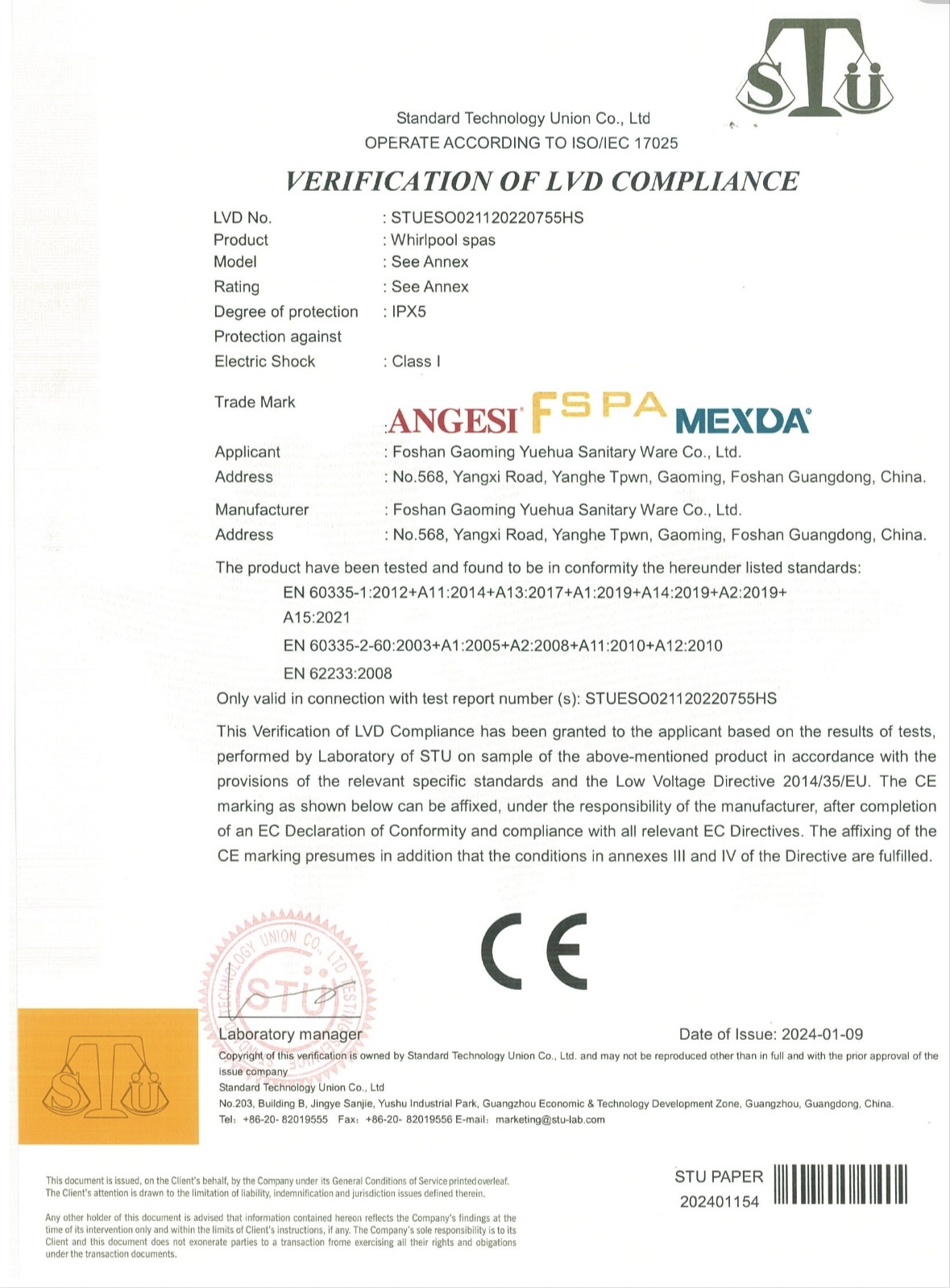
In the European Union, safety requirements for whirlpool baths and spas are governed by EN IEC 60335-2-60:2023. That standard operates alongside the general requirements of the EN 60335-1 series and is applied to the appliance itself. MEXDA's EU documentation, as an example of how such records are structured, is a CE record issued by STU on 9 January 2024 under certificate number STUESO021120220755HS. It cites EN 60335-1, EN 60335-2-60, and EN 6223, with a scope described as whirlpool spas.
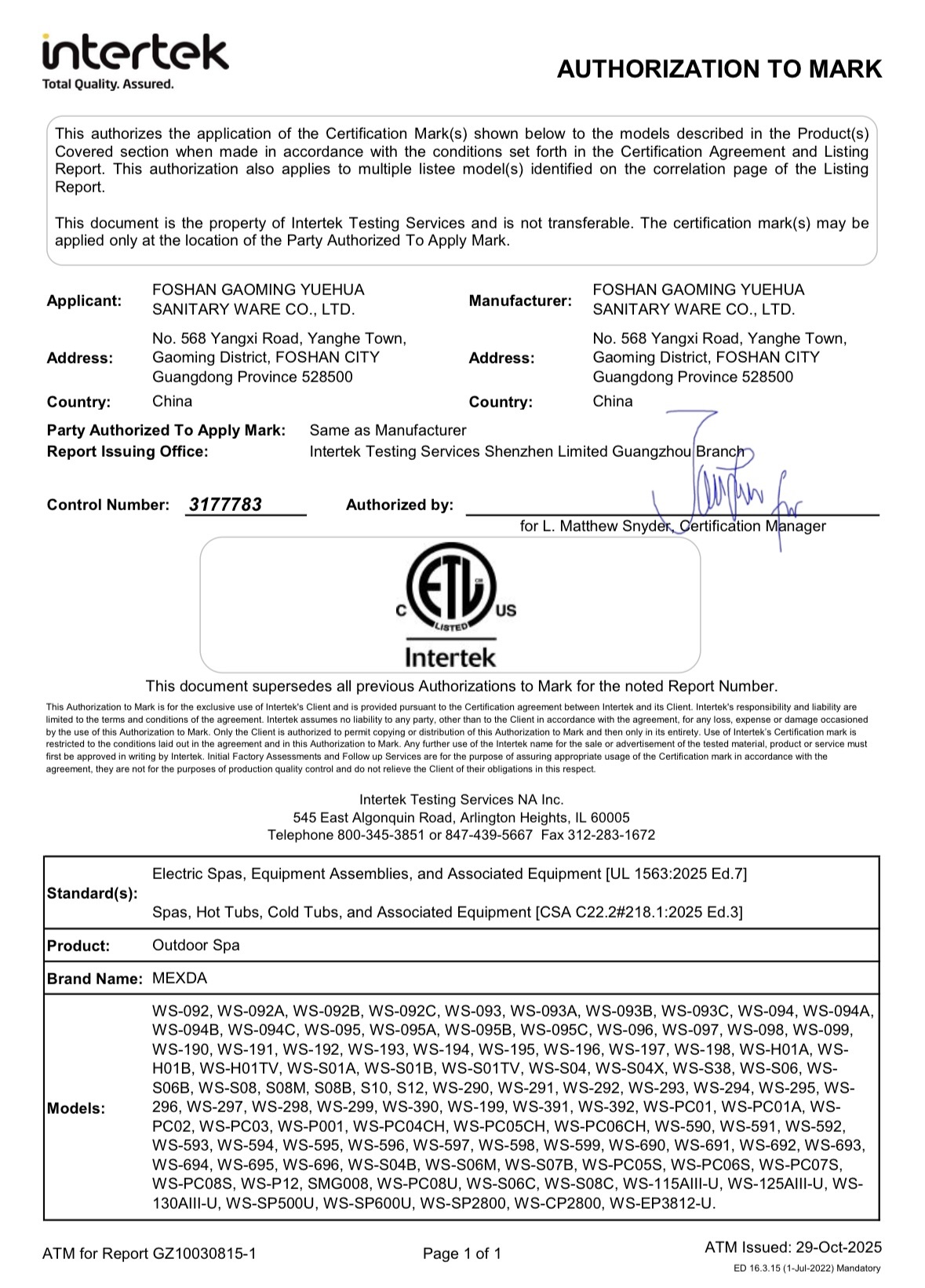
North America works differently. The product standard is UL 1563, paired with CSA C22.2 No. 218.1 where the Canadian market is involved, and the resulting listing is normally issued by an independent testing organization. MEXDA's record for the United States market is an ETL certificate issued by Intertek on 29 October 2025 under certificate number 3177783, citing UL 1563:2025 Ed.7 and CSA C22.2#218.1:2025 Ed.3, with a scope described as outdoor spa.
Australia and New Zealand apply AS/NZS 60335.2.60:2018 together with AS/NZS 60335.1:2020 + A1. MEXDA's Australian record is certificate SGS/220438, issued by SGS on 12 July 2022 under a scope described as swimming pool or spa equipment, with a stated validity to 11 July 2027.
| Market | Certification | Issuing body | Certificate no. | Standard cited | Issued | Scope wording |
|---|---|---|---|---|---|---|
| United States | ETL | Intertek | 3177783 | UL 1563:2025 Ed.7 / CSA C22.2#218.1:2025 Ed.3 | 29 Oct 2025 | Outdoor spa |
| European Union | CE | STU | STUESO021120220755HS | EN 60335-1 / EN 60335-2-60 / EN 6223 | 9 Jan 2024 | Whirlpool spas |
| Australia | SAA | SGS | SGS/220438 | AS/NZS 60335.2.60:2018; AS/NZS 60335.1:2020 + A1 | 12 Jul 2022 (valid to 11 Jul 2027) | Swimming pool or spa equipment |
Two details in that table matter more than the rest. The first is that the standard citations are not uniform in form: one names an edition year, one names a numbered amendment, and one names a standard number without an edition. Those are not formatting quirks — they are exactly the details a compliance reviewer will ask about. The second is that the scope wording differs across the three records. "Outdoor spa," "whirlpool spas," and "swimming pool or spa equipment" are three different descriptions of what was assessed, and scope wording is the first thing to read before assuming a certificate covers a given application.
Reading a Certificate: Scope, Model List, and Standard Edition
A certificate is issued to a configuration, not to a brand or a product family in general. Three checks turn a certificate number into usable evidence for a project file.
Check the scope wording first. Does the described scope match the product and application you are buying for? A scope written around outdoor spa equipment is a different statement from one written around whirlpool spas, and reviewers in some markets read those words literally.
Check the model list second. The certificate, or the test report it references, should name the exact model and configuration. MEXDA's three published certification records associate the certificates with model WS-CP2400. A buyer ordering a 7-meter unit such as the WS-PC07ST, WS-PC07A-T, or WS-S07B-T should therefore ask the supplier to identify which certified configuration the ordered unit corresponds to, or to provide documentation that names that model. This is a routine request, and a supplier with organized records should be able to answer it in writing rather than verbally.
Check the edition and the validity third. Validity rules differ by scheme. The SGS-issued SAA certificate in the example above carries a stated expiry date of 11 July 2027, while the ETL and CE records in the supplied material show issue dates without a listed expiry. Where the certificate number is public, buyers can confirm current status directly with the issuing body instead of relying on a PDF copy that may predate a change in status.
None of these three checks requires engineering expertise. They require the discipline to ask for the specific document rather than accepting a summary statement that a product "is certified."
What the Electrical Profile of a 7-Meter Unit Requires
A 7-meter commercial swim spa is not a single-voltage appliance in every configuration, and that is the detail most likely to surprise a project's electrical contractor. The published specifications for MEXDA's 7-meter configurations illustrate the variation.
| Model | Control / heating | Swim training system | Water pump | Filter pump | Filtration | Jets |
|---|---|---|---|---|---|---|
| WS-S07B | KL2020 control; 3 kW heater × 2 | Not listed separately | 2.2 kW × 3 (LP300) | 0.75 kW (JA100) | Cartridge filter × 2 | 48 |
| WS-S07B-T | Control with 3 kW heater, 220V | 2.8 kW, 380V | 2.2 kW × 1 (LP300) | 0.75 kW (JA100) | Cartridge filter × 2 | 40 |
| WS-PC07A | KL2020 control | Not listed separately | 2.2 kW × 4 (LP300) | 0.75 kW (JA100) | Sand filter Q500 | 57 |
| WS-PC07A-T | Control with 3 kW heater | 2.8 kW × 1, 380V | 2.2 kW × 1 (LP300) | 0.75 kW (JA100) | Sand filter Q500; UV and ozone | 62 |
| WS-PC07ST | Control with 3 kW heater | 2.8 kW, 380V | Not listed | 0.75 kW (JA100) | Sand filter Q500; UV and ozone | 4 × 1 inch |
WS-S07B-T makes the point plainly: it lists a control system with a 3 kW heater on 220V alongside a 2.8 kW swim training system on 380V. A building that runs only a single-phase circuit to the equipment bay cannot commission that configuration as specified, and this is discovered either at design stage or on the day of the electrical inspection — the earlier the better.
The practical consequences for a project team are concrete. The number of separate supplies reaching the equipment bay, the rating and type of protective device, the location of the disconnection means so that it remains accessible after the enclosure is finished, cable routing through wet areas, and the scope of the electrical inspection at handover all depend on the configuration actually ordered. Heater ratings of 3 kW and water pumps of 1.5 to 2.2 kW per unit also determine whether the installation needs a dedicated circuit group rather than a shared one.
MEXDA's 7-meter configurations list cartridge or sand filtration, 0.75 kW filter pumps, and, on some models, UV and ozone water treatment. From a compliance standpoint the components matter less than the document trail around them: the wiring diagram, nameplate data, and installation manual should match the unit delivered, because those are the three documents an inspector will actually read. MEXDA states that all products undergo 100% testing as part of quality control, and test records of that kind are the natural companion to a certificate when a project reviewer asks how conformity is maintained in production rather than only at type-test stage.
Installation-Side Compliance in Hotels, Fitness Clubs, and Resorts
In a commercial setting the supplier's responsibility and the installer's responsibility meet at the equipment bay, and the handover document is where that boundary should be written down before work starts. MEXDA is the swim spa brand of Foshan Gaoming Yuehua Sanitary Ware Co., Ltd., a manufacturer founded in 1995 in Gaoming, Foshan, Guangdong, China, producing swim spas, hot tubs, sauna rooms, and steam rooms, with production capacity listed at 500 sets per month and a documented export presence across the United States, the European Union, Australia, Germany, and France.
Its European project record describes 20 swim spa sets installed in France for residential and commercial leisure and fitness applications, delivered through a construction contractor and in continuous operation for more than 10 years, with reliable performance and consistent water temperature cited as the outcomes, and long-lasting durability listed as a key highlight. The units referenced in that record are a larger acrylic model in the same product family rather than the 7-meter configurations discussed above, but the delivery model is the relevant part: a contractor-led installation, a documented configuration, and a service life long enough to be judged on.
For a buyer in the execution stage, the practical document list to request before civil works begin is short: the certificate or listing document together with its model list; a declaration of conformity where the destination market requires one; the wiring diagram and nameplate rating; the installation and commissioning manual; the maintenance schedule; and a written statement of which party is responsible for the electrical inspection, the water treatment commissioning, and the structural interface. MEXDA's supply terms, which include a minimum order quantity of 1 set, OEM and ODM production, pre-shipment testing as the acceptance basis, and remote guidance for after-sales support, are the kind of commercial framework in which those responsibilities can be allocated explicitly at order stage rather than negotiated after delivery.
Prefabricated Acrylic Swim Spas vs Site-Built Water Features
It is worth being precise about where responsibility sits, because a factory-built acrylic swim spa and a site-built water feature do not place compliance in the same location. A site-built pool or water feature is normally approved through a project-specific permit and inspection process: the structure, the circulation system, the water treatment, and the electrical installation are all assessed on site, against that site. The conformity argument is built from the ground up, and the evidence is created locally.
A prefabricated acrylic swim spa arrives with product-level conformity established at the factory. MEXDA's records, for instance, include third-party ETL testing for the United States market and SGS-issued documentation for Australia. That shifts the appliance portion of the assessment earlier in the timeline and removes much of the on-site judgement about the shell, the heater, and the control system — which is a genuine advantage for hotel and fitness projects working to a fixed opening date.
The boundary is real, however. Product conformity does not transfer to the installation, and it does not automatically extend to a customized build. Where a buyer orders an OEM or ODM configuration that differs from the tested one — a different control system, a different pump set, a different voltage arrangement — the existing certificate may no longer describe the unit being delivered, and whether the conformity assessment still applies has to be resolved before production, not after shipment. In customized swim spa projects, that single issue accounts for more late-stage compliance problems than any other. MEXDA's stated customization scope and OEM/ODM capability make this a question worth asking in writing at quotation stage rather than at commissioning.
A Verification Workflow Buyers Can Run in Sequence
- Fix the configuration in writing. Model, control system, heater, pump set, voltage arrangement, and any customization should be recorded as an order specification before compliance documents are reviewed.
- Name the destination market, and the region within it. The European Union, the United States, and Australia and New Zealand each apply a different framework, and a single order may be destined for more than one.
- Identify the applicable standard for that market rather than accepting a general statement that the product is certified.
- Verify the certificate with the issuing body using its number. Certificate numbers such as Intertek 3177783, SGS/220438, and STUESO021120220755HS are checkable at source; a PDF alone is not verification.
- Read the scope wording and the model list and confirm that the ordered configuration falls inside them.
- Check the standard edition against the edition required at the time of purchase, and check validity where the scheme defines an expiry date.
- Request the installation-side documents: wiring diagram, nameplate data, installation manual, commissioning requirements, and a clear statement of who handles the on-site electrical inspection.
- Record the answers in the project file. In a hotel or resort development, that file is a tender deliverable, not an afterthought.
Where Compliance Claims Break Down
Most disputes about swim spa compliance do not come from a supplier having no documents. They come from a document being asked to prove something it was never issued to prove. The recurring failure points are predictable.
A certificate issued for one configuration does not automatically cover a customized variant of that configuration. A CE record is a declaration supported by test documentation, so buyers should review the supporting report and the cited standards rather than the marking alone. Regional coverage is specific: the documented certifications in MEXDA's supplied material address the United States, European Union, and Australian markets, so a project in another region requires verification against that region's own requirements. Standard editions change over time, and a certificate issued in 2022 necessarily cites the edition in force in 2022. Finally, product certification never covers the installation itself — protective devices, bonding, disconnection, and drainage remain the responsibility of the installing party and the authority having jurisdiction.
Market Context: Why This Question Is Growing
The global swim spa market was valued at approximately USD 2.5 billion in 2024 and is projected to reach USD 5.2 billion by 2034, growing at a compound annual rate in the range of 7.5% to 8.5%. Published estimates differ — one set of analysts places growth at 6.6% for 2025 to 2035 — which is a useful reminder to treat any single growth figure as an estimate rather than a settled fact.
North America remains the largest region, with a 38.2% share of the global market in 2025, valued at USD 1.99 billion, followed by Europe at 28.5%. The Asia-Pacific region, led by China and Australia, holds approximately 20% of the pool and spa market share. Supplier concentration is moderate: Master Spas is estimated at a 16–18% share, Endless Pools at 9–11%, and Hydropool at 6–8%.
For buyers, the practical reading of those numbers is that no single supplier controls the category, which makes documentation quality one of the few comparison criteria that can be assessed objectively rather than asserted. Dual-zone hybrid swim spas, with separate temperature control for the swim and spa areas, are identified as the fastest-growing segment — and dual-zone designs add control and circulation components, which tends to increase the number of electrical and water-treatment questions a project has to answer before opening.
Future Outlook
Three shifts are likely to shape how swim spa compliance is handled in commercial projects over the next few years. First, as swim spas move deeper into hotel, fitness, and resort infrastructure, installation scrutiny will follow the pattern already established for other fixed water and electrical equipment in those buildings. Second, edition tracking will become a standing task rather than a one-off: the EU framework now points to EN IEC 60335-2-60:2023, and certificates issued against earlier editions remain historical records of a test performed at a point in time. Third, verification will increasingly move to issuing-body databases, where a certificate number can be checked in minutes — which raises the cost of presenting an expired or out-of-scope document, and rewards suppliers who keep model lists current.
The direction of travel favors buyers who ask structural questions early. Compliance documentation is becoming part of the specification, not a formality attached to delivery.
FAQ
Which standards apply to a commercial swim spa in the European Union?
Safety requirements for whirlpool baths and spas in the EU are governed by EN IEC 60335-2-60:2023, applied alongside the general requirements of the EN 60335-1 series. As an example of how a manufacturer's record is structured, MEXDA's CE record cites EN 60335-1, EN 60335-2-60, and EN 6223. Buyers should confirm that the edition cited in the documentation they receive matches the edition required in their market at the time of purchase.
Can a European certificate be used to install a swim spa in the United States?
No. The European Union and North America apply different frameworks: EN 60335-based requirements in the EU and UL 1563 with CSA C22.2 No. 218.1 in North America. MEXDA's US market record is a separate ETL certificate, number 3177783, issued by Intertek on 29 October 2025. A unit intended for both markets requires documentation for both.
How can a buyer confirm that a certificate covers the exact swim spa model being purchased?
By locating the model list on the certificate or in the test report it references, and by verifying the certificate number with the issuing body. MEXDA's three published certification records associate the certificates with model WS-CP2400. Where the ordered unit is a different configuration, the buyer should request documentation that names that configuration or a written statement of which certified configuration it corresponds to.
Does a product certificate cover the electrical installation at a hotel or resort?
No. Product certification addresses the appliance. Wiring method, protective devices such as residual-current or ground-fault protection, equipotential bonding, means of disconnection, and drainage are generally governed by national and local electrical and building codes and by the authority having jurisdiction.
How long is a swim spa certificate valid?
Validity depends on the scheme. In the supplied material, the SGS-issued SAA certificate SGS/220438, issued 12 July 2022, carries a stated validity to 11 July 2027, while the ETL and CE records show issue dates without a listed expiry. Because rules differ, current status is best confirmed with the issuing body using the certificate number.
Does OEM or ODM customization affect an existing certification?
A change that moves a unit away from the tested configuration — a different control system, pump set, or voltage arrangement — means the existing certificate may no longer describe the unit being delivered. MEXDA offers OEM and ODM production with a minimum order quantity of 1 set, so the question of whether a conformity assessment still applies should be raised at quotation stage and answered in writing before production begins.
A downloadable specification brochure covering the MEXDA swim spa range is available here: MEXDA SWIM SPA specification brochure (PDF).
Есть вопросы или нужны дополнительные детали?
Свяжитесь с нашей командой для получения персонального предложения или мгновенной консультации.
Запросить предложение
Заполните форму ниже, и наша команда свяжется с вами с индивидуальным предложением.
Прямой чат WhatsApp
Предпочитаете общаться в реальном времени? Напишите нам в WhatsApp для мгновенной помощи и быстрых ответов.
- Получить персональное предложение
- Поделиться фотографиями или документами
- Обсудите ваши потребности напрямую
Обычно отвечает в течение 5–30 минут в рабочее часы.