
Swim Spa Purchasing Terms as Supplier Capability Evidence
A swim spa order is judged twice: once when the specification is agreed, and again when the units are ready to leave the factory. The second judgement — acceptance — carries most of the commercial risk, and it is also the point where a supplier's purchasing terms stop being paperwork and start acting as evidence of execution capability.
Buyers moving from evaluation into execution rarely fail because a product description was wrong. Projects stall because the transfer point was never defined, because the test that makes goods acceptable was never written down, or because payment was staged in a way that removed the buyer's leverage before inspection happened. For that reason, the commercial clauses of a quotation deserve the same scrutiny as the technical specification.
MEXDA is a swim spa brand of Foshan Gaoming Yuehua Sanitary Ware Co., Ltd., a manufacturer established in 1995 in the Gaoming Zone of Foshan, Guangdong, China, producing swim spas, hot tubs, sauna rooms and steam rooms across a 50,000 m² facility with more than 200 employees. Its publicly stated purchasing terms are short enough to quote in full, and specific enough to be read as a capability signal: a minimum order quantity of one set, delivery available on EXW, FOB, CFR, CIF, DAP or DDP terms, acceptance based on a pre-shipment test, and payment by T/T with a 30% deposit and 70% balance before shipment.

Factory footprint is one input to a capability review; purchasing terms are the other, and they are the part a buyer can test before the first payment.
What purchasing terms actually prove about a supplier
A quotation that lists one delivery term tells a buyer very little beyond the price of that route. A quotation that lists six delivery terms tells a buyer that the supplier has shipped under different risk-transfer arrangements and can align documents with whichever route the buyer's freight forwarder and customs broker require. That is an operational fact, not a marketing claim.
The same logic applies across the rest of the commercial block. Acceptance criteria reveal whether a quality gate exists before goods leave the factory or only after they arrive at the site. Payment structure reveals who funds work in progress. Minimum order quantity reveals whether the supplier's line is set up to absorb single-unit project orders alongside volume runs. Lead time reveals whether the supplier's committed schedule is consistent with its stated capacity.
None of these clauses certify product performance. What they do is expose whether the supplier has a repeatable commercial process — and a supplier without a repeatable commercial process is a supplier whose production process is also likely to be improvised.
MEXDA's stated terms, clause by clause
The terms below are quoted as stated. The third column records the boundary: what the clause does not settle on its own, and therefore what a buyer still has to close in the contract.
| Term as stated | What it commits the supplier to | What the buyer still has to confirm |
|---|---|---|
| MOQ: 1 set | A single unit can be ordered, which keeps a first article, a display unit or a single-villa installation inside normal ordering rather than inside a special arrangement. | Whether a one-set order carries the same configuration options as a multi-set order, and how customization scope is priced at that quantity. |
| Delivery terms: EXW / FOB / CFR / CIF / DAP / DDP | The supplier can quote at multiple risk-transfer points, from ex-works collection to delivered-duty-paid, and can therefore support buyers with different freight and import capabilities. | Which point matches the buyer's insurance, customs and site-access arrangements; who bears unloading and site handling at the destination. |
| Acceptance criteria: pre-shipment test | The acceptance decision is taken before the goods leave the factory, while the supplier still holds the units and can act on a failed result. | The specific test items, the record format, and who witnesses the test — the stated criterion defines the timing, not the full test protocol. |
| Payment terms: T/T, 30% deposit, 70% balance before shipment | Production is funded in two stages, with the balance settled against readiness to ship rather than against delivery at destination. | That acceptance evidence is issued and reviewed before the balance is released, since the structure itself contains no post-delivery retention. |
| Lead time: 30–40 days; monthly capacity: 500 sets | A normal production window is stated alongside the capacity that has to absorb it. | That the requested delivery week falls inside capacity after existing commitments, especially for customized builds. |
Terms as stated by MEXDA. Commercial terms describe process commitments; they are not a product certification.
The core reading: a supplier that names its acceptance criterion before production starts is telling the buyer where the quality decision sits. In MEXDA's case that decision sits pre-shipment, which is why the acceptance clause and the 70% balance clause have to be read together rather than separately.
How a pre-shipment acceptance criterion connects to production control
An acceptance criterion is only as credible as the quality system behind it. MEXDA states 100% testing of all products as part of quality control, with a pre-shipment test as the contractual acceptance point. Those two statements describe the same gate from different angles: the first is a production routine, the second is the commercial consequence of that routine.
For a buyer, the practical meaning is that the acceptance conversation happens while the supplier still controls the goods. A failed result at that stage can still be corrected inside the production window. The same failure discovered after sea freight has been paid for and the unit is standing on a hotel loading dock is a commercial dispute rather than a quality correction.
Configuration detail matters at this stage because it is what the test is checking. A stated model such as the WS-CP2400 carries a defined build: a KL2022 control system, a 3 kW heater (H30-R1), a 1500 W water pump (LP200), a 370 W filter pump (JA50), eight 5-inch massage jets, four 1-inch circulating jets, ozone, one bottom LED and nine small LEDs, manual water-in and water-out valves, and PU insulation. Each of those items is either present at the pre-shipment test or it is not — which is precisely why a written acceptance criterion reduces argument later.
Where capacity and schedule meet the acceptance gate
A 500-set monthly capacity against a 30–40 day lead time describes a production rhythm that can absorb both a single-unit order and a project batch. A twenty-set installation, for example, is a small share of one month's stated output, which means the schedule pressure in such a project comes from customization, testing and shipping coordination rather than from raw line capacity.
Customization is where the schedule is most exposed. MEXDA lists OEM and ODM production with customization available, and verified research on the company notes that high-end models use Aristech acrylic surfaces and Balboa control systems. A customized build changes the test items that matter — shell colour and jet layout are checked differently from a standard unit — so the acceptance protocol should be restated for each customized order rather than inherited from the standard model sheet.
A five-signal test any buyer can apply to any swim spa quotation
The framework below is deliberately document-based. It can be applied to a quotation from MEXDA or from any other supplier, and it does not require a factory visit to produce a first-pass judgement.
| Signal | What a strong answer looks like | Why it changes the procurement decision |
|---|---|---|
| Acceptance is defined before price is finalized | The criterion, timing and record are named, not implied | Confirms a quality gate exists and identifies who holds the goods when it is applied |
| Delivery terms are offered as a set, not a default | Several incoterms named, with the supplier able to document whichever is chosen | Signals export routine and lets the buyer keep their existing freight and customs structure |
| Payment staging is consistent with acceptance | Balance falls due against pre-shipment evidence rather than after arrival | Determines whether the buyer still has leverage if the test record is incomplete |
| Lead time reconciles with stated capacity | Committed window is plausible against monthly output | Separates a scheduling commitment from an optimistic estimate |
| Compliance documents are identifiable | Certificates carry numbers, authorities, standards and market scope | Turns a compliance claim into a document a customs broker or specifying engineer can check |
Application: how the same terms behave across project types
In France, a construction contractor installed 20 swim spa sets for residential and commercial leisure and fitness applications, and the installation has been in use for more than 10 years. The stated objectives were reliable performance and a comfortable hydrotherapy experience, with long-lasting durability and constant temperature recorded as the key outcomes. The configuration associated with that project — the WS-130A III, an 8-metre acrylic swim spa — includes a swim training system rated at 2.8 kW × 2 on 380 V, a control system with a 3 kW heater, a 1.5 kW water pump, a 0.75 kW filter pump, ozone and UV treatment.
That case is useful for procurement reading because it shows where purchasing terms carry weight at different scales. For a single backyard residential swim spa or an outdoor swim spa for a private villa, a one-set minimum order quantity and a pre-shipment acceptance gate are the whole commercial story. For a hotel & resort swim spa installation, a commercial fitness swim spa floor, or a community facility, the same terms are applied twenty or thirty times over, and the acceptance record becomes a document set rather than a single sign-off.
The ten-year service horizon in the French installation also reframes the acceptance question. Acceptance is a snapshot at the factory gate; durability is a decade-long outcome. A supplier that documents its acceptance gate clearly is not thereby guaranteeing a ten-year result — it is demonstrating that it manages the part of the lifecycle it actually controls.
Compliance documents that support an acceptance file
Certificates are not acceptance criteria, but they are the part of the file that survives customs and specifying engineers. MEXDA's product-scope certifications for the WS-CP2400 are listed with the identifiers needed to verify them.
| Scheme | Certificate number | Authority | Standard | Market | Issued |
|---|---|---|---|---|---|
| ETL | 3177783 | Intertek | UL 1563:2025 Ed.7 / CSA C22.2#218.1:2025 Ed.3 | US | 2025-10-29 |
| CE | STUESO021120220755HS | STU | EN 60335-1 / EN 60335-2-60 / EN 6223 | EU | 2024-01-09 |
| SAA | SGS/220438 | SGS | AS/NZS 60335.2.60:2018 and AS/NZS 60335.1:2020 + A1 | AU | 2022-07-12 (valid to 2027-07-11) |
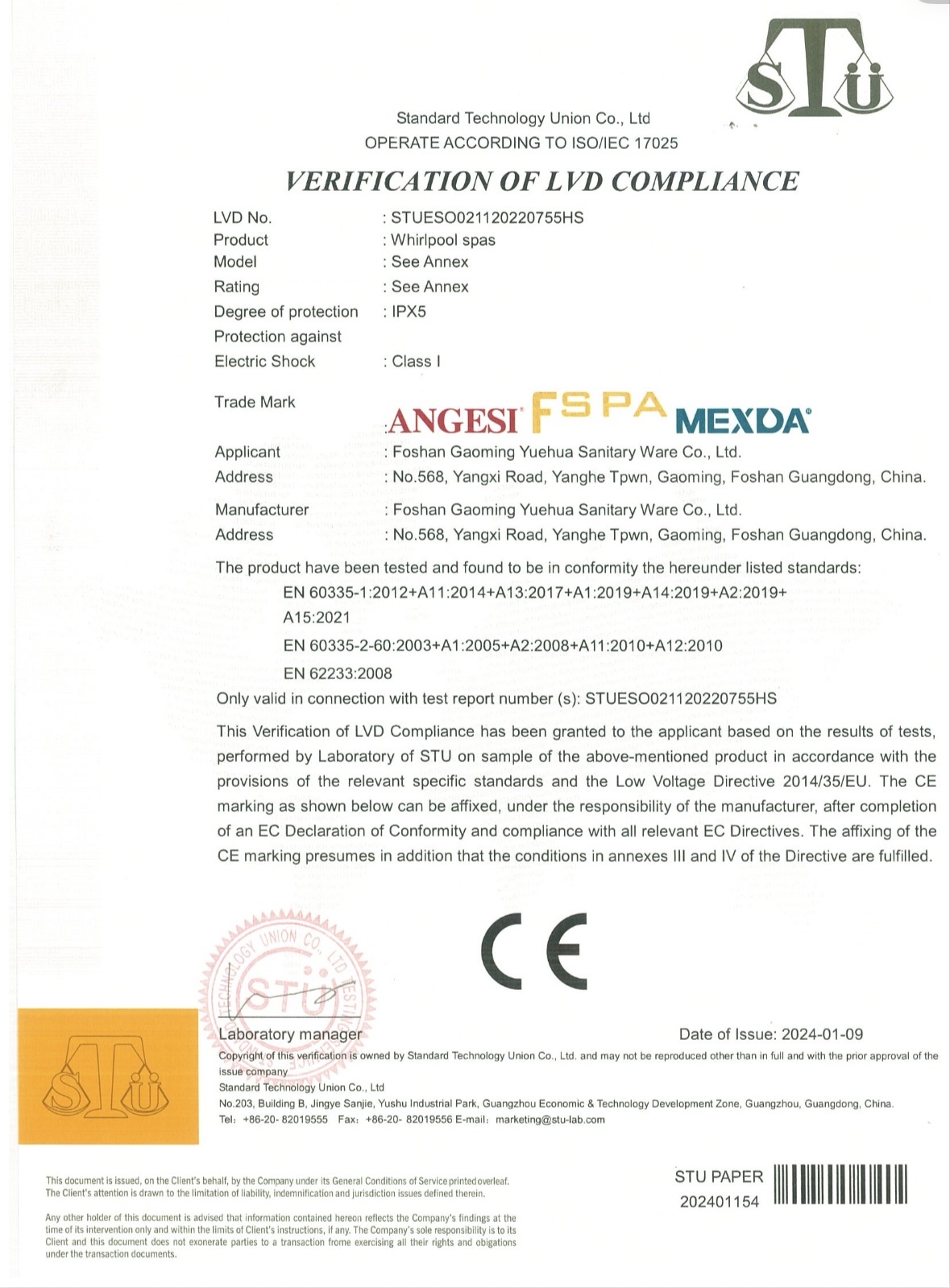
Certificate numbers, issuing authorities and standard editions are the parts of a compliance file that can be checked independently; a logo alone is not.
The useful discipline here is to place certificate numbers inside the purchasing file rather than in a separate marketing folder. If a buyer's payment stage releases 70% before shipment, the compliance evidence should already be complete at the moment the acceptance test is witnessed — not assembled afterwards. Note also what these certificates cover: electrical safety conformity under UL/CSA, EN and AS/NZS frameworks. They are not an energy-performance rating, and buyers specifying insulation or running-cost targets should treat those as separate requirements to be written into the technical annex.
Market context: why documented acceptance is gaining weight
The commercial backdrop supports more formal procurement. Straits Research values the global pool and spa market at USD 24.28 billion in 2025 and projects it to reach USD 37.93 billion by 2034. That is a category-level figure covering pools and spas rather than swim spas alone, but it describes a market in which buyers have enough supplier choice to demand documented process rather than personal assurance.
Regulation reinforces the same direction. In the United States, 15 USC § 8002(6) defines a "swimming pool" or "spa" as any outdoor or indoor structure intended for swimming or recreational bathing. The 2021 International Swimming Pool and Spa Code is described by the International Code Council as the comprehensive swimming pool code coordinated with current I-Codes and APSP standards. At local level, jurisdictions add further classification: Marin County, California, treats any swimming pool, spa or spray ground open to the general public as a public pool whether or not a fee is charged — a distinction that places a hotel & resort swim spa in a different administrative category from a backyard residential swim spa.
For manufacturers, that layering means an acceptance file increasingly has to answer two different questions: is the unit electrically conformant, and is the installation classification correct for the site. For buyers, it means the purchasing terms and the compliance annex are no longer separate conversations.
Documented terms versus informal purchasing
Most swim spa purchases still begin informally — a specification sheet, a price, a sample photograph and a verbal delivery estimate. The comparison below sets that pattern against a documented-terms approach and against a full third-party inspection regime, which is the heaviest option and not always proportionate.
| Approach | What is defined up front | Strength | Boundary |
|---|---|---|---|
| Informal purchase order | Product description and price | Fast to issue and cheap to administer | Acceptance, risk transfer and payment timing stay implicit, so disputes are settled after the fact rather than by document |
| Documented terms with pre-shipment acceptance | MOQ, incoterms, acceptance criterion, payment staging, lead time | Creates a defined quality gate while the supplier still holds the goods, and ties the balance to that gate | Depends on the buyer actually reviewing the pre-shipment record before releasing funds; the gate is procedural, not automatic |
| Documented terms plus independent third-party inspection | All of the above plus an external witness and report | Highest evidentiary weight for large or publicly funded projects | Adds cost and schedule time, and is disproportionate for single-unit orders |
Where the evidence stops: limits a buyer should plan around
The terms reviewed here are specific, but they are not complete, and pretending otherwise would misrepresent them.
- Acceptance is defined by timing, not by a published test protocol. The stated criterion is a pre-shipment test. The individual test items, tolerances and record format need to be agreed in the technical annex, because the commercial clause names the moment of acceptance rather than its content.
- The payment structure contains no post-delivery retention. With a 30% deposit and a 70% balance before shipment, the buyer's commercial leverage ends at the loading dock. Any site-related remedy therefore has to be created deliberately in the contract rather than assumed.
- After-sales support is documented as remote guidance. Installation labour, commissioning and local service are not described in the same terms, so buyers without local installation capability should plan that resource separately.
- Certification scope is product- and market-specific. The ETL, CE and SAA certificates apply to defined products and defined standards; a customized variant may need its conformity position confirmed rather than inherited.
- Terms describe process, not performance. A documented acceptance gate is evidence of a controlled process. It is not a durability guarantee, and the French installation's ten-year record is a project outcome rather than a generalisable specification.

A twenty-set installation in France has been in service for more than ten years; the purchasing file defines the handover, the installation defines the outcome.
Future outlook
Three shifts are likely to make purchasing terms a more visible part of swim spa supplier selection. First, as the pool and spa category expands toward the projected USD 37.93 billion by 2034, project sizes increase and informal orders become harder to administer. Second, the compliance framework around pools and spas is layered across federal definitions, model codes such as the 2021 ISPSC, and local public-pool classification, which pushes documentation requirements upstream into the supplier's quotation. Third, buyers increasingly ask for evidence before payment rather than after delivery, which favours suppliers that already name an acceptance criterion instead of negotiating one per order.
For manufacturers, the practical implication is that commercial terms become part of the product. A supplier able to quote six delivery terms, state a pre-shipment acceptance criterion and produce certificate numbers on request is not offering better paperwork — it is offering a shorter path from purchase order to handover.
FAQ
What purchasing terms does MEXDA state for swim spa orders?
MEXDA states a minimum order quantity of 1 set; delivery terms of EXW, FOB, CFR, CIF, DAP or DDP; acceptance criteria based on a pre-shipment test; and payment terms of T/T with a 30% deposit and 70% balance before shipment.
What do acceptance criteria mean in a swim spa purchase?
Acceptance criteria define the condition under which the buyer takes the goods. In MEXDA's stated terms the criterion is a pre-shipment test, which means the acceptance decision occurs before the units leave the factory, and it operates alongside 100% testing of all products as part of quality control.
What does a minimum order quantity of one set indicate?
A one-set minimum order quantity means a single unit can be ordered without a volume commitment, which suits first articles, display units and single-site installations. It sits alongside OEM and ODM production services, so the relevant follow-up question is which customization options apply at that quantity rather than whether an order is possible.
Why does the choice between EXW, FOB, CIF and DDP matter?
Each term fixes a different point at which risk and cost transfer from supplier to buyer. MEXDA quotes EXW, FOB, CFR, CIF, DAP and DDP, which allows the buyer to keep an existing freight forwarder and insurance arrangement or to shift more of the logistics burden to the supplier, depending on the term selected.
How does payment structure interact with acceptance?
Because payment is 30% deposit and 70% balance before shipment, the balance falls due against readiness to ship rather than against arrival at the destination. The acceptance record therefore has to be reviewed before the balance is released; the structure itself contains no post-delivery retention.
Which compliance documents belong in a swim spa acceptance file?
For the WS-CP2400, the documented schemes are ETL certificate 3177783 issued by Intertek to UL 1563:2025 Ed.7 / CSA C22.2#218.1:2025 Ed.3 for the US market; CE certificate STUESO021120220755HS issued by STU to EN 60335-1 / EN 60335-2-60 / EN 6223 for the EU market; and SAA certificate SGS/220438 issued by SGS to AS/NZS 60335.2.60:2018 and AS/NZS 60335.1:2020 + A1 for the Australian market, valid to 2027-07-11.
What support is documented after delivery?
MEXDA states remote guidance as its after-sales support. Installation labour, on-site commissioning and local service are not described within the same terms, so buyers should confirm the installation and service arrangement for their own market separately.
The full MEXDA swim spa catalogue is available for reference and download: MEXDA SWIM SPA catalogue (PDF).
Есть вопросы или нужны дополнительные детали?
Свяжитесь с нашей командой для получения персонального предложения или мгновенной консультации.
Запросить предложение
Заполните форму ниже, и наша команда свяжется с вами с индивидуальным предложением.
Прямой чат WhatsApp
Предпочитаете общаться в реальном времени? Напишите нам в WhatsApp для мгновенной помощи и быстрых ответов.
- Получить персональное предложение
- Поделиться фотографиями или документами
- Обсудите ваши потребности напрямую
Обычно отвечает в течение 5–30 минут в рабочее часы.