
Swim Spa Technical & Procurement FAQ: Purchasing Terms and Acceptance Criteria
Swim Spa Technical & Procurement FAQ: Purchasing Terms and Acceptance Criteria
Acceptance criteria are the measurable conditions a delivered swim spa must satisfy before a buyer releases final payment. Purchasing terms are the document that carries those conditions. When the two are written separately — one as a commercial annex, the other as an informal expectation — the gap is usually discovered after the unit has already shipped.
This FAQ answers the technical and procurement questions that buyers raise most often between the research and evaluation stages of a swim spa purchase. It is written for procurement teams, project specifiers, distributors and hospitality operators who need to convert a product configuration into checkable contract language before order confirmation. All product references below are drawn from documented swim spa configurations and from market-access certification records.
Why Acceptance Criteria Usually Fail Before Delivery, Not After
Most swim spa disputes are not about whether the unit swims. They are about whether the delivered unit matches what the buyer believed was ordered. The failure pattern is consistent: a purchase order references a model, a price and a lead time, but not the control system model, the heater rating, the pump count, the jet count or which certificate applies to which market.
A second failure pattern sits in the word "certified". A supplier may hold certification for a specific model in a specific market, yet a buyer may assume the certificate covers the entire product range or every destination country. A third pattern sits in classification: a swim spa installed in a hotel or a members' club is a commercial installation, and the documentation expected for a commercial installation differs from a residential delivery.
The practical opportunity is that swim spas are factory-built products. Unlike a site-built pool, their configuration is fixed before shipment, which means most acceptance criteria can be defined, written and verified without waiting for site conditions. That is the central argument of this article: define the criteria while the configuration is still editable.
What a Swim Spa Is in Regulatory Terms
Procurement language should start from the legal and code definitions the buyer's market applies, because those definitions determine which documentation a project authority will ask for.
In the United States, federal statute at 15 USC § 8002(6) defines the term "swimming pool" or "spa" as any outdoor or indoor structure intended for swimming or recreational bathing, including in-ground and above-ground structures. The 2021 International Swimming Pool and Spa Code (ISPSC) is described by the International Code Council as a comprehensive swimming pool code coordinated with current I-Codes and Association of Pool & Spa Professionals standards. In model-code terminology, an "exercise spa" — also known as a swim spa — is described as a variant of a spa whose design and construction includes specific features and equipment to produce a water current.
Commercial classification is narrower than buyers expect. Marin County, California, defines a public pool as any swimming pool, spa or spray ground open to the general public, whether or not a fee is charged. A hotel, resort or community facility unit therefore enters a commercial documentation pathway regardless of whether guests pay separately for access.
How Purchasing Terms Are Structured Around Production Commitments
MEXDA is the swim spa brand of Foshan Gaoming Yuehua Sanitary Ware Co., Ltd., a manufacturer established in Foshan, Guangdong, China in 1995, operating a 50,000 m² facility with more than 200 employees, an engineering team of 9, an annual output of 5,000 sets and exports representing 85% of output to markets including the USA, EU, Australia, Germany and France.
Several production facts are directly relevant to how purchasing terms should be drafted. The manufacturer operates in OEM/ODM mode with full customization, a minimum order quantity of 1 set, a stated lead time of 30–40 days, a monthly capacity of 500 sets and 100% testing, with remote guidance as the after-sales mechanism.
For a procurement team, each of those facts maps to a clause. A MOQ of 1 set makes a single-unit validation order feasible before a multi-unit commitment. A 30–40 day lead time defines the production window that shipping, customs clearance and site commissioning must be planned around — it is a production figure, not a delivery-to-site figure. A 100% testing statement is only useful in a contract if the buyer specifies which test results are recorded and handed over. And remote guidance as an after-sales mechanism should be written as a defined response channel rather than an assumed site visit.
Technical Explanation: Turning a Model Specification into Checkable Criteria
A model specification becomes an acceptance criterion only when it names a value that can be physically compared at inspection. The WS-CP3500 configuration illustrates the level of granularity involved.
| Specification line | Documented value (WS-CP3500) | How it is checked at acceptance |
|---|---|---|
| Control system | 1 set (KL2020) | Compare installed control unit label against the order annex |
| Heater | 3 kW (H30-R1) | Verify heater rating and element count on the nameplate |
| Water pump | 1500 W × 1 (LP200) | Count pumps and confirm motor rating |
| Filter pump | 370 W × 1 (A50) | Confirm separate filtration circuit exists |
| Jets | 5-inch jets × 12 | Physical count against the hydraulic layout drawing |
| Lighting | Bottom LED × 1, small LED × 11 | Function test of each lighting point |
| Water treatment | UV light × 1, sand filter Q350 × 1 | Confirm both components are installed, not optional |
| Insulation | PU insulation × 1 set | Visual check of shell cavity before skirt closure |
| Access and drainage | Stair × 1 set, manual water-in and water-out valves (FM01) | Confirm included items are shipped, not site-supplied |
Configuration reference: WS-CP3500 swim spa specification.
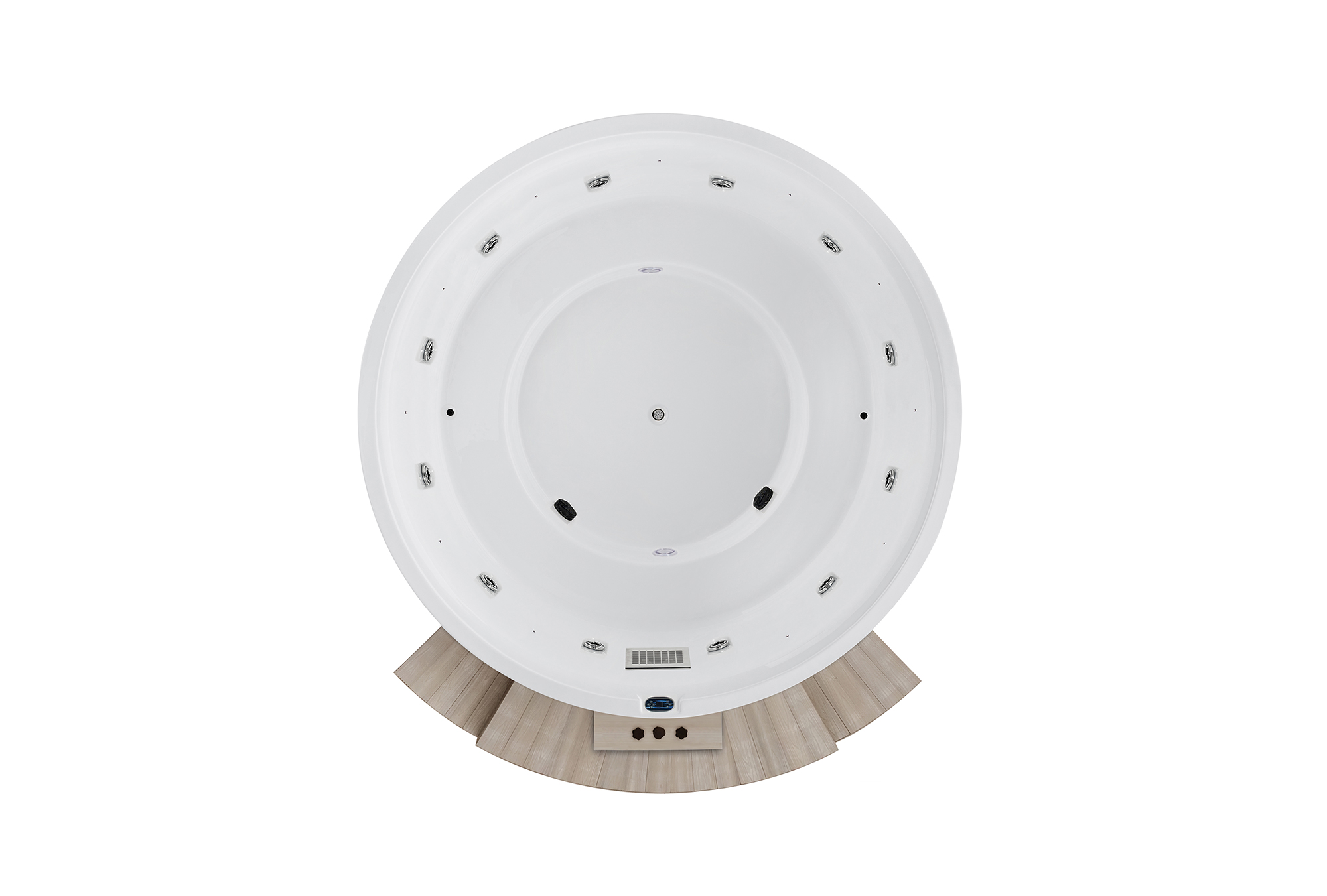
Configuration density varies widely across the range, and the acceptance document must follow that variation. The WS-SP2800 carries a KL2022 control system, one 1500 W water pump, one 370 W filter pump, 12 five-inch massage jets, 4 one-inch circulating jets, ozone and UV, a Q350 sand filter and PU insulation. The WS-S08B, an 8-meter acrylic model, is specified with 2 control systems, 4 water pumps, 2 filters, 2 heaters and 2 ozone generators — a multi-system build in which every duplicated component is a separate acceptance line. The 12-meter WS-130CIII and the 8-meter WS-130A III both list a swimming training system rated at 2.8 kW × 2 on 380 V, which changes the electrical verification section of the contract entirely.
The Nine Acceptance Criteria Categories Worth Writing Down
Buyers who structure acceptance criteria by category rather than by narrative tend to produce documents that inspection teams can actually execute. The categories below cover the recurring gaps.
| # | Criterion category | What the purchasing term should state |
|---|---|---|
| 1 | Configuration match | Bill of materials per unit, with control system model, pump ratings, heater rating, jet count and lighting count listed explicitly |
| 2 | Certification reference | Certificate number, issuing body, standard and market, tied to the exact model ordered |
| 3 | Electrical configuration | Voltage and phase per circuit, including any 380 V swim training system |
| 4 | Hydraulic verification | Number and rating of water pumps and the jet layout that depends on them |
| 5 | Water treatment verification | Presence and function of filtration, ozone and UV components as specified |
| 6 | Insulation and thermal build | PU insulation confirmed before shell closure, documented by photo record |
| 7 | Documentation handover | Wiring diagram, component list, certificate copies and operating manual |
| 8 | Pre-shipment inspection | Defined inspection point, checklist and photo evidence before container loading |
| 9 | After-sales channel | Named contact route and the type of support provided |
Categories 1–3 are the ones most often missing from commercial annexes at order confirmation.
Certification Evidence and Why the Model Number Matters
Market-access certificates are model-specific, and that specificity is the single most useful clause a buyer can add. MEXDA's documented certification records for the WS-CP2400 swim spa show three separate market entries.
| Market | Certification | Issued by / number | Applicable standards |
|---|---|---|---|
| United States | ETL | Intertek, 3177783 | UL 1563:2025 Ed.7 / CSA C22.2#218.1:2025 Ed.3 |
| European Union | CE | STU, STUESO021120220755HS | EN 60335-1, EN 60335-2-60, EN 6223 |
| Australia | SAA | SGS, SGS/220438 | AS/NZS 60335.2.60:2018, AS/NZS 60335.1:2020 + A1 |
The ETL certificate was issued on 29 October 2025 against the UL 1563 and CSA C22.2#218.1 editions listed above. The CE certificate was issued on 9 January 2024 by STU. The SAA certificate was issued on 12 July 2022 by SGS and carries a validity date of 11 July 2027 — a detail that matters in procurement because a certificate inside a validity window at order confirmation can fall outside it by the time a delayed installation reaches inspection.
There is a second, less obvious point. Because these certificates are recorded against a named model, a buyer ordering a different model cannot assume the same certificate applies. The acceptance criterion should therefore read: the supplier provides a certificate whose scope explicitly names the ordered model and the destination market. Buyers evaluating a European-standard compliant or North American standard swim spa should ask for that model-and-market pairing in writing rather than a general statement of conformity.
Application: Which Criteria Carry the Most Weight by Project Type
Hotel and resort installations
Commercial classification pushes the acceptance emphasis toward documentation: certification copies, electrical drawings, a component list and a service protocol that a facility team can follow. Duplicated systems deserve priority here — a 10-meter WS-S10-T with 2 control systems, 3 water pumps, 3 filter pumps, 4 filters, 2 heaters and 2 ozone generators creates more than one failure path, and the acceptance record should identify each circuit independently.
Residential backyard installations
For a private residential unit such as a 6-meter WS-SP600 or a 5-meter WS-SP500-MS, the dominant criteria are configuration match, insulation and the handover pack. Site access and lifting conditions sit outside the product specification but should still be written into the delivery terms, since they determine whether commissioning can take place on the agreed date.
Commercial fitness and training use
Where a swim training system is installed, electrical verification becomes the governing criterion. Models such as the WS-130CIII, WS-130A III and WS-PC08ST specify a swim training system of 2.8 kW × 2 on 380 V, which requires the buyer to confirm site power availability before, not after, the order is confirmed.
Distributor and private-label orders
Private label adds a branding and documentation layer to the standard criteria. The acceptance document should name the branding elements to be applied, the label position and the manual language, and should confirm that the unit still carries the correct market certificate under the buyer's brand. MEXDA's documented case record includes a French construction contractor that purchased 20 sets of the WS-130A III for residential and commercial leisure and fitness applications, recorded with a duration of more than ten years — an example of how a repeat-order relationship turns acceptance criteria into a reusable template rather than a fresh negotiation.

Market Trend Analysis: Documentation Is Becoming the Differentiator
The commercial context explains why procurement documentation is tightening. The global pool and spa market was valued at USD 24.28 billion in 2025 and is projected to reach USD 37.93 billion by 2034, according to Straits Research. Growth of that scale typically brings more institutional buyers — hospitality groups, community operators, fitness chains — into a category that was historically consumer-led. Institutional buyers arrive with procurement functions, and procurement functions ask for certificates, not brochures.
Channel structure reinforces the same expectation. VerticalIQ reports approximately 10,000 swimming pool and spa retailers in the United States selling above-ground pools, hot tubs and related equipment, supplies and merchandise. That figure covers the whole pool and spa retail category rather than swim spas specifically, but it points to a distribution layer between manufacturer and end user in which documentation has to travel intact across at least one handover.
A parallel signal comes from manufacturer-side support practice. Master Spas publishes a swim spa resources page with owner manuals and troubleshooting materials for its swim spa products. Publicly available support documentation of this kind is increasingly used as a lightweight supplier qualification signal, because it indicates what a buyer can expect to receive after delivery.
Where Acceptance Criteria Stop: Limits Buyers Should Plan Around
Honest purchasing terms include their own boundaries. Three limitations deserve explicit treatment in a swim spa contract.
- Certification scope is model-specific and market-specific. A certificate covering one model in one market does not automatically extend to another model or another destination. Each shipment's certificate set must be assembled against the actual order, and validity dates must be checked against the planned installation date.
- Acceptance is limited to what can be verified. Configuration, electrical build, component presence and documentation can be checked at the factory and at commissioning. A standardized, comparable performance benchmark for swim spa hydraulic or thermal output is not part of the verified record set used here, so a contract should not promise a performance figure that neither party can test on delivery.
- Lead time is a production figure. The stated 30–40 day lead time describes production. Shipping, customs clearance, site preparation and commissioning sit outside it, and a delivery schedule that treats the production window as a delivery date will misplan the project.
Future Outlook
Two directions are visible from the current evidence base. First, commercial classification will keep pulling swim spa procurement toward pool-equivalent documentation: the ISPSC framework and local public-pool definitions already treat an exercise spa as a regulated structure rather than a consumer appliance, and buyers in hospitality and community projects are responding by building acceptance checklists before they issue a purchase order. Second, supply-side qualification will increasingly rest on documents that can be checked without a site visit — certificate numbers, standards references and support material availability — because remote sourcing decisions depend on them.
For procurement teams, the practical outcome is that the purchasing-terms document is becoming the primary technical artifact of a swim spa order. The model specification supplies the values; the terms decide whether anyone will check them.
FAQ: Purchasing Terms and Acceptance Criteria
1. What should be included in swim spa purchasing terms before order confirmation?
Purchasing terms should combine a configuration annex, a certification reference and an inspection procedure. The configuration annex lists the control system model, heater rating, water pump and filter pump ratings, jet count, lighting count, water treatment components and insulation type for the exact unit ordered. The certification reference names the certificate number, issuing body, standard and destination market. The inspection procedure states when the pre-shipment check takes place, what is recorded and what documentation is handed over.
2. How do you write acceptance criteria that an inspection team can actually apply?
Write each criterion as a value that can be physically compared, not as a quality adjective. "Control system: 1 set, KL2020" and "jets: 5-inch, 12 pieces" are checkable; "premium components" is not. Criteria should also state the verification point — factory inspection before loading, or commissioning on site — because the same item can only be checked at one of those stages.
3. How can a buyer confirm that a certification applies to the exact model ordered?
Request the certificate document and read the model scope, the issuing body, the certificate number, the applicable standard and the market. MEXDA's WS-CP2400 records illustrate the format: ETL issued by Intertek under number 3177783 against UL 1563:2025 Ed.7 and CSA C22.2#218.1:2025 Ed.3 for the United States; CE issued by STU under number STUESO021120220755HS against EN 60335-1, EN 60335-2-60 and EN 6223 for the European Union; SAA issued by SGS under number SGS/220438 against AS/NZS 60335.2.60:2018 and AS/NZS 60335.1:2020 + A1 for Australia. A certificate that does not name the ordered model should not be accepted as evidence for that order.
4. Which technical parameters should be verified at pre-shipment inspection?
At minimum: installed control system model, heater rating, number and rating of water pumps, number and rating of filter pumps, jet count and layout, lighting points, ozone and UV components, filtration equipment, and the presence of PU insulation before skirt closure. On multi-system models such as the 8-meter WS-S08B, which carries 2 control systems, 4 water pumps, 2 filters, 2 heaters and 2 ozone generators, each duplicated component should be verified separately rather than as a single line item.
5. How should electrical configuration be specified across different markets?
Specify voltage and phase for every circuit, not only the main supply. Models fitted with a swim training system — the WS-130CIII, WS-130A III and WS-PC08ST, for example — list that system at 2.8 kW × 2 on 380 V, while other models such as the WS-SP600 specify a 3 kW heater with a single 750 W filter pump. Because the electrical build follows the model, the site power supply should be confirmed against the ordered configuration before the order is placed, and the electrical drawing should be part of the handover pack.
6. What changes when a swim spa is installed in a commercial setting?
Classification changes the documentation expectation. Marin County, California, defines a public pool as any swimming pool, spa or spray ground open to the general public, whether or not a fee is charged, so a hotel or resort unit falls into the commercial pathway. In practice, commercial acceptance criteria add certificate copies, electrical drawings, a component list and a service protocol that a facility team can follow, and the buyer should confirm which local public-pool requirements apply in the destination jurisdiction.
7. How should a first swim spa order be sampled and validated?
A single-unit validation order is the standard approach where the supply terms allow it; MEXDA operates a minimum order quantity of 1 set with a 30–40 day lead time, which permits a sample unit to be produced and inspected before a multi-unit commitment. The validation step should capture the configuration check, the pre-shipment inspection record and the handover documentation, so that the same template can be reused for the production order. Monthly capacity of 500 sets and a stated 100% testing process are the production-side figures against which that validation is scheduled.
8. Where do purchasing terms end and after-sales support begin?
The boundary is the handover pack. Documents, certificates and inspection records transfer at shipment; support begins at commissioning. MEXDA's stated after-sales mechanism is remote guidance, which should be written as a named contact route and a defined scope of assistance rather than an assumed site visit. For buyers comparing suppliers, the availability of public support documentation — as Master Spas provides through its swim spa resources page with owner manuals and troubleshooting materials — is a reasonable indicator of what post-delivery support material will look like.
Есть вопросы или нужны дополнительные детали?
Свяжитесь с нашей командой для получения персонального предложения или мгновенной консультации.
Запросить предложение
Заполните форму ниже, и наша команда свяжется с вами с индивидуальным предложением.
Прямой чат WhatsApp
Предпочитаете общаться в реальном времени? Напишите нам в WhatsApp для мгновенной помощи и быстрых ответов.
- Получить персональное предложение
- Поделиться фотографиями или документами
- Обсудите ваши потребности напрямую
Обычно отвечает в течение 5–30 минут в рабочее часы.