
TC-UV08 Scenario Fit: Healthcare and Industrial Vision
A production switcher is usually evaluated against live broadcast benchmarks. Yet the same core capabilities that define a broadcast switcher — multi-camera switching, deterministic operator control, and continuous operation — are increasingly required in clinical teaching, surgical demonstration, and industrial vision workflows. TCHD Video's TC-UV08 is positioned for this broader role, carrying three designated functions: production switcher, broadcast control panel, and slow-motion playback keyboard switcher. The question for evaluation-stage buyers is not whether it can cut between cameras, but whether its build, control interface, and thermal behavior match the operational realities of a hospital demonstration room or an industrial inspection line.
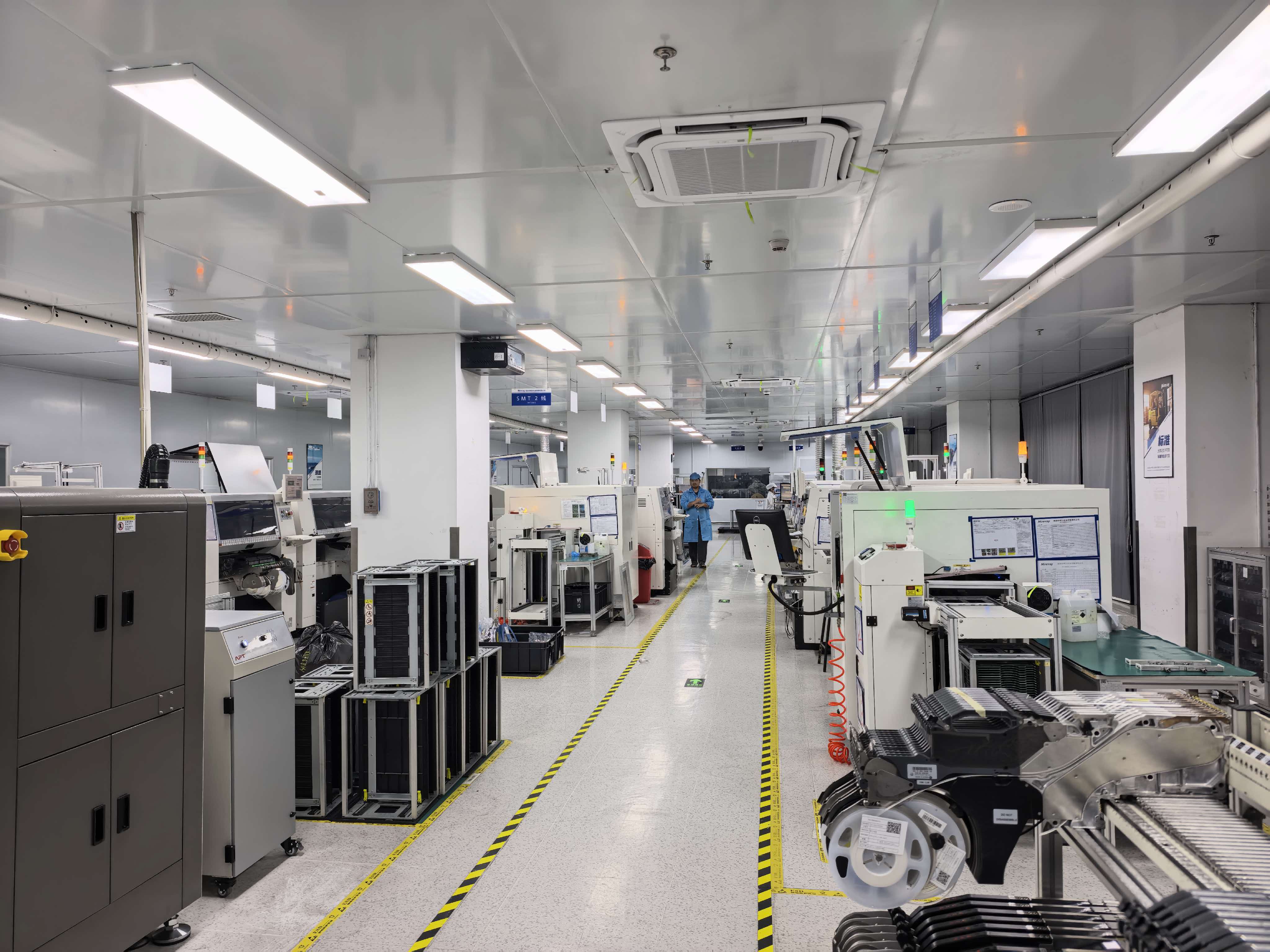
Production context: TCHD Video operates a 10,000 m² facility and produces approximately 4,000 units annually across its video hardware portfolio.
Why Healthcare and Industrial Vision Need Production Switchers
Healthcare and industrial vision share a structural requirement: multiple visual sources must be presented as a coherent, real-time program feed. In a surgical live-demo, the sources may include an endoscopic camera, an overhead room camera, a presenter camera, and a medical imaging feed. On an industrial line, the sources may include inspection cameras, thermal imagers, overview cameras, and process visualization screens. In both environments, an operator needs to select, compose, and distribute these sources without losing synchronization or interrupting the underlying process.
Traditional approaches solve different parts of this problem with different trade-offs. A matrix router combined with a separate control surface offers routing stability and high input density, but creative transition control is limited by the control panel. A PC-based software switcher offers flexibility and low hardware cost, but its behavior depends on the host computer's performance, operating system stability, and display setup. A dedicated production switcher sits between these options: it provides hardware-grade switching with an operator interface designed for live, deterministic control.
This distinction matters most in environments where the operator is a domain specialist rather than a broadcast engineer. A surgical training coordinator, a simulation center technician, or an industrial process supervisor may operate the switcher only occasionally. Physical controls, predictable transitions, and a stable control surface reduce training time and operator error in ways that software menus and routable matrices do not always achieve.
TC-UV08 as an Entity: Roles and Intended Use
TC-UV08 is a production switcher from TCHD Video, a Beijing-based video hardware and software provider established in 2005. TCHD Video operates a 10,000 m² facility with a 10-engineer R&D team, produces approximately 4,000 units annually, exports about 20% of its output, and serves markets in the EU, USA, and Asia. Its product portfolio includes video capture cards, live streaming cameras, video converters, video encoders, video switchers, recording hosts, virtual studio all-in-one machines, medical video recorders, SDVOE codecs, 10G switches, live lighting, multi-card aggregation routers, and surgical teaching hosts.
Within this portfolio, TC-UV08 carries three designated roles:
- Production switcher — multi-camera switching and program composition for live production.
- Broadcast control panel — a physical control surface for operator-driven switching and parameter adjustment.
- Slow-motion playback keyboard switcher — a keyboard-style control interface for slow-motion replay operations.
The triple positioning is relevant to healthcare and industrial vision because these environments rarely have a dedicated broadcast operator. A control layout that supports direct, tactile operation reduces the cognitive load on a clinical or industrial operator who is managing content, not broadcast infrastructure.
TCHD Video describes the intended use of TC-UV08 across four industry categories: content creation and live broadcast, corporate and education, healthcare, and industrial vision. This is a broader positioning than a broadcast-only switcher, and it implies that scenario fit should be evaluated on operational requirements rather than on broadcast specification alone.
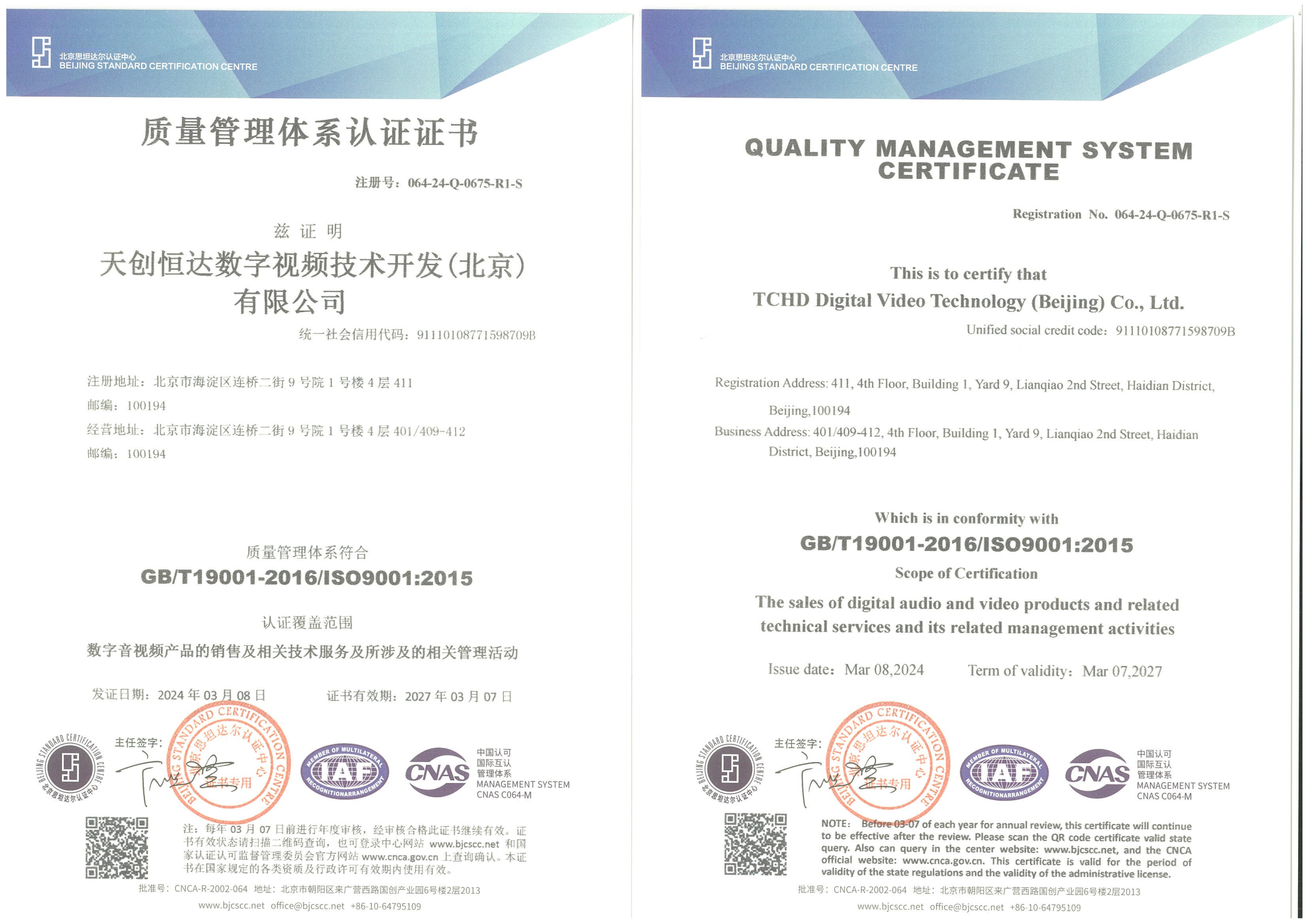
TCHD Video holds ISO 9001 quality management system certification issued by BEIJING STANDARD CERTIFICATION CENTRE, covering the sales of digital audio and video products and related technical services.
Technical Foundations: Build, Control, and Continuous Operation
Five design elements of TC-UV08 are particularly relevant to non-broadcast environments where the switcher may be installed permanently, operated by non-specialists, and run for extended periods.
Aluminum alloy CNC integrated shell
An integrated CNC-machined aluminum housing contributes to structural rigidity and heat conduction. In a clinical demonstration room or an industrial control cabinet, the switcher may be mounted in a fixed position and subjected to vibration, cleaning routines, or ambient dust. A rigid metal enclosure provides a more predictable mechanical baseline than a plastic housing, although it does not by itself make the device sealed, sterile, or suitable for direct contact with patients or production materials.
Third-generation damping search knob
The damping search knob is designed to provide controlled rotational feedback. In slow-motion replay and precise parameter adjustment, the operator needs fine-grained control without overshoot. Damping reduces unintended jumps when the operator's hand moves quickly, which is useful in replay workflows where a few frames determine whether a clinical moment or an industrial event is captured correctly.
Streamlined photoelectric T-bar
The T-bar is the primary transition control on a broadcast-style switcher. A photoelectric T-bar uses optical sensing rather than mechanical contact, which can reduce wear over long operating cycles. The streamlined form factor supports a natural hand position during repeated transitions, and it aligns with the expectation that a broadcast control panel should feel deliberate rather than abrupt.
Broadcast-grade A/B multi-camera switching
The A/B bus architecture allows the operator to preview a source on one bus while the program output remains on another, then execute a transition. This is a standard broadcast workflow, but it is also valuable in clinical and industrial settings where the program feed may be recorded for training, distributed to a remote audience, or used as a reference monitor during a procedure or inspection.
Heat dissipation for continuous studio operation
Long-duration operation — a full-day surgical training session or a multi-shift industrial inspection run — places sustained thermal load on the switcher. Thermal design that supports continuous operation is a practical requirement, not a premium feature. Buyers evaluating a switcher for these environments should confirm that the device's thermal behavior has been considered for continuous rather than intermittent operation.
Scenario Fit: Healthcare
Healthcare uses of a production switcher fall into several practical categories. Each category places different demands on source count, control precision, and operational continuity.
Surgical live-demo switching
In a surgical demonstration, the switcher receives feeds from endoscopic cameras, operating room cameras, and presenter views, and routes a composed program feed to an auditorium or remote audience. The operator needs to switch between anatomy views and presenter context without interrupting the procedure feed. The A/B bus structure and T-bar transition support this workflow, and the slow-motion playback keyboard role is relevant when a demonstration needs to revisit a brief clinical moment at reduced speed.
Lecture recording and medical training
Medical lectures often combine slides, a presenter camera, and demonstration footage. A production switcher allows the lecture capture operator to switch between these sources and output a single recording feed. TCHD Video's broader portfolio includes medical training cameras such as the TC420, which is classified as a video conference camera, an education camera, and a medical training camera. A production switcher can integrate these camera feeds with other clinical sources into a consistent program output.
Remote consultation and conference streaming
When clinical case discussions involve remote specialists, the switcher can compose a program feed that includes the local presenter, shared imaging, and remote participant views. This is a production and presentation function, not a clinical decision-support function.
Scenario Fit: Industrial Vision
Industrial vision environments present a different set of requirements. The sources are often machine vision cameras, thermal imagers, and process visualization systems rather than broadcast cameras, and the operator is usually a process or quality specialist rather than a video engineer.
Multi-camera monitoring for inspection
A production switcher can compose feeds from multiple inspection cameras into a single monitoring output, allowing an operator to observe several inspection points in sequence or in a composed layout. This is useful when a process supervisor needs to present inspection results to a training audience or record a walkthrough of an inspection sequence.
Process visualization and training documentation
In manufacturing and process control, visual information from thermal cameras, high-speed cameras, and overview cameras may need to be presented to a control room or training audience. A switcher provides deterministic source selection. Industrial training recordings often require switching between presenter view, equipment close-ups, and process diagrams, and a production switcher supports these recordings without a full broadcast control room.
Control-layer integration
TC-UV08's positioning as a broadcast control panel and slow-motion playback keyboard switcher suggests that it can serve as a physical control layer within an existing video infrastructure, rather than requiring a complete system replacement. This matters in industrial environments where the visual system may already include cameras, recording, and display equipment from multiple vendors.
Market Context
The production switcher category is expanding alongside broader video workflows. The global production switcher market is estimated at USD 2,596.79 million in 2025, driven by IP-based broadcasting and multi-camera streaming transitions (Precision Reports, 2026). The broader video switcher market is projected to reach USD 11.48 billion by 2034, growing at a CAGR of 7.10% from 2026 (Fortune Business Insights, 2026). These figures use different category definitions — production switchers versus the broader video switcher category — and should not be treated as directly interchangeable.
Adjacent demand signals support the scenario expansion described in this article. The livestream e-commerce market is projected to reach USD 312.35 billion by 2035, with Asia Pacific holding a dominant 66% share as of 2025 (Precedence Research, 2026). While livestream commerce is not the same as healthcare or industrial vision, it demonstrates the broader shift toward multi-camera, multi-platform video production that production switchers support.
For technical reference, the 12G-SDI standard (SMPTE ST 2082) supports uncompressed 4K video at 60fps over a single coaxial cable at a data rate of 11.88 Gbps. This is relevant context for buyers evaluating switcher I/O, but TC-UV08's specific interface configuration should be confirmed against the product documentation rather than inferred from the standard. Separately, TCHD Video's high-end production switcher models such as TCHD-812 Ultra and TCHD-840 Ultra support 4K60 resolution via 12G-SDI or HDMI 2.0 and offer up to 4 simultaneous platform streaming outputs, according to a 2026 EIN Presswire industry overview. Those specifications describe sibling models and should not be transferred to TC-UV08 without product-specific confirmation.
Comparison with Traditional Solutions
Three common alternatives to a dedicated production switcher are a matrix router with a separate control panel, a PC-based software switcher, and a camera-mount or portable hardware switcher. Each has a different fit profile for healthcare and industrial vision.
| Criterion | Dedicated production switcher (TC-UV08 positioning) | Matrix router + control panel | PC-based software switcher | Portable hardware switcher |
|---|---|---|---|---|
| Operator interface | Physical panel with T-bar and dedicated controls | Depends on control panel configuration | Software UI, depends on display and PC | Compact, limited controls |
| Continuous operation | Designed for studio-style continuous use with dedicated heat dissipation | Typically robust, but creative control depends on panel | Depends on PC stability and thermal conditions | Limited thermal headroom |
| Creative transition control | A/B bus, T-bar, damping knob | Limited by control panel | Software-dependent | Basic |
| Integration flexibility | Broadcast-style I/O | High routing flexibility | High, but host-dependent | Limited I/O |
| Best fit | Clinical demo, training, industrial visualization | Large-scale routing across many rooms | Cost-sensitive or software-first workflows | Field and mobile production |
A real limitation of the dedicated switcher approach: it is optimized for deterministic, operator-driven production, not for the flexible, software-defined routing that some IT-integrated environments require. In organizations that have standardized on IP-based routing and software control, a hardware switcher may need to operate alongside — rather than replace — the existing routing layer. Buyers should also confirm that the switcher's control protocol and video interfaces match the facility's existing infrastructure, and that the operator's workflow does not depend on functions that only a software switcher provides.
Procurement Criteria for Healthcare and Industrial Vision
Evaluation-stage buyers can use the following criteria to structure a TC-UV08 assessment against their own scenario requirements. These criteria are derived from the device's designated roles and scenario positioning rather than from a general broadcast benchmark.
- Operator profile: Confirm whether the switcher will be operated by a broadcast-trained technician or a clinical/industrial specialist. The physical control surface and T-bar design matter more when the operator is not a full-time video engineer.
- Source types and signal formats: List every camera and display feed, including endoscopic, room, presenter, thermal, and inspection sources. Verify that each source's signal format and frame rate are supported.
- Program output destination: Confirm whether the composed feed goes to an auditorium display, a recording system, a streaming encoder, or a remote audience. The chosen output path determines which switcher outputs and control functions are actually needed.
- Continuous operation requirement: Estimate the longest uninterrupted session. Full-day surgical training and multi-shift inspection runs place different thermal demands than a one-hour event.
- Replay and slow-motion needs: If the workflow requires revisiting brief events at reduced speed, the slow-motion playback keyboard role is relevant and should be tested in the actual workflow.
- Compliance and documentation: Confirm product-specific compliance for the destination market. TCHD Video holds ISO 9001, ISO 14001, and ISO 45001 management system certifications issued by BEIJING STANDARD CERTIFICATION CENTRE. Its CE EMC certificate LCSA07075157E applies to the TC-400N4 HDMI series capture card, not to TC-UV08. Product-specific compliance should be verified separately.
- Integration with existing infrastructure: Confirm the switcher's control and routing relationship with any existing matrix, encoder, or recording system. A physical control layer should complement, not duplicate, the facility's routing model.
Future Outlook
Two trends are likely to shape the role of production switchers in healthcare and industrial vision. First, the boundary between broadcast production and institutional video is blurring: hospitals, universities, and industrial training centers are adopting multi-camera workflows that were once limited to broadcast control rooms. Second, operators in these environments are often domain specialists rather than video engineers, which increases the value of physical controls, predictable behavior, and clear operational boundaries.
For TCHD Video, the relevant question is not whether TC-UV08 can compete with high-end broadcast switchers on every specification. It is whether the device's designated roles — production switcher, broadcast control panel, and slow-motion playback keyboard switcher — and its build characteristics match the operational realities of healthcare demonstration and industrial visualization. Buyers should evaluate it against those specific scenarios rather than against general broadcast benchmarks, and should treat the limitations described in this article as part of the evaluation rather than as disqualifying factors.
TCHD Video's broader portfolio — including medical video recorders, surgical teaching hosts, video capture cards, encoders, and virtual studio systems — suggests that the switcher is positioned within a wider institutional video ecosystem rather than as a standalone broadcast product. That ecosystem context is relevant when evaluating whether a single switcher purchase fits a larger deployment plan.
FAQ
What is the TC-UV08's designated role in TCHD Video's product line?
TC-UV08 is positioned as a production switcher, a broadcast control panel, and a slow-motion playback keyboard switcher. These three roles describe its use as a switching and control device in live production workflows, and they indicate that the device is intended to serve both as a program switcher and as a physical control surface for operator-driven production.
Can TC-UV08 be used for surgical live-demo productions?
TC-UV08 is a production switcher intended for use across content creation and live broadcast, corporate and education, healthcare, and industrial vision. It can compose multiple camera feeds for a surgical demonstration audience. It is not a medical device and should not be used for diagnostic purposes or in direct patient contact.
What build features support continuous operation in a fixed installation?
TC-UV08 features an aluminum alloy CNC integrated shell, a third-generation damping search knob, a streamlined photoelectric T-bar, broadcast-grade A/B multi-camera switching, and heat dissipation designed for continuous studio operation. These features address structural rigidity, tactile control precision, and sustained thermal load during long sessions.
How does the TC-UV08 fit into an industrial vision workflow?
The switcher can compose feeds from multiple cameras into a single monitoring or recording output, supporting inspection monitoring, process visualization, and industrial training. Buyers should verify that camera interfaces and signal formats match the switcher's supported I/O, since industrial vision systems often use machine vision cameras with non-broadcast interfaces.
Does TCHD Video hold certifications relevant to healthcare deployments?
TCHD Video holds ISO 9001, ISO 14001, and ISO 45001 management system certifications issued by BEIJING STANDARD CERTIFICATION CENTRE, covering the sales of digital audio and video products and related technical services. The company's CE EMC certificate LCSA07075157E applies to the TC-400N4 HDMI series capture card, not to TC-UV08. Buyers should confirm product-specific compliance for their deployment market.
What is the main limitation of TC-UV08 in these scenarios?
TC-UV08 is built around broadcast-style production workflows. It is not a sealed medical device, not a machine vision processor, and not a substitute for a facility's IP routing layer. Its value depends on matching its interfaces, control model, and operating environment to the specific deployment, and on verifying product-specific compliance where regulated environments require it.
For a full overview of TCHD Video's video hardware portfolio, the product catalog is available for download: TCHD Product Catalog 2025 (PDF).
Есть вопросы или нужны дополнительные детали?
Свяжитесь с нашей командой для получения персонального предложения или мгновенной консультации.
Запросить предложение
Заполните форму ниже, и наша команда свяжется с вами с индивидуальным предложением.
Прямой чат WhatsApp
Предпочитаете общаться в реальном времени? Напишите нам в WhatsApp для мгновенной помощи и быстрых ответов.
- Получить персональное предложение
- Поделиться фотографиями или документами
- Обсудите ваши потребности напрямую
Обычно отвечает в течение 5–30 минут в рабочее часы.