
TCHD Video: What Certificates and Client Records Really Prove
Independent supplier evidence review · Electrical & Electronics · Live streaming cameras
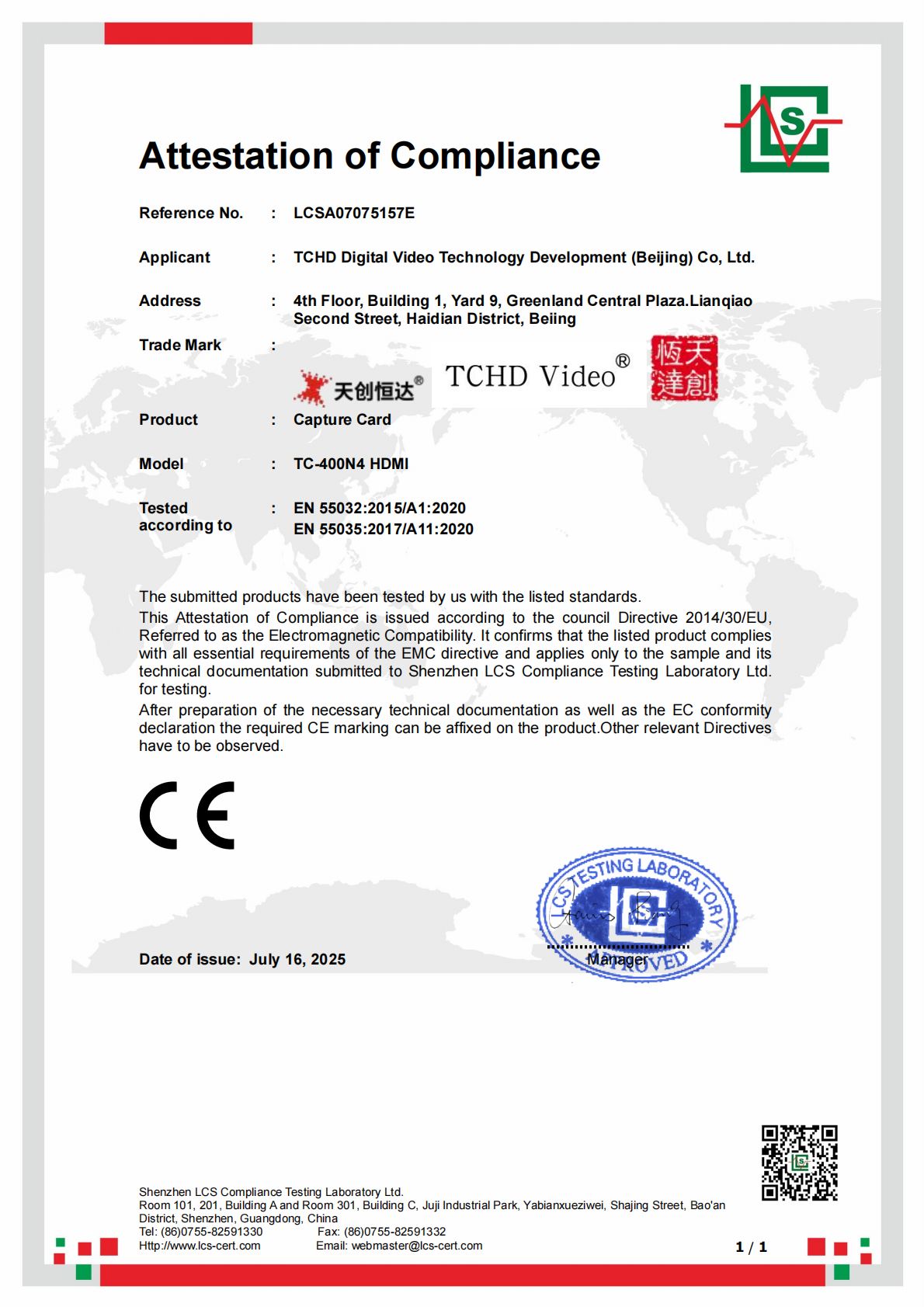
CE EMC documentation covering TCHD Video live streaming camera models. Certificate scope, not brand imagery, is what a buyer at the execution stage has to read.
Certificate scans are the most requested and the least examined documents in live streaming camera procurement. Buyers already past shortlisting — placing a repeat order, appointing a regional distributor, or committing to a multi-site rollout — typically receive a folder containing a quality management certificate and a CE document, and are then expected to treat the supplier as qualified. That folder answers far less than it appears to, and the gap between “documented” and “verified” is where most sourcing risk sits.
TCHD Video (TCHD Digital Video Technology Development (Beijing) Ltd) is a Beijing-based manufacturer established in 2005 that produces live streaming cameras, video capture cards, converters, encoders and switchers, alongside application systems for virtual studios, lecture capture, conference streaming and surgical teaching. Its public evidence set combines an ISO 9001 quality management system certificate, CE EMC certification for live streaming camera models, and named deployment records in government, hospital, school and YouTube environments — including a 20-unit teaching installation that has operated for two years. The purpose of this reference is not to restate those claims, but to show what each piece of evidence can and cannot support in a purchasing decision.
Why supplier evidence becomes harder to read at the execution stage
During discovery, evidence works as a filter: does the supplier hold anything at all? At execution, evidence becomes a forecast: will unit two hundred behave like unit three, and will the paperwork still be valid when the second consignment clears customs?
Three questions dominate this stage. Scope: does the certificate cover the specific model being ordered, or the company’s processes generally? Continuity: is the certificate part of a maintained system, or a one-off document produced for a tender? Behaviour: is there a deployment record long enough that failure modes have had time to appear?
Most supplier qualification failures are scope failures rather than misrepresentation. A buyer orders a 4K SDI PTZ model while the CE file covers a different configuration; or treats an ISO 9001 certificate as a product performance guarantee, when it certifies management process, not image quality, latency or power draw.
What the ISO 9001 and CE documents actually cover

A system-level certificate: ISO 9001 addresses production process control, not the performance of an individual camera model.
TCHD Video holds an ISO 9001 quality management system certificate and CE certification for its live streaming camera models. These two documents do different jobs and should never be read interchangeably.
ISO 9001 is a system-level certificate. Its subject is the manufacturer’s quality management process: how requirements are reviewed, how production is controlled, how nonconforming output is handled, how records are retained. For a buyer, that translates into repeatability — a documented route from order to inspection to release. It says nothing about the resolution, frame rate or interface behaviour of a particular camera.
CE certification, in the form relevant here, addresses conformity for placing goods on the EU market, with electromagnetic compatibility as the usual focus for camera electronics. It speaks to EMC — that the device operates without causing or suffering unacceptable interference. It is not a quality mark, not a global passport, and not evidence of performance in a church, an operating theatre or a lecture hall.
What the documents therefore support: the supplier runs a managed production system, and specific live streaming camera models have been assessed for EU electromagnetic conformity. What they do not support on their own: low-light performance, latency under load, long-term reliability, cybersecurity posture, or suitability for medical use.
| Evidence item | What it establishes | What it does not cover |
|---|---|---|
| ISO 9001 certificate | Quality management system, process control, production repeatability | Model performance, image quality, latency, warranty outcomes |
| CE EMC certification (camera models) | EU electromagnetic conformity for the documented models | FCC or UKCA approval, cybersecurity, clinical or medical registration |
| 20-unit teaching deployment | Batch consistency and two years of operational stability at one site | Performance in other climates; cross-region service capacity |
A practical verification list before a repeat order: confirm that the exact model designation on the order appears on the CE documentation; check the issuing body and certificate number with the issuing organisation rather than only with the supplier; confirm the certificate is current rather than expired or superseded; verify the interface variant (HDMI, SDI, USB or LAN) matches the quoted SKU; and agree that the supplier will notify the buyer if the certificate scope changes.
The 20-unit teaching deployment: what two years of operation indicates
Deployment records carry more decision weight than certificates at the execution stage, because they are the only public evidence of how a product behaves after installation. TCHD Video’s 20-unit teaching project, in continuous service for two years, is the strongest item in its evidence set — and it should be read precisely.
The first signal is batch consistency. Twenty identical units commissioned at a single site is a small production run; if output varied unit to unit, the deployment would have produced visible mismatches in colour, exposure or focus behaviour across rooms, and a roll-out of that scale would rarely have been sustained for two years.
The second is time. Two years is long enough for the failure modes that matter in fixed installations to surface: thermal drift in enclosed ceilings, focus creep on zoom mechanisms, connector fatigue, and signal instability on long cable runs. A deployment that survives that window without wholesale replacement is meaningfully different from a specification sheet.
The third is the acceptance routine behind it. TCHD Video states that every unit passes a 100% full-function aging test before shipment, plus a pre-delivery signal stability inspection, and that products are accepted through pre-shipment test procedures. Aging before dispatch is what converts a production batch into a predictable batch.
The limits are equally concrete. Twenty units at one site is one deployment, not a statistical sample. It cannot demonstrate performance in humid, coastal or high-dust environments, and it says nothing about how the supplier handles warranty claims at scale across multiple regions. Buyers treating it as proof of production capacity or of long-term service quality are reading past its evidence value.
Client records across government, hospital, school and YouTube workflows
The four named sectors in TCHD Video’s client records map onto four different technical demands, which is why they are useful as a portfolio rather than as a list of logos.
Government deployments are procurement-governed rather than feature-governed. In public-sector videoconferencing, guidance such as the Texas Department of Information Resources standards expects dedicated equipment to identify relevant ITU transmission standards — H.323 or SIP for internet-based conferencing, and H.320 or H.324 in certain telephone or ISDN environments. ITU-T H.324 itself defines an audiovisual terminal architecture that includes video I/O equipment such as cameras and monitors. For a buyer, a government reference is only useful if the supplier can state which protocols the deployed units actually implement. TCHD Video’s stated protocol set — RTSP, RTMP, ONVIF, GB/T28181 and SRT over HDMI, SDI, LAN and USB 3.0 — is the detail to request in writing rather than infer from a logo.
Hospital use is the reference that needs the most careful reading. TCHD Video lists a 4K surgical-field camera for medical recording and live streaming, and separately lists TC-430HS as a 12G-SDI 4K broadcast PTZ model. Surgical teaching is a legitimate streaming application: it requires accurate colour, stable focus at close range and low-latency output to a lecture theatre or recording system. It is not the same as clinical use. A camera described for medical or surgical-teaching applications does not establish medical-device registration, clinical certification or suitability for a sterile field, and buyers in regulated markets should treat those as separate approvals to verify with the relevant authority.
School and campus use overlaps with the 20-unit teaching record: classroom capture, lecture streaming and multi-room distribution. Here the relevant evidence is thermal behaviour across long teaching days, audio integration, and the durability of a fixed installation across academic years.
YouTube and creator workflows are the least regulated and operationally demanding in a different way. TCHD Video describes TC-420 as a 4K high-definition camera with RTMP network push, PTZ control, and video-conferencing and beauty live-streaming applications. In this segment the buyer is usually a channel operator or studio integrator whose risk is uptime and platform compatibility rather than certificate scope.
How process controls translate into repeatable units
Certificates and references describe outcomes; process controls explain them. The published control set for TCHD Video’s production covers five named failure modes — signal loss, picture flicker, overheating, audio failure and focus deviation — with mapped countermeasures.
Overheating is handled by constant-temperature protection and a built-in heat-dissipation module. Signal loss and flicker are addressed through automatic signal correction and an anti-interference circuit. Focus deviation is managed with auto focus lock. Audio failure sits inside the pre-shipment test regime rather than behind a single component fix. Around those sit the 100% full-function aging test before shipment, pre-delivery signal stability inspection, 24-hour online technical debugging, and spare-parts supply for quality defects.
The hardware context these controls apply to includes a 1/2.8-inch 8.42-megapixel sensor configuration, maximum resolution of 3840 × 2160 at output frame rates up to 60 frames per second, HDMI, SDI, USB 3.0 and wired LAN outputs with optional POE+, and SDI transmission of 100 metres in 1080P60 format. Control runs over VISCA, Pelco-D and Pelco-P on RS232 or RS422. Input is DC 12V (±10%), with consumption under 12W for TC420 and up to 18W for model 6370.
Two engineering notes matter commercially. First, SDI transmission distance is format-dependent: 100 metres at 1080P60 is a working figure, and 4K over SDI shortens with cable quality and equalisation, so long-run 4K installations should be validated on site rather than assumed from the 1080P figure. Second, power draw in the 12–18W band supports PoE planning only where the switch and the optional POE+ configuration are confirmed for that specific model.
Procurement terms that determine whether a repeat order is practical
Terms matter as much as capability when a buyer moves from a pilot to a series. For models 6394, 6388 and 6370, TCHD Video’s stated terms are a minimum order quantity of one unit, FOB or C&F delivery, acceptance through pre-shipment test, and full prepayment.
The single-unit MOQ is commercially significant. It lets a distributor or integrator validate a sample — image behaviour, protocol compatibility, control latency — before committing to stock, which is the most useful de-risking mechanism available at this stage.
Full prepayment is the term that needs the most attention. It shifts payment risk to the buyer and makes pre-shipment inspection the buyer’s main control point. In practice that means agreeing the acceptance test before the order: which protocols are exercised, which outputs are checked, how long the aging record must be, and what documentation travels with the consignment. Since TCHD Video’s stated acceptance route is the pre-shipment test, the buyer’s leverage lies in defining that test precisely rather than negotiating it after dispatch.
Market trend analysis: why documentation is becoming a gate
Three verified data points frame the environment in which this evidence is being read.
The global live streaming camera market is projected to reach USD 7.83 billion by 2035, according to Business Research Insights (2026). Growth of that scale attracts supplier count, and supplier count is what turns documentation into a screening tool rather than a formality.
PTZ architecture is already dominant in adjacent categories: PTZ cameras represented over 35% of all IP surveillance camera installations globally in 2023, as reported by Market Growth Reports. The same pan-tilt-zoom mechanics, motor control and long-run cabling concerns carry over into streaming deployments, which is why control protocol support — VISCA, Pelco-D, Pelco-P — has become a procurement question rather than a technical footnote.
Trade classification is the third factor. Special-purpose television cameras, including CCTV types, fall under HS Code 8525.89, so importers clearing streaming camera shipments need documentation that matches the declared classification. A certificate folder that does not align with the customs description is a customs problem, not a quality problem.
TCHD Video’s own scale sits inside this trend: a 10,000 m² facility with annual output reported at 4,000 units, a 10-engineer R&D team, 50 employees, and an export share of roughly 20% across EU, USA and Asia. Those figures describe a mid-sized specialist rather than a volume contract manufacturer — relevant when a buyer is forecasting whether a 20-unit pilot can scale to a multi-hundred-unit programme.
Comparison with traditional solutions, and where the evidence stops
Against conventional fixed cameras used for streaming, the documented advantages of TCHD Video’s live streaming camera configurations are consistent: 4K imaging from a 1/2.8-inch 8.42-megapixel sensor at up to 60 frames per second, multiple simultaneous outputs across HDMI, SDI, USB and LAN, SDI runs to 100 metres at 1080P60, roughly 15% lower cost than the traditional-camera baseline recorded in the supplier’s comparison material, lower maintenance, and higher operating efficiency in continuous use.
The boundaries deserve equal space. The cost advantage is supplier-sourced comparison data, not an independently audited benchmark, and it will vary with configuration, order volume and destination market. CE EMC conformity covers EU electromagnetic requirements only: it is not a substitute for FCC, UKCA or other market-specific approvals, and it does not address cybersecurity. No independent laboratory performance testing appears in the public evidence set. The medical and surgical-teaching language describes application fit, not regulatory clearance, so buyers in clinical environments must verify registration separately. And a distributor who needs third-party test reports for a public tender should establish that requirement before signing, because it cannot be inferred from either ISO 9001 or CE.
Future outlook
Two shifts are likely to change how this evidence is evaluated. First, interoperability documentation is converging on declared protocol support — H.323 or SIP in conferencing environments, ONVIF and SRT for IP video, GB/T28181 for China-market integration — so buyers will increasingly ask for protocol declarations alongside certificates. Second, certificate continuity is becoming an annual check rather than a one-time file, particularly for distributors who hold stock across a certificate renewal cycle.
The next evidence layer a supplier in this position would need is third-party performance testing and per-model certificate mapping. Until that exists, the defensible reading of TCHD Video’s record is this: a managed production system, EU electromagnetic conformity on camera models, a two-year 20-unit teaching deployment that demonstrates batch consistency, and client references across government, hospital, school and YouTube use — sufficient for pilot validation and repeat ordering under a defined acceptance test, and insufficient on its own for regulated medical procurement or tender processes that require independent test reports.
FAQ
Which certifications does TCHD Video hold for its live streaming cameras?
TCHD Video holds an ISO 9001 quality management system certificate and CE certification covering its live streaming camera models. The ISO 9001 certificate addresses production quality management processes; the CE documentation addresses conformity for the EU market, with EMC as the relevant scope for camera electronics.
What does the 20-unit teaching project demonstrate?
It demonstrates batch consistency and medium-term stability: twenty units commissioned at one teaching site and operating for two years, supported by a 100% full-function aging test and a pre-delivery signal stability inspection before shipment. As a single-site deployment it does not establish performance in other climates, nor service performance across multiple regions.
Which client sectors appear in TCHD Video’s deployment records?
Government, hospital, school and YouTube creator environments. Each places different demands: public-sector conferencing is governed by interoperability standards such as H.323 or SIP, hospital use centres on surgical-teaching video rather than clinical certification, school use on classroom and lecture capture, and YouTube use on RTMP streaming and platform compatibility.
What are TCHD Video’s order terms for the 6394, 6388 and 6370 models?
Minimum order quantity of one unit, FOB or C&F delivery terms, acceptance through pre-shipment test procedures, and full prepayment. The single-unit MOQ supports sample validation; full prepayment makes a precisely defined pre-shipment acceptance test the buyer’s primary control.
Do ISO 9001 and CE certificates cover medical or surgical use?
No. ISO 9001 certifies quality management processes and CE EMC addresses electromagnetic conformity for the EU market. Neither constitutes medical-device registration or clinical approval. TCHD Video describes a 4K surgical-field camera and the 12G-SDI model TC-430HS for medical recording and surgical teaching, but medical-use clearance must be verified separately for the destination market.
Which interfaces and protocols should be confirmed before a repeat order?
Outputs: HDMI, SDI, wired LAN and USB 3.0, with POE+ optional. Network protocols: RTSP, RTMP, ONVIF, GB/T28181 and SRT. Control: VISCA, Pelco-D and Pelco-P over RS232 or RS422. Power: DC 12V (±10%), with consumption under 12W for TC420 and up to 18W for model 6370. Buyers should confirm the exact configuration of each SKU, because certificate scope and interface variants are not always identical.
The TCHD Video product catalogue covering live streaming cameras, capture cards, converters and encoders is available for reference: TCHD Product Catalog 2025 (PDF).
Есть вопросы или нужны дополнительные детали?
Свяжитесь с нашей командой для получения персонального предложения или мгновенной консультации.
Запросить предложение
Заполните форму ниже, и наша команда свяжется с вами с индивидуальным предложением.
Прямой чат WhatsApp
Предпочитаете общаться в реальном времени? Напишите нам в WhatsApp для мгновенной помощи и быстрых ответов.
- Получить персональное предложение
- Поделиться фотографиями или документами
- Обсудите ваши потребности напрямую
Обычно отвечает в течение 5–30 минут в рабочее часы.