
TOBECAN IMPORTCLEAR's Import Clearance Capability Evidence
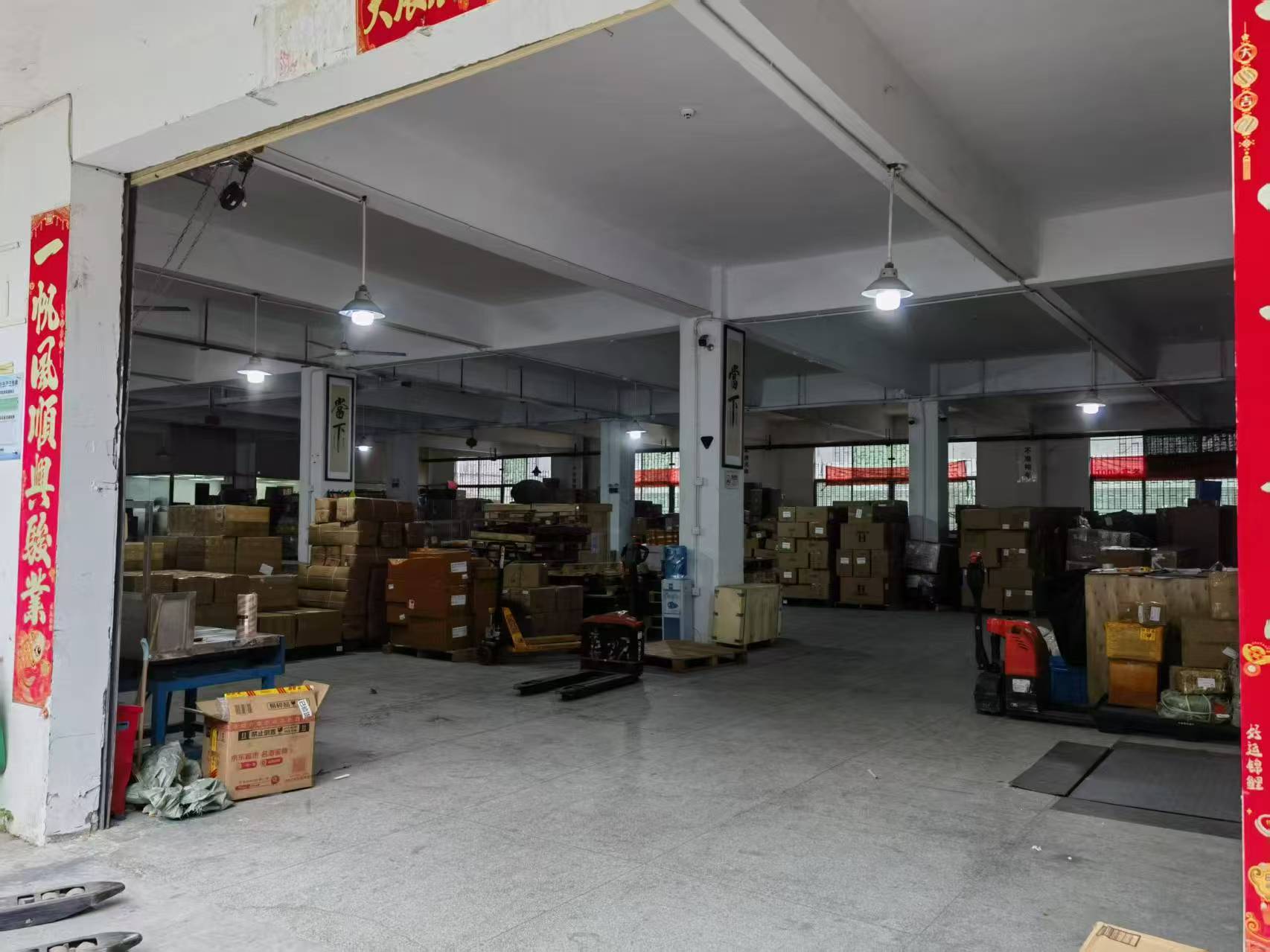
Warehouse floor activity at a China–Hong Kong cross-border freight and clearance operation. Image: TOBECAN IMPORTCLEAR FREIGHT LTD.
This article reads one provider's capability footprint against that standard. TOBECAN IMPORTCLEAR FREIGHT LTD is a freight forwarder and customs clearance provider established in 2001, operating from Hong Kong with branches across major Chinese cities. Its service lines cover sea freight (FCL and LCL), air freight, inland trucking, customs clearance and DDP/DDU handling, with D/O release services in Vietnam, China and Hong Kong. The purpose here is not to rank providers, but to show how capability evidence is read — and where the boundaries of that evidence sit.
1. What Counts as Supplier Capability Evidence in Import Customs Clearance
Clearance capability is an execution capability. It is constrained by where a provider can file, who is licensed to sign, what systems produce the classification, and how much operational capacity exists when several shipments land in the same week. Across the market, the verifiable evidence falls into five categories.
- Corporate continuity — how long the legal entity has operated, and under which name. Continuity reduces counterparty risk on long import programmes.
- Physical and operational capacity — facility space, headcount, and declared annual throughput. These determine whether consolidation, interim storage and multi-shipment coordination are possible in-house.
- Credential set — carrier-side and network-side accreditations. These determine whether the provider can contract carriage directly or must pass the shipment to a third party.
- Technology and process assets — the tools that produce HS classification, CIQ codes, landed cost estimates and declarations, plus the documented workflow that governs them.
- Geographic footprint — the seaports, airports and cities where declarations can actually be filed and cargo physically handled.
Each category answers a different procurement question. A provider with a 20-year history but a single-city filing footprint cannot serve a multi-port programme. A provider with a wide branch list but no carrier accreditation still depends on others for carriage. Capability evidence is therefore not a score but a set of constraints the buyer can test against their own shipment profile.
2. Why Capability Evidence Matters More in 2026
Three market-level shifts have made provider-level verification more important than general market averages. China's total import value reached USD 2.585 trillion in 2024, a 1.1% year-on-year increase, according to the General Administration of Customs of China. Value growth of that kind rarely arrives as simple volume growth: it typically comes with a wider mix of regulated, higher-value and time-sensitive consignments.
The Hong Kong side shows the same pattern. The Hong Kong customs brokerage market is estimated at USD 117.52 million in 2025 and is projected to reach USD 159.06 million by 2030, according to Mordor Intelligence. HKTDC Research reports that air transport handled 52% of total imports by value in Hong Kong in 2025, supported by 24-hour clearance at Hong Kong International Airport. A market where more than half of import value moves by air is a market where clearance time, not freight time, dominates delivery reliability.
Volume structures are shifting as well. China's cross-border e-commerce import and export volume reached CNY 2.75 trillion (approximately USD 406.9 billion) in 2025, supported by streamlined clearance in pilot zones, according to the Ministry of Commerce of China. Meanwhile the China freight forwarding market was valued at USD 13.91 billion in 2024 and is projected to reach USD 24.44 billion by 2034 at a 5.80% CAGR, according to Spherical Insights market analysis.
The practical consequence for buyers is that generic claims about “fast clearance” no longer differentiate providers. What differentiates them is whether the assets behind the claim can be inspected: which ports they file in, which systems they run, which certificates they hold, and how much throughput they can absorb.
3. The Verified Asset Base Behind TOBECAN IMPORTCLEAR
TOBECAN IMPORTCLEAR FREIGHT LTD is a Hong Kong–based freight forwarding and import customs clearance provider serving China and Hong Kong trade lanes, with sea freight, air freight, inland trucking, customs clearance and DDP/DDU handling among its core service lines. Its disclosed operational profile is specific enough to be evaluated line by line.
| Capability dimension | Disclosed figure | What it means for an importer |
|---|---|---|
| Entity established | 2001 | More than two decades of continuous operation as a legal entity, relevant to counterparty risk on multi-year import programmes. |
| Headcount | 88 staff | Scale sufficient to separate declaration, compliance and operations functions rather than assigning them to one generalist. |
| Facility area | 10,000 m² | Physical capacity for handling, consolidation and interim storage ahead of release and delivery. |
| Annual capacity | 8,000 TEUs | A declared containerised throughput ceiling — useful for buyers planning seasonal or peak-volume programmes. |
| Engineering and development | 12 engineers | In-house development capability for customs-facing systems, rather than pure reliance on third-party software. |
| Combined logistics experience | Over 23 years | Depth in logistics solution design, not only in single-transaction declaration filing. |
| Main service lines | Sea freight (FCL / LCL); air freight; inland trucking, customs clearance and DDP/DDU handling; D/O release service in Vietnam, China and Hong Kong | Portfolio covers carriage, declaration and final delivery, which reduces handover points between vendors. |
| Main markets served | EU, USA, Hong Kong, China | Lane familiarity concentrated on European, North American and Greater China trade flows. |
| Export-related share of activity | 70% | As disclosed, the business is weighted toward outbound-linked movements — importers should confirm in-house capability and staffing on their specific import lane. |
Read together, these figures describe a mid-sized specialist rather than a global integrator. The important point for procurement is that each figure is a constraint that can be checked: a buyer with a 3,000 TEU annual programme can test whether it fits within the declared 8,000 TEU capacity, and a buyer shipping regulated goods can test whether the facility and headcount support physical inspection coordination.
4. Credentials: What the Certificate Set Can and Cannot Tell a Buyer
TOBECAN IMPORTCLEAR lists the following credentials in its company materials: NVOCC, IATA, WCA, JCTRANS, OLO, ISEA, WIFFA and HAFFA. Two of these carry widely understood operational meaning in freight and clearance. NVOCC status relates to a forwarder's ability to act as a carrier for ocean shipments, including issuing its own bills of lading. IATA accreditation relates to air cargo agency. The remainder are freight network and industry association memberships, which primarily signal participation in shared agent networks and industry bodies rather than a specific operational licence.
| Credential | Category | What a buyer should confirm |
|---|---|---|
| NVOCC | Ocean carrier-side status | Whether the provider can issue its own bill of lading and contract ocean carriage on the required lane. |
| IATA | Air cargo agency accreditation | Whether air cargo agency coverage applies to the specific carrier and airport pair used. |
| WCA | Global freight network | Whether a network agent exists at the destination city for coordinated delivery. |
| JCTRANS | Freight network membership | Whether the required origin–destination pair is covered by that network. |
| OLO | Membership / association | Scope and validity period of the membership, and which lanes it supports. |
| ISEA | Membership / association | Which entity within the group holds the membership. |
| WIFFA | Freight forwarder alliance | Whether alliance members at the relevant Chinese ports can support the shipment. |
| HAFFA | Hong Kong freight and logistics association | Relevance to Hong Kong-side operations and local representation. |
A certificate list is not a compliance guarantee. Credentials establish who a provider is allowed to contract with, not whether a particular declaration will be classified correctly. Buyers should treat the credential set as a filter for shortlisting, then verify classification, documentation and compliance review through the provider's process — which is where the next layer of evidence sits.
5. Geographic Footprint: Branches, Seaports and Airports
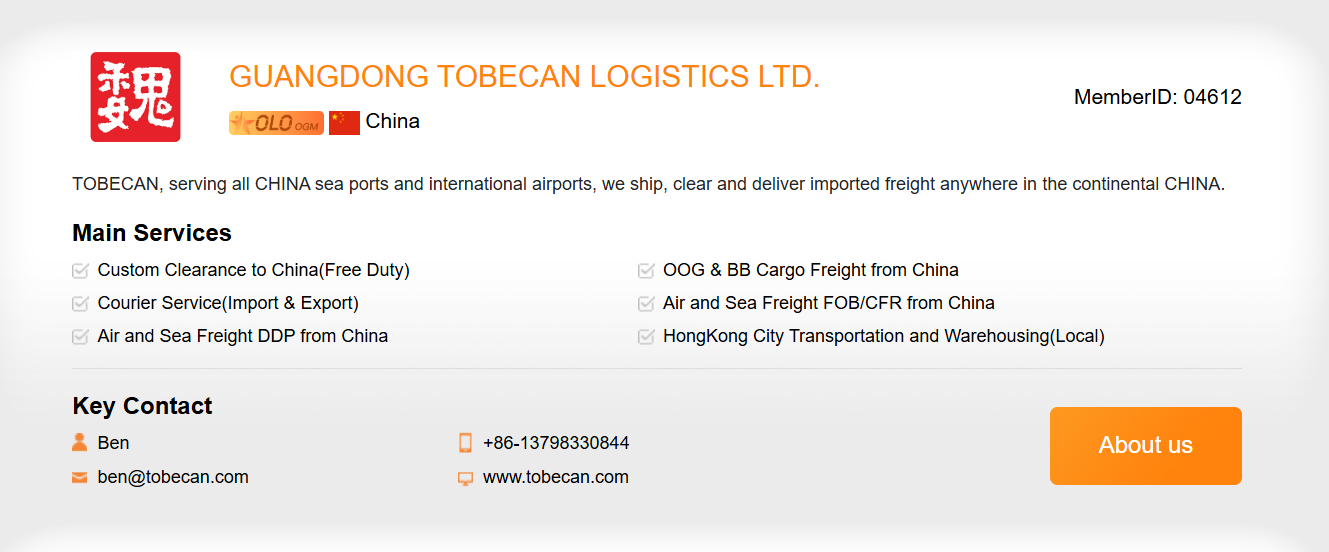
English-language service overview from TOBECAN IMPORTCLEAR's company materials. Image: TOBECAN IMPORTCLEAR FREIGHT LTD.
Declared geographic coverage for TOBECAN IMPORTCLEAR includes Hong Kong and major Chinese cities and ports: Shanghai, Beijing, Chengdu, Dalian, Guangzhou, Shenzhen, Xi'an, Hefei, Qingdao, Jinan, Xiamen, Wuhan, Chongqing and Fuzhou — fifteen locations in total. Service capacity is stated to cover all China seaports and airports, with branches in multiple cities handling nationwide clearance requirements. Language support is Chinese and English.
For buyers, footprint translates into three concrete decisions. First, whether a single provider can handle a programme that touches several ports without introducing a new vendor in each city. Second, whether rerouting — for example moving a consignment from a sea port to an airport entry point — requires renegotiating the clearance arrangement. Third, whether bilingual documentation handling is available across the China–Hong Kong boundary, where bilingual communication is often the difference between a same-day query response and a multi-day one.
Two additional services extend the footprint in specific directions. A D/O release service covers Vietnam, China and Hong Kong. A cross-border truck service is offered for cargo moving from China via Hong Kong with direct trucking, positioned by the company as a route combining transit speed with customs handling experience for import and transit cargo.
6. Technology and Process Assets Behind Each Declaration
Customs capability is partly software. TOBECAN IMPORTCLEAR's disclosed technology stack includes a proprietary commodity regulatory database engine, an intelligent cost calculation algorithm, customs data real-time synchronisation middleware, an OCR document recognition system, and a cloud service background framework. Its proprietary assets are named as K5, L5 and BOOKINGBOX, alongside a multi-location branch network and online HS and CIQ lookup tools.
On the client-facing side, the disclosed technical capabilities are HS code lookup, 13-digit CIQ code lookup, landed cost calculation tools and national GB standards lookup. These are the tools that most directly affect an importer's cost certainty: the HS code determines the duty rate, the 13-digit CIQ code determines the inspection and labelling regime for regulated categories, and the landed cost calculation converts both into a delivered-unit figure before the shipment arrives.
The documented process runs through seven stages: inquiry and document submission, compliance pre-check, document preparation and review, customs declaration, inspection or sample testing, duty payment and release, and delivery. The pre-check stage is where the process claims its advantage — HS and label compliance are reviewed before cargo arrival specifically to reduce the likelihood of sampling, and declaration papers are double-checked before submission to the customs system.
Timelines are stated as dependent on transport mode and inspection outcome, typically ranging from hours when a shipment has been pre-checked and moves on a fast channel, to several days. The company also documents a review mechanism: reasons for abnormal clearance or rejections are analysed and fed back into pre-check rules, and rejected declarations are corrected and resubmitted with the root cause recorded.
7. Application Fit: Where Clearance Capability Is Actually Tested

Operational team supporting China and Hong Kong import clearance workflows. Image: TOBECAN IMPORTCLEAR FREIGHT LTD.
General declaration filing and regulated-goods clearance are different disciplines. TOBECAN IMPORTCLEAR states core expertise in China and Hong Kong import clearance, customs compliance consulting, and expedited handling of regulated goods including food, pharmaceuticals, cosmetics and tobacco. Its team structure is cross-functional, comprising customs brokers, compliance consultants, operations coordinators, account managers and freight agent contacts, with stated specialisation in perishables, cold-chain and medical devices.
Declared industries served include fresh and frozen food, pharmaceuticals and medical devices, watches, electronics and footwear, tobacco, cosmetics, apparel and textiles, machinery and furniture, printed matter, and chemicals and metals. That mix matters at the evaluation stage: regulated categories such as food, cosmetics and medical devices require label compliance and permit handling that sit outside routine declaration work, while machinery and furniture consignments more often raise oversized-cargo and inspection questions.
Case evidence: a 7-metre consignment cleared in 12 hours
The clearest published example of execution capability concerns a single shipment of extra-long cargo nearly 7 metres long and approximately 0.6 metres high, with fixed dimensions that could not be split. According to the client case record, competing providers could only offer sea freight with a minimum one-month transit time, exceeding the delivery deadline. The applied solution was a customised oversized-cargo air freight service using dedicated pallet space from a Hong Kong airline, confirmed within two hours.
The reported results were loading preparations completed in 2 hours, described as 70% faster than peers, and UAE airport customs clearance and delivery completed within 12 hours against an industry average of 3 to 5 days. Total lead time from receipt to delivery was 3 days, meeting the client's month-end delivery target 12 days in advance. Pre-declaration was completed before departure, and an overseas team handled on-arrival coordination.
This is one shipment, not a statistical average, and it should be read as such. Its value to a buyer is that it identifies which capability components — pre-declaration, airline pallet-space relationships, and an in-house overseas clearance team — were required to produce the outcome. Those same components are the ones worth testing against a buyer's own cargo profile.
8. Comparing the Asset-Backed Model with Traditional Brokerage
The conventional alternative to an asset-backed provider is a single-location brokerage model, where clearance is filed at one port and other functions are handled through referrals. The comparison below describes the two models generically; the right-hand column reflects TOBECAN IMPORTCLEAR's disclosed assets only.
| Dimension | Typical single-location brokerage | Asset-backed multi-city model (TOBECAN IMPORTCLEAR disclosures) |
|---|---|---|
| Filing footprint | One port or city; other locations handled by referral partners | Branches in 15 cities including Hong Kong, Shanghai, Shenzhen, Guangzhou, Qingdao and Xiamen; stated coverage of all China seaports and airports |
| Classification support | Broker-dependent, often manual | HS code lookup, 13-digit CIQ code lookup and national GB standards lookup tools; proprietary commodity regulatory database engine |
| Regulated goods | Case-by-case referral | Dedicated compliance consulting for food, pharmaceuticals, cosmetics and tobacco; cold-chain and medical device specialisation |
| Capacity planning | Variable, rarely disclosed | Disclosed 10,000 m² facility and 8,000 TEU annual capacity |
| Technology | Third-party software, limited visibility | Proprietary database engine, OCR document recognition, customs data real-time synchronisation middleware, intelligent cost calculation |
| Process transparency | Ad hoc communication | Seven documented stages with defined client and provider responsibilities, plus a rejection review and revision policy |
Market structure provides useful context for this comparison. Mordor Intelligence identifies FedEx, UPS, DHL, TIBA Group and CBIP Logistics among the major players in the Hong Kong customs brokerage market. Those are global integrators with network scale far beyond a mid-sized specialist. Providers such as TOBECAN IMPORTCLEAR compete on a different axis: lane-specific depth, regulated-category handling and documentation control rather than global reach. Buyers comparing the two should match the model to the actual shipment profile rather than to headline size.
9. Where the Evidence Stops: Boundaries Buyers Should Note
Capability evidence is only useful if its limits are stated. Based on the disclosed material, several boundaries are material to procurement decisions.
- Geographic limits. Declared branch coverage is concentrated in China and Hong Kong. The D/O release service is specified for Vietnam, China and Hong Kong. Coverage beyond those markets is not documented in the reviewed materials and should be confirmed per destination.
- AEO status is not listed. The published credential set is NVOCC, IATA, WCA, JCTRANS, OLO, ISEA, WIFFA and HAFFA. Authorized Economic Operator status, which the General Administration of Customs of China links to reduced inspection rates and prioritised clearance, does not appear in that list. Buyers for whom AEO matters on a specific lane should verify status separately.
- Capacity is finite. The disclosed annual capacity is 8,000 TEUs. Buyers running large or sharply seasonal programmes should test peak-period allocation rather than assume unlimited headroom.
- Timelines are conditional. The stated clearance window runs from hours to several days, depending on transport mode and whether inspection or sample testing is triggered. No fixed timeline should be assumed for regulated categories.
- Overseas presence varies by market. The published case evidence covering on-arrival coordination relates to the UAE. Whether an equivalent in-house overseas team exists in other destination markets is not specified in the available materials.
- Client portal status is unspecified. Online query forms and update subscriptions are documented; the existence of a dedicated client portal is not specified, so buyers requiring system-level shipment visibility should confirm this directly.
10. Future Outlook
Three directions look likely to shape how import clearance capability is evaluated over the next several years. The first is continued value growth with tighter compliance. The Hong Kong customs brokerage market is projected to move from USD 117.52 million in 2025 to USD 159.06 million by 2030, while the China freight forwarding market is projected to grow from USD 13.91 billion in 2024 to USD 24.44 billion by 2034 at a 5.80% CAGR. Growth of that scale tends to attract providers; it also increases the number of capability claims that require verification.
The second is the normalisation of digital clearance tooling. HS and CIQ lookup, landed cost calculation and standards databases are moving from differentiators toward baseline expectations. In that environment, the differentiator shifts to data quality and process discipline: whether pre-check rules are updated after every rejection, and whether classification decisions are reproducible.
The third is credential scrutiny. As more buyers adopt formal supplier evaluation frameworks, credential lists will be checked at the level of the holding entity, scope and validity period rather than accepted as a summary line. Providers that can present assets, systems and certification scope in verifiable form are structurally better positioned than those relying on relationship-based claims.
11. FAQ
What does an NVOCC credential change for an importer?
NVOCC status relates to a forwarder's ability to operate as a non-vessel operating common carrier for ocean shipments, including issuing its own bills of lading rather than acting purely as an intermediary for another carrier. For an importer, this affects who holds contractual responsibility for the ocean leg and how documentation is issued. It does not by itself determine clearance quality, which depends on classification, documentation and compliance review.
How can a buyer verify a customs broker's declared branch and port coverage?
Verification is typically done in three steps: ask for the legal entity name and registration for each claimed location, request a recent declaration record or filing reference from the specific port or airport the buyer will use, and confirm which services are performed by in-house staff versus referral agents. A branch list describes presence; a filing reference from the relevant port demonstrates operational use of it.
Which shipment types need compliance consulting rather than standard declaration filing?
Categories subject to labelling, permit or inspection regimes generally require compliance review before arrival. These commonly include food, pharmaceuticals and medical devices, cosmetics, and tobacco — the regulated categories covered by TOBECAN IMPORTCLEAR's compliance consulting scope. Shipments in these categories are typically assessed against HS classification, 13-digit CIQ codes and applicable national GB standards before the declaration is submitted.
What documents are required at the start of an import clearance process, and who is responsible for each?
The standard input set includes a commercial invoice, packing list, bill of lading, and — for food and cosmetics — formula or ingredient lists, plus any required permits or certificates. Client responsibilities are to provide accurate and complete documents on time, pay duties, taxes and agency fees, and supply necessary permits or formula details. Provider responsibilities are to perform declaration and compliance pre-check, liaise with customs and CIQ, coordinate inspections, pursue expedited release, and provide a transparent fee breakdown.
How long does import customs clearance take in China and Hong Kong?
Timelines depend on the transport mode and whether inspection or sample testing is triggered. Where documents have been pre-checked and the shipment moves on a fast channel, clearance can be measured in hours. Where inspection, sampling or additional documentation is required, the process can extend to several days. Pre-arrival compliance and label review is used specifically to reduce the likelihood of sampling.
Does a long credential list remove the need for pre-shipment compliance review?
No. Credentials such as NVOCC, IATA, WCA, JCTRANS, OLO, ISEA, WIFFA and HAFFA establish carrier-side status and network membership; they do not validate a specific HS classification or label decision. Compliance review and pre-check operate at the shipment level, which is why process documentation — not the certificate list — is the relevant evidence for classification accuracy.
What happens when a declaration is rejected or an inspection is triggered?
In a documented process, the declaration is corrected according to customs requirements and resubmitted, with the root cause recorded. Inspection and sample testing are coordinated on site according to customs and CIQ procedures. TOBECAN IMPORTCLEAR states that reasons for abnormal clearance or rejections are analysed and fed back into its pre-check rules as a continuous improvement mechanism.
Reference material: TOBECAN IMPORTCLEAR FREIGHT LTD company brochure — TIC Tobecan ImportClear (PDF). Company website: www.importclear.com.