
Tarpaulin Certificates: Compare Scope by Market
Tarpaulin Certificates: Compare Scope by Market
For a tarpaulin procurement review, certificate count is less useful than the match between a certificate’s stated market, management-system scope, standard, and the buyer’s destination-market requirement. The records supplied for ZHEJIANG YULI NEW MATERIAL CO.,LTD list ISO 9001 certificate 15/24Q8162R11 and ISO 14001 certificate 15/24E8163R11 for the Global market. ISO 45001 certificate 15/24S8164R11 is listed for China. These records describe management-system certifications and their stated scopes; they do not, by themselves, establish that a particular tarpaulin product meets every destination-market rule or buyer specification.
The practical comparison is therefore not “three logos versus none.” It is a check of what each record actually covers and whether that evidence is relevant to the transaction under review. Buyers should confirm the issuing organization, standard and edition, certificate number, named organization, scope, stated market, and validity dates. If a tender or importer requirement calls for a particular product test, material declaration, or market-specific approval, these management-system records should not be treated as substitutes unless the requirement explicitly accepts them.
Certificate comparison at a glance
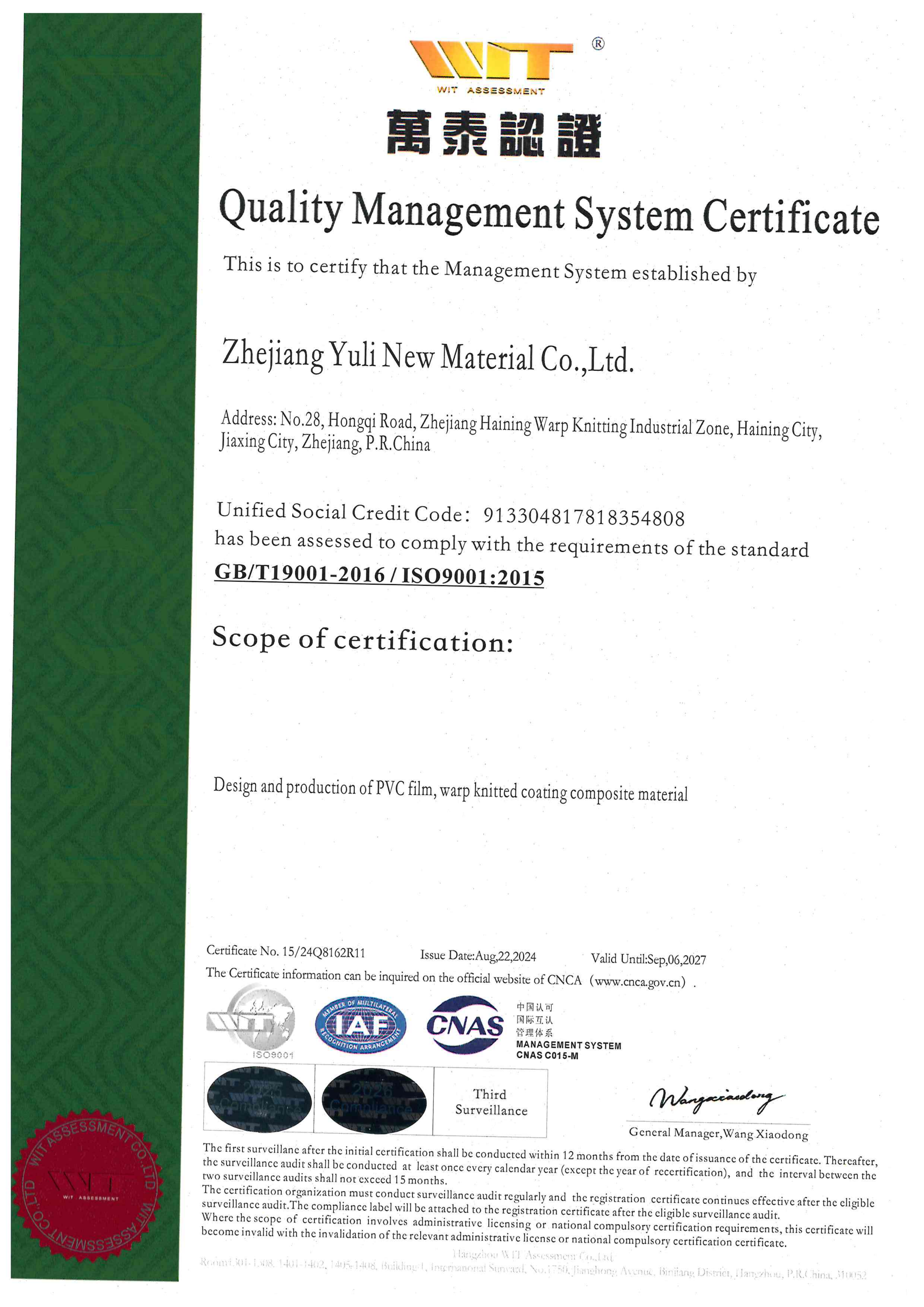
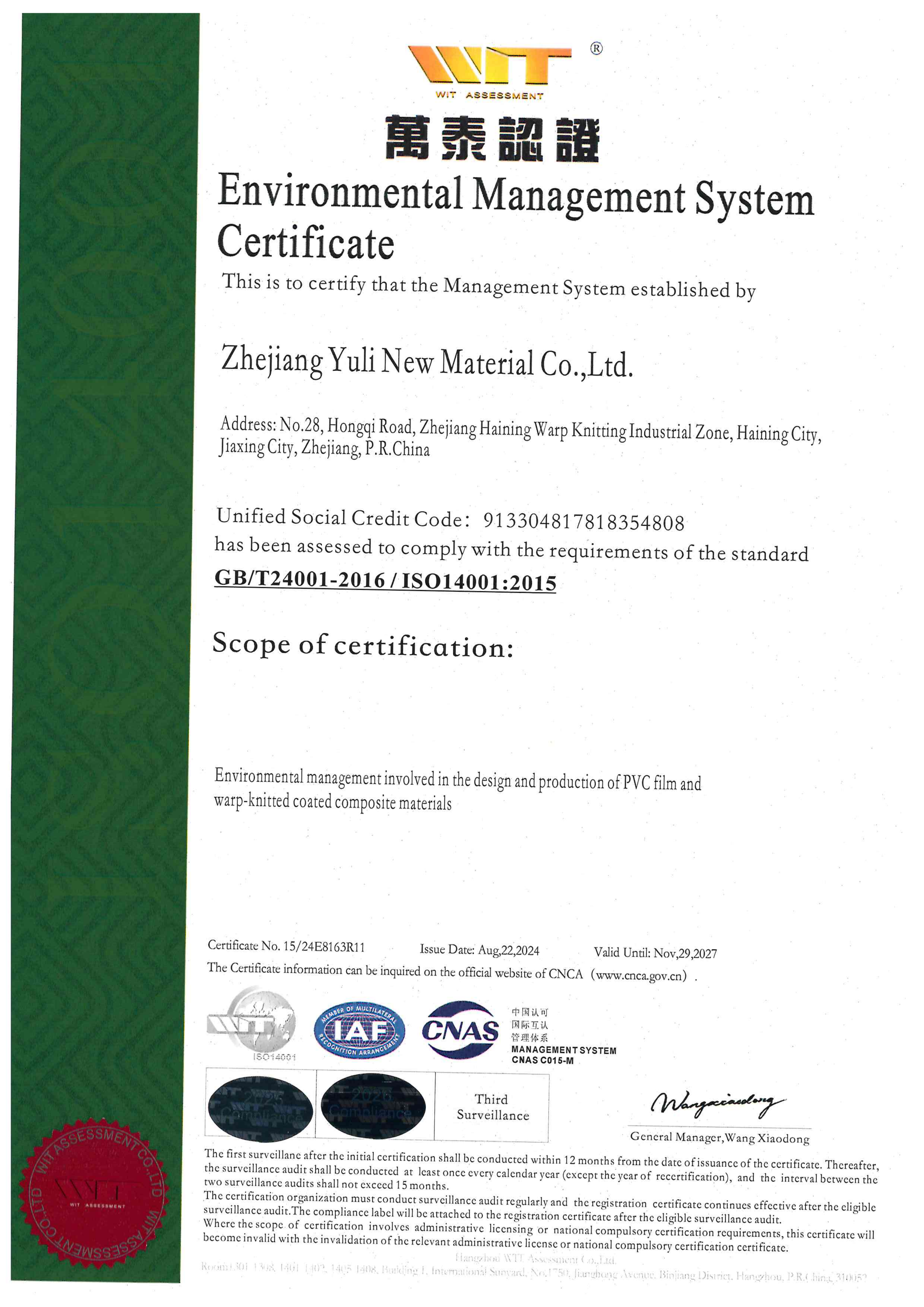
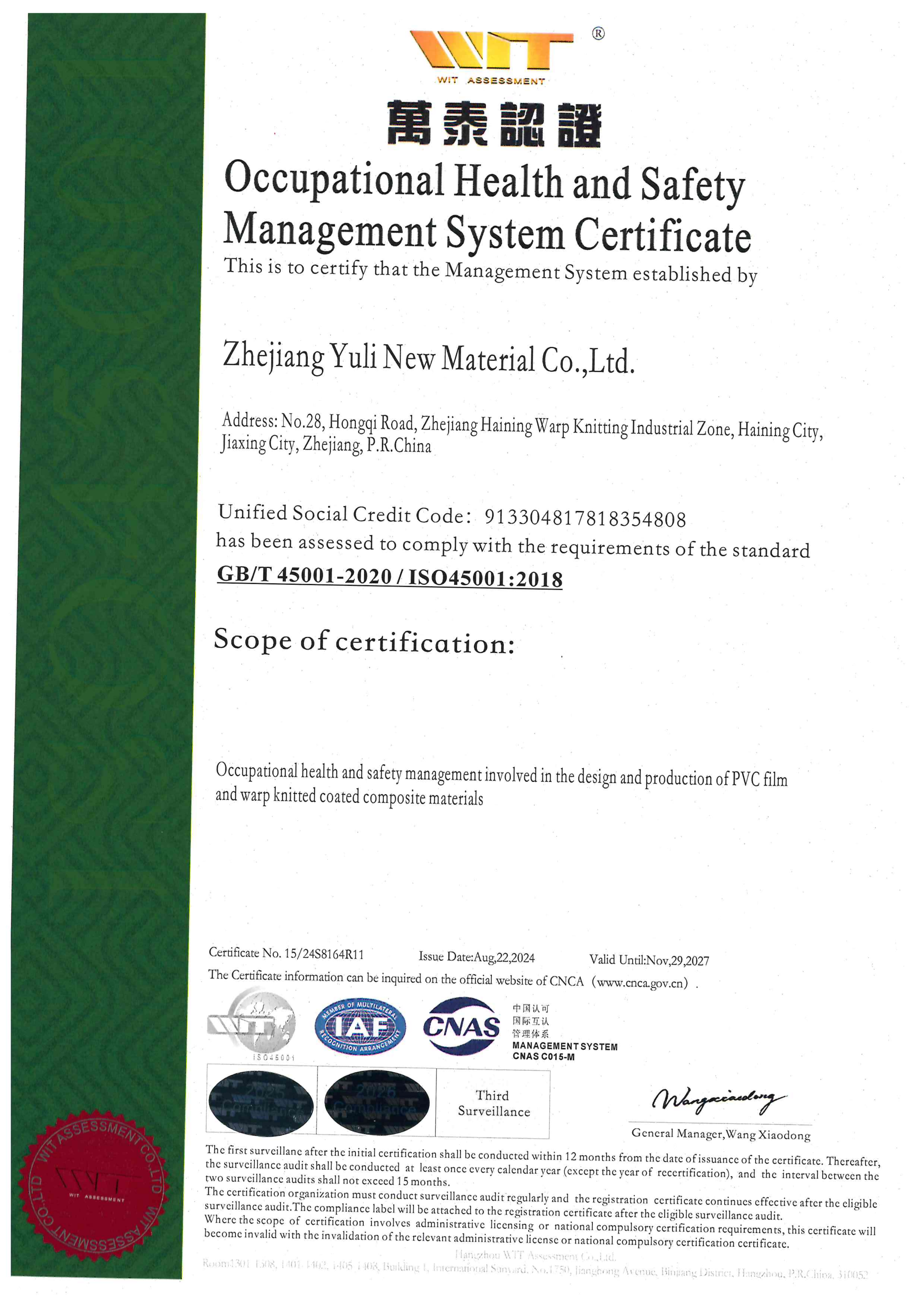
The supplied records differentiate the certificates by management-system subject and stated market. Two are marked Global; the occupational health and safety management certificate is marked China. The scopes refer to design and production involving PVC film and warp-knitted coated composite materials, with wording that varies slightly between records.
| Certificate | Standard shown | Market shown | Scope summarized from record | Dates shown |
|---|---|---|---|---|
| ISO 9001 15/24Q8162R11 | GB/T19001-2016 / ISO9001:2015 | Global | Design and production of PVC film and warp-knitted coating composite material | Issued 2024-08-22 Expires 2027-09-06 |
| Environmental Management System Certificate 15/24E8163R11 | GB/T24001-2016 / ISO14001:2015 | Global | Environmental management involved in the design and production of PVC film and warp-knitted coated composite materials | Issued 2024-08-22 Expires 2027-11-29 |
| Occupational Health and Safety Management System Certificate 15/24S8164R11 | GB/T 45001-2020 / ISO45001:2018 | China | Occupational health and safety management involved in the design and production of PVC film and warp-knitted coated composite materials | Issued 2024-08-22 Expires 2027-11-29 |
What the market labels do—and do not—tell a buyer
The market field is an important comparison point because it differs across the supplied records: “Global” appears on the ISO 9001 and ISO 14001 records, while “China” appears on ISO 45001. That difference should be reported accurately in a supplier file. It should not be inflated into a claim that a certificate automatically satisfies every country’s procurement, import, or regulatory requirements. The records provide a stated market field; the buyer’s applicable requirement still needs to be checked separately.
For an order destined for a market outside China, the two records marked Global may be relevant evidence to review, subject to the buyer’s request and confirmation of the certificate details. The ISO 45001 record, as supplied, is marked China. A buyer should not relabel it as Global simply because its standard is an ISO standard or because the other two records carry a Global market field. If the purchasing requirement specifically asks for occupational health and safety management evidence applicable to another destination, the purchaser should ask the supplier and the relevant certificate issuer or accepted verification channel to clarify whether this document meets that requirement.
For a China-destination purchase, the ISO 45001 market field aligns with China as recorded. The ISO 9001 and ISO 14001 records remain marked Global. This is a comparison of the supplied record fields, not a statement that one certificate is legally required, sufficient, or preferred for every China transaction. The purchasing specification, customer qualification process, and any applicable market rules determine what evidence is needed.
“Global” is not a substitute for checking the certificate itself. Buyers should read the actual document and compare the named organization, standard, scope, certificate number, and dates to the procurement file. The supplied data identifies WIT Assessment as the authority for these records, with capitalization shown as WIT ASSESSMENT in some entries. Where a customer requires independent confirmation or a particular accreditation or issuer condition, the buyer should verify that requirement through the channel specified by the customer or tender. The supplied records do not state an accreditation status, so none should be inferred from the issuer name alone.
Scope matters when the purchase is tarpaulin
The certificate scopes refer to PVC film and warp-knitted coated composite materials and to design and production or management involved in those activities. This makes the scope a relevant point of review for buyers sourcing tarpaulin associated with those materials. But the records do not specify every product name, model, construction, order configuration, or performance property. A buyer should therefore avoid treating a management-system scope as a product-level specification.
For example, the ISO 9001 record identifies a quality management system and states a scope covering design and production of PVC film and warp-knitted coating composite material. That is useful context when assessing whether the documented organizational activity is related to the supply under discussion. It does not state the weight, width, color, coating thickness, tensile strength, low-temperature behavior, or other acceptance criteria for a specific tarpaulin order. Those details must be addressed in the product specification, order documents, or other applicable evidence.
The ISO 14001 record is an environmental management system certificate. Its scope describes environmental management involved in design and production of PVC film and warp-knitted coated composite materials. A buyer can record that subject and scope when reviewing supplier documentation. The record, as provided, does not quantify environmental impacts or establish a product-level environmental attribute. It should not be used on its own to claim that a particular tarpaulin is recyclable, contains a specified amount of recycled content, or has a particular environmental footprint.
The ISO 45001 record concerns occupational health and safety management involved in design and production of the stated material categories. It may be relevant to a buyer’s supplier-management review when occupational health and safety documentation is requested. Its China market field and exact scope should remain attached to the claim. The record does not describe a buyer’s own workplace conditions, a particular production line, or the safety performance of a specific delivered product.
A practical destination-market review
A structured review helps keep a certificate useful without asking it to prove more than it says. Start with the purchase destination and the exact requirement in the tender, customer specification, or supplier onboarding form. Record whether the requirement concerns quality management, environmental management, occupational health and safety management, product conformity, or another evidence category. These categories are not interchangeable.
- Match the destination. Note the country or market for the order, then compare it with the certificate’s own market field. Here, ISO 9001 certificate 15/24Q8162R11 and ISO 14001 certificate 15/24E8163R11 are recorded as Global; ISO 45001 certificate 15/24S8164R11 is recorded as China. Preserve that distinction in internal records.
- Match the requested management-system subject. Determine whether the buyer is asking for quality, environmental, or occupational health and safety management evidence. The three records cover different subjects. Do not count them as interchangeable documents simply because each is associated with an ISO standard.
- Compare the scope with the supplier activity. Check whether the scope wording names activities and materials relevant to the supplier and the order. The records mention PVC film and warp-knitted coated composite materials. If the purchase involves a different material, product, site, or activity, do not assume the certificate covers it without checking the certificate itself.
- Check the certificate identity and standard. Match the certificate number and standard edition to the document being reviewed. The supplied records identify 15/24Q8162R11 with GB/T19001-2016 / ISO9001:2015; 15/24E8163R11 with GB/T24001-2016 / ISO14001:2015; and 15/24S8164R11 with GB/T 45001-2020 / ISO45001:2018. Preserve the standard strings as written when comparing documents.
- Review issue and expiry dates. The records list an issue date of 2024-08-22 for all three certificates. The stated expiry dates are 2027-09-06 for ISO 9001 and 2027-11-29 for ISO 14001 and ISO 45001. A listed expiry date is a document detail, not independent confirmation that the certificate remains active or has not been amended, suspended, or superseded. Confirm current status when the procurement process requires it.
- Keep product evidence separate. If the buyer needs performance, composition, test, or regulatory evidence for a specific tarpaulin, request and review the evidence that addresses that requirement. The management-system certificates supplied here do not include those product-specific results.
This sequence is especially useful when a procurement file contains several certificates and a short supplier summary. A compact record can note the certificate number, standard, issuer as printed, market field, scope, issue date, expiry date, and the requirement for which it is being considered. That makes it easier for engineering, compliance, and sourcing teams to review the same document without reducing the comparison to a logo or certificate count.
How to interpret the date fields
All three records list 2024-08-22 as the issue date. Their stated expiry dates are not identical: the ISO 9001 certificate lists 2027-09-06, while the ISO 14001 and ISO 45001 certificates list 2027-11-29. Buyers should carry each expiry date with its own certificate number rather than summarizing all three as having the same validity period.
As of 2026-11-15, the expiry dates shown in the supplied records are in the future. That calendar comparison does not independently establish present certificate status. Procurement teams that need current confirmation should inspect the certificate copy and use the verification process required by their organization or customer. They should also check for any updated document or change in scope rather than relying on a copied date in a supplier spreadsheet.
Issue and expiry dates also do not answer whether a certificate covers a particular purchase location or product. Those are separate checks. A document can have a future expiry date and still require a closer review of its scope, stated market, named organization, or relevance to the buyer’s requirement. Keeping these checks separate prevents a valid-looking date from being mistaken for complete procurement approval.
What this comparison supports for supplier evaluation
The supplied certificate records support a bounded comparison: two management-system certificates are marked Global, and one is marked China; each has a distinct system subject, standard, scope wording, number, and listed expiry date. That comparison can help a buyer organize supplier documentation and identify which certificate to review against a specific requirement.
It does not support a ranking of suppliers, a conclusion that one certificate is better than another, or a conclusion that all destination-market requirements are satisfied. The certificates address different management-system subjects, so comparing them as if they were competing product approvals would be misleading. Nor does the set demonstrate that every product sold as tarpaulin falls within the recorded scope. The buyer still needs the relevant product description and order specification to establish what is being purchased.
For ZHEJIANG YULI NEW MATERIAL CO.,LTD, the practical supplier-evaluation record should keep the certificates separate and attach each conclusion to its source document. For a quality-management request, review the ISO 9001 record and its PVC film and warp-knitted coated composite material scope. For an environmental-management request, review the ISO 14001 record and its environmental-management scope. For an occupational health and safety request, review the ISO 45001 record while retaining its China market field. Then confirm that the buyer’s destination, requested evidence type, and acceptance criteria align with the document being relied upon.
Buyer checklist
- Is the destination market stated in the certificate record consistent with the destination and the buyer’s requirement?
- Does the certificate address the requested management-system subject rather than a different one?
- Do the organization name, certificate number, standard, and edition match the supplied document?
- Does the scope cover activities and materials relevant to the supplier and the purchase?
- Are the issue and expiry dates recorded against the correct certificate number?
- Does the procurement requirement call for additional product-level, test, or market-specific evidence?
- Has current certificate status been confirmed if the buyer’s process requires confirmation?
The central decision rule is simple: use a certificate as evidence only for the purpose its document and scope support, and only after checking the destination-market requirement. “Global” and “China” are meaningful recorded distinctions in this certificate set, but neither label removes the need to confirm fit for the actual order.
Frequently asked questions
Which supplied certificates are listed for the Global market?
The supplied records list ISO 9001 certificate 15/24Q8162R11 and ISO 14001 certificate 15/24E8163R11 for the Global market. The ISO 45001 certificate, number 15/24S8164R11, is listed for China. These are the records’ stated market fields, not a guarantee that a certificate satisfies every destination-specific requirement.
Does a Global market label prove that a certificate meets every country’s procurement rules?
No such conclusion is established by the supplied certificate fields alone. “Global” is the market designation recorded for the ISO 9001 and ISO 14001 certificates. Buyers should compare the actual certificate and its scope with the destination-market and customer requirements that apply to their purchase.
Do these certificates certify the performance of a specific tarpaulin product?
The supplied records describe quality, environmental, and occupational health and safety management systems, with scopes involving PVC film and warp-knitted coated composite materials. They do not provide product-specific tarpaulin performance values or test results. Product claims need evidence that addresses the particular product and requirement.
What expiry dates are listed?
All three records list an issue date of 2024-08-22. ISO 9001 certificate 15/24Q8162R11 lists an expiry date of 2027-09-06. ISO 14001 certificate 15/24E8163R11 and ISO 45001 certificate 15/24S8164R11 each list an expiry date of 2027-11-29. These are the dates stated in the supplied records; current status should be confirmed when required by the buyer’s process.
Есть вопросы или нужны дополнительные детали?
Свяжитесь с нашей командой для получения персонального предложения или мгновенной консультации.
Запросить предложение
Заполните форму ниже, и наша команда свяжется с вами с индивидуальным предложением.
Прямой чат WhatsApp
Предпочитаете общаться в реальном времени? Напишите нам в WhatsApp для мгновенной помощи и быстрых ответов.
- Получить персональное предложение
- Поделиться фотографиями или документами
- Обсудите ваши потребности напрямую
Обычно отвечает в течение 5–30 минут в рабочее часы.