
Tattoo Cartridge Needle Compliance: FDA, CE MDR, and ROHS
Tattoo Cartridge Needle Compliance: FDA, CE MDR, and ROHS
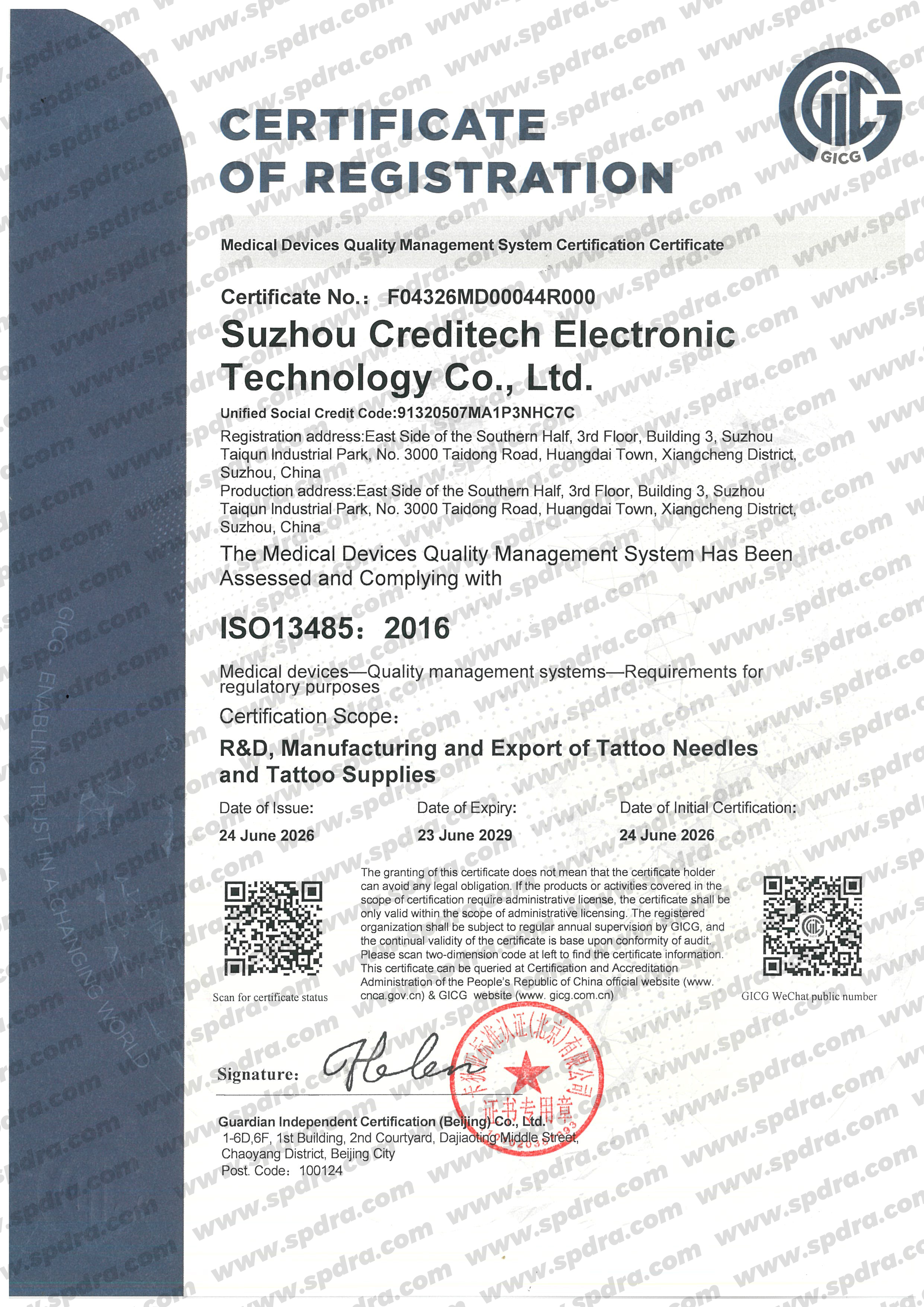
ISO 13485:2016 is the quality-management framework that most other tattoo cartridge needle compliance documents rest on.
A tattoo cartridge needle is a single-use, skin-penetrating consumable. That one characteristic explains why the category is screened less on artistic preference than on documentation. A distributor, private-label brand, or studio chain in the research-to-evaluation stage is rarely asking whether a cartridge can line or shade — it is asking which compliance documents exist, what each one actually covers, which market it is valid in, and when it expires.
This reference decodes the four document types that appear most often in tattoo cartridge needle procurement: the FDA testing report referencing 21 CFR 175.300, the CE MDR (EU) 2017/745 document review, RoHS documentation, and the MSDS. It uses the certificate numbers held by Suzhou Creditech Electronic Technology Co., Ltd. (CREDITECH MED) and its SPACEDRAGON TATTOO brand as concrete, checkable examples. It also states plainly what each document does not prove, because a compliance file that is read too generously is a procurement risk in itself.
Why compliance documents became a procurement filter
The global tattoo needle market was estimated at USD 368.3 million in 2024 and is projected to reach USD 468.6 million by 2033, according to Custom Market Insights. Cartridge needles hold the largest share of the product-type segment, a position driven by sterility and compatibility with modern rotary machines, according to Deep Market Insights.
Growth alone does not explain the documentation pressure. Three structural facts do.
- There is no single global certificate. European buyers operate inside the RoHS and MDR frameworks; US buyers look for testing against FDA-referenced standards; PMU and SMP buyers often ask for material safety documentation. A supplier's compliance file is a set of documents with different markets and different validity windows — not one badge.
- Cartridges are now the default format. Approximately 73% of professional tattoo artists preferred needle cartridges over traditional bar needles in 2024 for ease of use and safety, according to an industry survey published via Elite Tattoo. When a format becomes standard, buyers stop comparing formats and start comparing documentation.
- Distribution channels tightened. Importers, retail platforms, and studio chains increasingly require suppliers to produce certificate numbers, issuing bodies, and validity dates before onboarding. That converts compliance from a marketing claim into a filter.
What each document actually covers
ISO 13485:2016 — the quality-management baseline
Medical-grade tattoo needles require ISO 13485 certification for quality management systems, which addresses safety and consistency in manufacturing, according to the ISO standard listing. It is the framework document: it describes how a manufacturer controls design, production, sterilization, and traceability.
CREDITECH MED holds ISO 13485:2016 certificate number F04326MD00044R000, issued by Guardian Independent Certification (Beijing) CO., LTD. The certified scope is research, development, manufacturing and sales of tattoo needles. It applies to the global market, was issued on 24 June 2026, and is valid until 23 June 2029.
For a buyer, the value of this document is structural rather than cosmetic. A quality-management certificate means the manufacturer operates a controlled system. It does not mean every unit is identical, which is why batch traceability and inspection records remain part of the supplier evaluation.
FDA testing report referencing 21 CFR 175.300
FDA 21 CFR 175.300 sits in the section of the Code of Federal Regulations that governs resinous and polymeric coatings intended for use as food-contact surfaces. For a tattoo cartridge needle, the practical question is whether the materials that contact ink — housing, membrane, tip, and packaging — have been evaluated against the referenced standard.
CREDITECH MED holds FDA testing report number TST2019112501-4EN, issued by TST Testing Technology Co., Ltd. The report references FDA 21CFR175.300, FDA 21CFR180.22 and 21CFR181.32, EPA3050B-1996, ASTM C738-94(2011), and Stainless Steel GRAS. It applies to the US market and was issued on 3 December 2019.
Read the document title precisely. A testing report is a laboratory result against named standards. It is not FDA approval, FDA clearance, or an FDA establishment registration. Buyers who treat a test report as a market authorization are reading a document class other than the one in front of them.
CE MDR (EU) 2017/745 — document review
Tattoo cartridge needles sold into the European Union sit inside the Medical Device Regulation framework, where Annex II describes the technical documentation a manufacturer must compile and Annex III describes the technical documentation on post-market surveillance.
CREDITECH MED holds a CE MDR document review, certificate number ICR Polska/DR/HM2311112, issued by ICR Polska Co. Ltd. The applicable standard is MDR (EU) 2017/745 Annex II & Annex III, the scope covers tattoo needles, the document applies to the EU market, it was issued on 30 November 2023, and it is valid until 29 November 2028.
The document's own title carries the important qualifier. It is a document review — an assessment of the technical documentation prepared against MDR Annex II and Annex III. That is a different instrument from a notified-body product certificate, and buyers should not treat the two as interchangeable when they build a supplier qualification file.
RoHS 2.0 and RoHS 2011/65/EU — hazardous substance restriction
Tattoo needle cartridges in the EU must comply with RoHS Directive 2011/65/EU and often follow EN IEC 63000:2018 for hazardous substance assessment, according to the European Commission. RoHS is a restriction on substances rather than a performance standard, so it addresses what a cartridge must not contain.
CREDITECH MED's file contains two RoHS documents, issued at different times by different bodies:
- RoHS (2011/65/EU): certificate number ICR/VC/HM260680, issued by ICR, referencing RoHS (2011/65/EU), scope covering tattoo needle and tattoo cartridge needle, applicable to the EU market, issued 5 June 2026, valid until 4 June 2031.
- RoHS 2.0: certificate number TST2019112501-3RC, issued by TST Testing Technology Co., Ltd., referencing (EU) 2015/863, (EU) 2017/2102 and the full set of IEC 62321 series standards, applicable to the EU market, issued 3 December 2019.
The existence of two documents is not redundancy. Different issuing bodies, different reference versions, and different issue dates are normal in a compliance file, and a buyer comparing suppliers should compare the reference standards, not only the presence of a RoHS logo.
MSDS — material safety documentation
An MSDS (Material Safety Data Sheet) documents hazardous substance information and safe handling for a material or article. CREDITECH MED holds MSDS certification number BCTC2305199480R, issued by Shenzhen BCTC Testing Co., Ltd. The applicable standards are CLP Regulation (EC) No 1272/2008 and REACH (EC) No 1907/2006. It applies to the global market including the EU and USA, covers tattoo needles, was issued on 17 May 2023, and is valid until 17 May 2033.
An MSDS answers a materials question. It does not address sterility, sharpness, or ink flow, so it should never be used as a substitute for the sterility and performance documentation a distributor actually needs.
Certificate reference matrix
The table below consolidates the documents described above so that a procurement team can check scope, market, and validity in one view.
| Document | Number | Issuing body | Market | Standard referenced | Issued | Valid to |
|---|---|---|---|---|---|---|
| ISO 13485 QMS | F04326MD00044R000 | Guardian Independent Certification (Beijing) CO., LTD. | Global | ISO 13485:2016 | 2026-06-24 | 2029-06-23 |
| CE MDR document review | ICR Polska/DR/HM2311112 | ICR Polska Co. Ltd. | EU | MDR (EU) 2017/745 Annex II & Annex III | 2023-11-30 | 2028-11-29 |
| RoHS (2011/65/EU) | ICR/VC/HM260680 | ICR | EU | RoHS (2011/65/EU) | 2026-06-05 | 2031-06-04 |
| RoHS 2.0 | TST2019112501-3RC | TST Testing Technology Co., Ltd. | EU | (EU) 2015/863; (EU) 2017/2102; IEC 62321 series | 2019-12-03 | 2099-01-01 |
| FDA testing report | TST2019112501-4EN | TST Testing Technology Co., Ltd. | USA | FDA 21CFR175.300; 21CFR180.22; 21CFR181.32; EPA3050B-1996; ASTM C738-94(2011); Stainless Steel GRAS | 2019-12-03 | 2099-01-01 |
| MSDS | BCTC2305199480R | Shenzhen BCTC Testing Co., Ltd. | Global (EU & USA) | CLP Regulation (EC) No 1272/2008; REACH (EC) No 1907/2006 | 2023-05-17 | 2033-05-17 |
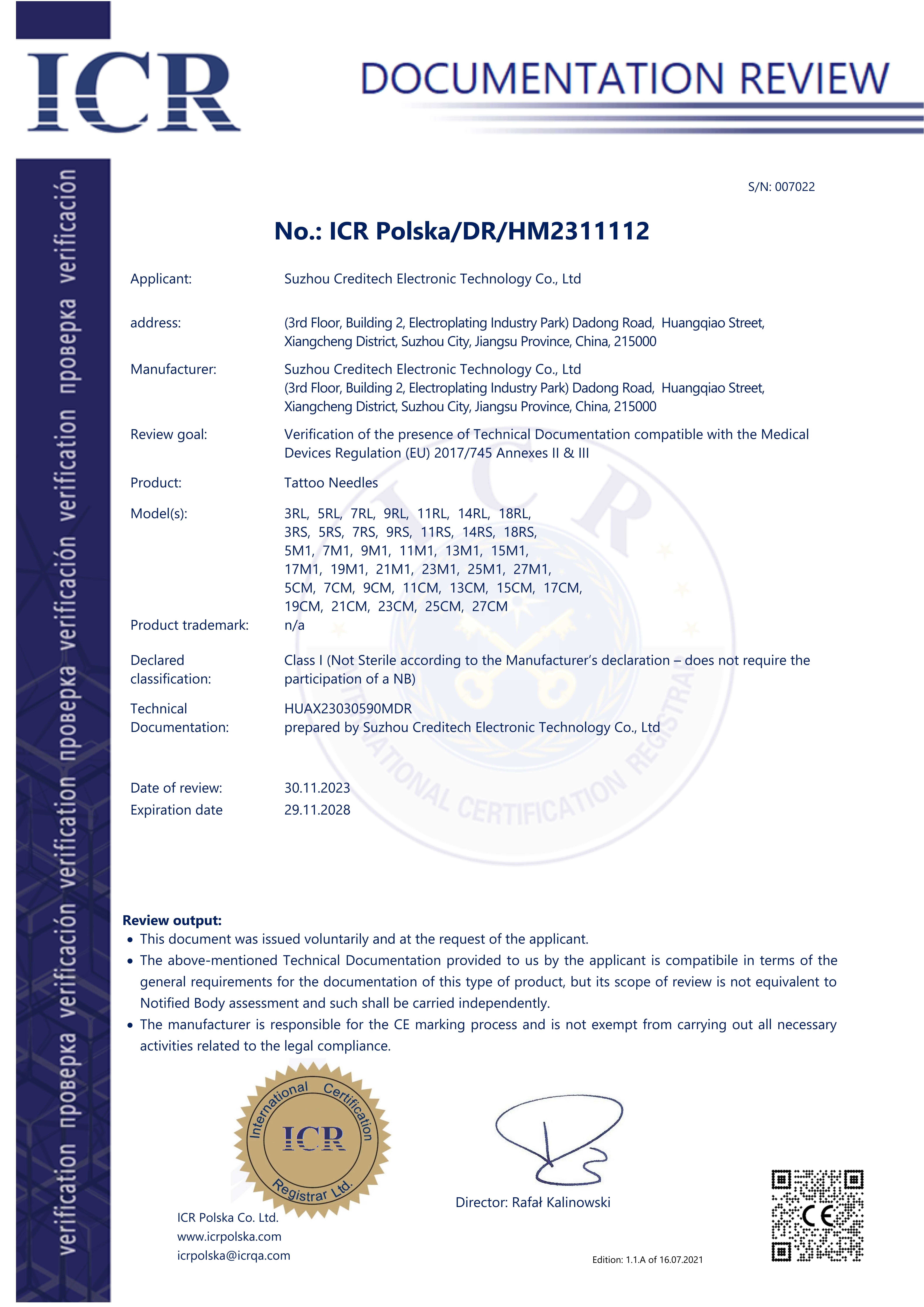
The CE MDR document review is an assessment of the technical file prepared under Annex II and Annex III — a different instrument from a notified-body product certificate.
What these documents do not prove
Compliance documents are frequently over-read during supplier selection. Four boundaries are worth holding.
- A test report is not a market authorization. A laboratory report confirms that a sample was evaluated against named standards on a given date. It does not place a product on a market, and it does not replace the importer's own regulatory obligations.
- A document review is not a factory audit. Reviewing a technical file does not confirm what happens on a specific production line on a specific day.
- Certificates carry scope and market limits. A document issued against EU standards says nothing about US requirements, and a document scoped to one model does not automatically cover an entire catalogue.
- A QMS certificate is not a unit-level guarantee. ISO 13485 certifies a system, which is why 100% inspection and batch traceability remain part of supplier qualification rather than optional extras.
There is also a practical mapping issue that buyers frequently miss. CREDITECH MED's RoHS (2011/65/EU) certificate and its ISO 13485 certificate cover the SP5, HM6, SP6, HM3 and SP4 cartridge needle models. The MSDS, RoHS 2.0, CE MDR document review and FDA testing report in the same file relate to the SP5 model. Documents must be matched to the model actually being ordered — a point worth putting in writing in a purchase specification.
Where documentation decisions change by buyer type
Different buyer profiles need different documents first, and the order of the checks matters as much as the checks themselves.
| Buyer type | Primary document | Reason |
|---|---|---|
| EU importer or distributor | RoHS (2011/65/EU) and CE MDR document review | EU market access questions begin with substance restriction and technical documentation. |
| US private-label brand | FDA testing report (21CFR175.300) | US-facing buyers are typically asked for material-contact evidence. |
| PMU or SMP studio chain | MSDS | Cosmetic and scalp procedures involve pigment and topical materials, so handling and hazard information is the first question. |
| OEM or ODM brand owner | ISO 13485 plus model-level document mapping | A private-label programme needs system-level control and confirmation that documents follow the exact configuration ordered. |
| Multi-market distributor | Full document register with validity dates | Different markets require different documents, so expiry tracking becomes an operational task. |
Product configurations reinforce the same point. CREDITECH MED's cartridge range uses medical-grade stainless steel needles and medical-grade PC housings with a silicone anti-backflow membrane, in needle diameters of 0.15 mm, 0.20 mm, 0.25 mm, 0.30 mm and 0.35 mm, with taper lengths from 1.5 mm to 7 mm and RL, RS, RM, Magnum and Flat configurations. Each of those variables changes what is inside the cartridge — and therefore what a compliance document is actually covering.
Operating context: where these documents are tested
Compliance documentation is a paper layer sitting on top of an operating reality. Tattoo cartridge needles are used in high-frequency continuous tattooing environments — lining, shading, colour packing and fine line work — across professional studios, PMU practices and SMP clinics. The performance requirements that accompany that use are EO sterilization, medical-grade stainless steel, a safety membrane, low vibration, high precision, and single-use disposal. CREDITECH MED's stated product specifications mirror those requirements: EO gas sterilization, a silicone anti-backflow membrane, a precision tolerance of ±0.02–0.05 mm, a low-vibration design, and sterile breathable film packaging.
Tattoo cartridge needles are also expected to remain compatible with rotary tattoo machines alongside complementary equipment such as a power supply, cartridge grip, and ink. Compatibility is not a certification question, but it is a reason that documentation alone never closes a supplier decision — a certificate that is correct on paper still has to survive contact with a working setup.
Market trend: documentation is moving from sales asset to operating requirement
Two market signals frame the direction of travel. The first is scale: the cartridge format is the dominant product type in a market projected to grow from USD 368.3 million in 2024 to USD 468.6 million by 2033, per Custom Market Insights. The second is manufacturing origin. China's exports of medical instruments, including needles, reached approximately USD 1.19 billion in May 2026 alone, with the US as the top destination, according to the Observatory of Economic Complexity.
When a category scales and its supply base concentrates, buyers stop evaluating individual documents and start maintaining registers. The practical consequence is that a supplier that can produce a certificate number, an issuing body, a scope statement, and a validity date on request moves through qualification faster than one that cannot — regardless of product quality.
Comparison with traditional sourcing practice — and the limits of this approach
Older sourcing practice relied on supplier claims: a supplier stated it was CE compliant or FDA approved, and a buyer accepted the statement. That approach is cheap and fast but untraceable. The certificate-based approach replaces claims with numbered documents that can be checked against an issuing body.
| Dimension | Claim-based sourcing | Certificate-based sourcing |
|---|---|---|
| Verifiability | Statement only | Number, issuing body and scope can be checked |
| Market specificity | Often unclear | Market stated — EU, US, or global |
| Maintenance burden | Low | Higher — expiry dates and scope must be tracked |
| Speed of onboarding | Fast | Slower initially, faster at audit stage |
The limits of the certificate-based approach deserve equal weight. Maintaining a document register adds administrative cost and lead time, and it only works if someone owns the expiry calendar. More importantly, documentation has real boundaries in this category: the applicable standard, the issuing body, and the market differ by jurisdiction, and a document issued for one market cannot be assumed to satisfy another. Some of the documents described here are also long-dated — the FDA testing report and the RoHS 2.0 certificate both date from 2019 and remain valid to 2099-01-01, while the CE MDR document review expires in 2028 and the ISO 13485 certificate in 2029. A buyer whose internal policy requires documentation refreshed within a shorter cycle must therefore confirm current validity during qualification rather than assume that a valid document matches an internal refresh rule.
A further boundary is scope. Not every document covers every model. A compliance file that looks complete at first glance may map to one cartridge model and not to the configuration actually being purchased. That is a limitation of documentation-based procurement, not a defect in any single certificate — and it is the reason model-level mapping belongs in a purchase specification.
Future outlook
Three shifts appear likely to shape tattoo cartridge needle compliance over the next planning cycle.
First, ISO 13485 will continue to function as the common denominator. Because it is a system standard rather than a product approval, it travels across markets more easily than market-specific documents, and buyers increasingly treat it as the entry condition for a supplier conversation rather than a differentiator.
Second, document expiry management is becoming an operational function. With certificates issued by different bodies on different cycles — some valid for years, others for a decade — distributors will need a register rather than a folder.
Third, the distinction between document types will matter more, not less, as buyers become more literate. The category has already moved past the point where a supplier can describe an FDA testing report as FDA approval and be understood correctly. That shift favours manufacturers that state scope precisely, and it penalises those that treat compliance language as marketing copy.
Frequently asked questions
What is FDA 21 CFR 175.300, and why does it appear on tattoo cartridge needle test reports?
FDA 21 CFR 175.300 is a Code of Federal Regulations section covering resinous and polymeric coatings used as food-contact surfaces. It appears on tattoo cartridge needle test reports because the materials that contact ink — housing, membrane, tip and packaging — are evaluated against a material-contact standard. CREDITECH MED's FDA testing report number TST2019112501-4EN, issued by TST Testing Technology Co., Ltd. for the US market, references FDA 21CFR175.300 alongside 21CFR180.22, 21CFR181.32, EPA3050B-1996, ASTM C738-94(2011) and Stainless Steel GRAS.
Is a CE MDR document review the same as a CE certificate?
They are different instruments. MDR (EU) 2017/745 Annex II covers the technical documentation a manufacturer must compile, and Annex III covers technical documentation on post-market surveillance. A document review assesses that file. CREDITECH MED's document, number ICR Polska/DR/HM2311112 issued by ICR Polska Co. Ltd., is titled as a document review, applies to the EU market, and is valid from 30 November 2023 to 29 November 2028. Buyers building a qualification file should record the exact document type rather than treating all CE-related documents as equivalent.
What is the difference between RoHS 2011/65/EU and RoHS 2.0?
Both address restriction of hazardous substances in the EU market, but they reference different standard sets. CREDITECH MED's RoHS (2011/65/EU) certificate, number ICR/VC/HM260680 issued by ICR, references RoHS (2011/65/EU) and is valid from 5 June 2026 to 4 June 2031. Its RoHS 2.0 certificate, number TST2019112501-3RC issued by TST Testing Technology Co., Ltd., references (EU) 2015/863, (EU) 2017/2102 and the full set of IEC 62321 series standards. Tattoo needle cartridges in the EU must comply with RoHS Directive 2011/65/EU and often follow EN IEC 63000:2018 for hazardous substance assessment, according to the European Commission.
What does an MSDS cover for tattoo cartridge needles?
An MSDS documents hazardous substance information and safe handling for a material or article. CREDITECH MED holds MSDS certification number BCTC2305199480R, issued by Shenzhen BCTC Testing Co., Ltd., referencing CLP Regulation (EC) No 1272/2008 and REACH (EC) No 1907/2006. It applies to the global market including the EU and USA and is valid from 17 May 2023 to 17 May 2033. It does not address sterility, sharpness, or ink flow, so it complements rather than replaces sterility and performance documentation.
Do these certificates expire, and how should a buyer track them?
Validity periods differ by document. In CREDITECH MED's file, the ISO 13485:2016 certificate (F04326MD00044R000, Guardian Independent Certification (Beijing) CO., LTD.) runs from 24 June 2026 to 23 June 2029; the CE MDR document review runs to 29 November 2028; the RoHS (2011/65/EU) certificate runs to 4 June 2031; and the MSDS runs to 17 May 2033. The FDA testing report (TST2019112501-4EN) and RoHS 2.0 certificate (TST2019112501-3RC) both carry a validity date of 2099-01-01. A buyer whose internal policy requires more frequent refreshes must confirm current validity during supplier qualification rather than assume a match.
Which document should an EU distributor request first?
EU market access questions typically begin with substance restriction and technical documentation, which points to the RoHS (2011/65/EU) certificate and the CE MDR document review as the first two documents to request. ISO 13485:2016 should be requested in parallel because it establishes the quality-management system behind both. The MSDS becomes relevant where PMU or SMP procedures involve pigments and topical materials. Because certificates carry market and model scope, the request should specify the exact cartridge model being purchased — for example, whether the order is for SP5, HM6, SP6, HM3 or SP4 configurations.
Reference
Suzhou Creditech Electronic Technology Co., Ltd. (CREDITECH MED) is a tattoo cartridge needle and PMU cartridge manufacturer established in 2009, operating an ISO 13485-certified production system and supplying SPACEDRAGON TATTOO, ESTLIA and LPT Tattoo Supply across Europe, North America, South America and Southeast Asia. A complete company and product document set is available in the CREDITECH MED company brochure.